Disclosure: As an Amazon Associate, dailyhomedecorating.com earns from qualifying purchases. Links on this page are affiliate links; they cost you nothing extra. Prices and availability change often, so check the current Amazon listing before you buy.
So, is a kitchen shelf worth it in a real home rather than in a showroom photograph? The short answer is that a kitchen shelf is worth it when it removes a daily friction, a counter that never clears, a cupboard that swallows spices, a mixer with no home, and when it is fixed safely and loaded sensibly. It is not worth it when it is bought as decoration for a kitchen whose storage problem is actually too much stuff, or when the only available wall cannot hold it properly.
Key Takeaways
- Worth it if a specific daily friction disappears: counters clear, staples visible, one appliance gains a permanent home.
- Not worth it if the real problem is volume of stuff rather than access to it.
- The value is mostly time and calm, saved in small amounts every single day.
- Safety and fixing quality decide whether the value lasts or turns into worry.
What You Actually Get From a Kitchen Shelf
The starting point for any kitchen shelf decision is not the shelf at all. It is the pile. Walk the kitchen with fresh eyes and name what actually needs a home: the stand mixer that lives on the counter because the cupboard is full, the spice jars stacked two deep so the cumin hides for months, the cookbooks leaning against the fruit bowl. A shelf bought for an imagined kitchen fails quietly, gathering the wrong things in the wrong places. A shelf bought for the real pile, item by item, tends to disappear into daily use within a week, which is the highest praise storage can earn.
Think in zones rather than in furniture. The prep zone wants knives, boards, oils and the spices you reach for mid-recipe. The cooking zone wants pans, lids and utensils close to the hob but clear of heat and steam. The serving zone wants plates, glasses and linens on the route to the table. A kitchen shelf earns its place when it completes a zone, shortening the path between task and tool. A shelf that mixes zones randomly becomes a prettier version of the junk drawer, and the household will treat it exactly that way.
Open shelving changes behaviour, for better and for worse. Visible storage is fast storage: no doors to open with floury hands, no dark cupboard corners. It is also honest storage, because clutter has nowhere to hide and dust settles where everyone can see it. Households that cook daily and tidy as they go usually thrive with open shelves. Households that prefer everything behind doors should be honest about that preference before buying, because the most beautiful open shelf still fails if the sight of everyday jars quietly irritates the people using the room.
Large kitchens have the opposite temptation: endless wall invites endless shelving, and the collection expands to fill it. A bigger room still benefits from zones, from restraint near the hob, and from leaving one stretch of wall deliberately empty so the room can breathe. In a large kitchen a freestanding rack often works better as a defined station, for baking, for coffee or for preserving, than as general overflow. A station has a theme, a boundary and a purpose, and it stays tidy because everything on it belongs to one job.
What you get, stated plainly, is a shorter kitchen. Shorter distances between ingredient and pan, between clean plate and cupboard hand, between the shopping bag and its final home. Those saved steps are individually trivial and collectively the difference between a kitchen that feels efficient and one that feels like an obstacle course. Households rarely describe this as storage value. They describe it as the kitchen finally working, which is the same thing said honestly.
In this guide
The Real Costs Beyond Money
Cleaning rhythm decides whether open storage stays pleasant. A weekly pass with a damp cloth along each level, lifting items rather than wiping around them, takes minutes when done often and an afternoon when left for a season. Wire racks are the most forgiving because crumbs fall through to an easily swept floor. Wood and laminate boards want spills wiped promptly, especially oils, tomato and turmeric, which stain with enthusiasm. Build the wipe into an existing routine, such as the evening counter clear-down, and the shelf will keep looking like the photographs that persuaded you to buy it.
Steam, heat and water quietly decide where a shelf may live. Above a kettle or beside a hob, finishes age faster, labels peel and wooden boards can suffer. Near the sink, splashes test every edge and bracket. The safest placements keep shelves within easy reach of the work but outside the direct plume of steam and the splash arc of the tap. If the only available wall sits in a hard-working spot, choose the most wipeable, rust-resistant format you can, and accept a slightly more frequent wipe-down as part of the bargain.
Sustainability, in the practical sense, means buying once and buying repairable. A shelf whose brackets, boards and fixings can be replaced individually will outlast a sealed novelty design. Solid materials can be sanded, re-oiled or repainted when fashions change; a rack can move house, change rooms and end its days in a garage or studio. Before buying, ask whether the design could serve in a hallway, a utility room or a child’s bedroom later. Furniture that can migrate rarely becomes waste, and a kitchen shelf is exactly the kind of honest object that migrates well.
Lighting is the upgrade nobody budgets for and everybody notices. A shelf run in a shadowed corner stays a shadowed corner however good the shelving is. Battery or plug-in strip lighting under a wall shelf transforms the counter below into usable prep space and makes labels readable without the main light blazing. Even without added lighting, simply keeping the tallest items toward the ends of a shelf, rather than in the middle where they block light from a window or pendant, keeps the whole run feeling brighter and more open.
There is also the cost of commitment. A wall shelf rearranges a room’s habits, and a freestanding rack claims floor space permanently. Guests, partners and children all have to learn the new map. That learning cost is small and brief, but it is real, and it is why a shelf bought for a household that did not want it can sit resented. The households that benefit are the ones that wanted the change, however modest, before the box arrived.
Who It Pays Off For: Three Households
First, the daily cook in a small kitchen. For this household the shelf is not optional flair; it is the extra cupboard the flat never had, and it pays for itself in calm within a fortnight. Second, the baker or batch cook, whose equipment and staples overflow standard cupboards and who gains a dedicated station where projects stop colonising the dining table. Third, the shared household, where visible, logical storage ends the daily archaeology of cupboards and the repeated buying of spices that were in the house all along, hidden at the back of a dark shelf.
Style coherence is worth a little thought and no anxiety. A kitchen shelf does not need to match the cabinets exactly; it needs to not fight them. Repeating one material or colour from elsewhere in the room, the tap finish, the handles, the worktop tone, is enough to make a shelf look chosen rather than landed. Mixed styles settle surprisingly well when the objects on the shelves are consistent. When in doubt, choose the plainer shelf and let the jars, bowls and plants provide the personality, because those are far easier to change.
Guests reveal how a shelf really works. Watch where a helpful visitor puts the clean plates, where they look for a glass, where they hesitate. Those hesitations mark the places your system is private rather than logical. A small amount of labelling, a consistent home for the everyday glasses, the mugs nearest the kettle, fixes most of it. You do not need a shelf that impresses guests. You need a shelf that a guest can use without a guided tour, because that is also the shelf your future tired self will use happily.
Who Should Skip It
Skip it if your cupboards are half empty and your counters already clear: the shelf would be decoration solving nothing. Skip it, for now, if the only wall is unsound, rented under a strict no-fixing rule and unsuitable for a freestanding alternative, because a badly fixed shelf is worse than none. And skip it if the honest problem is accumulation. A shelf organises a reasonable amount of stuff beautifully. It cannot redeem an unreasonable amount, and buying storage to avoid sorting is the most expensive route to the same clutter, one level higher.
Open shelving changes behaviour, for better and for worse. Visible storage is fast storage: no doors to open with floury hands, no dark cupboard corners. It is also honest storage, because clutter has nowhere to hide and dust settles where everyone can see it. Households that cook daily and tidy as they go usually thrive with open shelves. Households that prefer everything behind doors should be honest about that preference before buying, because the most beautiful open shelf still fails if the sight of everyday jars quietly irritates the people using the room.
Returns and measurements are unglamorous and decisive. Before ordering, confirm the shelf’s footprint against your taped outline on the floor or wall, check that doors, drawers and appliance lids still open, and read the seller’s description of what is actually in the box, because some designs are sold as boards only, brackets only or frames without boards. Keep the packaging until the shelf is fixed and loaded for a few days. A surprising share of storage regret is simply a size that was almost right, discovered one day too late to exchange easily.
Strengths and Trade-Offs of Owning a Kitchen Shelf
Strengths
- Daily items become visible and reachable without opening a single door.
- Counters clear, which returns prep space no cupboard can provide.
- Zones form naturally, so shared households stop hunting for essentials.
- The format can move, expand or migrate rooms as needs change.
Trade-Offs
- Open storage shows dust and clutter honestly and needs a light routine.
- Wall formats depend entirely on fixing quality and wall structure.
- A shelf can encourage keeping more than the kitchen truly needs.
Decanting is optional, and honesty helps here too. Matching jars for flour, rice and pasta genuinely help: they stack neatly, show levels at a glance and turn a shelf into a calm visual rhythm. But decanting everything, including the odd packet used twice a year, creates washing, labelling and refilling chores that many households abandon by spring. A hybrid approach works well in real kitchens: decant the five or six staples you use weekly, keep occasional items in their original packaging in a basket, and let the shelf look lived-in rather than staged.
Alternatives to Consider

Amazon Basics Kitchen Rolling Cart
Best for: rolling kitchen cart. Not suited for: kitchens whose layout, wall or load fights this format’s basic way of working.
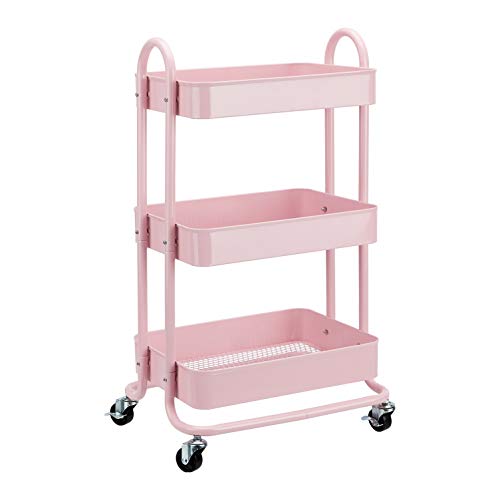
a mobile cart in the accessible tier, useful precisely because it does not commit you to one wall forever. Rolling storage suits renters, small galley kitchens and anyone whose prep zone moves between stove, sink and table. Its honest trade-off is movement itself: a cart that rolls easily also needs a parking spot, a habit of locking or chocking it during heavy chopping, and a floor flat enough that it does not drift. As an alternative to fixed shelving, a cart tests the idea of extra storage for a season before any wall is drilled, and it can be sold, moved or repurposed if the experiment fails.
Sorbus Floating Shelves
Best for: floating wall shelves. Not suited for: kitchens whose layout, wall or load fights this format’s basic way of working.
a set of floating shelves in the accessible-to-mid tier, aimed at the display end of kitchen storage: spice jars you want visible, a small plant, mugs you actually like looking at. Floating designs hide their brackets, which is the whole visual point, and that hidden hardware is also why the fixing matters more, not less. Keep loads modest and everyday, anchor into solid structure wherever the wall allows, and let cabinets do the heavy lifting for bulk. As the low-commitment wall option, floating shelves deliver the visible-storage benefit on one calm wall without restructuring the whole kitchen.

Seville Classics UltraDurable Baker’s Rack
Best for: freestanding baker’s rack. Not suited for: kitchens whose layout, wall or load fights this format’s basic way of working.
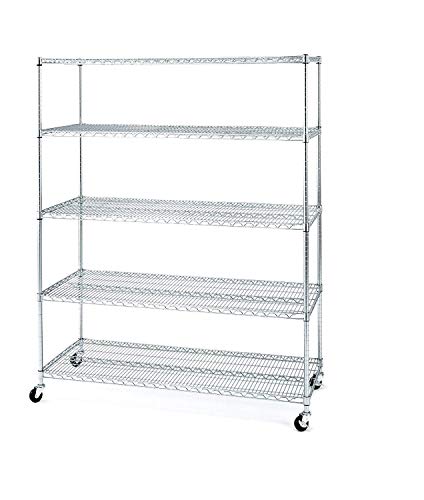
a wire-frame baker’s rack built around open shelving and a work surface feel, the kind of piece home bakers reach for when a stand mixer, flour bins and cooling trays all need one address. In prose terms it sits in the mid-to-premium tier of freestanding kitchen shelving. Treat it as a small pantry station: heavy jars low, trays and linens higher, and nothing perched where a bump could walk it off an edge. As the full-commitment alternative to cupboard refits, a rack like this one answers the question at the heavy end: if the pile is big, this is what worth it looks like.
Renters are not excluded from kitchen shelving, but the honest options differ. Freestanding racks and rolling carts ask nothing of the wall except an anti-tip fixing, and even that can sometimes be solved with the landlord’s written permission for two small holes, which many landlords grant when the alternative is a toppling risk. Over-door and clamp formats exist for light duties. What renters should avoid is the heavy floating shelf hung on hope and adhesive strips: adhesive mounting is for pictures and hooks, not for a row of filled jars above a hard floor.
How to Get the Most Value If You Buy
The first week with a new shelf should be treated as a trial, not a final arrangement. Load it, cook three or four real meals, and notice what your hands look for and fail to find. Almost every household rearranges at least two levels after that first week, moving the daily mugs down, exiling the fondue set upward, grouping the baking things that were scattered. Resist screwing display items into a fixed composition. Storage that cannot evolve becomes decoration, and decoration in a working kitchen slowly turns into an obstacle course.
Seasonal rotation keeps a modest shelf feeling generous. The preserving jars, the holiday platters, the ice-cream maker and the picnic gear rarely all need prime space at once. A shelf arranged for the current season, with off-season pieces boxed in a cupboard, garage or loft, gives daily items the breathing room that makes a kitchen feel calm. Rotation day, twice a year, is also the natural moment to check fixings, wipe every level properly, discard the expired and the duplicated, and re-anchor anything that has developed the slightest wobble.
Baskets and bins are the compromise between open and closed storage. On an open shelf, a basket swallows the visually noisy things, packets, packets of packets, chargers and twist ties, while the calm items stay on display. Choose baskets that slide without snagging, that you can lift down one-handed, and that are sized to the shelf depth so they do not overhang. Label the end if the household shares cooking duties, because a basket system only works when everyone returns things to the same basket without a discussion.
Finally, keep the purpose in view. A kitchen shelf is not a renovation and it is not a lifestyle statement. It is a tool for shortening the distance between ingredients, equipment and the person cooking. Judge every candidate, every arrangement and every accessory by that standard. Does this make dinner easier on an ordinary Tuesday? Does it make the room safer, calmer and quicker to clean? If the answer is yes, the shelf is doing its job, whatever it cost and whatever style it wears. If the answer is no, no finish or brand name will rescue it.
Value also compounds when the shelf is allowed to evolve. Re-audit it each season, exile what has not been touched, promote what is reached for daily, and keep the prime zone between knee and shoulder ruthlessly current. A shelf treated as a living system keeps paying. A shelf treated as a finished display stops paying the moment the household’s cooking changes, which it will.
Safety belongs in the worth-it calculation too, stated plainly. A tall or freestanding shelf must be anchored to the wall against tipping before it is loaded, especially in a home with children. A wall or floating shelf must be fixed into wall studs or solid structure wherever possible, with anchors that genuinely suit the wall where that is not possible. Heavy items always live on the lowest levels, and nobody, adult or child, ever climbs on a shelf to reach something high; a proper step stool is part of the purchase. A shelf that cannot meet those basics in your home is not worth it at any tier, however much storage it promises.
The Decision Checklist
- Can you name the specific items, today, that this shelf will house?
- Will at least one daily friction visibly disappear in the first week?
- Is the wall or floor position genuinely suitable and safely fixable?
- Will heavy items sit low and tall units be anchored against tipping?
- Does the household actually want open or rack storage in this room?
- Have you sorted first, so the shelf organises rather than hides?
- If five answers are yes, buy with confidence. If the first answer is vague, sort and measure before spending anything.
The starting point for any kitchen shelf decision is not the shelf at all. It is the pile. Walk the kitchen with fresh eyes and name what actually needs a home: the stand mixer that lives on the counter because the cupboard is full, the spice jars stacked two deep so the cumin hides for months, the cookbooks leaning against the fruit bowl. A shelf bought for an imagined kitchen fails quietly, gathering the wrong things in the wrong places. A shelf bought for the real pile, item by item, tends to disappear into daily use within a week, which is the highest praise storage can earn.
The Earn-Its-Place Test: When a Kitchen Shelf Repays the Space It Takes
Worth-it questions about a kitchen shelf are really questions about frequency, so start by honestly counting how often the job it does actually arises in your household in a normal month, not in the motivated week when you decided to shop for one. Multiply that frequency by the friction it removes each time — minutes saved, mess avoided, a workaround retired, a room made usable for longer each day — and the value of a kitchen shelf stops being a feeling and becomes a rough but usable number. Measure before anything else, and measure the kitchen shelf in its working state rather than its packed or folded state, because handles extend, lids open, cords trail, doors swing and users stand somewhere, and all of that belongs in the measurement. Look at replacement parts and consumables for the kitchen shelf while you are still comparing, confirming that the pieces most likely to wear, clog, tear, fade or get lost can actually be obtained without replacing the whole product.
Decide in advance what good enough looks like for the job the kitchen shelf does in your home, because chasing a flawless result usually costs more time than the flaw itself, and most households are happier with a reliable ninety percent they actually repeat. A kitchen shelf earns its place fastest in households where the job is frequent and the current workaround is genuinely annoying, and slowest where the job is seasonal, occasional, or already handled well by something you own. Test the kitchen shelf in the first week under deliberately ordinary conditions rather than saving it for a special occasion, so that any problem surfaces while returning, exchanging or adjusting your setup is still simple. The deciding experiment is to live one ordinary week noticing every moment the kitchen shelf would have been used, marking each one down, because a week of real tally marks settles the worth-it question better than another evening of comparison shopping.
When something about the kitchen shelf disappoints, change one variable at a time — position, setting, timing, load, accessory or technique — and give the change a fair trial, because changing three things at once leaves you with a better or worse result and no idea why. Use a simple decision checklist at the end: the kitchen shelf fits the measured space, suits the real frequency of the job, matches the household’s cleaning temperament, has obtainable parts, and has a named storage home — five yeses make a confident order. Keep the packaging of a larger kitchen shelf until those first ordinary tests are done, flattened if space is tight, because re-boxing an awkward shape from scratch is the hidden difficulty inside many otherwise straightforward returns. Keep a short note of what you adjusted on the kitchen shelf during the first month, even just a line on your phone, since those notes turn vague impressions into a setup you can repeat, share or troubleshoot months later.
Then subtract the standing costs honestly: the floor, shelf, cupboard or counter space a kitchen shelf occupies every day, the cleaning and upkeep it asks for, and the small accessories or consumables its ownership quietly requires. Check the floor, wall, ground or surface the kitchen shelf will meet, since level, texture, moisture and finish decide more about everyday performance in food storage & organization settings than most shoppers expect when they are comparing listings on a screen. If you want a concrete listing check, take a name already shortlisted in this guide, such as Amazon Basics Kitchen Rolling Cart, Sorbus Floating Shelves and Seville Classics UltraDurable Baker’s Rack, and verify that exact kitchen shelf listing against the measurements and compatibility questions above, field by field, rather than trusting the headline description alone.
Frequently Asked Questions
How long does a kitchen shelf take to pay off in daily life?
Most households feel the benefit within the first week, because the payoff is not financial in the simple sense. It is measured in cleared counters, faster cooking and fewer duplicate purchases of hidden staples. If after a month of real cooking nothing feels easier, the shelf was probably the wrong format or in the wrong place, and rearranging or relocating it usually recovers the value better than replacing it.
Is a kitchen shelf worth it in a very small kitchen?
Usually yes, and small kitchens often gain the most, because vertical wall space is the only storage expansion available. The condition is discipline: fewer, fuller shelves, consistent containers and a ruthless prime zone for daily items. A small kitchen with a well-planned shelf feels larger than the same kitchen with crowded counters, because the work surfaces, not the floor area, decide how big a kitchen feels while cooking.
Are floating shelves worth it compared with a freestanding rack?
They answer different problems. Floating shelves are worth it for light, visible, daily storage on a sound wall, where looks matter and loads stay modest. A freestanding rack is worth it for bulk, appliances and heavy jars, and for homes where walls cannot be drilled. Choosing between them by load and wall, rather than by taste alone, is what makes either one feel worth it a year later.
What is the biggest reason a kitchen shelf disappoints?
Buying it before sorting and measuring. A shelf chosen for an imagined kitchen arrives to find the real pile does not fit, the wall is weaker than assumed or the walkway shrinks. The fix is boring and total: audit the items, measure the space, check the wall, then buy. Disappointment almost never comes from the shelf itself; it comes from the skipped homework.
Does a kitchen shelf add value to the home itself?
Treat any such effect as a bonus rather than a reason. A tidy, well-fixed shelf can make a kitchen photograph and present better, and freestanding pieces simply move with you. The dependable value is the daily one: time, calm and counters. Buy for the cooking you do every week, not for a hypothetical future buyer, and the decision stays honest either way.
When should I choose a cart instead of a shelf?
Choose a cart when you are renting without fixing permission, when the kitchen’s layout changes with projects or seasons, or when you want to test extra storage before committing to a wall. Choose a fixed shelf or anchored rack when the load is heavy and permanent. Many households start with a cart, learn exactly what they store, and later buy the fixed shelf with that knowledge, which is a sensible order.
One more consideration that experienced cooks raise is sequencing: install and arrange the shelf around the way a recipe actually unfolds. Ingredients move from store to prep, prep to hob, hob to plate, plate to table, and washing up returns everything home. A shelf that sits naturally on that loop gets used without thought, while a shelf placed against the loop, however handsome, slowly becomes a museum of good intentions. Walk your favourite recipe through the room before finalising any position, and let the dish you cook most often have the loudest vote in where things live.
Consider also the humble question of labels. On a working shelf, a small label on a jar or a basket end is not fussiness; it is how a system survives other people’s help, tired evenings and the slow fading of memory about which white powder is which. Labels matter most for safety-adjacent lookalikes, flour versus bicarbonate, sugar versus salt, and for the household member who cooks least often and deserves a kitchen that explains itself. Keep them plain, consistent and easy to replace when a jar’s contents change.
Humidity deserves a final word in kitchens without strong extraction. Steam from daily cooking settles on cool surfaces, and shelves near that traffic benefit from wipeable finishes and a little air gap behind boards where the design allows. Store paper-packaged goods in sealed containers in such kitchens, keep the shelf out of the kettle’s direct plume, and add the shelf’s underside to the weekly wipe, because that is where cooking film quietly accumulates out of sight.
If the household includes anyone with limited reach, grip or mobility, let their needs set the prime zone without negotiation. Daily items at their comfortable height, nothing heavy above anyone’s shoulder, pull-down moments designed out rather than endured. A kitchen shelf is one of the easiest storage forms to make genuinely inclusive, because levels can be arranged person by person in a way fixed cupboards rarely allow. That adaptability is worth naming among the category’s real virtues.
Photographs of finished shelves, including the ones that sell the products, almost always show them a third emptier than real life allows. Forgive your own shelf its fuller reality. Working storage is allowed to look worked in, provided the zones read clearly, the walkway stays safe and the heavy things stay low. Judge the arrangement after a month of dinners, not on installation afternoon, and adjust it the way you would adjust a recipe: by taste, in small changes, until it suits the household at the table.
One more consideration that experienced cooks raise is sequencing: install and arrange the shelf around the way a recipe actually unfolds. Ingredients move from store to prep, prep to hob, hob to plate, plate to table, and washing up returns everything home. A shelf that sits naturally on that loop gets used without thought, while a shelf placed against the loop, however handsome, slowly becomes a museum of good intentions. Walk your favourite recipe through the room before finalising any position, and let the dish you cook most often have the loudest vote in where things live.
Consider also the humble question of labels. On a working shelf, a small label on a jar or a basket end is not fussiness; it is how a system survives other people’s help, tired evenings and the slow fading of memory about which white powder is which. Labels matter most for safety-adjacent lookalikes, flour versus bicarbonate, sugar versus salt, and for the household member who cooks least often and deserves a kitchen that explains itself. Keep them plain, consistent and easy to replace when a jar’s contents change.
Related Guides
Keep exploring with these related guides from this shelf cluster and from guides already live on the site:
the full kitchen shelf pros and cons
our kitchen shelf buying guide
how to choose a kitchen shelf step by step
kitchen rugs for linoleum floors