Disclosure: As an Amazon Associate, dailyhomedecorating.com earns from qualifying purchases. Links on this page are affiliate links; they cost you nothing extra. Prices and availability change often, so check the current Amazon listing before you buy.
This under sink organizer pros and cons guide starts with the cabinet as it actually is: a dark box wrapped around a trap, possibly a garbage disposal, and a small crowd of bottles that has outgrown the space. It weighs the genuine relief of a reachable cabinet against the real risks of fit, false confidence and decaying order, so the balance can be judged for a specific kitchen rather than in the abstract.
Under Sink Organizer Pros and Cons: Quick Verdict
The pros of an under sink organizer are strong and daily: reach, visibility, early leak detection and faster routines. The cons are concentrated at the start: fit risk around the plumbing, space taken by mechanisms, and the discipline a system quietly demands. Households that measure first and group by job collect nearly all of the pros; households that buy from a photograph collect the cons. It suits busy kitchens, deep cabinets and anyone who has bought a duplicate bottle. It does not suit cabinets with no honest clear zone, or anyone expecting tidiness to substitute for a child lock.
In this guide
Key Takeaways
- Measure around the plumbing first: pipes, disposal and water lines decide what fits, and buying before measuring is the classic failure in this category.
- Never force or bend plumbing to fit an organizer, and check for drips after rearranging bottles near pipes.
- Group products by job, keep daily items front and top, and leave air at the front so the system survives real habits.
- If children are in the home, fit a cabinet child lock and keep the most hazardous chemicals highest or out of that cabinet.
- Choose the smallest system that makes everything reachable, visible and dry; capacity beyond the real bottle census is wasted money and space.
The Pros
Everything becomes reachable
The deepest advantage is the end of the back row. Sliding baskets, drawers and rolling caddies bring the whole inventory into the light, which turns a kneeling excavation into one reach. In a cabinet opened many times a day, that difference compounds into the main reason owners describe the purchase as a relief rather than a tidy.
The inventory becomes visible
When every bottle has a zone and the zones can be seen, the household stops buying duplicates of products it already owns, notices the expired bottle before it becomes archaeology, and can read the whole stock at a glance before a shop. Visibility is a financial advantage disguised as a tidiness one.
Leaks are caught early
A zoned cabinet exposes the floor and the trap to a passing glance, so a slow weep at a joint is spotted in days. The chaotic cabinet hides the same leak until the floor swells. No organizer prevents leaks, but the visibility a good system creates is genuine protection for the most leak-threatened cupboard in the home.
Daily routines get faster
Grouped by job, the products used together live together, so dishwashing, surfaces and the weekly deep clean each take one reach instead of three. On the worst evenings, when time and temper are short, that is the advantage owners actually feel.
The cabinet becomes easier to clean
A system that lifts out in pieces or rolls out whole can be wiped and rinsed in minutes, and the empty cabinet floor can be inspected at the same time. The unorganised cabinet, by contrast, is cleaned rarely and badly, because emptying it is a project in itself.
Space that was air becomes storage
The second tier, the raised platform over the pipes and the inside of the door are all space that an unorganised cabinet wastes entirely. Used well, an organizer can return a large share of the cabinet’s volume to service without touching a single pipe.
The Cons
Fit is genuinely risky
The under-sink cabinet is the least standard space in the home, shaped by a trap, perhaps a disposal, supply lines and hose loops placed differently in every kitchen. An organizer bought from cabinet dimensions alone can collide with all of it. The mitigation is measuring around the plumbing first, but the risk is real and returns in this category are common for a reason.
Mechanisms consume space
Drawer walls, glides, basket frames and caddy sides all take room that open shelves would surrender to bottles. In a very small cabinet the mechanism can eat the advantage, which is why a simple tray sometimes beats a framed system honestly.
Tidiness can breed false confidence
A neat cabinet feels like a safe cabinet, and it is not. The chemicals inside remain the strongest in the house, and a sliding basket can present them to a small child more efficiently than a jumble did. The organizer changes nothing about the need for a child lock and high storage for the most hazardous items.
Order decays without a system people can guess
An organizer is a physical argument about where things belong, and if the argument is too subtle, the household will not follow it. Narrow, fussy zones collapse within a month in a busy home. The con is not the product’s fault exactly, but it is predictable, and it punishes over-engineered layouts.
Some designs fight cleaning
Fixed assemblies with tight corners collect detergent sediment in exactly the places a cloth cannot reach. In a damp, splashy cupboard, a design that cannot be lifted out and rinsed will slowly become the dirtiest object in the room it was bought to tidy.
It cannot fix an inventory problem
If the cabinet is full of products nobody uses, an organizer arranges the surplus more beautifully without reducing it. The honest first step for an over-full cabinet is an audit, and buyers who skip it often buy a larger organizer than their real census needs.
What the Trade-Offs Mean for You
For the busy family kitchen, the reach and visibility pros dominate, provided the zones are wide enough to forgive careless returns and the child lock is fitted the same day as the organizer. For the small flat, the mechanism-space con matters most: measure the clear zone, and let a tray or a compact caddy compete honestly against framed tiers. For the renter, the fit con is softened by freestanding designs that move house, while the inventory con deserves attention, because a small cabinet fills with good intentions faster than any other. For the bathroom vanity, the cleaning and cord realities reshape the balance toward rolling designs that leave the cabinet entirely.
Against the alternatives, the comparison is instructive. A simple pair of bins offers most of the visibility pro and none of the fit risk, at the cost of the second tier. A door rack adds daily-item reach with no floor footprint, but cannot hold weight or depth. Doing nothing keeps the money and the archaeology. The organizer wins when the census is long enough, and the cabinet deep enough, that reach and tiers repay their space and their price in daily use.
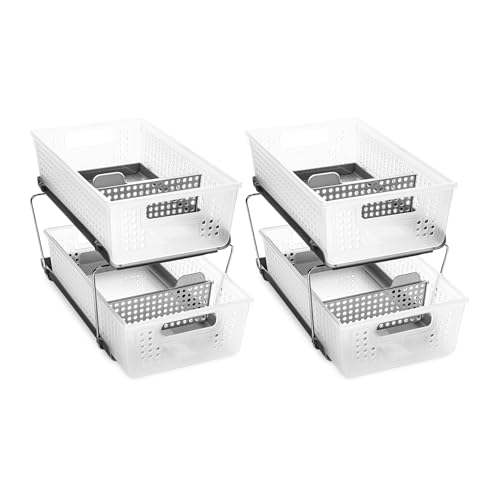
madesmart 2-Tier Organizer
Tier: mid-tier. Check price on Amazon when listings are linked at publication.
The madesmart 2-Tier Organizer is the classic sliding-basket design that most people picture first: two stacked trays, the lower one sliding forward so bottles at the back stop being a rumour. In daily use its strength is visibility. Dish soap, sponges and scrub brushes live on top where a wet hand can find them, while taller refill bottles stand below. The plastic construction wipes clean after the inevitable detergent drip, and the open sides mean a slightly-too-tall bottle can lean rather than jam. It suits a standard kitchen cabinet with a centred drain, because the frame is compact enough to leave a working gap for the trap. It is less happy in a very shallow vanity, where the second tier can crowd the basin underside.
YouCopia RollOut Caddy
Tier: mid-tier. Check price on Amazon when listings are linked at publication.
The YouCopia RollOut Caddy is built around wheels and a handle, and that changes the whole relationship with the space. Instead of reaching past the bottles you can see to the bottles you cannot, you pull the caddy out like a small wagon, take what you need, and roll it home. It is especially kind in deep cabinets and in bathroom vanities where the kneel-and-reach routine is at its worst. The open caddy format handles odd shapes well: trigger sprayers, tall refill jugs and the plunger-adjacent oddments that never fit a shelf. Its trade-off is structure; without tiers it does not multiply vertical space the way a stacked unit does, so it pairs best with a modest bottle count.
simplehuman Under Sink Organizer
Tier: premium. Check price on Amazon when listings are linked at publication.
The simplehuman Under Sink Organizer takes a different route: a steel frame with a pull-out drawer and dividers that keep bottles upright instead of corralled. The appeal is order that survives a rushed Tuesday. Bottles stop domino-ing when you grab one, and the drawer glide means the whole inventory comes to you rather than you kneeling into the cabinet. The build feels closer to a piece of kitchen hardware than a storage bin, which matters in a cabinet you open many times a day. It asks for a cleaner rectangle of floor space than most, so cabinets with an offset disposal or a low trap arm may not give it the straight run it wants.
Measure Around the Plumbing First, Every Time
Before any design, brand or tier discussion, there is one job that decides whether an under sink organizer succeeds or gets returned: measure around the actual plumbing. The classic failure in this category is buying before measuring. A cabinet door opening is not the space you have. The space you have is what remains after the drain trap curves down and back, after the garbage disposal takes its bulky share, after hot and cold supply lines and their shut-off valves claim their corners, and after the dishwasher discharge hose loops through on its way to the disposal or the drain.
So empty the cabinet completely, get a torch and a tape measure, and map the obstacles like a floor plan. Note where the trap sits: centred, or pushed to one side? Note how low the trap arm runs, because that height decides whether a second tier can slide beneath it or whether the upper tray will collide every time it moves. Note the disposal, if you have one: its body is wider than the drain above it, and it often claims the entire half of the cabinet it hangs in. Note the water lines and valves, which usually live at the back wall and punish any organizer deep enough to press against them.
Then measure the clear zones that remain: the flat floor to the left of the plumbing, the flat floor to the right, the height from the cabinet floor to the lowest pipe, and the door opening itself, which is narrower than the interior on framed cabinets. Write the numbers down rather than trusting memory, and sketch the cabinet as a simple rectangle with the pipes drawn in. That sketch, compared honestly against any organizer you are considering, prevents nearly every disappointment in this category. An organizer that fits the cabinet but not the plumbing does not fit.
One more discipline belongs in this section because it is a safety matter, not a convenience one: never force or bend plumbing to fit an organizer. Pipes, traps and supply lines are not obstacles to be persuaded. If a frame only fits when a trap is pushed aside or a hose is kinked, the organizer is the wrong size, full stop. Forcing a joint can start a slow leak that soaks a cabinet floor for weeks before anyone notices. And after you rearrange bottles near pipes, check for drips: run the tap, run the disposal if you have one, then feel each joint with a dry hand and look with a torch. Do the same check a day later. Bottles get bumped during a tidy-up, and a bumped valve or a nudged trap can weep quietly.
Cleaning Chemicals, Children and the Under-Sink Cabinet
This needs saying plainly, because an organizer changes how chemicals are stored. Most under-sink cabinets hold the household’s strongest cleaning products: drain openers, bleach-based sprays, oven cleaners and dishwasher pods that look, to a small child, exactly like sweets. If there are children in the home, fit a cabinet child lock on the under-sink doors. An organizer is not a safety device; in fact, by making bottles tidier and easier to pull out in a sliding basket, it can make them easier for a determined toddler to reach.
Keep the most hazardous items highest and, where the layout allows, out of that cabinet altogether. A high shelf in a utility cupboard or a locked box elsewhere in the home is a better home for drain opener than the top tier of an organizer at toddler eye level. Within the cabinet, put the strongest chemicals at the back of the highest tier you have, keep everyday items like washing-up liquid at the front, and never decant chemicals into drink bottles or unlabelled containers. Keep products in their original labelled packaging so any adult, babysitter or grandparent knows instantly what they are holding.
The lock itself should be one you will actually use. Magnetic locks are invisible from outside and suit households that open the cabinet twenty times a day; simple latches cost less patience but get left unlatched more often, and an unlatched lock is decoration. Whichever style you choose, test it from a child’s height and with a child’s determination before you trust it, and re-check it after any reorganisation, because a new organizer can change how the door sits and whether the latch still catches.
How to Buy Smart
Buy after the census and the sketch, not before. Check how the design comes apart for cleaning, whether it glides or slides under realistic weight, whether its coating or plastic suits a damp cupboard, and whether the hazardous-storage plan, lock included, is settled. Favour the smallest system that makes everything reachable, and treat spare capacity as a feature, because seasonal and life changes will fill it honestly.
Setup and Care That Reduce the Cons
Set up on a completely empty, dry cabinet. Wipe the floor, check it for old water damage while it is empty and visible, and lay a washable tray or liner where bottles will stand. Place the organizer empty, confirm it slides or sits without touching any pipe, then load it by zone: daily items front and top, weekly items behind and below, tall bottles where the clearance was measured for them. Load gradually and test the door swing and any drawer glide with the real weight in place, because a frame that glides empty can drag loaded.
Care is a short monthly ritual: lift out the top tray or the front row, wipe drips before they set, rinse baskets that have caught detergent sediment, and run the dry-hand leak check along the trap and valves while you are down there anyway. Once or twice a year, empty the cabinet fully and audit the inventory; expired products, duplicates and the bottle bought for a single job in a previous home are the silent capacity thieves. The organizer’s job is to make that audit easy, and a design you can empty in two minutes is one you will actually audit.
Layout Patterns That Work in Real Cabinets
The split-level kitchen. The most common successful layout in a standard kitchen cabinet puts a sliding two-tier unit on the clear side of the trap, a washable drip tray on the plumbing side for the few bottles that must live there, and the daily spray on a door rack if the swing clears. Its virtue is that each zone has one job and the plumbing keeps a respectful margin on every side. It survives busy households because nothing in it needs to be moved to reach anything else, and the monthly wipe takes minutes because every component lifts or rolls out.
The deep-cabinet rescue. In a deep cabinet, the winning pattern is a rolling caddy for the working inventory and a single fixed shelf or tray at the very back reserved for true refills, the bottles that leave the cabinet monthly rather than daily. The caddy carries the daily and weekly groups out into the light, and the back stops pretending to be everyday storage. This pattern concedes that depth cannot be made convenient, only honest, and it is the layout most often praised by owners with unreliable knees.
The vanity parking space. A bathroom vanity works best when the organizer leaves: a caddy that parks under the sink and comes out whole for the morning routine, with hair tools given a heat-aware spot away from aerosols and small jars corralled so cords cannot drag them out. The cabinet itself stays nearly empty, which makes its plumbing the most visible in the home and its leaks the fastest caught. Small space, simple plumbing, total access: the pattern fits the room exactly.
The rental reset. For a rental, the pattern is freestanding and reversible: a compact tier or caddy sized from the clear zone, bins for the groups, nothing screwed, glued or forced. It respects the lease, survives the move, and, because older rental plumbing wanders, it is chosen from the sketch rather than the cabinet’s headline size. Owners of this pattern consistently report that the system, more than the specific product, is what they carry to the next home.
The family fortress. Where small children are in the home, the layout is a safety plan first and a storage plan second: a fitted cabinet lock on the doors, the most hazardous products moved out of the cabinet to a high or locked store, the remaining chemicals at the back of the highest tier, and the harmless daily items, sponges, cloths and liners, at the front where small hands that defeat a latch anyway find nothing dangerous. The organizer’s zones make the safety geography obvious to every adult in the house, which is precisely why it works.
The minimalist tray. The final pattern is a refusal, and a respectable one: a single washable tray grouping the whole short census, a hook for the brush, and nothing else. It suits the small flat, the tiny census and the cabinet whose plumbing leaves no honest room for frames. Its lesson generalises across every pattern in this guide: the right system is the smallest one that makes everything reachable, visible and dry, and every larger pattern has to justify its extra size against this one’s simplicity.
Notes From Real Cabinets
There is a particular archaeology to an unorganised under-sink cabinet. The front row is the present: the spray in daily use, the washing-up liquid, the sponge. Behind it lies a stratum of good intentions, the specialist cleaners bought for specific jobs, each used twice. At the very back, in the dark beside the trap, sits the oldest layer: bottles whose labels have faded, a brush missing its handle’s other half, and at least one container nobody in the household can identify. An organizer’s real job is not tidiness for its own sake. It is ending the archaeology, so that every layer is reachable and every bottle has to justify its place by being findable.
Think about how often the cabinet is opened and by whom. In a busy family kitchen it might be opened a dozen times a day by several people with different habits and different heights. A system that only works when one careful person maintains it will decay within a month. The robust choice is the one that stays roughly right when a teenager stuffs a bottle back in the wrong place: zones wide enough to forgive, categories obvious enough to guess, and nothing balanced so precisely that one careless return collapses the order. Designing for the household you have, rather than the household in a catalogue photograph, is the difference between a system and a weekend project.
Bathroom vanities deserve separate thought from kitchen sinks, even though the products share a category name. A vanity cabinet is usually smaller, the plumbing is usually simpler, and the contents are different: hair tools with cords, skincare in small jars, cleaning supplies for one small room. Heat matters here, because a hair dryer put away warm should not rest against aerosol cans or plastic that softens. Cords matter too; they snag on basket edges and drag small items out with them. A rolling caddy often wins in a vanity precisely because it leaves the cabinet entirely, turning a cramped cupboard into a simple parking space.
Renters face a version of this problem with extra rules. Anything that screws into a door or a cabinet wall may be forbidden, and anything permanent is money left behind at the end of the lease. Freestanding organizers, tension and over-door designs that leave no marks, and simple bins all respect those limits. The measuring discipline matters even more in a rental, because the plumbing in older buildings wanders into layouts no catalogue anticipates, and returns from a small flat are a chore nobody needs. The good news is that everything learned in a rental cabinet transfers; the zones and the census work in any kitchen.
The garbage disposal changes the map more than any other single feature. Its body hangs low and wide, it vibrates in use, and its power cord and dishwasher hose both need their own untroubled routes. Bottles stored touching a disposal get gently rattled with every use, which walks them slowly out of position and occasionally tips a tall, top-heavy spray bottle into the trap. Leave the disposal a clear margin, put nothing on the side where the hose curves, and treat the disposal’s half of the cabinet as a half at most. Many successful layouts are simply a good organizer on the non-disposal side and a single drip tray on the other.
Consider the door itself as storage territory with rules. The inside face of the door is the first thing you see and the easiest thing to reach, which makes it prime land for the two or three items used every single day. But door storage swings, and everything on it must clear the trap and the front edge of any floor organizer through the whole arc of the swing. Test with the fattest bottle you plan to hang, not the thinnest. Hinges also limit the lower corner of most doors. Within those rules, door racks are the cheapest capacity in the whole cabinet, because the space they use was doing nothing at all.
Water is the cabinet’s permanent resident risk. Every under-sink space has joints, and every joint will eventually weep, usually slowly and usually at the back where nobody looks. This is why visibility is a genuine feature and not a marketing word. An organizer that lets you see the cabinet floor and the trap at a glance turns leak detection into something that happens during normal use. Dark, enclosed, over-stuffed systems hide the evidence until the floor swells. When you compare designs, ask how quickly you would notice a slow drip under each one; the honest answer should influence the choice as much as capacity does.
Grouping by job rather than by product type is the organising idea that survives contact with real life. The dishwashing group, the surfaces group, the laundry-transfer group that lives under the kitchen sink only because the utility room is full: each group in its own zone or basket means a task takes one reach, not three. It also exposes duplication kindly. When all the glass cleaners stand together, the household can see it owns three, and the census for the next shop writes itself. An organizer is really just the physical form of those groups, which is why choosing the groups comes before choosing the frame.
Height zoning is the quiet skill in this category. The top tier or the front of a platform is the cabinet’s high street: expensive in effort terms, reserved for what is used daily. The floor at the back is the suburbs, fine for refills and the descaler that appears monthly. Trouble starts when the geography inverts, when the daily spray migrates to the back and a refill jug takes the front. Sliding baskets and drawers exist largely to flatten this geography, making the back temporarily front. If your cabinet is deep and your knees are vocal, that flattening is worth more than raw capacity, and it should steer the whole purchase.
There is also a case for doing less. Some cabinets, especially in small flats, hold six bottles and a sponge, and for them a full framed organizer is furniture in search of a problem. A single washable tray, a small caddy for the daily group, and the discipline of the census will outperform a two-tier frame that crowds the trap. The honest guides in this category should say so, and this one does: the best organizer is the smallest system that makes everything reachable, visible and dry, and no larger. Bigger systems earn their size only when the bottle census demands it.
Seasonal change is a real load on this small space. Winter brings grit and salt that need their own cleaners near the door; summer brings barbecue and garden products that migrate indoors; a new baby or a new pet rewrites the chemical inventory entirely, and should rewrite the safety arrangements in the same week. A system with a little spare capacity absorbs these changes without a rebuild. One filled to the brim on day one has nowhere to put the new arrival except in front, blocking the door swing and starting the slow slide back into archaeology. Buy for the census plus a margin, not for the census at its absolute peak tidiness.
Finally, judge any organizer by its worst day, not its first day. On the worst day the sink is full, a pan is leaking something orange, a child is asking a question at volume, and the cabinet must give up the right bottle in one reach with one wet hand. Designs that pass that test share traits: obvious zones, nothing stacked on anything else, handles and glides that work with wet fingers, and no part of the system that requires two hands and a clear counter to operate. Keep that scene in mind while comparing, and the glossy features sort themselves into the genuinely useful and the merely photogenic quite quickly.
Labels deserve a moment of respect in any system. Not decorative labels, but honest ones: a strip of tape on a basket edge naming its group, a marker note on a refill bin. In a household where several people use the cabinet, labels end the quiet arguments about where things live, and they help a guest or a babysitter find the surface spray without a guided tour. Labels also expose drift. When the basket marked for dishwashing supplies contains a plant mister and a tube of filler, the system is telling you the census has changed, and the twice-yearly audit has something concrete to work with.
The sponge and brush problem is small and constant. These are wet objects stored in a dark cupboard, and they will make any organizer smell like a pond if they are put away dripping into a closed tray. The layouts that cope best give washing tools an open, draining home: a hook, a mesh pocket, a tray with somewhere for water to go that is not the cabinet floor. It is a tiny criterion, easily overlooked in a comparison table, and it decides whether the cabinet greets you pleasantly or reproachfully every single morning. Judge every design by where the wet sponge sleeps.
Bin liners and rolls are the awkward citizens of this cabinet: bulky, light, and prone to unrolling themselves into the plumbing. A surprising amount of under-sink frustration is liner frustration. The fixes are mundane and effective: a door-mounted holder if the swing allows it, a vertical slot at the side of a tiered unit, or simply a tall narrow bin that keeps the roll upright and contained. When you map your clear zones, reserve a named home for the rolls, because if you do not, they will choose the trap, and they will win.
Think about the heaviest thing you store. A full refill jug of detergent or a cluster of glass bottles concentrates real weight on one basket, one glide, one shelf leg. Designs differ honestly here, and the difference is not visible in photographs. Load any candidate mentally with your heaviest realistic row before judging its glide or its slide; a basket that glides beautifully empty and drags loaded will be left half-open and resented within a month. Weight honesty is also why the census matters: five glass bottles are a different purchase from fifteen plastic ones, even at the same count.
There is a rhythm to restocking that a good layout supports. New purchases should land in a known place, refills behind or below the in-use bottle, so stock rotates instead of stratifying. The archaeological cabinet fails at rotation completely, which is how households end up with three opened bottles of the same cleaner, each a third full. A simple rule helps: nothing enters the cabinet without a zone, and a new bottle of something already open goes to the back of its group, not the front. The organizer makes the rule physical; the household only has to keep it roughly.
Guests and grandparents are the usability auditors nobody hires. A system that only its creator can navigate will be dismantled, politely, by anyone house-sitting for a weekend. The test is simple: could a newcomer find the washing-up liquid, the surface spray and a bin liner in under a minute, and return each to an obvious home? Zones grouped by job, a little labelling, and air at the front pass that test. Cryptic stacking and precision arrangements fail it. Since real households include other people, design for the newcomer and the system will also be kinder to you on your tiredest evenings.
The cabinet under the kitchen sink often inherits jobs from the whole house: the toolkit overflow, the light bulbs, the batteries, the tape. Each inheritance is reasonable and together they crowd out the cabinet’s actual purpose. A firm boundary helps: this cabinet is for sink-related work and cleaning, and everything else needs a better home found deliberately, not someday. The organizer purchase is a natural moment to enforce the boundary, because the census forces every object to argue for its place while the cabinet stands empty and the argument can still be won.
Humidity from the dishwasher and the sink itself keeps this cupboard damper than any other storage in the kitchen. Cardboard packaging softens and slumps, paper labels peel, and anything stored in its shipping box slowly becomes part of the sediment. Decanting is forbidden for chemicals, which must stay in their original labelled packaging, but for dry goods such as liners, cloths and sponges, moving them out of cardboard into the organizer’s trays or a washable bin removes a whole category of decay. It is unglamorous advice, and it visibly extends the tidy life of the cabinet.
Consider the sound of the system. A drawer that glides, a caddy that rolls, a basket that slides: these are pleasant. A wire rack that rattles against a disposal, a door holder that clatters at every close, a frame that scrapes the trap: these are small daily irritations that teach the household to avoid the cabinet. You cannot hear a product in a listing photograph, so reason from construction: contact points against pipes are both a plumbing risk and a noise source, and clearance, chosen generously at the measuring stage, is silence bought in advance.
Accessibility deserves explicit thought, because the under-sink cabinet is the lowest, deepest storage in most homes. For anyone with limited mobility, a bad back or unreliable knees, the difference between a fixed shelf and a rolling caddy is not convenience but independence: the caddy brings the whole inventory to a seated or standing position outside the cupboard. Handles that work with weak grips, light loads split across two smaller units rather than one heavy one, and the daily group placed at the least demanding reach all belong in the choice, and they cost nothing if considered at the sketch stage.
Overflow has to go somewhere planned. Every household occasionally buys the bulk pack, hosts the big clean, or inherits a relative’s surplus bottles. A system filled exactly to capacity treats each of these events as a crisis and responds by stacking in front of the trap. Deliberate spare capacity, even a single empty slot or a tray kept half clear, absorbs the surge and gives it a temporary legal home until the audit restores order. When you size a system from the census, add the margin on purpose and defend it; the margin is not wasted space, it is the system’s shock absorber.
Finally, there is the question of when to replace or rethink a system that once worked. The signs are consistent: the front row no longer matches the daily group, a zone has silently changed jobs, the glide or slide has begun to drag under ordinary loads, or the household itself has changed, with a baby, a pet or a new mobility need rewriting the safety and access rules. An organizer is not a lifetime commitment, and the measuring and census skills transfer intact to its successor. Re-run the six honest steps, and the cabinet will tell you what it needs now, which may be less, or different, rather than more.
Living With the Trade-Offs: Where the Under Sink Organizer Earns Its Place
Advantages and disadvantages read differently once an item is in daily use, so this section weighs the under sink organizer the way a household experiences it over months rather than minutes. It focuses on the frictions, workarounds and quiet benefits that decide whether the balance stays positive.
Start With Your Space and Your Routine
Take a photograph of the space before you order and mark the intended position of the under sink organizer on it, then revisit that photo whenever a listing tempts you toward a larger or different style. Equally, list what your old under sink organizer did well, because replacements sometimes quietly lose a virtue you relied on, such as a size, a shape or a simplicity the new model has redesigned away. A slight wobble, a stiff action or a small misalignment on day one rarely improves on its own, so address it during setup while adjustments are still easy to make. Households with children or pets put different demands on a under sink organizer than the listing photographs suggest, so judge edges, stability and cleanability against your real household, not a styled one.
When Small Problems Appear
The trade-off test worth doing is substitution: name what else could occupy the same space, budget of attention and storage as the under sink organizer, and see whether the under sink organizer still wins the comparison. If two options look nearly identical, compare the parts you will touch every day, since those contact points decide whether a under sink organizer feels solid or flimsy after the novelty wears off. Apply the same checks to each shortlisted example, whether that is the madesmart 2-Tier Organizer; the YouCopia RollOut Caddy; the simplehuman Under Sink Organizer, because consistent testing is what makes the differences between models visible. Seasonal checks suit most Food Storage & Organization items well, so tie a quick inspection of the under sink organizer to a job you already do, such as changing clocks or clearing gutters.
Recheck any adjustable part of the under sink organizer after the first week of use, once materials have settled and the household has stopped being careful with it. Keep the fittings, spare parts and instructions that come with the under sink organizer together in one labelled place, because the part you need in a year is always the one that was put somewhere safe. Think about the end of the under sink organizer’s life with you as well, including whether it could move to another room, be passed on, or be stored without damage when your needs change.
A Short Decision Checklist
- The one feature you will not compromise on
- Who will use the under sink organizer most, and any limits they have
- What your current arrangement does well that the under sink organizer must not lose
- The material and finish, matched to light, moisture and wear in its spot
- Delivery path, from the door to the final position
- Packaging kept until the under sink organizer has passed its first trial in place
- The measured space, including clearance to use and clean around the under sink organizer
- Assembly needs, tools required and whether help is needed
Taken together, these checks take only a little time, yet they answer the questions that decide whether the under sink organizer suits your home, your household and your routine, and they do so before money changes hands rather than after.
Frequently Asked Questions
What is the biggest advantage of an under sink organizer?
Reach. A good organizer ends the kneel, torch and excavation routine by giving every bottle a zone and bringing the back row forward, on a sliding basket, a drawer or wheels. That single change compounds daily, because the cabinet is opened many times a day by everyone in the house. Visibility follows from reach: when the whole inventory can be seen, duplicates stop being bought, expired products get caught, and a slow leak under the trap is noticed in days rather than discovered by a swollen cabinet floor at the end of the season.
What is the biggest disadvantage?
Fit risk. The space under a sink is the least standardised cupboard in the home, shaped by a trap, perhaps a disposal, supply lines and hose loops that no two kitchens place alike. An organizer bought from cabinet dimensions alone can collide with all of it, and the honest fixes are measuring around the plumbing first or choosing a smaller, humbler system. The second disadvantage is false confidence: a tidy cabinet can feel like a safe cabinet, while the chemicals inside still need a child lock and the most hazardous bottles still belong high or elsewhere.
Do organizers work in bathroom vanities too?
Yes, with adjustments. Vanities are smaller, the plumbing is usually simpler, and the contents differ: hair tools with cords, small jars, and one room’s cleaning supplies. Cords snag on basket edges, and a hair dryer put away warm should not rest against aerosols or soft plastic. A rolling caddy often wins in a vanity because it leaves the cabinet completely, turning a cramped cupboard into a parking space, while a compact two-tier unit suits a vanity with a taller, emptier well. Measure around the trap exactly as you would in a kitchen, and zone by routine rather than by product type.
Can an organizer damage my plumbing?
The organizer itself cannot, but a forced installation can. Never bend, push or persuade a trap, supply line or hose to make a frame fit; a stressed joint can weep slowly for weeks behind a tidy row of bottles. Choose a size that clears every pipe with room to spare, load it, then run the tap and the disposal and check each joint with a dry hand and a torch, repeating the check the next day. Keep bottles from resting against the disposal, whose vibration walks them into pipes over time. Respected clearance is the whole secret.
Are expensive organizers worth it over basic ones?
Sometimes, and the difference shows up in glide, rigidity and coatings rather than in capacity. A steel frame with a smooth drawer and dividers stays pleasant through years of daily use, and a coating that survives the dampest cupboard in the house protects against rust. A basic plastic two-tier unit organises the same bottles perfectly well for a renter, a first flat or a light census. The honest test is your bottle count, your cabinet’s damp history and how long you expect to stay. Pay for durability when the household is hard on the cabinet; save the difference when it is not.
How do I stop an organizer becoming messy again?
Design for the household’s worst habits rather than its best intentions. Keep zones wide and obvious, group by job so the right home for a returned bottle is guessable at speed, and leave air at the front so putting things back is easier than leaving them out. Run the monthly minute: wipe drips, glance at the trap for leaks, evict one expired or duplicated bottle. Twice a year, empty the cabinet fully and repeat the census. Systems decay when returning an item is harder than abandoning it; every lasting setup makes the tidy action the lazy action.
Related Guides
Keep reading with the rest of this cluster, and browse the wider storage guides linked below.
under sink organizer buying guide
is an under sink organizer worth it
how to choose an under sink organizer
best makeup organizers for tidy counters
best rugs for a kitchen sink area