Disclosure: As an Amazon Associate, dailyhomedecorating.com earns from qualifying purchases. Links on this page are affiliate links; they cost you nothing extra. Prices and availability change often, so check the current Amazon listing before you buy.
Fire pit reviews usually fail in one of two ways: they crown a single winner for every garden on earth, or they list a dozen bowls with a paragraph of brochure language each. These fire pit reviews do neither. This article reviews the field by role — the smokeless flagship, the patio traditionalist, the propane bowl, the big-circle wood burner, the entry-tier starter, and the fire table — judging each against the job it claims to do, the households it genuinely suits, and the trade-offs its owners actually live with. Read it as a map of the territory rather than a podium: by the end you should know which corner of the category is yours, what living with that choice feels like across a season, and which questions to settle before any purchase makes sense.
Key Takeaways
- There is no universal best fire pit; there are correct matches between design, fuel, plot, and household patience.
- Smokeless wood designs lead the field for suburban gatherings; propane leads for decks, restrictions, and weeknight spontaneity.
- Entry-tier bowls are honest starters, premium tiers buy materials and engineering, and no tier buys exemption from safety duties.
- Best for: readers who want the whole field judged in one place before shortlisting. Not suited for: readers who want a single name with no thinking attached.
- Every design here is outdoor-only, needs safe distance from the house and anything flammable under local rules, and demands supervised fires and cold ash handling where wood is burned.
In this guide
Fire Pit Reviews: How the Field Was Judged
Consistency is what separates reviews from advertising, so the criteria come first. Each design in these fire pit reviews is judged on heat at the chairs — how many sitters feel genuinely warm at a comfortable distance; smoke across a whole evening, including the lighting minutes and the dying ones; build after heat cycles rather than out of the box; upkeep measured in minutes and in how easily it gets postponed; and safety as a design property — stability, available screens and stands, reachable propane valves, connections that can be leak-checked with soapy water. Styling is judged last, deliberately, because styling is the only quality a photograph can judge for you. Where this article names a tier — entry, mid, premium — it is describing positioning in words, the way owners experience it: materials, engineering, and finish, rather than a number that would be stale by the time you read it.
The field itself has settled into clear families, and the reviews follow them. Smokeless stainless pits are the premium wood story: double walls, secondary combustion, dramatically reduced smoke. Traditional steel bowls are the volume story: every size and finish imaginable, honest fire, honest smoke. Propane bowls and tables are the convenience story: appliance manners, instant control, wide permission under rules that restrict wood. Built-ins and oversized designs are the commitment story. A reader who knows which story they are living in has done half the choosing already, which is why each review below opens with the household it serves before it discusses the product at all — the order that brochures reverse, and the order that actually predicts satisfaction.

Solo Stove Bonfire — Smokeless Flagship, Reviewed
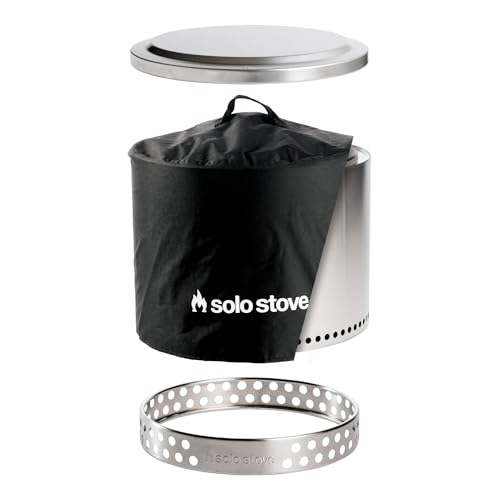
The household: suburban, sociable, close enough to neighbours that smoke is a social fact, committed enough to burn weekly in the mild seasons. For that household the Solo Stove Bonfire is the field’s reference point, and this review treats it as such. The design is a stainless double-walled cylinder with low intakes and rim vents that feed heated air into the top of the flame, burning off smoke before it leaves the pit. In use, with dry seasoned hardwood loaded properly, the effect is the category’s headline made real: a vigorous, almost sculptural flame, strong radiant heat for a circle of four to six, and a fraction of the smoke an open bowl produces — clothes and eyes notice the difference within one evening.
The trade-offs are the engineering’s shadow. The same airflow that eats smoke eats fuel, so evenings burn through a respectable pile, fed in steady additions by whoever plays fire-keeper. The stainless body takes on heat colouring that owners either read as character or mourn as lost showroom shine; this review reads it as inevitable and honest. Ash duties remain in full — cool completely, then into a lidded metal container — and the premium tier only makes sense at a weekly rhythm of use. Verdict: the best wood experience currently available to a smoke-conscious household, and an expensive ornament for a household that lights up monthly. Best for: regular suburban hosts. Not suited for: occasional users or anyone expecting smokeless to mean effortless.

TIKI Brand Patio Fire Pit — The Patio Traditionalist, Reviewed
The household: design-led, new to wood fires, furnishing a patio as an outdoor room and wanting the fire to belong visually among the furniture. The TIKI patio fire pit answers with a deep, handsome steel bowl and the brand’s wood-pack system, which lowers the skill barrier that defeats beginners — the fire arrives partly engineered, so early evenings succeed while technique develops. Heat is the traditional bowl’s honest radiant warmth; smoke is the traditional bowl’s honest smoke, moderated by the bowl’s depth and sensible loading rather than eliminated by engineering. Owners should expect the full wood liturgy: dry fuel, supervised fires, cold ash into a metal container, a cover against the weather.
Against the smokeless flagship it loses the smoke contest clearly and wins on approachability, looks, and mid-tier positioning; against entry bowls it wins on design coherence and loses nothing that matters. Its natural companions are the furnished patio’s other citizens, which is why our seating guides — best chairs for a fire pit above all — pair with it so often in readers’ plans. Verdict: the right first wood pit for a household that cares how its patio looks at noon as well as at nine in the evening. Best for: new hosts with a furnished patio. Not suited for: smoke-sensitive streets or campers counting every inch of storage.
Outland Living Firebowl — The Propane Bowl, Reviewed
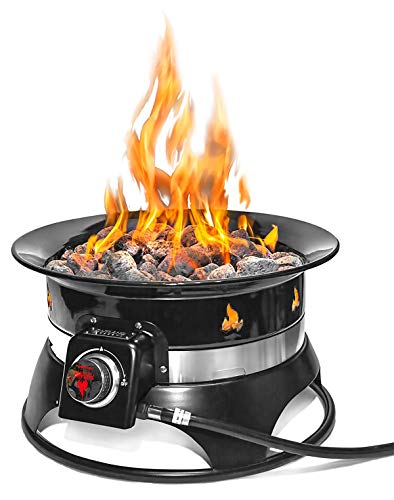
The household: deck-based, time-poor, possibly under rules that restrict wood burning, wanting firelight on a Tuesday without a project attached. The Outland Living Firebowl is the field’s cleanest expression of the propane bowl: a portable round burner dressed with lava rock, a hose to a standard tank, ignition that takes an evening from cool to gathered in moments. Heat is present and pleasant at close range, though this review repeats the category truth — propane’s flame picture flatters its warmth, and less heat reaches seated knees than a comparably lively wood fire delivers. In exchange, the entire wood burden vanishes: no smoke, no sparks, no ash, no ember watch, and an off switch that ends the evening at a twist — the property that keeps it legal and welcome in settings where wood is banned outright.
Its duties are the propane liturgy, smaller but real: check connections for leaks with soapy water before use, keep the valve closed when idle, route and protect the hose, store the tank as instructed, and supervise the flame like any fire — outdoor use only, safe distances, children and pets at a watched distance, and never a thought of bringing it indoors, where carbon monoxide makes any burner lethal. Verdict: the most liveable fire in the field for the households it targets, and the wrong fire entirely for ritual seekers. Best for: decks, restrictions, spontaneity. Not suited for: ember cooking or crackle romantics. The fuel argument in full lives in fire pit versus propane fire pit.
Bali Outdoors Wood Burning Fire Pit — The Big-Circle Bowl, Reviewed
The household: large, loud, and frequently gathered — extended family, team celebrations, a garden that hosts by default. The Bali Outdoors design serves them with a wide wood-burning bowl, in many configurations edged by a ledge, built to hold a fire big enough to warm a circle that has outgrown intimacy. Everything about it is the traditional bowl scaled: more radiant reach, more fuel per evening, more ash the next day, more placement to think about, because a big fire demands its clearances with emphasis — safe distance from the house, fences, and planting under local rules, on a surface that can take the heat, with room for guests to circulate without passing close behind chairs. In a generous plot it is magnificent; in a small one it is a crowd scene in a phone box.
This review’s caution is about frequency disguised as capacity. Many households buy for the biggest gathering of their year and spend the other fifty weeks building oversized fires for four people, or small fires that look lost in a wide bowl. If your circle is big monthly, this is your design and the premium in fuel and upkeep is honestly spent. If your circle is big twice a year, the flagship and traditional mid-size bowls will serve the ordinary evenings better, and a borrowed second pit can serve the exceptions. Verdict: a specialist that knows its specialism. Best for: genuinely large, frequent gatherings with space to place it properly. Not suited for: small patios, small storage, or small typical evenings. Hosts planning the seating ring should start with best chairs around a fire pit.
Amazon Basics Steel Fire Pit — The Entry-Tier Starter, Reviewed
The household: curious, unconvinced, unwilling to commit a premium tier to an experiment. The Amazon Basics steel bowl is the field’s honest baseline — a simple wood burner that contains a fire, radiates warmth, and gathers a circle, with no engineering claims to audit. This review respects the role: for a first season of fires, a baseline bowl teaches a household everything it needs to know about itself — how often it lights up, how it feels about smoke and ash, where the pit wants to live — at the gentlest commitment in the category. The lessons arrive with the tier’s known costs: thinner steel that asks for a cover and dry storage to hold rust at bay, smoke in full traditional measure, and a lifespan measured in seasons rather than decades if it winters outdoors uncovered.
Judged as a flagship it would fail; judged as a starter it succeeds, and confusing those judgements is how entry products get unfair reviews and premium products get uncritical ones. The sensible paths from here are the ones owners actually take: graduate to smokeless or propane with self-knowledge in hand, or discover that simple was sufficient and keep the bowl in service with care. Verdict: the rational first step for the undecided. Best for: first-time buyers testing the life. Not suited for: daily fires through wet winters, where heavier materials repay their tier quickly. Readers ready to skip the experiment can compare the whole decision path in the fire pit buying guide.
Endless Summer Propane Fire Pit Table — The Furniture Fire, Reviewed
The household: patio-as-living-room, where every object must earn its footprint daily, and where a fire that is also a table solves a genuine space equation. Endless Summer’s fire tables put a burner at the centre of a usable surface, hide the tank in the base, and restore a flat tabletop with a lid when the flame is off. Reviewed as furniture, they are convincing: drinks and plates have somewhere to be, the flame sits at conversational height, and the unit looks intentional at noon. Reviewed as a heater, they are the propane category in a tailored suit — pleasant close-range warmth, a beautiful flame picture, and no pretence of warming a crowd the way a big wood bowl can. Reviewed as an appliance, they carry the full propane liturgy: soapy-water leak checks, valve discipline, hose care, outdoor-only use without exception.
The fire table’s real competition is not other pits but other furniture — a household choosing one is deciding that its patio’s centre is a table that sometimes burns, rather than a fire that sometimes holds drinks. For dining-led patios that is often exactly right, and this review scores the format highly for it. For gathering-led households the bowl formats win, because circles form around centres, not surfaces. Verdict: the best-dressed fire in the field, chosen correctly by households honest about which they host more — dinners or firesides. Best for: dining patios and deck living rooms. Not suited for: deep-chair circles around a primal flame. Complete the setting with best outdoor chairs for the patio.
What These Reviews Agree On
Six designs, three fuels, four tiers — and the agreements across the field are more useful than the differences. First, fuel philosophy decides satisfaction more than brand: every disappointed owner in the pattern of feedback behind reviews like these bought a fuel their habits rejected. Second, dry fuel and correct loading are performance features in every wood design, and no engineering repeals them. Third, safety duties are constant across the field — outdoor use only, safe placement under local rules, no gasoline or flammable liquids ever, supervised fires, children and pets at a distance, ash cold before its metal container, propane checked with soapy water and closed at the valve — and any review or retailer that soft-pedals them is failing its readers. Fourth, the system costs more than the bowl: cover, screen, stand, tools, fuel store, seating. Fifth, frequency sanctifies or condemns every tier: weekly use makes premium cheap and entry fragile; monthly use reverses both judgements.
The disagreements are equally instructive because they map to households rather than errors. Reviewers who prize ritual rank the smokeless flagship first and forgive its fuel appetite; reviewers who prize liveability rank propane first and forgive its softer heat; reviewers who prize value rank the honest starter first and forgive its rust. All three rankings are correct — for their households. The practical use of this article is therefore diagnostic: find the paragraph above that describes your evenings, your plot, your rules, and your patience, and you have found your review’s winner. Then verify the match against the balanced ledger in fire pit pros and cons and the value case in is a fire pit worth it, because a shortlist confirmed from three angles rarely disappoints.
Safety Standards Applied Across Every Review
Because these reviews recommend open flames for home gardens, the safety standard applied to every design deserves its own section rather than a repeating footnote. No design was reviewed favourably on any criterion that required unsafe use. Placement means a level, non-combustible surface, at a safe distance from the house, fences, sheds, overhanging branches, and anything flammable, following local regulations — which the buyer must check, along with seasonal burn bans, before purchase and before lighting. Fires are attended, always; children and pets are kept at a supervised distance, always; the bowl is treated as a burn hazard long after flames fade, always. Wood ash cools completely before it moves, into a metal container with a lid stored clear of combustibles. Propane connections are leak-checked with soapy water, tanks are closed when idle, and hoses are inspected rather than assumed. Carbon monoxide draws the brightest line: no fire pit, of any fuel, in any design reviewed here, belongs in a house, garage, tent, or enclosed porch — outdoors only, without a single exception for weather, warmth, or a fire that looks finished.
Reviewers also owe readers the wind clause, because it decides more evenings than any product feature. Gusty, dry weather multiplies spark travel and smoke drift, and the responsible responses are to move to propane where permitted, postpone the fire, or gather indoors — judgement calls that local burn bans sometimes make on your behalf. A design with a deep bowl and an available spark screen earns its safety marks partly here, as does any household layout that gives the fire a sheltered, sensible home from the start. Safety, in short, is not the tax on the pleasure these reviews describe. It is the condition that lets the pleasure repeat, season after season, in gardens where everyone — hosts, guests, children, neighbours — relaxes because the fire is being run properly.
Final Verdict Across the Field
The field is in good health. A household can buy, today, a smokeless wood fire that respects its neighbours, a propane bowl that respects its calendar, a table that respects its floor plan, a bowl that respects its big family, or a starter that respects its uncertainty — and each of those designs, matched correctly, will be loved. The failures in this category are almost never products; they are mismatches, bought from photographs and podium-style reviews that crowned one winner for every garden on earth. These fire pit reviews decline to crown. They hand you the map, the criteria, and the honest trade-offs, and they trust the reader who knows their own Tuesdays to find the corner of the field that is theirs. Start with the single-design deep dive in fire pit review if the flagship is your corner, or the method in how to choose a fire pit if it is not — yet.
Head-to-Head: The Comparisons Readers Actually Make
Most readers arrive at reviews with two designs in mind, so this section stages the field’s commonest duels directly. Smokeless flagship against traditional patio bowl is the duel of the wood loyalists: the flagship wins smoke, flame theatre, and corrosion resistance, and wins them decisively for close-neighbour burning; the traditionalist wins on looks among furniture, on the gentler skill curve of its wood packs, and on tier. Households split on a single question — how much does smoke cost you socially? — and should let that answer, not styling, referee. Propane bowl against fire table is the duel of the convenience camp: same fuel, same liturgy, different geometry. The bowl gathers a circle and travels; the table hosts a dinner and stays. Floor plan referees that one, and households with both dining and gathering ambitions sometimes solve it with the bowl plus a separate ordinary table, at the cost of two footprints instead of one.
Entry bowl against everyone is the duel of commitment: the starter loses every performance contest narrowly and the durability contest clearly, and wins the only contest its buyers are actually entering — the right to learn, for the gentlest stake, whether fire life suits them at all. Reviewers who mock entry products misunderstand their function; households who expect flagship service from them misunderstand it too. Big bowl against flagship is the duel of capacity: the flagship’s engineering serves six beautifully and eight adequately; the big bowl serves ten without strain and four with waste. Frequency at scale is the referee — count your gatherings honestly across a season, not your invitations at their most optimistic, and the winner names itself. Across all four duels the pattern of these reviews holds: the correct referee is always a fact about your household, never a fact about a product’s finish.
Ownership Diaries: What a Season Does to Each Design
Reviews compress time; ownership stretches it, so this section stretches the field’s designs across a season in imagination, following the pattern owners consistently report. Spring opens with inspection: covers off, bowls brushed, propane connections checked with soapy water, the first fire lit small while everyone relearns the pit’s draw and the garden’s breeze. The smokeless flagship shakes off winter best, its stainless indifferent to the wet months; the entry bowl shows whether its owner stored it kindly, in freckles of rust that a wire brush and a resolution address; the fire table wipes down like the furniture it is. Early verdicts in spring are really verdicts on autumn’s habits, which is why these reviews keep insisting that care is a performance feature.
Summer is the social peak and the rule-checking season in one. Burn bans and dry spells test the wood designs’ households — the propane owners keep their evenings, the wood owners learn the local alert systems and the virtue of patience — while heat waves push fires later into the night, where the fire table’s dinner-then-flame rhythm shines and the big bowl hosts its largest circles. Smoke complaints, if they are coming, arrive in summer when every window in the street is open, and the flagship earns its tier in August more than in any other month. Autumn is the connoisseur’s season and the whole field’s finest hour: early darkness, cool air, dry seasoned fuel from the summer’s store, and fires that start at suppertime and end when the ash container’s tomorrow-self is still respected. Winter sorts the stored from the hardy, the covered from the forgotten — and writes next spring’s inspection results in advance.
Across the season, one more pattern deserves recording because no specification captures it: the designs become furniture in the household’s emotional sense, gathering associations the way a kitchen table does. Birthdays happened around it; a grandparent told stories at it; the dog learned its distance and the children learned its craft. Reviews can score heat, smoke, build, and upkeep, and this article has — but the reason owners replace a worn pit with the same design rather than a newer one lives in that paragraph, and it is the strongest evidence that the category, matched well, delivers something beyond its measurable performance. Buy the match, run it safely, keep it kindly, and the immeasurable part tends to follow.
How to Read Fire Pit Reviews Critically — Including These
A reader’s guide to reviews belongs inside a review, because the category’s information ecosystem is noisy. Discount any review that promises zero smoke, instant whole-garden heat, or maintenance-free wood burning: physics and chemistry have not signed those claims, and a source that repeats them will repeat anything. Discount star-shaped certainty in general — this article uses none, deliberately — because a fire pit’s quality is a match quality, and matches cannot be averaged across households that burn weekly and households that burn twice, plots that sprawl and plots that squeeze. Look instead for reviews that name their criteria, state their trade-offs in the same breath as their praise, separate the product’s performance from the operator’s technique, and treat safety as a standard rather than a disclaimer. Those habits, visible on the page, predict trustworthiness better than any conclusion the page reaches.
Apply the same scepticism to owner feedback you read elsewhere. A complaint about smoke from a household burning unseasoned wood is data about fuel; a complaint about rust from a bowl wintered full of wet ash is data about storage; a complaint about weak heat from chairs arranged at dining distance is data about geometry. The product’s true failure modes are narrower and more specific — welds that crack under heat cycles, bowls that burn through in a season of normal use, igniters that die young, finishes that peel in sheets — and reviews earn their authority by distinguishing those from the operator error that surrounds any fire product. This article has tried to model that distinction throughout, and readers should hold it to the same test: where a verdict here depends on technique, it says so; where it depends on the product, it says that too.
Finally, weight recency and relevance over volume. A design’s current production version, your current local rules, and your current household are the three facts that matter; a glowing verdict from a different climate, under different burn regulations, for a family twice your size, is entertainment rather than evidence. Cross-check the shortlist you build here against the structured method in how to choose a fire pit, confirm your setting against the seating and placement guidance in best chairs for a fire pit area, and let your own Tuesdays cast the deciding vote. Reviews — these included — are maps. The territory is your garden at dusk, and it always has the final word.
There is one more household these reviews should serve explicitly, because it is larger than any other and rarely addressed: the household that has not yet decided whether it wants a fire at all, and is reading reviews as a way of imagining the life before pricing it. For that reader, the field’s shape is the message. At one end, fire as furniture — a table with a flame at its heart, lit between courses, extinguished before dessert is cleared. In the middle, fire as appliance — a bowl that answers a knob, warms a deck for an hour, and asks almost nothing. At the far end, fire as craft — wood selected, stacked, lit, tended, and remembered, with smoke managed by engineering or accepted as signature. None of these is a compromise version of the others; each is a complete way of spending an evening, with its own devotees who would not trade. The undecided reader’s task is not to rank the products but to recognise the evening — and recognition, when it comes, is usually instant and slightly surprising, like hearing your own name in a crowd.
Budget, in that recognition, plays a quieter role than shoppers expect. Within each family of designs, tiers buy materials, engineering, and finish — real things, honestly graded in the reviews above — but across families, the price ladder matters less than the match, because a premium product in the wrong family disappoints more completely than a modest product in the right one. This is why the article has organised itself by role first and tier second, and why its final advice to the undecided is to spend a borrowed evening in each world before spending money in any: a friend’s wood fire, a campsite’s propane bowl, a restaurant’s fire table. An hour of real smoke, real warmth, and real tending teaches more than a hundred reviews — including, the authors concede with respect, this one.
Portability deserves a fuller word in these reviews, because it quietly divides the field. The flagship and the propane bowl both travel — to campsites, holiday homes, a different corner of the same garden as the sun’s season changes — and that mobility is a genuine performance dimension: a pit that can follow the household’s life gets used in more of it. The fire table and the big bowl are citizens of one patio, and their owners trade mobility for presence. Neither trade is superior, but buyers should make it consciously, picturing not just the first summer but the house moves, garden redesigns, and camping habits of the next several years. A pit bought for a life it cannot follow becomes a listing on a resale site; a pit bought for the life actually lived becomes, as the ownership section above recorded, part of the family’s furniture in every sense.
Noise, of all things, completes the review criteria — not the pit’s, but the evening’s. Wood fires crackle, and the sound is half their music; propane burns with a soft hush that some owners find serene and others find oddly silent, like a film with the volume low. It is a small criterion that looms large in memory, and it illustrates the deepest habit this article hopes to teach: judge fires with all the senses you will actually bring to them, across all the hours you will actually sit there, in the weather you actually get. A review can hand you the field, the criteria, and the trade-offs. The senses, the hours, and the weather are yours — and in the end they, not any reviewer, will write your verdict.
Accessories, reviewed as part of the field, complete the picture — because several of them change a design’s effective score. A fitted cover is not an accessory at all in any climate with rain; it is the difference between a bowl that ages in years and one that ages in seasons, and it should be priced into every design from the first day. A spark screen upgrades a wood bowl’s safety profile in any garden with children, pets, dry planting, or close seating, and its absence from a shortlist in such a garden is a review failure, not a saving. A stand or heat shield is mandatory thinking wherever a pit stands on decking or fine stone. Long-handled tools, a metal ash container with a lid, a dry fuel store for wood, a spare-tank habit for propane — each is small, each is unglamorous, and together they are the difference between the ownership described in these reviews at their best and the ownership that generates the category’s complaints. Judge any shortlist as a system, and the reviews above will hold; judge bowls alone, and no review can protect you.
With the system priced and the families mapped, the field’s final shape is simple enough to state in one breath: choose the family whose evening you recognise, choose the tier your frequency justifies, choose the size your real circle fills, and let safety and placement veto anything that survives those filters. That is the whole method — the rest of this article, and indeed the rest of this cluster of guides, is commentary on those four clauses.
These reviews close with the observation that the field’s centre has moved, and buyers should know it. A generation ago the category was a bowl, a bag of charcoal’s woodland cousin, and a tolerance for smoke; today its centre is a contested, engineered, genuinely various market in which a household can specify its fire the way it specifies its kitchen — by fuel, by form, by the exact texture of its evenings. That variety is the good news and the burden in one: choice this real cannot be delegated to a podium. What reviews can do — what these have tried to do — is make the variety legible: families named, criteria stated, trade-offs priced in the open, and safety held as the constant beneath every verdict. The rest is the reader’s garden, the reader’s rules, and the reader’s Tuesdays, which no review can visit and every purchase must answer to.
A note on guarantees and returns belongs in any honest set of reviews, because fire products are unusually hard to evaluate in a shop and unusually revealing in a first month at home. A design’s real character — its smoke in your wind, its heat at your chairs, its ash in your routine — declares itself across three or four real fires and not before, so a retailer’s willingness to stand behind that learning period is itself a product feature, and one worth weighing alongside materials and engineering. Buyers should light their first fires promptly, in varied weather, while that period is open, rather than saving the pit for a perfect occasion that arrives after it closes. It is the same advice this article gives about every aspect of the category, wearing a commercial hat: use the fire, early and often, and let evidence — not anticipation, not regret — write the final review.
One pattern in the feedback behind reviews like these deserves a final mention, because it predicts more returns than any product flaw: the gap between the fire a household imagines and the fire its garden permits. Again and again, the disappointed buyer’s story contains a photograph — a vast bowl on a vast lawn at a vast dusk — and a garden that could not stage it: too small for the clearances, too windy for the smoke, too overlooked for the late hours, too restricted for the fuel. The satisfied buyer’s story, just as reliably, contains a measurement, a rule checked, a neighbour consulted, a chair moved twice before it was right. Reviews can narrow the field to honest designs, and these have; they cannot measure a single reader’s garden. That last act of the review belongs to the reader, tape in hand, and it is the act on which every verdict in this article silently depends.
Reviews, finally, are a snapshot, and this one should date itself honestly: it judges the field as it stands, with smokeless engineering mature, propane design fluent, and materials honest at every tier — a field in better health than at any previous point a reviewer could name. Designs will iterate, burners will improve, finishes will come and go, and the criteria in this article will outlast all of it, because they are drawn not from this season’s catalogue but from the physics of fire and the habits of households. Apply them to whatever the field offers next year and they will still separate the honest designs from the photographed ones, the matched purchases from the regretted ones. That durability — of method over model — is the real product of a reviews article, and it is why this one has spent as many words on how it judges as on what it judges.
Reading Fire Pit Reviews Against Your Own Space and Routine
A single review session can flatter or condemn a fire pit unfairly, so this section slows the judgement down and looks at what only repeated, ordinary use tends to reveal. Run the fire pit through your least favourite version of its job first, not the easiest demonstration: the awkward corner, the rushed weekday timing, the fuller load, the lower light, or whatever condition in your routine makes this category work hardest. Read the manual’s warnings page for the fire pit even if you read nothing else, because that page is a compressed list of every way the product has ever been misused, and it tells you exactly which of your own habits needs adjusting. Notice the small recovery moments: how the fire pit behaves when you pause mid-task, change your mind, need to move it, clean it sooner than planned, or hand it to someone in the household who has never used it before.
Test the fire pit in the first week under deliberately ordinary conditions rather than saving it for a special occasion, so that any problem surfaces while returning, exchanging or adjusting your setup is still simple. If a problem with the fire pit repeats in the same spot or the same stage of the job, treat the pattern as the clue — patterns point to setup, surface or technique, while random problems point more often to the individual unit. Check the floor, wall, ground or surface the fire pit will meet, since level, texture, moisture and finish decide more about everyday performance in patio & outdoor living settings than most shoppers expect when they are comparing listings on a screen. Seasonal thinking helps more than expected: a fire pit bought in one season will meet different light, humidity, mud, heat, guests and routines in another, so judge its size, storage and upkeep against the hardest season it will face.
Keep a short note of what you adjusted on the fire pit during the first month, even just a line on your phone, since those notes turn vague impressions into a setup you can repeat, share or troubleshoot months later. Consider the cleaning rhythm honestly: a fire pit that needs attention after every use suits a household that enjoys small rituals, and frustrates a household that wants to finish a job and walk away, so match the upkeep to the temperament, not the intention. For troubleshooting, start with the boring causes first: power, water, fit, blockage, alignment, a full container, a loose connection or a setting changed by the last person who used the fire pit, because boring causes account for most apparent failures. Share the checklist result with anyone who shares the space, since a fire pit chosen by one person and resented by another rarely survives, however sensible the purchase looked on paper.
Plan the storage home for the fire pit before it arrives, naming the exact cupboard, corner, shelf, hook or stretch of floor, because a product without a home migrates around the house and slowly becomes the clutter it was bought to reduce. Keep the packaging of a larger fire pit until those first ordinary tests are done, flattened if space is tight, because re-boxing an awkward shape from scratch is the hidden difficulty inside many otherwise straightforward returns. When something about the fire pit disappoints, change one variable at a time — position, setting, timing, load, accessory or technique — and give the change a fair trial, because changing three things at once leaves you with a better or worse result and no idea why. A well-judged fire pit explains itself to that second person without a lecture, with controls, grips, openings or adjustments that make sense on contact, and that intuitiveness is worth recording because guests, partners and teenagers will all test it.
Photograph your setup once the fire pit is working well — the position, settings, arrangement or layout you settled on — so that after a move, a deep clean or a seasonal break you can recreate the arrangement that worked instead of rediscovering it. Look at replacement parts and consumables for the fire pit while you are still comparing, confirming that the pieces most likely to wear, clog, tear, fade or get lost can actually be obtained without replacing the whole product. Finally, remember that the best fire pit for your home is the one whose size, habits and upkeep disappear into your routine, leaving only the result behind — a cleaner surface, a better-lit seat, a tidier shelf, an easier job — week after ordinary week. Pay attention to the second and third use rather than the first, because the first use of a fire pit measures your learning curve while the later uses measure the product itself, and confusing those two is the commonest reviewing mistake.
Think about who else will use the fire pit and what they will do differently: shorter reach, less patience, stronger habits, no interest in the manual, and a tendency to leave things wherever they were last set down. Measure before anything else, and measure the fire pit in its working state rather than its packed or folded state, because handles extend, lids open, cords trail, doors swing and users stand somewhere, and all of that belongs in the measurement. If you want a concrete listing check, take a name already shortlisted in this guide, such as Solo Stove Bonfire, TIKI Brand Patio Fire Pit and Outland Living Firebowl, and verify that exact fire pit listing against the measurements and compatibility questions above, field by field, rather than trusting the headline description alone.
Frequently Asked Questions
Which fire pit is best overall?
There is no honest universal answer, which is the point of this article. The smokeless flagship leads for suburban wood hosts who burn often; the propane bowl leads for decks, restrictions, and spontaneous use; the fire table leads for dining patios; the big bowl leads for large frequent gatherings; the entry bowl leads for undecided beginners. Best overall means best matched — to your fuel habits, plot, rules, and frequency — and a review that names one winner for everyone is selling, not reviewing.
Are expensive fire pits actually better?
They are better at specific things: premium tiers buy stainless or heavier materials that resist corrosion, and engineering — like double-wall smokeless combustion — that genuinely changes smoke and flame behaviour. They do not buy exemption from ash, supervision, placement rules, or fuel quality, and they do not make an occasionally used pit better value than an honestly chosen starter. Judge tiers by cost per evening at your real frequency, not by finish alone.
How much smoke is normal for a wood fire pit?
Some smoke at lighting and as a fire dies is normal in every wood design. A well-built fire of dry, seasoned hardwood in a traditional bowl produces a steady plume that wind will push somewhere; a smokeless design, correctly loaded, cuts that dramatically once it reaches working temperature. Heavy, constant smoke usually indicts the fuel — wet, unseasoned, or treated wood — or a smothered, overloaded fire, rather than the pit itself.
Can I leave a fire pit outside all year?
Most designs can live outdoors under a well-fitting cover, with ash removed cold and the unit checked each season; stainless and heavier steel cope best. Entry-tier thin steel suffers most from wet winters and rewards shed or garage storage. Propane units need their connections and burners protected and inspected, and tanks stored as the maker instructs. Year-round outdoor life is possible for the whole field — with care as the rent.
What size fire pit suits a family of five?
A mid-size bowl — the flagship class — suits most families of five: large enough for a lively fire and a full circle of chairs at radiant distance, small enough to feed, clean, and store without resentment. Size up only if your gatherings regularly outgrow five or six sitters, and size down for couples or small patios. Always measure the full arrangement — pit, clearances under local rules, chairs, and walkways — rather than the bowl alone.
Do fire pit reviews agree on anything about safety?
Responsible ones agree completely: outdoor use only, because of fire and carbon monoxide; safe distance from the house and anything flammable, following local rules and burn bans; never gasoline or other flammable liquids; supervised fires with children and pets at a distance; ash completely cold before it goes into a lidded metal container; and propane connections checked with soapy water with the valve closed when idle. Any source that treats these as optional should not be trusted on anything else either.
Related Guides
Go deeper with the single-design fire pit review, the decision steps in how to choose a fire pit, the seating in best Adirondack chairs for a fire pit, and seasonal timing in black friday outdoor deals.