Disclosure: As an Amazon Associate, dailyhomedecorating.com earns from qualifying purchases. Links to Amazon on this page are affiliate links; they cost you nothing extra. Prices and availability change often, so check the current Amazon listing before you buy.
Ask a furniture maker for the best wood for chairs and you will not get a single species — you will get a question back: chairs for what? A chair is the most demanding object in the house. It holds a moving human load on four slender legs, concentrates stress at a handful of joints, gets dragged sideways across floors thousands of times, and is expected to do all of it for decades while looking graceful. The woods that succeed at that job share traits — strength in thin sections, hardness that resists denting, grain that bends or holds joinery well, and stability once dried — and the woods that fail are usually not weak in general, just wrong for a chair’s specific geometry.
This guide explains the species honestly: the classic hardwoods, the underrated rubberwood, the fine-grained birch, the outdoor specialists, and the softwoods to approach with caution — with the reasoning a buyer or a maker actually needs. The reviews cover six chairs built on real wood frames and legs, chosen because their species and construction demonstrate the principles in finished furniture. If you are finishing or refinishing wood chairs you already own, Best Stain For Adirondack Chairs covers the protective side, and Best Chairs For Live Edge Table pairs wooden chairs with the tables they serve.
Where to Buy
Every chair reviewed below is sold on Amazon, where you can check the current price, finish options, and availability before you buy. When a listing names its wood species — as the picks here do — that transparency is itself a quality signal worth rewarding.
- Karl home Mid-Century Lounge Accent Chair — Check on Amazon
- GIANTEX Indoor & Outdoor Wood Rocking Chair — Check on Amazon
- Yaheetech Mid Century Accent Chair — Check on Amazon
- Christopher Knight Home Wingback Accent Chair — Check on Amazon
- VINGLI Mid-Century Modern Accent Chair — Check on Amazon
- Costzon Nursery Glider with Ottoman — Check on Amazon
In this guide
Quick Picks
| Pick | Badge | Why it earns its place |
|---|---|---|
| Karl home Mid-Century Lounge Accent Chair | Best Overall | A solid wood frame rated to 330 lb, finished in a walnut tone — hardwood strength and stain craft in one chair. |
| GIANTEX Indoor & Outdoor Wood Rocking Chair | Best Budget | Solid rubber wood rocker rated to 300 lb — proof that an affordable hardwood can be a structural hardwood. |
| Christopher Knight Home Wingback Accent Chair | Best Premium | Solid birch legs with a rich teak finish — fine-grained hardwood chosen for controlled, even color. |
| Yaheetech Mid Century Accent Chair | Best for Dining Rooms | Rubberwood legs under a spring-supported seat — the durable, sustainable hardwood at work. |
| VINGLI Mid-Century Modern Accent Chair | Best for Lounging | A sturdy wooden frame and legs with a natural finish under a high, pocket-coil-cushioned back. |
| Costzon Nursery Glider with Ottoman | Best for Nurseries | A solid wood base engineered for a smooth, stable glide and a stated 396 lb chair capacity. |
Key Takeaways
- Hardwoods dominate chair making for structural reasons: strength in thin legs, hardness at wear points, and joints that stay tight for decades.
- Rubberwood is the value champion — a genuine, dense hardwood from plantation trees, ideal for legs and frames, and kinder to forests.
- Birch is the finisher’s hardwood: fine, even grain that takes controlled stain colors like the teak finish shown below.
- Outdoor chairs need rot resistance above all — dense hardwoods with maintained finishes, or naturally durable species, kept under cover when possible.
- A listing that names its species is telling you something; “solid wood” with no species named deserves a question, not your trust.
How These Picks Were Chosen
The pool was filtered for chairs whose wood is structural — frames, legs, and bases that carry the load — rather than veneer or trim. Each pick names or clearly demonstrates its material: solid wood frames, rubberwood legs, birch legs, and a solid wood glider base. Chairs built primarily from engineered board, plastic, or metal were excluded from this particular guide, however good they are at their own jobs, because a guide about wood for chairs should be illustrated by chairs that stake their strength on wood.
The set spans the species stories a buyer meets in the real market: an unspecified solid hardwood frame finished to a walnut tone, rubberwood in two different chairs at two different prices, birch chosen for its finishing behavior, and mixed hardwood construction in a high-back lounge chair and a nursery glider. Together they let the article compare species the way shoppers actually encounter them — in finished furniture, with prices and purposes attached.
Species guidance in the prose sections reflects standard woodworking knowledge: relative hardness, workability, finishing behavior, and outdoor durability are well-established properties of these woods. No invented specifications are attached to any chair; each review uses only the manufacturer’s verified information from the pool.
The 6 Best Best Wood for Chairs — Reviewed

Karl home Mid-Century Lounge Accent Chair
Our badge: Best Overall
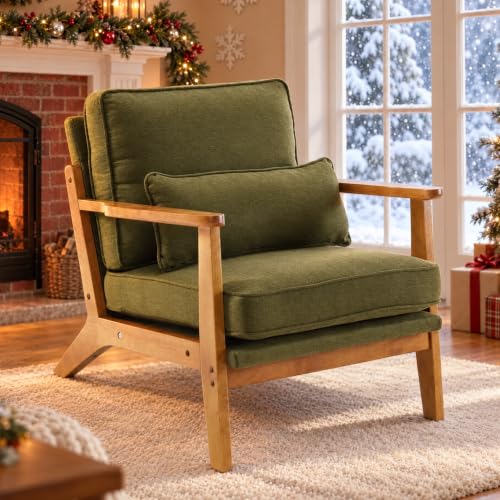
The Karl home Mid-Century Lounge Accent Chair leads this guide because it demonstrates both halves of the wood question: structure and finish. Its solid wood frame carries up to 330 lb — a serious rating for a lounge chair — and the frame is finished in a warm walnut tone that sets off the green linen upholstery, the wide curved armrests, and the flared legs of its mid-century silhouette. The seat is high-density sponge, a lumbar pillow is included, and the whole chair reads as what it is: hardwood used confidently.
Strengths
- Solid wood frame with a 330 lb capacity and a rich, even walnut-toned finish.
- Ergonomic armrest and back angles with a lumbar pillow included.
- Breathable linen over high-density sponge suits long, relaxed sits.
Trade-offs
- The maker does not headline the frame’s species; the finish color is the story told.
- Indoor chair; the linen and finish are not weatherproofed.
- The distinctive green-and-walnut palette will not suit every room.
| Color | Green |
| Size | 28.3 inches L x 31.5 inches W x 29.5 inches H |
| Dimensions | 39.5 x 36.3 x 37.5 inches |
| Weight | 33.3 pounds |
The Karl home teaches the first lesson of chair wood: the frame is the chair. Upholstery can be replaced and cushions renewed, but the frame’s species and joinery decide whether the chair exists in twenty years. A solid hardwood frame at this capacity, with legs flared for stability and arms wide enough to be structural, is the specification to look for in any wooden chair — and the walnut tone shows the second lesson, that a mid-dark stain on hardwood hides a decade of small marks while keeping the grain alive.
As a lounge chair it is generous and humane: the back and arm angles were designed for relaxation, the linen breathes in warm rooms, and the chair serves living rooms, bedrooms, and balconies with equal ease. It is the pick for the reader who wants one chair that embodies the guide’s advice.
Choose the Karl home if you want a solid-wood lounge chair with a showcase finish. Skip it if you need outdoor durability or a species-certified pedigree on the label.
Best for: Living-room lounging on a strong, beautifully finished hardwood frame / Not suited for: Outdoor use or buyers who require a named species
GIANTEX Indoor & Outdoor Wood Rocking Chair
Our badge: Best Budget
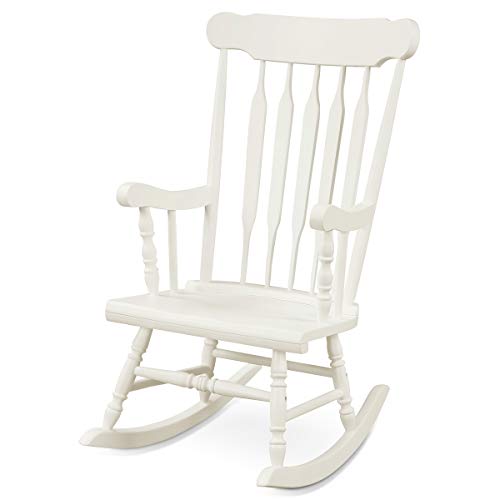
The GIANTEX Indoor & Outdoor Wood Rocking Chair is the rubberwood proof of concept. Rubber wood — harvested from plantation trees at the end of their latex-producing life — is a genuine hardwood: dense, stable, and strong enough that this rocker’s frame is rated to 300 lb. The chair disperses load across four support points with cross bars, its rocking arc is calculated to keep the sitter centered, and the wood is finished smooth and free of burrs, with a slatted back that sheds heat on warm evenings.
Strengths
- Solid rubber wood frame rated to 300 lb, with cross-braced, four-point support.
- Smooth, splinter-free finishing shows rubberwood’s even grain at its best.
- Sustainable species story: plantation timber given a second, structural life.
Trade-offs
- Rubberwood outdoors wants a covered porch and finish maintenance, not full exposure.
- The white finish shows dirt sooner than a mid-tone would.
- Firm, slatted seat without a cushion.
| Color | White |
| Size | 32.5D x 25.5W x 46.5 In |
| Dimensions | 32.5 x 25.5 x 46.5 inches |
| Weight | 32 pounds |
Rubberwood’s reputation problem is purely linguistic — the name sounds like a synthetic. In the workshop it behaves as what it is: a medium-density hardwood that machines cleanly, holds screws and joints well, and takes paint and stain evenly thanks to its relatively uniform grain. For chair legs and frames, those are exactly the virtues that matter, and this rocker deploys them where a rocker needs them most, in a structure that flexes thousands of times a year without loosening.
As furniture, the GIANTEX is a versatile porch and garden rocker with a 46.5-inch back, curved arms, and an easy coded-parts assembly. It is the budget lesson of this guide: you do not need an exotic species to get a strong wooden chair — you need a real hardwood, honestly built.
Choose the GIANTEX if you want solid hardwood outdoors at an accessible position. Skip it if you want zero finish maintenance — no outdoor wood offers that, whatever the listing implies.
Best for: Porch rocking on sustainable, structural rubberwood / Not suited for: Uncovered full-weather exposure without upkeep

Yaheetech Mid Century Accent Chair
Our badge: Best for Dining Rooms
The Yaheetech Mid Century Accent Chair puts rubberwood where dining and accent chairs need it most: the legs. Rubberwood legs give this tufted, faux-leather chair its stability and its 300 lb capacity, finished with plastic foot pads that protect floors. Above them, a cushioned seat on three sinuous springs and a gently slanted solid backrest deliver the comfort, and wide track arms complete a retro profile that suits dining rooms, reading nooks, and living rooms alike.
Strengths
- Rubberwood legs provide hardwood stability with floor-protecting pads.
- Spring-supported seat cushion outlasts foam-only seats.
- Compact proportions suit apartments, dining sets, and reading corners.
Trade-offs
- Faux leather is an indoor upholstery; keep the chair out of weather.
- The retro brown palette commits to a warm mid-century look.
- Assembly required, though designed to be simple.
| Color | Retro Brown |
| Size | set of 1 |
| Dimensions | 29 x 28.5 x 33 inches |
| Weight | 38.27 pounds |
Legs are where chairs die first — they take the sideways drag, the floor’s moisture, and the stress concentration at the seat joint — so a maker’s leg species is a honest tell of the chair’s intended lifespan. Yaheetech’s choice of rubberwood, the same structural hardwood as the rocker above, in a mid-priced accent chair is the market working as it should: a plantation hardwood delivering premium performance where it counts, without a premium story attached.
The chair itself is a versatile, comfortable accent with a minimalist line that complements most decor, sized kindly for smaller rooms. It is the kind of piece that anchors a reading corner for years.
Choose the Yaheetech if you want hardwood-legged durability in a compact accent or dining chair. Skip it for outdoor use. Hosts building a dining set around hardwood should also browse Best Arm Chairs For Living Room for the upholstered end of the spectrum.
Best for: Dining and reading corners that want hardwood legs and retro comfort / Not suited for: Outdoor placement

Christopher Knight Home Wingback Accent Chair
Our badge: Best Premium
The Christopher Knight Home Wingback Accent Chair is the birch exhibit. Its solid birch legs carry a rich teak finish — and that pairing is a deliberate craft choice, because birch’s fine, pale, even grain accepts controlled stain colors more predictably than almost any other hardwood. Where an open-grained wood would blotch under a teak tone, birch delivers the smooth, furniture-grade result you see here. The chair above the legs is a wingback club chair in camel polyester, 31.25 by 32.25 by 33 inches, with a curved back and a soft cushion built for reading.
Strengths
- Solid birch legs: a fine-grained hardwood that stains evenly and holds detail.
- Teak-toned finish shows controlled color that blotch-prone species cannot match.
- Wingback comfort with sturdy, mid-century leg construction.
Trade-offs
- Birch’s pale natural color means the finish does the aesthetic work; purists of natural grain may prefer oak or walnut.
- Indoor upholstery and furniture-grade finish, not weatherproofing.
- Substantial at 44.1 pounds.
| Color | Camel |
| Size | 31.25″Wx32.25″Dx33.00″H |
| Dimensions | 32.25 x 31.25 x 33 inches |
| Weight | 44.1 pounds |
Birch deserves its reputation among finishers. It is hard, strong, and shock-resistant — qualities that made it a classic for chair parts and turned components — and its closed grain sands to a smooth surface that takes paint as beautifully as stain, which is why painted fine furniture so often hides birch or its close relatives underneath. For a buyer, a chair on birch legs is a chair whose maker cared about the finish line as much as the frame.
As a seat, the wingback is the traditional reading chair perfected: wings that shelter, a cushion that supports, and proportions that suit living rooms and bedrooms with classic leanings. It is premium in the quiet way — materials and finish, not ornament.
Choose the Christopher Knight if you value finishing craft and classic comfort. Skip it if you want raw, rustic grain character — the VINGLI below shows more of the wood itself.
Best for: Reading chairs where even, furniture-grade stain is the point / Not suited for: Rustic-grain lovers or outdoor use

VINGLI Mid-Century Modern Accent Chair
Our badge: Best for Lounging
The VINGLI Mid-Century Modern Accent Chair shows its wood openly: a sturdy wooden frame and curved legs in a natural finish, paired with breathable linen upholstery, high-density foam with pocket coils, and a metal-reinforced back support. The high back and angled armrests make it a true lounge chair, and at 49.27 pounds it has the planted, substantial feel that well-built wooden furniture gives a room.
Strengths
- Sturdy wooden frame and legs with a natural finish that honors the grain.
- Pocket coils plus foam give the seat a supportive, lasting cushion.
- High back and angled arms suit long lounging sessions.
Trade-offs
- The maker markets the frame’s build more than its species name.
- Heaviest chair in this roundup; place it thoughtfully.
- Indoor linen upholstery.
| Color | Green |
| Size | Medium (M) |
| Dimensions | 31 x 31.1 x 35.8 inches |
| Weight | 49.27 pounds |
The VINGLI demonstrates the mixed-construction reality of good modern chairs: wood where wood excels — the frame’s structure and the legs’ stance — with metal reinforcement where a slim profile needs help, and engineered cushioning where the body lands. Purists sometimes dismiss hybrids, but chair history is full of them, and the honest test is whether each material is doing the job it is best at. Here, the wood carries the chair’s character and much of its strength, and the natural finish makes that visible rather than hiding it under color.
As a lounge chair for living rooms, bedrooms, and balconies, it is generous and comfortable, with the mid-century curved-arm profile that has remained in fashion because it supports real bodies gracefully.
Choose the VINGLI if you want visible wood, high-back comfort, and substantial build. Skip it if you need to move the chair often.
Best for: Loungers who want natural wood presence and a high back / Not suited for: Frequent rearrangers

Costzon Nursery Glider with Ottoman
Our badge: Best for Nurseries
The Costzon Nursery Glider with Ottoman puts its wood where engineering matters most: a solid wood base and frame that carry the glide mechanism. A glider base is a torture test for joinery — it cycles thousands of times under load, in silence, or the whole product fails its purpose — and Costzon’s solid wood structure delivers a smooth, gentle motion with a stated chair capacity of 396 lb and an ottoman rated to 375 lb. Thick padded cushions, an ergonomic back, side storage pockets, and a zip-off seat cover complete a chair built for the nursery’s long nights.
Strengths
- Solid wood base engineered for silent, stable, high-cycle gliding.
- Generous stated capacities for both chair and ottoman.
- Padded comfort with practical, cleanable upholstery details.
Trade-offs
- The wood is structural and mostly hidden; this is not a showcase-grain piece.
- Nursery styling suits family rooms more than formal ones.
- The ottoman adds a second footprint.
| Color | Brown |
| Size | 2 Piece Set |
| Dimensions | 28.5 x 29.5 x 39.5 inches |
| Weight | 40.22 pounds |
The glider’s lesson for wood shoppers is that joinery and structure outrank species glamour. A base that must never creak, loosen, or tip is a pure engineering problem, and solid wood — properly dried, properly joined — solves it with a warmth and repairability that metal bases rarely match in a nursery. When the glider’s working life as a nursery chair ends, the same structure serves as a reading rocker for years, which is the lifecycle good wood makes possible.
Daily, the Costzon is the chair parents actually live in: the ottoman elevates tired legs, the pockets hold the night’s supplies, and the motion soothes babies and adults impartially. Its wood story is the quietest in this guide and, in its way, the most convincing.
Choose the Costzon if you need a glider whose base will stay silent and solid for years. Skip it if you want the wood itself to be the visual feature. Nursing-focused readers will find its full comfort case in Best Chairs For Nursing Mothers.
Best for: Nurseries that need a silent, solid wood glide base / Not suited for: Showcase furniture hunters
Comparison Table
| Pick | Color | Dimensions | Weight | Check price on Amazon |
|---|---|---|---|---|
| Karl home Mid-Century Lounge Accent Chair | Green | 39.5 x 36.3 x 37.5 inches | 33.3 pounds | Check price on Amazon |
| GIANTEX Indoor & Outdoor Wood Rocking Chair | White | 32.5 x 25.5 x 46.5 inches | 32 pounds | Check price on Amazon |
| Yaheetech Mid Century Accent Chair | Retro Brown | 29 x 28.5 x 33 inches | 38.27 pounds | Check price on Amazon |
| Christopher Knight Home Wingback Accent Chair | Camel | 32.25 x 31.25 x 33 inches | 44.1 pounds | Check price on Amazon |
| VINGLI Mid-Century Modern Accent Chair | Green | 31 x 31.1 x 35.8 inches | 49.27 pounds | Check price on Amazon |
| Costzon Nursery Glider with Ottoman | Brown | 28.5 x 29.5 x 39.5 inches | 40.22 pounds | Check price on Amazon |
How to Choose the Best Wood for Chairs
Match the species to the chair’s job
Dining chairs want hardness and joint strength in a light frame — hard maple, birch, beech, and rubberwood all serve, which is why they recur in quality sets. Lounge chairs can carry heavier frames, so oak and walnut come into their own, trading weight for presence and grain. Rockers and gliders want toughness and fatigue resistance in the moving structure. Outdoor chairs want rot resistance first — naturally durable species or dense hardwoods under maintained finishes, ideally under cover. There is no universal best wood; there is a best wood per job, and the reviews above are organized by job for that reason.
Understand hardness without worshipping it
Hardness — commonly compared on the Janka scale — predicts dent resistance at wear points: leg bottoms, arm fronts, the seat rail where belts and buttons land. But the hardest wood is not automatically the best chair wood. Extremely hard, heavy species can be brittle in thin sections and punishing to joinery, while slightly softer hardwoods with interlocking grain — rubberwood among them — survive chair geometry beautifully. Judge the whole profile: strength, hardness, stability, and how the species behaves in thin, joined parts.
Insist on dry, stable wood — and signs of it
More chairs fail from moisture than from species. Wood that was not dried properly shrinks after the joints are glued, and the chair loosens within a few seasons no matter how noble the timber. You cannot moisture-test a listing, but you can read the proxies: a maker who names species, states capacities, and builds with cross-bracing and sensible joinery is a maker whose drying is probably competent too. Wobble in a new chair is never a break-in phase; it is a defect, and it only grows.
Read grain direction like a maker
Chair legs should run with straight grain along their length; grain that runs out the side of a leg is a fracture waiting for a sideways drag. In finished furniture you can often see this at the leg’s face — look for long, continuous grain lines rather than dramatic diagonal sweeps. Seat rails and arms follow the same rule. You will not catch every flaw from listing photos, but preferring makers whose product photography shows the wood honestly — as the picks here do — tilts the odds your way.
Budget honestly across the chair’s life
A solid hardwood chair costs more than a softwood or board chair and outlasts several of them, while remaining repairable — legs can be re-glued, finishes renewed, upholstery replaced. The cheapest wooden chair is the one bought once. If budget forces a compromise, compromise on ornament, not on the frame: a plain hardwood chair like the GIANTEX rocker will outlive a decorated softwood one every time.
How Do You Care for Wooden Chairs So They Last Decades?
Daily care is mostly protection from water and grit. Felt or plastic glides under every leg — several picks here include foot pads for exactly this reason — keep floor moisture and dragging grit away from the wood’s most vulnerable end grain. Wipe spills promptly, especially on seat rails and arms, and keep wooden chairs out of standing damp: a porch chair on wet concrete wicks moisture through its feet all season.
Seasonal care is inspection. Once or twice a year, turn each chair over and check the joints for play, the glides for wear, and the finish for dull or thin patches at the wear points. Tighten what tightens, re-glue what your skill allows, and touch up the finish where it has worn through to raw wood — raw spots are where moisture enters and joints begin their slow failure. Indoors, keep wooden chairs out of the harshest direct sun where you can; UV ages finishes and, over years, the wood beneath them.
Problem: A leg joint has developed a wobble — Stop dragging the chair immediately; dragging is what converts play into fracture. A wobbling mortise joint needs re-gluing by a competent hand — it is a small repair now and a broken leg later.
Problem: The finish looks cloudy or white-ringed — That is moisture trapped in the finish, usually from wet glasses. Gentle heat or a maker-approved finish remedy can release it; prevention is coasters and prompt wiping.
Problem: Legs are uneven and the chair rocks — Check the glides first — one missing glide mimics a warped chair — then check for a loosened joint twisting the frame. True the cause, not the symptom.
Problem: The wood feels dry and the color has faded — The finish has thinned. Clean the chair, and renew the finish per its type — oil finishes wipe on easily; film finishes may need a light sand and a fresh coat.
Problem: Fine cracks appear at a joint line — Hairline finish cracks at joints are common with seasonal humidity movement. Monitor them; a crack that opens, creaks, or pairs with wobble is structural and needs repair.
The Classic Species, Honestly Appraised
Oak is the chair wood of the popular imagination — strong, hard, openly grained, and honest — and it earns its place in dining and mission-style chairs, at the cost of weight and a grain that dominates a room. Walnut is the premium storyteller: rich color, beautiful grain, slightly softer than oak, and priced like the heirloom material it is. Hard maple is the quiet professional — pale, dense, and exceptionally strong in thin parts, favored where chairs take commercial abuse. Beech, the European classic, bends beautifully, which is why bentwood and steam-bent chairs so often wear it. Cherry starts pale and darkens to a deep red-brown with light, rewarding owners who buy for the decade rather than the day.
Against those classics, this guide’s featured species hold their own on merit. Rubberwood matches the working hardwoods on the properties chairs actually need, with a sustainability story the classics cannot tell. Birch out-finishes them all when controlled color is the goal. The lesson is not that famous species are overrated — it is that chair wood should be chosen by properties and purpose, and that a well-built rubberwood chair will outserve a poorly built walnut one every year of its life.
Softwoods and Engineered Woods: The Honest Limits
Pine and other softwoods make charming, inexpensive chairs, and their limits are structural facts, not snobbery: they dent at every knock, their joints loosen sooner under chair stresses, and thin softwood legs live dangerously. A softwood chair suits light, occasional use — a bedroom chair, a child’s chair that will be outgrown — and disappoints as the household’s daily dining workhorse. Painted finishes help softwoods by hiding dents and adding a sacrificial layer, which is why painted pine is a tradition in farmhouse furniture.
Engineered woods — plywood, MDF, particleboard — have legitimate chair roles in molded shells and upholstered frames where their consistency is an asset, but they do not belong in slender legs and high-stress joints, and they forgive neither moisture nor repair. When a listing says “wood” without a species or the word “solid,” assume engineered content in the structure and price the chair accordingly. The picks in this guide were chosen to keep you on the solid side of that line.
Reading a Chair Listing Like a Woodworker
You can learn to audit a wooden chair from its listing in about a minute, and the audit predicts the chair’s decade better than any photograph. First, find the species — named timber for the frame and legs is the single strongest signal in the listing, and its absence demotes every other claim. Second, find the capacity and ask whether it suits the construction described; a solid hardwood frame should carry serious numbers, as the picks in this guide do, from the GIANTEX’s 300 lb to the Costzon base’s 396 lb chair rating. Third, look at the joints the photos reveal: cross-bracing, corner blocks, and stretchers between legs are the visible grammar of a chair built to be sat in for years, while legs that simply meet the seat at four naked points are a sentence that ends early.
Fourth, weigh the chair — literally, in the specifications. Solid hardwood has a density you can feel in the numbers: the chairs in this guide run from roughly 32 to 49 pounds, and a “solid wood” chair listed at half the weight of its peers is telling you about its hollow or engineered core more honestly than its marketing does. Fifth, read the care instructions the maker bothers to give. A maker who tells you how to clean the wood, protect the feet, and maintain the finish is a maker who expects the chair to still be in service when those instructions matter. Listings that skip all five signals are asking you to buy a silhouette. Buy the structure instead — it is the part of the chair your grandchildren will sit on. Makers of dining sets apply the same signals at table scale, as the guidance in Best Chairs For Live Edge Table shows from the table side.
Joinery: The Invisible Half of Wood Quality
Two chairs can share a species, a finish, and a silhouette, and differ by twenty years of life, because wood quality is only half the story — the other half is how the pieces are joined. The strongest traditional chair joint, the mortise and tenon, locks a leg into a rail with a fitted wooden tongue and a large glue surface, and it can be re-glued a century later. Dowels approximate that strength when they are long, well-fitted, and glued in sound wood. Screws alone, driven into end grain, are the weakest common method, and they announce themselves in listings by their silence — makers with real joinery describe it, because it costs them money to do.
You can audit joinery without dismantling anything. Look for stretchers between the legs, which triangulate the base against the sideways forces that loosen chairs; look for corner blocks under the seat in product photography; and read the assembly instructions if they are published — a chair whose legs bolt to a steel plate under the seat is engineered differently from one whose legs are glued into the rails, and both can be honest designs, but only one of them can be re-glued by a repairer in twenty years. The chairs in this guide were chosen partly on these signals: braced bases, structural frames, and makers who describe construction instead of adjectives. Species gets a chair into this guide; joinery is what keeps it in your house.
Wood and the Seasons: Living With a Breathing Material
Wood moves. Across the year, humidity swells it slightly in summer and shrinks it in heated winter rooms, and a well-made chair is designed to let that movement happen without tearing itself apart — panels float, joints are fitted with the seasons in mind, and finishes flex rather than fighting the material. Owners can help by keeping wooden chairs in reasonably stable indoor humidity and away from the two extremes that punish furniture: the radiator’s dry blast and the damp basement corner. A chair that creaks softly in January and falls silent in June is not failing; it is reporting the weather, as wooden furniture has done for centuries. What should concern you is change in one direction only — a joint that grows looser month by month, in every season. That chair is asking for the repair bench, and the earlier it gets there, the smaller the repair remains.
Wooden Chairs for Children: A Special Case
Children’s chairs invert the usual priorities in one respect: they will be outgrown, so a century of joinery is wasted on them — but they will also be climbed, stood on, dragged, and used as fort architecture, so the strength question becomes a safety question rather than a longevity one. Choose dense, splinter-resistant wood with a smooth, intact finish, a wide and stable stance, and no joints that a small climber’s leverage can worry loose; inspect them more often than adult chairs, because their service is rougher and their users cannot report a developing wobble. Painted finishes suit children’s wood particularly well, hiding the dents of an honorable childhood and refreshing in an afternoon when the chair passes to a sibling. A well-chosen child’s chair is not a miniature heirloom — it is a safe tool for a few energetic years, and it should be bought, and retired, on exactly those terms.
A Word on Veneer
Veneer — a thin slice of fine wood over a stable core — has an honorable history in furniture and an dishonorable reputation earned by its cheapest uses. In chair seats and backs, quality veneer over a sound core can be beautiful and durable. In legs and joints, it has no structural business. The distinction to carry into any listing is location: veneer as a surface is craftsmanship; veneer as a structure is a warning.
Heirlooms Are Just Chairs That Were Repaired
Every antique chair in every family was, at some point, a wobbling chair somebody chose to fix. Solid wood’s repairability is what converts a purchase into an heirloom across enough decades — joints re-glued, finishes renewed, a broken leg replaced by a turner who matched the species. When you buy solid wood today, you are buying all of those future decisions the option to say yes.
Wood Chairs in Real Rooms: Matching Species to Service
The final wood decision is really a room decision. Dining rooms that host daily family meals want the dent-forgiving, finish-friendly species — the beech and rubberwood patterns in this guide’s picks — because the chairs will be slid, bumped, and wiped ten thousand times. A reading corner can afford the beautiful, softer choice, since its chair’s enemies are only sunlight and time. Entryways and desks ask for hardness; nurseries ask for smooth, splinter-free finishes and non-toxic coatings above all. Match the species to the service honestly and the chair ages into the room’s story; mismatch it and even a fine chair becomes the piece you apologize for. The same matching logic governs the chairs around a statement table — see Best Chairs For Live Edge Table — and the carved-wood care notes in Best Stain For Adirondack Chairs apply indoors more often than their title suggests.
Common Buying Mistakes
Assuming “wood” means solid hardwood
Listings use wood loosely. Look for the species name and the word solid attached to the parts that matter — frame and legs — and treat their absence as information.
Choosing species by photograph alone
Stain can make five species look identical in a listing photo. The photo shows color; the specification shows substance. Buy the substance and let the finish be the bonus.
Putting indoor wood outdoors
A beautiful indoor hardwood chair will weather, loosen, and split outside, however noble the species. Outdoor chairs need outdoor species, finishes, and ideally cover — as the GIANTEX’s porch-first design acknowledges.
Dragging chairs instead of lifting them
Sideways dragging is the number-one killer of chair joints, across all species. Lift chairs to move them, fit glides, and teach the household — the strongest oak chair cannot outlast being dragged daily.
Ignoring a new chair’s wobble
Wobble is not character and does not settle in. It is a loose joint that will worsen under load. Return or repair immediately, while the fix is small and the warranty is warm.
Final Recommendation
Choose the wood by the job — hardwood always for structure, rubberwood for value, birch for finish, durable species and cover for outdoors — and the chair will repay you for decades. Of the chairs here, the Karl home Mid-Century Lounge Accent Chair best embodies the whole argument: a strong solid-wood frame, beautifully finished, at a fair position. For solid hardwood outdoors on a budget, the GIANTEX rocker is the pick — start from its Check on Amazon listing. Buy the frame first and the finish second, lift instead of dragging, and your wooden chairs will be the furniture your household hands down rather than throws out.
Frequently Asked Questions
What is the strongest wood for chair legs?
Among common furniture woods, hard maple, oak, beech, and birch are all excellent leg materials — hard, strong in thin sections, and proven over centuries. Rubberwood belongs in the same practical conversation for household chairs. Just as important as species is straight grain along the leg and sound joinery at the seat; a straight-grained rubberwood leg outlasts a runout oak one.
Is rubberwood real wood?
Yes — rubberwood is a genuine hardwood harvested from rubber trees at the end of their latex-producing years, which makes it one of the most sustainable furniture woods. It is dense, stable, and strong enough for chair frames and legs, as two picks in this guide demonstrate with 300 lb capacities.
Which wood is best for outdoor chairs?
Naturally rot-resistant species are the traditional answer, but the practical answer for most buyers is a dense hardwood with a maintained penetrating finish, kept under cover when possible — or sidestepping wood entirely with HDPE lumber. Whatever the species, outdoor wood care is a rhythm: clean, inspect, and renew the finish before it fails.
Does the wood species affect how a chair takes stain?
Profoundly. Fine, closed-grain woods like birch take controlled, even color; open or resinous woods blotch without conditioner; pale woods show the stain’s true color while dark woods shift it. Identify the species first, test on a hidden area, and let the wood — not the can’s label photo — set your expectations.
How can I tell if a chair is solid wood?
Look for the species named in the specification, grain that continues around edges and end grain visible at leg bottoms, and a weight consistent with solid construction. Listings that say only “wooden” or show no material detail are usually describing engineered content. Weight is a useful tell: the solid chairs in this guide run from about 32 to 49 pounds.
Can a loosened wooden chair be repaired?
Usually, yes — that repairability is solid wood’s great advantage. A wobbling joint can often be re-glued and clamped by a furniture repairer for a fraction of the chair’s replacement cost, and finishes can be renewed indefinitely. Engineered-wood joints, by contrast, rarely survive a second gluing. Buy solid, and you are buying the option to repair.


