Disclosure: As an Amazon Associate, dailyhomedecorating.com earns from qualifying purchases. Links to Amazon on this page are affiliate links; they cost you nothing extra. Prices and availability change often, so check the current Amazon listing before you buy.
The search for the best stain for adirondack chairs usually begins in spring, standing in front of a chair that winter has turned gray. Wooden Adirondacks live the hardest life of any furniture in the yard — full sun, standing rain, freeze and thaw — and their finish is the only thing between the wood and the weather. The right stain does three jobs at once: it restores the color, it feeds and seals the wood against moisture, and it carries UV protection that slows the graying from coming back. The wrong stain, or the right stain applied to unprepared wood, peels by August and leaves the chair looking worse than honest gray.
This guide covers the staining decision completely: which stain types suit Adirondack wood, how opacity changes both looks and maintenance, how to prep a weathered chair so the finish lasts, and when to stop refinishing and replace. The reviews cover six chairs chosen around that decision — wooden chairs whose frames reward good finishing, plus the HDPE Adirondack that removes staining from your life entirely, included honestly as the alternative many owners eventually choose. Readers weighing that same fork for other outdoor pieces will find Best Patio Chairs For Big Guys and Best Teak Patio Sofas Loveseats useful companions.
Where to Buy
Every chair reviewed below is sold on Amazon, where you can check the current price, color options, and availability before you buy. Stains and prep supplies are also easiest to compare there, where listings state opacity, base type, and coverage in one place.
- POLYWOOD Modern Adirondack Chair — Check on Amazon
- GIANTEX Indoor & Outdoor Wood Rocking Chair — Check on Amazon
- Karl home Mid-Century Lounge Accent Chair — Check on Amazon
- Yaheetech Mid Century Accent Chair — Check on Amazon
- Christopher Knight Home Wingback Accent Chair — Check on Amazon
- VINGLI Mid-Century Modern Accent Chair — Check on Amazon
In this guide
Quick Picks
| Pick | Badge | Why it earns its place |
|---|---|---|
| POLYWOOD Modern Adirondack Chair | Best Overall | HDPE lumber Adirondack that never needs staining, painting, or sealing — the permanent answer to the refinishing cycle. |
| GIANTEX Indoor & Outdoor Wood Rocking Chair | Best Budget | Solid rubber wood outdoor chair whose smooth, burr-free finish shows what good wood care looks like at an accessible position. |
| Karl home Mid-Century Lounge Accent Chair | Best Premium | Solid wood frame chair with a walnut-toned finish against green linen — a study in stain color done right. |
| Yaheetech Mid Century Accent Chair | Best for Wood Lovers | Rubberwood legs and a tufted retro build — durable hardwood components that reward oiling and care. |
| Christopher Knight Home Wingback Accent Chair | Best for Porches | Solid birch legs with a rich teak finish under a wingback club chair — classic stained-wood furniture craft. |
| VINGLI Mid-Century Modern Accent Chair | Best Compact | Wooden legs and frame with a high back and breathable linen — a compact chair whose wood parts are easy to maintain. |
Key Takeaways
- For outdoor wood, penetrating oil-based stains outlast film-forming finishes because they cannot peel — they fade gradually and recoat without stripping.
- Opacity is a maintenance decision: transparent stains show wood and need frequent renewal; semi-solid and solid stains hide weathering and last longer between coats.
- Prep is 80 percent of the result — clean, brighten, sand, and let the wood dry fully before any stain touches it.
- End grain and horizontal surfaces drink stain and weather fastest; give them extra coats and extra attention.
- If refinishing has become an annual dread, an HDPE Adirondack ends the cycle permanently — the first pick below exists for exactly that owner.
How These Picks Were Chosen
Because this keyword is about a finish rather than a chair, the picks were chosen to illuminate the decision from every side. The list leads with the HDPE Adirondack that makes staining unnecessary, because for many searchers that is the honest answer. The remaining picks are chairs built with real wood — solid rubber wood, birch, and hardwood frames and legs — whose construction and finishes demonstrate what stained and oiled wood looks like when it is done well, and whose care routines mirror what an Adirondack owner actually does each season.
No stain product is linked or rated in this guide, because the verified pool contains chairs, not finishes. Stain guidance is therefore given as category knowledge — base types, opacity levels, prep sequence, and application method — which is the durable information anyway: brands reformulate, but the difference between a penetrating oil and a film finish is permanent. Where a chair’s own finish is described, it comes from the manufacturer’s verified information in the pool.
Chairs were excluded if their wood content was merely decorative trim over plastic, because a guide about wood finishing should be built on furniture that genuinely uses wood where it matters — frames, legs, and structure.
The 6 Best Best Stain for Adirondack Chairs — Reviewed

POLYWOOD Modern Adirondack Chair
Our badge: Best Overall
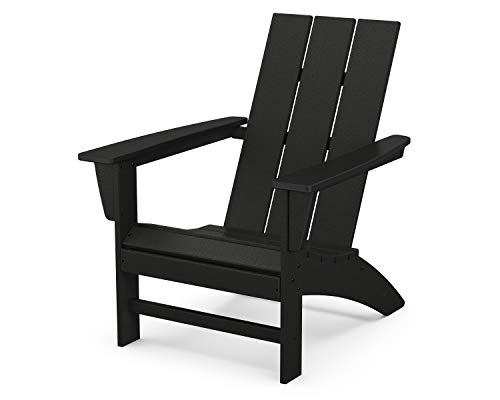
The POLYWOOD Modern Adirondack Chair leads a stain guide by abolishing the task. It is built from genuine POLYWOOD HDPE lumber with ColorStay technology — UV inhibitors integrated into the material itself — so the color is not a coating that can peel, fade unevenly, or demand renewal. It will not crack, peel, or chip, it cleans with soap and water, and it is assembled with marine-grade stainless hardware. For the owner who has sanded one chair too many, this is not a compromise; it is the exit from the refinishing cycle, in a chair with a contoured seat, a waterfall front, and wide Adirondack arms.
Strengths
- No staining, painting, or sealing — ever — with color integrated through the material.
- HDPE lumber stands up to moisture and temperature extremes that destroy wooden finishes.
- Contoured comfort and marine-grade hardware make it a genuine chair, not just a low-maintenance one.
Trade-offs
- It is not wood, and owners who love wood grain and the refinishing ritual will feel the difference.
- Premium materials carry a premium position, repaid over years of skipped maintenance.
- At 34 pounds it is a set-it-and-leave-it chair rather than a portable one.
| Color | Black |
| Size | 32.11in. x 29.25in. x 34.66in. |
| Dimensions | 32.13 x 29.25 x 34.68 inches |
| Weight | 34 pounds |
The honest math behind this pick: a wooden Adirondack needs cleaning, brightening, sanding, and staining every one to three seasons depending on exposure, plus the stain itself and a weekend’s weather window. Multiplied across a set of chairs and a decade of ownership, that is real time and money spent maintaining a finish instead of sitting in the chair. The POLYWOOD’s price buys those weekends back, permanently, and its all-weather performance means it can live at the fire pit through every season without a cover or a garage.
None of that makes wooden Adirondacks a mistake — the rest of this guide exists because wood, well finished, is beautiful and satisfying. It makes the POLYWOOD the right answer for a specific, common owner: the one whose search for stain is really a search for an end to staining.
Choose the POLYWOOD if your refinishing enthusiasm has run out. Keep reading if it has not — the wooden chairs below, and the staining guidance that follows, are for you. Owners furnishing a whole fire-pit circle may also like Best Sunbrella Patio Sofas Loveseats for weatherproof companions.
Best for: Owners who want Adirondack comfort with zero refinishing, forever / Not suited for: Wood lovers who enjoy the finishing craft itself
GIANTEX Indoor & Outdoor Wood Rocking Chair
Our badge: Best Budget
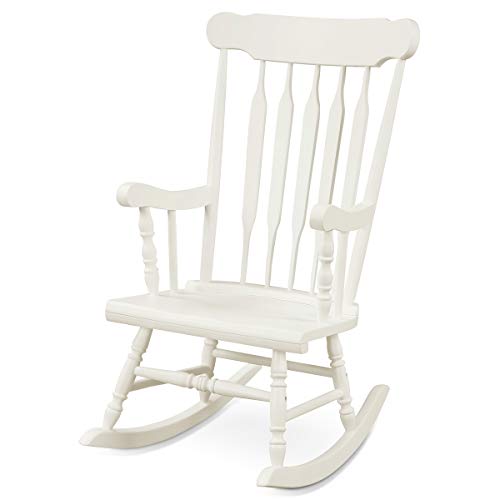
The GIANTEX Indoor & Outdoor Wood Rocking Chair is this guide’s working example of solid wood done affordably: a rubber wood frame, sturdy and wear-resistant, rated to 300 lb, finished smooth and free of burrs, with a slatted back that sheds heat and a four-point support structure with cross bars. Rubber wood is a dense hardwood, and on a chair that lives on porches and patios it demonstrates the essential wood-care truth — a sound hardwood with a maintained finish outlasts a softwood with a neglected one, every time.
Strengths
- Solid rubber wood construction with a smooth, splinter-free finish.
- 300 lb capacity on a stable, cross-braced rocking structure.
- Slatted design promotes airflow and dries quickly after rain.
Trade-offs
- Wood wants a covered porch and periodic finish care rather than full exposure.
- The white finish will show dirt sooner than a mid-tone stain would.
- No cushion included; the slatted seat is firm.
| Color | White |
| Size | 32.5D x 25.5W x 46.5 In |
| Dimensions | 32.5 x 25.5 x 46.5 inches |
| Weight | 32 pounds |
For the staining student, the GIANTEX teaches the maintenance rhythm on a forgiving subject. Its smooth finish needs only a damp-cloth cleaning in season, and when the finish eventually dulls, a light sanding and a fresh coat restore it — the same cycle, at smaller scale, that an Adirondack demands. The chair’s calculated rocking arc keeps the sitter’s weight centered, which also keeps the rockers’ finish wear even rather than grinding one spot bare.
As furniture, it is a genuine porch pleasure: a 46.5-inch-high back, curved armrests, and a minimalist profile that suits living rooms as readily as gardens. It assembles with coded parts and brief instructions, and its versatility — porch, poolside, balcony, lawn — makes it the wooden chair most likely to be used daily in this roundup.
Choose the GIANTEX if you want real wood outdoor seating with manageable care at an accessible position. Skip it if you want a finish you can forget entirely — return to the POLYWOOD.
Best for: Porch owners who want solid hardwood with a simple care routine / Not suited for: Fully exposed, uncovered placement without finish upkeep

Karl home Mid-Century Lounge Accent Chair
Our badge: Best Premium
The Karl home Mid-Century Lounge Accent Chair is included as a masterclass in stain color: its green linen upholstery is set against a solid wood frame in a walnut tone, and the pairing is the whole design. The chair carries up to 330 lb on that frame, with a high-density sponge seat, wide curved armrests, flared legs, and a lumbar pillow included. When Adirondack owners ask what stain color to choose, this chair is the visual answer — a mid-dark, warm brown that flatters both the wood and everything placed against it.
Strengths
- Solid wood frame with a rich walnut-toned finish that anchors the design.
- 330 lb capacity with a high-density sponge seat and lumbar pillow.
- Wide, curved armrests and ergonomic angles suit long, relaxed sits.
Trade-offs
- An indoor lounge chair; its linen and finish are not weatherproofed for yard duty.
- The mid-century palette is distinctive and will not suit every room.
- Color can vary slightly between screens and the delivered piece, as the maker notes.
| Color | Green |
| Size | 28.3 inches L x 31.5 inches W x 29.5 inches H |
| Dimensions | 39.5 x 36.3 x 37.5 inches |
| Weight | 33.3 pounds |
The lesson this chair teaches Adirondack owners is about contrast and restraint. A walnut-depth stain is dark enough to hide the small weathering marks that transparent finishes advertise, light enough to keep the grain alive, and warm enough to sit beside greens, creams, and natural fibers without argument. When you test stain colors on your Adirondack’s underside — as the buying guide insists — test a walnut-depth option alongside your first instinct; it is the depth most owners end up happiest with outdoors, where sunlight lightens everything by a shade.
As a chair, the Karl home is a generous, comfortable lounge piece for living rooms, bedrooms, and balconies, with the humanized details — pillow included, arms at a natural height, breathable linen — that make a chair a daily favorite rather than a showpiece.
Choose the Karl home if you want a premium lounge chair whose wood finish is a design feature. Skip it for outdoor duty; its beauty is an indoor beauty. For outdoor wood in a similar spirit, the rocker above is your chair, and the finishing guidance below applies to it directly.
Best for: Indoor lounging with a showcase walnut-toned wood frame / Not suited for: Outdoor exposure or stain-proof expectations

Yaheetech Mid Century Accent Chair
Our badge: Best for Wood Lovers
The Yaheetech Mid Century Accent Chair pairs a button-tufted faux leather seat with rubberwood legs — and rubberwood is the wood note that matters here. It is a dense, durable hardwood that takes oil and finish evenly, resists denting better than softwoods, and appears in quality furniture precisely because it ages gracefully with basic care. The chair’s cushioned seat rides on three sinuous springs, its solid backrest slants gently for support, its wide track arms give your arms real estate, and plastic foot pads protect floors. It holds up to 300 lb.
Strengths
- Rubberwood legs offer hardwood durability that rewards simple oil-and-wipe care.
- Spring-supported cushion and a gently slanted solid back give lasting comfort.
- Compact, small-space-friendly proportions with a handsome retro profile.
Trade-offs
- Faux leather upholstery is an indoor material; keep this chair out of the weather.
- The retro brown palette is a commitment to a warm, mid-century look.
- Assembly is required, though the maker designs it to be simple.
| Color | Retro Brown |
| Size | set of 1 |
| Dimensions | 29 x 28.5 x 33 inches |
| Weight | 38.27 pounds |
For Adirondack owners, the transferable lesson is wood selection. The chairs that refinish well decade after decade are built from dense hardwoods that sand evenly and accept stain uniformly. Soft, fast-grown woods blotch, raise grain, and drink stain unevenly — which is why prep and conditioner matter so much more on them, as the how-to section explains. When you eventually replace a wooden outdoor chair, the species is a specification worth shopping for, not a detail.
As daily furniture, the Yaheetech is a versatile reading-nook and living-room chair with a minimalist mid-century line that complements most decor, sized kindly for apartments and guest rooms. It is the kind of chair that gets sat in daily and still looks deliberate.
Choose the Yaheetech if you appreciate real hardwood components in a compact accent chair. Skip it for any outdoor placement. Wood-species guidance for a full chair project continues in Best Wood For Chairs.
Best for: Readers and loungers who value hardwood legs and retro style / Not suited for: Outdoor use or ultra-modern minimal rooms

Christopher Knight Home Wingback Accent Chair
Our badge: Best for Porches
The Christopher Knight Home Wingback Accent Chair stands on solid birch legs with a rich teak finish — and birch is the finisher’s friend among hardwoods: fine-grained, pale, and exceptionally even in how it accepts stain, which is why it is chosen when a maker wants a controlled, furniture-grade color like this teak tone. Above those legs sits a wingback club chair in camel polyester upholstery, with a curved backrest and a soft cushion sized for long reading sessions, at 31.25 inches wide by 32.25 deep by 33 high.
Strengths
- Solid birch legs with a teak finish demonstrate even, controlled staining on fine hardwood.
- Wingback shape and soft cushioning make it a genuine reading chair.
- Sturdy mid-century leg construction with a warm, versatile camel palette.
Trade-offs
- Upholstered indoor chair; the finish is furniture-grade, not weatherproof.
- At 44.1 pounds it is substantial to move for cleaning.
- The wingback formality suits traditional rooms more than casual ones.
| Color | Camel |
| Size | 31.25″Wx32.25″Dx33.00″H |
| Dimensions | 32.25 x 31.25 x 33 inches |
| Weight | 44.1 pounds |
The Adirondack lesson here is about expectations by species. Birch and similarly fine-grained woods stain evenly and predictably; coarse, open-grained, or resinous woods blotch and need a pre-stain conditioner to approach the same evenness. Many disappointing Adirondack refinishes are not bad stain or bad technique — they are a blotch-prone wood treated as if it were birch. Identify your chair’s wood before you buy stain, and let the species set your prep plan.
As a chair, the Christopher Knight is an elegant, comfortable accent for living rooms, bedrooms, and reading corners, with the wingback’s side wings doing their centuries-old job of making a seat feel sheltered. On a covered porch — its badge here — it brings indoor comfort to a protected outdoor room beautifully, provided the weather stays off it.
Choose the Christopher Knight if you want classic wingback comfort on beautifully finished hardwood legs. Skip it for exposed outdoor use.
Best for: Reading corners and covered porches that want classic, even-toned wood / Not suited for: Rain-exposed placement

VINGLI Mid-Century Modern Accent Chair
Our badge: Best Compact
The VINGLI Mid-Century Modern Accent Chair completes the wood tour with a sturdy wooden frame and legs under a high-back, green-upholstered lounge chair. The backrest and armrests are angled for relaxation, the upholstery is breathable linen over high-density foam with pocket coils, and a metal back support reinforces the frame. Its natural wood frame against the upholstery shows the lightest touch of wood finishing — a clear, natural tone that lets the material speak — which is the transparent end of the stain spectrum this guide keeps referencing.
Strengths
- Sturdy wooden frame and legs with a natural finish that showcases the grain.
- High back with pocket-coil and foam cushioning for real lounging comfort.
- Breathable linen suits warm rooms and sunny corners.
Trade-offs
- Indoor chair; natural finishes outdoors need the full protective system described below.
- At 49.27 pounds it is the heaviest accent chair in this roundup.
- The beige-and-green palette is specific; check it against your room.
| Color | Green |
| Size | Medium (M) |
| Dimensions | 31 x 31.1 x 35.8 inches |
| Weight | 49.27 pounds |
The VINGLI’s clear-finish look is exactly what transparent stain promises outdoors — and the comparison teaches the trade honestly. Indoors, a natural finish lasts for years because the weather is kind. Outdoors, that same transparency offers the least UV protection of any opacity, which is why transparent Adirondack finishes need the most frequent renewal. Admire the look here; outdoors, buy it with semi-transparent stain and a maintenance calendar, or step up in opacity and keep more of your weekends.
As furniture, the VINGLI is a substantial, comfortable high-back for living rooms, bedrooms, and balconies, with the curved-arm mid-century profile that has stayed in fashion for seventy years because it works.
Choose the VINGLI if you love the natural-wood look and high-back comfort indoors. Skip it for outdoor duty. For the full outdoor set context, Best Wicker Patio Sofas Loveseats covers the woven alternative.
Best for: Natural-finish wood lovers who lounge indoors / Not suited for: Outdoor exposure
Comparison Table
| Pick | Color | Dimensions | Weight | Check price on Amazon |
|---|---|---|---|---|
| POLYWOOD Modern Adirondack Chair | Black | 32.13 x 29.25 x 34.68 inches | 34 pounds | Check price on Amazon |
| GIANTEX Indoor & Outdoor Wood Rocking Chair | White | 32.5 x 25.5 x 46.5 inches | 32 pounds | Check price on Amazon |
| Karl home Mid-Century Lounge Accent Chair | Green | 39.5 x 36.3 x 37.5 inches | 33.3 pounds | Check price on Amazon |
| Yaheetech Mid Century Accent Chair | Retro Brown | 29 x 28.5 x 33 inches | 38.27 pounds | Check price on Amazon |
| Christopher Knight Home Wingback Accent Chair | Camel | 32.25 x 31.25 x 33 inches | 44.1 pounds | Check price on Amazon |
| VINGLI Mid-Century Modern Accent Chair | Green | 31 x 31.1 x 35.8 inches | 49.27 pounds | Check price on Amazon |
How to Choose the Best Stain for Adirondack Chairs
Choose the base: penetrating oil first
For outdoor chairs, a penetrating oil-based stain is the default recommendation because of how it fails: gradually and gracefully. It soaks into the wood fibers rather than forming a film on top, so it cannot peel, crack, or blister — it thins with weather until a fresh coat, applied after a wash, restores it. Film-forming products and paint-like solid stains can look superb initially, but on horizontal Adirondack surfaces that hold water and bake in sun, films eventually lift, and removing a failed film is the worst job in refinishing. Water-based stains have improved greatly and clean up easily; the best of them suit covered porches and mild climates, while full-exposure chairs still reward oil’s penetration and water repellency.
Choose opacity as a maintenance schedule
Transparent and clear finishes show all the grain and offer the least UV protection — plan on renewal every season in full sun. Semi-transparent stains add pigment that screens UV while keeping grain visible; they are the sweet spot for most Adirondacks, with renewal roughly every two to three seasons depending on exposure. Semi-solid and solid stains hide weathering, repairs, and mismatched boards, protect the longest, and change the chair’s character toward painted — the right choice for a chair that has already lived several lives. Decide with your calendar, not just your eyes.
Pick a color that sunlight will finish
Sun lightens and warms every stain over its first season, so choose one shade deeper and slightly cooler than your target. Mid-browns in the walnut family — the depth shown on the Karl home chair above — forgive weathering, complement greenery, and age evenly. Very dark stains show dust and fade in patches on horizontal surfaces; very light stains show every watermark. Always test on the chair’s underside and let it dry fully before judging, because wet stain lies about its final color by several shades.
Respect the wood species
Cedar and redwood Adirondacks carry natural oils and extractives that can resist or discolor finishes; they reward stains formulated for those species and a proper brightening prep. Pine and other softwoods blotch without a pre-stain conditioner. Dense hardwoods take stain evenly but slowly, favoring thinner coats. The species is not a detail — it is the first line of your plan, and the chairs reviewed above show the range from rubberwood to birch.
Buy for the whole job
A refinishing project needs more than the stain: a wood cleaner, a brightener, sandpaper in two grits, a quality brush that holds oil stain without shedding, and drop protection for the deck. Buying the system together — and checking that each product is compatible with the stain’s base — prevents the mid-project discovery that your brightener fights your finish. Coverage figures on the can assume smooth, sound wood; weathered Adirondacks drink more, so buy with headroom.
How Do You Stain an Adirondack Chair So It Lasts?
Work in this order, and do not skip steps to save an afternoon — the afternoon you save is the season you lose. First, clean: wash the chair with a wood cleaner to strip dirt, mildew, and the gray, oxidized surface layer, scrubbing with the grain and rinsing thoroughly. Second, brighten: a wood brightener neutralizes the cleaner, opens the grain, and restores the wood’s natural tone so the stain color reads true. Third, dry: let the chair dry fully — at least a couple of dry days — because stain over damp wood seals moisture in and fails early. Fourth, sand: a light pass with medium then fine grit removes raised fibers and failed finish remnants; you are smoothing, not reshaping. Wipe away every trace of dust.
Then stain, in shade, on a mild day. Stir — never shake — the stain, apply it with the grain in thin, even coats, and wipe off the excess after the minutes the maker specifies; stain left pooled on the surface dries tacky and wears in patches. Work one board at a time, keep a wet edge, and give the end grain and the horizontal seat and arm surfaces an extra pass, because they drink the most and weather the fastest. Let the finish cure for the full stated time before the chair returns to service, and keep it out of rain during that window.
Problem: The new stain looks blotchy — The wood absorbed unevenly, common on softwoods and weathered boards. A pre-stain conditioner before the next coat, and thinner coats, even it out; severely blotched boards may need sanding back and a semi-solid opacity to unify them.
Problem: The finish feels tacky days later — Excess stain was left on the surface instead of wiped off. Wipe the tacky areas with a cloth dampened with the solvent the maker specifies, and let it dry fully before use.
Problem: The color came out darker than the sample — Weathered, open-grained wood drinks more pigment. Next time, test on the underside, apply thinner coats, and wipe sooner; this time, know that a season of sun will lighten it toward your target.
Problem: Black spots appear under the finish — That is usually mildew or iron staining sealed in by rushing the prep. The fix is to clean and brighten properly at the next recoat; prevention is drying the chair fully and never staining over visible mildew.
Problem: The seat boards wear faster than the rest — Horizontal surfaces take the weather and the sitting. Give them the extra coat at application and plan a maintenance coat on those boards alone between full refinishes.
The Gray Question: Weathered Silver or Fresh Stain?
Some owners deliberately let cedar and teak-family chairs silver, and it is a legitimate aesthetic — a uniform, silvery gray that suits coastal and modern gardens. The catch is the word uniform: a chair left to weather under trees, sprinklers, and partial shade grays unevenly, with black mildew freckles and water stains that read as neglect rather than patina. Achieving the good gray still takes work — annual cleaning and brightening without stain — so it is a maintenance style, not an absence of one.
Staining, by contrast, keeps the wood’s warm register and adds measurable protection against moisture cycling, which is the mechanical process that eventually splits boards. If your chairs are a hardwood you love, stain defends your investment. If they are aging softwood with spreading checks and soft spots, no finish reverses structural decline — that chair’s next season should be as firewood, replaced by something from the top of this guide.
Storing and Covering: The Finish’s Second Half
What happens between seasons decides how long a stain lasts as much as the stain itself. Chairs stored under cover — a garage, a shed, or at minimum a breathable cover on a porch — skip the freeze-thaw and standing-water cycles that age finishes fastest. Avoid sealed plastic wrapping, which traps condensation against the wood; breathable covers protect from rain while letting moisture escape. Elevate stored chairs off damp concrete on blocks so the feet, the most vulnerable end grain on the chair, stay dry.
In season, small habits compound: brush standing water off horizontal surfaces after storms when you pass, keep the chairs out from under dripping eaves and sprinklers, and wash them once mid-season to remove the pollen and grime that hold moisture against the finish. A stained Adirondack given this ordinary respect will hold its color and its boards for many years — which is, after all, the point of choosing the stain carefully in the first place. The same care philosophy extends to the rest of the outdoor room, as Best Teak Patio Sofas Loveseats details for teak.
Staining a Whole Set: Working Like a Finisher
Most Adirondack owners own more than one chair, and a set changes the project’s logic. Work assembly-line style: clean all the chairs on day one, brighten and dry them together, then stain them in sequence on the finishing day, so each chair gets the same product batch, the same conditions, and the same number of coats. Mixed batches and mixed weather are how a matched set becomes a gradient. Keep the chairs in the same order through every stage — the chair you practiced on should be identifiable, and it should be the one that lives in the least prominent spot until a season of sun evens everyone’s confidence.
Buy stain for the set, not the chair, with headroom for the extra thirst of horizontal boards and end grain, and keep the leftover, labeled with the product and the date, for the maintenance coats that seat boards will want between full refinishes. Photograph one chair before, during, and after; a year later, that record tells you exactly how your chosen system aged, which is the information that makes the second refinishing half the work of the first. A set stained with this much method looks intentional from the street — the quiet signature of a house whose outdoor room is cared for as seriously as its indoor ones, a standard the seating in Best Sofas For Sunroom meets from the furniture side.
Repair Before You Refinish: Reading a Chair’s Bones
Stain cannot fix structure, and an honest refinisher inspects before investing a weekend. Work through the chair with your hands: rock it and listen for the creak that means a joint is moving; press a screwdriver gently into any suspicious board end — sound wood resists, failing wood accepts it like cake; look along the seat boards for the cupping and splitting that say moisture has been cycling through them for years; and check every fastener for the rust bloom that weakens a connection from inside. Joints that move can often be re-glued and re-fastened, and a single rotten board can be replaced and stained to blend — semi-solid opacities forgive exactly this kind of patchwork.
But there is a threshold, and experienced owners name it plainly: when several boards are soft, when the frame’s main joints move together, or when the chair’s wood has thinned to the point that fasteners no longer bite, refinishing is decoration on a failing structure. That chair has given its seasons. Retire it with thanks, and put the refinishing budget toward a sound wooden chair — or toward the HDPE exit at the top of this guide, if your appetite for the cycle has genuinely ended. The judgment to stop is part of the craft, and it is what keeps the chairs you keep worth keeping.
Disposing of Old Finish Responsibly
A refinishing project produces waste with opinions: stain-soaked rags can self-heat as they dry, stripped finish and sanding dust should not enter the garden, and leftover product deserves a second life rather than a landfill. Spread used rags flat outdoors to dry fully before disposal, exactly as the product label directs — this is a genuine fire-safety step, not a formality. Store leftover stain sealed, labeled with the chair and the date, in a cool place; a penetrating stain kept well serves maintenance coats for seasons. Sanding dust from old finishes should be collected and binned, and if a very old chair’s finish is of unknown origin, treat its dust with extra respect and wear a mask throughout the prep. The craft of refinishing includes its ending: a clean site, safe waste, and a labeled can waiting for the chair’s next season.
Brushes, Pads, and Sprayers: Choosing Your Applicator
The tool that carries the stain shapes the result more than most first-time refinishers expect. A quality natural-bristle brush remains the control champion for penetrating oil stains: it works the product into open grain, holds enough stain to keep a wet edge along a board, and lays off cleanly with the grain. Foam pads move faster across wide seat boards and are kind to beginners, at the cost of some working-in power. Sprayers suit only experienced hands outdoors — overspray drifts onto decks, plants, and the chair’s own finished sections, and sprayed penetrating stain still needs back-brushing to penetrate evenly, which quietly cancels the speed advantage. Whichever you choose, work with the grain, keep the tool loaded consistently, and clean it the day you use it; a brush preserved well will finish every chair you ever own.
Testing Your Finish: The Water-Drop Ritual
Once a season, put a spoonful of water on the chair’s arm and watch it. On a living finish, the water beads or darkens the wood slowly and evenly; on a spent finish, it soaks in instantly and spreads. That ten-second test, done each spring, tells you whether this is a wash-and-relax year or a recoat year — and catching the recoat year early is what keeps a penetrating stain a maintenance coat instead of a restoration project.
Common Buying Mistakes
Choosing a film finish for a full-sun chair
Film-forming finishes peel on horizontal, sun-baked surfaces, and stripping a failed film is miserable work. Penetrating oil stains fade gracefully instead and recoat without stripping.
Staining over gray, dirty wood
Stain seals in whatever is on the surface. Skipping the clean-and-brighten steps locks in mildew and oxidation, and the finish fails from underneath within the season.
Judging color from the wet can
Wet stain is several shades darker and richer than its cured color. Always test on the underside, let it dry completely, and view it in daylight before committing the whole chair.
Leaving excess stain to “soak in” on the surface
Penetrating stain that pools on top dries tacky and wears in shiny patches. Apply thin, wait the specified minutes, and wipe the excess — the wood takes what it needs quickly.
Ignoring the end grain
Board ends drink water like straws and start most splitting and rot. Extra stain on every end — seat boards, arm ends, feet — is the cheapest longevity in the whole project.
Final Recommendation
Choose a penetrating oil-based stain in a semi-transparent, walnut-depth tone, prep the chair like the finish depends on it — because it does — and you will get seasons of warm color from a wooden Adirondack. If that sentence reads like a chore rather than a pleasure, the honest recommendation is the POLYWOOD Modern Adirondack Chair, which delivers the same silhouette and comfort with no finishing at all. For wood lovers who stay in the craft, the GIANTEX rocker shows the care routine at its most manageable; compare it via its Check on Amazon listing. Either way, decide with your calendar in hand: the best stain is the one whose maintenance you will actually do.
Frequently Asked Questions
What type of stain is best for Adirondack chairs?
A penetrating oil-based exterior stain, usually in semi-transparent opacity, is the standard recommendation for full-exposure chairs. It soaks into the fibers instead of filming on top, so it fades gradually rather than peeling, carries UV-screening pigment, and recoats after a simple wash. Water-based stains suit covered porches and mild climates.
How often do Adirondack chairs need restaining?
It depends on opacity and exposure: transparent finishes may need annual renewal in full sun, semi-transparent typically every two to three seasons, and solid stains the longest. The water test tells you the truth — if water no longer beads or darkens the wood evenly, the finish is spent, whatever the calendar says.
Can I stain over an old finish?
Over a weathered, penetrating stain of a compatible type, yes — clean, brighten, and recoat. Over a peeling film finish or paint, no: the failed layer must be sanded or stripped back to sound wood first, or the new stain will fail with the old one. When in doubt, sand a test patch and watch how the stain takes.
Do I need to sand before staining?
A light sanding after cleaning and brightening, yes — it removes raised fibers and failed finish and gives the stain an even surface. Aggressive sanding is unnecessary and can close the grain on some woods, reducing penetration. Medium then fine grit, with the grain, and a thorough dust wipe is the whole job.
Why did my stain come out blotchy?
Blotching is uneven absorption — softwoods, weathered boards, and resinous species all drink stain at different rates across a single board. A pre-stain conditioner before coating, thinner coats, and prompt wiping minimize it. On badly weathered chairs, stepping up to a semi-solid opacity unifies the color.
Is it worth restaining an old Adirondack, or should I replace it?
Restain if the boards are sound — no soft spots, no spreading splits, joints tight. A weekend and a can of stain restore a sound chair for seasons. Replace if the wood itself is failing; no finish reverses rot. Owners who replace and never want to refinish again should look at HDPE chairs like the POLYWOOD at the top of this guide.


