Disclosure: As an Amazon Associate, dailyhomedecorating.com earns from qualifying purchases. Links to Amazon on this page are affiliate links; they cost you nothing extra. Prices and availability change often, so check the current Amazon listing before you buy.
The best chairs for live edge table start from a simple truth: a live edge table is not furniture you match; it is furniture you negotiate with. The slab brings its own silhouette — the tree’s original contour, bark line and all — its own thickness, its own wood species and tone, and usually a height and leg arrangement dictated by the slab rather than by dining standards. The best chairs for live edge table are the ones that honor that negotiation: heights that clear the slab’s thick edge and apron, profiles that complement organic lines without competing with them, materials that speak the table’s language of wood and natural texture, and footprints that let the table remain the room’s undisputed protagonist.
This guide reviews six chairs chosen for live edge partnerships — an upholstered dining set that tucks cleanly under a slab, an industrial pair for smaller tables, a tufted mid-century chair for long dinners, a linen-and-wood statement chair for the table’s ends, a compact leather armchair for host positions, and a deep chenille chair for the mixed-seating style that live edge rooms do so well. The wood-matching principles beneath the choices are developed in Best Wood For Chairs, and the styling arithmetic echoes Best Accent Chairs Under $500.
Where to Buy
Every pick below is sold on Amazon, where you can check the current price, color options, and availability before you buy.
- Yaheetech Dining Chairs Set of 4 — Check on Amazon
- Walker Edison Douglas Urban Industrial Faux Leather Dining Chairs — Check on Amazon
- Yaheetech Mid Century Accent Chair — Check on Amazon
- Karl home Mid-Century Lounge Accent Chair — Check on Amazon
- VASAGLE Accent Chair — Check on Amazon
- LSSPAID Modern Accent Chairs — Check on Amazon
In this guide
Quick Picks
| Pick | Badge | Why it earns its place |
|---|---|---|
| Yaheetech Dining Chairs Set of 4 | Best Overall | Armless upholstered Parsons chairs on rubberwood legs that slide under the slab and let the table own the room. |
| Walker Edison Douglas Urban Industrial Faux Leather Dining Chairs | Best for Small Tables | Slim armless chairs in navy faux leather on steel legs — an industrial counterpoint sized for four-person slabs. |
| Yaheetech Mid Century Accent Chair | Best Comfort | A spring-cushioned, button-tufted armchair on rubberwood legs for dinners that run long — as side chairs or a host pair. |
| Karl home Mid-Century Lounge Accent Chair | Best Statement | Linen over a solid wood frame with wide curved arms — the end chair that answers the slab’s craftsmanship in kind. |
| VASAGLE Accent Chair | Best Host Chair | Compact PU-leather formality with a spring seat, rated to 300 lb — gravitas for the table’s ends in a small footprint. |
| LSSPAID Modern Accent Chairs | Best Mixed Seating | Deep chenille comfort for the eclectic arrangement — one or two as the table’s soft landing at its ends. |
Key Takeaways
- Measure the slab first: its underside height, apron, and leg positions decide which chairs can physically serve — before style enters the conversation.
- Armless chairs are the live edge default: they tuck fully under the slab, protect its edge from armrest collisions, and keep the table the visual lead.
- Wood harmony beats wood matching: legs in a related tone or a deliberate contrast serve the table better than a failed attempt at an exact match.
- End chairs may be grander — an armchair at each end is the classic live edge arrangement — provided their arms clear the slab’s underside.
- Protect the investment both ways: felt pads under chair legs for the floor, and chair profiles that will not gouge the live edge they slide against.
How These Picks Were Chosen
The pool was filtered through a slab’s realities. Side chairs had to be armless or low-armed, with seat heights in the standard dining range and backs that read quietly against a dramatic tabletop. Legs mattered doubly: rubberwood and wood legs harmonize with slabs and glide kindly on floors, while steel legs offer the industrial contrast many live edge rooms — especially those on metal table bases — are styled around. Upholstery was favored over bare wood for the sides, because a live edge table supplies the room’s wood statement and benefits from soft counterpoint along its length.
The final six give the live edge owner a full kit: a complete armless set for the sides, a slim pair for small slabs, two armchair options for the ends at different scales, a formal host chair, and a soft chair for mixed arrangements. Every pick’s dimensions are listed so the underside-clearance math can be done before ordering — in this category, the tape measure is the first style tool.
Specifications come from the verified pool; where a pool dimension conflicts with the maker’s stated size, the consistent fields are used and the flag is recorded in the sources file.
The 6 Best Best Chairs for Live Edge Table — Reviewed

Yaheetech Dining Chairs Set of 4
Our badge: Best Overall
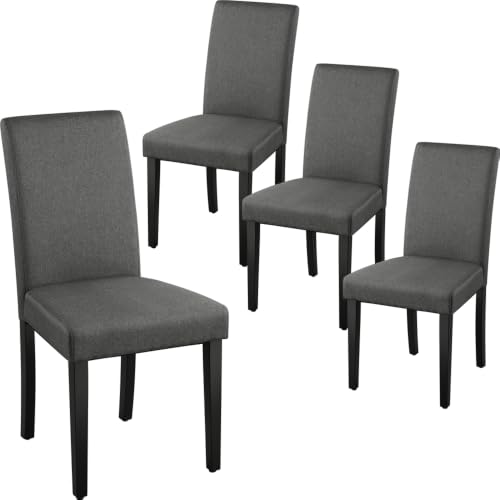
The Yaheetech Dining Chairs Set of 4 is the live edge default done right: four armless Parsons-style chairs in dark gray fabric over high-density foam, each 18 inches wide, 22.5 deep, and 36.5 high, on solid rubberwood legs with protective, slip-resistant foot pads, each chair rated to 298 lb. Armless is the operative word — the chairs slide fully beneath the slab, out of the silhouette, so the table’s edge runs uninterrupted — and the rubberwood legs speak the table’s material language at a respectful volume.
Strengths
- Armless profile tucks completely under the slab and never strikes its edge.
- Rubberwood legs harmonize with wood tables and protect floors with padded feet.
- A complete set of four at a set price — the sides of the table, solved in one order.
Trade-offs
- Upright dining posture; long, lounging dinners will want the armchair picks at the ends.
- Fabric upholstery asks for prompt spill care at a busy table.
- Sold as four; six-chair tables order a second set or mix with the pairs below.
| Color | Fabric- Dark Gray |
| Size | Set of 4 |
| Dimensions | 22.5 x 18 x 36.5 inches |
| Weight | 55.45 pounds |
The dark gray is a considered choice for live edge rooms: neutral enough to sit quietly against walnut, oak, or acacia slabs, dark enough to ground the arrangement, and practical at a dining table’s spill rate. The high backs give the arrangement just enough vertical presence to balance a thick slab without competing with it, and the foam padding carries a two-hour dinner honestly. For most live edge tables seating four to six, this set along the sides plus something grander at the ends is the complete, correct answer — which is what “best overall” means in a category ruled by fit.
Choose the Yaheetech set if your table seats four or more and you want the sides solved beautifully and simply. Skip it if your slab seats two to four and deserves a more deliberate pairing — the Walker Edison below is sized for you.
Best for: The sides of four-to-eight-seat live edge tables / Not suited for: Tiny two-person slabs

Walker Edison Douglas Urban Industrial Faux Leather Dining Chairs
Our badge: Best for Small Tables
The Walker Edison Douglas Urban Industrial Faux Leather Dining Chairs pair a live edge slab with its most natural stylistic partner: slim, armless chairs in navy faux leather on powder-coated steel legs, sold as a set of two, each about 18.9 inches wide and 31 inches high. The industrial note — steel against wood — is the dialect half of all live edge rooms already speak, since most slabs stand on steel bases; these chairs rhyme with the base and let the top sing.
Strengths
- Slim armless profile sized for four-person slabs and breakfast nooks.
- Steel legs echo live edge tables’ metal bases for a coherent look.
- Faux leather wipes clean at dining speed.
Trade-offs
- A firmer, more upright sit than the upholstered picks.
- Navy is a commitment — handsome with warm slabs, deliberate in neutral rooms.
- Back height is modest against very thick, dramatic slabs.
| Color | Navy Blue |
| Size | Set of 2 |
| Dimensions | 22 x 18.87 x 31.12 inches |
| Weight | 13 pounds |
At 13 pounds for the pair’s per-chair share, these are also the easiest chairs in the guide to live with daily — pulled out for guests, tucked away after, rearranged for the slab’s occasional second life as a desk or a serving surface. Small live edge tables in kitchens and apartments, where the table is also the room’s hardest-working surface, are their natural habitat. Order two sets for a four-top and the whole arrangement costs less than most single statement chairs.
Choose the Walker Edison pair if your slab is small, your style is industrial, or your chairs must move often. Skip it if long, cushioned dinners are the table’s main event.
Best for: Small slabs and industrial-styled dining / Not suited for: Long, lounging dinners

Yaheetech Mid Century Accent Chair
Our badge: Best Comfort
The Yaheetech Mid Century Accent Chair brings armchair comfort to the live edge table: a button-tufted faux leather back in retro brown, a cushioned seat on three sinuous springs, wide track arms, and rubberwood legs with floor-protecting pads, rated to 300 lb. Used as a host pair at the slab’s ends — or, in generous rooms, along the sides — it gives the long dinner a chair that treats it as an evening rather than a meal, in materials that converse naturally with wood.
Strengths
- Spring-cushioned comfort for dinners that run to midnight.
- Retro brown leather-look and rubberwood legs harmonize with slabs of any species.
- 300 lb rating and a compact, small-space-friendly footprint.
Trade-offs
- Arms must be checked against your slab’s underside clearance — measure before ordering for side use.
- Sold singly; a table’s worth is a deliberate investment.
- Faux leather, not hide — set expectations accordingly.
| Color | Retro Brown |
| Size | set of 1 |
| Dimensions | 29 x 28.5 x 33 inches |
| Weight | 38.27 pounds |
The mid-century silhouette is live edge’s oldest friend — both movements prize honest materials and organic line — and this chair’s tufted back gives the arrangement a crafted detail at sitting height, where the slab’s drama is all at table height. As end chairs they frame the slab beautifully; the wide track arms give hosts a throne’s posture without a throne’s bulk. The arm-clearance caveat is real and manageable: most slabs on standard legs clear a chair arm of this height, and the measurement takes a minute.
Choose the Yaheetech Mid Century for the ends of the table, or the sides of a wide one. Skip it if your slab’s underside is low — stay armless and safe.
Best for: Host chairs and comfort-first arrangements / Not suited for: Low-underside slabs at the sides

Karl home Mid-Century Lounge Accent Chair
Our badge: Best Statement
The Karl home Mid-Century Lounge Accent Chair is the end chair as a craftsman’s reply: breathable green linen over a solid wood frame with walnut-toned flared legs, extra-wide curved armrests, high-density sponge cushioning, and an included lumbar pillow, rated to 330 lb. Where a live edge slab displays the tree’s edge, the Karl displays joinery and proportion — two pieces of honest woodwork in conversation across the table’s length.
Strengths
- Natural materials answer the slab’s craftsmanship in kind.
- Wide curved arms and a lumbar pillow serve the long host’s evening.
- A genuine statement silhouette for the table’s ends.
Trade-offs
- Its width and arms are end-chair only — too broad for the sides of most tables.
- Linen requires prompt spill attention at a dining table.
- The pool’s dimension figure conflicts with the maker’s stated size; the spec box uses the maker’s stated size.
| Color | Green |
| Size | 28.3 inches L x 31.5 inches W x 29.5 inches H |
| Weight | 33.3 pounds |
The Karl’s green linen deserves a styling note: against warm walnut and acacia slabs it reads as the forest’s other color, and against pale oak it provides the arrangement’s depth. Its arms sit lower than its generous width suggests, but the clearance measurement remains obligatory — a statement chair that cannot tuck at least partly toward the table cramps the host’s knees. In the rooms where it fits, it completes the live edge story better than any other chair in the pool: the table from the forest, the chairs from the workshop.
Choose the Karl for the ends of a statement table in a natural-materials room. Skip it for side duty or spill-heavy family dining.
Best for: Statement end chairs in crafted, natural rooms / Not suited for: Side seating or toddler dining

VASAGLE Accent Chair
Our badge: Best Host Chair
The VASAGLE Accent Chair gives the host’s end of the table a formal option: a button-tufted PU leather armchair in warm tan, with a 6.3-inch spring-supported cushion, an ergonomic angled back, curved armrests, and splayed legs, rated to 300 lb — in a footprint under 25 inches wide that suits slabs whose ends are tight. The synthetic leather wipes clean after the dinner’s evidence, and the tailored silhouette carries a formality the softer chairs do not attempt.
Strengths
- Compact formality: host gravitas in a small footprint.
- Spring seat and angled back carry a long dinner uprightly.
- Wipe-clean upholstery at the messiest seat in the house.
Trade-offs
- An upright, composed sit — the host’s chair, not the lounger’s.
- Arm clearance against the slab must be measured, as with all end armchairs.
- PU leather breathes less than the fabric picks in warm rooms.
| Color | Brown |
| Size | 29.5″D x 24.6″W x 28.7″H |
| Dimensions | 29.5 x 24.6 x 28.7 inches |
| Weight | 22 pounds |
The VASAGLE’s mid-century tailoring suits the live edge table’s other common habitat — the considered, design-led dining room where the slab is art and the ends want chairs with posture. Its tan warms cool-toned slabs (ash, pale oak, gray-washed finishes) particularly well. At 22 pounds it also moonlights around the house between dinners, which end chairs in smaller homes must do to earn their footprint.
Choose the VASAGLE if your table’s ends are compact and your dinners are composed. Skip it if your hosting style is the four-hour lounge — the Karl and the Yaheetech Mid Century recline the evening better.
Best for: Compact, formal host chairs / Not suited for: Lounging dinners

LSSPAID Modern Accent Chairs
Our badge: Best Mixed Seating
The LSSPAID Modern Accent Chairs serves the eclectic arrangement live edge rooms wear so well: a deep chenille armchair with a 7-inch spring-backed cushion, a matching lumbar pillow, a relaxed 115-degree seating angle, a 24.8-inch seat depth, and a solid wood frame rated to 350 lb. Placed at one or both ends — or as the single soft chair in a room of armless sides — it gives the table a landing of genuine comfort, in a charcoal that grounds any slab’s warmth.
Strengths
- The deepest, softest sit in this guide — the end chair guests claim.
- 350 lb solid-wood frame; anti-slip pads protect the floor.
- Charcoal chenille is the universal donor of dining palettes.
Trade-offs
- Its depth and angle suit ends, not sides; diners sit back from the table’s edge.
- Chenille at a dining table needs a napkin discipline and prompt spot care.
- A relaxed sit some hosts find too informal for formal slabs.
| Color | Charcoal |
| Size | Set of 1 |
| Dimensions | 30.5 x 29.5 x 31.5 inches |
| Weight | 33 pounds |
Mixed seating — a bench on one side, armless chairs on the other, soft armchairs at the ends — is the live edge table’s native arrangement, because a slab that refuses uniformity invites chairs that refuse it too. The LSSPAID is the mix’s comfort anchor, the chair that turns the table’s ends into the seats the evening migrates toward when the meal becomes conversation. Its hollow base even lets the robot vacuum patrol beneath, a modern grace note in a rustic arrangement.
Choose the LSSPAID if your live edge style is eclectic and your dinners end in long conversation. Skip it for formal rooms or tight ends.
Best for: Eclectic arrangements and conversation-length evenings / Not suited for: Formal dining rooms
Comparison Table
| Pick | Color | Dimensions | Weight | Check price on Amazon |
|---|---|---|---|---|
| Yaheetech Dining Chairs Set of 4 | Fabric- Dark Gray | 22.5 x 18 x 36.5 inches | 55.45 pounds | Check price on Amazon |
| Walker Edison Douglas Urban Industrial Faux Leather Dining Chairs | Navy Blue | 22 x 18.87 x 31.12 inches | 13 pounds | Check price on Amazon |
| Yaheetech Mid Century Accent Chair | Retro Brown | 29 x 28.5 x 33 inches | 38.27 pounds | Check price on Amazon |
| Karl home Mid-Century Lounge Accent Chair | Green | — | 33.3 pounds | Check price on Amazon |
| VASAGLE Accent Chair | Brown | 29.5 x 24.6 x 28.7 inches | 22 pounds | Check price on Amazon |
| LSSPAID Modern Accent Chairs | Charcoal | 30.5 x 29.5 x 31.5 inches | 33 pounds | Check price on Amazon |
How to Choose the Best Chairs for Live Edge Table
Measure the slab’s underside before anything else
Three numbers govern this entire category: the height from the floor to the slab’s underside (minus any apron), the distance between the table’s legs or base elements along each side, and the slab’s thickness, which sets the visual weight the chairs must balance. A chair’s arms must clear the first number with an inch to spare; the side chairs’ combined widths must respect the second; and the third tells you whether slim chairs will look starved against the table or correctly quiet. No chair in this guide — or anywhere — should be ordered before those numbers exist.
Default to armless at the sides
Armless side chairs tuck fully under the slab, which does three things at once: it protects the live edge from the thousand small collisions of armed chairs, it keeps the table’s silhouette clean when the room is not dining, and it fits more seats along the slab’s length. Arms belong at the ends, where the geometry opens up and the host’s chair earns its presence. This is the category’s nearest thing to a law, and this guide’s selection is built on it.
Harmonize wood, do not clone it
A chair leg that almost matches the slab’s species and stain looks like a mistake; one that harmonizes — a tone or two away, in the same warmth family — looks like a decision, and one that contrasts deliberately (steel against wood, charcoal against walnut) looks like design. Rubberwood legs, as on the Yaheetech picks, sit naturally in the harmonize zone for most slabs. Bring a leg to the table, literally, before committing to a set: wood in photographs lies about tone with complete confidence.
Balance the slab’s visual weight
Thick, dramatic slabs need chairs with some presence — high backs along the sides, substantial chairs at the ends — or the arrangement looks top-heavy, all table and apology. Thin, elegant slabs invert the rule: slim chairs keep the ensemble light. The Yaheetech dining set’s 36.5-inch backs suit the first case; the Walker Edison’s lower profile suits the second. Stand back from your table and squint; the balance you see is the balance your guests will feel.
Protect both pieces of the investment
Live edge slabs are vulnerable exactly where chairs meet them: the edge itself. Choose chairs whose backs and arms cannot gouge it — upholstered over bare hardwood at contact points — keep felt pads fresh under every chair leg for the floor’s sake, and teach the household the two-hand slide rather than the drag-and-bump. A slab outlives a dozen sets of chairs when it is treated as the heirloom it is; the chairs in this guide were chosen to be worthy, gentle companions to it.
How Do You Arrange Chairs Around a Live Edge Table?
Begin with the ends, because they frame the composition: a considered armchair at each end — Karl for craft, VASAGLE for formality, LSSPAID for comfort — angled a few degrees toward the table’s center rather than squared to it, which softens the arrangement’s geometry the way the slab’s edge softens the table’s. Fill the sides with the armless sets, spaced by the slab’s own rhythm: live edge tables often have a natural “bay” where the edge curves outward, and placing chairs to the curve rather than to a rigid grid honors the piece. Leave the place settings’ elbow room honest — twenty-four inches of table edge per diner is the comfort standard, whatever the slab’s length tempts you to squeeze.
Light the arrangement from above with a pendant or chandelier centered on the slab’s visual center, which may not be its geometric center — hang it where the table looks balanced, and let the chairs below echo the asymmetry. The result should feel grown rather than installed: a table from a tree, chairs from good workshops, and an arrangement that respects both. The formal-dining version of this composition is explored in Best Sofas And Coffee Tables Formal Living Area, whose proportion logic translates to the dining room directly.
Problem: The chairs make the table look smaller — They are too tall or too many. Drop the back height at the sides, or remove one chair per side and give the remaining diners their honest elbow room.
Problem: Armed end chairs jam against the slab — The arms are too high for the underside. Angle the end chairs slightly outward, pull them an inch from the edge, or exchange them for a lower-armed model — never force the tuck.
Problem: The wood tones fight — Insert a buffer: a runner, placemats, or a rug in a tone between the two woods breaks the direct comparison and lets each read on its own terms.
Problem: Guests keep bumping the live edge — The chairs are sitting too close or the edge has a dramatic protrusion at a place setting. Shift the settings to the slab’s calmer stretches and let the wild sections be serving space.
Problem: The room feels like a showroom, not a home — Mix one element: a bench on one side, or the soft LSSPAID at one end only. Live edge rooms come alive when the arrangement admits it is lived in.
Caring for the Partnership
A live edge table and its chairs age together, and their care is a shared routine. The slab wants its finish respected — coasters as a household reflex, spills wiped in the moment, and no chair ever dragged against its edge. The chairs want their pads checked seasonally, because a worn felt pad is a floor scratch and a wobble waiting to happen, and a wobbling chair at a slab table bumps the edge with every sit. Upholstery at a dining table wants prompt spot care, especially the natural fabrics this guide loves; the linen picks forgive the fast and remember the slow. Attend to the partnership quarterly and it will look intentional for a decade — the table deepening in character, the chairs holding their lines, the room keeping its story.
Live Edge Beyond the Dining Room
Many slabs in this guide’s world work second jobs — desk, console, kitchen island front — and the chair logic travels with them. At a live edge desk, the side chairs become the desk chair and the guest chair, and the same armless-tuck and tone-harmony rules apply with an office chair’s ergonomics added. At a console or entry slab, a single statement chair — the Karl’s exact talent — creates the vignette. The principles are portable because they were never really about dining: they are about letting an organic, singular piece lead, and furnishing around it with respect. The living-room chairs that share that respect are gathered in Best Arm Chairs For Living Room.
The Bench: The Sixth Seat That Is Not a Chair
No live edge arrangement is complete without considering the bench — often a slab’s own sibling, cut from the same tree or styled to echo it, run along one side. A bench seats three where two chairs sit, slides completely beneath the table when the room needs its floor back, and gives the arrangement the communal, refectory character that live edge rooms wear best. Its costs are real: no back support for long dinners, a shared exit problem (the middle sitter is committed), and a harder sit that wants a cushion or a runner for the evening meals. The households that bench well use it on the wall side, where the room’s architecture supplies the missing back, and keep chairs — this guide’s armless sets — on the open side where diners come and go. Children, incidentally, vote for the bench with their whole hearts, which settles the question in many family rooms. Consider the bench as the arrangement’s flexible side, and let the chairs in this guide do the supported, individual work at the ends and the open side.
Live Edge in the Open-Plan Room
Most live edge tables now live in open-plan spaces, where the dining area shares air with the kitchen and the living room — and the chairs must mediate between the zones. The dining set that looks resolved from the kitchen can look orphaned from the sofa, which is why this guide’s picks favor quiet profiles and honest materials: they read as furniture, not as a dining exhibit, from every angle the open plan exposes. The arrangement trick is to let the chairs borrow one element from the living zone — a color from its palette, in the way the living-room seating in Best Chairs For Lounging borrows comfort language — so the table’s group belongs to the whole room rather than camping in it. A rug under the whole arrangement, sized to hold table and chairs with their legs on it even when pulled out, draws the boundary the architecture omitted. Open-plan live edge done this way is the style at its best: one great tree, well accompanied, in a room that flows around it like water around a stone.
Chairs That Leave the Table: Second Jobs Around the House
Dining chairs in a live edge home rarely only dine. The armless set hosts the desk when a guest works over, the vanity on the mornings the household doubles, the hallway’s extra seat at every party — and the chairs that do those second jobs gracefully are the ones with the proportions and the manners to belong in other rooms. This is a quiet argument for buying dining chairs you genuinely like, at a quality above the purely functional: a chair that can sit in a bedroom corner without apology — the crossover examined in Best Chairs For Bedroom Sitting Area, where several of this guide’s profiles also serve — is a chair whose cost is divided across the whole house’s life rather than the dining room’s evenings alone. The Yaheetech Parsons pair and the Walker Edison’s slim lines both pass that test; the end armchairs pass it even more easily, since an armchair is at home anywhere by definition.
The second-job logic also disciplines the first purchase. A household that knows its dining chairs will serve the desk buys casters-off stability and a seat height that works at both table and desk. A household that hosts often buys the set that stacks, folds, or lines up against a wall without sulking. And every household should buy with the holiday in view — the one day a year the table seats its maximum and the chairs are borrowed from every room — because the arrangement that survives Thanksgiving without a single folding-chair apology is the arrangement that was planned, once, with the whole house in mind. Live edge tables are bought for decades; their chairs, chosen with second jobs and holidays included, are how the decades get furnished without a second round of shopping.
The Slab’s Story Deserves the Right Audience
A live edge table is usually bought in a moment of love — the grain, the contour, the sense that this exact piece of tree was waiting for this exact room — and the chairs are bought afterward, sometimes hastily, as if any seat could serve a masterpiece. This guide exists because the opposite is true: the chairs are the table’s daily interpreters, the thing every guest touches, the frame through which the slab is seen at every meal for decades. A set chosen with the care this guide prescribes — measured to the underside, harmonized in tone, quiet in profile, gentle at every contact point — does not merely accompany the table; it completes the original purchase, the way the right frame completes a painting that would otherwise lean against the wall of its own potential. Conversely, the wrong chairs tax the table daily: the collisions, the visual arguments, the squeezed elbows that make guests remember the discomfort and forget the grain.
So the final advice is a matter of respect for your own first decision. You chose the singular piece, the one no factory can repeat. Give it the company that lets it be singular in peace — chairs that know their role, serve their diners beautifully, and step back, every evening, into the supporting cast. That is not a lesser ambition for a chair. It is the oldest ambition in furniture: to make the room, and the meal, and the years of meals after, work. The slab will take the compliments. The chairs, chosen well, will deserve half of them.
Buying Chairs for a Table You Have Not Bought Yet
A surprising share of this keyword’s readers are shopping in the other order — the slab is chosen, commissioned, or still a gleam in a timber yard’s eye, and the chairs are being planned around a table that does not yet exist in the room. The planning order matters, and it inverts several of this guide’s rules into promises: choose the slab’s height and leg system with the chairs already in mind, because a table built to standard dining height with generous leg spacing accepts every chair in this guide, while a slab mounted low on a sculptural base may accept none of them gracefully. If the table is being commissioned, bring the chair shortlist to the maker — slab builders think in clearances professionally, and an inch added to a leg’s height at the workshop is free, while the same inch discovered missing at delivery costs a set of chairs. If the table is being bought finished, measure it in the showroom with the same tape you would use at home, and photograph its underside; the underside, unglamorous as it is, will govern your dining for a decade.
And if the chairs must be bought first — for a current table, with the slab as next year’s ambition — buy them to the standard: dining height, armless at the sides, tones that harmonize with the wood you intend rather than the wood you have. Chairs bought to the standard survive the table’s upgrade without a second purchase, which is the quiet definition of buying well in a room that is still becoming itself. The live edge table rewards patience at every stage; its chairs, planned in the same spirit, are simply patience with cushions.
A closing observation for the households still torn between two finalists: when the measurements, the tones, and the budgets all come back equal, choose the chair your guests will describe afterward. Not the one they will praise — guests praise the table — but the one that will disappear from their account of the evening entirely, leaving only the meal, the conversation, and the slab’s grain in the retelling. That invisibility is the dining chair’s highest achievement and the live edge table’s best friend, and it is achieved by exactly the unglamorous virtues this guide has catalogued: the right height, the quiet profile, the gentle contact, the comfort that never announces itself. The chair that gets mentioned is the chair that failed; the chair that vanishes did its job so completely that the evening had no friction to remember. Buy for the vanishing, and every dinner on your singular, irreplaceable table will be remembered the way you bought it to be.
Common Buying Mistakes
Ordering chairs before measuring the underside
The category’s most expensive habit. Arms, backs, and knees all live under the slab; its clearance is the first specification, and it is measured, not assumed.
Trying to match the slab’s wood exactly
Almost-matching is worse than harmonizing or contrasting. Choose your strategy deliberately and commit — the room can tell the difference even when the shopper cannot.
Putting armed chairs along the sides
They collide with the edge, crowd the length, and break the tuck. Arms at the ends, armless at the sides — the arrangement that has served every slab since the style began.
Overcrowding the slab’s length
A live edge table with chairs shoulder to shoulder hides the edge you paid for. Fewer, better-spaced chairs show the table and seat the diners — the double win.
Choosing chairs that upstage the table
Ornate, towering, or aggressively styled chairs start an argument the table should never have to have. In a live edge room there is one protagonist; cast accordingly.
Final Recommendation
For most live edge tables, the Yaheetech Dining Chairs Set of 4 along the sides is the foundation — armless, harmonious, and priced to leave budget for the ends, where the Karl makes the craft statement or the VASAGLE brings the formality. Small slabs should start with the Walker Edison pair; comfort-led rooms, with the Yaheetech Mid Century at the ends — its Check on Amazon listing carries the dimensions to verify against your slab. Measure the underside, harmonize the wood, keep the edge sacred — and let the table be what it is: the room’s one irreplaceable thing, well accompanied.
Frequently Asked Questions
What seat height works with a live edge table?
Standard dining height — a seat around 18 inches — suits most slabs, which are typically built to dining-table height. The variable is the slab’s thickness and apron: measure from the floor to the underside, and ensure the chair’s arms (at the ends) and the diners’ knees (everywhere) clear it with room to spare.
Should dining chairs match a live edge table’s wood?
Harmonize rather than match. Legs in the same warmth family, a tone apart, read as intentional; an attempted exact match that misses reads as an error. Deliberate contrast — steel legs, dark upholstery — is the other honorable strategy, and the one most industrial live edge rooms choose.
Can I use armchairs with a live edge table?
At the ends, classically yes — provided their arm height clears the slab’s underside with an inch to spare. Along the sides, armless chairs are the rule: they tuck fully, protect the edge, and fit the slab’s length better. Measure before ordering any armed chair for any position.
How many chairs fit a live edge table?
Allow about twenty-four inches of table edge per diner for comfortable dining, measured along the slab’s usable length — discounting dramatic curves where a setting would sit awkwardly. A six-foot slab typically seats three per side by that rule, or two per side plus the ends in spacious comfort.
How do I protect the live edge from the chairs?
Choose upholstered contact points over bare wood, keep the sides armless so nothing strikes the edge at arm height, maintain felt pads under chair legs, and slide chairs rather than dragging them. The edge is the table’s value and its vulnerability in the same inch of wood; treat it as both.
What style of chair suits a live edge table best?
Quiet, material-honest chairs: mid-century profiles, simple Parsons shapes, industrial steel-and-leather, and natural linen or wood — the styles in this guide. The table supplies the drama; the chairs supply the dining. Rooms that follow that casting rule always look resolved.


