Disclosure: As an Amazon Associate, dailyhomedecorating.com earns from qualifying purchases. Links to Amazon on this page are affiliate links; they cost you nothing extra. Prices and availability change often, so check the current Amazon listing before you buy.
Families searching for the best weighted blankets for autism are usually looking for one practical thing: a blanket that feels settling and comfortable at rest time, without creating new problems around heat, washing, sizing, or a child or adult who simply does not enjoy pressure. This guide treats weighted blankets strictly as a comfort and bedding choice. It makes no medical claims, promises no effect on sleep conditions, behavior, or wellbeing, and encourages you to follow the guidance of the person’s own clinicians and therapists about whether a weighted blanket is appropriate at all, what weight range they suggest, and how it should be supervised, especially for children. Within that frame, the best weighted blankets for autism are the ones with even weight distribution, tolerable textures, breathable options, secure construction, and care routines a busy household can actually sustain.
Three true weighted blankets anchor this guide — a small-compartment bead design, a cotton-covered design with a removable cover, and a breathable hand-knit cotton design with no loose fill — followed by three lighter, non-weighted comfort alternatives for people who prefer softness without pressure, because honoring sensory preference includes the option of no weight at all. If you are comparing broader weighted options, see Best Weighted Blankets For Elderly for adult sizing and handling considerations and Best Weighted Blankets For Insomnia for nighttime comfort framing, and complete a calm bedroom setup with help from Black Friday Throw Pillow And Blanket Deals and Best Throw Pillows For Bedrooms Under $15.
Where to Buy
Every linked pick in this guide is sold on Amazon, where you can check the current size, weight option, color, and availability before you buy. Start with the lead pick, the YnM Weighted Blanket, and use its Check on Amazon listing to confirm the weight and dimensions. The remaining picks are the Gravity Weighted Blankets for Adults — Check on Amazon; the Bearaby Cotton Hand-Knit Weighted Blankets for Adults — Check on Amazon; the Bedsure Cooling Cotton Waffle Blanket for Hot Sleepers — Check on Amazon; the Bedsure Fleece Bed Blankets Queen Size Grey — Check on Amazon; and the Exclusivo Mezcla Soft Large Fleece Throw Blanket for Couch — Check on Amazon. Check price on Amazon for each, and confirm any weight choice with the person’s care team where relevant.
In this guide
Quick Picks
| Pick | Badge | Why it earns its place |
|---|---|---|
| YnM Weighted Blanket | Best Overall | Smallest compartments and fine stitching for the most even bead distribution. |
| Gravity Weighted Blankets for Adults | Best for Cover Care | Removable micro-plush cover makes washing the part that touches skin easy. |
| Bearaby Cotton Hand-Knit Weighted Blankets for Adults | Best Premium | Breathable hand-knit cotton with no beads, fill, or cover to manage. |
| Bedsure Cooling Cotton Waffle Blanket for Hot Sleepers | Best Light Alternative | Breathable cotton waffle coverage for people who dislike pressure and heat. |
| Bedsure Fleece Bed Blankets Queen Size Grey | Best for Familiar Softness | Predictable, even fleece feel with full-bed coverage and simple washing. |
| Exclusivo Mezcla Soft Large Fleece Throw Blanket for Couch | Best Budget | Light personal throw for rest corners, reading, and travel between rooms. |
Key Takeaways
- Choose weighted blankets only as a comfort preference, with clinician or therapist guidance for children and for anyone with health considerations.
- Even distribution matters most: small compartments or knit construction prevent lumpy, shifting weight.
- Texture tolerance decides success; let the user feel the cover fabric before committing to nightly use.
- Breathable cotton and knit designs suit warm sleepers better than dense microfiber and heavy fill.
- A removable cover or a light alternative blanket gives you a washing plan and a no-pressure option on difficult days.
- Stop using any blanket that the person finds distressing, too hot, or hard to push off independently.
How These Picks Were Chosen
The pool contains three weighted blankets, and all three are included because they represent genuinely different constructions: stitched bead compartments, a covered bead blanket, and a bead-free knit. Selection weighted evenness of distribution, seam security, breathability, texture options, and washability — the practical factors families cite when a blanket is abandoned. The three additional picks are labeled honestly as non-weighted alternatives, included because many autistic children and adults prefer light, predictable softness, and a guide that only offered pressure would fail them. No health benefit is claimed for any pick. Specifications come only from the verified pool, and general sizing guidance follows the widely shared comfort rule of thumb described by the makers themselves — around ten percent of body weight plus a small margin for adults choosing for themselves — while deferring to professional guidance for children and for anyone else where safety is in question.
The 6 Best Best Weighted Blankets for Autism — Reviewed
YnM Weighted Blanket
Our badge: Best Overall
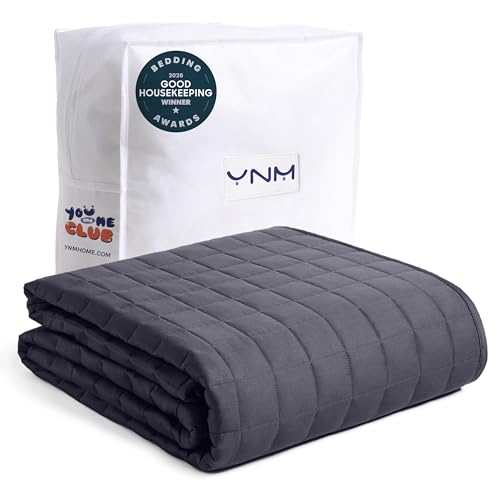
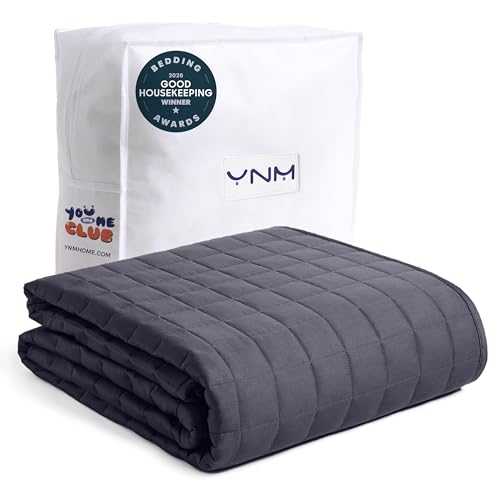
The YnM Weighted Blanket leads on distribution, the single most important construction quality in a bead weighted blanket. Its two-inch compartments are the smallest in its class, its stitching is exceptionally fine, and its seven-layer design uses more glass beads and less fiberfill, which helps it feel settled without feeling puffy or hot. It suits adults and older users choosing weighted comfort for themselves, and families whose care team has already discussed weighted blanket use and sizing.
Strengths
- Tiny compartments keep weight even from edge to edge.
- Less fiberfill means a cooler, flatter feel than puffy designs.
- Sixteen loops secure a duvet cover to prevent internal slipping.
Trade-offs
- Fifteen pounds is heavy to carry and wash without a cover routine.
- Microfiber face has a synthetic feel some users dislike.
- This size serves one person; sharing requires a larger size option.
| Color | Exclusive Microfiber Dark Grey |
| Size | 60 in x 80 in 15 lb |
| Dimensions | 79.9999999184 x 59.9999999388 x 0.0399999999592 inches |
| Weight | 15 pounds |
In daily use, evenness is what you notice: the blanket lies where you place it, the weight does not pool at the foot by morning, and there is no rustling migration of fill when the sleeper turns. Pairing it with a washable duvet cover is strongly recommended for any household, because the cover takes the washing load and lets the heavy inner piece be cleaned only occasionally and gently. Introduce any weighted blanket gradually, in supervised, awake settings first — reading, resting, quiet time — so the user can communicate clearly whether the pressure feels good, neutral, or unwelcome, and respect that answer completely. Choose the YnM for the most controlled bead distribution. Skip it if the user dislikes synthetic textures; the cotton knit below is the kinder surface.
Best for: Adults wanting even, cooler bead weight / Not suited for: Anyone advised against weighted blankets or unable to move it freely
Choose it for distribution quality; skip it on professional advice or texture grounds. Check on Amazon

Gravity Weighted Blankets for Adults
Our badge: Best for Cover Care
The Gravity Weighted Blankets for Adults pairs an inner weighted piece with fine glass beads and gridded stitching with a premium micro-plush duvet cover, which makes it the easiest weighted option here to keep clean and soft against the skin. In this twin and throw footprint it suits a single sleeper, a rest corner, or a couch-based quiet space where a dedicated personal blanket is useful.
Strengths
- Removable plush cover washes easily and feels gentle.
- Gridded stitching keeps beads distributed across the inner piece.
- Personal twin size is manageable to move between bed and couch.
Trade-offs
- Plush cover adds warmth that hot sleepers may not want.
- Two-piece system takes a few minutes to reassemble after washing.
- Twin footprint will not serve as a shared bed blanket.
| Color | Grey |
| Size | 15 lbs 48″x72″ Twin/Throw |
| Weight | 15 pounds |
The cover system is more than convenience for sensory households. Texture lives in the cover, so if the plush face is loved, you keep it; laundry day does not change the blanket’s feel, because the same cover goes back on the same inner piece. That predictability matters to many users who find change itself unsettling. Keep a simple routine: cover washed regularly, inner piece spot-cleaned and aired, and the blanket stored in its usual place so it is always findable at rest time. As with every weighted option here, treat it purely as comfort bedding, introduce it gradually and supervised, and let the user’s response lead. Choose Gravity for washable plush comfort. Skip it if warmth is already a problem at night.
Best for: Single sleepers who love plush texture and easy washing / Not suited for: Hot sleepers or shared beds
Choose it for cover care; skip it for cool sleeping. Check on Amazon
Bearaby Cotton Hand-Knit Weighted Blankets for Adults
Our badge: Best Premium
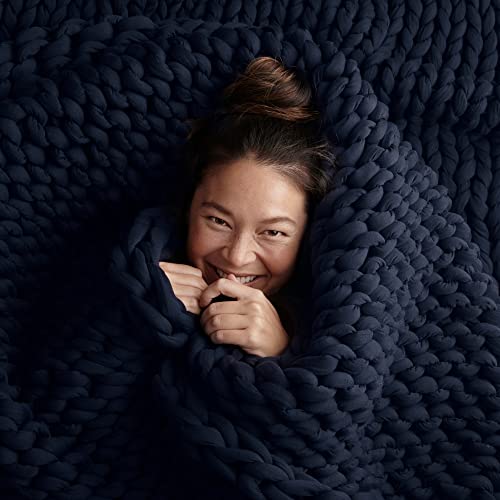
The Bearaby Cotton Hand-Knit Weighted Blankets for Adults removes beads, fill, and covers from the equation entirely: the weight is the cotton knit itself. For users who dislike the faint movement or sound of bead fill, who prefer natural fiber against the skin, or who run warm and need air to move through the blanket, this is the most tolerable weighted construction in the pool.
Strengths
- No beads or fill, so nothing shifts, leaks, or rustles.
- Open cotton knit breathes in warm rooms.
- One-piece design with no cover to align or reattach.
Trade-offs
- Open loops can catch on jewelry, zippers, and pet claws.
- Fifteen pounds of knit is bulky to wash and carry.
- Sized for one adult; not a family sharing blanket.
| Color | Midnight Blue |
| Size | 15 lbs (40”x72”) |
| Dimensions | 71.99999992656 x 39.9999999592 x 0.01181102361 inches |
| Weight | 15 pounds |
The knit texture is itself a sensory feature: smooth cotton loops with a gentle, visible rhythm that some users enjoy tracing or holding, and a surface that feels cool rather than plush. Because the blanket breathes, it can be used for couch rest time in seasons when a covered bead blanket feels sealed. It also looks like a normal, beautiful throw, which helps it live openly in shared family spaces without marking out its user. Introduce it the same careful way as any weighted blanket, and store it folded in its regular spot. Choose Bearaby for breathable, bead-free weight. Skip it in homes where pet claws or rough handling would damage the loops.
Best for: Warm sleepers and natural-fiber, bead-free preference / Not suited for: Pet-claw households or sharing
Choose it for calm, breathable construction; skip it for maximum ruggedness. Check on Amazon

Bedsure Cooling Cotton Waffle Blanket for Hot Sleepers
Our badge: Best Light Alternative
The Bedsure Cooling Cotton Waffle Blanket for Hot Sleepers is included deliberately as the no-pressure option: a breathable cotton and bamboo-derived rayon waffle blanket with full queen coverage for users who want to feel covered and cool without any added weight. Many people prefer exactly this, and having it ready respects their choice on any given night.
Strengths
- Light, airy coverage with no pressure at all.
- Waffle texture gives a gentle, interesting hand feel.
- Full-bed size works for shared beds and family use.
Trade-offs
- Provides none of the settled pressure weighted-blanket fans seek.
- Light color shows spills and needs regular washing.
- Minimal warmth for cold rooms.
| Color | 01 – Ivory |
| Size | Queen (90″ X 90″) |
| Dimensions | 16.535433054 x 12.598425184 x 22.834645646 inches |
| Weight | 3.8 Pounds |
Keep this blanket in the same rest space as the weighted options so switching is effortless and unremarkable. On warm nights, during illness, or simply when pressure feels wrong, the light blanket preserves the bedtime routine — same bed, same order of events, different layer — and routine preservation is often the real comfort. Its waffle texture also gives hands something pleasant to hold without weight. Readers building a full sensory-considerate bedroom may also find Best Blankets For Eczema useful for its gentle-fabric discussion, applied with the same no-medical-claims care. Choose the waffle blanket as the household’s light standard. Do not present it as a substitute where a care team has specifically discussed weighted use; present it as an alternative the user can choose.
Best for: Pressure-free, cool coverage and routine-friendly switching / Not suited for: Users who specifically want weighted pressure
Choose it for light comfort; skip it for weighted feel. Check on Amazon

Bedsure Fleece Bed Blankets Queen Size Grey
Our badge: Best for Familiar Softness
The Bedsure Fleece Bed Blankets Queen Size Grey offers the most predictable texture in the guide: the same smooth fleece on every part of the blanket, night after night, with full queen coverage and easy washing. Predictability is a genuine feature for users who find novelty in bedding disruptive, and this blanket’s sameness is its strength.
Strengths
- Uniform fleece feel with no surprise textures or seams.
- Full-bed coverage for shared and family beds.
- Forgiving wash-and-dry routine for busy households.
Trade-offs
- No weighted pressure for those seeking it.
- Fleece warmth can build up for hot sleepers.
- Plain styling will not add much visual interest.
| Color | Grey |
| Size | Queen (90″ X 90″) |
| Dimensions | 94.48818888 x 86.61417314 x 0.0399999999592 inches |
| Weight | 3.19 pounds |
Buy two of the same blanket if it becomes the chosen one, so laundry day never substitutes a different texture — a small expense that protects a working routine. The fleece tolerates frequent washing well when washed cold and dried low, releases pet hair relatively easily, and layers under or over other blankets without bunching. It is also a kind guest and sibling blanket, because its feel needs no explanation. Choose it as the dependable family standard. Skip it only where cooling or weighted pressure is the specific goal.
Best for: Predictable softness and family-wide use / Not suited for: Cooling or weighted-pressure goals
Choose it for sameness and ease; skip it for specialist needs. Check on Amazon

Exclusivo Mezcla Soft Large Fleece Throw Blanket for Couch
Our badge: Best Budget
The Exclusivo Mezcla Soft Large Fleece Throw Blanket for Couch fills the portable comfort role: a light, smooth, oversized throw for a reading chair, a calm corner, a car ride, or a familiar layer at a relative’s house. A personal, transportable blanket helps many users carry a piece of home routine into new environments.
Strengths
- Light and packable for travel between places.
- Smooth on both sides with no wrong side up.
- Long throw cut covers legs fully while seated or reclining.
Trade-offs
- No weight and only light warmth.
- Forest green may not suit every room or preference.
- Not a full-bed blanket for nightly shared use.
| Color | Forest Green |
| Size | Throw XL (50″ x 70″) |
| Dimensions | 70 x 50 x 0.04 inches |
| Weight | 1.55 pounds |
Designate this throw as the always-available one: same chair, same basket, same bag for trips. Its anti-static finish helps in dry, heated rooms where fleece can cling unpleasantly, and it washes and dries quickly enough to be ready again the same day. For school, therapy waiting rooms, or family visits, confirm with the setting that a personal comfort item is welcome, and label it clearly with the user’s name. Choose it for portable familiarity. Skip it as a primary bed blanket.
Best for: Calm corners, travel, and personal comfort routines / Not suited for: Primary weighted or full-bed use
Choose it for familiarity anywhere; skip it for bed coverage. Check on Amazon
Across all six picks, the pattern to notice is that the non-weighted options are not filler. Many households discover, through honest trial, that what the user actually enjoys is a predictable, smooth, washable layer — and that pressure is optional, seasonal, or wanted only at certain times of day. Keeping a light fleece or a breathable waffle blanket in the same rest space gives the user a genuine choice each evening, and choice itself reduces bedtime conflict. It also protects the weighted blanket: when it is one option among two rather than the only tool, nobody forces it on a bad night just because it was expensive. Judge success by the user’s willingness and calm participation in the routine, never by whether the blanket is used every single night.
Siblings and shared bedrooms add a layer of fairness to manage. A weighted blanket is conspicuous — it looks special, it costs more, and brothers and sisters notice. Handle it matter-of-factly: each child in the house has their own bedding chosen for their own comfort, and the weighted blanket is simply one person’s, like another’s preferred pillow or nightlight. Never use it as a reward to be earned or a privilege to be withdrawn, and never lend it casually to a sibling for whom it has not been sized and considered; weight that suits one body is wrong for a smaller one. If a sibling genuinely wants similar pressure, that is a separate decision with its own guidance, not a hand-me-down. Keeping the blanket ordinary — stored plainly, washed routinely, discussed without ceremony — protects both the user, who should never feel their comfort is a spectacle, and the household, whose other children learn that different needs simply get different blankets.
When a weighted blanket is outgrown, rejected after a season of use, or replaced, retire it thoughtfully. Tastes and sensory needs change, sometimes quickly, and a blanket that helped at one age may be refused at another without anything having gone wrong. Do not insist on continued use to justify the purchase, and do not pass a heavy blanket down to a younger child as a default; reassess from the beginning, with guidance, for each person. Stored clean and dry, it can wait in case preferences swing back, and its trial notes — weight, texture verdicts, what worked — are worth keeping with it, because they are the most useful thing the next decision will inherit.
Comparison Table
| Pick | Size | Weight | Color | Check price on Amazon |
|---|---|---|---|---|
| YnM Weighted Blanket | 60 in x 80 in 15 lb | 15 pounds | Exclusive Microfiber Dark Grey | Check price on Amazon |
| Gravity Weighted Blankets for Adults | 15 lbs 48″x72″ Twin/Throw | 15 pounds | Grey | Check price on Amazon |
| Bearaby Cotton Hand-Knit Weighted Blankets for Adults | 15 lbs (40”x72”) | 15 pounds | Midnight Blue | Check price on Amazon |
| Bedsure Cooling Cotton Waffle Blanket for Hot Sleepers | Queen (90″ X 90″) | 3.8 Pounds | 01 – Ivory | Check price on Amazon |
| Bedsure Fleece Bed Blankets Queen Size Grey | Queen (90″ X 90″) | 3.19 pounds | Grey | Check price on Amazon |
| Exclusivo Mezcla Soft Large Fleece Throw Blanket for Couch | Throw XL (50″ x 70″) | 1.55 pounds | Forest Green | Check price on Amazon |
How to Choose a Weighted Blanket With Care
Start with professional guidance and the user’s own voice
For children, and for any user with respiratory, circulatory, mobility, or other health considerations, ask the relevant clinician or therapist before buying, and never use a weighted blanket with a child who cannot remove it independently or communicate discomfort. For adults choosing for themselves, the makers’ common rule of thumb — around ten percent of body weight, plus a pound — is a starting point for comfort preference, not a prescription. The user’s response during gradual, supervised trial matters more than any chart.
Prioritize even distribution and secure stitching
Weight that pools is weight that annoys and can feel unevenly heavy in the wrong places. Prefer small compartments, gridded stitching, or knit construction, and inspect seams before first use. Shake the blanket and lay it flat: distribution should look and feel uniform without effort. Loops or ties for a cover prevent the inner blanket from bunching inside its washable shell.
Match texture before weight
A blanket with perfect weight and an intolerable cover will be rejected nightly. Micro-plush feels warm and fuzzy, microfiber feels smooth and synthetic, cotton knit feels cool and natural. Where possible, let the user handle similar fabrics first, and favor removable covers so texture can be changed without replacing the whole blanket.
Plan heat and washing honestly
Weighted blankets trap more heat than light ones; breathable knit and bead-heavy, fill-light designs run cooler. Washing a heavy blanket is real work, so a cover system or a household machine that handles the load comfortably should be part of the purchase decision, along with a light alternative for laundry days and heat waves.
Let the user control the trial, every time
Consent is not a one-time event with a weighted blanket; it is the ongoing rule. The person using the blanket should be able to start, stop, lighten, or refuse it on any given day without negotiation, and caregivers should treat a pushed-off blanket as clear communication rather than noncompliance. Some users love pressure during a calm evening routine and reject it completely when already overwhelmed; others want it only across the legs, only over a sheet, or only for a short wind-down period before sleep rather than all night. Build those preferences into the routine explicitly — where the blanket lives, who brings it, how it is offered — so the blanket becomes predictable. Predictability is often the real comfort: the same blanket, in the same place, offered the same way, that the user can accept or decline freely. Any professional involved in the person’s care, such as an occupational therapist, can help judge fit, and their guidance and the user’s own responses always outrank general product advice.
Evaluate texture with hands, feet, and face — separately
A fabric that feels pleasant to the palm can feel unbearable against the cheek or the soles of the feet, and sensory responses often differ by body area. Before buying, test candidate fabrics in all three places if possible, and notice seams, tags, and edge bindings as carefully as the main surface — a scratchy seam across the shoulders can ruin an otherwise perfect blanket. For users who cannot easily describe the problem, watch behavior instead: repeated kicking at a seam, avoiding one side of a reversible blanket, or accepting the blanket only over clothing are all useful data. Choosing a smooth, low-texture face for skin contact and keeping any textured side outward is a simple arrangement that resolves many rejections that look, at first glance, like rejection of weight itself.
How Should You Introduce and Care for a Weighted Blanket?
Introduce the blanket during calm, awake, supervised time — over legs while reading or watching something familiar — for short periods, and let the user end the trial whenever they wish. Build duration only if the user clearly enjoys it, keep the blanket off the head and neck, and never tuck a weighted blanket tightly around someone or use it to restrain movement. Store it in a consistent, reachable place, folded rather than dropped in a heap, so its availability becomes part of the household’s predictable landscape.
Care follows construction: wash removable covers regularly with normal bedding care, clean inner weighted pieces only as directed and only in machines that can handle the weight safely, and air the blanket draped in fresh air between washes. Inspect stitching monthly for bead leakage, especially after washing, and retire a leaking blanket promptly, since loose glass beads are a household hazard around small children and pets.
Problem: Blanket feels lumpy by morning — Distribution is failing or the inner piece is bunching inside its cover. Re-secure all cover ties, shake and redistribute before use, and favor smaller-compartment or knit designs if lumpiness persists.
Problem: User feels too hot — Switch to the breathable knit or the light waffle alternative, use the weighted blanket over legs only during awake rest time, and lower room temperature rather than pushing through discomfort.
Problem: User rejects the texture — Change the cover, not the whole system, where the design allows it, or move to the cotton knit or familiar fleece; texture rejection is information, not a problem to argue with.
Problem: Blanket is too heavy to manage on laundry day — Use a cover so the inner piece rarely needs washing, ask for a second pair of hands, and consider the lighter alternatives for everyday use with the weighted blanket reserved for supervised rest time.
Building a Predictable Rest Space
Blankets work best inside a predictable environment: the same low lighting, the same order of evening events, the same place for the blanket, and minimal surprise changes to bedding. When you introduce anything new — a cover, a different blanket, a new sleeping arrangement — change one element at a time and allow days to adjust before judging it. Keep spares identical where a favorite emerges, label personal blankets in shared households, and communicate the routine to caregivers, relatives, and respite helpers so the user’s comfort system travels intact between the people who support them. That consistency, far more than any single product, is what makes rest feel safe and familiar.
Weighted Blankets for Different Ages and Settings
Adults choosing for themselves can weigh preference, texture, and heat freely within general safety sense. Older children and teenagers require the supervision and professional-input lens described throughout this guide, plus honest attention to growth: a blanket sized for one year may be wrong the next. Shared family spaces benefit from personal, labeled blankets rather than one communal weighted blanket, both for hygiene and because weight appropriateness is individual. Schools, therapy rooms, and clinics should follow their own professional policies rather than this shopping guide, and families should ask those settings what they use before mirroring it at home, keeping the home routine aligned with Best Blankets For Daycare style consistency where younger children are concerned — familiar items, clearly labeled, washed on a reliable schedule.
Travel and transitions deserve specific planning, because a weighted blanket that works beautifully at home can become a source of stress away from it. The blanket is heavy luggage, it may not fit hotel laundry routines, and unfamiliar bedding changes how its pressure feels. Families who rely on the blanket as part of a calming routine often do better with a smaller, lighter travel version used only across the lap or legs, introduced at home first so it is already familiar before the trip. At school, therapy settings, or a relative’s home, agree in advance where the blanket will be stored, who may offer it, and how the user can ask for or refuse it; a blanket that appears unexpectedly, placed by a well-meaning adult, loses the predictability that makes it welcome. Write the care and use notes down for other caregivers rather than relying on verbal handovers — weight, preferred side, usual duration, and the clear rule that the user can remove it at any time and must always be able to do so independently.
Safety framing should stay plain and consistent. A weighted blanket is a comfort item some people enjoy; it is not a restraint, it must never be used to keep a person in bed or in a chair, and it should never be placed on someone who cannot remove it themselves. It is not appropriate for infants, and for children it should only be considered with professional guidance, sized and weighted conservatively, and used with supervision. Watch for overheating, discomfort, or distress and stop if any appear. If sleep difficulties are significant or persistent, a clinician — not a bedding purchase — is the right next step, and this guide’s role is limited to helping you choose a well-made, washable, evenly stitched blanket for those households who, with appropriate guidance, decide the comfort of gentle pressure suits their family member.
Cost deserves a calm word, because weighted blankets are expensive and expense creates pressure to make them work. Resist that pressure explicitly as a household: agree before purchase that the trial’s outcome — embraced, occasional, or declined — will be accepted without disappointment aimed at the user, and that the budget has room for the ordinary blanket that may turn out to be the real winner. Some families rent, borrow, or trial through libraries and lending programs where available, or start with the smallest, lightest sensible option rather than the flagship. What matters is that the person at the center never senses that their comfort must justify a receipt. A blanket chosen freely, trialed kindly, and kept or set aside on the evidence of the user’s own responses is money well spent in every outcome — including the outcome where the beloved blanket turns out to be a plain, washable fleece that costs a fraction as much.
Review the arrangement at natural intervals — a new school year, a growth spurt, a change of bedroom or routine — rather than assuming the first decision is permanent. Bodies change, preferences mature, and a blanket that was refused at one stage may be requested at another, or the reverse. A brief, pressure-free re-offer at those milestones respects the person’s development without reopening settled questions weekly. Keep the trial notes from the first round; they turn each review from a fresh experiment into a continuation, and they remind everyone involved that the user’s own responses, then as now, are the deciding evidence.
Keep the language around the blanket ordinary at home. It is bedding, chosen the way pillows are chosen, and treating it as equipment with a capital E can make a child feel managed rather than comfortable. Ordinary language — your blanket, the heavy one, the one you like on Fridays — keeps the focus where it belongs: on a person who knows their own comfort and a household that listens the first time they express it.
Above all, let the person’s comfort outrank every chart, guide, and well-meant recommendation in the room — including this one. Bedding that is chosen with the user, tested without pressure, and kept or set aside on their evidence alone respects the person it is meant to serve, and that respect is the foundation every calmer night is built on.
Common Buying Mistakes
Buying weight by age charts alone
Charts cannot know the individual. Use professional guidance and supervised trial, respect the user’s feedback, and err toward lighter and returnable when uncertain.
Expecting medical outcomes from bedding
A weighted blanket is comfort bedding, not treatment. Buy it for how it feels, keep clinical questions with clinicians, and be wary of any seller promising cures or guaranteed effects.
Ignoring texture until the blanket arrives
Texture rejection is the most common reason these blankets are abandoned. Choose cover fabrics deliberately and prefer systems that let you change the surface.
Skipping the washing plan
A fifteen-pound blanket with no cover in a household that washes bedding weekly is a plan to fail. Solve laundry before purchase, not after.
Using a weighted blanket without supervision for a child
Never place a weighted blanket on a child who cannot remove it independently, and follow the child’s own care team’s advice about whether to use one at all.
What a Good First Month With a Weighted Blanket Looks Like
A realistic first month is quieter than marketing suggests. Week one is introduction: the blanket appears in a calm, familiar setting, offered for short periods across the legs or lap during an activity the person already enjoys, with refusal accepted instantly and without comment. If it is welcomed, week two extends duration slightly and experiments with placement — over a sheet versus directly, legs only versus torso — changing one variable at a time so the person’s responses teach you something. By weeks three and four, a pattern usually declares itself: the blanket is requested, tolerated at certain times, or consistently declined, and each of those is a successful outcome of the trial because each is information. What a good first month never includes is escalation — heavier weights to force an effect, use during distress as a calming intervention imposed by others, or disappointment expressed to the user when the blanket is not chosen. Keep the blanket’s storage place, offering routine, and exit freedom identical throughout, involve any occupational therapist or clinician already supporting the person if questions arise, and let the user’s own behavior, recorded simply and without spin, make the final decision.
Final Recommendation
For even, cooler bead weight with a cover-ready design, start with the YnM Weighted Blanket, and consider the breathable knit runner-up where texture or heat is the concern — Check on Amazon for the Bearaby’s current options. Keep a light alternative in the same room, introduce everything gradually and supervised, and let the user’s clear preference be the final word.
Frequently Asked Questions
How long should someone try a weighted blanket before deciding?
Give any new blanket a fair, unpressured trial of short sessions over one to two weeks — across the legs during a calm activity first, then, if welcomed, for longer rest periods. Sensory responses vary by day, stress, illness, and temperature, so a single night’s rejection is not a verdict, and neither is a single night’s enthusiasm. Keep notes if several caregivers are involved, so decisions rest on the pattern of the user’s own responses. If the blanket is consistently pushed away, believed answers matter more than persistence: stop, and put the budget toward the smooth, washable everyday blanket the person actually enjoys.
What should I tell other caregivers about the blanket?
Share the practical facts in writing: the blanket’s weight, which side the user prefers against the skin, how long they usually enjoy it, where it is stored, and the non-negotiable rules — the user chooses, the user can always remove it independently, and it is never used to restrict movement. Also share what rejection looks like for this person, since pushing it off, going still, or becoming louder can each be communication. Consistent handling across home, school, and family settings keeps the blanket predictable, which is a large part of why it helps a routine feel calm.
How heavy should a weighted blanket be?
For adults choosing by comfort, makers commonly suggest around ten percent of body weight plus about a pound as a starting point. For children and anyone with health considerations, ask their clinician or therapist first, and never use a weighted blanket with someone who cannot remove it independently.
Are weighted blankets safe for children?
Safety depends on the individual child, their size, strength, and ability to communicate and move the blanket, which is why this guide defers to the child’s own care team rather than giving a blanket-wide answer. Supervised, awake introduction and constant respect for the child’s response are essential.
Should the blanket be used during the day as well as at night?
Only if the user chooses it and finds it comfortable in that setting — for example, across the legs during a calm, seated activity as part of an agreed routine. Daytime use should follow the same rules as nighttime: voluntary, removable at any moment by the user, never used to keep someone seated or still, and discontinued if it causes distress or overheating. If a school or therapy setting proposes daytime use, that plan belongs with the professionals supporting the person and the person’s own responses, not with a product guide.
What if the person hates the feeling of pressure?
Then a weighted blanket is the wrong product, and that answer should be honored immediately. The light waffle, fleece, and throw alternatives in this guide exist precisely so comfort does not require pressure.
Do weighted blankets get hot?
Most trap more heat than light blankets. Bead-heavy designs with less fiberfill and open cotton knits run cooler, and using the blanket over legs during rest time rather than all night is another way households manage warmth.
How do I wash a weighted blanket?
Prefer a removable cover and wash that regularly. Clean the inner piece only as its care label directs and only in equipment that can handle its wet weight safely; otherwise use professional laundry help or spot cleaning and airing.
Can a weighted blanket be shared?
Weight appropriateness is individual, so sharing one blanket across people of different sizes is rarely ideal. Larger sizes exist for couples by comfort preference, but personal blankets are the cleaner, safer default in most households.


