Where to buy
Check the latest price, availability and delivery on Amazon. Orders are placed on Amazon. We may earn a commission from qualifying purchases.
- Best architectural fixture: Gama Sonic GS-214 Stainless Steel Bollard Solar Lamp with EZ Anchor — Check on Amazon
- Best smart system: Ring Solar Pathlight, 4-Pack with Ring Bridge (2nd Gen) — Check on Amazon
- Best controlled accents: Linkind Smart Solar Spot Lights SL5C, 2-Pack — Check on Amazon
- Best disciplined coverage: Linkind StarRayS Solar Spot Lights, 6-Pack, Warm White — Check on Amazon
- Best budget staple: URPOWER 2-in-1 Solar Spot Lights, 2-Pack — Check on Amazon
One further pick — the Gama Sonic Baytown II Bulb solar lamp post — is covered in prose only, with no Amazon link, because we could not pin the full lamp-post version’s Amazon listing to the two-source standard this site requires before linking. Its review describes its position at the top of this budget tier, what we could not confirm, and why its traditional form is a hard sell in a modern garden. Three other picks are linked but marked “check price”: their listings are real and verified, so check the current price on Amazon before you buy.
Read the full guide ↓
Disclosure: As an Amazon Associate, dailyhomedecorating.com earns from qualifying purchases. Links to Amazon on this page are affiliate links; they cost you nothing extra. Listing details such as price and availability change often, so check the current Amazon listing before you buy.
A modern garden after dark is an exercise in restraint: a path edge drawn in low light, one specimen tree lifted out of the dark, a textured wall washed just enough to read its surface — and everything else left black. That discipline makes solar lighting both promising and disappointing at this budget. Promising, because the modern landscape is built from a few strong gestures rather than a parade of fixtures, and a few gestures are what $200 of solar can deliver. Disappointing, because most solar products are designed for the opposite aesthetic — cottage stakes, novelty shapes, rainbow color modes — and because the category’s ceiling sits far below this budget.
Here is that ceiling, verified before any recommendation was made. On Amazon, solar garden lights top out well below $200 per product, and the $150-to-$200 band is thin to the point of being a rounding error. The highest-priced mainstream Amazon solar garden product we could verify is Ring’s four-pathlight kit with its Bridge, which sits at the top of the category’s range — check the current price on Amazon. The most expensive single solar fixture with a verifiable Amazon presence is a stainless-steel bollard from Gama Sonic, positioned just below that kit. The one fixture we found at the very top of this budget is a commercial bollard sold direct by a solar retailer, not an Amazon listing at all. Everything else sits in the category’s lower tiers, most of it in the budget tier.
So treat $200 as a system budget, not a product price, and spend it the way a modern landscape is composed: one architectural fixture where the geometry demands it, a smart layer that behaves as one system, and a handful of controlled accents. Spent with discipline, $200 buys a coherent night scheme for a modern home; spent chasing coverage, it buys eighteen mismatched stakes at three color temperatures. Every pick here is tied to a stated pack count, because in this category the pack is the product: a small box of four lights and a large box of twelve at a similar tier are not the same purchase.
Two more truths belong up front. First, every lumen and runtime figure in solar lighting is a maker’s number: no common test standard governs these listings, and runtime claims assume a full day of strong sun your yard may not deliver. We print maker figures labeled as maker figures, and the choosing guide below compares them head-on with wired low-voltage lighting — the comparison that matters most for modern homes, where a renovation-grade landscape usually wires its main lines and uses solar, if at all, as the flexible layer on top. Second, a solar light is a battery with a lamp attached, and the battery is the part that dies. At $200 system scale, whether that battery can be replaced is the difference between an installation and a two-year rental — which is why the most expensive pick here has a swappable battery, and why we say plainly which cheaper picks are sealed.
Quick Picks
Short on time? Each row below names a buyer type and the product that suits it. For linked picks, check the current price on Amazon — prices change often, so the listing itself is the authority. Pack counts are named in each row because in this category the pack is the product.
| Buyer type | Pick | Why it stands out | Link |
|---|---|---|---|
| Best architectural fixture | Gama Sonic GS-214 Stainless Steel Bollard Solar Lamp — check price on Amazon | A true bollard — the modern landscape’s own fixture form — in stainless steel and glass, with a replaceable battery pack and two-year warranty | Check on Amazon |
| Best smart system | Ring Solar Pathlight, 4-Pack with Ring Bridge (2nd Gen) — check price on Amazon | Motion-sensing pathlights that fire as a group and link with Ring cameras and doorbells — Bridge in the box, removable battery in every light | Check on Amazon |
| Best controlled accents | Linkind Smart Solar Spot Lights SL5C, 2-Pack — check price on Amazon | App-controlled color spotlights tunable to one matched temperature and brightness across every accent — the uniformity modern schemes depend on | Check on Amazon |
| Best disciplined coverage | Linkind StarRayS Solar Spot Lights, 6-Pack, Warm White — check price on Amazon | Six matched 3000K dusk-to-dawn spotlights at the lowest per-light cost in this guide — buy the pack, aim four, keep the spares | Check on Amazon |
| Best budget staple | URPOWER 2-in-1 Solar Spot Lights, 2-Pack — check price on Amazon | The category’s long-running workhorse: adjustable heads, stake or wall mounting, and a decade on sale | Check on Amazon |
| Best statement piece | Gama Sonic Baytown II Bulb Solar Lamp Post with EZ-Anchor Base — prose only, positioned at the top of this budget tier at a specialist retailer | A full-height solar lamp post that anchors without concrete — a traditional form, bought for the silhouette, not the output | Prose only — see review |
How These Picks Were Chosen
The first filter was verifiability. Every linked product here is a real Amazon listing whose ASIN we pinned from two independent sources — the maker’s own store, retailer listings, coverage of the Amazon offer, or trackers reading Amazon’s data — before a link was allowed. Linked picks carry no printed price in this guide, only a “check price” label, so check the current price on Amazon before you buy. One relevant product failed the test outright: the Baytown II lamp post’s full-post Amazon listing could not be pinned, so it is reviewed in prose, with its position in this budget tier described and no link. Anything we could not verify at all was left out entirely.
The second filter was the ceiling research described in the introduction. Because the $150–$200 band is nearly empty, a guide at this budget must show its working. We researched the top of the market first — smart kits, premium metal fixtures, lamp posts, commercial bollards — and only then built the list downward, so every plan in the final recommendation is assembled from products we actually verified. No plan here invents spend to reach $200; where the best plan for a job sits well under the budget, we say so.
The third filter was the modern one, and it eliminated more products than the first two combined. A fixture earns a place in a contemporary landscape only if its form is quiet — a cylinder, a column, a head you aim and then forget — and if its light can be made to agree with every other light in the scheme. That ruled out the decorative majority of the category: lantern silhouettes, flame effects, mosaic globes and novelty stakes, whatever their prices. It also put control on the checklist beside brightness, because a modern scheme fails visibly when one accent runs warm and its neighbor runs cool. The solar-specific checks then applied as always: an IP rating from specification fields, not a title’s “waterproof”; a battery answer — replaceable, removable, or sealed — stated in the review; a warranty term from the maker’s published terms, never a review site’s summary; and the full system cost, with any hub or bridge counted as part of the pick, not footnoted. Lumens and runtimes are printed only as labeled maker figures, because no common standard stands behind them.
The 6 Best Solar Garden Lights for Modern Homes Under $200
Gama Sonic GS-214 Stainless Steel Bollard Solar Lamp with EZ Anchor
Who it suits: Owners of contemporary homes who want one fixture that belongs to the architecture — a driveway edge, a gate pier, the corner where a path turns — and who understand that in a modern landscape the bollard is not an accessory but a building element.
Start with the form, because the form is the argument. The bollard — a low column that throws its light downward onto the walking surface and keeps its source out of your eyes — is the fixture type modern landscape architecture standardized on, and nearly everything solar makes avoids it in favor of stakes and lanterns. The GS-214 is the exception: a genuine bollard in black stainless steel, with the maker’s GS Solar LED bulb behind thick glass. Positioned at the top of the single-fixture tier, it is the most expensive single solar garden light with a verifiable Amazon presence — check price on Amazon — and the first solar product in this class that reads as a serious architectural choice rather than a garden ornament — the one pick here you could set beside a board-formed concrete wall without the fixture apologizing for itself.
Be clear about what the money does not buy: output. The retailer spec table for this model (item 214001) rates it at 100 lumens — a maker figure, and a modest one. A wired bollard at this money would out-light it several times over. What wired cannot do is install the way this does: the EZ Anchor base screws into the ground with no concrete, no trench and no cable, and the light runs dusk-to-dawn on its own panel. For a single geometric marker far from any outlet, that install is the entire case — though the anchor still needs soil at the bed edge to bite into; it is not a freestanding weight for paving.
The serviceability is the second half of the case, and it is documented rather than promised. The integrated lithium-ion battery pack is rated by the maker’s retailer documentation at roughly three years, or about 1,000 charges — and it can be replaced, buying roughly another three years, instead of ending the fixture’s life. The GS Solar bulb is likewise a replaceable part, though a proprietary one that only fits Gama Sonic fixtures. The spec table lists a two-year manufacturer warranty, the longest published term among this guide’s Amazon-linked picks. One honest gap: the verified spec data publishes no IP rating for this model, so we will not invent one — the bulb is encased in thick glass to keep water out, per the maker’s description, but if a stated IP number matters to you, this fixture asks you to trust construction instead of a rating.
One discipline note, then the buying note. A bollard is a rhythm, not a solo: real bollard runs march in matched intervals, and a matched pair of GS-214s already exceeds this budget. Read this pick as a single marker at one decisive point, or a one-fixture trial of the form before committing a wired run to it. On buying: the live Amazon listing has at times shown no featured offer, with the purchasable offer from the maker’s own Amazon storefront sitting under “See All Buying Options” — so check the current price on Amazon, and look there if the main offer area is empty. A specialist solar retailer also carries the same fixture. Hence the check-price label.
- A true bollard form in stainless steel and glass — the only pick here that reads as architecture rather than garden decor.
- Replaceable battery pack (about three years or 1,000 charges per pack) and a replaceable bulb, under a two-year maker warranty.
- EZ Anchor installation: no concrete, no wiring, dusk-to-dawn operation, light thrown downward.
Honest limitation: One hundred maker-rated lumens is accent light at a statement-level cost — you are paying for form, metal, glass and serviceability, a pair already breaks this budget, and the verified spec data publishes no IP rating for the model.
Choose it if one point in the landscape deserves a real fixture and you plan to keep it for years. Skip it if your $200 needs to light a whole yard — the sets below cover ten times the ground.
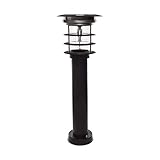
Ring Solar Pathlight, 4-Pack with Ring Bridge (2nd Gen)
Who it suits: Modern homeowners whose house already runs on systems — camera doorbells, voice routines, app-controlled everything — and who want the garden lighting to join that infrastructure instead of sitting outside it as a row of independent stakes.
In a contemporary home the landscape lighting is not a separate purchase; it is another node on the network, and this kit is the only pick in the guide built that way. Each pathlight is a 16.8-inch bollard-style fixture — a clean cylinder that sits comfortably in a modern scheme — rated by Ring at up to 80 lumens of 3500K light, a maker figure, adjustable downward in the app, triggered by a motion sensor covering 120 degrees out to about 15 feet. When one light in a group detects motion, the group fires together, and the lights can link to Ring doorbells and cameras so a camera event lights the path or a path light wakes a camera. Understand what that means for the light itself: this is a motion light, not a dusk-to-dawn glow. It stays dark until something moves, then runs for a shut-off interval you set in the app, between 30 seconds and two minutes. In a modern garden that restraint is arguably the correct behavior — darkness is the default, light is the event — but if your mental picture is a path that glows all evening, this is not that product.
The kit’s cost needs its ecosystem counted in the open. The four-pack with Bridge sits at the top of this category’s mainstream range — check the current price on Amazon, and check Ring’s own store as well. The Bridge is not optional decoration: Ring states that a Ring Bridge or a compatible hub is required to control its smart lights, unless your home has Amazon Sidewalk coverage or a Sidewalk-capable device already on the network — the kit includes the Bridge so the system works out of the box. Bought separately, the Bridge is an extra purchase on top of the lights. Counted properly, the kit’s per-light cost includes the hub, and expansion singles are sold on both Amazon and Ring’s store — check the current price on Amazon before you buy. Ring publishes a one-year limited warranty for the pathlight, and the spec fields rate it IP66.
Two modern-specific cautions. The first is temperature discipline: these lights are fixed at 3500K, a neutral white cooler than the StarRayS set’s 3000K. Inside a Ring-only scheme that is a consistent, deliberate look; mixed in one sightline with 3000K accents, the mismatch reads as a mistake — keep the Ring run on its own axis and let warmer accents work a different plane. The second is the battery door. Each light runs on a removable 18650 lithium-ion cell — one included per light — which can also be topped up over micro-USB when a cloudy week or a shaded yard starves the panel. That answers solar’s two oldest problems at once: a battery you replace instead of landfilling the fixture, and a rescue charge for December. At system scale it matters more — six lights are six aging batteries, and every one is a standard cell you can buy anywhere.
- The only genuinely smart system in the guide: grouped motion lighting linked to Ring cameras, doorbells and Alexa routines — infrastructure, not ornaments.
- Removable, standard 18650 battery in every light, with a micro-USB top-up for cloudy weeks.
- IP66 rating from the spec fields, and a published one-year limited warranty from the maker.
Honest limitation: Eighty maker-rated lumens, delivered only when motion triggers it, is pathway guidance light, not illumination — the fixed 3500K will fight warmer accents in the same view, and the smart features depend on the Bridge, the app and Ring’s ecosystem, so the system’s value collapses if you ever leave that ecosystem. Prices also differ by channel, so check the current price on Amazon and at Ring’s own store before you buy.
Choose it if you already live in Ring’s ecosystem or want grouped, motion-aware path lighting with replaceable batteries. Skip it if you want an all-night glow or dislike app-dependent hardware — the dusk-to-dawn sets below light more garden for less money.

Linkind Smart Solar Spot Lights SL5C, 2-Pack
Who it suits: Modern homeowners lighting a small number of deliberate subjects — one specimen tree, a sculpture, a slatted screen — who want every accent to agree in color and brightness, set once from a phone and then left alone.
Uniformity is the unglamorous condition a modern scheme lives or dies by. Two spotlights washing the same wall at slightly different temperatures look like a purchasing error; six accents at six brightness levels look like a yard sale. The SL5C is the pick that treats that problem as the product: a two-pack of app-controlled, color-changing solar spotlights at a low per-light cost — check price on Amazon. From the AiDot app you group the lights, set one color and one brightness for the group, and schedule them — so every accent in the composition matches, because a single instruction drives them all. The same pair that washes a hedge warm white in June can run a holiday scheme in December — but for this lens the headline is the opposite of the party trick: these are the only accents here you can tune to exactly the temperature your other lighting uses.
The engineering claim is in the panel, not the app. Linkind’s maker AiDot launched the SL5C as the first smart solar spotlight with MPPT — maximum power point tracking — charge control, a technique borrowed from larger solar systems that squeezes more charge out of weak, angled or intermittent light. That is aimed squarely at solar’s real enemy, the short grey days of winter, and while the size of the benefit is the maker’s claim, the technology is real and the direction is right. The listing’s spec fields rate the lights IP67, the strongest water rating in this guide alongside the StarRayS below.
What you do not get is a verified brightness figure. Linkind does not headline a lumen number for the SL5C in the spec data we could verify, and hands-on coverage describes its output as modest — the trade the maker made for smart control and color at this price. Treat these as accent and wash lights for shrubs, signs and small trees, not as security floods. Documentation for the model lists a 12-month warranty — half the GS-214’s term.
The battery question is this pick’s honest weakness: no user-replaceable battery is documented for the SL5C in the material we could verify, so when the cell fades, the light is done. At this per-light cost that is a defensible trade, and the final recommendation builds a multi-pack accent layer from these — but it is why this guide does not suggest building a permanent $200 scheme out of sealed lights alone.
- App grouping: one instruction sets color and brightness identically across every accent.
- MPPT charge control — the only pick engineered specifically to charge better in weak winter light.
- IP67 rating from the listing’s spec fields, at a low per-light cost, with no hub or bridge to buy.
Honest limitation: No verifiable maker lumen figure, modest output by reviewer accounts, a 12-month warranty, and no documented user-replaceable battery.
Choose it if you want matched, scheduled accents on a few chosen subjects for pocket money per light. Skip it if you need documented brightness or a light you can service for a decade.

Linkind StarRayS Solar Spot Lights, 6-Pack, Warm White
Who it suits: Anyone whose modern scheme needs a matched set of simple, warm accents in quantity — a row of grasses, a fence line, a sequence of small trees — and is disciplined enough to buy six and place four.
This is the coverage engine of the guide, and the modern reading of it is about restraint rather than reach. Six warm-white (3000K) spotlights, each staking into the ground or mounting on a wall, with three brightness modes and dusk-to-dawn operation: the verified configuration is model L180003-WW-US-6, and Amazon’s own listing title for it carries an IP67 rating. This pick is marked check-price, so check the current price on Amazon before you buy. The per-light story is the point either way: spread across six lights, the pack works out to the cheapest respectable per-light cost in the guide. What that buys a modern garden is not eighteen glowing points; it is one temperature, one fixture shape, repeated only where the composition calls for it, with the leftovers held as matched spares — the correct way to use a six-pack in a landscape that prizes editing.
Brightness needs the standard warning, applied with specifics. Linkind markets the wider StarRay family with maker figures running as high as 650 lumens on some versions, and the family’s versions differ in LED count and output — the version confusion is itself a reason this guide refuses to print a single lumen number for the six-pack. What is consistent across the family’s documentation is the design: a separate adjustable panel and head, so the panel can face the sun while the beam faces the tree — the most useful physical feature a solar spotlight can have, because panel angle and beam angle are rarely the same angle. Run the lights on a lower mode and they trade peak brightness for hours, which in winter keeps them lit at midnight.
The compromises are the usual sealed-set compromises. No user-replaceable battery is documented for these lights in the material we could verify, and we could not verify a published warranty term for this pack — check the listing’s warranty line before you buy, and treat the purchase as a consumable system: superb coverage now, at a per-light cost low enough that a failure in year three is an annoyance rather than a loss. One aesthetic caution specific to this lens: the set’s fixed 3000K is a virtue inside its own scheme and a conflict inside Ring’s 3500K one — do not interleave the two on the same axis.
- Six matched 3000K dusk-to-dawn spotlights at the lowest per-light cost in this guide — buy the pack, place with restraint, keep matched spares.
- Separately adjustable panel and head, three brightness modes, stake or wall mounting.
- IP67 in Amazon’s listing title for this exact model.
Honest limitation: Check the current price on Amazon before you buy; the family’s lumen claims vary by version and are maker numbers throughout, and no replaceable battery or verified warranty term could be documented.
Choose it if matched warm coverage at the lowest per-light cost is the job and you accept sealed lights as consumables. Skip it if you are building a permanent system — that is the Ring kit and the GS-214 above.

URPOWER 2-in-1 Solar Spot Lights, 2-Pack
Who it suits: Buyers who want the proven, inexpensive spotlight pair for a sign, a house number or a pair of shrubs — and as the affordable partner that rounds out the premium plans in this guide.
Some context first, because it is this pick’s real credential: this listing has been on Amazon since July 2015. In a category where brands appear and vanish with the seasons, a solar spotlight sold in the same form for a decade has demonstrated that its design works and its maker answers for it. The design is the classic 2-in-1: each light stakes into the ground or screws to a wall, with an adjustable head and an adjustable panel, two brightness modes, and dusk-to-dawn operation. The maker’s figures — labeled as maker figures — are about 200 lumens on the high mode from a 2,200 mAh battery, with a working time of six to nine hours on a full charge. The two-pack sits in the budget tier, varying by color variant — check price on Amazon for a low per-light cost.
Now the spec honesty, because this listing is a small museum of the category’s habits. Amazon’s listing text rates the light IP64 — splash-resistant, the weakest water rating in this guide — while roundups variously describe the same light as IP65 or IP67. Those numbers cannot all be true, and the listing’s own figure is the one to plan around: IP64 is fine under eaves or in open rain for a season, but not the rating to bury in a wet bed and forget. The battery is integrated rather than user-replaceable, so the decade this design has survived should not be confused with a decade of service from any single unit — individual units live and die by their cells. Its visible hardware is also the least architectural in the guide; in a strict modern scheme it earns its place tucked at the base of what it lights, not on display.
Why include an inexpensive pair in a $200 guide at all? Because systems are built from parts, and this is the part that finishes plans. The architectural plan in our final recommendation pairs one GS-214 bollard with a pair of these for the secondary accents and still lands under budget; bought alone in multiples, four pairs give you eight adjustable spots while staying comfortably inside this budget. It is not the brightest, toughest or smartest light here — it is the known quantity.
- A design on sale in the same form since 2015 — the category’s known quantity.
- Adjustable head and panel, stake or wall mounting, two brightness modes.
- A low per-light cost in the budget tier — check price on Amazon.
Honest limitation: The listing’s own IP64 rating is the weakest here and conflicts with higher figures quoted elsewhere; output and runtime are modest maker figures, and the battery is not user-replaceable.
Choose it if you need a cheap, proven pair to finish a plan or test where spots should go before committing. Skip it if the spot will live in standing water or you want a decade from a single unit.

Gama Sonic Baytown II Bulb Solar Lamp Post with EZ-Anchor Base
Who it suits: Buyers who want the look of a traditional lamp post — at a garden entrance, beside a drive, anchoring a patio corner — without trenching cable or hiring an electrician, and who understand they are buying the form.
That form is precisely the issue for this lens. The Baytown II is a lantern-headed post in a historical idiom — a handsome object in a traditional garden, and a quotation from another century in a modern one. Contemporary landscapes mark their entrances with bollards, columns and concealed sources, not carriage-lamp silhouettes, so in a guide for modern homes it is included for completeness and read honestly as off-brief: if your house is modern, the GS-214 above is the same maker’s money spent in your own language. It is also reviewed in prose only: the full lamp-post version’s Amazon listing could not be pinned to this site’s two-source standard, so there is no link; the pick is positioned at the top of this budget tier in a specialist solar retailer’s listing.
What that money buys is a full-height lamp post in Gama Sonic’s Baytown II design, built around the maker’s GS Solar LED bulb, with an EZ-Anchor base that installs in the ground without concrete. The maker rates the bulb’s output at 130 lumens. Sit with that number: a top-of-budget position for 130 maker-rated lumens is not a brightness purchase at all. It is a furniture purchase — a lamp post that happens to run on sunlight — and judged as furniture, against the cost of a wired post light plus trenching plus an electrician, it can be entirely rational in the garden it suits. Judged as lighting, it cannot compete with anything else here.
The GS Solar bulb is a replaceable part — proprietary to Gama Sonic, but replaceable — which puts this post ahead of every sealed light here on serviceability, and the same lantern head is sold separately as a three-way mounting kit (post, pier or wall) for less from the same retailer, for buyers who already have a post or a pillar. What we could not verify to this guide’s standard: a published warranty term for the post configuration and any Amazon offer for it — precisely why it carries no link.
- A full lamp post with tool-free EZ-Anchor installation — no trench, no cable, no electrician.
- Replaceable (proprietary) GS Solar bulb; the lantern head alone sells as a three-mount kit for less.
- A single statement object positioned at the top of this budget tier.
Honest limitation: One hundred thirty maker-rated lumens at a top-of-budget position is the least light for the size of the purchase in this guide by a wide margin, its traditional form sits against modern architecture rather than with it, and neither its Amazon offer nor its warranty term could be verified to our standard — hence no link.
Choose it if the lamp-post form itself is the goal and one glowing entrance point is enough. Skip it if your home is contemporary — the bollard above is this budget in the right idiom — or if you need the garden lit, since every other plan here lights more for less.
Prose only — no Amazon link for this pick, for the reasons stated above.
Comparison Table
| Product | Pack | Price | Per light | Output (maker figure) | IP (spec) | Battery | Warranty | Link |
|---|---|---|---|---|---|---|---|---|
| Gama Sonic GS-214 Bollard | 1 fixture | Check price on Amazon | Single fixture — top of the single-fixture tier | 100 lumens, dusk-to-dawn | Not published in verified spec data | Replaceable pack (~3 yrs / 1,000 charges) | 2 years (retailer spec table) | Check on Amazon |
| Ring Solar Pathlight with Bridge (2nd Gen) | 4 lights + Bridge | Check price on Amazon | Kit per-light cost includes the Bridge | Up to 80 lumens, motion-triggered | IP66 | Removable 18650, USB top-up | 1 year (maker) | Check on Amazon |
| Linkind SL5C Smart Spot Lights | 2 lights | Check price on Amazon | Low per-light cost | No verified maker figure; app-controlled color | IP67 | Sealed; MPPT charging | 12 months (model documentation) | Check on Amazon |
| Linkind StarRayS Spot Lights | 6 lights | Check price on Amazon | Lowest per-light cost in this guide | Maker figures vary by version; 3 modes | IP67 | Sealed | Not verified — check listing | Check on Amazon |
| URPOWER 2-in-1 Spot Lights | 2 lights | Check price on Amazon | Low per-light cost in the budget tier | About 200 lumens (high mode); 6–9 hrs | IP64 (listing) | Sealed, 2,200 mAh | Not verified — check listing | Check on Amazon |
| Gama Sonic Baytown II Lamp Post | 1 post | Prose only — top of this budget tier at a specialist retailer | Single post | 130 lumens, dusk-to-dawn | Not verified | Replaceable proprietary bulb | Not verified — buy where stated in writing | Prose only |
How to Choose Solar Garden Lights for a Modern Home
Decide what solar is for in your landscape — because in a modern build, it is rarely the main system. Say it plainly: a contemporary home being built or renovated properly wires its principal lighting lines — cable goes in before the hardscape closes, and the result is identical output every night for a decade. A wired all-in-one kit from a mainstream Amazon brand such as SUNVIE bundles twelve cast-aluminum spotlights with a 60-watt transformer with photocell and timer, a hundred feet of cable and the connectors — everything in one box, at a mid-tier position in this budget. That brand’s own Amazon spec fields rate its 12-watt wired spotlight at 900 lumens and its 3-watt path fixtures at 150 lumens each, and wired output is the same on a December Tuesday as on a June Saturday, all night, on a timer. A ten-pack of those 12-watt wired fixtures alone sits in a lower tier in current listings, transformer separate. Solar’s role in that landscape is the flexible layer: the far corner the trench never reached, the accent you test for a season before committing cable, the fixture you may move when the planting matures. Neither answer is wrong. What is wrong is buying solar while expecting wired behavior, at any budget — and in a modern home, where every visible inconsistency reads as a design failure, that mismatch is punished twice.
Do the sun audit before you do anything else. A solar light is a harvester before it is a lamp: the panel needs roughly six to eight hours of direct sun to fill the battery, and “direct” means sun on the panel, not brightness somewhere in the yard. Modern architecture complicates this in a specific way — deep eaves, pergolas, slatted screens and high boundary walls are the style’s signatures, and every one throws long, deliberate shade exactly where the planting beds and path edges are. Walk your garden at midday and mid-afternoon and note where those shadows fall — then remember winter moves every one of them and shortens the day behind them. A light that runs nine hours in June may manage four in December; its fuel shrank, it is not broken. Every runtime figure in this category is a summer figure wearing no label. Place panels, not just lights: where a pick offers a separately adjustable panel (the StarRayS and URPOWER designs), angle the panel at the sun and the head at the subject, and never let a shrub’s July growth shade a panel you placed in April.
Compose in points, not in coverage. The instinct this budget creates — $200, so how much of the garden can it cover? — is the instinct to resist. A modern night landscape is a small number of decisions: the path axis lit, one tree lifted, one wall washed, darkness everywhere else doing compositional work. Eighteen spotlights spread evenly across every bed produces the flat, sourceless glow of a retail park, at three mismatched color temperatures.
Start from the subjects — most modern gardens have three to five — and buy for those; that is why the plans below either concentrate the budget (one bollard, one smart system) or hold lights back as spares.
Enforce one temperature per sightline. This is the discipline cheap solar makes hardest and modern design makes non-negotiable. The picks here do not agree with each other: the Ring pathlights are fixed at 3500K, the StarRayS set at 3000K, the URPOWER pair at whatever its maker set, and only the SL5C can be tuned. Mixed in one view, those differences do not read as variety — they read as error, the lighting equivalent of two whites in one room. The workable strategies are separation and control: give each system its own axis or plane (Ring on the front path, warm accents in the rear garden), or build the accent layer from the tunable pick so it can match whatever it sits beside. Decide the temperature map before you buy a single pack.
Count the pack, and count the ecosystem. Pack pricing hides everything in this category. Compare offers by their per-light position — this guide’s range runs from the StarRayS six-pack, the lowest per-light cost here, up to the Baytown post, a single top-of-budget object — then add what the system needs to deliver its headline features. Ring’s pathlights need their Bridge or an existing Sidewalk-capable hub; the kit here includes the Bridge, and bought separately it is an extra purchase, so a plan built from singles alone is not the saving it first looks, just incompletely counted. App-based lights like the SL5C need no hub, which is part of their value.
At this budget, refuse sealed batteries in anything you call permanent. For a low-cost accent light, a sealed battery is a fair trade; for a fixture meant to define a path or entrance for years, it is not — the LED will outlive the cell several times over, and when the cell dies the whole fixture becomes waste. That is why the architectural pick here is a serviceable one, and why sealed lights belong in the accent role, where replacement is a line item, not a loss.
Read IP ratings from spec fields, and match them to the spot. The digits mean specific things: IP64 is splash-proof, IP65 withstands water jets, IP66 powerful jets, IP67 temporary immersion. Titles will call all of them “waterproof.” This guide’s verified spread — IP64 on the URPOWER listing, IP66 on the Ring, IP67 on both Linkind sets, and no published figure at all for the GS-214 — is the real landscape of the category. Put IP67 lights in wet beds and low spots, keep IP64 lights where a roof edge or planting gives some shelter, and treat an unrated fixture as a fair-weather citizen.
Common Buying Mistakes
Lighting everything. The defining error at this budget. A modern garden at night is mostly darkness with a few lit decisions in it; a buyer who spends the whole $200 budget on maximum fixture count gets a garden that glows uniformly and reads as nothing. Buy for named subjects — a tree, a wall, a path axis.
Mixing color temperatures in one view. A 3500K pathlight run crossing a 3000K accent wash looks like two competing installations, because it is. Solar listings rarely headline their temperature, and fixed-temperature products cannot be corrected after purchase. Map temperatures by zone before buying, or build from the one tunable pick in this guide.
Believing the lumen headline. Solar lumen figures are maker numbers with no common standard behind them, and the same physical light can appear under different claims in different listings — this guide found one long-selling spotlight described at three different IP ratings across sources, and one spotlight family whose versions claim figures from a few hundred lumens to several times that. Judge by role instead: path guidance, accent wash, or area light.
Choosing decor forms for an architectural garden. Flame torches, lantern silhouettes, mosaic globes and novelty stakes dominate this category’s shelves because they photograph well. In a contemporary landscape each one is a period quotation that fights the architecture. The solar forms that belong are the quiet ones: bollard, cylinder, aimable head.
Expecting motion lights to glow, or dusk-to-dawn lights to guard. The Ring pathlights light when something moves and rest dark otherwise; the dusk-to-dawn sets glow all night but notice nothing. Buying one behavior while wanting the other is the most common disappointment in this category — choose the behavior first, the product second.
Final Recommendation
There is no $200 solar garden light; there are $200 solar lighting plans, and for a modern home they rank differently than raw coverage would rank them. The main plan — the smart infrastructure layer: the Ring four-pack with Bridge, plus two expansion singles — the Ring Solar Pathlight single is the same light sold one at a time — gives six grouped, motion-aware pathlights with replaceable batteries and the hub included, within this system budget; check the current prices on Amazon before you buy. It behaves like the rest of a modern home’s systems, keeps darkness as the default, and is the most complete scheme this budget buys. The architectural plan: one GS-214 bollard defining the entrance or the path’s turning point, plus a URPOWER pair washing the secondary accents — a permanent fixture and its supporting cast, within this budget; check the current prices on Amazon before you buy. Read the bollard as a single marker or a trial of the form; a matched run is wired money, and this plan is how you find out whether you want one. The uniform accent plan: four two-packs of the Linkind SL5C — eight app-controlled spots, every one set to the same color and brightness from a single instruction — plus one StarRayS six-pack for the warm dusk-to-dawn layer, fourteen lights, comfortably within this budget; check the current prices on Amazon before you buy. The maximum-coverage plan, included and argued against: three StarRayS six-packs, eighteen dusk-to-dawn spots, within this budget. It is unbeatable coverage for the tier and, for most modern gardens, the wrong purchase — eighteen points of light is a parking lot’s idea of a landscape. If your property is genuinely large, buy the packs and place half; the spares are matched, which a second order a year later would not guarantee.
Choose the Baytown II lamp post only if the post itself is the purchase and your architecture is not contemporary, and buy it where its warranty is stated in writing. And hold the wired comparison in mind before you commit: if you are building or renovating, the main lines belong in cable, and this budget is best spent on the layer solar is actually good at — the far corner, the test accent, the fixture that may move next season. Solar earns its place in a modern garden where sun is plentiful, outlets are not, and the design is strong enough to leave most of the garden dark. Spend it on few points, matched temperatures and batteries you can replace anywhere the fixture is meant to stay.
FAQ
Why does nothing here actually cost $200?
Because the verified Amazon market tops out lower. The highest-priced mainstream solar garden product we could pin down is Ring’s four-pack kit with Bridge, at the top of the category’s range; the priciest single fixture with a verifiable Amazon presence, the Gama Sonic bollard, sits below it; and the one solar bollard we found at the very top of this budget is a commercial fixture sold direct by a specialist retailer, not on Amazon — check the current price on Amazon for any linked pick before you buy. The $150–$200 band is nearly empty, so the honest purchase at this budget is a small, deliberate system, not a single product.
Solar or wired for a modern home renovation?
Both, in layers — and if forced to choose one for the main lines, wired. A mid-tier wired kit in this budget comes with twelve aluminum fixtures, a timer transformer and cable included, with maker-rated outputs (up to 900 lumens per 12-watt fixture in that brand’s spec fields) that hold steady every night regardless of weather. Solar buys freedom from trenching and outlets, movable lights and accent charm, with output that follows the weather. The standard modern answer: wired for the permanent scheme, solar for the corners, tests and changes the cable never anticipated.
Can solar lights actually look architectural?
One form can: the bollard. It is the fixture type contemporary landscape design already uses, it throws light downward instead of into eyes, and the GS-214 builds it in stainless steel and glass with a replaceable battery — the first solar product at this level that reads as architecture. Beyond it, solar’s architectural strategy is concealment and discipline: quiet cylindrical pathlights that behave as one system (the Ring kit), and aimable heads hidden at the base of what they light. The category’s decorative majority — lanterns, flames, globes — belongs to other gardens.
Do Ring solar pathlights need the Bridge?
For their smart features, effectively yes — Ring states that a Ring Bridge or a compatible hub is required to control its smart lights, unless your home has Amazon Sidewalk coverage or a Sidewalk-capable device already providing it. The four-pack in this guide includes the Bridge (2nd Gen); bought separately it is an extra purchase — check the current price on Amazon. Add-on singles like the single Ring Solar Pathlight assume the Bridge is already in the house.