Where to buy
Check the latest price, availability and delivery on Amazon. Orders are placed on Amazon. We may earn a commission from qualifying purchases.
- Best for balconies and pots: Linkind Smart Solar Spot Lights SL5C, 2-Pack — Check on Amazon
- Best smart system (ground-floor patios): Ring Solar Pathlight, 4-Pack with Ring Bridge (2nd Gen) — Check on Amazon
- Best coverage value: Linkind StarRayS Solar Spot Lights, 6-Pack, Warm White — Check on Amazon
- Best budget staple: URPOWER 2-in-1 Solar Spot Lights, 2-Pack — Check on Amazon
- Best premium fixture (owners only): Gama Sonic GS-214 Stainless Steel Bollard Solar Lamp with EZ Anchor — Check on Amazon
One further pick — the Gama Sonic Baytown II Bulb solar lamp post — is covered in prose only, with no Amazon link, because we could not pin the full lamp-post version’s Amazon listing to the two-source standard this site requires before linking; its review notes that it sits at the premium end of the tier and is sold through a specialist solar retailer. The linked picks below direct you to check the current price on Amazon.
Read the full guide ↓
Disclosure: As an Amazon Associate, dailyhomedecorating.com earns from qualifying purchases. Links to Amazon on this page are affiliate links; they cost you nothing extra. Listing details such as price and availability change often, so check the current Amazon listing before you buy.
Start with the sentence most $200 solar guides will not print in an apartment edition: most of this tier was designed for people who own ground. The premium end of the market is a stainless bollard that screws into soil, a full-height lamp post that anchors into a lawn, and coverage packs that assume a yard with a path, a fence line and a row of trees. A renter has none of that — a balcony or small patio, a few planters, an entry door that opens onto a corridor or shared landing they do not control, and a lease. So this guide does two jobs: it reviews the same verified $200-tier products as our main guide — same listings, same labels — and grades each one against the only questions that matter in an apartment: can you install it without touching anything permanent, will your patch of sky feed it, and can every piece leave with you when the lease ends?
The honest answer, up front: an apartment’s outdoor lighting needs saturate well below the full budget — two app-controlled spotlights for the planters and a proven pair for the pots lights everything a balcony can hold. The full $200 becomes a sensible spend in only two situations: you have a ground-floor patio with a real strip of garden you are allowed to light, or part of this budget is quietly destined for a house you own or a family home whose yard is also yours to work on. If neither is true, the correct outcome of this guide is to spend about half of it and keep the rest, rather than inventing purchases to close the gap. There is no single $200 solar garden light worth buying on Amazon in any case: the premium end of the tier is a multi-light smart kit and a single premium bollard fixture, and everything else clusters in the lower and middle parts of the tier, with most packs positioned well below the premium fixtures.
Two solar truths matter even more in an apartment than in a house. First, every lumen and runtime figure in this category is a maker’s number with no common test standard behind it — treat them as labeled claims, not measurements. Second, a balcony is the hardest solar site there is: a homeowner with a shaded corner can move the light, but you cannot move the balcony. The slab above you is a roof, the railing throws a moving fence of shadows, and the tower across the street may own your afternoon. A panel needs roughly six to eight hours of direct sun — sun on the panel, not daylight in the room — and a balcony that delivers two will starve every product in this guide equally, at every price.
Quick Picks
Short on time? Each row names a buyer type and the product that suits it, graded for apartment use. For linked picks, check the current price on Amazon — the listing itself is the authority.
| Buyer type | Pick | Why it stands out | Link |
|---|---|---|---|
| Best for balconies and pots | Linkind Smart Solar Spot Lights SL5C, 2-Pack — check price on Amazon | App-controlled color spots that stake into planters, with MPPT charging built for exactly the short, weak sun windows a balcony gets — and no hub to buy | Check on Amazon |
| Best smart system | Ring Solar Pathlight, 4-Pack with Ring Bridge (2nd Gen) — check price on Amazon | Grouped motion lighting with the Bridge in the box and a removable battery in every light — worth it only if you have a ground-floor patio or path that is actually yours to light | Check on Amazon |
| Best coverage value | Linkind StarRayS Solar Spot Lights, 6-Pack, Warm White — check price on Amazon | Six dusk-to-dawn spots at a low per-light cost — a planter row or patio edge lit for the cost of one premium fixture | Check on Amazon |
| Best budget staple | URPOWER 2-in-1 Solar Spot Lights, 2-Pack — check price on Amazon | The category’s decade-old workhorse: stakes into pots or mounts on a wall, and its modest splash rating matters least exactly where renters use it — under a balcony’s cover | Check on Amazon |
| Best premium fixture | Gama Sonic GS-214 Stainless Steel Bollard Solar Lamp — check price on Amazon | Real stainless steel and glass with a replaceable battery — and an anchor that screws into the ground, which makes it a landlord’s fixture, not a renter’s. Owners only | Check on Amazon |
| Best statement piece | Gama Sonic Baytown II Bulb Solar Lamp Post with EZ-Anchor Base — premium end of the tier, at a specialist retailer | A full-height lamp post that anchors into soil. In an apartment guide it is here so we can say plainly: do not buy this on a lease | Prose only — see review |
How These Picks Were Chosen
The first filter was verifiability, identical to our main guide’s. Every linked product here is a real Amazon listing whose ASIN we pinned from two independent sources — the maker’s own store, retailer listings of the same product, coverage of the Amazon offer, or trackers reading Amazon’s data — before a link was allowed. Linked picks carry no printed price in this guide; check the current price on Amazon on the listing itself. One product failed the test outright: the Baytown II lamp post’s full-post Amazon listing could not be pinned, so it is reviewed in prose, as a premium-tier fixture sold through a specialist retailer, with no link. Anything we could not verify at all was left out entirely.
The second filter is the one this edition exists for: the renter’s test, applied to every pick without softening the facts. Does it install with zero permanent alteration — a stake into a planter you own — or does it need screws in an exterior wall or an anchor in soil? Ground and exterior walls belong to the landlord; planting beds in a shared yard are common property, and anything installed there can be removed by management without asking you. Does it come away clean at move-out? Two picks fail this test outright. They are reviewed at full length anyway — real specs, real positioning in the tier — because an apartment guide that quietly deleted the premium end of the tier would be lying by omission. They are labeled owners only, and their reviews name the exact fact that disqualifies each one.
The third filter was solar-specific. We required, wherever the data exists: an IP rating from specification fields rather than the word “waterproof” in a title; a battery answer — replaceable, removable, or sealed — stated in the review, including when the honest answer is “the maker does not document one”; a warranty term from the maker’s published terms or a retailer’s spec table; and the full system picture, with any hub or bridge the lights need counted as part of the pick, not footnoted. Lumens and runtimes are printed only as labeled maker figures. For apartment readers we added one more requirement: the pick had to make sense at apartment scale, and the reviews grade it that way.
The 6 Best Solar Garden Lights Under $200 — Apartment Edition
Linkind Smart Solar Spot Lights SL5C, 2-Pack
Who it suits: Renters whose “garden” is a balcony, a terrace or a row of planters — anyone who wants app-controlled accent light on pots, a small tree in a tub, or the balcony’s one good corner, with nothing screwed down and nothing left behind.
This is the best apartment fit in the guide, and the reason is in the panel rather than the app. The SL5C is a two-pack of app-controlled, color-changing solar spotlights positioned in the lower part of the tier — check price on Amazon. Its maker, AiDot, launched it as the first smart solar spotlight with MPPT charge control, a technique borrowed from larger solar systems that extracts more charge from weak, angled or intermittent light. On a balcony that is the whole ballgame: your sun arrives in a window — an hour before the railing shadows it, a stretch between the tower’s shadow and your own building’s — and a charger built to harvest partial light is worth more than any brightness claim. The listing’s spec fields rate the lights IP67, the strongest water rating in this guide.
The install is the renter’s ideal: each light stakes into soil, and a large planter or tub is soil you own. No screws, no anchor in the landlord’s ground, no cable — and at move-out the pair lifts out of the pots and into a box. Control runs through the AiDot app, with grouping and schedules and no hub or bridge to buy. The color-changing output also earns its keep in a small space — warm white on the planters most evenings, a holiday scheme in December — because a balcony light is always also a decoration: everything you light is in the room with you.
Now the limits, unchanged from our main guide because the facts are unchanged. Linkind publishes no lumen figure for the SL5C in the spec data we could verify, and hands-on coverage describes the output as modest — these are accent and wash lights for shrubs, signs and potted trees, not security floods, and on a balcony “modest” is usually the correct amount of light anyway. Documentation for the model lists a 12-month warranty. And no user-replaceable battery is documented: when the cell fades, the light is done. At its low per-light position in the tier, that trade is defensible.
- MPPT charge control — the only pick engineered to charge well in the short, weak sun windows a balcony actually gets.
- Stakes into planters you own: zero permanent alteration, and it moves out with you.
- App control, grouping and full color-changing output with no hub or bridge to buy.
- IP67 rating from the listing’s spec fields, at a low per-light cost.
Honest limitation: No verifiable maker lumen figure, modest output by reviewer accounts, a 12-month warranty, and no documented user-replaceable battery.
Choose it if your outdoor space is a balcony or planter row and your sun comes in short windows. Skip it if your balcony fails the sun audit entirely — no charger chemistry fixes a panel that never sees the sun — or if you need documented brightness.

Ring Solar Pathlight, 4-Pack with Ring Bridge (2nd Gen)
Who it suits: Renters with a ground-floor patio, a private garden strip, or an entry path that is genuinely theirs — and Ring households who want that path to light as a group and talk to the doorbell and cameras they already run.
Begin with what this product is, because its name invites a misunderstanding in an apartment context. Each pathlight is a 16.8-inch bollard-style fixture that Ring rates at up to 80 lumens of 3500K light — a maker figure, adjustable downward in the app — fired by a motion sensor covering 120 degrees out to about 15 feet. Grouped lights trigger together, and the system links to Ring doorbells and cameras, so a camera event lights the path or a path light wakes a camera. It is a motion light, not a dusk-to-dawn glow: it rests dark until something moves, then runs for a shut-off interval you set, between 30 seconds and two minutes. On a balcony that behavior is mostly wrong — there is no approach path to detect, and a light that fires every time you step outside is a nuisance. On a ground-floor patio with a gate and a path, it is exactly right — and the only genuinely smart system in this guide.
The system needs its ecosystem counted in the open, exactly as in our main guide. The four-pack includes the Bridge in the box — check the current price on Amazon, and check Ring’s own store as well, since the kit is sold through both channels. The Bridge is not optional: Ring states that a Ring Bridge or a compatible hub is required to control its smart lights, unless your home has Amazon Sidewalk coverage or a Sidewalk-capable device already on the network. Bought separately, the Bridge is an additional purchase — check the current price on Amazon. Expansion singles are also sold separately — check price on Amazon. For one apartment, though, a Bridge plus four or six pathlights is a system sized for a house’s front path — usually more system than space. The smaller honest configuration is two singles plus a Bridge bought separately, and even that only makes sense where a real path exists. Ring publishes a one-year limited warranty, and the spec fields rate the light IP66.
The battery design remains the best in this guide, and for renters it carries an extra virtue. Each light runs on a removable 18650 lithium-ion cell, included, which can also be topped up over micro-USB when a shaded week starves the panel — and shaded weeks are the apartment condition, not the exception. A removable standard cell also means nothing is installed: the whole kit packs into one box on moving day, ready for the next address.
- The only genuinely smart system here: grouped motion lighting linked to Ring cameras, doorbells and Alexa routines.
- Removable, standard 18650 battery in every light, with a micro-USB top-up for the shaded weeks balconies specialize in.
- IP66 rating from the spec fields, and a published one-year limited warranty from the maker.
Honest limitation: Eighty maker-rated lumens delivered only on motion is pathway guidance, not illumination — and the system is sized and priced for a house path, so for most apartments it is more hub, more lights and more money than the space can use.
Choose it if you have a ground-floor patio or private path and already live in Ring’s ecosystem. Skip it if your outdoor space is a balcony — the SL5C pair above lights it better with far less system to manage — or if you dislike app-dependent hardware.

Linkind StarRayS Solar Spot Lights, 6-Pack, Warm White
Who it suits: Patio renters with a run of planters, a planter-box edge or a small ground-floor garden strip they are allowed to light — anyone who needs honest dusk-to-dawn spots in quantity and does not need an app.
Six warm-white (3000K) spotlights, each staking into the ground or mounting on a wall, with three brightness modes and dusk-to-dawn operation: the verified configuration is model L180003-WW-US-6, and Amazon’s own listing title for it carries an IP67 rating. In apartment terms, read “ground” as the soil in your largest planters and tubs: a row of six lights wants six homes, so these fit the bigger patio — a planter-lined terrace edge, a ground-floor garden strip, a row of tubs along a railing — not a two-pot balcony. For current pricing, check price on Amazon. The story is the pack arithmetic: six lights in one pack give this pick the lowest respectable per-light cost in this guide.
The design detail that matters most on a patio is the separately adjustable panel and head: the panel can hunt for the one sunny angle — tilted up over a railing shadow, say — while the beam still lands on the plant. Run the lights on a lower mode and they trade peak brightness for hours, the trade that keeps them lit at midnight in winter. Brightness claims need the standard warning with specifics: Linkind markets the wider StarRay family with maker figures running as high as 650 lumens on some versions, the family’s versions differ, and that is why this guide prints no single lumen number for the six-pack.
The compromises are the sealed-set compromises, stated plainly. No user-replaceable battery is documented for these lights, and we could not verify a published warranty term for this pack to the standard this guide requires — check the listing’s warranty line before you buy. For a renter there is a softer side to that verdict: a sealed light you carry away is a consumable you chose, at a low per-unit cost, and a failure in year three is an annoyance rather than a loss. Use the stakes in planters; the wall configuration means screws in a wall that is not yours.
- Six dusk-to-dawn spotlights at a low per-light cost — the coverage value of the guide.
- Separately adjustable panel and head: the panel hunts the sunny angle, the beam stays on the plant.
- IP67 in Amazon’s listing title for this exact model; 3000K warm white; three brightness modes.
Honest limitation: Check the current price on Amazon before you buy, the family’s lumen claims vary by version and are maker numbers throughout, and no replaceable battery or verified warranty term could be documented.
Choose it if you have a patio or planter row with room for six and coverage is the job. Skip it if your whole outdoor world is two pots — buy the SL5C pair and keep the change.

URPOWER 2-in-1 Solar Spot Lights, 2-Pack
Who it suits: Renters who want the proven, inexpensive pair — one for the balcony’s potted tree, one for the entry planter — and the natural partner that rounds out the apartment plans in this guide.
The credential first: this listing has been on Amazon since July 2015. In a category where brands vanish with the seasons, a decade in the same form demonstrates that the design works and the maker answers for it. The design is the classic 2-in-1: each light stakes into the ground or screws to a wall, with an adjustable head and an adjustable panel, two brightness modes, and dusk-to-dawn operation. The maker’s figures — labeled as maker figures — are about 200 lumens on the high mode from a 2,200 mAh battery, with a working time of six to nine hours on a full charge. Check the current price on Amazon — the listing itself is the authority, and pricing can vary by color variant, at a low per-light cost for the pair.
The apartment lens flatters this pick in one specific way. Amazon’s listing text rates the light IP64 — splash-resistant, the weakest water rating in this guide — while roundups around the web variously describe the same light as IP65 or IP67; those numbers cannot all be true, and the listing’s own figure is the one to plan around. In a yard, IP64 is a real limitation. On a covered balcony or under a patio overhang — where apartment lights actually live — splash resistance is close to the whole requirement, and the gap to the IP67 picks narrows to nearly nothing. The honest caveats travel with it: the wall-mount configuration means screws, so use the stakes in planters unless your lease or landlord allows fixings, and the battery is integrated rather than user-replaceable, so a single unit’s life is its cell’s life — the design’s decade on sale is not a promise about any one unit.
Why an inexpensive proven pair anchors an apartment guide at a $200 budget: because apartment systems are small, and this is the part that finishes them. One pair washes the two spots a balcony actually has; paired with the SL5C in the plans below, it completes a full apartment setup while staying well below the full budget. It is not the brightest, toughest or smartest light here — it is the known quantity.
- A design on sale in the same form since 2015 — the category’s known quantity.
- Adjustable head and panel, stake or wall mounting, two brightness modes.
- Its IP64 splash rating, the weakest here, is barely a compromise in the covered spots apartments provide.
- A low per-light cost for the pair — check price on Amazon.
Honest limitation: The listing’s own IP64 rating conflicts with higher figures quoted elsewhere; output and runtime are modest maker figures, and the battery is not user-replaceable.
Choose it if you need a cheap, proven pair for pots and covered corners. Skip it if the spot will live in standing water or fully open rain — that is what the IP67 picks are for.

Gama Sonic GS-214 Stainless Steel Bollard Solar Lamp with EZ Anchor — Owners Only
Who it suits: Homeowners. That is the review’s first duty in an apartment guide: the buyer this fixture suits owns the ground it anchors into. If that is not you, read this as a “do not buy” — the facts below are the genuine article’s facts, kept intact, and they are exactly why it does not belong on a lease.
At the premium end of the tier, this is the most expensive single solar garden light with a verifiable Amazon presence, and what the money buys is materials and serviceability rather than brightness. The body is black stainless steel with the maker’s GS Solar LED bulb behind thick glass; the retailer spec table for this model (item 214001) rates output at 100 lumens — a maker figure, and a modest one: a wired bollard at this money would out-light it several times over. The serviceability is documented rather than promised: the integrated lithium-ion battery pack is rated at roughly three years, or about 1,000 charges — and it can be replaced, buying roughly another three years instead of ending the fixture’s life. The GS Solar bulb is likewise replaceable, though proprietary to Gama Sonic fixtures. The spec table lists a two-year manufacturer warranty, the longest published term among this guide’s Amazon-linked picks.
Now the disqualifier, in the maker’s own design. This bollard installs with an EZ Anchor base — a ground anchor that screws into soil. Soil in a rented garden, a shared yard or a communal planting bed is the landlord’s property, and a fixture designed to anchor permanently into it is a fixture designed for an owner. Installing it without written permission risks exactly the conversation no renter wants at deposit time — and unlike every other pick here, it cannot stake into a planter or sit on a balcony slab as a workaround; it is the wrong shape for temporary use entirely. A buying note for the owners still reading: the live Amazon listing has carried no featured offer, with the purchasable offer from the maker’s own Amazon storefront sitting under “See All Buying Options,” and the same fixture is also sold at a specialist solar retailer. That is why this guide labels the pick check price on Amazon.
- Stainless steel and glass construction — the only pick here that reads as a permanent fixture rather than a stake light.
- Replaceable battery pack (about three years or 1,000 charges per pack) and a replaceable bulb, under a two-year maker warranty.
- EZ Anchor installation: no concrete, no wiring — and no business being installed in ground you rent.
Honest limitation: One hundred maker-rated lumens at a premium price point is accent light at a statement price, the verified spec data publishes no IP rating — and for renters, the ground anchor ends the discussion before any of that matters.
Choose it if you own the ground and want one permanent-looking fixture you can service for years. Skip it if you rent — in this guide’s terms, that is the whole apartment readership without a written landlord exception.
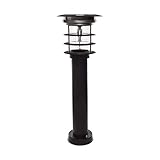
Gama Sonic Baytown II Bulb Solar Lamp Post with EZ-Anchor Base — Owners Only
Who it suits: Homeowners who want the look of a traditional lamp post without trenching cable or hiring an electrician. In an apartment edition, this pick is reviewed in full so that the verdict can be equally full: do not buy this on a lease.
It is reviewed in prose only: the full lamp-post version’s Amazon listing could not be pinned to this site’s two-source standard, so there is no link, and it is sold through a specialist solar retailer’s listing of the exact model, at the premium end of the tier. What that positioning buys is a full-height lamp post in Gama Sonic’s Baytown II design, built around the maker’s GS Solar LED bulb, with an EZ-Anchor base that installs in the ground without concrete. The maker rates the bulb’s output at 130 lumens. Sit with that number, because it is the most instructive figure in this guide: a premium-tier lamp post rated at 130 maker-rated lumens is not a brightness purchase at all. It is a furniture purchase — a lamp post that happens to run on sunlight — and judged as furniture, against a wired post light plus trenching plus an electrician, a homeowner can find it entirely rational. Judged as lighting, it cannot compete with anything else in this guide.
For a renter, the analysis is shorter than the product. A full-height post anchored into the ground is the definition of a landlord’s fixture: it goes into soil you do not own, stands in a yard or at an entrance you almost certainly share, and no reading of a standard lease covers installing one. The serviceability facts deserve their sentence even here — the GS Solar bulb is a replaceable part, proprietary to Gama Sonic but replaceable, and the same lantern head is sold separately as a three-way mounting kit (post, pier or wall) from the same retailer. What we could not verify to this guide’s standard: a published warranty term for the lamp-post configuration and any Amazon offer for it — precisely why it carries no link.
- A full lamp post with tool-free EZ-Anchor installation — no trench, no cable, no electrician.
- Replaceable (proprietary) GS Solar bulb; the lantern head alone sells as a three-mount kit.
- The only single solar object that genuinely fills a $200 budget — and the least rentable object in the guide.
Honest limitation: One hundred thirty maker-rated lumens at the top of the tier is the weakest light-for-the-money proposition in this guide by a wide margin, neither its Amazon offer nor its warranty term could be verified to our standard — and it anchors permanently into ground a renter does not own.
Choose it if you own a garden entrance and the lamp-post form itself is the goal. Skip it if you rent, full stop — every other plan in this guide lights an apartment without a single premium statement fixture.
Prose only — no Amazon link for this pick, for the reasons stated above.
Comparison Table
| Product | Pack | Price | Per light | Output (maker figure) | IP (spec) | Battery | Warranty | Apartment verdict | Link |
|---|---|---|---|---|---|---|---|---|---|
| Linkind SL5C Smart Spot Lights | 2 lights | Check price on Amazon | Low per-light cost | No verified maker figure; app-controlled color | IP67 | Sealed; MPPT charging | 12 months (model documentation) | Best fit — stakes into planters, no hub | Check on Amazon |
| Ring Solar Pathlight with Bridge (2nd Gen) | 4 lights + Bridge | Check price on Amazon | Premium per-light cost, Bridge included | Up to 80 lumens, motion-triggered | IP66 | Removable 18650, USB top-up | 1 year (maker) | Ground-floor patios only — oversized for balconies | Check on Amazon |
| Linkind StarRayS Spot Lights | 6 lights | Check price on Amazon | Lowest per-light cost in this guide | Maker figures vary by version; 3 modes | IP67 | Sealed | Not verified — check listing | Patios and planter rows with room for six | Check on Amazon |
| URPOWER 2-in-1 Spot Lights | 2 lights | Check price on Amazon | Low per-light cost | About 200 lumens (high mode); 6–9 hrs | IP64 (listing) | Sealed, 2,200 mAh | Not verified — check listing | Covered balconies and pots — the budget staple | Check on Amazon |
| Gama Sonic GS-214 Bollard | 1 fixture | Check price on Amazon | Single premium fixture | 100 lumens, dusk-to-dawn | Not published in verified spec data | Replaceable pack (~3 yrs / 1,000 charges) | 2 years (retailer spec table) | Owners only — anchors into the ground | Check on Amazon |
| Gama Sonic Baytown II Lamp Post | 1 post | Premium end of the tier, at a specialist retailer | Single premium fixture | 130 lumens, dusk-to-dawn | Not verified | Replaceable proprietary bulb | Not verified — buy where stated in writing | Owners only — a landlord’s fixture by design | Prose only |
How to Choose Solar Garden Lights for an Apartment
Do the balcony sun audit first — it outranks every other step. A solar panel needs roughly six to eight hours of direct sun to fill its battery, and “direct” means sun landing on the panel itself. Stand outside at mid-morning, midday and mid-afternoon on a clear day and note where direct sun actually lands and for how long — then discount for winter, when shadows lengthen and the day shortens behind them. Six-plus hours on a railing planter or a corner of the floor: solar will work, buy with confidence. Three to five: buy small, favor the MPPT-equipped SL5C or the Ring light with its USB top-up, and expect short winter evenings. Under three — a north-facing or fully covered balcony — no product in this guide will perform at any price, and the honest purchase is no purchase. The audit is not a preliminary; it is the decision.
Read your lease and your building’s rules before your shopping list. The standard renter’s constraints, stated plainly: nothing screwed into exterior walls, railings or balcony structures without written permission; nothing anchored into soil in shared or communal areas, which are the landlord’s property and can be cleared by management without notice; nothing in a shared entry or corridor, however dark it is, because that space is not yours to light; and everything installed must come away at move-out leaving no trace, or the deposit conversation follows. Building and HOA rules add their own layer — some restrict visible fixtures and anything attached to a railing. The picks that survive these rules live in your own planters and pots and on your own furniture.
Count cost per light, count the ecosystem, and count the space. Pack pricing hides everything in this category, so think in per-light terms — this guide’s range runs from low-cost multi-packs such as the StarRayS to a single premium fixture such as the Baytown post — then add what the system needs: Ring’s pathlights need their Bridge or an existing Sidewalk-capable hub, and the kit here includes it, while app-based lights like the SL5C need no hub at all. Then apply the apartment correction no homeowner guide needs: count your placements. A balcony holds two to four lights gracefully; a six-pack with nowhere to go is not a bargain, it is clutter in a box. Buy the pack size your planters can absorb.
Mind the neighbors; your garden is three feet from their window. Light spill is a design constraint in a building, not an afterthought. A spotlight staked in a planter and aimed outward will land in the unit below or across the courtyard; a motion light on a shared landing fires for every resident’s comings and goings, all night. Aim beams down and inward, onto your own plants and your own floor, and prefer dusk-to-dawn accent light at low modes over bright motion bursts. The goal: a balcony that glows for you and is invisible to everyone else.
Match the IP rating to the microclimate you actually have. The digits mean specific things: IP64 is splash-proof, IP65 withstands water jets, IP66 powerful jets, IP67 temporary immersion — and titles will call all of them “waterproof.” An exposed railing planter in open rain wants IP65 or better, which the Ring (IP66) and both Linkind picks (IP67) provide. A covered balcony lives a sheltered life, and there the URPOWER’s listing-rated IP64 is a reasonable fit rather than a flaw.
Decide solar versus wired knowing that, for renters, the contest is mostly rigged — in both directions. Our main guide makes the wired case honestly, and it stays honest here: a wired all-in-one kit from a mainstream Amazon brand such as SUNVIE bundles twelve cast-aluminum spotlights with a 60-watt transformer with photocell and timer, a hundred feet of cable and the connectors, and that brand’s spec fields rate its 12-watt wired spotlight at 900 lumens and its 3-watt path fixtures at 150 lumens each — output that holds steady every night of the year. But installing it requires cable run through soil, a mounted transformer and permanently placed fixtures: every step needs a yard and an owner’s permission, so it is not a product a renter can use at all. At apartment scale solar therefore wins by default wherever the sun audit passes — it is the only outdoor lighting a lease allows. Where the audit fails, wired is not your fallback either; the fallback is to light the indoor side of the glass and leave the balcony dark. Buying solar for a sunless balcony while expecting wired behavior is the one genuinely wrong answer, at any budget.
Common Buying Mistakes
Buying for the garden you wish you had. An eighteen-light coverage plan is a fine purchase for a yard and an absurd one for a balcony. Apartment needs saturate at two to four well-placed lights; size the purchase to the planters you own today.
Anchoring or screwing into things that are not yours. A bollard anchored into a shared garden bed, a spotlight screwed into a balcony wall, a post set at a communal entrance — each is an alteration of the landlord’s property, and each can be removed by management or charged against a deposit. If a pick cannot stake into your own planter or stand on your own furniture, it is not an apartment pick, whatever its price.
Skipping the sun audit because the balcony “feels bright.” A room can be flooded with daylight while its floor and planters sit in permanent shadow — brightness is not direct sun on a panel, and every runtime claim in this category assumes six to eight hours of the direct kind. Feelings do not charge batteries; check the actual sunny spots, at actual times of day, before spending anything.
Forgetting the hub. Smart pathlights bought as singles can arrive unable to perform a single smart feature: Ring states that a Bridge or compatible hub is required to control its smart lights, absent Sidewalk coverage. Singles can look like the cheaper route until the Bridge joins the cart.
Aiming spotlights at the neighbors. In a house, a badly aimed spot washes your own fence. In an apartment it washes the bedroom window below you, nightly, and the complaint that follows is entirely fair. Aim down, aim inward.
Believing the lumen headline. Solar lumen figures are maker numbers with no common standard behind them, and the same physical light can appear under different claims in different listings — this guide found one long-selling spotlight described at three different IP ratings across sources. Judge by role — path guidance, planter accent, wall wash — never by the number alone.
Final Recommendation
For most apartment readers, the whole job costs about what the premium picks in this guide cost singly — and that is the finding, not a failure of the budget. The balcony plan: two two-packs of the Linkind SL5C — check price on Amazon — four app-controlled color spots, staked into your largest planters and harvesting your short sun window with MPPT charging — plus one URPOWER pair, also check price on Amazon, for the covered corner or entry planter. Every light is removable in minutes, nothing is attached to the building, and more than half of the $200 still stays in your pocket. That remainder is not unspent budget; it is the correct answer to a tier whose premium end was built for landowners. The patio plan: with a ground-floor patio or planter-lined terrace to place them on, one StarRayS six-pack plus one SL5C pair — check the current price on Amazon for both — lights an edge, a row of tubs and two feature plants with light to spare, while staying well below the full budget.
The Ring plan, with its conditions attached: the four-pack kit with Bridge — check price on Amazon — is the most complete smart system this budget buys, and it earns that verdict only where a real path exists — a ground-floor patio with a gate, a private garden strip, an entry walk that is yours. There, its grouped motion lighting, removable cells and USB rescue charging justify the money. The scaled-down version — two Ring Solar Pathlight singles plus a Bridge bought separately, check the current price on Amazon for both — suits a small patio path; on a balcony, skip the system entirely and run the balcony plan above. The exception that proves the framing: if part of this $200 is honestly destined for a house — your own, or a family home whose yard you also light — the homeowner plans from our main guide apply there: the smart path plan (Ring kit plus two singles), the whole-garden wash, maximum coverage and the premium plan are all sound ways to spend the full amount on ground you own.
And the two owners-only picks, one last time: the GS-214 bollard and the Baytown II lamp post, both at the premium end of the tier, are good products for owned ground and the wrong products for a lease — one anchors into soil, the other is a post. Spend the apartment share of this budget on lights that live in your planters, leave with you, and ask nothing of the building; keep the rest; and if your balcony failed the sun audit, keep all of it — a dark balcony with $200 intact beats a dark balcony with $200 of starved panels staked hopefully into pots.
FAQ
Can I install solar garden lights in a rented apartment at all?
Yes — the kinds that live entirely on your own property. Lights that stake into your planters and pots or rest on your own furniture alter nothing and leave with you. What a lease generally does not cover is anything screwed into exterior walls or railings, anything anchored into soil in shared areas, and anything placed in communal entrances or corridors. For a borderline installation, get the landlord’s written permission first.
My balcony gets very little direct sun. Should I buy anyway?
No. Every product here is a battery charged by its panel, and a panel in permanent shade charges almost nothing regardless of price or quality. Two partial mitigations exist — the SL5C’s MPPT charging harvests more from weak light, and the Ring pathlight’s battery can be topped up over micro-USB — but both assume some real sun. Under roughly three hours of direct sun on the panel, save the money; no tier of this market fixes a sunless balcony.
How much of the $200 should an apartment actually spend?
Well below the full amount for most readers, per the plans above: two SL5C pairs plus a URPOWER pair for a balcony, or a StarRayS six-pack plus an SL5C pair for a patio — check price on Amazon for each pack. The full budget becomes sensible only with a ground-floor patio path that justifies the Ring system, or when part of it is really a homeowner budget for a house or family yard. Keeping the unspent remainder is the accurate outcome of lighting a small space well.
Do Ring solar pathlights need the Bridge?
For their smart features, effectively yes — Ring states that a Ring Bridge or a compatible hub is required to control its smart lights, unless your home has Amazon Sidewalk coverage or a Sidewalk-capable device already providing it. The four-pack in this guide includes the Bridge (2nd Gen); bought separately, check the current price on Amazon. Add-on singles like the single Ring Solar Pathlight assume the Bridge is already in the house.
Will solar spotlights bother my neighbors?
They can, if aimed carelessly — a spotlight’s whole job is a directed beam, and in a building the unit below or across the courtyard is a few feet from that beam’s path. Stake lights in planters with the heads angled down at your own plants, and prefer the lower brightness modes after dark. Aimed that way, solar accents are dimmer than most balcony string lights and effectively invisible to everyone but you.
Can the batteries be replaced?
In the picks that anchor the homeowner end of this guide, yes: every Ring pathlight uses a standard removable 18650 cell, and the Gama Sonic GS-214’s battery pack is replaceable at roughly three-year intervals, as is the Baytown II’s proprietary bulb. The Linkind and URPOWER sets document no user-replaceable battery, so treat them as sealed units whose life is their battery’s life — acceptable at their low per-light positioning in the tier, and one more reason they suit renters: a sealed light that dies in year three is a small consumable you carry away, not a fixture left behind.