Where to buy
Check the latest price, availability and delivery on Amazon. Orders are placed on Amazon. We may earn a commission from qualifying purchases.
- Best smart system: Ring Solar Pathlight, 4-Pack with Ring Bridge (2nd Gen) — Check on Amazon
- Best premium fixture: Gama Sonic GS-214 Stainless Steel Bollard Solar Lamp with EZ Anchor — Check on Amazon
- Best smart spotlights: Linkind Smart Solar Spot Lights SL5C, 2-Pack — Check on Amazon
- Best coverage value: Linkind StarRayS Solar Spot Lights, 6-Pack, Warm White — Check on Amazon
- Best budget staple: URPOWER 2-in-1 Solar Spot Lights, 2-Pack — Check on Amazon
One further pick in this guide — the Gama Sonic Baytown II Bulb solar lamp post — is covered in prose only, with no Amazon link, because we could not pin the full lamp-post version’s Amazon listing to the two-source standard this site requires before linking. For the linked picks, check the current price on Amazon on the listing before you buy.
Read the full guide ↓
Disclosure: As an Amazon Associate, dailyhomedecorating.com earns from qualifying purchases. Links to Amazon on this page are affiliate links; they cost you nothing extra. Listing details such as price and availability change often, so check the current Amazon listing before you buy.
Lighting the outside of a bedroom is a different job from lighting a garden, and it fails in the opposite direction. A garden guide worries about too little light; a bedroom guide has to worry about light in the wrong state at the wrong hour. The fixtures in this guide all live within a few metres of where somebody sleeps — along the path that passes the bedroom windows, on the patio outside the sliding door, in the bed beneath the sill — and every one of them will be judged at 2 a.m., through curtains, by a person who did not choose to be awake. A dusk-to-dawn light that seems gentle at dinner becomes an all-night presence on the bedroom wall. So the question this guide asks of every product is not “how much light?” but “how much control?” — control over when the light is on, how bright it runs, how quickly it goes dark again, and whether it can tell you something happened without flooding the room to do it.
That is why $200, spent on the bedroom side of a house, buys a controlled system rather than a pile of fixtures. The market context matters: on Amazon, solar garden lights generally sit well below $200 per product. Even the premium end of the mainstream category — a hub-controlled pathlight kit, a stainless-steel bollard — sits below the top of this budget, and most solar garden products sit in the lower part of the range. There is no single $200 solar light to buy for your bedroom windows, and that is good news: the budget stretches to a hub-controlled path system with lights to spare, or a premium fixture plus supporting spots, with room left in the budget — provided you spend it on control first and coverage second.
Two truths from the wider category apply with extra force outside a bedroom. First, every lumen and runtime figure in solar lighting is a maker’s number. No common test standard governs these listings, and runtime claims assume six to eight hours of strong direct sun that the shaded side of a house — which is where many bedrooms are — may never deliver. We print maker figures labeled as maker figures throughout. Second, a solar light is a battery with a lamp attached, and the battery is the part that dies. Around a bedroom, that decides whether you bought a system or a slow-motion replacement schedule. The two most expensive picks in this guide are the two whose batteries you can swap, and we say plainly which of the cheaper picks are sealed.
Quick Picks
Short on time, or comparing several options at once? Each row below names a buyer type and the product that suits it. For each linked pick, check the current price on Amazon — the listing itself is the authority.
| Buyer type | Pick | Why it stands out | Link |
|---|---|---|---|
| Best smart system | Ring Solar Pathlight, 4-Pack with Ring Bridge (2nd Gen) — check price on Amazon | Motion-sensing pathlights that stay dark until something moves, fire as a group, and can alert your phone through Ring cameras instead of lighting up the bedroom — with the required Bridge in the box and a removable battery in every light | Check on Amazon |
| Best premium fixture | Gama Sonic GS-214 Stainless Steel Bollard Solar Lamp — check price on Amazon | A real stainless-steel-and-glass bollard: light thrown down at the path from a low fixture rather than outward at window height, a replaceable battery pack, and a two-year maker warranty | Check on Amazon |
| Best smart spotlights | Linkind Smart Solar Spot Lights SL5C, 2-Pack — check price on Amazon | App control of each light individually — schedules, grouping and warm white when you want it — with MPPT charging for weak winter sun, and no hub to buy | Check on Amazon |
| Best coverage value | Linkind StarRayS Solar Spot Lights, 6-Pack, Warm White — check price on Amazon | Six 3000K dusk-to-dawn spotlights in one pack — the warm path glow of this guide, best placed on the far side of the garden where an all-night light cannot reach the windows | Check on Amazon |
| Best budget staple | URPOWER 2-in-1 Solar Spot Lights, 2-Pack — check price on Amazon | The category’s long-running workhorse pair: adjustable heads, stake or wall mounting, two brightness modes — the affordable accent for the corner away from the glass | Check on Amazon |
| Best statement piece | Gama Sonic Baytown II Bulb Solar Lamp Post with EZ-Anchor Base — prose only, premium tier at a specialist retailer | A full-height solar lamp post that anchors without concrete — a piece of garden furniture for the far end of the plot, and the one pick to keep well away from bedroom windows | Prose only — see review |
How These Picks Were Chosen
The first filter was verifiability, unchanged from how this site builds every guide. Every linked product here is a real Amazon listing whose ASIN we pinned from two independent sources — the maker’s own store, retailer listings of the same product, or other independent coverage of the Amazon offer — before a link was allowed. For every linked pick, check the current price on Amazon before you buy. One genuinely relevant product failed the test outright: the Baytown II lamp post’s full-post Amazon listing could not be pinned, so it is reviewed in prose only, described qualitatively as a premium-tier piece at a specialist retailer, with no link.
The second filter is the one this lens adds, and it reorders the guide. Each pick was assessed for bedroom behaviour before garden behaviour: Does it stay dark when nothing is happening, or burn from dusk to dawn whether you want it or not? Can its brightness be turned down, its hours scheduled, its shut-off shortened? Does its light travel at window height or stay low and local? A pick can be an excellent garden light and a poor bedroom light — the dusk-to-dawn sets below are exactly that, and their reviews say where they belong instead: on the far side of the plot, washing trees and fences you can see from the bed but whose light cannot reach it. A final filter was solar-specific: an IP rating taken from specification fields rather than the word “waterproof” in a title; a battery answer — replaceable, removable, or sealed — stated in the review; a warranty term taken from the maker’s published terms or a retailer’s spec table; and the full system requirement, meaning any hub or bridge the lights need for their headline features is counted as part of the pick, not footnoted. Lumens and runtimes are printed only as labeled maker figures, because no common standard stands behind them.
The 6 Best Solar Garden Lights Under $200 for Bedrooms
Ring Solar Pathlight, 4-Pack with Ring Bridge (2nd Gen)
Who it suits: Anyone whose bedroom windows overlook the path, patio or side yard, and who wants that space watched and lit on demand — dark while they sleep, lit the moment someone walks it.
Start with the behaviour, because it is the whole argument. Each pathlight is a 16.8-inch bollard-style fixture that Ring rates at up to 80 lumens of 3500K light — a maker figure, and one you can turn down in the app — triggered by a motion sensor covering 120 degrees out to about 15 feet. When one light in a group detects motion, the group fires together, and the lights can link to Ring doorbells and cameras. The consequence for a bedroom is profound: this is a motion light, not a dusk-to-dawn glow. It rests dark all night, runs only for a shut-off interval you set in the app — between 30 seconds and two minutes — and then the garden outside your window is dark again. For lighting the ground beside a sleeping room, darkness-by-default is not a compromise — it is the feature. Linked to a camera or doorbell, an event can also alert your phone and record video, so the information reaches you without the light show reaching the whole room. One honest note on colour: at 3500K the output is a touch cooler than the StarRayS set’s 3000K warm white, so light-sensitive households should run these at a reduced app brightness.
The kit needs its ecosystem requirement stated in the open. The four-pack includes the Bridge in the box — check the current price on Amazon. The Bridge is not optional decoration: Ring states that a Ring Bridge or a compatible hub is required to control its smart lights, unless your home has Amazon Sidewalk coverage or a Sidewalk-capable device already on the network. Bought separately, the Bridge is an extra purchase, so compare the kit with the hub included against building a set from singles. Counted properly, this is the premium system in this guide, and what that premium buys is the control layer. Expansion singles, the same light sold one at a time, are also available — check price on Amazon. Ring publishes a one-year limited warranty, and the spec fields rate the pathlight IP66.
The detail that earns this system its place at the top of a $200 guide is in the battery door. Each light runs on a removable 18650 lithium-ion cell — the box includes one per light — and the cell can also be topped up over micro-USB when a cloudy week or a shaded yard starves the panel. Bedrooms often sit on the house’s least sunny side, so that rescue option matters doubly here. A battery you can rescue-charge in December, and replace outright in year three instead of landfilling the fixture, is what makes a six-light system around a bedroom a system rather than a countdown.
- Dark by default: motion-triggered, app-set shut-off of 30 seconds to two minutes — no all-night glow outside the window.
- Grouped firing and linking to Ring cameras and doorbells, so an event can alert your phone instead of flooding the bedroom with light.
- Removable, standard 18650 battery in every light, with a micro-USB top-up for cloudy weeks — the best battery design here.
Honest limitation: Eighty maker-rated lumens, delivered only when motion triggers it, is pathway guidance light, not illumination — and the smart features depend on the Bridge, the app and Ring’s ecosystem, so the system’s value collapses if you ever leave that ecosystem. Check the current price on Amazon before you buy, as the kit and the Bridge are also sold separately.
Choose it if the ground outside your bedroom needs to be watched and occasionally lit, but dark and quiet the rest of the night. Skip it if you want a path that glows all evening — that product belongs on the far side of the house from where you sleep.

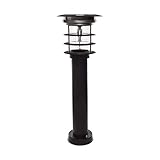
Gama Sonic GS-214 Stainless Steel Bollard Solar Lamp with EZ Anchor
Who it suits: Buyers with one important point on the bedroom side of the house — the bend where the path turns past the windows, a gate, the corner by the patio door — who want it marked by a permanent-looking fixture whose light stays low.
This is a premium-tier single fixture — among the most expensive single solar garden lights with a verifiable Amazon presence; check price on Amazon — and the bedroom case for it rests on its shape. A bollard is a low post that throws its light down at the ground it stands on; it does not sit at window height, and it does not fire a beam across the garden toward the glass. For a light that must run all night — this one is dusk-to-dawn — that geometry is the difference between a path edge you can see from the bed and a lamp glaring into the room. Place it at the turn of the path, away from the window line itself, and what reaches the bedroom is the lit ground, not the light source. No spotlight set here can make that claim as naturally.
What the money buys beyond shape is materials and serviceability rather than brightness. The body is black stainless steel with the maker’s GS Solar LED bulb behind thick glass; the retailer spec table for this model (item 214001) rates output at 100 lumens — a maker figure, and a modest one: a wired bollard at this money would out-light it several times over. What wired cannot do is install the way this does. The EZ Anchor base screws into the ground with no concrete, no trench and no cable, and the light then runs dusk-to-dawn on its own panel. For a single accent point far from an outlet, that install is the entire argument.
The serviceability is documented rather than promised. The integrated lithium-ion battery pack is rated by the maker’s retailer documentation at roughly three years, or about 1,000 charges — and it can be replaced, buying roughly another three years, instead of ending the fixture’s life. The GS Solar bulb itself is likewise a replaceable part, though a proprietary one that only fits Gama Sonic fixtures. The spec table lists a two-year manufacturer warranty, the longest published term among this guide’s Amazon-linked picks. One gap to note honestly: the verified spec data publishes no IP rating for this model, so we will not invent one. A practical note on buying it: the purchasable offer on Amazon may sit under “See All Buying Options” rather than as a featured offer, from the maker’s own Amazon storefront, and the same fixture is also sold at a specialist solar retailer. Check the current price on Amazon before you buy.
- Bollard form: light directed down at the path from a low fixture, so an all-night light can mark the route past the bedroom without shining at the windows.
- Stainless steel and glass construction — the only pick here that reads as a permanent fixture rather than a stake light.
- Replaceable battery pack (about three years or 1,000 charges per pack) and a replaceable bulb, under a two-year maker warranty.
Honest limitation: One hundred maker-rated lumens at a premium price is accent light at a statement price — you are paying for metal, glass, placement geometry and serviceability. The verified spec data also publishes no IP rating for the model.
Choose it if one point on the bedroom-side path deserves a real fixture, set low and away from the glass, that you plan to keep for years. Skip it if your $200 needs to light a whole yard, or if any all-night light near the room is unwelcome — the multi-light sets below cover more ground, and the Ring system above stays dark.
Linkind Smart Solar Spot Lights SL5C, 2-Pack
Who it suits: Bedroom-side gardeners who want control over individual lights — this pair washing the hedge below the window on a schedule, that pair off entirely — from an app, without Ring’s hub or ecosystem.
The SL5C is the smart end of the spotlight market: a two-pack of app-controlled, color-changing solar spotlights — check price on Amazon. Read through the bedroom lens, its headline feature is not the color — it is that each light answers to the AiDot app individually. Grouping, schedules and individual control mean the pair under the bedroom window can run a different life from the pair at the patio: on at dusk in warm white, off at the hour the house goes to sleep, while lights elsewhere do something else entirely. That granularity is what the Ring system sells at the premium end of this guide; here it comes in a lower tier, with no hub to buy.
The feature that justifies the maker’s name for it is in the panel, not the app. Linkind’s maker AiDot launched the SL5C as the first smart solar spotlight with MPPT — maximum power point tracking — charge control, a technique borrowed from larger solar systems that squeezes more charge out of weak, angled or intermittent light. That is aimed squarely at solar’s real enemy, the short grey days of winter, and it matters doubly on the bedroom side of a house, which is frequently the shaded side: a panel that harvests more from a brief window of sun is the difference between a light that keeps its schedule in December and one that gives up by nine. The listing’s spec fields rate the lights IP67, the strongest water rating in this guide alongside the StarRayS below.
What you do not get is a verified brightness figure. Linkind does not headline a lumen number for the SL5C in the spec data we could verify, and hands-on coverage describes its output as modest — the trade the maker made for smart control and color at this tier. Treat these as accent and wash lights for shrubs, signs and small trees, not as security floods, and aim them accordingly near a bedroom: at the planting, never across it toward the glass. The battery question is this pick’s honest weakness: no user-replaceable battery is documented for the SL5C in the material we could verify, so plan on the sealed-unit reality — when the cell fades, the light is done. At this pick’s lower-tier positioning that is a defensible trade, but it is exactly why this guide does not suggest building a permanent bedroom-side system out of sealed lights alone.
- Individual app control — schedules and grouping for each light — with no hub or bridge to buy: one of the most accessible ways to buy control in this guide.
- MPPT charge control — the only pick engineered specifically to charge better in weak winter light, which is the bedroom side’s usual condition.
- IP67 rating from the listing’s spec fields; full color-changing output when the occasion wants it.
Honest limitation: No verifiable maker lumen figure, modest output by reviewer accounts, a 12-month warranty, and no documented user-replaceable battery.
Choose it if you want bedroom-side accent lights you can schedule off at bedtime, light by light, for pocket money each. Skip it if you need documented brightness or a light you can service for a decade.

Linkind StarRayS Solar Spot Lights, 6-Pack, Warm White
Who it suits: Anyone who wants the warm, all-night path-and-garden glow — and has somewhere to put it that is not outside the bedroom windows: the far fence line, the front garden, the trees at the end of the plot that you look out at, rather than sleep beside.
The product itself is the coverage engine of the wider category. Six warm-white (3000K) spotlights, each staking into the ground or mounting on a wall, with three brightness modes and dusk-to-dawn operation: the verified configuration is model L180003-WW-US-6, and Amazon’s own listing title for it carries an IP67 rating. The 3000K colour is the warmest in this guide and the kindest through a window at distance. Check the current price on Amazon before you buy. As a six-pack in the lower tier of this guide, it is the coverage-value pick here — one pack spreads across several spots at once.
Brightness needs the standard warning, applied with specifics. Linkind markets the wider StarRay family with maker figures running as high as 650 lumens on some versions, and the family’s versions differ in LED count and output — the version confusion is itself a reason this guide refuses to print a single lumen number for the six-pack. What is consistent across the family’s documentation is the design: a separate adjustable panel and head, so the panel can face the sun while the beam faces the tree — and can be aimed precisely away from a window line. Run the lights on a lower mode and they trade peak brightness for hours, which in winter keeps them lit at midnight — and, beside a house, keeps a distant glow gentle rather than insistent.
The compromises are the usual sealed-set compromises, stated plainly. No user-replaceable battery is documented for these lights in the material we could verify, and we could not verify a published warranty term for this pack to the standard this guide requires — check the listing’s warranty line before you buy, and treat the purchase as a consumable system.
- Six dusk-to-dawn spotlights in one pack — the warm path glow of this guide, as its coverage-value option.
- 3000K warm white, three brightness modes, and separately adjustable panel and head, so beams can be aimed at planting and away from windows.
- IP67 in Amazon’s listing title for this exact model; stake or wall mounting.
Honest limitation: Dusk-to-dawn means all night — the wrong behaviour beside a bedroom window at any price. Check the current price on Amazon before you buy; the family’s lumen claims vary by version and are maker numbers throughout, and no replaceable battery or verified warranty term could be documented.
Choose it if the far side of the garden deserves a warm all-night wash and the bedroom side is handled by something controllable. Skip it if the only place these would go is under the windows — buy control instead.

URPOWER 2-in-1 Solar Spot Lights, 2-Pack
Who it suits: Buyers who want the proven, inexpensive spotlight pair for the jobs away from the glass — a sign, a flag, the shrubs at the far end of the bedroom-side path — and as the affordable partner that rounds out the premium plan in this guide.
Some context first, because it is this pick’s real credential: this listing has been on Amazon since July 2015 — a decade in the same form, in a category where brands vanish with the seasons. The design is the classic 2-in-1: each light stakes into the ground or screws to a wall, with an adjustable head and an adjustable panel, two brightness modes, and dusk-to-dawn operation. For bedroom-side use, stake it low and aim at planting; a spot screwed high beside a window throws its spill exactly where you least want it. The maker’s figures — labeled as maker figures — are about 200 lumens on the high mode from a 2,200 mAh battery, with a working time of six to nine hours on a full charge; the low mode is the bedroom-friendly setting, dimmer and longer. Check the current price on Amazon — the listing varies by color variant, so check the variant you want on the listing itself, which is the authority.
Now the spec honesty, because this listing is a small museum of the category’s habits. Amazon’s listing text rates the light IP64 — splash-resistant, the weakest water rating in this guide — while roundups around the web variously describe the same light as IP65 or IP67. Those numbers cannot all be true, and the listing’s own figure is the one to plan around: IP64 is fine for a light under eaves or in open rain for a season, but it is not the rating to bury in a wet bed and forget. The battery is integrated rather than user-replaceable, so the decade this design has survived should not be confused with a decade of service from any single unit.
Bought alone in multiples, four pairs give you eight adjustable spots — which is why this pair also finishes the premium plan in our final recommendation. It is not the brightest, toughest or smartest light here. It is the known quantity.
- A design on sale in the same form since 2015 — the category’s known quantity.
- Adjustable head and panel, stake or wall mounting, two brightness modes — run the low mode anywhere near the house.
- A lower-tier pair — check price on Amazon for the current variant.
Honest limitation: The listing’s own IP64 rating is the weakest here and conflicts with higher figures quoted elsewhere; it is a dusk-to-dawn light with no scheduling, so placement — low, aimed at planting, away from windows — is your only control; the battery is not user-replaceable.
Choose it if you need a cheap, proven pair to finish a plan or test where spots should go before committing. Skip it if the spot will live in standing water, or anywhere its all-night beam can reach a bedroom window.

Gama Sonic Baytown II Bulb Solar Lamp Post with EZ-Anchor Base
Who it suits: Buyers who want the look of a traditional lamp post — at a garden entrance, beside a drive, anchoring the far corner of the plot — without trenching cable or hiring an electrician, and who understand they are buying the form. In a bedrooms guide it is the boundary case: keep it as far from the windows as your garden allows.
This is the one product in the guide that spends nearly the whole budget on a single solar object, and it is reviewed in prose only: the full lamp-post version’s Amazon listing could not be pinned to this site’s two-source standard, so there is no link; it is sold by a specialist solar retailer and sits in the premium tier of this guide. What that money buys is a full-height lamp post in Gama Sonic’s Baytown II design, built around the maker’s GS Solar LED bulb, with an EZ-Anchor base that installs in the ground without concrete. The maker rates the bulb’s output at 130 lumens. Sit with that number: 130 maker-rated lumens at a premium-tier price is not a brightness purchase at all. It is a furniture purchase — a lamp post that happens to run on sunlight — and judged as furniture, against the cost of a wired post light plus trenching plus an electrician, it can be entirely rational.
The bedroom reading adds one more condition. A lamp post is a dusk-to-dawn light source at head height and above, designed to be seen — precisely the profile that intrudes on a sleeping room. At the garden entrance or the far end of the drive, that presence is the point, and from the bedroom it reads as a distant, pleasant marker; beside the patio outside the sliding door, it would be the single worst purchase in this guide. The post has no app, no schedule and no dimming to rescue a bad position, so placement is the whole decision. Its GS Solar bulb is a replaceable part — proprietary to Gama Sonic, but replaceable — which puts it ahead of every sealed light here on serviceability, and the same lantern head is sold separately as a three-way mounting kit (post, pier or wall), for less than the full post, from the same retailer. What we could not verify to this guide’s standard: a published warranty term for the lamp-post configuration and any Amazon offer for it — precisely why it carries no link.
- A full lamp post with tool-free EZ-Anchor installation — no trench, no cable, no electrician.
- Replaceable (proprietary) GS Solar bulb; the lantern head alone sells as a three-mount kit for less.
- The only single solar object that genuinely fills a $200 budget.
Honest limitation: One hundred thirty maker-rated lumens at this premium tier is poor light output for the tier by a wide margin; it is an all-night light at height with no controls of any kind, so it must live far from bedroom windows; and neither its Amazon offer nor its warranty term could be verified to our standard — hence no link.
Choose it if the lamp-post form itself is the goal and it will stand at the far end of the garden from where you sleep. Skip it if you need the garden lit, or if the only available spot is anywhere near the bedroom — every other plan in this guide lights more, more controllably, for less.
Prose only — no Amazon link for this pick, for the reasons stated above.
Comparison Table
| Product | Pack | Price | Per light | Output (maker figure) | IP (spec) | Battery | Warranty | Link |
|---|---|---|---|---|---|---|---|---|
| Ring Solar Pathlight with Bridge (2nd Gen) | 4 lights + Bridge | Check price on Amazon | — | Up to 80 lumens, motion-triggered | IP66 | Removable 18650, USB top-up | 1 year (maker) | Check on Amazon |
| Gama Sonic GS-214 Bollard | 1 fixture | Check price on Amazon | — | 100 lumens, dusk-to-dawn | Not published in verified spec data | Replaceable pack (~3 yrs / 1,000 charges) | 2 years (retailer spec table) | Check on Amazon |
| Linkind SL5C Smart Spot Lights | 2 lights | Check price on Amazon | — | No verified maker figure; app-controlled color | IP67 | Sealed; MPPT charging | 12 months (model documentation) | Check on Amazon |
| Linkind StarRayS Spot Lights | 6 lights | Check price on Amazon | — | Maker figures vary by version; 3 modes | IP67 | Sealed | Not verified — check listing | Check on Amazon |
| URPOWER 2-in-1 Spot Lights | 2 lights | Check price on Amazon | — | About 200 lumens (high mode); 6–9 hrs | IP64 (listing) | Sealed, 2,200 mAh | Not verified — check listing | Check on Amazon |
| Gama Sonic Baytown II Lamp Post | 1 post | Prose only — premium tier at a specialist retailer | — | 130 lumens, dusk-to-dawn | Not verified | Replaceable proprietary bulb | Not verified — buy where stated in writing | Prose only |
How to Choose Solar Garden Lights for Bedrooms at This Budget
Choose the behaviour before the product, because beside a bedroom the behaviour is the product. Solar garden lights come in two temperaments. Motion lights — the Ring pathlights here — rest dark and fire only when something moves, for an interval you set. Dusk-to-dawn lights — everything else in this guide — burn from sunset to sunrise regardless. If the ground outside the bedroom needs watching and occasional safe passage, motion is the answer: light exactly when a person is there, darkness the other 99 percent of the night. If a space needs a constant gentle presence, dusk-to-dawn is the answer, placed where its constancy cannot reach a pillow. The expensive mistake is buying one temperament while wanting the other, and beside a bedroom it is the mistake you will be reminded of every single night.
Do the sun audit on the bedroom side specifically, because it is often the worst side of the house. A solar light is a harvester before it is a lamp: the panel needs roughly six to eight hours of direct sun to fill the battery, and “direct” means sun on the panel, not brightness somewhere in the yard. Bedrooms frequently sit on the shaded side, under the eaves’ longest shadow and the neighbour’s fence — so walk that side at midday and again in mid-afternoon, note where the shadows fall, and remember that winter moves every one of them and shortens the day behind them. A light that runs nine hours in June may manage four in December, not because it is broken but because its fuel shrank; every runtime figure in this category is a summer figure wearing no label. Where a pick offers a separately adjustable panel (the StarRayS and URPOWER designs), angle the panel at the sun and the head at the subject; where the harvest is hopeless, favour the picks designed for scarcity — the SL5C’s MPPT charging, or the Ring’s USB top-up — over any amount of advertised lumens.
Decide solar versus wired with your eyes open, because at $200 the wired case is strong. A wired all-in-one kit from a mainstream Amazon brand such as SUNVIE bundles twelve cast-aluminum spotlights with a 60-watt transformer with photocell and timer, a hundred feet of cable and the connectors — everything in one box. That brand’s own Amazon spec fields rate its 12-watt wired spotlight at 900 lumens and its 3-watt path fixtures at 150 lumens each, and wired output is the same on a December Tuesday as on a June Saturday, all night, on a timer you set once — and a timer, beside a bedroom, is itself a control this guide values: wired lights can be told to go off at 11 p.m. and stay off. A ten-pack of those 12-watt wired fixtures is also sold alone, with the transformer bought separately. Against that, $200 of solar buys no trenching, no cable, no outlet, lights you can move on a whim — and output that depends on yesterday’s weather and fades as batteries age. Neither answer is wrong: solar for renters, accent light, distant corners and a Saturday-morning install; wired for security light, shaded lots, and anyone who wants a system to behave identically for a decade. What is wrong is buying solar while expecting wired behaviour, at any budget.
Compare packs like for like, and count the ecosystem. Pack sizes hide a lot in this category. Compare what each pack actually contains — this guide ranges from multi-packs built for coverage to a single premium lamp post — and then add what the system needs to deliver its headline features. Ring’s pathlights need their Bridge or an existing Sidewalk-capable hub; the kit here includes the Bridge, and bought separately it is an extra purchase, so a plan built from singles alone is not necessarily simpler than the kit, just incompletely costed. App-based lights like the SL5C need no hub, which is part of their value. For every linked pick, check the current price on Amazon before you compare.
At this budget, refuse sealed batteries in anything you call permanent. For a low-cost accent light, a sealed battery is a fair trade. For the fixtures you intend to define the bedroom-side path for years, it is not: the LED will outlive the cell several times over, and when the cell dies the whole fixture becomes waste. That is why this guide’s two premium picks are its two serviceable ones, and why sealed lights belong in lower-tier, supporting roles.
Read IP ratings from spec fields, and match them to the spot. The digits mean specific things: IP64 is splash-proof, IP65 withstands water jets, IP66 powerful jets, IP67 temporary immersion. Titles will call all of them “waterproof.” This guide’s verified spread — IP64 on the URPOWER listing, IP66 on the Ring, IP67 on both Linkind sets, and no published figure at all for the GS-214 — is the real landscape of the category. Put IP67 lights in wet beds and low spots, IP64 lights in sheltered spots, and treat unrated fixtures as fair-weather citizens.
Common Buying Mistakes
Lighting the whole house when the brief was one bedroom. The coverage plans in this category are seductive — fourteen, eighteen lights for under $200 — but a bedroom needs the lights on its own side of the house: the path it overlooks, its patio, its corner of the garden. The remaining lights will glow outside other rooms. Buy the bedroom’s share properly — controlled, serviceable, well-placed — and let the rest of the garden be a separate decision.
Believing the lumen headline. Solar lumen figures are maker numbers with no common standard behind them, and the same physical light can appear under different claims in different listings — this guide found one long-selling spotlight described at three different IP ratings across sources, and one spotlight family whose versions claim figures from a few hundred lumens to several times that. Judge by role and behaviour instead: dark-by-default, scheduled, or all-night.
Putting a dusk-to-dawn light under the window because the spot was convenient. The sunny patch beside the bedroom wall is often the easiest place to stake a light and the worst place for the sleeper. Near the room, the order of preference is motion first, scheduled app control second, and a low bollard aimed at the ground third. If none of those fits the spot, the spot does not get a light.
Forgetting the hub. Smart pathlights bought as singles or hub-free packs can arrive unable to perform a single smart feature. Ring states the requirement plainly — a Bridge or compatible hub, absent Sidewalk coverage. Price the ecosystem before the lights.
Judging a solar light in its first week. Batteries ship partially charged and panels perform at their annual best in summer. A light bought in June has shown you its ceiling, not its character; the honest test is a grey week in November — and, beside a bedroom, a week of sleeping next to it. Buy from sellers with real return windows, and give new lights two or three sunny days before concluding anything.
Final Recommendation
There is no $200 solar garden light; there are $200 solar garden lighting plans, and around a bedroom the right plan spends on control first. The bedroom plan: the Ring four-pack with Bridge — check price on Amazon — for the ground the bedroom actually overlooks — the path, the patio edge, the side yard — where its lights rest dark, fire as a group when someone walks through, and can alert your phone through a linked camera instead of announcing themselves to the whole room; plus one StarRayS six-pack — check price on Amazon — placed on the far side of the garden, where its warm 3000K dusk-to-dawn wash lights the trees and fence you look out at without ever reaching the windows. Together the two packs are presented as a plan within this guide’s $200 budget — check the current price on Amazon for each before you buy — and any room left in the budget is not a rounding error: the bedroom’s lighting problem is solved at that point, and the honest advice is to keep the remainder unspent. If the bedroom side needs more controlled points rather than a distant glow, swap the StarRayS pack for two expansion singles: the Ring Solar Pathlight single — check price on Amazon — is the same light sold one at a time, and kit plus two singles gives six motion-aware lights with replaceable batteries and the hub included.
Now the wider category’s two coverage plans, verdict changed for this lens. The whole-garden wash plan — four SL5C two-packs (eight app-controlled spots) plus a StarRayS six-pack — gives fourteen spotlights; the maximum-coverage plan — three StarRayS six-packs — puts eighteen dusk-to-dawn spots in the ground. Check the current price on Amazon for each pack before you buy. For one bedroom they overspend on the wrong thing: a bedroom is overlooked by perhaps a quarter of the house’s perimeter, and only the lights on that quarter affect the sleeper. The bedroom-sized version — one StarRayS pack for the far side plus two SL5C two-packs under app control near the house — does the bedroom’s whole job while leaving part of the budget unspent. The premium plan survives the lens change intact: one GS-214 bollard — check price on Amazon — defining the turn of the bedroom-side path — low, downward, permanent — plus a URPOWER pair — check price on Amazon — away from the glass, as a plan within this guide’s $200 budget. Choose the Baytown II lamp post only if the post itself is the purchase and it will stand at the far end of the plot; near a bedroom it is the one pick here we would actively talk you out of. And hold the wired comparison in mind: if your bedroom side is deeply shaded, or the light’s job is security rather than welcome, the same money in a wired low-voltage kit — on a timer that switches it off at bedtime — will serve you better every night of the year.
FAQ
Why does nothing here actually cost $200?
Because the verified Amazon market tops out lower. Even the premium mainstream products — Ring’s four-pack kit with Bridge, the priciest single fixtures with a verifiable Amazon presence — sit below the top of this budget, and the upper part of the budget band is nearly empty for single products. Check the current price on Amazon for each pick. So at this budget the honest purchase is a system of lights, not a single product.
Will solar lights outside my bedroom window keep me awake?
It depends entirely on the light’s behaviour, which is why this guide ranks behaviour above brightness. A motion-triggered light rests dark and runs for 30 seconds to two minutes when something passes — most sleepers never register it. A dusk-to-dawn light glows against the curtains all night; at a distance, aimed at planting, that reads as a pleasant garden view, but staked under the window it is the most common cause of regret in this category. If you are light-sensitive, put control beside the room — motion or app scheduling — and keep constant glow far away and low.
How long do solar garden lights stay lit in winter?
Shorter than the box suggests — every runtime claim assumes a full charge from six to eight hours of direct sun, and winter offers less sun, at a lower angle, often through cloud. Expect a meaningful drop, sometimes half or worse on the darkest weeks. Designs that fight back have a rescue option: the Ring pathlight’s battery can be topped up over USB, and the Linkind SL5C’s MPPT charging harvests more from weak light. Running multi-mode lights on a lower setting also trades brightness for hours.
Can the batteries be replaced?
In the picks that anchor this guide, yes: every Ring pathlight uses a standard removable 18650 cell, and the Gama Sonic GS-214’s battery pack is replaceable at roughly three-year intervals, as is the Baytown II’s proprietary bulb. The Linkind and URPOWER sets document no user-replaceable battery, so treat them as sealed units whose life is their battery’s life — acceptable in their lower-tier supporting roles, and the reason they fill supporting roles rather than permanent ones here.
Do Ring solar pathlights need the Bridge?
For their smart features, effectively yes — Ring states that a Ring Bridge or a compatible hub is required to control its smart lights, unless your home has Amazon Sidewalk coverage or a Sidewalk-capable device already providing it. The four-pack in this guide includes the Bridge (2nd Gen); bought separately it is an extra purchase — check the current price before you buy. Add-on singles like the single Ring Solar Pathlight assume the Bridge is already in the house.
Solar or wired low-voltage — which is better at $200?
Different, and the evidence cuts both ways. A wired kit with twelve aluminum fixtures, a timer transformer and cable included is the comparison here, with maker-rated outputs (up to 900 lumens per 12-watt fixture in that brand’s spec fields) that hold steady every night regardless of weather — and a timer that can switch the lot off at bedtime. Solar buys freedom from trenching and outlets, movable lights, and accent charm — with output that follows the weather and batteries that age. Choose wired for security and shade, solar for sun, renters and far corners.