Where to buy
Check the latest price, availability and delivery on Amazon. Orders are placed on Amazon. We may earn a commission from qualifying purchases.
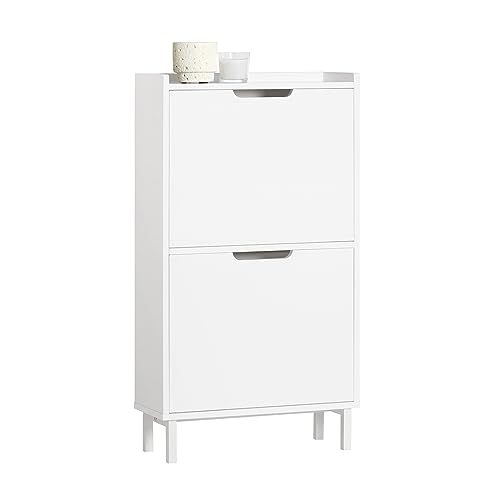
- Best overall for small apartments: Haotian Slim Shoe Cabinet with 2 Flip Drawers, FSR151 — Check on Amazon
- FUFU&GAGA Shoe Cabinet with 2 Flip Drawers — Check on Amazon
- BORNOON Shoe Cabinet with 2 Flip Drawers — Check on Amazon
- Angel Sar Rattan Shoe Cabinet with 2 Flip Drawers — Check on Amazon
- VASAGLE LIRY Collection Shoe Cabinet, 3-Tier with Hinged Doors — Check on Amazon
- HOMEFORT Shoe Storage Cabinet with 2 Flip Drawers — prose-only pick, see the review below for why
Read the full guide ↓
Disclosure: As an Amazon Associate, dailyhomedecorating.com earns from qualifying purchases. Links to Amazon on this page are affiliate links; they cost you nothing extra. Listing details such as price and availability change often, so check the current Amazon listing before you buy.
The best shoe cabinet for small apartments under $100 has to solve a geometry problem before it solves a storage problem. In a small apartment there is no mudroom, no foyer, often no hallway at all — the front door opens into the living room, and the shoes come off in the same square meters where you eat, work and watch television. Every pair left by the door is visible from the sofa. Every inch of furniture depth is taken from a room that had none to spare. And in a rental, the cabinet cannot be built in, screwed into a stud wall without thought, or left behind when the lease ends. That is why apartment shoe storage fails in predictable ways: the open rack that turns the living room’s entrance into a shoe shop display, the deep cabinet that narrows the only passage to the kitchen, the tall unit that a landlord’s no-anchors rule makes a tip hazard. A closed cabinet is the right format — it hides the shoes and reads as furniture — but in an apartment the cabinet’s dimensions matter more than its capacity, and its depth matters most of all.
This guide ranks the under-$100 closed-cabinet field by apartment logic. Depth first: the winner is about seven and a half inches deep, the shallowest closed cabinet we could verify, and it can stand behind a door or in a passage that no other cabinet here fits. Width second: compact footprints under two feet and standard slim widths around thirty inches cover the wall fragments apartments actually offer. Rental reality third: freestanding stability, anti-tip solutions that respect lease terms, and furniture you assemble in the room and take with you when you leave. Capacity is stated honestly throughout — apartment cabinets hold the daily rotation, and this guide treats that as a feature, because a small home edited to its rotation is calmer than a small home storing everything badly. One farmhouse model is covered prose-only because its price would not stay verifiably under $100. If your apartment has no entryway at all, read on: the placement advice in the later sections matters as much as the picks.
In this guide
Quick Picks
Short on time, or comparing several options at once? Each row below names an apartment situation and the cabinet that suits it, with a link to the listing where one is available.
| Apartment situation | Pick | Why it stands out | Link |
|---|---|---|---|
| Best overall for small apartments | Haotian Slim Shoe Cabinet, FSR151 | About 7.5 inches deep — fits behind doors and in passages nothing else fits | Check on Amazon |
| Best compact all-rounder | FUFU&GAGA Shoe Cabinet with 2 Flip Drawers | 22.4 inches wide, removable tiers, a low styled top | Check on Amazon |
| Best for couples and sharers | BORNOON Shoe Cabinet with 2 Flip Drawers | Four compartments — two per person — behind hidden-handle fronts | Check on Amazon |
| Best for studio style | Angel Sar Rattan Shoe Cabinet | Rattan fronts and legs — storage that decorates a one-room home | Check on Amazon |
| Best if you have a real entry wall | VASAGLE LIRY Collection Shoe Cabinet | Hinged doors and flat shelves for full-size shoes — needs depth | Check on Amazon |
| Most capacity, farmhouse look | HOMEFORT Shoe Storage Cabinet | Layered flip drawers — covered prose-only, verify the live price | See review |
How These Picks Were Chosen
The base filters are the same as our main under-$100 cabinet guide: fully closed cabinets only — no open racks, which in an apartment living room are a visual problem, not a storage solution — real Amazon listings, and prices verified inside the budget at research time, with one prose-only exception handled openly. Check price on Amazon before you buy; this category’s prices move with coupons. The apartment screening then re-weighted everything. External depth counted double, because in a small home depth is taken from living space. Footprint flexibility counted next: cabinets that work in under two feet of width, or tall-and-narrow formats that spend height instead of width, outranked wide low cabinets that assume a foyer. Rental practicality counted throughout — freestanding assembly, no built-in anything, and anchoring options compatible with lease terms, including the honest advice that a strap into a stud is usually one small filled hole at move-out, while adhesive alternatives and wedging strategies exist for strict leases. Capacity was deliberately de-weighted: a cabinet that holds eight pairs in seven inches of depth serves an apartment better than one holding sixteen in fourteen.
We did not use these cabinets ourselves. Dimensions, mechanisms and materials come from maker listings, instruction manuals and specification sheets, cross-checked against retail coverage; where a figure comes from a maker’s optimistic listing copy, the review says so and gives the realistic planning number instead. Apartment Therapy’s long-running coverage of the slim cabinet that leads this guide — written from a small New York apartment — informed the realistic capacity and fit expectations for that pick in particular.
The 6 Best Shoe Cabinets for Small Apartments Under $100
Haotian Slim Shoe Cabinet with 2 Flip Drawers, FSR151
Who it suits: Studios and one-bedrooms with no entryway, narrow passages, and behind-the-door gaps — any apartment where depth is the scarcest resource in the home.
Start with the number that decides apartment storage: about 7.5 inches deep. The Haotian FSR151 is the slimmest closed shoe cabinet we could verify in this budget, shallower than the famous Scandinavian cabinet it takes its format from, and that inch and a half of difference against standard slim cabinets is the difference between fitting behind a front door’s swing and not fitting at all. The two-drawer version measures roughly 19.7 inches wide and 35.8 inches high; a three-drawer sibling in the same width stands about 50.8 inches tall, and for apartments the tall version is often the smarter buy — height is the one dimension small homes have, and spending it costs no floor. The fronts are flat panels in white, black or grey with hollowed cutout handles, so nothing protrudes into a passage for hips and laundry baskets to catch. The base is raised, letting cleaning pass underneath and a pair of slippers tuck below, and the interior shelf adjusts. Long-running apartment coverage of this cabinet line is candid about capacity — around six pairs in the compact version — and about fit: the steep tilt of a 7.5-inch bucket suits small-to-average sizes and everyday shoes, and the drawers can stick slightly, wanting a braced hand as you pull. Check price on Amazon; it sits at the accessible end of this budget.
For renters, the practicalities are friendly: it is light, flat-pack, assembles in the room it will serve, and leaves with you. Anchoring deserves a sentence of its own — a tall, 7.5-inch-deep cabinet should be fixed; if your lease forbids screws, place the tall version in a corner or against a wall run where a wedge or furniture strap to an adjacent heavy piece can steady it, and never rely on a shallow cabinet standing free in a earthquake-or-toddler zone. Within its brief — daily pairs, tiny footprint, closed front, minimal look — this is the apartment cabinet the others are measured against, and the wider slim-format discussion continues in Best Shoe Cabinet For Small Spaces Under $100.
- About 7.5 inches deep — behind doors and in passages no other closed cabinet fits.
- Tall three-drawer version spends height instead of floor space.
- Cutout handles and raised base — passage-proof and cleaning-friendly.
Honest limitation: Around six pairs in the compact version and a firm ceiling on shoe size; the drawers can stick slightly and want a braced pull.
Choose it if depth is your apartment’s binding constraint. Skip it if your shoes are large or your collection is the problem, not your floor plan.
FUFU&GAGA Shoe Cabinet with 2 Flip Drawers
Who it suits: Small apartments with one usable wall fragment beside the door — under two feet wide — that need a cabinet which doubles as a styled surface.
Where the Haotian wins on depth, the FUFU&GAGA wins on footprint balance: about 22.4 inches wide, 9.4 inches deep and 29.2 inches high is a cabinet that fits the wall fragment beside a front door in most one-bedrooms, deep enough to be less fussy about shoe sizes than the ultra-slim — planning ceiling around a men’s size 10 — and low enough that its top becomes genuinely useful apartment furniture: a plant, a mail tray, the bowl for keys, at a height that does not crowd a small room’s sightlines. The two flip drawers each carry two tiers, and the tiers remove, which in an apartment matters out of proportion to the feature’s size: one drawer configured for stacked everyday flats, the other opened up for the ankle boots you actually wear all winter, reconfigured in minutes when the season turns. The MDF body has a waterproof finish — apartment entries meet wet weather with nowhere else for it to go — and the modern flat fronts come in finishes from deep brown to light wood. Check price on Amazon; it sits mid-budget.
Think of it as the apartment’s entry console that happens to hold shoes: roughly six to eight daily pairs for one or two people, in the room where you live, without announcing itself as storage. It will not serve a shoe collection, and in a studio it should be paired with under-bed boxes for the archive — but as the visible, daily, closed storage in a small home, it is the most livable object in this guide. Assembly is standard flat-pack, sized kindly for small rooms: build it where it stands, because carrying assembled furniture through apartment doorways is nobody’s hobby.
- Compact 22.4-inch width for the wall fragment beside the door.
- Removable tiers — one drawer for flats, one reconfigured for boots season.
- Low top works as the apartment’s entry console surface.
Honest limitation: Six to eight pairs realistically, with a fit ceiling around a men’s size 10 — a rotation cabinet, not a collection cabinet.
Choose it if you have one small wall and want it to look intentional. Skip it if two people with full collections share the apartment — read the BORNOON next.
BORNOON Shoe Cabinet with 2 Flip Drawers
Who it suits: Couples and flatmates in small apartments — two people, one entryway, and a daily need to keep two shoe rotations separate in under a square meter of wall.
Sharing a small entryway has a specific friction: two people’s shoes in one communal cabinet means the smaller pairs sink, the morning search doubles, and the cabinet top becomes contested territory. The BORNOON’s divided interior is the apartment answer — two flip drawers split into four compartments, which for a couple is simply two compartments each: work shoes and everyday shoes, separated, findable, closed away. The cabinet is the brand’s slim format, roughly nine and a half inches deep with hidden handles and unbroken flat fronts in white or black; against a pale apartment wall the white version all but disappears, which in a small living space is a genuine design achievement. A range warning applies: the brand’s three-drawer model is the famous one and was priced above this budget when checked, so the two-drawer is the pick — check price on Amazon and confirm the variant before ordering, as the listings look nearly identical.
Capacity, stated for a couple rather than a catalog: plan on roughly five mixed pairs per person across two compartments each — a full weekly rotation for two adults in an apartment, provided the out-of-season pairs live under the bed where apartment archives belong. Fixed compartment widths suit mixed sizes better than two large-footed adults, who should split the difference with the VASAGLE below if their entry wall allows its depth. For the family-scale reading of this cabinet’s division system, see Best Shoe Cabinet For Families Under $100; in the apartment context, it is the sharing pick.
- Four compartments — two per person for couples and flatmates.
- Hidden handles and flat fronts that disappear against apartment walls.
- Two-drawer version verified in budget; the three-drawer was not.
Honest limitation: Fixed compartment widths and rotation-sized capacity — two edited shoe wardrobes, not two full ones.
Choose it if two people share one small entry. Skip it if both wear large sizes or neither will edit a rotation.
Angel Sar Rattan Shoe Cabinet with 2 Flip Drawers
Who it suits: Studio apartments, where the entry is the living room is the bedroom — and the shoe storage will be looked at all day, every day.
In a studio, there is no such thing as a purely functional object: everything is in the room. That is the Angel Sar’s case. Its two flip drawers wear natural rattan fronts with slim golden handles, the body stands on metal legs that create a light shadow gap and let a vacuum pass, and in natural wood, black or white it functions as a small woven sideboard that happens to contain about six pairs of shoes — two fold-down drawers at roughly three pairs each, with adjustable shelving in current listings. Six pairs is a studio-sized rotation, and the honest studio system pairs this cabinet with under-bed storage for everything else. What the cabinet returns for its small capacity is disproportionate: it makes the entrance corner of a one-room home look decorated rather than stored-in, and in studio living that visual calm is worth pairs. Check price on Amazon; it sits toward the premium end of this budget, buying the front of the thing.
Studio cautions are placement ones. Keep the woven fronts out of the bike-storage corner — rattan dislikes knocks — and off the direct line of a wet-weather door swing. The breathable weave is a quiet plus in a one-room home, where shoe odor has nowhere to dissipate to. If your studio’s style is strict monochrome minimal instead, the BORNOON in white is your disappearing act; the Angel Sar is for studios that run warm. The decor-first angle is developed in Best Shoe Cabinet For Modern Homes Under $100.
- Rattan fronts and metal legs — a sideboard’s looks in a studio’s entrance corner.
- About six pairs — a one-room rotation, honestly sized.
- Breathable woven fronts help in single-room living.
Honest limitation: The smallest capacity here and a natural material that dislikes knocks — style is the purchase.
Choose it if your whole home is one room and looks matter daily. Skip it if the cabinet must hold more than a rotation.
VASAGLE LIRY Collection Shoe Cabinet, 3-Tier with Hinged Doors
Who it suits: The minority of small apartments with a genuine entry wall or a closet-sized alcove — and apartment dwellers whose large shoes make every slim cabinet a non-starter.
This pick comes with its condition in the first line: it is about 13.8 inches deep, the deepest cabinet in this guide, and in most small apartments that depth disqualifies it from hallway duty. It earns its place for two apartment situations. The first is the apartment with an alcove, a wide entry niche or a dead corner of living room where fourteen inches exist and a cabinet can sit as furniture: there, its hinged doors and three flat shelves store shoes the normal way — lying flat, full-size, no tilting — with the upper shelf adjustable through five positions for heels and ankle boots, capacity an honest 9 to 12 pairs, and a wide top that works as the apartment’s console. The second is the large-footed apartment dweller, for whom slim flip drawers are not a compromise but a refusal: if your shoes do not fit the format, the format is wrong, and this is the under-$100 closed cabinet that fits your feet. The build includes an elevated base and an anti-tip kit. Check price on Amazon; it sits comfortably in budget.
Measure with unusual care before choosing it in a small home: tape its footprint and door swing on the floor and live with the tape for a day. If the swing crosses the front door’s path or the depth steals the passage, the apartment answer is the Haotian, full stop. But where the space genuinely exists, this is the most conventional, capacious and size-forgiving cabinet under $100 — the one that behaves like the built-in your apartment does not have. The full-field context is in Best Shoe Cabinet Under $100.
- Flat shelves behind hinged doors — the only pick that fits large shoes properly.
- Adjustable upper shelf and 9–12 honest pairs; top works as a console.
- Anti-tip kit and elevated base included.
Honest limitation: Fourteen inches deep with door swing — an alcove or entry-wall cabinet, never a passage cabinet.
Choose it if you have the niche or the shoe size that demands it. Skip it if your only space is a passage — depth will punish you daily.
HOMEFORT Shoe Storage Cabinet with 2 Flip Drawers
Who it suits: Small apartments with one decent stretch of wall — around thirty inches — whose owners want maximum closed capacity in the flip format and a farmhouse look.
The HOMEFORT is covered prose-only, without a link, because its price sightings straddle this budget’s line — trackers show it inside $100, Amazon’s own category page has shown it above — and an under-$100 guide does not link on a coin flip. Verify the live listing; when it sits under $100, it offers the apartment-relevant version of capacity: two flip drawers with two internal layers each, panels that adjust to two positions or remove, and a realistic mid-teens count of mixed pairs — the most daily storage in the slim class, in a body roughly thirty inches wide on wood legs with a flat, styleable top. For a couple in a one-bedroom whose only shoe wall is the living room wall, that combination — closed, slim, capacious, furniture-looking — is exactly the brief. The maker’s manual confirms the layered, adjustable design; assembled weight around 52 pounds gives it a settled, furniture feel once built.
Apartment cautions: assembly is reported as the fiddliest here, and in a small home, build it in place — there is no spare room to assemble in and carry through. The farmhouse finish is a style commitment in a modern apartment; in washed grey it blends more quietly than the rustic brown. If the live price is over budget, the apartment substitutes are the BORNOON for division and the FUFU&GAGA for compactness; the next tier up is mapped in Best Shoe Cabinet Under $150.
- Two layers per drawer — the slim class’s highest realistic capacity.
- Adjustable panels adapt layers to seasons and sizes.
- Prose-only: price sightings conflict across the $100 line — verify first.
Honest limitation: Price instability, fiddly assembly, and a farmhouse look that must suit the room.
Choose it if the live price is under $100 and one wall must do all the work. Skip it if the price has drifted or your wall run is under thirty inches.
Comparison Table
| Product | Footprint character | Best apartment use | Link |
|---|---|---|---|
| Haotian FSR151 | ~7.5 in deep, 19.7 in wide | Behind doors, passages, no-entry studios | Check on Amazon |
| FUFU&GAGA 2 Flip | ~9.4 in deep, 22.4 in wide | The wall fragment beside the door | Check on Amazon |
| BORNOON 2 Flip | Slim, 4 compartments | Couples and flatmates sharing | Check on Amazon |
| Angel Sar Rattan | Slim, legged, ~6 pairs | Studio style corner | Check on Amazon |
| VASAGLE LIRY | ~13.8 in deep, doors swing | Alcoves, entry walls, large sizes | Check on Amazon |
| HOMEFORT 2 Flip | Slim, layered drawers | Maximum capacity on one wall — verify price | See review |
How to Choose the Best Shoe Cabinet for Small Apartments Under $100
- Measure depth against your passage, not your hopes. Tape the cabinet’s depth on the floor where it would stand and walk past it carrying shopping. If you brush the tape, go slimmer — the 7.5-inch class exists for exactly this test.
- Spend height before width. Tall narrow cabinets store more per square foot of floor. If your wall run is short but your ceiling is standard, the tall variant of a slim cabinet is the apartment move.
- Check the door-swing map. Your front door, the cabinet’s drawers or doors, and you, all need the same square of floor at different seconds. Chart the arcs; flip drawers need a knee’s depth, hinged doors a full width.
- Plan the rental-safe anchor. Slim tall cabinets must be steadied. A strap to a stud is one small hole to fill at move-out; strict leases can use corner placement plus a strap to adjacent heavy furniture. Never leave a 7.5-inch-deep tall cabinet free-standing where it can be pulled.
- Size for the rotation, store the archive elsewhere. Under-bed boxes, a closet shelf or over-door storage take the out-of-season pairs. The cabinet that only holds this month’s shoes stays findable and closable.
- Give the top a job with edges. A tray turns the cabinet top into a landing strip that contains keys and mail; without edges, the top becomes the pile the cabinet was bought to replace.
- Think about the move. Apartment furniture gets carried down stairs eventually. Flat-pack cabinets that disassemble or carry light — and that you assembled in place — are the ones still with you in the next home.
- Match finish to your light. Small entries are often windowless; pale finishes keep them open, dark finishes ground a bright studio. Judge by your bulb light at night, not the listing photo.
Where Does a Shoe Cabinet Go When There Is No Entryway?
The defining small-apartment problem deserves its own answer. When the front door opens straight into the living room, the cabinet has four candidate homes. First, the door wall itself, beside the door’s hinge side if the swing allows — the natural drop zone, and the right answer whenever a nineteen-to-thirty-inch fragment exists there. Second, behind the door, in the wedge that is dead space whenever the door is open — the ultra-slim cabinet’s natural habitat, provided the door’s handle does not strike it; measure the handle’s arc before ordering. Third, the end of a furniture run: at the back of a sofa that divides a studio, or continuing a bookshelf line, where a low cabinet reads as part of the furniture plan rather than an entryway apology. Fourth, the bedroom or dressing corner, accepting the walk — workable when the living room truly has no wall, and better than a living-room pile. What unites the good placements is that the cabinet stands where shoes already come off; a cabinet placed by leftover space rather than by behavior will be walked past, and walked-past storage is decoration with shoes around it. The tighter the home, the more this behavioral rule decides success — a theme the companion guide at Best Shoe Cabinet For Small Spaces Under $100 pursues into closets, landings and other non-apartment small spaces.
The Apartment Storage System Around the Cabinet
A cabinet alone does not organize an apartment’s shoes; a cabinet at the center of a small system does. The system has three tiers, and the discipline is knowing which tier a pair belongs to. Tier one is the cabinet: this week’s shoes, by the door, closed away. Tier two is the near archive — a lidded box in the closet or a flat box under the bed holding next season’s pairs and the formal shoes, reachable in a minute but out of the daily visual field. Tier three is the honest exit: shoes not worn in a year leave the apartment, because in a small home every stored object pays rent in space and an unworn pair is the most expensive kind. Households that run the three tiers find an eight-pair cabinet generous; households that ask the cabinet to be all three tiers find a sixteen-pair cabinet inadequate. The cabinet did not change — the system did.
Two small accessories complete the apartment setup, neither of them furniture. A slim boot tray beside the cabinet through the wet months keeps slush out of the drawers and off the floor the landlord will inspect at move-out. And a washable mat inside the cabinet’s bottom area, or a liner on its floor, catches the daily grit that otherwise grinds into the finish — apartment cabinets live harder lives than house cabinets, because the entry is also the living room and there is no mudroom taking the first hit of weather. With the tray, the liner and the three tiers in place, the picks in this guide stop being compromises and start being what they were designed to be: the closed, calm front line of a small home’s storage.
Measuring a Small Apartment Entry: The Tape Protocol
Small spaces punish approximate measuring, so here is the exact protocol these picks assume. Stand at the front door and identify the wall fragment you intend to use. Measure its length at baseboard height, not at eye height — baseboards, radiators and door casings steal inches at the bottom that the wall above does not admit to. Measure the depth available by closing the front door and marking, with tape on the floor, the line the door’s swing sweeps; your cabinet’s front must live behind that line or accept a daily tap. Measure the handle height and arc separately: a lever handle at the wrong height will strike a tall cabinet that a knob would have cleared. Then measure your largest daily shoe — length and height together — and keep that pair of numbers in front of you while reading any listing, because interior fit is decided by your shoe, not by the cabinet’s exterior headline dimensions. Finally, photograph the taped outline and live with it for a day of normal apartment traffic — laundry basket, grocery bags, a bicycle if you keep one — before ordering. Ten minutes of tape prevents the most common small-apartment outcome in this category: a good cabinet returned because the home it entered was measured in optimism.
Small Apartment, Two People: Dividing the Cabinet Fairly
Most small-apartment shoe conflict is not about space; it is about shares. One partner’s six pairs colonize the cabinet while the other’s live in a bag by the bed, and the resentment attaches to the furniture. The fix is allocation at installation, stated in pairs rather than vibes: in a two-drawer cabinet, a drawer each; in a divided cabinet, two compartments each; in a door cabinet, a shelf each with the adjustable shelf set to equalize the heights. Equal shares feel smaller than shared space and work better, because each person edits their own rotation instead of negotiating a commons. Visitors’ shoes, gym overflow and the seasonal swap belong to the under-bed tier, which is shared precisely because it is rarely opened. Couples who set the allocation on day one almost never discuss the cabinet again — which, in a small apartment where every object is within earshot of every argument, is the highest praise storage can earn.
Moving Day: The Renter’s Cabinet Checklist
Apartment cabinets get moved, and the ones chosen with moving in mind survive it. Before a move, photograph the cabinet assembled — front, interior, and the drawer mechanisms — because reassembly in the new home goes twice as fast with a reference, and flip hardware reinstalled in the wrong orientation is the classic second-home failure. Keep the hardware bag taped inside a drawer rather than in a box of mixed screws. Wrap the fronts, not just the corners: flat panels and woven fronts alike are damaged by other furniture in a truck, never by their own weight. At the new home, re-run the tape protocol before choosing the wall — the fragment that fit the last apartment’s door wall rarely matches the new one’s swing — and re-anchor even if the last installation felt rock solid, because floors and walls differ. Cabinets in this guide are light, flat-pack and forgiving of all this; that portability, unglamorous as it sounds, is a core reason they suit rental life better than any built-in a landlord would never approve.
Common Buying Mistakes
- Measuring the wall but not the door swing — then living with a cabinet the front door taps every single day.
- Buying depth you do not have because the capacity looked better, and narrowing the only passage in the home.
- Expecting an apartment cabinet to hold a full collection, filling it completely, and recreating the pile on top of it.
- Skipping any form of anchoring on a tall slim cabinet in a rental — the lease worry is one filled hole; the alternative is a tipping cabinet.
- Ordering the lookalike three-drawer variant of a two-drawer pick and overspending past the budget in one click.
- Placing the cabinet where space was left over instead of where shoes come off.
- Choosing a deep door cabinet for a passage because the photos showed a foyer.
- Forgetting wet weather: no tray, no mat, and a small apartment’s only entry corner smells of damp shoes by November.
Final Recommendation
- Most small apartments: Haotian Slim Shoe Cabinet, FSR151 — in the tall version if your wall allows height.
- One small wall, styled: FUFU&GAGA Shoe Cabinet with 2 Flip Drawers.
- Couples and flatmates: BORNOON Shoe Cabinet with 2 Flip Drawers.
- Studios that live in one room: Angel Sar Rattan Shoe Cabinet.
- Alcoves and large sizes: VASAGLE LIRY Collection Shoe Cabinet.
- Maximum slim capacity, price permitting: HOMEFORT Shoe Storage Cabinet — verify the live price.
For most small apartments the Haotian is the answer, because depth is the constraint that cannot be negotiated and seven and a half inches negotiates it. Choose the FUFU&GAGA when you have a slightly kinder wall and want the cabinet to double as your entry console; the BORNOON when two rotations must stay separate; the Angel Sar when the room is your whole home and must look like one; the VASAGLE only when an alcove or a large shoe size honestly demands its depth. Tape the footprint before you order, anchor whatever you buy, and keep the archive under the bed — a small apartment with an edited rotation and a closed cabinet feels larger than a bigger home with a shoe pile, every single day. If the entry also needs a seat or a surface, the pairings in Best Entryway Bench Under $100 complete the corner.
Studio Living: One Room, Zero Hiding Places
The studio is the small apartment’s hardest case and deserves its own paragraph of honesty. In one room, the shoe cabinet is bedroom furniture, living-room furniture and entry furniture simultaneously, visible from the bed at the hour you are most tired of looking at your possessions. That visibility changes the ranking criteria: the cabinet’s front matters as much as its interior, its top will be styled whether you plan it or not — because an unstyled surface in a studio becomes a shelf by default — and its odor discipline matters, since the shoes sleep in the same air you do. The practical studio system is the prettiest cabinet you can justify for the daily pairs, placed to define the entry zone of the room — a rug line and the cabinet together invent a foyer the floor plan omitted — with the archive exiled under the bed and the wet-weather tray treated as non-negotiable. Studios furnished this way feel deliberately zoned; studios with an open rack by the door feel like a room with a shoe problem, and the difference costs nothing but the choice of a closed front.
A Note on Honest Expectations
Under-$100 apartment cabinets are flat-pack furniture, and this guide’s enthusiasm is calibrated accordingly. What the money buys, spent well, is a closed front, a footprint that respects the room, mechanisms that work daily and finishes that survive apartment weather for years — not heirloom joinery, and not capacities beyond the realistic figures stated in each review. The apartment buyers who love these cabinets are the ones who sized them to a rotation, anchored them properly and gave their tops a tray; the disappointed ones asked a seven-inch cabinet to be a closet. Read the limitations in each review as part of the product, choose the pick whose limitations your home can absorb, and the cabinet will repay the honesty by simply working, quietly, in the smallest room of your life.
Frequently Asked Questions
What depth shoe cabinet suits a small apartment?
Seven and a half to nine and a half inches covers most apartment passages and behind-door gaps. The slimmest class, around 7.5 inches deep, fits where nothing else closed will go; standard slim cabinets around 9.4 inches fit most walls beside a door. Anything deeper belongs in an alcove or on a true entry wall, never in a passage.
Can I put a shoe cabinet behind my front door?
Often, yes — it is the ultra-slim cabinet’s best trick. Measure the wedge with the door fully open, check that the door handle’s swing clears the cabinet front, and confirm the drawers can still tip toward you when you stand in the gap. If the handle strikes or the drawers cannot open, the spot fails and the wall beside the door is next best.
How do I anchor a cabinet in a rental without losing my deposit?
A furniture strap into a stud leaves one or two small screw holes — typically filled with a dab of filler at move-out for pennies, and many leases permit picture-hanging-scale holes. For strict no-hole leases, use corner placement, load the bottom drawer heaviest, and strap the cabinet to an adjacent heavy furniture piece. What you should not do is leave a tall 7.5-inch-deep cabinet entirely free-standing.
How many pairs should an apartment shoe cabinet hold?
Your daily rotation: four to eight pairs for one person, eight to twelve shared between two in the divided or layered models. Everything beyond that — seasonal, formal, spare — belongs in under-bed or closet storage. An apartment cabinet sized to the rotation stays closable and findable; one sized to the collection becomes the pile it replaced.
Will slim cabinets fit my shoe size?
Small-to-average sizes fit the slim format well. Around a men’s size 10 is the practical ceiling for standard slim cabinets, and the ultra-slim 7.5-inch class is tighter still. If your household wears larger sizes, choose the hinged-door VASAGLE for the pairs that matter and let a slim cabinet handle the smaller pairs.
How much assembly space do I need in a small apartment?
About the cabinet’s own footprint plus room to kneel — build it in place, panel by panel, rather than clearing a construction zone you do not have. Carry parts in from another room as needed, keep hardware in a bowl, and stand the cabinet up only when the frame is complete. Every pick in this guide was chosen partly for tolerating exactly that procedure.
What if my apartment has no wall fragment at all?
Then the cabinet goes where furniture already stands: continuing a sofa’s back line, at the end of a bookshelf run, or in the bedroom dressing corner, accepting the short walk as the price of a living room without a shoe zone. The placement section above ranks these fallbacks; the principle is that a cabinet integrated into the furniture plan beats a cabinet squeezed into a passage it narrows, every time.
Is a closed cabinet better than a rack for an apartment?
In living space, yes: the closed front hides footwear, contains odor better than an open pile and reads as furniture from the sofa. In a closet, a rack holds more for less and nobody sees it. Most small apartments end up with the cabinet in the room and, if anything, a cheap rack inside a closet for the archive.


