Where to buy
Check the latest price, availability and delivery on Amazon. Orders are placed on Amazon. We may earn a commission from qualifying purchases.
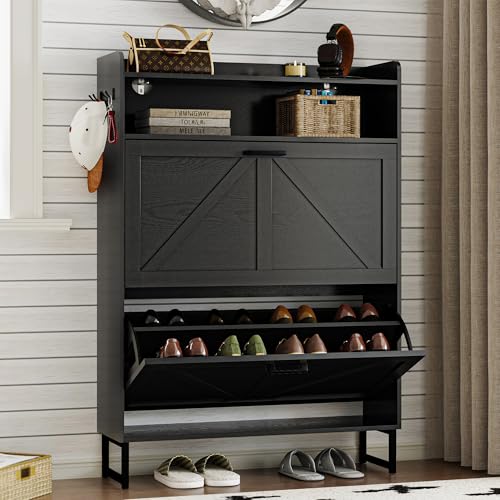
- Best overall for families: BORNOON Shoe Cabinet with 2 Flip Drawers, 4 Compartments — Check on Amazon
- VASAGLE LIRY Collection Shoe Cabinet, 3-Tier with Hinged Doors — Check on Amazon
- FUFU&GAGA Shoe Cabinet with 2 Flip Drawers — Check on Amazon
- Haotian Slim Shoe Cabinet with 2 Flip Drawers, FSR151 — Check on Amazon
- Angel Sar Rattan Shoe Cabinet with 2 Flip Drawers — Check on Amazon
- HOMEFORT Shoe Storage Cabinet with 2 Flip Drawers — prose-only pick, see the review below for why
Read the full guide ↓
Disclosure: As an Amazon Associate, dailyhomedecorating.com earns from qualifying purchases. Links to Amazon on this page are affiliate links; they cost you nothing extra. Listing details such as price and availability change often, so check the current Amazon listing before you buy.
Shopping for the best shoe cabinet for families under $100 is a different problem from shopping for a shoe cabinet, full stop. A single person needs a cabinet that fits their shoes. A family needs a cabinet that survives its users: children who pull the top drawer open and lean on it, teenagers whose sneakers are somehow always the largest object in the house, two adults with work shoes, gym shoes and the seasonal rotation, and a morning routine in which four people need four different pairs in the same ninety seconds. The cabinets that fail families rarely fail on day one. They fail in month three, when a divider snaps under a size-twelve sneaker, when the shallow cabinet tips a few degrees further forward every time a child uses a drawer as a step, or when the whole household’s shoes overflow a cabinet that was honestly sized for two people and the overflow pile — the thing the cabinet was bought to abolish — quietly regrows beside it.
So this guide judges the same under-$100 closed-cabinet field through family criteria: total realistic capacity across mixed sizes, internal division so each person’s shoes have a home, anti-tip hardware and the discipline of using it, interiors that adjust as children’s feet grow two sizes a year, and surfaces that survive wet boots, mud and the daily scuff of bags and backpacks. The winner is a divided flip cabinet that gives each family member a compartment of their own. The runner-up is the one hinged-door cabinet in the price tier, for families whose feet have outgrown flip drawers. One high-capacity farmhouse model is covered prose-only because its price will not sit still under $100. And two smaller cabinets make the list as second-cabinet picks — because the honest answer for many families is not one bigger cabinet but a main cabinet plus a slim one where the overflow actually happens, a pattern we return to in the buying advice. Every pick is a fully closed cabinet, not an open rack: in a family entryway, hiding the shoes is half the point.
In this guide
Quick Picks
Short on time, or comparing several options at once? Each row below names a family situation and the cabinet that suits it, with a link to the listing where one is available.
| Family situation | Pick | Why it stands out | Link |
|---|---|---|---|
| Best overall for families | BORNOON Shoe Cabinet with 2 Flip Drawers | Four divided compartments — one per person — in a slim closed cabinet | Check on Amazon |
| Big feet and teenagers | VASAGLE LIRY Collection Shoe Cabinet | Hinged doors and flat shelves fit full-size shoes flip drawers reject | Check on Amazon |
| Most capacity, farmhouse style | HOMEFORT Shoe Storage Cabinet | Two drawers with two layers each — covered prose-only, verify the live price | See review |
| Best second cabinet | FUFU&GAGA Shoe Cabinet with 2 Flip Drawers | Compact, removable tiers that adapt as kids’ shoes grow | Check on Amazon |
| Tightest hallway | Haotian Slim Shoe Cabinet, FSR151 | About 7.5 inches deep — daily pairs for the whole family, nothing more | Check on Amazon |
| Style-led family entry | Angel Sar Rattan Shoe Cabinet | Rattan fronts for the pairs on show rotation; small capacity, big looks | Check on Amazon |
How These Picks Were Chosen
The base filters match our main under-$100 guide: fully closed cabinets only — no open racks, fabric cubbies or curtain-front boxes — real Amazon listings, and a price verified inside the budget at research time, with one deliberate exception handled transparently as prose-only. On top of that, family screening added four tests. First, division: can the interior be split so a child’s shoes are not buried under adult pairs? Divided drawers and adjustable shelves scored; single communal buckets did not. Second, growth: children’s feet change size faster than furniture should be replaced, so removable tiers and adjustable panels — interiors that reconfigure — outranked fixed ones. Third, safety hardware: every tall, shallow cabinet is a tip risk with children in the house, so the presence of an anti-tip kit in the box was treated as a requirement, not a feature. Fourth, honest capacity: maker pair counts assume small shoes, so each review states a realistic family expectation — mixed adult and child pairs, not the headline figure.
We did not use these cabinets ourselves. We worked from maker listings, instruction manuals and specification sheets, and from retail coverage of the models, weighting the specifications that predict family service: compartment layout, interior adjustability, depth, stated load capacity and anchoring hardware. Where a listing was vague about a dimension or a mechanism, the review says so. One more family-specific note: no cabinet in this guide stores tall winter boots, and families in snowy climates should plan a boot tray beside whichever cabinet they choose rather than expecting the cabinet to absorb the season.
The 6 Best Shoe Cabinets for Families Under $100
BORNOON Shoe Cabinet with 2 Flip Drawers
Who it suits: Families of three or four sharing one entryway, who need each person’s shoes corralled separately more than they need raw pair count.
The family problem in most entryways is not storage volume — it is archaeology. Somewhere under the adult sneakers are the small shoes someone needs in four minutes. The BORNOON’s answer is structural: two flip drawers, each split by dividers into two compartments, four compartments in total. Assign one per person and the morning dig disappears; a child’s compartment holds three or four small pairs easily, an adult’s holds two to three everyday pairs, and nobody’s shoes migrate. The cabinet itself is the brand’s familiar slim format — roughly nine and a half inches deep, flat clean fronts with hidden handles, in white or black — so it fits the hallway a family actually has rather than the mudroom in a catalog. A note on the range: BORNOON’s three-drawer version is the famous one, and it was priced above this budget when checked, so the two-drawer is the honest family pick here; check price on Amazon and confirm you are looking at the two-drawer listing, because the two sit side by side and look nearly identical.
Family service notes. The dividers that make this cabinet are fixed in position, so compartment width is what it is: perfect for mixed households, less ideal if every member wears large sizes, in which case the VASAGLE below is the better main cabinet. Flip drawers reward a household rule — pull from the top, push fully closed — and the cabinet must be wall-anchored, as every slim cabinet in a house with children must be; treat the anchor as part of assembly, not an optional extra. Capacity honesty: plan on roughly ten to twelve mixed pairs across the four compartments, not the teens that listings imply with small shoes. For a family whose entryway chaos is about whose and where, rather than how many, this is the most useful cabinet under $100, and the general field it leads is surveyed in Best Shoe Cabinet Under $100.
- Four divided compartments across two flip drawers — a named home for each person’s shoes.
- Slim closed format in white or black, with hidden handles that keep the face flush in a busy hallway.
- The two-drawer is the version verified inside this budget; the popular three-drawer was above it when checked.
Honest limitation: Fixed compartment widths suit mixed-size families better than uniformly large feet, and realistic capacity is everyday pairs for the household — not the whole collection including seasonal shoes.
Choose it if sorting by person is your family’s entryway problem. Skip it if your household’s feet are all adult-large — start with the VASAGLE instead.
VASAGLE LIRY Collection Shoe Cabinet, 3-Tier with Hinged Doors
Who it suits: Families with teenagers and large adult sizes, and any household that has already discovered flip drawers reject its biggest shoes.
Every family has a moment when the children’s feet stop being small. This is the cabinet for after that moment. Instead of tilted buckets, the VASAGLE stores shoes flat on three tiers of shelving behind two hinged barn-style doors, in a cabinet about 13.8 inches deep, 31.5 inches wide and 27.6 inches high. Flat storage means a size-twelve sneaker lies down the way it does in a closet — no diagonal forcing, no toe-crushing tilt — and the upper shelf adjusts through five positions, so one tier can be raised for a teenager’s high-tops or a parent’s ankle boots while the others stay low for everyday pairs. The maker rates it around 9 to 12 pairs, which for a family means the daily rotation of three or four people with nothing left over; the stated static load capacity is about 165 pounds, the base is elevated for cleaning underneath, and an anti-tip kit is included — use it, because a low wide cabinet full of children opening both doors at once still deserves anchoring. Check price on Amazon; it sits comfortably in this budget and is the durability-minded family’s anchor pick.
The family trade-offs are footprint and swing. Fourteen inches of depth plus door swing needs a real entryway or mudroom wall, not a narrow apartment hallway; measure both before ordering. The low height, though, is a family asset in disguise: the top becomes a bench-adjacent landing surface at exactly the height where school bags get dumped, keys land and the day’s mail piles up — put a tray on it and the cabinet organizes more than shoes. For households pairing it with a slim cabinet elsewhere, the natural partner roles are covered in Best Shoe Cabinet For Small Spaces Under $100. As a single-cabinet answer for a big-footed family, nothing else under $100 stores shoes this normally.
- Flat shelves behind hinged doors — full-size and teen shoes fit without tilting or forcing.
- Five-position adjustable upper shelf; roughly 9–12 pairs of realistic family capacity.
- Anti-tip kit included and a sturdy top that works as the family’s landing surface.
Honest limitation: The deepest cabinet here, and it needs door-swing clearance — a genuine mudroom or entry wall cabinet, not a narrow-hallway one.
Choose it if large sizes rule your household. Skip it if your only wall is a slim hallway — the BORNOON format was built for that wall.
HOMEFORT Shoe Storage Cabinet with 2 Flip Drawers
Who it suits: Larger families who need the most flip-drawer capacity in this class and like farmhouse styling — provided the live price cooperates.
This is the capacity pick, and it comes with a condition stated plainly: we cover it prose-only, without a purchase link, because its price sightings straddle the $100 line — retail trackers have shown it inside the budget while Amazon’s own category page has shown it above. Check the live listing yourself; on a day it sits under $100, it is arguably the strongest family cabinet in this guide. The design is the generous end of the flip family: two flip drawers with two internal layers each, the maker rating each layer at roughly four to five pairs, and internal panels that adjust to two positions or remove entirely. For a family, that adjustability is the point — one layer configured low for children’s shoes, another opened tall for a parent’s boots-adjacent footwear, reconfigured in minutes as feet grow. The body stands on wood legs in a farmhouse washed-grey or antique-white finish, the flat top takes the family landing-strip role, and at roughly 52 pounds assembled it feels like furniture rather than flat-pack. The maker’s manual confirms the two-layer drawer layout and adjustable panels.
Beyond the price question, the family caveats are assembly and arithmetic. Owner coverage describes a sturdy finished cabinet with some assembly friction, so schedule two adults and an unhurried hour. And discount the layer math the usual way: four to five pairs per layer assumes neat rows of average shoes; a realistic family figure across both drawers is the mid-teens of mixed pairs — still the most in this guide. If the price is over budget when you check, do not stretch: the BORNOON divides better and the VASAGLE fits bigger feet, and the wider field at the next tier is mapped in Best Shoe Cabinet Under $150.
- Two flip drawers, two layers each — the highest realistic pair count among the flip picks.
- Adjustable and removable internal panels let layers grow with children’s feet.
- Prose-only: price sightings conflict across the $100 line, so verify before you buy.
Honest limitation: Price instability is the headline issue, assembly is reported as fiddly, and even here tall winter boots remain a boot-tray problem, not a cabinet problem.
Choose it if the live price is under $100 and maximum family capacity in a closed cabinet is the brief. Skip it if the listing has drifted over budget on your shopping day.
FUFU&GAGA Shoe Cabinet with 2 Flip Drawers
Who it suits: Smaller families and households buying a second cabinet — for the back door, the kids’ zone or the overflow that the main cabinet cannot hold.
Not every family cabinet has to be the main cabinet. The FUFU&GAGA — about 22.4 inches wide, 9.4 inches deep and 29.2 inches high — is the best supporting actor in this guide: compact enough for the wall by a back door or the end of a hallway, with two flip drawers whose internal tiers remove. That removability is its family superpower. This year a drawer holds two tiers of small children’s shoes; next year, with a tier pulled, the same drawer takes a teenager’s bulkier pairs. Furniture that reconfigures survives childhood; furniture that does not gets replaced by it. The MDF body has a waterproof finish the maker highlights — genuinely useful where children’s wet shoes arrive daily — and the modern flat-front styling in finishes from deep brown to light wood keeps a second cabinet from looking like an afterthought. Realistic capacity is a household’s overflow, roughly six to eight mixed pairs, and the fit ceiling is around a men’s size 10. Check price on Amazon; it sits mid-budget.
Place it where the overflow actually happens. In many homes that is not the front entry at all but the door from the garage, the foot of the stairs, or outside the children’s bedrooms, where school shoes shed at day’s end. A closed cabinet in that spot stops the migration of small shoes through the house better than any rule about using the front cabinet. It is not a main cabinet for a family of five, and pretending otherwise repeats the overflow mistake; as the second half of a two-cabinet system, it is the smartest money in this guide after the BORNOON itself.
- Compact footprint made for back doors, hall ends and kids’ zones.
- Removable drawer tiers — the interior grows as the children’s shoes do.
- Waterproof-finished MDF for the wet-shoe reality of family life.
Honest limitation: Overflow capacity only — roughly six to eight mixed pairs, with a fit ceiling around a men’s size 10.
Choose it if you are completing a two-cabinet system or housing a small family’s daily pairs. Skip it if it must serve as the only cabinet for a large household.
Haotian Slim Shoe Cabinet with 2 Flip Drawers, FSR151
Who it suits: Families in apartments and narrow homes whose hallway cannot spare depth — daily pairs only, ruthlessly edited.
Some family hallways are 36 inches wide and already carry a stroller. For those, the Haotian’s roughly 7.5-inch depth is not a compromise but the whole ballgame: it is the slimmest closed cabinet in this guide, standing where a nine-inch cabinet would narrow the passage and a fourteen-inch cabinet would block it. The two-drawer version is about 19.7 inches wide and 35.8 inches high, with a three-drawer sibling at the same width and about 50.8 inches tall for families who have height instead of width — the tall version is the family configuration to look at first. Inside are the format’s usual tipped buckets with an adjustable shelf, a raised base that lets a pair of slippers tuck underneath and cleaning pass below, and cutout handles that leave no hardware protruding into the walkway for hips and bags to catch. Apartment Therapy’s coverage of the line puts realistic capacity in the compact version at around six pairs; the tall three-drawer stretches that for a family’s daily rotation, small-to-average sizes assumed. Check price on Amazon — it sits at the accessible end of the budget.
The discipline this cabinet demands is editing. It holds what the family wears this week; everything else — out-of-season shoes, the good shoes, the outgrown-but-kept shoes — must live in closets, or the overflow pile returns and the cabinet gets blamed for a storage policy it never promised to be. Large adult sizes are its other hard limit: the steep tilt of a 7.5-inch bucket is unforgiving, and a household of big feet should treat the Haotian as the children’s-and-daily-pairs cabinet beside a VASAGLE, not as the main event. Families in genuinely tight quarters will find the fuller treatment in Best Shoe Cabinet For Small Apartments Under $100.
- About 7.5 inches deep — the only closed cabinet here for truly narrow family hallways.
- Tall three-drawer sibling in the same width for vertical family storage.
- Raised base, cutout handles — designed for walkways that carry strollers and bags.
Honest limitation: Daily-pairs capacity only and a firm ceiling on shoe size; this cabinet requires an edited shoe policy to succeed.
Choose it if depth is the constraint and the family can live rotation-only. Skip it if you expect one cabinet to absorb the whole household collection.
Angel Sar Rattan Shoe Cabinet with 2 Flip Drawers
Who it suits: Design-conscious families whose entryway is part of the living room — the cabinet for the pairs on show rotation, not the whole fleet.
Family entryways in open-plan homes have a problem no capacity chart captures: the shoe storage is in the living room, visible from the sofa, in every photograph of every birthday. The Angel Sar is the pick for that room. Its two flip drawers wear natural rattan fronts with golden handles, the body stands on sturdy metal legs, and in natural wood, black or white it reads as a woven decor piece that happens to contain shoes. The function is deliberately modest — two fold-down drawers at about three pairs each, roughly six pairs in total, with adjustable shelving inside current listings — which makes it the rotation cabinet for the pairs the family wears daily, styled to disappear into a boho, coastal or warm-modern scheme. The raised legs let a robot vacuum pass underneath, a small mercy in a house with children and crumbs. Check price on Amazon; it sits toward the premium end of this budget, buying looks rather than pairs.
The family honesty: rattan is a natural weave, charming and breathable — owners count the airflow a plus against shoe odor — but it will not take the punishment of a scooter-corridor hallway, and six pairs is six pairs. This cabinet succeeds as one element of a family system: the beautiful front-line cabinet in the living space, with the fleet stored in a BORNOON, VASAGLE or closet rack out of sight. Bought as a whole-family solution it will overflow by the weekend; bought as the visible third of a sensible system, it is the pick that keeps a family entryway from looking like a shoe shop. The decor-led angle is developed further in Best Shoe Cabinet For Modern Homes Under $100.
- Natural rattan fronts and metal legs — living-room furniture first, shoe storage second.
- Two drawers, roughly six daily pairs; raised legs for vacuum access.
- Breathable woven fronts, in natural, black or white versions.
Honest limitation: The smallest capacity in the guide and a natural material that dislikes knocks — a system piece, not a sole family cabinet.
Choose it if the entryway is decorated living space and the fleet lives elsewhere. Skip it if it must be the family’s only shoe storage.
Comparison Table
| Product | Format | Best family use | Link |
|---|---|---|---|
| BORNOON 2 Flip Drawers | Flip, 4 compartments | One compartment per person — the sorting cabinet | Check on Amazon |
| VASAGLE LIRY | Hinged doors, shelves, ~13.8 in deep | Teenagers and large adult sizes, stored flat | Check on Amazon |
| HOMEFORT 2 Flip Drawers | Flip, 2 layers per drawer | Maximum capacity — verify the live price | See review |
| FUFU&GAGA 2 Flip Drawers | Flip, removable tiers | Second cabinet; interiors that grow with kids | Check on Amazon |
| Haotian FSR151 | Flip, ~7.5 in deep | Narrow hallways, daily pairs only | Check on Amazon |
| Angel Sar Rattan | Flip, rattan fronts, ~6 pairs | The visible cabinet in open-plan living space | Check on Amazon |
How to Choose the Best Shoe Cabinet for Families Under $100
- Count people before pairs. A family cabinet is an allocation system. Four divided compartments for four people beat sixteen communal slots, because the daily failure is finding shoes, not storing them.
- Plan for the largest feet in the house, not the average. One teenager in size-twelve sneakers breaks a flip-drawer plan for the whole family. If any member wears large sizes, anchor the system on the hinged-door cabinet or assign the big pairs a different home.
- Anchor it the day you build it. Children pull top drawers open and lean. Tall shallow cabinets plus children equals a non-negotiable wall anchor — check the kit is in the box before you order, and use it.
- Buy interiors that reconfigure. Removable tiers and adjustable panels let the same cabinet serve a toddler’s shoes now and a teenager’s later. Fixed interiors have a childhood expiry date.
- Set a rotation policy and say it out loud. Cabinets hold this week’s shoes. Seasonal and outgrown pairs belong in labeled closet boxes; without the policy, any cabinet overflows and gets blamed.
- Put the second cabinet where shoes actually shed. Garage doors and bedroom hallways collect more family footwear than front entries in many homes. A compact closed cabinet at the real drop zone outperforms a bigger one at the wrong door.
- Choose finishes for mud, not showrooms. Waterproof surfaces, raised bases and darker or wipeable finishes survive family weather. Delicate weaves belong in the living-space cabinet, not the mud corridor.
- Keep a boot tray beside it. No sub-$100 cabinet stores tall winter boots. A tray contains the season; the cabinet handles the other ten months.
- Check the top’s job. In family entries the cabinet top becomes the landing strip for keys, permission slips and lunch money. A flat, sturdy top with a tray on it organizes the morning as much as the drawers do.
One Cabinet or Two? The Family Storage Math
Run the arithmetic honestly and many families discover that one cabinet was never going to work. A household of four, wearing two pairs each in weekly rotation, needs eight pairs of closed storage before guests, gym bags or seasonal swaps enter the picture. Only the largest cabinets in this guide hold that comfortably in mixed sizes — which is why the two-cabinet pattern recurs in these reviews: a main cabinet at the front door for adults and daily pairs, a compact cabinet at the garage door or kids’ zone for the small-shoe fleet. Two closed cabinets at two drop zones beat one oversized cabinet at the wrong door, and both can be had inside a combined budget not far above this guide’s single-cabinet ceiling. The alternative pattern — one cabinet plus a closet rack for the archive — suits families whose overflow is seasonal rather than daily. What does not work is the single mid-size cabinet bought hopefully and filled completely on the first weekend: a cabinet at one hundred percent capacity is a cabinet nobody can find anything in, which is the original problem wearing a nicer box. Leave a drawer a third empty and the system breathes.
Safety and Durability: The Family Deep-Dive
Two topics decide whether a family cabinet is still loved in year three, and neither appears on a listing’s feature bullets in any useful form. The first is tipping physics. A flip cabinet is a tall, shallow box; its stability comes from depth it does not have, which is why every responsible maker in this guide ships an anti-tip kit. The dangerous moment is specific: top drawer open, loaded, with a child pulling down on its edge — the cabinet’s center of gravity walks forward over its front feet. Anchoring to a wall stud or with the supplied strap into solid fixing removes the risk entirely, and it takes ten minutes during assembly. If your walls are rental plasterboard, use the correct anchors for the material and test the strap’s hold before the shoes go in. Treat any cabinet that arrives without anchoring hardware as a cabinet to anchor with a universal furniture strap bought separately — the strap costs little and the alternative is not a risk worth modeling in a home with small children.
The second topic is mechanism wear. Flip drawers pivot on simple hardware that tolerates years of open-close cycles and resents two things: being slammed, and being overloaded on one side so the bucket twists as it tips. Family-proofing is mostly habit design — drawers assigned per person get treated as personal property and closed properly; communal drawers get yanked. This is the unglamorous second reason the divided BORNOON leads this guide. Door cabinets wear differently: hinges loosen with enthusiastic slamming, and the fix is a screwdriver once a year. Panel cabinets of every format share one enemy, water standing in the base — wet family shoes drip, so a washable mat or tray on the cabinet floor, emptied weekly, is the difference between a cabinet that ages and one that swells at the seams by its second winter.
Managing the Small-Shoe Years
Children’s shoes break adult storage logic in both directions: they are tiny, numerous and replaced constantly. A toddler’s four pairs occupy less space than one adult pair, which tempts families to stuff a shared drawer — and then no small shoe can ever be found, because small things sink. The working system is a dedicated low compartment or drawer for children’s shoes, at the height the child can reach, with the outgrown-pair rule enforced monthly: when a pair is outgrown, it leaves the cabinet the same day, to a labeled box for a sibling or out of the house entirely. Cabinets with removable tiers, like the FUFU&GAGA, earn their keep here — a tier removed doubles a compartment’s height for the next size up without new furniture. School shoes and weekend shoes split naturally across two compartments where the cabinet offers them, which is why the divided formats dominate this guide’s top ranks. None of this requires buying anything beyond the cabinet itself; it requires deciding the system on installation day, while the drawers are still empty and the family can be gathered for the thirty-second explanation that makes the whole thing work.
The Morning Routine Test
Judge every cabinet in this guide against one scene: a school morning, raining, four people leaving within ten minutes, one of them already late. The cabinet passes if each person opens one drawer or door, takes one pair, and closes it — no digging, no shared bucket archaeology, no shoes stored on top because the inside failed. It passes if yesterday’s wet shoes went somewhere sensible that was not the cabinet’s dry interior — the tray beside it — and if the top still holds only the tray with keys and the permission slip that must not be forgotten. It passes, above all, if the system works on the household’s worst morning rather than its best evening, because storage that requires calm to operate will be bypassed under pressure and the pile will return. This is why division beats volume in the family rankings, why the second cabinet at the real drop zone beats the bigger cabinet at the formal door, and why the rotation rule matters more than any single product choice: the cabinet is the hardware, but the routine is the software, and families are buying the combination.
What $100 Buys a Family That $50 Doesn’t
The cheaper tier of closed shoe storage exists and holds shoes; what it generally does not hold is up. Family service is a durability problem disguised as a storage problem: drawers opened two thousand times a year, dividers leaned on by the full weight of a searching teenager, finishes meeting wet boots daily. The step to this guide’s tier buys the things that survive that service — interiors that adjust instead of snapping when a too-big shoe is forced, anchoring hardware included rather than improvised, panels and finishes that tolerate moisture at the base, and formats with enough division that no drawer becomes the overloaded communal bucket where mechanisms go to die. Families shopping the tier below should do so knowingly: a $50 cabinet in a closet is a fine purchase, while a $50 cabinet as a four-person entryway’s front line is usually a one-year purchase. The arithmetic of buying the sturdier cabinet once is the least glamorous and most reliable saving in this guide, and it is why the family picks above concentrate on structure — division, adjustability, anchoring — rather than on headline pair counts that no household of mixed sizes will ever realize.
Common Buying Mistakes
- Sizing for the children they are, not the teenagers they become. Feet grow faster than furniture budgets; adjustable interiors are the hedge.
- Skipping the wall anchor because the cabinet feels steady in the shop photos. Loaded top drawers and climbing children rewrite the physics at home.
- Buying one communal cabinet and expecting order. Without division, the smallest shoes sink and vanish; sorting is a structure, not a hope.
- Believing the headline pair count. It was measured in small shoes; a family’s mixed fleet will fit roughly two-thirds of it.
- Demanding boot storage from a shoe cabinet, then returning a good cabinet for failing a job no cabinet in the tier can do.
- Placing the only cabinet at the formal front door while the family actually lives through the garage door.
- Letting the cabinet top become a junk shelf. Without a tray and a rule, the landing strip becomes the second mess the cabinet was bought to hide.
- Choosing the delicate finish for the rough corridor. Rattan and scooters do not mix; match material to traffic.
Setting Up the Cabinet With Children: The First-Week Protocol
Installation day decides whether the family system ever forms, so treat the first week as a protocol rather than a hope. On day one, anchor the cabinet, then hold the two-minute family meeting at the cabinet itself: each person is shown their compartment or shelf, places their two rotation pairs in it with their own hands, and hears the one rule — a pair that is not in the cabinet lives in the closet box, never on the floor beside it. During the first week, expect the system to be tested by every member, especially the youngest; correct by returning shoes together, not by tidying silently at midnight, because a system maintained by one invisible parent collapses the first week that parent is away. At the week’s end, check three things: whether any compartment is overflowing (a sizing signal — reallocate space before resentment builds), whether the anchor strap is still taut, and whether the top has stayed a landing strip rather than becoming a shelf. Families that run this small protocol report the cabinet becoming invisible infrastructure within a month; families that skip it own a cabinet and a pile, which is the outcome this entire guide exists to prevent.
Final Recommendation
- Most families: BORNOON Shoe Cabinet with 2 Flip Drawers — one compartment per person.
- Large feet and teenagers: VASAGLE LIRY Collection Shoe Cabinet.
- Maximum capacity, price permitting: HOMEFORT Shoe Storage Cabinet — verify the live price first.
- Best second cabinet: FUFU&GAGA Shoe Cabinet with 2 Flip Drawers.
- Narrow hallways: Haotian Slim Shoe Cabinet, FSR151, in its tall three-drawer form.
- Open-plan living entries: Angel Sar Rattan Shoe Cabinet, as the visible part of a wider system.
Start with the BORNOON if your family’s chaos is about finding and sorting — its four compartments are the single most family-shaped idea in this guide. Start with the VASAGLE if the chaos is about size, because flat shelves forgive the feet that flip drawers punish. Add the FUFU&GAGA at the second drop zone when one cabinet proves almost enough, and treat the HOMEFORT as the capacity upgrade on any day its live price sits honestly under $100. Whichever you choose, anchor it, set the rotation policy, and keep the boot tray beside it — the cabinet is a system, and the families who love theirs are the ones who run it like one. For the tightest homes, continue with Best Shoe Cabinet For Small Apartments Under $100; for the unfiltered under-$100 field, the main guide is Best Shoe Cabinet Under $100.
Frequently Asked Questions
How many pairs does a family of four need a cabinet to hold?
Plan on eight to twelve pairs: two in weekly rotation per person, plus a spare slot or two for guests and gym shoes. That is everyday storage; seasonal boots and outgrown shoes belong in closet boxes. Only the largest cabinets in this guide hold the top of that range in mixed adult and child sizes, which is why many families run a main cabinet plus a compact second one.
Are flip-drawer cabinets safe around children?
They are safe when anchored — and anchoring is not optional. A tall, shallow cabinet with an open, loaded top drawer is front-heavy, and children lean on open drawers. Every pick here should be fixed to the wall with its anti-tip kit on assembly day, and children should be taught that drawers are not steps or handles for climbing.
What if one family member wears very large shoes?
Give the large pairs the hinged-door cabinet, whose flat shelves accept full sizes without tilting, or store that person’s shoes in a closet rack and let the flip cabinet serve the rest of the family. Forcing large sneakers into shallow flip drawers is the fastest route to broken dividers and a returned cabinet.
Can one cabinet handle winter for a family?
Not the boots. Tall winter boots fit no cabinet in this tier, and slush makes enclosed storage a poor home for them anyway. Run a boot tray by the door through winter, keep the cabinet for everyday shoes, and store off-season boots in a closet when spring comes.
Is it better to buy one large cabinet or two smaller ones?
For most families, two placed where shoes actually shed — front door and garage door, or entry and kids’ zone — outperform one large cabinet at a single door. Division and location solve the finding problem; raw capacity alone does not.
How do I stop the cabinet overflowing within a month?
Set the rotation rule at installation: the cabinet holds this week’s shoes, everything else lives in labeled closet storage, and a pair entering the cabinet in spring sends a winter pair out. Overflow is a policy failure, not a capacity failure — the fix is the rule, enforced kindly and consistently.


