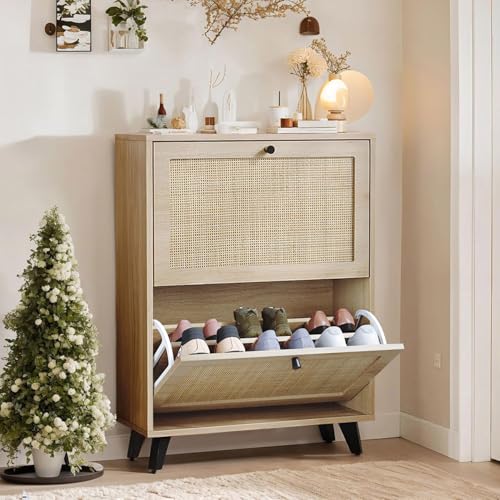
Where to buy
Check the latest price, availability and delivery on Amazon. Orders are placed on Amazon. We may earn a commission from qualifying purchases.
- Best overall for modern homes: Angel Sar Rattan Shoe Cabinet with 2 Flip Drawers — Check on Amazon
- VASAGLE LIRY Collection Shoe Cabinet, 3-Tier with Hinged Doors — Check on Amazon
- FUFU&GAGA Shoe Cabinet with 2 Flip Drawers — Check on Amazon
- BORNOON Shoe Cabinet with 2 Flip Drawers — Check on Amazon
- Haotian Slim Shoe Cabinet with 2 Flip Drawers, FSR151 — Check on Amazon
- HOMEFORT Shoe Storage Cabinet with 2 Flip Drawers — prose-only pick, see the review below for why
Read the full guide ↓
Disclosure: As an Amazon Associate, dailyhomedecorating.com earns from qualifying purchases. Links to Amazon on this page are affiliate links; they cost you nothing extra. Listing details such as price and availability change often, so check the current Amazon listing before you buy.
The search for the best shoe cabinet for modern homes under $100 is really a search for storage that does not look like storage. Modern interiors — clean lines, uncluttered surfaces, a restrained palette, furniture chosen as composition — are undone by exactly one category of object: the visibly functional one. An open shoe rack in a modern entryway is not a neutral choice; it is a pile of footwear interrupting a designed room, which is why the closed cabinet is the only serious format for this brief. But closing the shoes away is only half the assignment. The cabinet’s own front becomes part of the room’s composition: its proportions, its material, whether its handles protrude, whether its finish warms the palette or flattens it, whether it reads as a considered piece or as a box that happens to contain shoes. A modern home does not need the cabinet to be invisible. It needs the cabinet to be intentional.
This guide therefore judges the under-$100 closed-cabinet field on design criteria first — front treatment, material honesty, silhouette, hardware — without surrendering the practical ones: every pick is a genuinely closed cabinet, every capacity figure is stated realistically, and the one model whose price would not stay honestly under $100 is covered prose-only rather than linked on a wish. The winner is a woven rattan cabinet that treats texture as the decoration modern rooms often lack. Behind it come a farmhouse-modern door cabinet for larger shoes, a flat-front minimalist compact, a divided cabinet in graphic black or white, the slimmest flat-panel cabinet on the market for gallery-narrow halls, and the prose-only farmhouse piece. If your home leans Scandinavian, Japandi, warm minimal or contemporary, at least two of these belong on your wall — the reviews explain which two, and why the others, however good, would fight your rooms.
In this guide
Quick Picks
Short on time, or comparing several options at once? Each row below names a modern style direction and the cabinet that suits it, with a link to the listing where one is available.
| Style direction | Pick | Why it stands out | Link |
|---|---|---|---|
| Best overall for modern homes | Angel Sar Rattan Shoe Cabinet | Natural woven fronts and metal legs — texture as decoration | Check on Amazon |
| Modern farmhouse, big shoes | VASAGLE LIRY Collection Shoe Cabinet | Framed hinged doors, flat shelves, a console-height top to style | Check on Amazon |
| Flat-front minimalism | FUFU&GAGA Shoe Cabinet with 2 Flip Drawers | Clean compact front, removable tiers, several modern finishes | Check on Amazon |
| Graphic black or white | BORNOON Shoe Cabinet with 2 Flip Drawers | Hidden handles, divided interior, a crisp monochrome slab | Check on Amazon |
| Gallery-narrow minimal | Haotian Slim Shoe Cabinet, FSR151 | About 7.5 inches deep, cutout handles, flat-panel restraint | Check on Amazon |
| Warm farmhouse texture | HOMEFORT Shoe Storage Cabinet | Wood legs and layered drawers — covered prose-only, verify the live price | See review |
How These Picks Were Chosen
The practical filters match our main under-$100 cabinet guide: fully closed cabinets only, real Amazon listings, prices verified inside the budget at research time — check price on Amazon before you buy, because this category’s prices move — and realistic capacity stated instead of headline pair counts. The design screening layered on top asked four questions of each candidate. Does the front have a point of view — weave, frame, fluting, a deliberate flatness — or is it merely a door? Does the hardware disappear, integrate or at least agree with the front? Are the proportions furniture-like, with legs or a considered base rather than a box sitting on the floor? And does the finish palette — natural, white, black, washed grey, rustic oak — map onto rooms people actually describe as modern? Cabinets that failed the design screen but passed everything else were not excluded from the wider guide; they were simply not the answer to this brief, and this guide says plainly when a pick is here for fit or capacity rather than beauty.
We did not use these cabinets ourselves. Judgments rest on maker listings, manuals, specification sheets and retail photography and coverage, with dimensions and mechanisms verified against the sources in the accompanying notes. One honesty note on photography: entryway styling in listing photos is professional work, and any cabinet looks more designed beside a plant and a framed print than it will beside your door on a wet Tuesday. The reviews therefore separate what the cabinet itself contributes — material, line, proportion — from what the styling around it contributes, so you can judge the object you are actually buying.
The 6 Best Shoe Cabinets for Modern Homes Under $100
Angel Sar Rattan Shoe Cabinet with 2 Flip Drawers
Who it suits: Warm-modern, Japandi, Scandinavian and boho-leaning homes that need texture at the entry — and owners who will style the top rather than pile it.
Modern rooms fail at the entryway in a predictable way: everything is smooth. Flat walls, flat doors, flat-fronted storage — and the eye slides off all of it, because texture is what makes minimalism feel warm instead of empty. The Angel Sar is the one cabinet under $100 that sells texture as its main feature. Its two flip drawers are fronted in natural rattan — a real woven cane-style surface, not a printed imitation — set off by slim golden handles and a body raised on sturdy metal legs. In natural wood it brings the organic note a Japandi or Scandinavian entry is usually missing; in black, the same weave turns graphic and architectural; in white, it goes coastal and light. The legs matter more than they appear to: raising the body creates the shadow gap underneath that makes furniture look designed rather than placed, and it lets a vacuum pass. Function is the standard slim pattern — two fold-down drawers at roughly three pairs each, about six pairs in total, with adjustable shelving inside the current listings — which positions it honestly as the daily-rotation cabinet for a designed entry, not a family’s fleet storage. Check price on Amazon; it sits toward the premium end of this budget, and the premium is the front.
Styling guidance, since this cabinet rewards it: the flat top is a composition surface — one object, or a small tray grouping, never a drift of keys and post. The woven fronts breathe, which owners value against shoe odor, and they will show slight natural irregularity in the weave; that is the material being itself, and if machine uniformity is your aesthetic, the FUFU&GAGA’s flat front below is your pick instead. Keep it out of scooter-and-bike corridors — rattan dislikes knocks — and it will hold a modern entry together better than any painted box at this price. The broader modern-entryway picture, including how this cabinet pairs with consoles and benches, continues in Best Console Table Under $100.
- Natural woven rattan fronts — genuine texture for smooth modern rooms.
- Metal legs create a furniture shadow gap and vacuum clearance.
- Natural, black and white versions run warm, graphic or coastal from one design.
Honest limitation: About six pairs, and a natural material that dislikes knocks — a design pick with a rotation-sized interior.
Choose it if your modern room needs warmth and texture at the door. Skip it if capacity rules or your hallway takes daily impacts.
VASAGLE LIRY Collection Shoe Cabinet, 3-Tier with Hinged Doors
Who it suits: Modern-farmhouse and transitional homes — and modern homes whose owners wear full-size shoes that flip drawers reject.
Not every modern home is minimal; the modern-farmhouse direction — clean silhouettes with framed fronts and warm finishes — is where this cabinet lives. The VASAGLE’s two hinged doors carry a framed, barn-influenced panel design in a rustic white or warm brown palette, and behind them the format is the most conventional in this guide: three flat tiers of shelving in a cabinet about 13.8 inches deep, 31.5 inches wide and 27.6 inches high, with the upper shelf adjustable through five positions for heels and ankle boots. The design consequence of that depth is a top surface with real presence — at console height and over thirty inches wide, it takes a lamp, a framed print leant against the wall, a ceramic bowl for keys: the styled entryway vignette that modern-farmhouse rooms are built around. Capacity is an honest 9 to 12 pairs stored flat, which suits larger sizes in a way no flip drawer in this guide matches, and the build includes an elevated base and an anti-tip kit. Check price on Amazon — it sits comfortably within this budget and is the easiest cabinet here to live with if your taste runs warm.
The cautions are spatial and stylistic. Spatially, it is the deepest pick and its doors swing, so it wants a genuine entry wall rather than a narrow hall. Stylistically, the framed farmhouse front is a commitment: in a stark white minimal interior it will read as the one traditional object in the room. That is not a flaw — many modern homes deliberately run one warm, framed piece against clean lines — but buy it as that deliberate contrast, not by accident. For the unfiltered practical ranking of this same field, see Best Shoe Cabinet Under $100.
- Framed hinged doors in rustic finishes — the modern-farmhouse front.
- Flat adjustable shelves fit full-size shoes; the wide top styles like a console.
- About 9–12 pairs, anti-tip kit included, elevated base.
Honest limitation: Deepest cabinet here with door swing to plan, and a farmhouse front that must be a deliberate choice in a minimal room.
Choose it if your modern leans warm and your shoes run large. Skip it if your interior is strict minimalism — the flat fronts below speak that language.
FUFU&GAGA Shoe Cabinet with 2 Flip Drawers
Who it suits: Flat-front minimalists in compact modern homes — a small, clean slab of a cabinet whose interior quietly adapts.
If the Angel Sar is modern-with-texture, the FUFU&GAGA is modern-with-restraint: a compact flat-front cabinet, about 22.4 inches wide, 9.4 inches deep and 29.2 inches high, whose design statement is that it makes almost none. The fronts are clean planes, the palette runs to modern finishes — deep brown, black, grey, light wood tones depending on variant — and at under two feet wide it composes easily beside a door, under a mirror or at the end of a run of other low furniture. Minimalism at this scale is a discipline: the cabinet succeeds by being exactly proportioned and otherwise silent. Inside, the engineering is better than the silence suggests — two flip drawers with two tiers each, the tiers removable, so a drawer converts from stacked flats to a taller space for heels or low boots. The MDF carries a waterproof finish, a practical modern material choice for an entry that meets weather. Realistic capacity is one or two people’s daily pairs, with a fit ceiling around a men’s size 10. Check price on Amazon; it sits mid-budget.
In a modern room, this is the cabinet to choose when the entry wall already has its feature — art, a mirror, a dramatic door color — and the storage should support without competing. Its low top suits a single sculptural object or nothing at all. What it will not do is carry a household: it is the compact modern answer, and homes needing divided or high-capacity storage should read the BORNOON and HOMEFORT reviews below before deciding the FUFU&GAGA’s elegance is worth its limits.
- Flat, quiet fronts in modern finishes — storage that supports the room’s real feature.
- Compact 22.4-inch width composes beside doors and under mirrors.
- Removable drawer tiers give a minimalist cabinet a flexible interior.
Honest limitation: Rotation-sized capacity and a size-10-ish fit ceiling — minimalism with a small interior.
Choose it if your modern entry is compact and already composed. Skip it if the cabinet must hold a household’s shoes.
BORNOON Shoe Cabinet with 2 Flip Drawers
Who it suits: Monochrome modern homes — black-and-white palettes, graphic contrast — that also need a divided, shared interior.
The BORNOON’s design move is subtraction: hidden handles, unbroken flat fronts, a slim body roughly nine and a half inches deep, sold in clean white or black. Against a white wall the white version nearly disappears — the closest thing to invisible storage in this guide — while the black version becomes the deliberate dark slab that monochrome interiors use as punctuation. Either way, it is the graphic designer’s cabinet: no visible hardware, no applied decoration, proportion doing all the work. Inside, it is the most organized of the slim cabinets, with two flip drawers divided into four compartments — a compartment per person in a shared modern household, or per category in a single person’s disciplined one. A range note matters here: the brand’s three-drawer cabinet is its famous model and was priced above this budget when checked, so the two-drawer is this guide’s pick; check price on Amazon and confirm the variant, since the listings look nearly identical.
The modern caveat is finish discipline. Gloss-adjacent flat fronts in white show scuffs; in black they show dust. Neither is a defect, but a high-traffic modern entry with children and bags will keep this cabinet honest-looking only with a weekly wipe — build that into the choice. Compartment widths are fixed, suiting mixed sizes better than uniformly large feet. For the family-first reading of this same cabinet, Best Shoe Cabinet For Families Under $100 covers it from the sorting angle; here it earns its place as the monochrome option with the smartest interior in the slim class.
- Hidden handles and unbroken fronts — white disappears, black punctuates.
- Four divided compartments behind the minimal face.
- Two-drawer version verified in budget; the famous three-drawer was above it.
Honest limitation: Flat monochrome fronts show scuffs or dust depending on color, and compartment widths are fixed.
Choose it if your palette is monochrome and your household shares. Skip it if you want texture — that is the Angel Sar’s whole argument.
Haotian Slim Shoe Cabinet with 2 Flip Drawers, FSR151
Who it suits: Modern homes with gallery-narrow hallways, where the design brief is a flat white plane that takes almost no depth from the room.
Some modern architecture gives you a hallway that is essentially a gallery: long, narrow, lit for art, with no tolerance for furniture depth. The Haotian is the cabinet for that wall. At about 7.5 inches deep — the slimmest closed cabinet in this guide — with flat-panel fronts in white, black or grey and handles that are hollowed cutouts rather than applied hardware, it reads as a shallow architectural panel rather than a piece of storage furniture. The two-drawer version runs about 19.7 inches wide and 35.8 inches high; the three-drawer sibling stretches to about 50.8 inches tall in the same width, and that tall, narrow, flat plane is a genuinely modern proportion — closer to a wall sculpture’s footprint than a cupboard’s. The raised base keeps the panel floating slightly and lets cleaning pass beneath. Realistic capacity is daily pairs — around six in the compact version per long-running retail coverage — and the steep interior tilt caps shoe sizes, the standing price of extreme shallowness. Check price on Amazon; it sits at the accessible end of the budget.
Design-wise, this is the pick when the room’s composition cannot absorb a furniture object at all. Run two of the tall version side by side and the effect is a paneled wall section that happens to hold shoes — a trick modern interiors use constantly with built-ins, achieved here with freestanding cabinets. It is not the pick for large shoes or large collections, and this guide will not pretend otherwise; it is the pick for the wall that defeats every other cabinet on depth.
- About 7.5 inches deep with cutout handles — an architectural panel, not a box.
- Tall three-drawer version doubles as a paneled-wall effect when paired.
- Flat fronts in white, black or grey for strict modern palettes.
Honest limitation: Daily-pairs capacity and a firm shoe-size ceiling — the price of the slimmest profile here.
Choose it if your hallway is a gallery and depth is non-negotiable. Skip it if you need the cabinet to hold more than the daily rotation.
HOMEFORT Shoe Storage Cabinet with 2 Flip Drawers
Who it suits: Warm modern and farmhouse-modern homes wanting the layered, legged look with the most flip capacity in the class — price permitting.
The HOMEFORT is this guide’s prose-only pick: its price sightings straddle the $100 line — trackers have shown it within budget while Amazon’s own category page has shown it above — so it carries no purchase link here, and you should verify the live listing before shortlisting it. The design case, on any day its price behaves, is warmth with structure: two flip drawers with two internal layers each, internal panels that adjust or remove, a body standing on wood legs, and farmhouse finishes — washed grey, antique white — that suit the warm-modern direction where flat minimalism feels too cold. At roughly 52 pounds assembled it has the heft modern buyers associate with real furniture, and the flat top styles as a proper surface. The maker’s manual confirms the adjustable-panel, two-layer design, and capacity — realistically mid-teens of mixed pairs — leads the flip class.
As a modern choice it sits at the rustic edge of the category: in a strict minimal interior its farmhouse cues will read as a style accent rather than a native, which some rooms want and others do not. Assembly is reported as the fiddliest here. If the live price is over budget, the honest modern substitutes are the Angel Sar for texture and the VASAGLE for the warm framed look with doors; the next budget tier’s field is surveyed in Best Shoe Cabinet Under $150.
- Layered flip drawers on wood legs — warm structure for farmhouse-modern rooms.
- Adjustable internal panels; the flip class’s highest realistic capacity.
- Prose-only because price sightings conflict across the $100 line.
Honest limitation: Price instability first, farmhouse styling that must suit the room second, and the fiddliest assembly here third.
Choose it if the live price is under $100 and warm-modern is your direction. Skip it if the price has drifted up or your interior is strict minimal.
Comparison Table
| Product | Design language | Best modern use | Link |
|---|---|---|---|
| Angel Sar Rattan | Woven texture, metal legs | Warm minimal, Japandi, Scandinavian entries | Check on Amazon |
| VASAGLE LIRY | Framed farmhouse doors | Modern farmhouse with full-size shoes | Check on Amazon |
| FUFU&GAGA 2 Flip | Flat-front restraint | Compact minimal entries | Check on Amazon |
| BORNOON 2 Flip | Monochrome slab, hidden handles | Black-and-white palettes, shared homes | Check on Amazon |
| Haotian FSR151 | Architectural flat panel, ~7.5 in deep | Gallery-narrow hallways | Check on Amazon |
| HOMEFORT 2 Flip | Farmhouse layers on wood legs | Warm modern capacity — verify price | See review |
How to Choose the Best Shoe Cabinet for Modern Homes Under $100
- Decide the cabinet’s design job first. Disappear (white flat fronts), warm (rattan, wood tones), punctuate (black slab) or frame (farmhouse doors). A modern room can use any of the four — but only one per entryway. Choose the job, then the product.
- Match depth to the architecture, not the catalog. Modern hallways are often the narrowest in the house. Measure the passage honestly; a 7.5-inch panel cabinet that preserves the room’s lines beats a deeper cabinet that makes the architecture feel accidental.
- Treat the top as a composition. One object or a small tray grouping. If your household cannot keep a surface curated, choose the low console-style cabinet whose top reads as intentional even with keys on it — or accept a taller cabinet whose top is out of the drop zone.
- Check hardware against the front. Hidden handles and cutouts preserve flat modern fronts; visible handles should look chosen, like the Angel Sar’s slim gold bars, not inherited from a parts bin.
- Be honest about capacity versus looks. The most beautiful cabinets here hold the fewest pairs. Modern entries work because the rotation is edited — if your household will not edit, buy the divided or door cabinet and let function lead.
- Mind the palette under your light. North-facing and windowless entries cool every finish. Warm woods and rattan correct that; stark white can go blue-grey. Order by the light you have, not the listing photo’s.
- Anchor without ruining the wall line. Slim cabinets need wall fixing; plan the anchor point during assembly so straps do not show above a low cabinet in a clean-lined room.
- Keep one material story per entry. Rattan cabinet plus oak console plus chrome mirror is three stories. The cabinet should agree with the entry’s existing material — wood, weave, metal or lacquer — and let the other pieces be the contrast.
What $100 Buys in Design That $50 Doesn’t
Below $50, a closed shoe cabinet is a box with a door: flat printed finishes, visible hardware-store handles, a body that sits directly on the floor and reads at a glance as storage equipment. Nothing about that is dishonest — it stores shoes behind a panel for very little money, and in a closet it is all anyone needs. The step to this guide’s tier buys the three things that make a cabinet pass as furniture in a designed room. The first is a front with a material story: real woven rattan, framed door panels, fluted or deliberately blank lacquered planes — surfaces the eye reads as craft rather than packaging. The second is proportion and stance: legs that lift the body into a shadow gap, widths and heights that echo console furniture rather than shipping cartons, tops thick enough to style. The third is hardware that was chosen — slim metal bars, hidden pulls, cutouts — instead of whatever came in the parts bag. None of these upgrades holds a single extra pair of shoes, and in a modern living-space entryway they are worth more than pairs: they are the difference between storage you look at with pleasure ten times a day and storage you apologize for.
The honest counterweight is that design spending has a capacity cost at this price. Every dollar of weave, leg and finish is a dollar not spent on interior volume, which is why the most beautiful cabinets in this guide hold six to eight pairs while the plainest holds twelve. Modern homes absorb that trade better than most, because the style itself enforces the edited rotation the small interiors demand. If your household cannot edit — if the cabinet must swallow everything — spend on the door cabinet’s honest volume and accept the farmhouse front as your room’s one warm accent. Design brief and storage brief have to be settled together; the expensive mistake is buying the beautiful six-pair cabinet for a sixteen-pair life and spending the next year with an overflow pile beside it, which is worse, visually, than any plain cabinet ever made.
Reading a Modern Entry: Where the Cabinet Actually Goes
Modern floor plans place the shoe problem in one of three spots, and each spot favors different picks. The first is the open-plan edge, where the entry is simply the first zone of the living room: here the cabinet is furniture among furniture, texture and legs matter most, and the Angel Sar or the styled VASAGLE top earn their keep. The second is the corridor entry, a hallway with doors off it: here depth and door swing rule, flat fronts win, and the Haotian and FUFU&GAGA’s restraint is the design. The third is the dedicated foyer in larger modern homes, often with a closet nearby: here the cabinet can be the smaller, prettier rotation piece because the closet absorbs the archive — the one situation where a six-pair design cabinet is a complete answer rather than part of a system. Identify your spot before you fall for a front. Most modern-entry disappointment is a beautiful cabinet bought for the wrong of these three rooms, and no finish upgrade fixes a placement problem.
Styling the Entry Around the Cabinet
A modern entryway is a small composition with four elements: the cabinet, what hangs above it, what stands beside it and what lies underfoot. Above a low cabinet, a single large mirror or one framed print at generous scale beats a cluster of small frames, which reads as clutter against clean storage. Beside the cabinet, one vertical element — a tall plant, a floor lamp’s line, a coat stand with discipline — balances the cabinet’s horizontal mass. Underfoot, a flat-weave runner in a tone drawn from the cabinet’s finish ties the storage into the room instead of leaving it parked against the wall. The recurring mistake is accessorizing the cabinet top like a mantel: modern storage earns its place by the calm of its surfaces, and the most stylish version of every pick in this guide is the one with almost nothing on it. If your entry also needs a landing surface for bags and post, give that job to a dedicated piece — the pairings in Best Entryway Bench Under $100 show how bench and cabinet divide the work — rather than letting the cabinet top absorb the household’s drift.
Finishes Under Real Light: A Short Field Guide
Modern entries are lit worse than any product photograph, and finish choice is where that gap bites. Stark white cabinets in a windowless, warm-bulb hallway read creamy and calm; the same cabinet under a cool daylight bulb against a north-facing wall reads faintly blue and clinical. Natural rattan and light oak warm both situations, which is why the woven pick leads this guide for the average modern entry. Black fronts are the most light-dependent of all: in a bright, white-walled entry they are crisp punctuation; in a dim one they become a dark mass that swallows the wall’s detail and shows every dusting lapse under raking light. Washed grey and greige finishes are the diplomats — they neither warm nor cool aggressively and they hide the scuff spectrum best, which is why the farmhouse-leaning picks wear them well in family-modern homes. The practical rule is to choose the finish under the bulb you actually use at night, in the room the cabinet will actually stand in, and to remember that the cabinet’s largest surface is its front: you are choosing a wall color as much as a furniture finish.
Care and Keeping: Modern Finishes in Daily Service
Modern cabinets fail aesthetically before they fail mechanically, and the failure is usually housekeeping, not quality. Woven rattan wants a soft brush or vacuum brush attachment monthly — dust settles into the weave and greys it — and an occasional wipe with a barely damp cloth; soaking swells natural fibers and is the one real way to ruin the front. Flat lacquered and painted fronts want the opposite discipline: a microfiber cloth, no abrasive pads, and scuffs addressed early with a melamine sponge used gently, because a modern flat front’s whole value is its unbroken plane and small marks read at a distance. Black finishes show dust fastest and reward a weekly pass; white finishes hide dust and show scuffs, rewarding the opposite schedule. Metal legs and handles take the knocks of vacuums and mops — expect bright metal to mark at floor level and consider it patina rather than damage. None of this is burdensome; it is the five-minute monthly cost of furniture that continues to look chosen. The owners who conclude that modern cabinets are impractical are usually the owners who maintained them like utility shelving for a year and then blamed the aesthetic.
The Entry as a System: Cabinet, Light and Mirror
A modern entryway works as a trio, and the cabinet is only its base note. Light decides whether the cabinet’s finish reads as chosen: a warm bulb flatters rattan and wood, a cool one flatters lacquer and chrome, and a dim entry makes every finish read two shades more somber than the listing promised — upgrade the bulb before blaming the furniture. The mirror is the cabinet’s traditional partner because it doubles the entry’s light, gives the leaving-the-house check a home, and its frame is where the entry’s metal or wood story gets repeated so the cabinet does not tell it alone. Scale the mirror to the cabinet’s width, hang its bottom edge a hand’s width above the cabinet top, and the two pieces read as one designed unit at any budget. Add the runner underfoot in a tone drawn from the cabinet and the entry is composed: three decisions, each cheap, that make an under-$100 cabinet look like the anchor of an intentional room rather than a storage purchase that happened to fit.
Common Buying Mistakes
- Choosing the texture pick for a high-knock hallway, then blaming the weave. Match material to traffic, not just to taste.
- Buying the lookalike three-drawer variant of a two-drawer pick and blowing the budget — the listings sit side by side and the fronts are identical.
- Letting the cabinet top become the household’s junk surface, which undoes the entire modern brief in a week.
- Ignoring door swing and drawer arc in a composed entry — a cabinet door that strikes the front door’s swing path is a daily design failure.
- Mixing three material stories in one small entry because each piece was bought separately and liked individually.
- Believing headline pair counts and skipping the rotation edit modern entries depend on.
- Skipping the wall anchor on a slim cabinet because the strap would show — plan the fixing point instead; a fallen cabinet is worse styling than a hidden strap.
- Judging finishes on a bright product page for a windowless entry, then living with a color that reads two shades colder at home.
Final Recommendation
- Most modern homes: Angel Sar Rattan Shoe Cabinet — texture, legs and light.
- Modern farmhouse: VASAGLE LIRY Collection Shoe Cabinet.
- Strict minimal, compact: FUFU&GAGA Shoe Cabinet with 2 Flip Drawers.
- Monochrome and shared: BORNOON Shoe Cabinet with 2 Flip Drawers.
- Gallery-narrow halls: Haotian Slim Shoe Cabinet, FSR151.
- Warm capacity, price permitting: HOMEFORT Shoe Storage Cabinet — verify the live price.
Lead with the Angel Sar if your modern room is smooth and needs warmth — it is the only cabinet here that improves a room empty. Lead with the VASAGLE if your modern runs farmhouse and your shoes run large. The FUFU&GAGA and BORNOON are the flat-front answers, for compact restraint and monochrome division respectively, and the Haotian solves the architectural problem no other pick touches. Whichever you choose, edit the rotation, style the top with restraint, and anchor the cabinet invisibly — in a modern home, the storage succeeds when guests notice the room and never the shoes. For the practical unfiltered field, return to Best Shoe Cabinet Under $100; for tight modern apartments specifically, Best Shoe Cabinet For Small Apartments Under $100 applies these same picks to smaller floor plans.
Proportions: Reading a Cabinet Like a Designer
Modern buyers often sense that one cabinet looks right and another looks off without knowing why; the reason is usually proportion, and it can be checked with numbers. A cabinet reads as furniture when its width is at least one and a half times its depth footprint’s visual weight — in practice, wide-and-low or tall-and-narrow both work, while square-ish mid-height boxes read as appliances. Legs change the read more than any other single feature: four to six inches of leg turns a box into a piece, because the eye reads the shadow beneath as intention. Handle placement follows the same logic — centered, slim and repeated identically across drawers reads designed; a single oversized knob reads improvised. When comparing two finalists, put their dimension lines side by side and ask which silhouette you would accept as a sideboard in the living room, because in a modern entry that is literally the job. The picks in this guide were screened by that question, and it is why some perfectly competent cabinets from the wider field are absent here: competence was never this brief’s question.
A Note on Honest Expectations
Every cabinet in this guide is flat-pack furniture at a two-figure budget, and modern taste does not repeal that arithmetic. Panels are engineered wood, mechanisms are simple, and the finish that photographs like lacquer is a laminate doing honorable work. Set expectations at the level the sources support — a well-chosen pick will look designed, close cleanly and serve for years of daily use; it will not feel like a bespoke built-in, and no listing copy at this price should be believed when it implies otherwise. The modern brief is achievable under $100 precisely because the style rewards restraint: a flat front, a true material note, good proportions. Buy those, maintain them lightly, and the entry will hold its composition long after trendier purchases have dated.
Frequently Asked Questions
What shoe cabinet style suits a modern home best?
Closed cabinets with deliberate fronts: woven texture for warm minimal and Japandi rooms, flat handle-less fronts for strict minimalism, framed doors for modern farmhouse. The common thread is intention — a front designed as a surface, not a lid. Open racks suit almost no modern brief, because visible footwear breaks the clean line the style is built on.
Is rattan durable enough for an entryway?
For a normal residential entry, yes — with placement sense. Rattan fronts handle daily drawer use and offer welcome airflow against shoe odor, but they dislike direct knocks from bikes, scooters and vacuum impacts. Put woven cabinets in the living-space entry, and painted panels in the utility corridor.
How do I stop a modern entryway cabinet looking cluttered?
Edit twice: the shoes and the surface. Keep the cabinet to the daily rotation so drawers close cleanly, and hold the top to one object or a single tray. Clutter on top of closed storage reads worse than open storage, because it signals the system failed — the discipline is the design.
White, black or wood finish for a small modern entry?
White and light wood keep a small or windowless entry feeling open and disappear against pale walls. Black creates deliberate contrast and hides scuffs, but shows dust and needs wall space around it to read as punctuation rather than bulk. Match the cabinet to the wall it stands on if you want calm; contrast it if you want a feature.
Can a shoe cabinet work as entryway decor on its own?
The legged, textured picks come close — raised on legs with a styled top, they hold an entry wall the way a small console does. Flat-front cabinets need one companion piece above them, usually a mirror, to complete the composition. Plan the wall, not just the cabinet.
How long should a modern entryway cabinet last?
With anchoring, dry-shoe discipline and the light maintenance described above, the cabinets in this guide are multi-year furniture — panel construction at this tier typically serves five years and beyond of daily use before mechanisms and finishes tire. The woven and legged picks age most gracefully, because natural materials and replaceable-feeling hardware absorb wear as patina rather than damage.
Do modern slim cabinets fit normal shoe sizes?
Average sizes, yes; large sizes are the standing limit of the slim flip format across every brand in this guide. Modern homes with large feet should anchor on the hinged-door VASAGLE or the widest flip drawers, and keep the slim design picks for the sizes they genuinely fit.


