Affiliate disclosure: DailyHomeDecorating.com may earn from qualifying purchases through links in this article. As an Amazon Associate, this site earns from qualifying purchases. Product images and examples below were retrieved through Amazon Creators API; we have not tested these products on sofas. Paint and dye are not interchangeable. Confirm material compatibility, coverage, safety directions, and cure time on the product maker’s current instructions.
The best paint or dye for couches and sofas depends on what the upholstery is made from and whether the color product is designed for that surface. A fixed fabric sofa cannot be treated like a shirt in a dye bath: excess color may not be rinsed away, and residue can transfer to clothing. Leather and vinyl require their own compatible recoloring products. Identify the material, read the sofa care label, and test before treating a visible area.
This guide explains the difference between fabric paint and dye, how to choose products for fabric or leather, what to test, and when a slipcover or professional repair may be safer. We include Creator API product examples, but have not applied them to furniture. Always follow the sofa maker and product manufacturer instructions.
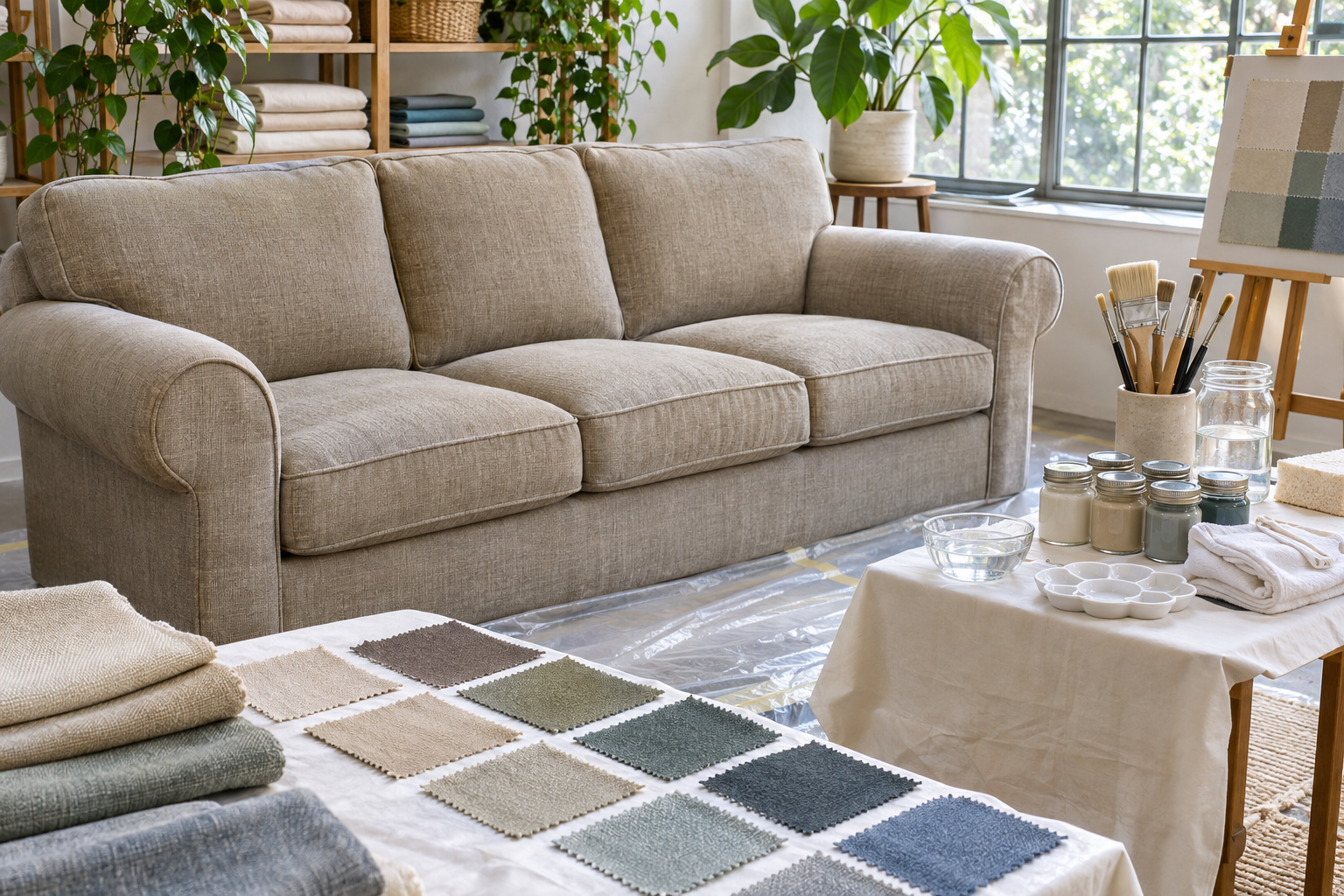
First decide whether painting or dyeing is appropriate
“Paint” and “dye” are often used interchangeably in product titles, but they work differently. A coating made for upholstery sits on the surface and must remain flexible; dye penetrates a compatible fiber and usually requires rinsing or washing away excess. The sofa’s fabric, backing, finish, and construction determine what is appropriate. Start with the sewn-in label and manufacturer’s care instructions.
For a fixed upholstered sofa, ordinary laundry dye is usually a poor fit because the entire piece cannot be immersed and rinsed thoroughly. Rit specifically says it does not recommend its dye for upholstered furniture because excess color must be removed and residual dye can rub off on clothing. Its advice is to use dye on removable covers or pillow covers that can be washed as directed. See the Rit upholstery guidance before considering a dye bath.
Identify the surface material
Check whether the sofa is woven fabric, microfiber, velvet, faux leather, bonded leather, or genuine leather. A product for one surface may not adhere to another. Look for the manufacturer’s material name, cleaning code, and any protective finish. If the label is missing or the material is unknown, ask the furniture maker or a professional before applying color.
Leather itself is not one uniform surface. Aniline, semi-aniline, pigmented, coated, and bonded materials can respond differently to cleaners and colorants. Vinyl and faux leather may need a product made for flexible synthetic surfaces. Do not use a fabric paint on leather simply because the shade is suitable; compatibility and surface preparation matter more than the color name.
Set a realistic result
Paint or recoloring products can refresh a worn surface, but they cannot repair torn upholstery, failing seams, sun-damaged fibers, or collapsed cushions. Color changes may look different on seams, textured areas, and high-contact seat fronts. A lighter color over a dark sofa may require multiple coats and can feel stiffer. For an expensive or heavily worn sofa, professional reupholstery or repair may be the better route.
Decide whether you want a subtle refresh, a spot repair, or a complete color change. Spot repairs are easier to test, but matching an aged fabric can be difficult. A full recolor has a larger chance of changing the hand, texture, or appearance. Compare the cost of enough product for the entire sofa with a slipcover, replacement covers, or professional service.
Choose products labeled for upholstery
Use a fabric coating only if the manufacturer explicitly identifies the intended upholstery materials and gives sofa-specific directions. Some products marketed as fabric paint are designed for clothing or crafts rather than cushions that flex and receive body contact. Check the listed surfaces, coverage, required preparation, drying time, and whether the finish is suitable for repeated sitting.
A flexible upholstery paint can still change the fabric feel. Fabricoat’s instructions call for testing on an inconspicuous area and cleaning the upholstery first; it also says the existing fabric should be lighter than the selected paint for a color change. Read the manufacturer’s application steps and follow the current package directions. Product claims do not guarantee your sofa will accept the finish.
Use leather recoloring products only on compatible leather
Leather balms, dyes, and color restorers are formulated for particular leather or vinyl surfaces. Confirm the maker’s compatibility list and whether it excludes suede, nubuck, aniline, bonded, or coated leather. A product title that says “leather” may not fit every sofa. Follow the manufacturer’s cleaning and preparation system, including any required degreaser, primer, or topcoat.
Test a hidden area and allow it to dry for the full instructed time before judging color or transfer. An old leather finish may absorb color unevenly. Do not apply a recoloring balm over protective coatings, oil, polish, or unknown repair products unless the product maker approves. For peeling bonded leather or extensive cracking, recoloring alone may not create a durable repair.
Check fabric care labels before cleaning
Furniture manufacturers often assign a cleaning code or method to upholstery. The code indicates what type of cleaning is allowed, not whether a new coating will adhere. Do not wet-clean fabric marked for solvent-only care or use household chemicals to strip a finish unless the sofa maker approves. The preparation step can cause shrinkage, rings, water marks, color loss, or damage to backing.
Read both the sofa’s care instructions and the color product’s directions. If they conflict, ask the furniture maker and colorant manufacturer before proceeding. A small patch test is essential but cannot prove that the product will wear well across a whole seat. Preserve the label and product documentation so you can identify what was applied later.
Test the color and texture
Choose a hidden test location such as the back lower edge, but make sure it uses the same material as the visible seat. Apply the full process in miniature: cleaning, preparation, color, drying, and any finish coat. Check the result in daylight and room lighting. After it is fully cured, rub it with a clean light cloth to look for transfer and bend the fabric gently to inspect cracking.
Do not interpret a test as successful while the product is still wet or tacky. Follow the stated cure time before sitting on or touching the area. If the patch becomes stiff, shiny, sticky, darker than expected, or transfers color, stop. A second coat may not solve adhesion problems and can worsen texture. Contact the manufacturer for advice before continuing.
Prepare the workspace
Move the sofa to a ventilated area when feasible and protect floors, nearby walls, hardware, and adjacent upholstery. Remove loose cushions and covers only if the manufacturer says they are removable. Keep children and pets away from wet product. Read the product label and safety information for ventilation, gloves, eye protection, and disposal. Avoid open flames and heat if the product is flammable.
Do not use a spray product indoors unless its label permits that use and you can control overspray and ventilation. Keep windows or exhaust ventilation arranged as directed, and do not point a fan in a way that spreads mist through the home. If anyone in the household has sensitivities, consider professional service or a removable cover instead of applying a coating inside the living space.
Clean without damaging the sofa
Remove dust and loose debris using the upholstery attachment or a soft brush, following the furniture maker’s directions. If the colorant requires a cleaner, use only the specified one and test it first. Residue, body oils, silicone polish, fabric protector, and stain treatments may interfere with adhesion. Avoid soaking the cushion; excess moisture can reach the padding and backing.
Let the surface dry completely for the time the instructions require. Do not speed drying with a heat gun, hair dryer, or direct sun unless the manufacturer explicitly permits it. Uneven moisture can create water rings or cause color to develop differently. If the upholstery is heavily soiled, professional cleaning before recoloring can help, but coordinate the process with the colorant maker.
Apply in thin, even layers
Follow the selected product’s exact application method; brushes, sponges, and sprays are not interchangeable. Work in small sections and keep the amount consistent. Thick coats can sit on the surface, stiffen the fabric, or create visible lines. If the product instructions call for brushing the pile while it dries, do so as directed. Do not improvise a dilution or mixing ratio.
Observe the stated drying interval between coats and the maximum number of layers. A damp cushion can look patchy until it dries, but adding more product too soon may create buildup. Keep a wet edge where the manufacturer recommends it and maintain the same direction on fabrics with a nap. Stop if the finish looks uneven or begins to crack.
Understand transfer, cure, and durability
Drying to the touch is not the same as full curing. Keep the sofa unused until the manufacturer’s full cure period passes. Then test a hidden area with a clean white cloth using normal pressure. Color transfer can stain clothing, skin, bedding, or nearby surfaces. Repeat the transfer check after the finish has cured and before returning the sofa to regular use.
No coating is guaranteed to withstand every household’s friction, cleaning routine, sunlight, or pet use. High-contact areas such as arm fronts and seat edges may wear faster. Keep the product details and care instructions. Ask the maker how to clean the recolored surface and whether applying an additional protector is compatible.
Do not recolor removable covers without checking fiber content
A removable cover is easier to dye because it can potentially be washed and rinsed, but suitability still depends on fiber type, seams, backing, and care label. Cotton, linen, polyester, nylon, and blends require different approaches. A lining or foam backing can shrink or delaminate in a hot dyebath. Confirm the full cover can tolerate the method before using household dye.
If the cover is washable and dyeable, test a scrap from the same fabric or a hidden area when possible. Expect color to differ from a chart because the original shade and fiber blend affect the result. Follow the dye maker’s temperature, fixative, rinse, and washing instructions exactly, and use a machine or container only as directed.
When a slipcover or reupholstery is better
A slipcover avoids a permanent chemical change and can be removed for cleaning if its care label allows. It may not fit tightly or remain in place on every sofa shape, so measure carefully and check return terms. Custom replacement covers can preserve the original frame while changing appearance, though they may cost more and take longer to make.
Professional reupholstery is worth comparing when the fabric is valuable, the sofa has complex curves, or the desired color is dramatically different. A professional can inspect the frame, foam, and fabric before quoting. If the frame or cushions are failing, repairing those parts at the same time may be more sensible than applying color to a surface that is near the end of its life.
Product examples and what each is for
The product cards below were returned by Amazon Creators API searches for upholstery paint and leather recoloring products. We have not tested them on furniture. Some are fabric paint; others are leather or vinyl color restorers. They are not interchangeable. Read the current label and compatibility list for your sofa’s exact material before purchasing, and confirm the listed product is intended for the surface you plan to treat.
Do not choose based on color alone. Check coverage, required preparation, number of coats, drying and cure times, safety instructions, and whether the product remains flexible. Seller listings can change or combine variations. Open the exact ASIN and verify that the selected item is the right formula and quantity for your project.

Fabricoat Fabric Paint & Upholstery Dye, Blue, Flexible Finish
Check material compatibility, safety directions, coverage, and cure time on the live listing.

Furniture Clinic Leather Recoloring Balm, Medium Brown Leather Dye | The original leather dye for repairing scratched & faded leather. Great for couches, car seats, chairs, and other furniture.
Check material compatibility, safety directions, coverage, and cure time on the live listing.

Leather Max Grey Mix Vinyl and Leather Repair Kit – Restorer of Your Furniture, Jacket, Sofa, Boat or Car Seat, Easy Instructions to Match Any Grey Color, Restore Any Material, Bonded, Italian
Check material compatibility, safety directions, coverage, and cure time on the live listing.

Tulip Fabric & Upholstery Paint, Black, 16.9 fl oz | Black Fabric And Upholstery Paint, For Light-Colored Fabrics, Permanent Washable Color, Brush Or Sponge Application
Check material compatibility, safety directions, coverage, and cure time on the live listing.
Estimate coverage before you start
Read the product’s stated coverage and compare it with the sofa’s visible surface area, including arms, back, seat fronts, and cushions. A large sectional may need more than one container, especially if the fabric is absorbent or the original color is dark. Coverage estimates can vary with texture, application method, and the number of coats required.
Buy enough of the same color batch for the full project if the maker recommends it. Check whether the product can be returned unopened and whether it has a shelf life. Do not dilute or stretch the formula beyond its directions to make it cover more area; this can weaken color consistency or flexibility.
Consider how the sofa is used
A decorative chair in a low-contact room is different from a family sofa used every day. Seat cushions and arm fronts receive repeated friction, body heat, and cleaning. Ask whether the product is rated for that level of contact and whether the manufacturer provides furniture-specific examples. If no wear information is available, treat longevity as uncertain and consider replacement covers or professional work.
If the sofa is used by children or pets, consider contact after curing and the possibility of scratches, spills, or chewing. Follow the product’s label for ventilation, drying, and safe re-entry. Keep animals away from wet color and supplies, and do not allow anyone to sit on the sofa until the complete cure period has passed.
Document the test and application
Take photos of the original sofa and hidden test area before applying anything. Record the product name, color, lot, preparation steps, coats, and curing time. This makes it easier to reproduce an approved result or explain a problem to the product maker. Keep the sofa care label and product package until you know the finish is performing as expected.
Work in consistent lighting and compare the cured test with a nearby untreated area. If the color is too dark or the finish feels wrong, stop before expanding the project. Do not assume a second product can safely cover or remove the first; ask the manufacturer. Mixing incompatible coatings can cause tackiness, peeling, or color transfer.
Common mistakes to avoid
Do not use immersion dye on a fixed sofa when the excess cannot be rinsed away. Do not assume a clothing paint or general craft paint will remain flexible on upholstery. Avoid skipping the patch test, applying thick coats, cleaning with an unapproved solvent, or sitting on the sofa before full cure. These shortcuts can lead to stiff fabric, uneven color, and transfer onto clothing.
Another mistake is trying to recolor damaged material instead of repairing it first. A color product will not fix torn seams, cracked leather, missing backing, or a sagging frame. If the result matters for daily use, confirm the product maker supports that application and consider a professional before committing to the whole sofa.
FAQ: Can I use regular fabric dye on an upholstered sofa?
Rit says it does not recommend using its dye on upholstered furniture because excess dye is difficult to remove and can rub off on clothing. It recommends its dye for removable fabric that can be immersed, rinsed, and laundered as directed. Check the maker’s own instructions for any other dye.
FAQ: Is upholstery paint the same as dye?
No. Paint generally forms a surface layer; dye is intended to color compatible fibers and often requires rinsing or laundering. Product names can blur the terms, so rely on the instructions and listed surfaces.
FAQ: Can I paint a polyester couch?
Only if the specific product says it is suitable for that fabric and furniture use. Test a hidden area and follow the product directions. Some finishes and synthetic blends resist adhesion.
FAQ: Can I recolor leather with fabric paint?
Do not assume so. Use a product explicitly compatible with the leather or vinyl surface and follow its preparation system. Different leather finishes respond differently.
FAQ: Will recoloring make the sofa feel stiff?
It can, depending on product, fabric, and application thickness. Thin coats and the correct flexible product may help, but only a full patch test can reveal the feel on your sofa.
FAQ: How long before I can sit on the sofa?
Follow the product’s complete cure time, not just the touch-dry time. Keep the sofa unused until that time has passed and test for transfer before regular use.
FAQ: Can I use a spray paint indoors?
Only if its label permits the application and you can meet the ventilation and overspray requirements. If not, choose a different method or professional service.
FAQ: What should I do if color rubs off?
Stop using the sofa and follow the product maker’s troubleshooting advice. Do not add a generic sealer. Contact the manufacturer and check whether the product is compatible with the upholstery.
Final thoughts
The best paint or dye for a couch is the product explicitly designed for the sofa’s exact surface, used exactly as directed. Fixed fabric upholstery is a poor candidate for dye that requires soaking and rinsing; leather and vinyl need compatible recoloring systems. Test the complete process in a hidden area, allow full cure, and check for color transfer before regular use.
For product care and layout ideas, read our sofa spot-removal guide, two-sofa layout guide, and affiliate disclosure.
Certain content on this site comes from Amazon and may change. Product names, images, features, and availability are supplied through Amazon Creators API or the live listing. Verify current details before purchase.