Where to buy
Check the latest price, availability and delivery on Amazon. Orders are placed on Amazon. We may earn a commission from qualifying purchases.
- Best overall for modern homes: Maxxima LED Outdoor Wall Wash Light, Up/Down, Photocell — Check on Amazon
- Maxxima LED Outdoor Wall Light with Dusk-to-Dawn Photocell, Black — Check on Amazon
- Globe Electric Charlie 1-Light Outdoor Wall Sconce, Oil Rubbed Bronze — Check on Amazon
- LUTEC 6222B Dual-Head LED Floodlight, Black — Check on Amazon
- Aootek Solar Motion Sensor Lights, 120 LED, 4-Pack — Check on Amazon
- LIT-PaTH Outdoor LED Wall Lantern, 2-Pack, Black — sold on Amazon, but its listing could not be verified to our standard for a link, so it is covered in prose below with no link; search the exact name on Amazon.
Read the full guide ↓
Disclosure: As an Amazon Associate, dailyhomedecorating.com earns from qualifying purchases. Links to Amazon on this page are affiliate links; they cost you nothing extra. Listing details such as price and availability change often, so check the current Amazon listing before you buy.
A modern house is judged in daylight. On a traditional house, a lantern hides among shutters, brackets and shadow lines. On a modern house, there is nowhere to hide. So this guide scores every pick twice: once for the light it makes at night, and once for the silhouette it leaves on your wall at noon.
Here is the second uncomfortable truth, and it is good news: at this budget, the modern look is accessible and the expensive look does not really exist. The verified quality options for a single outdoor wall light sit in the lower part of this budget — that is where you find an ETL-listed, wet-location-rated, aluminum-and-glass dusk-to-dawn lantern from a real lighting manufacturer — and the single most modern fixture in this guide, a genuine up-and-down architectural wall washer in aluminum and glass, sits in that same lower part of the tier; check the current price on Amazon. There is no clearly better single fixture waiting in the upper part of this budget. What the extra room in the budget buys a modern homeowner is not a fancier light; it is a pair of real fixtures, symmetrically mounted and properly installed, which is exactly what a modern facade actually asks for. Two wall washers flanking a front door are the natural way to use this budget. The name-brand smart wall light, the Govee Outdoor Wall Light, is positioned above this budget at its regular positioning, and only visits the under-$75 conversation when it is promoted. So the honest headline for modern homes is this: spend the $75 on repetition, alignment and installation, not on one hero fixture. The sections below show the working.
One more piece of discipline runs through everything that follows: color temperature is a design decision, not a detail. The hardwired picks in this guide split cleanly into a warm 3000K camp (both Maxxima fixtures) and a cool 5000K daylight camp (the LIT-PaTH pair and the LUTEC floodlight). A modern facade, with its long unbroken sightlines, exposes that mistake more ruthlessly than any other house style. Pick one temperature per view and hold the line.
The Modern Test: Silhouette, Off-State, Sightline
Every pick below was put through three tests that ordinary buying guides skip, because ordinary houses forgive what modern houses do not.
The silhouette test. Look at the fixture from the street at noon, switched off. Is its outline a deliberate shape — a clean bar, a disciplined cylinder, a lantern you chose on purpose — or is it a plastic box with a solar panel glued to its forehead? Modern architecture is drawn in a few strong lines; a fixture either continues those lines or interrupts them. There is no neutral.
The off-state test. A light spends most of its life off. Materials decide how it ages in that state: black aluminum and real glass hold their composure for years, seeded glass reads as texture, and thin plastic fades, chalks and yellows in UV until the fixture looks tired even when it still works. On a wall with no trim, no shutters and no shadow gaps, that aging is fully visible.
The sightline test. Stand where a visitor stands and take in the whole wall at once. Everything in that frame must agree: same color temperature, same finish family, spacing that looks measured rather than approximate. This is why this guide keeps returning to pairs and repetition. One good fixture is a purchase; two identical fixtures at even spacing are a design.
Those tests produce the working strategy of the whole guide: divide your walls into judged walls and working walls. Judged walls are the front facade and the entry — the surfaces the street, your guests and your own eye score every day. They get the fixtures that pass all three tests. Working walls — the garage side, the side return, the fence run, the bin store, the dark path to the meter — need light, not composition, and they are where floodlights and solar pucks earn their keep honestly. Most bad modern lighting is not a bad fixture; it is a working-wall fixture promoted to a judged wall. Keep the categories separate and almost every pick below has a place it serves well.
Quick Picks
Short on time, or comparing several options at once? Each row below names the modern-home job and the product that suits it, with a link to the listing where we could verify one.
| Modern-home job | Pick | Why it stands out | Link |
|---|---|---|---|
| Best overall for modern homes | Maxxima LED Outdoor Wall Wash Light | The up/down architectural beam is the modern exterior language itself; aluminum, glass lens, photocell, wet-location rated — and it works naturally as a pair; check price on Amazon | Check on Amazon |
| Best built fixture | Maxxima LED Outdoor Wall Light (MEL-6150), Black | ETL-listed, wet-location rated, aluminum and real glass, true dusk-to-dawn photocell — a lantern silhouette with unimpeachable paperwork | Check on Amazon |
| Best value pair | LIT-PaTH Outdoor LED Wall Lantern, 2-Pack, Black | Two aluminum-and-glass hardwired lanterns in one value-positioned pair — but fixed 5000K daylight, so place them where cool light belongs | Search Amazon by name (see review) |
| Best for modern-farmhouse and covered entries | Globe Electric Charlie 1-Light Sconce (44127) | Seeded glass, a bulb in the box, and the only replaceable socket in this guide — a heritage shape, covered locations only | Check on Amazon |
| Best for working walls: driveway and yard | LUTEC 6222B Dual-Head Floodlight, Black | 3,500 lumens (maker figure) of aimable work light; switch-controlled, and we say so — never a facade fixture | Check on Amazon |
| Best for working walls: no wiring | Aootek Solar Motion Sensor Lights, 120 LED, 4-Pack | Four motion lights for fences, gates and dark corners — repetition on a working wall is the one way solar reads intentional | Check on Amazon |
How These Picks Were Chosen
The first filter was verification, and it is the same standard whether a fixture is beautiful or not. Every pick in this guide is tied to a named configuration — a single fixture in black, a 2-pack, a 4-pack — because outdoor lighting listings love to headline one variant and show another in the photograph. Each product’s ASIN had to be confirmed from at least two independent sources before it earned a link. One pick failed that test and appears the honest way: the LIT-PaTH lantern pair, whose pair listing we could not pin to the same standard, so it is covered in full prose with no link and instructions to search its exact name. For linked picks, check the current price on Amazon before you buy, because listings change.
The second filter was the location rating, because it decides where a light may sensibly live and because modern facades tend to be exposed — flat walls, shallow eaves, nothing overhead. A damp-location or covered-location fixture belongs under a porch roof. Listings blur this constantly: “waterproof” and “weather resistant” are marketing words, not ratings, and an IP65 claim on a no-name listing is an unverified claim, not a certification. That frank one made the guide. A maker who tells you the limit is telling you the truth about the rest, too.
The third filter was control honesty. “Dusk to dawn” should mean a photocell. “Motion sensor” should mean a PIR sensor with a stated range. Finally, the modern filters described above: silhouette, off-state materials, and color temperature discipline. Judge brightness by fixture type — a lantern lights a door, a floodlight lights a yard, a wall wash spends its output on the wall — not by comparing raw numbers across brands.
The 6 Best Outdoor Wall Lights for Modern Homes Under $75
Maxxima LED Outdoor Wall Wash Light, Up/Down
Who it suits: Modern homeowners who want the architectural look — twin blades of light washing up and down the wall beside a door or along a facade — from a fixture that disappears into the architecture instead of decorating it.
This is the pick the whole guide is organized around, because it is the only fixture here whose form is native to modern architecture. The wall washer is an 8-inch aluminum-alloy bar with a glass lens that throws light both upward and downward, grazing the wall surface in the twin-beam pattern that modern exteriors are drawn around. Rated at 1,000 lumens (maker figure) in 3000K warm white from 12W, with a photocell for true dusk-to-dawn operation and an IP65 rating that Maxxima backs with a wet-location statement, it can live on a fully exposed facade — which is precisely where modern homes need it, since shallow eaves offer no shelter. That is the highest compliment this guide pays any product.
Now the logic that makes it the modern pick rather than merely a modern-looking one. A single wall wash beside a door is an accent; the modern move is the pair, one each side of the entry or a run of them down a long facade — and because this fixture sits in the lower part of this budget, a pair leaves room in this budget for the mounting hardware and sealing the job deserves; check price on Amazon. An aluminum, glass-lensed, photocell-equipped up/down light in this part of the tier is remarkable; this is the fixture type designer brands position at a much higher tier.
The honest caveats are about what a wall wash is. Its 1,000 lumens (maker figure) are split between two beams aimed at the wall itself, so the usable light on the ground and the doorstep is a fraction of the headline number — this is orientation and accent light, genuinely useful for finding the step, useless for lighting a driveway. On clean modern render or smooth cladding that modeling is the look working as intended; on a tired wall, budget for the wall, not just the light.
- Up-and-down architectural beams from an aluminum body with a real glass lens — the modern form, honestly built.
- Photocell dusk-to-dawn operation, IP65, stated suitable for wet locations.
- 1,000 lumens (maker figure) at a warm 3000K; well suited to buying as a matched pair — check price on Amazon.
Honest limitation: Most of its output washes the wall rather than lighting the ground, so it is accent light, not task light — check the current price on Amazon before buying.
Choose it if your facade is the point — a pair flanking the front door is the single best modern lighting move under this budget. Skip it if the position must genuinely illuminate steps or a path — take the Maxxima lantern below, or the LUTEC floodlight for working walls.

Maxxima LED Outdoor Wall Light (MEL-6150), Black
Who it suits: Homeowners — including modern ones — who want the best-built single lantern under this budget: hardwired, automatic at dusk, warm white, and made from the materials a porch light should be made from.
Let us be precise about this fixture’s modern verdict, because it splits cleanly in two. On paperwork and materials, it is the strongest product in this guide: Maxxima sells a hardwired lantern — check price on Amazon — with an aluminum base and a real glass shade (clear water glass, not acrylic), an integrated LED rated at 580 lumens (maker figure) in 3000K warm white drawing just 8.25W, and a photocell that turns it on at dusk and off at dawn with no switch discipline required from you. The manual rates it suitable for wet locations, it carries an ETL/CETL listing and a 3-year warranty — two things the no-name end of this category almost never offers — and the maker publishes an operating range of minus 22°F to 113°F, the kind of unglamorous specification that separates a lighting manufacturer from a listing farm. At about 11.7 inches tall it is a proper entry-lantern size, and 580 lumens (maker figure) is the right order of magnitude for a door: keys, house numbers, steps — without floodlighting the porch.
On silhouette, the honest score is lower. Neither verdict is a flaw in the product; it is a question of which house you actually have. What no one can argue with is the off-state: aluminum and real glass age with composure, and the 3000K output slots straight into the warm camp alongside the wall washer, so the two Maxximas can share a sightline without a color argument.
The trade-offs are the integrated-LED ones, and the manual is unusually straight about them: the LED is not replaceable, and if the light source fails, the whole fixture is replaced. A dusk-to-dawn light burns roughly 4,000 hours a year, so the maker’s 50,000-hour life claim (a maker figure, like all lifetime claims here) would still be a decade of nights — but weigh it against the socketed Globe Electric below if you think in decades. If you want one lantern, bought once, that simply works every night without being thought about, this is the one this guide would screw to its own wall.
- Aluminum base and real glass shade; ETL-listed and rated suitable for wet locations.
- True dusk-to-dawn photocell — no switch, no timer, no app.
- 580 lumens (maker figure) at 3000K warm white from just 8.25W, with a 3-year warranty.
Honest limitation: The LED is integrated and not replaceable — when it eventually fails, the entire fixture is replaced — and its lantern silhouette is a traditional shape that strict minimalist facades may not want.
Choose it if you want the best single hardwired lantern under this budget and value automatic operation. Skip it if you want to choose and change your own bulbs — that is the Globe Electric Charlie below.
LIT-PaTH Outdoor LED Wall Lantern, 2-Pack, Black
Who it suits: Anyone lighting two matched positions at once — both sides of a garage door, a front door and a back door — who would rather have two real lanterns than one fancy one, and who places them where cool daylight belongs.
Start with the format, because it is the whole review: this is a pair of hardwired lanterns, positioned at the value end of this tier, and each lantern is an aluminum housing with a glass shade and an integrated LED rated at 800 lumens (maker figure) — drawing 9.5W — which is why this pair anchors the value end of the guide. For a modern home, a matched pair is not a compromise but the correct instinct: symmetry is the cheapest design tool there is, and two identical fixtures at measured spacing will always look more deliberate than one expensive fixture standing alone. A pair flanking a garage door is exactly how these are meant to be used.
Then the discipline this lens demands. Each lantern’s light is 5000K — the cool, blue-leaning daylight that reads as security light. There is no warm version to swap to. Inside the warm-3000K scheme the two Maxxima picks build, a 5000K pair in the same sightline breaks the sightline test instantly: from the street, your facade would glow warm at the door and cold at the garage, and every visitor would feel the mismatch before they could name it. Mix one into a warm wall and it is not. The second caveat is control: this lantern has no sensor of any kind. Pair it with a timer or smart switch if you want automation, and allow for that switch separately in the job.
The third caveat is ours, not the product’s: we could not pin the pair’s own listing to the two-source standard this guide requires for a link, so there is deliberately no link here. Search Amazon for the exact name — “LIT-PaTH Outdoor LED Wall Lantern 2-Pack” — and confirm you are looking at the black 2-pack before buying; the same lantern is also sold singly. A pair of real aluminum-and-glass lanterns positioned at the value end of this tier is a high point of this entire category, and it is worth one careful search to get it.
- Two aluminum-and-glass hardwired lanterns in one value-positioned pair.
- 800 lumens (maker figure) per lantern, 9.5W each; ideal as a matched garage or entry pair.
- Simple, standard junction-box install.
Honest limitation: Fixed 5000K daylight with no warm version — keep the pair in its own sightline, away from any 3000K fixture — and no photocell or motion sensor; it is switch-controlled only.
Choose it if you need two matched hardwired lanterns in one self-contained view and your switch setup already handles timing. Skip it if the pair must share a wall with warm fixtures, or you want dusk-to-dawn automation built in — the Maxxima lantern above has the photocell this one lacks.
No link for this pick, by the verification policy explained above — search the exact product name on Amazon.
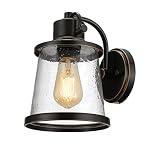
Globe Electric Charlie 1-Light Outdoor Wall Sconce (44127), Oil Rubbed Bronze
Who it suits: Modern-farmhouse and transitional-modern owners with a covered entry, who like a lantern’s glow and prefer a fixture whose bulb they can replace — and upgrade — themselves.
Start with this guide’s honesty about the shape: the Charlie is a heritage lantern — a metal frame in an oil-rubbed bronze finish behind a clear seeded glass shade — and on a strict minimalist facade it is a stylistic mismatch, full stop. Where it belongs is the large family of modern homes that borrow traditional warmth at the door: modern farmhouse, Scandinavian-influenced builds, black-windowed transitional houses. There, its seeded glass is a genuine asset in the off-state, reading as texture rather than ornament, and its modest size — about 9.5 inches tall — suits porches and doorways better than grand entries. Check the current price on Amazon.
Its most important specification is the one the integrated-LED picks cannot offer: a standard E26 screw-in socket, with an LED bulb included in the box. The bundled bulb is rated at 469 lumens in Amazon’s own spec field — the title rounds that to 500, and both are maker figures — at roughly 7W with a 15,000-hour claimed life. It is also the only pick here whose light source you will never throw away with the housing.
Its limitation is printed in its own manual, which is precisely why we trust the product: Globe Electric tells you to protect the Charlie against heavy rainfall and mount it beneath a covered location. On the flat, shallow-eaved walls modern homes favor, that restriction bites harder than on a traditional porch, so check your overhang honestly before ordering. It is switch-controlled with no photocell — though the socket saves the day again, because a dusk-to-dawn bulb with its own light sensor turns this into an automatic light in one twist.
- Standard socket with an LED bulb included — replace or upgrade the bulb, keep the fixture.
- Real seeded glass and a metal frame in an oil-rubbed bronze finish.
- Pairs naturally with a dusk-to-dawn or smart bulb to gain automatic operation — and to set its color temperature.
Honest limitation: The maker’s own manual restricts it to covered locations protected from heavy rain — it is not an exposed-wall fixture — its silhouette is a heritage shape, and it has no built-in sensor of any kind.
Choose it if your mounting spot sits under a porch roof or covered entry and you value a replaceable bulb. Skip it if the wall is fully exposed to weather — the wet-rated Maxxima lantern is the correct tool there — or your facade is strict minimalism.
LUTEC 6222B Dual-Head LED Floodlight, Black
Who it suits: Homeowners whose real need is a yard, driveway or side-of-house need — broad, bright, aimable light over the places a lantern cannot reach — and who will keep it on the working walls where it belongs.
This guide will not pretend otherwise: the 6222B fails the silhouette test completely. It is a hardwired dual-head floodlight in an aluminum housing — two open LED arrays on a bar — rated at 3,500 lumens (maker figure) in 5000K daylight from 32W, with two heads you aim independently: one down the driveway, one across the yard. On a judged modern facade it looks like site equipment, because it is. On a working wall — the garage side, above a side gate, over the driveway from a rear elevation — that same industrial honesty is exactly right, and in the black version — check price on Amazon — it delivers roughly six times the Maxxima lantern’s output while sitting in the lower part of this budget. The IP65 rating means it is built for exposed mounting in real weather, and floodlights are the one corner of this category where the big lumen numbers are at least plausible, because the fixture is a pair of open arrays rather than a shaded lantern throwing light through glass.
Now the honesty this pick exists to demonstrate. The 6222B has no motion sensor and no photocell. Comparison listings state it plainly: neither feature is specified for this model. One more modern-home caution: many modern houses are heavily glazed, and a 5000K flood burst reflects straight off that glass into the living space — aim working-wall floods away from your own windows, not just your neighbor’s. Judged as what it is — a switch-controlled, aimable, weather-sealed floodlight for walls nobody scores — it is superb value. Add a separate motion or timer control at the switch if you want automation, and the combination still lands far under this budget.
- 3,500 lumens (maker figure) at 5000K from two independently aimable heads.
- Aluminum housing, IP65-rated for exposed mounting.
- The most light for the budget in this guide by a wide margin — check price on Amazon.
Honest limitation: Switch-controlled only — no motion sensor and no photocell on this model, whatever the surrounding category copy implies — and its industrial silhouette disqualifies it from any wall the street can see.
Choose it if you need to light a driveway, yard or dark side path and already have (or will add) switch-side control. Skip it if the wall is part of your facade, or you want light that reacts to movement by itself — that is the Aootek below, in solar form, or a dedicated PIR floodlight model.

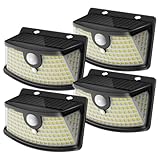
Aootek Solar Motion Sensor Lights, 120 LED, 4-Pack
Who it suits: Fence lines, gates, sheds and every dark corner where there is no junction box and no prospect of one — anyone whose install budget is ten minutes and a screwdriver, and who keeps solar on working walls.
Solar is the third power source in this category and the Aootek 4-pack is its best-known citizen: four wall-mounted motion lights in one value-positioned pack — check price on Amazon. Each unit runs 120 LEDs behind a PIR motion sensor rated to 26 feet across a 120° arc (maker figures), with three working modes that cover the sensible solar strategies: motion-only, where the light stays off until something moves; a permanent-on mode at about 10% brightness through the night; and a smart mode that holds a dim glow and brightens when motion arrives. The housing is plastic, the rating is IP65 — a maker’s claim on a listing, not a location certification — the solar panel is PET-laminated, and the whole thing mounts with screws in minutes, anywhere the sun reaches.
The modern verdict needs care, because it is not simply “plastic, therefore banned.” A single Aootek puck on a clean facade fails both the silhouette and off-state tests: it is visibly a plastic box, and UV will chalk and fade it while the wall around it stays crisp. But repetition is the one compositional trick solar can honestly perform. For a gate, a bin store or the dark run beside a garage, four of these transform a property with very little effort.
Now the solar fine print, which this guide will not skip. Aootek publishes no lumen figure for this model; third-party estimates put it around 600 lumens per light, and an estimate is all that is — treat these as strong path-and-gate lights, not floodlights. The listing even contradicts itself about how long the light stays on per trigger — 15 seconds in one section, 25 to 30 in another — which tells you how carefully budget solar copy is written. Buy them as brilliant, disposable convenience lighting — the best in this guide at their job — and not as a substitute for one hardwired fixture over the door you actually use at night.
- Four lights in one pack — an accessible way to cover gates, fences and dark corners; check price on Amazon.
- Three genuinely useful modes, including dim-all-night with a motion brightening boost.
- No wiring, no electrician; an evenly spaced row reads as rhythm on working walls.
Honest limitation: Plastic housing that fails the facade test, a sealed non-replaceable battery, no maker-published lumen rating, and performance that depends entirely on the sun your mounting spot actually gets.
Choose it if you need light where no wiring exists, or you are renting and cannot touch the wiring. Skip it if the spot is shaded, north-facing, part of your front facade, or the main door you rely on nightly — hardwired wins there every time.
Comparison Table
| Product | Power and control | Output (maker figure) | Build and rating | Modern verdict | Link |
|---|---|---|---|---|---|
| Maxxima LED Wall Wash Light | Hardwired, dusk-to-dawn photocell | 1,000 lumens, 3000K | Aluminum and glass lens, IP65, wet locations | Passes all three tests; the facade pick — buy it as a pair; check price on Amazon | Check on Amazon |
| Maxxima LED Outdoor Wall Light (MEL-6150) | Hardwired, dusk-to-dawn photocell | 580 lumens, 3000K | Aluminum and glass, wet-location rated, ETL | Best paperwork and materials; lantern silhouette suits modern-farmhouse and transitional facades | Check on Amazon |
| LIT-PaTH Outdoor LED Wall Lantern, 2-Pack | Hardwired, switch-controlled | 800 lumens each, 5000K | Aluminum and glass, outdoor rated | A real pair at the value end of the tier — keep its cool light in its own sightline | Search Amazon by name |
| Globe Electric Charlie Sconce (44127) | Hardwired, switch-controlled, replaceable bulb | 469 lumens (included bulb) | Metal and seeded glass, covered locations | Heritage shape for modern-farmhouse porches; the only socket in the guide | Check on Amazon |
| LUTEC 6222B Dual-Head Floodlight | Hardwired, switch-controlled | 3,500 lumens, 5000K | Aluminum, IP65 | Working walls only — site equipment, honestly placed | Check on Amazon |
| Aootek Solar Motion Sensor Lights, 4-Pack | Solar, PIR motion sensor | Not maker-published (est. ~600 lumens) | Plastic, IP65 (maker claim) | Never the facade; a spaced row on a fence is its one intentional look | Check on Amazon |
How to Choose an Outdoor Wall Light for a Modern Home Under $75
- Start with the wall, not the fixture. Walk to the street at noon and look at the surface the light will live on. Flat render, smooth cladding and long unbroken sightlines reward fixtures that disappear — the wall washer above all — and punish anything fussy, oversized or visibly plastic. The fixture is an object in that composition fourteen hours a day; buy the object first and the light second.
- Divide judged walls from working walls, and shop them separately. The front facade and entry get fixtures that pass the silhouette and off-state tests. The garage side, fence run and bin store get the LUTEC floodlight and the Aootek row, where output is the only score that matters. Promoting a working-wall fixture to the facade is the most common modern lighting failure, and it is a placement error, not a product error.
- Pick one color temperature per sightline and hold it. The hardwired picks split into a warm 3000K camp (both Maxxima fixtures, plus whatever bulb you choose for the Globe Charlie) and a cool 5000K camp (the LIT-PaTH pair, the LUTEC floodlight). Any single view of your house — one wall, one glance from the street — must contain one camp only. If your entry scheme is warm, the garage pair in the same view must be warm too, or moved out of the view.
- Spend the budget on a pair, not a hero. The verified quality options for a single fixture in this category sit in the lower part of this budget; in the upper part of this budget there is no clearly better single light, only more lights. Two wall washers, or a wall washer plus the Maxxima lantern across two roles, will always look more designed than a single fixture at the top of this budget — because symmetry and repetition are what modern facades are made of. Our broader guide to Best Outdoor Wall Light Under $75 works through the same budget without the design filter.
- Check the rating before the render. Modern facades are exposed facades: shallow eaves, no porch roof, nothing overhead. A fixture there needs a genuine wet-location position — the Maxxima lantern’s ETL listing and wet-location rating, the wall washer’s IP65 with a wet-location statement, the LUTEC’s IP65. A covered-location fixture like the Charlie belongs under real cover, whatever its listing title implies, and a no-name “waterproof” claim is not a rating at all.
- Decide how the light should switch itself. A photocell (dusk-to-dawn) suits doors and facade accents that should simply be on all night — both Maxxima picks have one built in. A PIR motion sensor suits security spots and saves power, but beside a bedroom window its bursts become the household’s problem; we cover that placement question in Best Outdoor Wall Light For Bedrooms Under $75. A plain switch-controlled fixture plus a timer or smart switch is the flexible middle path — and the only path for the LIT-PaTH pair and the LUTEC floodlight here.
- Choose your consumable. Integrated LED fixtures (four of the six picks) are replaced whole when the light dies — a more acceptable trade-off at the lower end of this tier, with warranties of up to 3 years on the Maxxima lantern. A socketed fixture like the Charlie lets you replace just the bulb forever, and lets you change color temperature or add a smart bulb later. On a house you plan to keep, that difference compounds.
- Count the whole job, not the fixture. At this tier the fixture is rarely the whole cost: add a timer or smart switch for switch-controlled picks, a dusk-to-dawn bulb for the Charlie, mounting hardware and sealant for masonry or render, and — if a new junction box is needed — an electrician, whose call-out alone can exceed this entire budget. Small outdoor spaces change the sums again — a balcony or compact patio needs smaller, softer light, not a floodlight — and Best Outdoor Wall Light For Small Rooms Under $75 covers those spaces specifically. Renters face a different constraint entirely: the wiring belongs to the landlord, and Best Outdoor Wall Light For Apartments Under $75 works through the renter-safe options.
- If your real budget is tighter, shop where the value is. Most of this guide’s picks sit in the lower part of this budget, because that is where this category’s quality actually sits; Best Outdoor Wall Light For Modern Homes Under $40 applies the same silhouette and sightline discipline with the lower ceiling.
What $75 Actually Buys a Modern Home
It is worth pausing on how strange this tier is, because shoppers arrive expecting a ladder and find a plateau. In most lighting categories, doubling the budget doubles the product. In outdoor wall lights, the verified quality options for a single fixture sit in the lower part of this budget: that is where you find an ETL-listed, wet-rated, aluminum-and-glass dusk-to-dawn lantern from a real lighting manufacturer, and a pair of aluminum lanterns from a value brand. In the upper part of this budget there is no better lantern waiting — there are only different things: multi-packs, bigger floodlights, and the first rung of smart lighting, which itself sits above this tier at its regular positioning, with the Govee Outdoor Wall Light reaching this budget only when it is promoted. That Govee is, for the record, the fixture many modern buyers actually picture — app control, color scenes, Matter support, 1,500 lumens (maker figure), IP65 — and it is honestly described here so you can make an honest decision: at its regular positioning it sits above this budget, its motion sensor is a separate purchase, and no link is offered because its US single-pack listing could not be pinned to this guide’s standard.
So the modern spending plans that actually make sense look like this. The facade plan: two Maxxima wall washers flanking the front door — check price on Amazon for each — with the remaining budget going to careful mounting — level, aligned, sealed — because at that point installation quality is the design. The layered plan: the Maxxima lantern at the door for warm, automatic, wet-rated duty plus one wall washer washing the long facade wall, one shared 3000K sightline. The pair plan: the LIT-PaTH pair on the garage elevation, plus a timer switch, keeping its 5000K daylight in its own view. Every one of those plans beats the imaginary alternative — a single hero fixture at the top of this budget that does not really exist — and each leaves the facade calmer than a mixed bag of unrelated lights would. If you came here planning to spend the full $75 on one fixture, spend it on two instead.
Common Buying Mistakes
- Judging a fixture by its night photograph. The listing shows a glow on a dark wall; your facade shows the object at noon. Buy the object.
- Mixing color temperatures in one sightline — a warm lantern at the door and a cool daylight pair at the garage, visible in the same glance from the street. It reads as an error, not a choice.
- Promoting a working-wall fixture to the facade: a dual-head floodlight or a plastic solar puck on the front wall of a house whose whole design is restraint.
- Mounting a damp-location or covered-porch fixture on a fully exposed modern wall, because the title said “outdoor” and “waterproof.” Shallow eaves protect nothing.
- Expecting a motion sensor or photocell that the specific model does not have — sibling models in the same listing family often differ in exactly this feature, as the LUTEC floodlight shows.
- Comparing lumen numbers across brands as if they were measured the same way. They are maker figures; treat a 3,500 from one brand and a 580 from another as different dialects, not a six-fold truth.
- Forgetting what grazing light does: a wall wash models every crack, bump and trowel mark in the surface it washes. On a tired wall, the fixture is not the problem or the solution.
- Aiming a floodlight across a glass-heavy facade, so every burst reflects into your own living space — the modern-house version of blinding the neighbors.
- Buying solar lights for a shaded or north-facing wall, then blaming the lights for a starving panel.
- Misreading multi-pack listings — ordering a single when the photo showed the pair, or the reverse. Check the pack count in the configuration, every time.
- Forgetting that integrated LED means the fixture is the consumable, and being surprised in year six that there is no bulb to change.
Final Recommendation
- Most modern homes: Maxxima LED Outdoor Wall Wash Light — bought as a pair, flanking the entry; check price on Amazon. It is the only pick whose form is native to modern architecture, and the pair is the design.
- One important door, maximum build quality: Maxxima LED Outdoor Wall Light (MEL-6150) — wet-location rating, ETL listing, glass, aluminum, warm light and a photocell; check price on Amazon.
- Two positions, one cool scheme: LIT-PaTH Outdoor LED Wall Lantern 2-Pack — two aluminum-and-glass lanterns in one value-positioned pair, kept in their own 5000K sightline on a switch or timer you control.
- Modern-farmhouse porches and bulb-changers: Globe Electric Charlie — seeded glass, a bulb in the box, and a socket that outlives every LED in this guide.
- Yards, driveways, dark sides of the house: LUTEC 6222B Dual-Head Floodlight — 3,500 lumens (maker figure), switch-controlled and kept off the facade; check price on Amazon.
- No wiring, no permission, no problem: Aootek Solar Motion Sensor Lights 4-Pack — four motion lights, spaced as a rhythm along fences and paths wherever the sun reaches; check price on Amazon.
Our top two for modern homes are the wall washer pair — because repetition and restraint are the whole game on a modern facade — and the Maxxima lantern for anyone whose “modern” house still wants a lantern’s welcome at the door, with the best paperwork in the category behind it. If your real want is the smart light with app control and color scenes, believe the positioning in this guide: at its regular positioning it sits above this budget, so either look for it when it is promoted or step up a tier, where it competes fairly. Whatever you choose, judge the fixture at noon before you judge it at midnight, fix one color temperature per sightline, decide the mounting position and the power source before the style, and let the fixture’s rating — not its title — tell you where it is allowed to live.
Frequently Asked Questions
What makes an outdoor wall light look right on a modern home?
Three things, all tested in this guide: a silhouette that continues the house’s lines rather than interrupting them (bars, washers and disciplined shapes over ornament), materials that age calmly in the off-state (aluminum and real glass over thin plastic), and color discipline — one color temperature across everything visible in a single view. The Maxxima wall washer passes all three; that is why a fixture from the lower part of this budget tops a guide with a $75 ceiling.
Should I buy one expensive fixture or a pair of cheaper ones?
A pair, at this budget — because the expensive single fixture does not exist. The verified quality options for one outdoor wall light sit in the lower part of this budget, and nothing verified waits in the upper part of this budget except multi-packs, floodlights and promoted smart lights. Two identical fixtures at even spacing also happen to be the stronger design move on a modern facade: symmetry reads as intention, and intention is what separates a designed exterior from a purchased one.
Can I mix 3000K and 5000K outdoor lights on the same house?
On the same house, yes; in the same sightline, no. Warm 3000K and cool 5000K can coexist on different elevations that are never seen together — a warm entry scheme on the front, a cool security scheme at the rear. The mistake is mixing them inside one view, where the eye compares them directly and the mismatch reads as an accident. Long, unbroken modern facades make more of the house visible in one glance, which is why this guide enforces the rule strictly.
What is the difference between wet-location and damp-location ratings?
A wet-location fixture is built to take direct rain and can be mounted on an exposed wall. A damp-location fixture handles humidity and indirect splashes but belongs under a porch roof, eave or covered entry. The distinction decides real products in this guide: the Maxxima lantern is rated for wet locations and can live anywhere, while Globe Electric’s own manual restricts the Charlie sconce to covered locations protected from heavy rain. When a listing says only “waterproof” or “weather resistant” with no rating behind it, treat that as marketing and look for an IP rating or a safety listing instead.
What happens when an integrated LED outdoor light dies?
The whole fixture is replaced. Integrated LED picks — the Maxxima lantern and wall wash, the LIT-PaTH lanterns, the LUTEC floodlight — have no bulb to change; the light source is built into the housing. The mitigations are lifespan and warranty: makers claim up to 50,000 hours (a maker figure), and the Maxxima lantern carries a 3-year warranty. If replaceability matters to you, choose a socketed fixture like the Globe Electric Charlie, where a dead bulb is a quick, simple fix.
Is $75 enough for a smart outdoor wall light?
Not at its regular positioning, as of this guide’s research. The category’s big-brand smart fixture, the Govee Outdoor Wall Light, is positioned above this budget for a single light, with 1,500 lumens (maker figure), color scenes and Matter, Alexa and Google Assistant support; it belongs in an under-$75 conversation only when it is promoted, and its motion sensor is sold separately. Below that tier, “smart” outdoor wall lights are no-name app-controlled products whose apps and support are the real gamble.
Do solar wall lights work in winter or in shade?
Poorly, and honestly so. A solar light is a battery charged by whatever sun its panel actually receives; short winter days, low sun angles, snow cover and shaded or north-facing walls all shrink the charge, and the light answers with dimmer output and shorter run times. The Aootek’s dim-all-night modes are the smart coping strategy — they sip power instead of spending it — but no solar light repeals the geometry. Put solar where the sun is, keep it on working walls, and keep critical doors on hardwired fixtures.