Where to buy
Check the latest price, availability and delivery on Amazon. Orders are placed on Amazon. We may earn a commission from qualifying purchases.
- Best overall for a modern facade: BesLowe Outdoor Wall Light Fixtures, 2-Pack, E26 Socket, Glass Shades, Matte Black — Check on Amazon
- Aootek Solar Motion Sensor Lights, 120 LED, IP65, 4-Pack — Check on Amazon
- Tuffenough Solar Outdoor Lights, 2500LM, 210 LED, 3 Heads, Remote, 2-Pack — Check on Amazon
- URPOWER Solar Spot Lights Outdoor, 2-in-1 Wall Light / Landscape Spotlight, 2-Pack — Check on Amazon
See 2 more Amazon options
- HMCITY 120 LED Solar Wall Lights, Motion Sensor, 3 Modes, 2-Pack — Check on Amazon
- SOLPEX Solar Deck Lights Outdoor, 16-Pack, Warm White — Check on Amazon
Read the full guide ↓
Disclosure: As an Amazon Associate, dailyhomedecorating.com earns from qualifying purchases. Links to Amazon on this page are affiliate links; they cost you nothing extra. Listing details such as price and availability change often, so check the current Amazon listing before you buy.
A modern house is judged in daylight. The flat wall planes, the unbroken render or cladding, the black window frames, the door with no trim to hide behind — all of it is composed to be looked at for the sixteen or so hours a day when the outdoor lights are off. That is the fact most outdoor lighting guides ignore and the one this guide is built on: on a modern home, a wall light is a daytime object first and a light source second. Every pick below therefore had to pass two tests before its brightness was even discussed. The silhouette test asks what the object looks like as a shape on a clean wall — a deliberate geometric form, or a gadget that happens to be stuck there. The off-state test asks what it communicates at noon, switched off: architecture, or appliance. A light can be excellent at midnight and still fail the house at midday, and on a facade with nowhere to hide, midday is most of the day.
Here is the tier’s honest condition, stated before the picks so nothing below can be misread. Under $40, the outdoor wall light market is overwhelmingly solar security hardware: five of the six picks in this guide are plastic-bodied solar units, most of them shining at 6,500K — a blue-white daylight color that belongs to parking structures and loading bays, and that sits awkwardly against the warm whites, natural wood and matte black of a contemporary palette. There is exactly one route in this budget to an object that reads as designed rather than deployed: a hardwired lantern pair with real glass and a standard bulb socket, which lets you choose a warm bulb and a filament silhouette of your own. That pick leads this guide. But it carries the tier’s sharpest trade-off — its maker publishes no wet-location rating or IP code we could verify — and its review states that plainly rather than letting the good looks argue it away. Everything else here is strategy: assigning each plastic box to the wall where its appearance does no harm, and using repetition, placement and color discipline to make honest hardware look like a decision.
Two ground rules govern every claim that follows. Brightness figures in this category are maker figures with no shared measurement standard behind them, so this guide prints them as classes — accent, doorway burst, area flood — and never as rankings; the loudest claim in the tier, a solar flood’s 2,500 lumens, has no independent measurement behind it at all and is treated accordingly. And weather language is read the same skeptical way: a location rating or an IP code a maker will print is a specification, while the word “waterproof” alone is a photograph caption. Where a maker publishes no rating, this guide prints none and steers the light to a covered wall. Readers comparing this tier against the full field should also see our main guide to the Best Outdoor Wall Light Under $40; this page is the same budget read through a stricter visual discipline.
Quick Picks
Short on time? Each row names the wall or the job, the light that fits it, and — because this guide is for modern homes — an honest note on how the object behaves on a clean facade.
| Best for | Pick | Why it stands out | Link |
|---|---|---|---|
| The judged front wall | BesLowe Outdoor Wall Light Fixtures, 2-Pack | The only designed object in the tier: two matte-black lanterns with real glass and E26 sockets, so the bulb — and its warm color — is your choice. Bulbs not included — check price on Amazon | Check on Amazon |
| Working walls, in rhythm | Aootek Solar Motion Sensor Lights, 4-Pack | Four identical solar wedges that read as a repeated system rather than clutter when mounted in a line — check the current price on Amazon | Check on Amazon |
| Driveway and yard only | Tuffenough Solar Outdoor Lights, 2-Pack | Three aimable heads and a remote per unit, the tier’s widest solar coverage — check the current price on Amazon. Quarantine it off the facade | Check on Amazon |
| Light without an object | URPOWER Solar Spot Lights, 2-Pack | A small tilting spot that washes a wall or tree from dusk to dawn while the hardware nearly disappears — check the current price on Amazon | Check on Amazon |
| Coverage per dollar | HMCITY 120 LED Solar Wall Lights, 2-Pack | The category’s best-selling wedge family, with a dim-all-night mode that behaves on a side wall — check-price pick: family pricing swings widely by pack size and week, so buy only at a live price comfortably under the $40 ceiling | Check on Amazon |
| Steps, decks and fence lines | SOLPEX Solar Deck Lights, 16-Pack | Sixteen low-profile warm-white markers — the only warm light among the solar picks — check the current price on Amazon | Check on Amazon |
How These Picks Were Chosen
The first filter was the budget, applied at the exact configuration each review recommends. Five of the six picks sit at or under $40 in that configuration on two-source evidence. The sixth, the HMCITY, is the tier’s most volatile listing family: the ASIN is verified, but the family’s prices swing too widely between variants to characterize one configuration’s position, so its review names the exact configuration to check and the ceiling to buy under instead.
The second filter was the pair of tests this guide exists to apply. Picks were not required to pass both tests — at this price, almost nothing does — but every review reports both results, and the Quick Picks and Final Recommendation assign each light to the wall its scores can defend. A pick that fails the facade can still win the side gate, and several below do exactly that.
The third filter was the wall-layer strategy, which is how a modern home should actually buy this tier. The strategy is to spend the tier’s one designed object, and your own attention, on the judged walls, and to let honest plastic hardware cover the working walls where nobody composes the view. That is why the multipacks score better in this guide than their individual design deserves — rhythm is a modern material, and bought as a multipack of identical wedges it is the cheapest route to it in this tier.
The fourth filter was evidence discipline on the technical claims, because a disciplined facade deserves disciplined facts. Brightness is printed as maker figures sorted into classes: under roughly 300 claimed lumens is accent light; the several-hundred class is a doorway or path burst; the thousand-plus class is an area flood in bursts. Weather claims are printed exactly as makers publish them: the Aootek, HMCITY and Tuffenough carry IP65 claims; the URPOWER’s listing says waterproof, with IP65 cited by third-party teardowns of the model; the SOLPEX and the BesLowe publish no IP code or location rating we could verify, and both are steered to covered or low-exposure mounting in their reviews.
Finally, two absences define the tier and belong on the record. The first is automation on a wired fixture: under $40, hardwired and sensor do not meet. The sensor-equipped hardwired two-packs we verified while researching sit above this budget line — both therefore discussed without links — so the automatic hardwired porch light starts in the under-$75 tier, and a modern home that wants its entry light to think for itself should budget there. The second absence is a genuinely designed solar sconce: app-controlled, architecturally styled outdoor wall lights exist, but nothing credible verified inside this budget does, and no pick below pretends otherwise.
The 6 Best Outdoor Wall Lights for Modern Homes Under $40
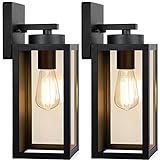
BesLowe Outdoor Wall Light Fixtures, 2-Pack — E26 Sockets, Glass Shades, Matte Black
Who it suits: Owners of contemporary homes replacing an existing entry or garage fixture, who want the object on the judged wall to look chosen rather than installed — and who already have the junction boxes and a wall switch to run a wired pair.
Silhouette test: pass — the only clear pass in this guide. Each fixture is a matte-black lantern with clear glass panels and a visible standard E26 socket, a form that reads as geometry rather than equipment: straight lines, a real material contrast between metal, glass and the bulb you choose, and a profile that sits as comfortably beside a black-framed door as it does on render, cladding or brick painted out in a single color. Because the socket is exposed and standard, the visible heart of the fixture is a bulb you select: an ST58 or ST64 Edison-style filament bulb, as the maker recommends, gives the lantern a deliberate vintage-modern note; a plain frosted bulb makes it quieter; a 2700K color temperature keeps it inside a warm contemporary palette that none of the solar picks below can enter. The pair sits toward the top of this budget as a two-fixture hardwired set — check the current price on Amazon — and it is sold through the brand’s own Amazon storefront.
The trade-off must be stated as plainly as the praise, because it is the sharpest in this tier. The listing markets this fixture as waterproof for exterior use, but we could not verify a formal wet-location rating or an IP code for it — so the one designed object in the budget is also the one with the least documented weather protection, and this guide steers it to porches, covered entries and under-eave walls, the damp locations where most entry lanterns honestly live, rather than to a bare rain-driven facade. Owners whose judged wall is fully exposed have to choose between the look and the paperwork, and should know that is the choice. The remaining compromises are the hardwired format’s own: bulbs are not included, so two LED bulbs are an extra purchase on top of the fixtures’ cost; there is no sensor of any kind, so automation means a timer, a smart switch, or a photocell bulb bought separately — the bulb route being the elegant one, since it puts the electronics in a cheap, replaceable part; and installation is real electrical work, an hour for a confident DIYer swapping an existing fixture and an electrician’s callout otherwise. It is also not a renter’s project: readers in leased homes should start with the solar picks below, or with our guide to the Best Outdoor Wall Light For Apartments Under $40, where nothing touches the landlord’s wiring.
- The tier’s only real fixture pair: metal lanterns, clear glass, standard E26 sockets — bulb, color temperature and any future smart bulb are your design decisions; check price on Amazon.
- Passes both of this guide’s tests: a silhouette a modern facade can carry at midnight and an object that still looks intentional at noon.
- No battery and no panel: hardwired light at full brightness all night, in December as in June, with nothing sealed to fade.
Honest limitation: No wet-location rating or IP code could be verified for this fixture, bulbs are not included, and there is no built-in sensor — the best-looking pick in the tier asks you to mount it under cover and bring your own automation.
Choose it if your entry or garage wall is covered or eaved and you want the one object in this budget that reads as architecture. Skip it if the wall takes direct rain and you need a documented wet-location rating, or if there is no junction box where the light belongs.
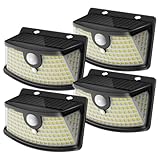
Aootek Solar Motion Sensor Lights, 120 LED, 4-Pack
Who it suits: Modern homeowners who need motion light at several working points — a side gate, a garage corner, a deck stair, a path junction — and who are willing to let repetition, rather than any single object, carry the design.
Silhouette test: fail, individually. The Aootek is the reference form of the solar wedge — a compact housing roughly 4.1 by 3.7 inches, a solar panel across the top, 120 LEDs behind a reflector and a PIR dome in the middle — and alone on a clean wall it reads as what it is: security hardware. Off-state test: fail alone, pass in formation, and the formation is the point. Four identical wedges mounted on one measured line, at one height, with even spacing, stop reading as four gadgets and start reading as a rhythm the wall was planned around; modern facades are built from repeated modules, and this is the only pick in the tier cheap enough to be used as one. The maker’s figures, printed as maker figures: a 270-degree lighting angle, detection to 26 feet across 120 degrees, an IP65 claim, and a PET-laminated monocrystalline panel rated up to 20.5 percent conversion — the spec that decides whether a December charge lasts the night. Three modes cover the real uses: motion-only at full brightness, a steady medium light, and a dim all-night level that brightens when the sensor fires, which is the mode a modern home should run anywhere the light can be seen from inside. On price, the honest summary is that this four-pack usually sits in the lower half of this budget — check the current price on Amazon, because its record also includes sharp spikes, covered below.
The compromises are the architecture’s own, and one of them is specific to glass-heavy modern homes: the light these wedges throw is a motion burst, and on a house with large windows a 6,500K-class blast reflecting off glass at night is a visual event indoors as well as out — aim the line away from glazing, or run the dim-plus-boost mode where the wall faces living space. The LED and battery are sealed into each unit, so a wedge’s life is its battery’s life, a few years of nightly cycles, after which it is replaced whole; at multipack per-unit costs the arithmetic is forgivable, provided the mounting is screws you can reach rather than adhesive you cannot. The price is also volatile: trackers recorded this same four-pack spiking far above its usual position within the last year, at times beyond this guide’s budget entirely, so the honest instruction is to buy when the live price sits comfortably inside the under-$40 tier and treat a spiked live price as the wrong week. And placement remains physics: the panel is fixed to the housing and needs direct sun, which on a modern home’s shaded north elevation may rule the pick out entirely.
- Four identical motion lights in one box — check price on Amazon — the cheapest verified way in this guide to turn a working wall into a deliberate repeated system.
- Three modes including the dim-plus-motion hybrid, an IP65 maker claim, and a sensor the maker rates to 26 feet.
- An established bestseller whose failure modes are the category’s known ones — no surprises hiding in the design’s novelty.
Honest limitation: A plastic security wedge that only design discipline — repetition, alignment, aiming — can civilize; the battery and LED are sealed and finite, and the price has spiked above this budget within the last year, so buy it on a dip, when the live price sits comfortably inside the tier.
Choose it if you have three or four working points to cover and can mount them as a measured line in decent sun. Skip it if the wall is a judged facade with a single mounting point — one wedge alone is the look this guide exists to prevent — or if the wall never sees direct sun.
Tuffenough Solar Outdoor Lights, 2500LM, 210 LED, 3 Heads, 2-Pack
Who it suits: Anyone whose modern home has a wide driveway, a motor court or a yard frontage that needs broad motion coverage — and who understands that this pick is equipment to be placed where equipment belongs, not an object for the facade.
Silhouette test: fail, decisively. Each Tuffenough unit is a small lighting rig — a solar panel on top, three adjustable LED heads splayed below it, a motion sensor in the center, in a housing about 11.4 inches wide — and its profile announces surveillance, not design. Off-state test: fail on any judged wall, irrelevant on the walls it is for. This guide’s verdict is quarantine: the driveway apron, the garage’s working flank, the yard’s far corner are legitimate places for a rig, and a modern home has them; the entry elevation is not one. Within its quarantine the pick is genuinely capable. The three heads aim left, center and right across a claimed 270-degree field, so one unit covers a drive in a way no wedge can; the remote control changes modes from the ground, which matters at gutter height; and the three modes run from motion-only through dim-with-boost to a steady strong light. The maker’s headline is 2,500 lumens from 210 LEDs at 6,500K, off a 2,000mAh battery per unit — printed here with this guide’s strongest caveat: no independent source we found has measured that figure, a battery this size cannot sustain it for more than a short burst, and it should be read as “the brightest class of solar flood in this tier, in bursts.” On price, the pair sits in the upper half of this budget and dips lower on deal days — check the current price on Amazon.
The compromises follow from the rig’s nature. The color is the deepest one for this guide’s readers: 6,500K is a blue-white security light, and against a warm contemporary palette — cedar, warm render, bronze or black metalwork — it does not merely look cheap, it re-colors everything it touches, turning a composed evening facade into a service yard for the seconds it fires. There is no warm variant of this configuration to choose instead. The output is a burst product: strongest in the first seconds, with the steady mode draining a small battery accordingly, so it is a coverage light, not a working light. Sensor range is a maker figure of about 26 feet that the listing itself states vaguely, so overlap two units on a long drive rather than trusting one to reach the street. And a placement warning this lens makes unavoidable: if the wall in question sits outside a bedroom window, a 6,500K motion blast is the last thing anyone in that room wants at 2 a.m. — our guide to the Best Outdoor Wall Light For Bedrooms Under $40 works through that case in detail.
- The widest coverage in this guide: three aimable heads per unit, two units in the box, a remote for ladder-free mode changes — check price on Amazon.
- A 2,000mAh battery per unit and an IP65 maker claim — the security end of the solar spectrum, sized for drives and yards.
- Three modes including a dim standby with motion boost, the setting that makes a big-claimed flood livable as a nightly light.
Honest limitation: The 2,500-lumen figure is a maker claim no independent source has measured, the light is 6,500K blue-white only, and the object itself is unapologetic security hardware — powerful on a working wall, wrong on a facade.
Choose it if a driveway, garage front or yard needs width more than welcome and the mounting point sits in full sun. Skip it if the light will be seen from the street as part of the house’s face, or hangs beside a door or seating area where its color and blast will annoy.

URPOWER Solar Spot Lights Outdoor, 2-in-1 Wall Light / Landscape Spotlight, 2-Pack
Who it suits: Modern homeowners who want the most contemporary effect in this tier — a wall, a tree or a plane of render washed with light from dusk — while the fitting itself stays as close to invisible as a budget product can manage.
Silhouette test: pass, by disappearance. The URPOWER is a small adjustable spotlight head on a short body, sold since 2015, that works as a ground stake in a planting bed or, with the stake removed, as a screw-mounted wall fitting — the configuration this guide recommends. Mounted low and aimed up, or tucked at a wall’s base, the hardware is a minor dark shape; what the facade shows is the light, not the light fitting, which is the oldest trick in architectural lighting and the only pick here that can perform it. Off-state test: pass on the same terms — there is barely an object to judge. Two brightness modes trade output against runtime, with maker figures of up to ten hours on low and about six on high. The head tilts 90 degrees and the panel 180 degrees, independently — the geometry that makes a wall-mounted solar light workable, since the panel can face the sky while the beam grazes the wall. Output is a claimed 200 lumens from four LEDs off a 2,200mAh battery: accent light, honestly sized for a lit olive tree, a glowing house number or a wash up a fence panel. The two-pack sits in the middle of this budget — check the current price on Amazon.
The compromises are output, age and aim. Output first: 200 claimed lumens will not light a doorway for keys or a stair for safety, and buyers who need either should take the Aootek or the Tuffenough and accept the motion mechanism — this pick’s calm is bought with dimness. Age second: a design from 2015 carries an older panel and battery generation than the newest wedges, and while the 2,200mAh capacity is respectable, winter runtime on the high mode falls well short of the maker’s six hours; the low mode is the winter setting, and even it shortens in December. Like every solar pick here, the LED and battery are sealed into the unit, so when the battery fades after some years the light is replaced whole. Its listing says waterproof, with IP65 cited by third-party teardowns of the model; this guide credits the claim to its sources rather than upgrading it.
- True dusk-to-dawn operation: on at dark, off at dawn, every night — a steady architectural wash with no motion theatrics.
- Independently tilting panel and head: the only pick that can charge facing up while lighting facing sideways, and the only one that doubles as a landscape stake.
- A decade-old, still-selling design with a 2,200mAh battery — check price on Amazon.
Honest limitation: Two hundred claimed lumens is accent light only, the design’s panel and battery are a generation old, and a single unit aimed carelessly makes a pool, not a wash — this is an effect to be composed, not a security light.
Choose it if a feature wall, tree or house number deserves an all-evening glow and the spot can sit low, hidden and in decent sun. Skip it if the job is security, steps or task light — bursts and brightness live in the picks above this one.

HMCITY 120 LED Solar Wall Lights, Motion Sensor, 3 Modes, 2-Pack
Who it suits: Buyers covering several ordinary points — steps, a fence gate, a side path, a shed door — who want the category’s most proven budget wedge, used the way this guide prescribes: in multiples, on working walls, bought at the right week’s price.
Silhouette test: fail, in the generic way. The HMCITY is, by its maker’s account and years of bestseller lists, the default solar wall light of this price class — a compact wedge about 4.1 inches wide carrying 120 LEDs, a PIR sensor and a monocrystalline panel — and its shape is the category’s shape, which is to say no shape at all. Off-state test: fail alone, workable in rhythm, for the same reason as the Aootek — a spaced line of identical small wedges on a side wall reads as infrastructure, and infrastructure is allowed to be plain. What earns this family its slot is behavior: its three modes are the clearest expression of the category’s choices — full brightness on motion only; a constant medium light with the sensor off; and a dim all-night level that boosts to full when the sensor fires. That third mode is why the family outsells its rivals and why it suits a modern home’s secondary walls: it behaves like a porch light and a security light in the same night, without the strobe effect that makes motion-only lights hostile near glass. The maker claims 960 lumens and an IP65 rating — both printed here as maker figures, with the same skepticism applied as everywhere in this guide — and an 18-month maker warranty stands behind the listing, longer than most of this tier offers. On price, this family needs more care than any other pick here: it is sold in 2-, 4-, 6-, 8-, 10- and 12-packs across two shell colors and two light colors, and verified pricing belongs to different configurations at different times — two-packs seen at the very bottom of this tier on deal days, larger packs higher up it. The two-pack linked here is the configuration to check: buy when the live price sits comfortably under the $40 ceiling, which on the family’s recorded history is nearly always, and ideally low in the tier.
The compromises are price chaos, sameness and solar physics. Price chaos first, because it defines the pick: the same brand page that deals a mid-size pack low in the tier one month lists other configurations above this budget the next, and a buyer who clicks the wrong variant can pay far more for the same wedges in a different count — check the pack size in the title before the price in the cart. Sameness second: this is a generic-class product sold under many names, and its real-world brightness is the class standard, a strong local burst for a doorway or a gate rather than area lighting, whatever the 960-lumen claim implies. Physics third: the panel is small and fixed to the housing, so the light must live where the sun does; shaded walls get a dim, short night, and the sealed battery sets the lifespan at a few years. None of this surprises at the price — but on a modern home there is one more discipline to observe, which is scale: these wedges are small, and on the tall blank elevations contemporary houses favor, a scattering of small fittings reads as clutter rather than rhythm. Keep them to the human-scale walls — passages, gates, steps — where their size is proportionate; our Best Outdoor Wall Light For Small Rooms Under $40 guide covers the tight-space cases where these compact wedges are often the only fit.
- The category’s best-selling wedge family, with the most useful mode set in this guide — including the dim-all-night-plus-motion-boost pattern — and an 18-month maker warranty.
- A wide pack range, from two-packs at the bottom of the tier on deal days up to large multi-packs, so the per-light cost can fall very low in the bigger configurations.
- An IP65 maker claim and a 120-LED array in a 4.1-inch housing that fits posts, fences and narrow wall strips where lanterns cannot go.
Honest limitation: A check-price pick whose listing family’s prices swing by pack and week; the 960-lumen figure is a maker claim, and the sealed battery makes the light a few-year consumable rather than a fixture.
Choose it if you find the linked two-pack, or a larger pack of the same model, at a live price comfortably inside this budget, and can mount a spaced line of them on a working wall. Skip it if the live price has drifted to the top of this budget or beyond — at that point the BesLowe pair above is the better object.

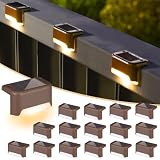
SOLPEX Solar Deck Lights Outdoor, 16-Pack, Warm White
Who it suits: Modern homeowners with a staircase, a deck edge, a boardwalk or a long fence line to define — buyers for whom the design unit is the pattern, sixteen points of gentle warm light in a measured run, rather than any single fitting.
Silhouette test: pass, by smallness. The sixteen-pack sits toward the top of this budget as a full box — check the current price on Amazon — while a hands-on roundup that tested the pack recorded it lower in the tier during its test period, so the live figure moves around within the budget; the per-light cost is small either way, which is the point of a sixteen-pack. Two qualities make this pick matter to this guide specifically. It is warm white — the only solar pick here whose color sits inside a contemporary palette instead of fighting it, so the pattern glows amber along a cedar fence rather than strobing blue across it. And its scale of light is honest: a tester who measured this class of light put each unit at roughly two lumens, a candle’s worth, which is exactly right for edge definition — a staircase where every tread line glows, a deck perimeter a guest can navigate by, a fence that reads as a designed border after dark.
The compromises are durability and brightness, and the owner record states both plainly. The listing says waterproof without an IP code we could verify, so these belong on vertical faces and under rail caps rather than face-up in pooling water. Buy them as pattern with a safety benefit — outlined step edges genuinely are safer — and they earn their slot outright; buy them as lighting and everything above them in this guide exists.
- Sixteen dusk-to-dawn markers in one box — check price on Amazon — the only way in this guide to outline a whole staircase or fence in a single purchase.
- Warm white, not security blue: the gentlest light in the guide, and the only solar color that belongs on a warm modern palette.
- An established listing since 2019 — the failure pattern is documented, is the format’s, and is priced in at this pack’s low per-light cost.
Honest limitation: Each light is a roughly two-lumen marker by tester measurement, the listing publishes no IP code we could verify, and owner reports include units dying over a winter — this is outline lighting, bought with spares built into the pack count.
Choose it if the project is a staircase, a deck edge or a fence line and the goal is a warm, even pattern. Skip it if any single spot needs real brightness — one Aootek wedge out-lights a handful of these where it matters.
Comparison Table
| Pick | Price | Power | Sensor / control | Weather claim | Light source | Modern verdict |
|---|---|---|---|---|---|---|
| BesLowe 2-Pack | Check price on Amazon | Hardwired | None — wall switch | “Waterproof” per listing; no verified wet-location/IP figure | E26 socket, bulb not included | The judged wall — the tier’s only designed object |
| Aootek 4-Pack | Check price on Amazon | Solar | PIR motion, 3 modes incl. dim + boost | IP65 (maker claim) | Integrated LED, sealed | Working walls, mounted as a repeated line |
| Tuffenough 2-Pack | Check price on Amazon | Solar | PIR motion, 3 modes, remote | IP65 (maker claim) | Integrated LED, 3 heads | Driveway and yard only — quarantined equipment |
| URPOWER 2-Pack | Check price on Amazon | Solar | Photocell dusk-to-dawn, 2 brightness modes | Waterproof; IP65 per third-party teardowns | Integrated LED, 200 lm claimed | Light without an object — washes and accents |
| HMCITY 2-Pack | Check price on Amazon — varies widely by pack size | Solar | PIR motion, 3 modes incl. dim + boost | IP65 (maker claim) | Integrated LED, sealed | Human-scale working walls, in rhythm |
| SOLPEX 16-Pack | Check price on Amazon | Solar | Photocell dusk-to-dawn, always-on at night | “Waterproof” per listing; no verified IP code | Integrated LED, ~2 lm per tester measurement | Pattern lighting — stairs, decks, fence lines |
How to Choose an Outdoor Wall Light for a Modern Home Under $40
Layer your walls before you shop. Walk the house in daylight and sort every exterior wall into two lists. Most modern homes under this budget end up mixed, and the pack pricing in this guide is what makes the mix affordable. Buyers working with a smaller lighting budget overall will find the same layering logic, with cheaper modules, in our guide to the Best Outdoor Wall Light For Modern Homes Under $30.
Use repetition as a material. A single solar wedge on a blank elevation is the most common way this tier makes a good house look accidental. Repetition converts a cheap gadget into a system, and a system is a design decision. The same rule disciplines the accent end: SOLPEX markers earn their keep in unbroken runs, and a run that stops halfway along a fence looks worse than none at all, so count the full length before ordering.
Hold the color line. Contemporary palettes are warm: 2700–3000K light against wood, warm render, bronze and black. Keep 6,500K bursts on the working walls where they read as security, and keep the judged walls warm: a 2700K bulb in the BesLowe, the SOLPEX’s warm markers, the URPOWER’s softer spot. Never mix the two temperatures in one field of view — a warm lantern beside a blue wedge makes both look wrong, and the eye reads the mismatch as carelessness rather than contrast.
Match the rating to the exposure, not the adjective. A covered porch is a damp location; a wall that takes driven rain is a wet location. The BesLowe’s missing rating is the tier’s honest tension: the best-looking pick has the least documented protection, so it belongs under eaves and porch roofs, and an exposed judged wall may have to wait for the under-$75 tier’s rated designer fixtures. Seating the backplate gasket, and on hardwired installs a bead of sealant across its top edge, does more for real weatherproofing than any adjective.
Choose the mechanism for the room behind the glass. Modern homes put living space behind large windows, which makes the sensor mechanism an interior decision as much as an exterior one. Dusk-to-dawn lights are hospitality lights, a calm constant glow. Neither is a defect; both are placement problems, solved by aiming and siting rather than by spending more.
Read lumens as classes, and count the whole cost. Under a shared standard this category does not have, one maker’s 2,500 and another’s 960 are not measurements of the same thing. Then count everything: the lantern pair needs two bulbs bought separately and possibly an electrician; the solar packs need nothing but carry a replacement horizon of a few years per unit; the check-price pack needs a minute of variant-checking. The per-light comparison is the honest one — the hardwired pair costs the most per fixture before bulbs, the multipack wedges cost little per unit, and the sixteen-pack markers cost least of all per light — and the facade arithmetic is simpler still: one designed object, honestly placed, is worth more than six gadgets scattered.
Common Buying Mistakes
Judging a wall light by its night photograph. Every listing in this category is photographed at midnight, glowing heroically against a dark wall. Your house will show the object at noon, off, in full sun, for most of its life. A light that only looks good in its own advertising’s darkness will spend your facade’s daylight looking like clutter.
Mounting one wedge alone on the facade. The single most common modern-home lighting error in this tier. One small plastic wedge, centered over a door or stranded on a blank elevation, reads as an alarm component, not a light fitting — because alone, that is what it looks like. The halfway state — one gadget, prominently placed — is the only genuinely wrong answer.
Letting 6,500K onto the judged wall. Blue-white security light against a warm contemporary palette does not read as brightness; it reads as a service yard. The mismatch is worst in combination: a warm interior glowing through glass beside a cold burst outside makes the whole elevation look unresolved. Zone the temperatures — cold for the drive and the side gate, warm for every wall the house presents — and never let the two share a field of view.
Believing the lumen headline. A 2,500-lumen claim from a matchbox battery describes a brief peak under the maker’s own conditions, not an evening’s output, and a 210-LED count describes a circuit board, not brightness. Guides that rank this tier by claimed lumens are ranking it by advertising. Shop by class and mechanism, as the section above lays out, and let coverage — heads, angles, placement — do the work the headline pretends to do.
Buying the wrong pack on a variant listing. Solar listings stack pack sizes, shell colors and light colors on one page, and the headline price belongs to whichever variant the page opened on — sometimes a single light on a page titled for a multipack. The HMCITY family is the extreme case in this guide, but every solar pick does it. Read the pack count in the cart, not the title in the search result; on a modern home, where the plan depends on an exact number of identical units, a wrong-variant order breaks the rhythm as well as the budget.
Ignoring the rating because the photo shows rain. Marketing photographs put every light in a storm. The specification is the wet-location listing or the IP code, and two picks in this very guide carry no verifiable code at all — including, pointedly, the best-looking one. Exposed walls get rated products; unrated products get covered walls. A cheap light killed by one wet season costs more in the end than a better-built one that survives five, and on a clean facade a water-stained, half-dead fitting is a daily eyesore, not just a failed purchase.
Forgetting that solar lights are consumables. A sealed lithium battery gives a few years of nightly cycles, less in hot climates, and the LED cannot be separated from it. On a modern home the failure mode is visual as well as functional: one dead wedge in a repeated line breaks the rhythm the line existed to create. Screw-mount solar units where you can reach them, keep the spare from the multipack, and hold one replacement’s worth of budget in reserve — at multipack per-unit costs, that is still a fair trade, made knowingly.
Final Recommendation
Start with the judged wall. If a wired box exists under cover at your entry, buy the BesLowe pair: with two warm bulbs of your choosing added, it is the only purchase in this budget that behaves like part of the architecture — a designed silhouette by day, a warm replaceable-bulb light by night, and an upgrade path to photocell or smart control for the price of a bulb. Where the facade should show light rather than a fitting, the URPOWER spots are the tier’s quiet answer, washing a wall or tree from dusk while the hardware nearly vanishes. Cover the working walls with rhythm: the Aootek four-pack, mounted as a measured line, or the HMCITY family bought at a checked live price comfortably inside the budget. Keep the Tuffenough pair in its quarantine — driveway, yard, garage flank — where its width is an asset and its looks are nobody’s problem. And run the SOLPEX sixteen-pack along the stairs and fence lines, where its warm dotted pattern is the most designed-looking light this budget can produce. What $40 will not buy a modern home — a sensor-equipped hardwired fixture, a smart architectural sconce, a rated designer object for an exposed facade — this guide has said plainly rather than papered over; those live in the under-$75 tier. What it buys, assigned with discipline, is a facade that still looks composed at noon and a house that is properly lit at night, and for most modern homes that is the whole brief.
FAQ
Is there a genuinely modern-looking outdoor wall light under $40?
One, with an asterisk. The BesLowe lantern pair — matte black, real glass, standard E26 sockets — is the only pick in this tier whose silhouette and off-state read as designed, and it lets you choose a warm bulb that fits a contemporary palette. The asterisk is weather documentation: no wet-location rating or IP code could be verified for it, so it belongs on covered entries and under eaves. Architecturally designed, fully rated sconces start above this tier.
Can I get a hardwired outdoor wall light with a motion sensor or photocell for under $40?
Not as a verified pair from an established brand, on this guide’s research. The hardwired two-pack under $40 is a plain switch-run fixture with no sensor; the sensor-equipped hardwired two-packs we verified all sit above this budget. Two workarounds keep the budget: a photocell or smart E26 bulb in a plain fixture, which puts the sensor in a replaceable bulb, or a solar motion light, which puts the sensor in a battery product instead.
Why does this guide keep criticizing 6,500K light?
Because color temperature is where this tier most visibly fights a modern home. Contemporary exteriors are composed in warm materials and warm interior light; a 6,500K burst is a blue-white security color that re-tones everything it touches and clashes in any shared field of view. The objection is not to the color but to its placement: on a judged wall, against warm render or cedar, it makes an expensive facade look like a service entrance.
Are the lumen numbers on solar wall lights real?
They are maker figures produced without a shared standard, and they should be read as classes rather than measurements. A claimed 2,500 lumens from a small solar flood describes a peak burst — no independent source we found has measured it — while a claimed 200 from an accent spot describes a gentle wash; neither was necessarily measured the way a bulb’s rated lumens are. LED counts are not brightness at all.
One designed light or several plain ones — which suits a modern facade better?
Both, on different walls — that is the layering this guide is built on. The judged wall wants either one designed object or none visible at all: a lantern pair, or a hidden spot producing a wash. The working walls want several plain ones, because coverage and rhythm are what those walls are for, and the Aootek and HMCITY packs exist for exactly that pattern.
Why does this guide not print prices?
Because prices on these listings change constantly, and a printed figure goes stale fast — so every pick here links out with a check-price prompt instead, and the live Amazon listing is the only price worth trusting. The HMCITY family is the extreme case: it sells the same wedge in six pack sizes and four color combinations, with pricing that swings widely between configurations and weeks, so its review names the exact configuration to check and the ceiling to buy under rather than characterizing one number.