Where to buy
Check the latest price, availability and delivery on Amazon. Orders are placed on Amazon. We may earn a commission from qualifying purchases.
- Best overall for modern homes: HMCITY 120 LED Solar Lights Outdoor, 2-Pack, Black Shell (JY2440) — Check on Amazon
- Best rhythm for a long wall or fence line: CLAONER Solar Motion Lights, 126 LED, 6-Pack (SL126AB-US) — Check on Amazon
- Best for working walls nobody judges: Aootek Solar Motion Sensor Lights, 120 LED, 4-Pack (AK06) — Check on Amazon
- Best flood — for the driveway only, and only when it fits the budget: Tuffenough Solar Outdoor Lights, 210 LED, 3 Heads, Remote, 2-Pack — Check on Amazon
See 2 more options — read the reviews before you search for these
- Maxxima LED Outdoor Wall Light, 580 Lumens, 3000K, Dusk to Dawn (PD-20622) — the only pick in this guide that reads as a designed fixture: aluminum, real glass, warm light, certified. It sells above this guide’s budget on Amazon, so it carries no link here; its review explains the two honest ways to buy it.
- MATAMEYE Outdoor Wall Lantern, E26, 2-Pack, Black — a real glass-and-iron lantern pair whose Amazon featured offer comes and goes. It is a traditional silhouette, not a modern one, and its review says so; search Amazon by the brand and model description there, and buy only when a live offer fits this guide’s budget.
Read the full guide ↓
Disclosure: As an Amazon Associate, dailyhomedecorating.com earns from qualifying purchases. Links to Amazon on this page are affiliate links; they cost you nothing extra. Listing details such as price and availability change often, so check the current Amazon listing before you buy.
Let us say the thing this guide’s title cannot: at under $30, there is no outdoor wall light that a modern home would choose on looks. Not one. What the budget actually buys — all it buys, in any configuration we could verify — is the solar motion light: a small wedge of ABS plastic with an LED array behind a frosted cover, a solar panel for a face, a sealed battery inside, and a PIR sensor underneath, sold in packs of two, four or six. Every verifiable solar pick in this tier shines at 6500K, a blue-white daylight tone that belongs to loading docks and parking structures, not to the warm, controlled exterior lighting a modern façade depends on. The one fixture in our research with a designed form, real materials and warm light — an aluminum-and-glass dusk-to-dawn sconce — sells above this budget on Amazon, and appears below as a prose-only review precisely because honesty about that gap is worth more than a link.
So this guide is written for the reader who knows all that and still has thirty dollars and a dark exterior to deal with. If that is you, the strategy is not to find the one plastic box that secretly looks good — it does not exist — but to sort your walls into layers and spend accordingly. A modern house has judged walls: the entry elevation, the façade the street sees, the wall behind the patio seating. It has working walls: the garage side, the utility strip, the stair down to the basement door, where a light’s job is pure function and nobody scores its silhouette. And it has long-run walls: fences, side paths, retaining walls, where the modern move is not a beautiful fixture but rhythm — the same small unit repeated at even intervals, so the eye reads a system instead of a gadget. The four linked picks below map onto those layers. The HMCITY pair is the least-bad object for a judged wall, because a matched pair restores the symmetry a modern entry is built on. The CLAONER six-pack is the rhythm pick. The Aootek four-pack is the working-wall pick. And the Tuffenough flood is quarantined to the driveway, where its three-headed silhouette cannot damage a façade.
Every pick is scored below by the two tests a modern home applies to anything mounted on its exterior. The silhouette test: is the object one quiet gesture — a single form, a single material read — or is it a stack of visible parts (panel, sensor dome, LED grid, seams) that the eye has to parse? The off-state test: what does the object do to the wall at noon, switched off, in flat daylight? Exterior lights spend far more hours as objects than as lights, and a modern façade has no trim, no shutters and no ornament to hide a cheap box behind — whatever you mount is on display, all day, at full size. Plastic solar wedges fail both tests in absolute terms; the question this guide answers is where each one fails least expensively, and where it should never be mounted at all. If your walls are all judged walls and the budget can move, skip to the Maxxima review and the tier above; if it cannot, start with the layer strategy in How to Choose, and if the budget is smaller still, the tighter version of this research is at Best Outdoor Wall Light For Modern Homes Under $15.
Quick Picks
Short on time? Each row names the wall layer and the light that belongs on it. For the current figure on any linked pick, check price on Amazon before you buy, because prices in this category move often.
| Wall layer / buyer type | Pick | Why it stands out | Link |
|---|---|---|---|
| Best overall for modern homes (judged wall) | HMCITY 120 LED Solar Lights, 2-Pack, Black | A matched pair — check price on Amazon. Symmetry is the one modern move available in this tier, and the mode button is on the front, where a finger can reach it | Check on Amazon |
| Best rhythm (long-run walls) | CLAONER Solar Motion Lights, 126 LED, 6-Pack | Six identical units in one pack — check price on Amazon. Repetition at even spacing reads as a system, not as six gadgets | Check on Amazon |
| Best for working walls | Aootek Solar Motion Sensor Lights, 120 LED, 4-Pack | Positioned at the low end of this tier — check price on Amazon — with a reflector that spreads light across steps and deck edges | Check on Amazon |
| Best flood — driveway only, buy when it fits the budget | Tuffenough Solar Outdoor Lights, 210 LED, 3 Heads, 2-Pack | Three adjustable heads for wide coverage — check the current price on Amazon and buy only when it fits this guide’s budget, and never beside the front door | Check on Amazon |
| Best designed fixture (over budget on Amazon) | Maxxima LED Outdoor Wall Light, 580 Lumens, 3000K (PD-20622) | Aluminum and real glass, warm 3000K, photocell dusk-to-dawn, ETL-listed for wet locations — positioned above this budget on Amazon; the maker’s own outlet store positions it inside this tier | No link — see its review |
| Best traditional lantern (unstable offer) | MATAMEYE Outdoor Wall Lantern, E26, 2-Pack | Real glass and iron with a standard E26 socket — an honest object, but a traditional silhouette; its Amazon featured offer comes and goes | No link — see its review |
How These Picks Were Chosen
The first filter was verification, and it eliminated more products than either the budget or the aesthetics did. Every linked pick below has an ASIN confirmed in Amazon’s own listing data and a position confirmed within this guide’s budget for the exact configuration reviewed: same pack count, same shell color. The MAXvolador single E26 lantern could not be pinned to a verifiable position inside this budget either (its larger pack configuration sits over budget), so it is named here rather than reviewed. Two hardwired products survived as prose-only reviews for two openly stated reasons: the Maxxima sits verifiably over budget on Amazon even though the maker’s outlet positions it inside the budget, and the MATAMEYE pair’s Amazon offer was not live at check time.
The second filter was the modern one, and it is a filter of placement rather than of products. Six identical units can turn a fence line into a rhythm. A reflector light can disappear into pure function on a working wall. Two further honesty rules from the base research govern every review. Water: an IP65 stamp on a no-name solar light is a maker’s claim, not a wet-location listing; only the hardwired Maxxima carries third-party certification (ETL) and a wet-location description, and everything solar should be treated as weather-resistant for sheltered wall mounting, not certified for the spot where the roofline dumps water.
Color deserves its own paragraph because it is where this tier fails a modern home most completely. Every verifiable solar pick under $30 is 6500K daylight — all four of them, without exception. The only warm fixture we could verify at all is the hardwired Maxxima at 3000K. If warm light on the entry is non-negotiable — and on a modern home it usually is — that fact, not any product below, should drive your decision: either buy the Maxxima the honest ways its review describes, or step up a tier, where the verified hardwired field opens up.
The 6 Best Outdoor Wall Lights for Modern Homes Under $30
HMCITY 120 LED Solar Lights Outdoor, 2-Pack, Black Shell (JY2440) — Best Overall for Modern Homes
Who it suits: Owners of contemporary homes who need light at one judged location — a front entry, a garage front, a patio door — and understand that in this tier the win is not beauty but the least visual damage: a matched pair, in black, at the smallest scale the category offers.
Start with why a pair matters. A modern entry is composed symmetrically or deliberately asymmetrically, and a single plastic wedge stuck beside a door reads as an afterthought either way. Two identical units flanking the door at least restore the composition: the eye reads a pair, a decision, rather than a gadget. The HMCITY is the pick for that job because it is the most restrained object among the verified small solar lights — a compact black shell (the black version is the one reviewed here; a white shell exists and would be the wrong choice against most modern façades) with the LED array behind a cover and the PIR sensor below. On the silhouette test it is a single wedge with a single read: panel face, sensor, done. On the off-state test it is a small dark rectangle that sits quietly against dark cladding, render or a garage door surround — not invisible, but the closest thing to quiet this tier produces. For the current figure, check price on Amazon; the pair is positioned comfortably inside this guide’s budget.
The specification, where it can be trusted, is the strongest of the small solar picks. The maker rates the 120 LEDs at 960 lumens — a maker figure, and the highest claim among the three small picks from hardware of the same class, which is itself the lesson about maker figures — and the battery is 1,800 mAh, half again the capacity of the six-pack pick below, behind a monocrystalline panel the maker rates at 20.5% conversion. The three modes are the useful set: motion-only, dim-with-motion-boost, and a constant dim. The detail that earns this light its slot in a modern home, oddly, is a button: the mode switch sits on the front, under the sensor, where you can reach it after mounting. On a façade you have composed, a back-button rival means unmounting the unit — breaking the composition and the mounting — every time you want to change its behavior. The black-shell listing carries an 18-month warranty, and the same family’s 4-pack and 6-pack variants exist if the pair proves the concept.
The compromises are the tier’s compromises, and under this lens the first is color: this light is 6500K daylight, a hard blue-white that flattens wood cladding and fights every warm interior glow spilling from the windows beside it. No setting fixes that; it is the light the LEDs make. (The family’s warm-white variant is the one solar product in our research that would answer the objection, but its position in this tier could not be verified to our standard, so it is a search term, not a recommendation.) The second compromise is sensor honesty: the maker advertises a 26-foot PIR range, and an independent hands-on assessment of this light puts realistic detection at roughly 10 to 16 feet head-on — enough for a doorway, not enough to guard a long drive from one mounting point. The housing is ABS plastic with a maker-claimed IP65 rating, the battery is sealed and finite, and this listing family leans on coupons and promotions: if you need four lights, buy the family’s 4-pack rather than two 2-packs. Judged as what it is — the quietest pair of motion lights this budget buys, with its control where your finger can reach it — it is the pick we would put on a judged wall. Every other solar pick below goes somewhere the street cannot see.
- A matched black pair — check price on Amazon. Symmetry is the one genuinely modern move available in this tier.
- Front-mounted mode button: change behavior without unmounting the unit and breaking the façade composition.
- Largest battery of the small picks (1,800 mAh) and an 18-month warranty on the black-shell listing.
Honest limitation: 6500K daylight only in the verified configuration — the blue-white tone is the least modern thing about it — and the advertised 26-foot sensor range is optimistic against an independently assessed 10–16 feet.
Choose it if one judged location needs a pair and you accept solar terms. Skip it if warm light is non-negotiable (read the Maxxima review), or if you need four or more lights, where the larger packs below offer better value per unit.

CLAONER Solar Motion Lights, 126 LED, 6-Pack (SL126AB-US) — Best Rhythm for Long Walls
Who it suits: Modern homeowners with a long-run problem — a fence line, a side path, a retaining wall, a run of garage and shed frontage — where the design answer is repetition: the same unit, at the same height, at even intervals, until the hardware stops reading as hardware.
Repetition is the one tactic this budget genuinely supports, and the CLAONER pack is built for it. Six identical lights in a single pack — check price on Amazon — deliver the widest coverage in this guide from one purchase in this tier. Each unit is a compact wedge, about 4.3 × 3.4 × 1.5 inches, with 126 LEDs behind a frosted cover, the solar panel across its face, and a PIR sensor below; one specification note, printed because this guide prints such things: older titles describe this light as 149 LED, but the current Amazon specification table says 126, and 126 is the figure to trust. That is a real effect, and it is the closest a budget box of plastic comes to a modern lighting scheme — the same logic by which a row of identical bollards looks designed while one bollard looks lost. The maker’s figures are 800 lumens (a maker figure) at 6500K, a 270° lighting angle, a sensor watching about 120°, three modes including a dim standby that brightens on motion, a modest 1,200 mAh battery per unit, and a 22% panel conversion figure that is also the maker’s. The carton is unusually complete — screws, wall plugs and double-sided tape are all included — and the 24-month warranty doubles the coverage most of this category offers.
The compromises concentrate where rhythm cannot help. Six units are still six ABS-plastic boxes with sealed batteries: each is a consumable with a realistic one-to-three-year battery life, and a rhythm with one dead unit in it reads worse than no rhythm at all, so budget the pack as a system you will refresh, not a fixture you install once. The light is 6500K only, and repetition multiplies the color problem as efficiently as it multiplies coverage — a fence line of blue-white bursts is a security aesthetic, not a garden one, so keep this pick on the working runs (side path, rear fence, garage-to-gate) rather than the patio wall where people sit in the evening. Output per light is modest: a marker for a path or a gate, not a wash of light. And the fixed face panel means the sun rule is absolute — a unit under a deep eave or on a shaded wall chronically undercharges, and six units give you six chances to site one wrong. Mounted where each panel sees open sky, at a measured interval, this is the pick that turns the tier’s weakness — cheap identical units — into its one design strength.
- Six identical units in one pack — check price on Amazon. The widest coverage from a single purchase in this tier.
- Repetition is a real design tool: even spacing along a fence or path reads as a system and passes the off-state test collectively.
- Screws, wall plugs and double-sided tape all included, plus a 24-month warranty — double the typical coverage in this class.
Honest limitation: Sealed 1,200 mAh batteries in ABS housings — the rhythm is a consumable system with a one-to-three-year refresh cycle, and it multiplies the 6500K color problem along with the coverage.
Choose it if you have a long run of working wall or fence and can space the units evenly in sun. Skip it if the wall is a judged one — a pair (above) or a real fixture (below) belongs there — or if the run is shaded, where no solar pick in this guide will serve you.

Aootek Solar Motion Sensor Lights, 120 LED, 4-Pack (AK06) — Best for Working Walls
Who it suits: Homeowners whose dark spots are purely functional — deck stairs, a basement door, a side gate, the path to the bins — and who want a position at the low end of this tier from a brand with a long record in this category, with no aesthetic ambitions for the walls involved.
Every modern house has walls nobody judges, and the discipline is to spend nothing on their appearance and everything on their function. The black 4-pack sits at the low end of this tier — check price on Amazon for the current figure, because this listing family runs frequent coupon cycles and the live check matters. The design difference from the CLAONER is the reflector: the 120 LEDs sit in a housing shaped to throw light outward across a 270° angle rather than straight down, which is exactly right for steps, deck edges and fence lines, where the job is a spread of light at ground level. The maker’s brightness figure is 500 lumens — a maker figure, and notably the most modest claim in this guide, which in this category reads as a point in the brand’s favor. Three modes mirror the CLAONER’s (security motion-only, permanent-on-all-night at reduced output, and a smart brightness mode), and the PIR sensor is rated by the maker at up to 26 feet over 120°; independent testing of this light’s sibling flood version found the sensor genuinely responsive, though the reliable head-on range will be shorter than the headline number, as with every PIR in this guide. The housing is IP65 maker-claimed ABS.
The compromises are functional ones. The permanent-on mode asks a small solar battery to burn all night and will spend it by the small hours in winter — buy this light for motion duty and it satisfies; buy it as an all-night lamp and it will not. The 500-lumen maker figure is the lowest here, so this is a marker and safety light: it shows you the steps and startles a raccoon, and it will not light a basketball game. The maker does not publish the battery capacity prominently, and this guide does not print numbers it cannot source, so treat longevity as the class standard — sealed, finite, replace-the-unit. The listing family churns (a 6-pack variant lives under a different ASIN), so confirm you are looking at the black 4-pack that fits this budget before checkout. None of that changes the core fact: this is the most affordable verified way in this guide to put a working motion light on the four walls of a house that no one will ever compliment — which is exactly where cheap light belongs.
- Positioned at the low end of this tier — check price on Amazon. No sale-waiting required.
- Reflector housing spreads light across a 270° angle — the right shape for steps, deck edges and fence lines.
- The most conservative brightness claim here (500 lumens, maker figure) and a long-selling brand record in this category.
Honest limitation: The dimmest pick in the guide — a marker-class light for working walls, not an area light — and its all-night mode will outrun its battery in winter.
Choose it if your dark spots are functional and sunlit. Skip it if the wall is visible from the street or the patio — that is what the pair above and the fixture below are for — or if you need real area brightness, which is the flood’s job, next.
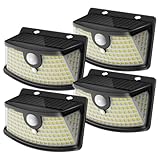
Tuffenough Solar Outdoor Lights, 210 LED, 3 Heads, Remote, 2-Pack (8330D-210R) — Best Flood, Driveway Only
Who it suits: Homeowners whose problem is a wide, dark, purely vehicular space — a driveway apron, a yard corner, a broad garage front set away from the entry — and who check the current price on Amazon before buying, since this listing’s position against this budget shifts often. It suits no one’s front door, and this review will keep saying so.
Scored by the modern tests, the Tuffenough fails on arrival, and it is important to be precise about why, because the failure is instructive. The silhouette is three adjustable heads on a body about 11.4 inches wide — three gestures, three angles, a small machine bolted to the wall. And the light itself is 6500K at flood intensity, a hard blue glare that reads as institutional wherever it lands. Over a driveway, none of that matters and its virtues are real: the three heads angle to cover the apron and both its edges at once, the maker’s headline figure is 2,500 lumens from 210 LEDs — a maker figure, and the one in this guide to read with the most skepticism, because it is claimed from an 1,800 mAh battery; even if the array can spike to that output on a full charge it cannot sustain it, so think of it as the brightest burst in the tier, for the seconds after the sensor trips, which for security duty is arguably the right shape of bright. A wireless remote switches modes without a ladder — genuinely useful in month one — alongside the standard three modes, an IP65 maker claim, and a 270° detection arc.
The price instruction for this pick is the guide’s strictest: check the current price on Amazon, and buy it only when it fits this guide’s budget. This listing moves in and out of the tier often enough that patient buyers will not wait long. The remaining compromises are size, light quality and appetite. The remote is a small loose object that garages eat; the light works without it, but mode changes then require reaching the unit. The warranty in roundup data is one year, the shortest here. A flood this size drinks its battery faster in motion-heavy spots, so a busy driveway may find it dim by the small hours. And the same sealed-battery, ABS-housing, sun-dependent terms apply as to every solar pick. Bought within this budget for a sunlit driveway set away from the entry, it is the most light this tier can buy. Bought at any price for a judged wall, it is the most damage this budget can do.
- Three adjustable heads per light — the only pick that covers a wide area rather than marking a spot.
- Its position against this budget shifts often — check the current price on Amazon before buying; includes a wireless remote for mode changes.
- 2,500-lumen maker figure is the tier’s highest claim — read it as a security burst, not sustained output.
Honest limitation: Its position relative to this budget shifts often, so confirm it fits the tier before buying — and a three-head silhouette that fails the modern tests completely: driveway equipment, not façade equipment.
Choose it if a sunlit driveway or yard corner needs area coverage and you can wait until it fits this budget. Skip it if the mounting spot is anywhere the house is judged — entry, façade, patio — or if you need to buy today without checking where it currently sits against the budget.

Maxxima LED Outdoor Wall Light, 580 Lumens, 3000K, Dusk to Dawn (PD-20622) — Prose-Only: The Designed Fixture, Over Budget on Amazon
Who it suits: Owners of modern homes with an existing junction box by the door who want the entry light to be a fixture rather than a gadget — warm light, automatic operation, real materials, certified for wet locations — and who can either stretch past this budget on Amazon or buy from the maker’s own store.
This is the only product in the guide that passes both modern tests, and it is here without a buy link, for a reason we will state plainly: on Amazon it sits above the budget in this guide’s title, while the maker’s own outlet store positions the same fixture inside this tier. We do not print affiliate links dressed up as under-$30 picks when a fixture sits above the budget, so this review is prose-only: search Amazon by the model number PD-20622 to check the current price on Amazon yourself. On Amazon it belongs to the tier above this research; through the maker’s outlet it is, plainly, the best under-$30 outdoor wall light of any kind that our research found — and for a modern home it is not close. The silhouette is a single quiet form. The light is 3000K warm white, the temperature a contemporary exterior is specified in, produced by an integrated LED at 8.25 watts with a photocell that turns it on at dusk and off at dawn: no motion required, no battery to fade, no blue burst when a guest arrives — the porch is simply, calmly lit, which is what modern exterior lighting is for.
Its credentials are the other kind of modern: verified rather than styled. This is an ETL-listed fixture, described by its maker as suitable for wet locations, with a stated 50,000-hour lifespan and a three-year warranty. The 580-lumen figure is a maker’s rating too, but from a certified fixture it means something different — and 580 lumens is, in any case, the right quantity for an entry glow rather than a security flood; the maker sells brighter siblings (875 and 1,000 lumens) in higher tiers for those who want more. Integrated LED means that when the light eventually dies, the fixture is replaced whole — the counterweight being the 50,000-hour rating and three-year warranty, against the solar picks’ sealed batteries and one-to-two-year coverage. And its position deserves one more plain sentence: it sits above this budget on Amazon and inside it at the maker’s outlet, and we found no Amazon position inside this budget, so if a third-party Amazon offer looks far lower than this fixture’s usual tier, check the seller carefully before trusting it. For a modern home, this fixture is the argument for stepping up a tier made physical: above budget on Amazon, or inside it at the outlet, it buys the difference between decorating a wall with equipment and lighting it with a fixture.
- The only pick that passes the silhouette and off-state tests outright: one quiet form in aluminum and real glass.
- The only warm-white (3000K) pick in the guide, and the only one with third-party certification: ETL-listed, wet-location suitable, three-year warranty.
- Photocell dusk-to-dawn operation — the entry is lit every night automatically, no motion required, no battery to fade.
Honest limitation: Positioned above this guide’s budget on Amazon, and it needs an existing junction box; the under-budget route is the maker’s own outlet store, not Amazon.
Choose it if you have a junction box at a judged location and can buy through the maker’s outlet or accept the Amazon stretch. Skip it if you rent, have no box by the door, or need motion-triggered security light rather than an all-night glow.
No Amazon link for this pick: its Amazon position is over this guide’s budget. Search Amazon for “Maxxima PD-20622” to see the live listing.
MATAMEYE Outdoor Wall Lantern, E26, Iron and Glass, 2-Pack, Black — Prose-Only: An Honest Object in a Traditional Silhouette
Who it suits: Homeowners whose taste runs transitional rather than strictly contemporary — or whose modern house has one traditional gesture to answer, a timber door or a brick return — and who value a real lantern pair with replaceable bulbs enough to buy opportunistically when this listing’s offer is live.
Under this lens, the MATAMEYE pair has to be introduced with its verdict: the silhouette is traditional. Each fixture is a compact lantern, about 8.3 inches tall and 4.2 inches wide — a cage of iron framing glass panels, a form that quotes the nineteenth-century carriage lamp. What the pair has, and what no solar pick here can claim, is material honesty: the glass is real glass, not the acrylic that “glass-look” listings substitute, the frame is iron, and behind the glass sits a standard E26 socket rated to 60W. Fit a 2700K or 3000K LED bulb and the lanterns glow warm, like the Maxxima. Fit a smart bulb and they gain schedules and dimming. When the bulb dies in a decade you replace a bulb, not a fixture. When this listing sells stably, the pair sits inside this budget with room to spare. So why no link? Because when we checked, Amazon’s crawl of the listing reported “No featured offers available”: the listing exists, but there was no live featured offer to verify against. The review stays, with the instruction to search Amazon for the MATAMEYE 2-pack lantern and buy only when a live offer from a credible seller fits this guide’s budget.
The compromises, beyond availability and style, are the ones E26 lanterns always carry. Bulbs are not included, so the true cost is the pair plus two outdoor-suitable LED bulbs, which can push the pair toward the edge of this budget all-in, and which this guide counts openly. There is no sensor of any kind: no photocell, no motion — the lanterns burn when the wall switch says so, unless you add a dusk-to-dawn or smart bulb, which is another cost and another decision. The iron frame, while a material upgrade over ABS, will want a wipe and a wax in coastal air where painted aluminum shrugs. For the strictly contemporary house, the conclusion stands: admire the honesty, buy the Maxxima. For the house with a traditional note to answer, this pair — bought when its offer returns, with warm bulbs fitted — is the one under-$30 purchase in this guide that will still look deliberate in ten years.
- Real glass panels in an iron frame — material honesty none of the solar picks can match, in a matched flanking pair.
- Standard E26 socket (max 60W): your choice of bulb means your choice of warm color temperature, smart features and lifetime cost.
- The pair sits inside this budget whenever the featured offer is actually live.
Honest limitation: A traditional lantern silhouette that a strict modern façade will read as a foreign accent — and no featured offer was live on Amazon at check time, so its availability here is not guaranteed; bulbs add to the true cost.
Choose it if your house answers to a traditional gesture and you can buy when the offer reappears within this budget. Skip it if your exterior is strictly contemporary (the Maxxima is your fixture), or if you need to order today with certainty.
No Amazon link for this pick: no live featured offer could be verified at check time. Search Amazon for “MATAMEYE outdoor wall lantern 2 pack” to check its current status.
Comparison Table
For current pricing on the linked picks, check price on Amazon before buying. Brightness figures are maker figures throughout, printed for class comparison only; there is no common test standard behind them. The modern verdict column scores the silhouette and off-state tests described in the introduction.
| Pick | Power | Sensor / control | Brightness (maker figure) | Materials | Configuration | Price | Modern verdict |
|---|---|---|---|---|---|---|---|
| HMCITY 120 LED Solar Lights | Solar, 1,800 mAh sealed battery | PIR motion, 3 modes, front button | 960 lm, 6500K | ABS plastic | 2-pack, black shell | Check price on Amazon | Quietest box; a black pair holds an entry’s symmetry |
| CLAONER Solar Motion Lights | Solar, 1,200 mAh sealed battery | PIR motion, 3 modes | 800 lm, 6500K | ABS plastic | 6-pack | Check price on Amazon | Weak singly, strong as rhythm on long runs |
| Aootek Solar Motion Sensor Lights | Solar, sealed battery | PIR motion, 3 modes | 500 lm, daylight | ABS plastic | 4-pack, black | Check price on Amazon | Pure function — working walls only |
| Tuffenough Solar Outdoor Lights | Solar, 1,800 mAh sealed battery | PIR motion, 3 modes, remote | 2,500 lm, 6500K | ABS plastic, 3 heads | 2-pack | Check the current price on Amazon — buy only when it fits this budget | Fails both tests — driveway only |
| Maxxima LED Outdoor Wall Light (PD-20622) | Hardwired 120V, integrated LED | Photocell dusk-to-dawn | 580 lm, 3000K | Aluminum, real glass | Single fixture | Above this budget on Amazon; inside it at the maker’s outlet | Passes both tests — the designed fixture |
| MATAMEYE Outdoor Wall Lantern | Hardwired, E26 socket (bulb not included) | None — wall switch or smart bulb | Depends on your bulb (max 60W) | Iron, real glass | 2-pack, black | No live featured offer — see its review | Honest materials, traditional silhouette |
How to Choose an Outdoor Wall Light for a Modern Home Under $30
Sort your walls before you sort products. Judged walls get the HMCITY pair at most — and honestly, they get the Maxxima if the budget can move at all. Working walls get the Aootek four-pack. The flood gets the driveway. This layering is the whole strategy; the general version of this research, covering all house styles, is at Best Outdoor Wall Light Under $30, and the renter’s version — where hardwiring is the landlord’s business and tape-mounting rules — is at Best Outdoor Wall Light For Apartments Under $30.
Score the off-state, not the product photo. Listing photography shows these lights at night, glowing, against black. Your house will show them at noon, off, against your cladding. Then audit the sun, honestly. Note the tension specific to modern homes: deep overhangs and shaded entries are contemporary signatures, and they are exactly where solar fails — one more reason the judged entry of a modern house usually ends up hardwired.
Match the sensor to the room outside the wall. A photocell (the Maxxima) does the opposite: on at dusk, off at dawn, indifferent to movement — the correct behavior for an entry and for any wall that backs a living space. For a bedroom’s balcony or patio door, where the light’s job is a gentle marker and glare is the enemy, the calculus has its own version in Best Outdoor Wall Light For Bedrooms Under $30. In compact modern lots, where the entry, the path and the neighbor’s wall are all within a few feet, placement discipline matters even more; Best Outdoor Wall Light For Small Rooms Under $30 works through the tight-site version of this problem.
Know when to step up a tier. The honest triggers are three. First, color: if warm light on the entry is non-negotiable, no verified solar pick under $30 can give it to you — the Maxxima through its maker’s outlet, or the under-$40 tier, is the answer. Stepping up is not failure; at this tier it is frequently the correct design decision, and this guide’s prose-only reviews exist to make it an informed one.
Common Buying Mistakes
Bolting a security flood beside the front door. A three-head 6500K flood is the right light over a driveway and the wrong object beside an entry: three visible heads at noon, a blue glare at night, and a façade that reads as a facility. Floods guard, markers guide, fixtures welcome — assign each product its job.
Judging by the night photograph. Every listing image in this tier is shot in darkness, where a cheap plastic wedge and a premium fixture both read as a glow. Score the off-state first; if a seller shows no clear daylight product shot, that absence is information.
Believing the lumen number. Both are maker figures with no shared standard. Compare machinery — LEDs, heads, batteries — and treat any single number as advertising.
Expecting warm light from a daylight product. Every verified solar pick here is 6500K. If your exterior scheme is warm — and a modern one almost always is — either site solar picks where their color cannot fight the scheme (working walls, long runs) or buy the warm fixture.
Mounting solar where the sun never goes. Audit the sun first, or buy hardwired.
Reading IP65 as a wet-location certification. In this guide only the ETL-listed Maxxima carries the second kind, and fully exposed mounting spots are where the difference matters.
Forgetting the bulb, and the pack math. E26 fixtures like the MATAMEYE pair ship without bulbs — two outdoor LED bulbs add to the cost, which belongs in the budget from the start. And pack math cuts both ways: per-light value improves as pack size grows, so buying the big pack for one doorway wastes money, and buying pairs for six spots wastes more.
Final Recommendation
For a modern home on a firm $30, spend it in layers. Put the HMCITY pair — in black, flanking the door or the garage front — on the one judged location that cannot wait, and accept its 6500K as the cost of the tier. Cover the working walls with the Aootek 4-pack when the next round of budget frees up, and give long fence or path runs the CLAONER 6-pack‘s rhythm treatment rather than a scattering of single units. Keep the Tuffenough flood over the driveway, bought only when it fits this budget, and nowhere else. But hear the guide’s real conclusion: if the entry matters — and on a modern home the entry is the composition — the correct purchase in this price neighborhood is the Maxxima PD-20622, inside this budget from its maker’s outlet or above it on Amazon, because it is the only product here that is a fixture instead of an appliance. It will not light it beautifully, and pretending otherwise is how façades end up wearing equipment.
FAQ
Is there a genuinely modern-looking outdoor wall light under $30? No — not in any configuration we could verify. Under $30 on Amazon buys solar motion lights in ABS-plastic housings, all of them 6500K daylight. The only verified product in our research with a designed form, real materials and warm light is a hardwired fixture that sits above this budget on Amazon (and inside it at its maker’s own outlet store). This guide’s strategy — layering walls and placing the plastic picks where their looks cost least — exists because that answer is no.
Why does color temperature matter so much on a modern home? Because a contemporary exterior is a controlled palette: warm light against wood, stone and render, nothing blue. Every verified solar pick in this tier is 6500K, a blue-white security tone that flattens warm materials and fights the warm interior light spilling from the windows. That is why this guide sites solar picks on working walls and long runs, and reserves judged walls for warm hardwired fixtures.
What is the silhouette test and the off-state test? Two questions applied to every pick. The silhouette test asks whether the mounted object reads as one quiet form or as a stack of visible parts — panel, sensor dome, LED grid, seams. The off-state test asks what the object does to the wall at noon, switched off: exterior lights spend most of their lives as objects, and a modern façade has no trim or ornament to hide a cheap housing behind. Plastic solar wedges fail both tests in absolute terms; the picks are ranked by where each fails least expensively.
Are the lumen numbers on these lights real? They are maker figures, not measurements to a common standard, and this guide labels them as such wherever they appear. A 2,500-lumen claim from a battery-powered light describes a brief burst at best. Compare LED counts, head counts and battery capacities instead — those are printed in the comparison table.
Does IP65 mean a light is rated for wet locations? No. IP65 on these listings is the maker’s own claim about dust and water-jet resistance. A wet-location rating is a third-party certification (UL or ETL) covering the fixture in its mounted position under direct rain. Of the products here, only the hardwired Maxxima carries that kind of certification; treat the solar picks as weather-resistant and give them whatever shelter the mounting spot allows.
How long do the solar lights’ batteries last? The batteries are sealed and not replaceable, so the light lasts as long as the battery does: in this class, roughly one to three years of daily cycling before runtime fades noticeably, after which the unit is replaced. At this tier most owners treat them as consumables. On a modern façade, that refresh cycle is itself a design consideration — one more argument for hardwiring the judged walls and letting the working walls carry the consumables.
Why do two of the six picks have no Amazon link? Because they failed this guide’s verification standard in two different, stated ways: the Maxxima sits above the budget in the title on Amazon, and the MATAMEYE pair had no live featured offer to verify against. Both are reviewed in full, because for a modern home they may be the right buys — but a link implying a verified under-$30 Amazon position would not have been honest.