Where to buy
Check the latest price, availability and delivery on Amazon. Orders are placed on Amazon. We may earn a commission from qualifying purchases.
- Best overall for renters: CLAONER Solar Motion Lights, 126 LED, 6-Pack (SL126AB-US) — tape included in the box, so nothing has to be drilled — Check on Amazon
- Best buy-any-day value: Aootek Solar Motion Sensor Lights, 120 LED, 4-Pack (AK06) — Check on Amazon
- Best pair for one balcony or entry: HMCITY 120 LED Solar Lights Outdoor, 2-Pack, Black Shell (JY2440) — Check on Amazon
- Brightest on a deal: Tuffenough Solar Outdoor Lights, 210 LED, 3 Heads, Remote, 2-Pack — Check on Amazon
See 2 more options — read the reviews before you search for these
- Maxxima LED Outdoor Wall Light, 580 Lumens, 3000K, Dusk to Dawn (PD-20622) — the one hardwired, warm-white, wet-location fixture in this guide. It belongs to your landlord’s side of the wall, not yours, and it sits above this guide’s budget on Amazon, so it carries no link here; its review explains the one legitimate way a renter ends up with one.
- MATAMEYE Outdoor Wall Lantern, E26, 2-Pack, Black — a hardwired glass-and-metal lantern pair whose Amazon featured offer comes and goes. Same landlord problem, plus an unstable offer; search Amazon by the brand and model description in its review, and only if you own the wall it would wire into.
Read the full guide ↓
Disclosure: As an Amazon Associate, dailyhomedecorating.com earns from qualifying purchases. Links to Amazon on this page are affiliate links; they cost you nothing extra. Listing details such as price and availability change often, so check the current Amazon listing before you buy.
Renting changes the outdoor lighting question completely, and most buying guides never notice. A homeowner shopping for a wall light is choosing a fixture. A renter is choosing something else: a light they are allowed to install at all. The junction box beside your front door, the wiring inside the wall, the porch fixture itself — none of that is yours. It belongs to the building, your lease almost certainly forbids you from touching the electrical system, and in many leases even drilling into exterior siding, stucco or brick is a deposit deduction waiting to happen. So the entire hardwired category — the lanterns, the dusk-to-dawn sconces, the fixtures a homeowner would default to — is closed to you, not on price but on permission. What remains, and what this guide is about, is the one class of outdoor wall light a renter fully owns: the solar motion light. It needs no wiring, mounts with tape or a removable hook, works the day it arrives, and — the part homeowners never have to think about — it comes down in five minutes and moves to your next apartment with you.
That framing produces some conclusions that look strange until you think like a tenant. The verified market under $30 is entirely solar: small ABS-plastic motion lights with sealed batteries, sold in multi-packs, positioned firmly inside this budget as buy-any-day picks — check price on Amazon for the current figure for each one. Every solar pick we could pin to our verification standard is 6500K daylight white; there is no warm-white solar light under $30 that met the standard, and the one warm fixture in this guide is hardwired, which for a renter makes it a conversation with a landlord rather than a purchase. Brightness figures across the category are maker figures with no common test standard behind them — the picks here claim 500, 800, 960 and 2,500 lumens from similar hardware, which tells you the numbers are advertising, not measurement — so we compare machinery instead: battery size, LED count, head count, and whether the mode button is reachable once the light is stuck to a wall you are not allowed to drill into. And the IP65 stamps on these lights are makers’ claims, not wet- or damp-location certifications; the only certified fixture in this guide is, again, the hardwired one you cannot install.
Two apartment-specific realities run through every review below. The first is sun. A solar panel is fixed to the face of each of these lights, so the wall’s sunlight is the light’s sunlight — and apartment walls are some of the shadiest in housing: balconies stacked above yours, north-facing entries, covered walkways. A solar light in full shade is not a dim light; it is a dead one by November. The second is density. A PIR motion sensor does not know which household it serves. On a shared walkway or a balcony overlooking a parking court, your sensor will fire for your neighbors, their guests and their dogs, which is why the lighting mode you choose — motion-only versus a dim standby that brightens — matters more in an apartment than it ever does on a detached house. If your budget is tighter than this guide’s, the same renter logic at a lower ceiling is worked through in Best Outdoor Wall Light For Apartments Under $15. Start there if $30 is the stretch; start here if it is the plan.
Quick Picks
Short on time? Each row names a renter situation and the light that fits it. For linked picks, check price on Amazon for the current figure before you buy, because this category’s prices move weekly.
| Renter situation | Pick | Why it stands out | Link |
|---|---|---|---|
| Best overall for renters | CLAONER Solar Motion Lights, 126 LED, 6-Pack | Six lights in one pack with strong coverage for the tier — check the current price on Amazon — and double-sided tape is in the box, so mounting needs zero holes in anyone’s siding | Check on Amazon |
| Best buy-any-day value | Aootek Solar Motion Sensor Lights, 120 LED, 4-Pack | Positioned at the accessible end of this tier — check price on Amazon — with a reflector design that spreads light across a balcony or landing | Check on Amazon |
| Best pair for one balcony or entry | HMCITY 120 LED Solar Lights, 2-Pack, Black | A focused pair for one spot, the biggest battery of the small picks, and a mode button on the front — reachable without peeling the light off the wall; check price on Amazon | Check on Amazon |
| Brightest — buy on the dip | Tuffenough Solar Outdoor Lights, 210 LED, 3 Heads, 2-Pack | Three adjustable heads per light for a parking spot or shared driveway edge; its pricing moves in and out of this guide’s budget on frequent deals — check the current price on Amazon and buy only when it sits within the under-$30 budget | Check on Amazon |
| The landlord’s fixture (over budget on Amazon) | Maxxima LED Outdoor Wall Light, 580 Lumens, 3000K (PD-20622) | Hardwired, ETL-listed, wet-location, warm 3000K, photocell dusk-to-dawn — positioned above this guide’s budget on Amazon, with the maker’s own outlet as the alternative route noted in its review. Not yours to install; possibly yours to request | No link — see its review |
| The lantern look (unstable offer, landlord’s wall) | MATAMEYE Outdoor Wall Lantern, E26, 2-Pack | Real glass and iron lanterns with replaceable E26 bulbs — but hardwired, and the Amazon listing showed no featured offer at check time; historically positioned inside this budget when it sold stably | No link — see its review |
How These Picks Were Chosen
The first filter was the lease, and it eliminated an entire technology before price was even considered. Anything that wires into a junction box is the building’s property and the landlord’s responsibility; a tenant who swaps a porch fixture is typically violating the electrical clause of the lease, creating a liability problem if anything ever goes wrong, and improving someone else’s asset with their own money. So this guide’s linked picks are all solar, and the two hardwired products that kept surfacing in our research are reviewed honestly as prose-only entries — one as the fixture you can legitimately ask your landlord to install, one as a warning about how good the forbidden option can look. If you are reading this guide as a new homeowner rather than a renter, the unfiltered version of this research is Best Outdoor Wall Light Under $30, where the hardwired near-misses get their full due without the tenancy framing.
The second filter was verification, applied exactly as strictly as the lease. Every linked pick has an ASIN confirmed in Amazon’s own listing data and a positioning confirmed by at least two independent sources at $30 or less for the exact configuration reviewed: same pack count, same shell color. This category churns hard. Listings cycle coupon codes, featured offers appear and vanish, and two former roundup staples — the Peasur 138 LED 6-pack and the BAXIA TECHNOLOGY BX-SL-101 4-pack — showed “No featured offers available” when we checked, so neither could be verified as buyable at a stable positioning and neither appears below. The Tuffenough flood survived verification only with a label attached: its deal positioning inside this budget is documented across multiple independent reports, but it has also been recorded sitting above this budget, so every mention of it in this guide carries the instruction to buy only when it sits within the under-$30 budget.
The third filter was mounting, which is where renter guides usually fail by silence. A light you must screw into vinyl siding, stucco or brick is a light that can cost you part of your deposit, so we weighted how each pick attaches: tape in the box, a mounting plate that works with removable hooks or a balcony-rail clamp, a mode button you can reach without unmounting the unit. PIR range figures are maker figures too — one pick below advertises 26 feet while independent assessment suggests 10 to 16 — and in apartment density, a shorter honest range is often a feature, not a flaw.
The 6 Best Outdoor Wall Lights for Apartments Under $30
CLAONER Solar Motion Lights, 126 LED, 6-Pack (SL126AB-US)
Who it suits: Renters who need light in several places at once — the entry door, the balcony, a assigned parking spot’s wall, the stairwell door of a small rental house — and want to solve all of them in one box, without drilling a single hole they will have to answer for at move-out.
The CLAONER pack wins this guide on coverage and on one box-content detail that matters more to a tenant than to anyone else. The coverage: six solar motion lights in a single pack — check price on Amazon for the current figure. Each unit is a compact wedge, about 4.3 × 3.4 × 1.5 inches, carrying 126 LEDs behind a frosted cover, a solar panel across its face, and a PIR motion sensor. The battery is a modest sealed 1,200 mAh. The box-content detail is this: screws, wall plugs and double-sided tape are all included, and there is a 24-month warranty, double the coverage most of this category offers. For a homeowner the tape is a convenience. For a renter it is the whole ballgame — a mounting method that leaves the wall exactly as it was found.
Six lights also map onto apartment geography better than they first appear to. One by the entry door, one on the balcony, one at the parking spot or garage wall if your lease includes one, one at the back door or patio gate, and two spares — because in a multi-pack, a spare is a rational thing to own when one unit’s sealed battery fades. The dim-standby mode deserves a renter-specific mention: on a balcony or a walkway shared with neighbors, a light that sits at a low glow and brightens as someone approaches is far less antisocial than one that snaps from black to full 6500K every time anyone on the floor walks past. Choose the mode before you mount, though — once a light is taped up, you will not be taking it down to fiddle, which is precisely the behavior this guide recommends anyway.
The compromises are the category’s compromises, and tenancy adds one. The housing is ABS plastic and the battery is sealed inside it, so each unit is a consumable: when the battery fades — realistically one to three years of daily cycling — the whole light is replaced, which, given this pack’s accessible positioning in the tier, most renters will accept without blinking. Test one unit’s adhesion for a week before committing all six, and keep the screws unused in the box for the day you own a wall.
- Six lights in one pack — the best coverage in this tier; check price on Amazon for the current figure.
- Double-sided tape included alongside screws and plugs — a genuinely deposit-safe mounting option in the box, plus a 24-month warranty.
- 126 LEDs and three modes, including a dim standby that brightens on motion — the neighbor-friendly setting for shared walkways and balconies.
Honest limitation: Sealed 1,200 mAh battery in an ABS housing — each light is a consumable with a realistic one-to-three-year battery life, it is 6500K daylight only, and tape mounting is unreliable on rough or sun-baked surfaces.
Choose it if you have several spots to cover and at least some of them see real sun. Skip it if your only outdoor space is a deeply shaded balcony — no solar pick in this guide will serve you there — or if you need one handsome fixture by the door, which is a homeowner’s purchase and lives in the prose-only reviews below.

Aootek Solar Motion Sensor Lights, 120 LED, 4-Pack (AK06)
Who it suits: Renters who want an accessible buy-any-day pick from a brand with a long track record in this category — four lights for an entry, a balcony, a deck stair and a back gate, bought on an ordinary Tuesday without waiting for a sale.
The Aootek is the pick for tenants who do not want to play the coupon game with a landlord’s wall. The black 4-pack is positioned at the accessible end of this guide — check the current price on Amazon. Its listing family runs frequent coupon cycles, so the live check still matters, but its positioning held inside this guide’s budget across our research. Three modes mirror the CLAONER’s set (security motion-only, permanent-on at reduced output, and a smart brightness mode), and the PIR sensor is rated by the maker at up to 26 feet over 120°; independent testing of this light’s sibling flood version found the sensor genuinely responsive, though every PIR rating should be read as optimistic head-on range, and in an apartment complex you will likely be grateful for less range rather than more.
The compromises start with that permanent-on mode. A small solar light asked to burn all night will spend its battery by the small hours in winter, and on a shaded apartment wall it may not even make it that far — buy this light for motion duty and it will satisfy; buy it as an all-night balcony lamp and it will not. The 500-lumen maker figure is the lowest here, so this is a marker and safety light: it will show you the step, light the lock as you come home, and startle a raccoon, and it will not light a courtyard barbecue. The maker does not publish the battery capacity prominently, and this guide does not print numbers it cannot source, so treat longevity as comparable to the class — sealed, finite, replace-the-unit. Mounting is the standard screw-or-tape arrangement of the class rather than a renter-specific kit, so apply the same discipline as with the CLAONER: tape or removable hooks on smooth surfaces, no screws into siding you do not own. One listing warning: a 6-pack variant exists under a different ASIN with churny promo positioning, so confirm you are looking at the black 4-pack and that it sits within this guide’s budget before checkout. Given its accessible positioning for four lights, none of that changes the core fact — this is an accessible verified way in this guide to put a working motion light at four spots around a rented home.
- Accessible buy-any-day positioning in this guide — check price on Amazon — no sale-waiting required.
- Reflector housing spreads light across a 270° angle at ground level — well suited to balcony floors, landings and deck stairs.
- The most conservative brightness claim here (500 lumens, maker figure) and a long-selling brand record in this category.
Honest limitation: The dimmest pick in the guide and a marker-class light — it marks steps and locks rather than illuminating areas, and its all-night mode will outrun its battery in winter, sooner on a shaded wall.
Choose it if you want four dependable motion lights at an accessible positioning in the tier. Skip it if you need real area brightness — the Tuffenough flood below is the brightness pick — or six-spot coverage in one box, which is the CLAONER’s job.
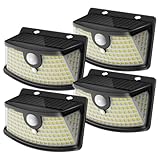
HMCITY 120 LED Solar Lights Outdoor, 2-Pack, Black Shell (JY2440)
Who it suits: Renters who need exactly two lights — one each side of a balcony door, or the entry and the back door — and want the easiest unit in the category to live with after it is mounted, without paying for a six-pack that will sit in a drawer until the lease ends.
HMCITY’s 120 LED light is, by Amazon’s own category rankings, the best-selling patio wall light format in this business, and the 2-pack is its most sensible size for an apartment. Check price on Amazon for the current figure — in our research this 2-pack sat comfortably inside this guide’s budget without needing sale timing. On paper the specification is the strongest of the small solar picks: 120 LEDs rated by the maker at 960 lumens (a maker figure — the highest claim among the three small picks, from a battery and panel of the same class, which is itself the lesson about maker figures), an 1,800 mAh battery that is half again the CLAONER’s capacity, and a monocrystalline panel the maker rates at 20.5% conversion. The three modes are the useful set — motion-only, dim-with-motion-boost, and a constant dim. But the detail that earns this light its slot in a renter’s guide is the mode button’s position: on the front, under the sensor, where a finger can reach it after the light is mounted. Every other pick in this class asks you to unmount the unit — to peel tape or back out screws in someone else’s wall — to change a setting. This one does not, and over a two-year lease that difference compounds every single time the seasons change and you want a different mode.
The compromises are sensor realism and the usual solar terms. For a homeowner guarding a long driveway that is a shortfall. Value discipline applies within the family too: the larger packs in the same family make the 2-pack the less economical way to buy four lights per unit — if your balcony and entry genuinely need four lights, buy the larger pack rather than two pairs.
- Positioned comfortably inside this guide’s budget in our research — check price on Amazon — no sale timing needed.
- Largest battery of the small picks (1,800 mAh) and a front-mounted mode button — change settings without unmounting, the renter-friendliest detail in the category.
- Realistic 10–16 foot sensor reach is honestly sized for apartment doors and balconies, whatever the 26-foot advertising says; 18-month warranty on the black-shell listing.
Honest limitation: The advertised 26-foot sensor range is optimistic — independent assessment suggests 10–16 feet in real use — and the 960-lumen figure is a maker claim from the same hardware class as its 500-lumen rival.
Choose it if you need two lights and value the reachable mode button and bigger battery. Skip it if you need four or more lights — the same family’s larger packs, or the CLAONER six-pack, spread the cost more efficiently per light.

Tuffenough Solar Outdoor Lights, 210 LED, 3 Heads, Remote, 2-Pack (8330D-210R)
Who it suits: Renters of houses, duplexes and townhomes whose lease includes a driveway, a garage front or an assigned parking area to watch over — and who are willing to time the purchase to this listing’s frequent deals.
The Tuffenough is a different species from the three picks above: not a marker light but a small floodlight, with three adjustable heads on a body about 11.4 inches wide that can be angled to cover a driveway and both its edges at once. This listing’s pricing moves in and out of this guide’s budget on frequent deals — check the current price on Amazon. That is why every mention of this pick carries the same instruction: buy it only when the live price shows it within the under-$30 budget. The package adds one feature nothing else here has — a wireless remote for switching modes without a ladder — alongside the standard three modes, an IP65 maker claim, and a 270° detection arc.
The compromises are price instability, size, light quality, and one renter-specific problem the other picks do not have: aim. The instability is documented above and is the reason for the label. And the same sealed-battery, ABS-housing, sun-dependent terms apply as to every solar pick — with the addition that a flood this size drinks its battery faster in motion-heavy spots, so a busy shared driveway may find it dim by the small hours.
- Three adjustable heads per light — the only pick that covers a wide area rather than marking a spot; the driveway and garage-front pick.
- Frequently appears on deals inside this guide’s budget — check price on Amazon; includes a wireless remote for mode changes.
- 2,500-lumen maker figure is the tier’s highest claim — read it as a security burst, not sustained output.
Honest limitation: Sale-dependent pricing — it cycles above this guide’s budget between frequent deal dips inside it — and a big, hard, 6500K flood whose throw must be aimed with neighbors in mind; wrong for balconies and shared walls.
Choose it if you rent a house or duplex with a driveway that needs real area light, and you can wait for a dip within this guide’s budget. Skip it if you live in a unit in a block (the marker picks above are the right shape), if the mounting spot overlooks other people’s windows, or if you need to buy today at a firm positioning.

Maxxima LED Outdoor Wall Light, 580 Lumens, 3000K, Dusk to Dawn (PD-20622) — Prose-Only: The Landlord’s Fixture
Who it suits: No renter can install this light — and that is exactly why it is reviewed here. It suits the tenant whose porch fixture is dead, dim or missing, who wants to know what a good one actually is before asking the landlord to replace it, and the renter who will own a home next and wants to know where the real quality sits in this category.
Start with the positioning that keeps it out of the linked picks: in our research its Amazon positioning sat above this guide’s budget, while the maker’s own outlet store positioned the same fixture inside that budget range. We do not present it as an under-$30 pick when its Amazon positioning is over budget, so this review is prose-only: search Amazon by the model number PD-20622 if you want to check its current listing yourself. What it offers is everything the solar picks are not. The light is hardwired and fully integrated LED — no bulb to buy, ever — producing 580 lumens of 3000K warm white at 8.25 watts. The 580 figure is a maker’s rating too, but from a certified fixture it means something different: this is an ETL-listed product, described by its maker as suitable for wet locations, with a stated 50,000-hour lifespan and a three-year warranty. The housing is aluminum with a clear water-glass lens — metal and real glass, against the solar picks’ all-ABS construction. And the automation is the other kind: not a PIR that waits for movement, but a photocell that turns the light on at dusk and off at dawn, every night, whether anyone walks past or not — the right mechanism for a porch that should simply be lit, and the mechanism no battery in this tier can imitate.
For a renter, the legitimate path to this fixture runs through the lease, not the checkout. If a landlord is replacing a fixture anyway and is open to a tenant’s suggestion, this is the model to name: it is available through the maker’s own outlet, it is certified for the wet location it will actually live in, and its photocell ends the “porch light left on all day” argument entirely. If your situation is the one in this review — a box by the door that is not yours to touch, a porch that should be warm and lit — the solar picks above are your workaround, and this fixture is your maintenance request.
- The only warm-white (3000K) pick in the guide, and the only one with third-party certification: ETL-listed, wet-location suitable, three-year warranty.
- Photocell dusk-to-dawn operation — the porch is lit every night automatically, no motion required, no battery to fade.
- Aluminum housing with a real glass lens and an integrated LED: no bulb to buy and nothing to recharge — for the wall’s owner.
Honest limitation: Positioned above this guide’s budget on Amazon in our research — it needs an existing junction box, and for a renter it is not installable at all: the alternative route is the maker’s own outlet, and the renter’s route is a maintenance request, not a purchase.
Choose it if you are a landlord reading over a tenant’s shoulder, a renter preparing a well-informed maintenance request, or a future owner planning ahead. Skip it if you were hoping to install it yourself in a unit you rent — the solar picks above exist for exactly your situation.
No Amazon link for this pick: its Amazon positioning is over this guide’s budget. Search Amazon for “Maxxima PD-20622” to see the live listing.
MATAMEYE Outdoor Wall Lantern, E26, Iron and Glass, 2-Pack, Black — Prose-Only: No Live Featured Offer
Who it suits: Strictly, homeowners — but renters meet this product constantly, because it is the lantern already hanging beside half the doors in older rental stock, and because it is what your landlord is most likely to install if a fixture gets replaced. It is reviewed so you know what it is, what it offers, and what to check when one is yours to maintain.
The MATAMEYE pair is the hardwired lantern this tier wants to have. Each fixture is a compact lantern, about 8.3 inches tall and 4.2 inches wide, built from an iron frame with glass panels — real glass, not the acrylic that “glass-look” listings substitute — around a standard E26 socket rated to 60W. That socket is the design’s whole argument, and it is an argument with a renter’s footnote. You choose the bulb, so you choose the brightness, the color temperature (a 2700K or 3000K LED bulb gives the warm welcome no solar pick here can), and the smart features; when the bulb dies in a decade you replace a bulb, not a fixture. The footnote: on a rental, the fixture is the landlord’s but the bulb is very often the tenant’s problem in practice — leases commonly make the tenant responsible for consumables, and a lantern like this is where that division of labor actually lives. If the pair beside your door matches this description and one side is dark, the fix is an inexpensive replacement bulb you are probably allowed — indeed expected — to change, not a maintenance battle. Two lanterns flank a door the way porch lights are supposed to look, and when this listing last sold stably, it was positioned inside this budget with room to spare. So why is there no link? Because when we checked, Amazon’s crawl of the listing reported “No featured offers available”: the listing exists, but there was no live featured offer to verify against, and older research conflicted with that status. A guide that links you to a listing with no buyable offer, at a positioning it cannot confirm, is not guiding you anywhere. The review stays — the product is real, the design is right, and the offer has historically returned — with the instruction to search Amazon for the MATAMEYE 2-pack lantern and buy only when a live offer from a credible seller sits within this guide’s under-$30 budget, and only for a wall you own.
The compromises, beyond availability, are the ones E26 lanterns always carry. Bulbs are not included, so the true cost is the pair plus two outdoor-suitable LED bulbs, which adds to the total and can push the pair toward the edge of this budget all-in, and which this guide counts openly rather than hiding in a footnote. There is no sensor of any kind: no photocell, no motion — the lanterns burn when the wall switch says so, unless fitted with a dusk-to-dawn or smart bulb, which is another consideration and another decision; a tenant maintaining one of these can solve the “left on all day” problem with a photocell bulb, which is usually within a tenant’s rights where swapping the fixture is not. We could not verify an IP rating or a wet/damp-location listing for this fixture from reliable sources, so the honest advice is damp-location mounting — under a porch roof or eave — rather than a fully exposed wall, and to check the listing’s own rating when the offer is live. And the iron frame, while a material upgrade over ABS, will want a wipe and a wax in coastal air where painted aluminum shrugs. None of this outweighs the design’s virtues for the right owner; it simply defines the renter’s relationship to it, which is maintenance and bulbs, never installation.
- Real glass panels in an iron frame — the only lantern-look pick here, sold as a matched pair for flanking a door.
- Standard E26 socket (max 60W): the bulb — the one part a tenant usually may change — controls brightness, warmth and smart features.
- Historically positioned inside this budget for the pair — whenever the featured offer is actually live.
Honest limitation: No featured offer was live on Amazon at check time, so no positioning in this guide is guaranteed — and bulbs are not included, adding extra cost to the true total when it returns.
Choose it if you own the wall, want a real lantern pair with replaceable bulbs, and can buy when the offer reappears within this guide’s budget. Skip it if you rent (installation is not yours to do), if you need to order today with certainty, or if you want automatic dusk-to-dawn operation without adding a smart or photocell bulb.
No Amazon link for this pick: no live featured offer could be verified at check time. Search Amazon for “MATAMEYE outdoor wall lantern 2 pack” to check its current status.
Comparison Table
For linked picks, check price on Amazon before buying. Brightness figures are maker figures throughout, printed for class comparison only; there is no common test standard behind them.
| Pick | Power | Sensor / control | Brightness (maker figure) | Materials | Configuration | Price |
|---|---|---|---|---|---|---|
| CLAONER Solar Motion Lights | Solar, 1,200 mAh sealed battery | PIR motion, 3 modes | 800 lm, 6500K | ABS plastic | 6-pack | Check price on Amazon |
| Aootek Solar Motion Sensor Lights | Solar, sealed battery | PIR motion, 3 modes | 500 lm, daylight | ABS plastic | 4-pack, black | Check price on Amazon |
| HMCITY 120 LED Solar Lights | Solar, 1,800 mAh sealed battery | PIR motion, 3 modes, front button | 960 lm, daylight | ABS plastic | 2-pack, black shell | Check price on Amazon |
| Tuffenough Solar Outdoor Lights | Solar, 1,800 mAh sealed battery | PIR motion, 3 modes, remote | 2,500 lm, 6500K | ABS plastic, 3 heads | 2-pack | Check price on Amazon — buy only within budget |
| Maxxima LED Outdoor Wall Light (PD-20622) | Hardwired 120V, integrated LED — landlord installs | Photocell dusk-to-dawn | 580 lm, 3000K | Aluminum, real glass | Single fixture | Above budget on Amazon; maker’s outlet alternative — see review |
| MATAMEYE Outdoor Wall Lantern | Hardwired, E26 socket (bulb not included) — landlord installs | None — wall switch or smart bulb | Depends on your bulb (max 60W) | Iron, real glass | 2-pack, black | Historically inside budget; no live featured offer at check time |
How to Choose an Outdoor Wall Light for an Apartment Under $30
Start with permission, because it decides everything else. Read your lease’s alteration and exterior clauses before you read another product listing. Everything in this guide’s linked picks lives inside that territory.
Then audit your sun, honestly, before buying anything solar. Walk to the mounting spot at midday and again in mid-afternoon, and look at where the shadow of the balcony above you falls. The panel on every solar pick here is fixed to the light’s face, so the wall’s sun is the panel’s sun. A south- or west-facing wall with four or more hours of direct sun will keep these lights working all year. An east wall is marginal. A north-facing entry, or a balcony ceilinged by the unit above — the default geometry of apartment buildings — will starve a panel-mounted light, and no battery size in this tier compensates. If your only outdoor surface is deep shade, the honest options are a railing mount that reaches past the slab’s shadow line, or accepting that solar is not your technology and putting the money toward the maintenance-request conversation instead. Where the light is for a balcony off a bedroom — a softer job, a marker rather than a guard — the calculus and the mode choices differ again, and the Best Outdoor Wall Light For Bedrooms Under $30 guide works through that case in detail.
Choose the mounting method like a deposit depends on it, because it does. The hierarchy, safest first: double-sided outdoor tape on a smooth, clean surface (the CLAONER includes it); removable hooks and siding-clip hooks that slide into vinyl seams without penetrating them; a balcony-rail clamp; and only then — with written permission, on a house rental, into wood trim rather than siding — a screw. Photograph every surface before mounting and after removal; the photos are worth more in a deposit dispute than the lights cost. And keep the small-space discipline in mind: a balcony is a small room with weather, and the footprint logic of the Best Outdoor Wall Light For Small Rooms Under $30 research applies — compact wedges that hug the wall, nothing that projects into the door swing or the railing line.
Match the sensor and mode to apartment density. PIR motion sensors keep a light dark until something moves — right for battery life and for not annoying the neighbors — but in a complex, “something” includes everyone on your floor. Prefer picks with a dim-standby mode for doors and balconies (the CLAONER and HMCITY both offer one), so the light idles at a glow and brightens for arrivals instead of strobing the walkway all night. Treat advertised PIR ranges as maker figures: the HMCITY’s claimed 26 feet against an independently assessed 10–16 is the honest spread for the class, and in dense housing the shorter real figure is the one you want. Treat brightness claims as class labels, not measurements: a 500-lumen maker figure and a 960-lumen maker figure describe the same class of small light, and the 2,500-lumen claim describes a burst from a three-head flood. What actually predicts performance is LED count, head count and battery size — all printed in the comparison table. Finally, do the per-light thinking and the moving math together. A 6-pack spreads its value across six spots; a 2-pack concentrates it on two — both can be fair value for different jobs depending on how many spots you actually need. Check price on Amazon for the current figure for each. And remember what these lights are in a tenant’s life: portable assets. They come down in minutes, pack in a shoebox, and light your next apartment’s door on the first night — no fixture you are forbidden to install can make that claim.
Common Buying Mistakes
Drilling into siding you do not own. The most expensive mistake in this guide costs more than every pick combined: four screw holes in vinyl siding, stucco or brick can be a deposit deduction, a repair bill, or a lease violation, depending on your landlord and your lease. If a light cannot be mounted without penetrating the building’s skin, it is the wrong light for a renter, whatever its reviews say.
Installing a hardwired fixture yourself. Swapping a porch light looks like a three-wire, ten-minute job, and legally it is electrical work on someone else’s building. The two prose-only reviews in this guide exist to make that request an informed one.
Lighting the shared hallway yourself. A dark stairwell feels like an invitation to help, and a cheap solar light feels like a harmless fix. But common areas are the landlord’s responsibility, often governed by fire and egress rules about what may be mounted where, and a tenant-installed light that falls, fails or confuses an exit path is a liability with your name on it. Report it in writing. Then report it again if nothing happens — the paper trail is the help.
Believing the lumen number. Reading “2,500 lumens” and “500 lumens” as measurements and concluding one light is five times brighter is the classic error of this category. Both are maker figures with no shared standard. Compare machinery — LEDs, heads, batteries — and treat any single number as advertising.
Mounting a solar light where the sun never goes. A solar light under a deep balcony slab or on a north wall does not become a slightly dimmer light; it becomes a light that works in July and quits in November, and its owner concludes the product was junk when the siting was. Audit the sun first — apartment shade is structural, not incidental.
Reading IP65 as a wet-location certification. An IP code on a listing is the maker’s claim about its own product; a wet-location rating is a third-party certification about a fixture in a mounted position. In this guide only the ETL-listed Maxxima carries the second kind, and fully exposed mounting spots — an uncovered entry wall in rain country — are where the difference stops being academic.
Putting a security flood where people arrive. A three-head 6500K flood is the right light over a driveway and the wrong light over a balcony or a front door — and in an apartment it is also a light aimed, in part, at other people’s homes. Match the light’s character to the spot’s job: floods guard open ground, markers guide doors and steps, and nothing in this guide welcomes — for warm and welcoming you need a bulb in a fixture, which is the landlord’s side of the wall. If the wall in question is a designed front entry where looks carry real weight, the design-led version of this research, Best Outdoor Wall Light For Modern Homes Under $30, is worth reading before you tape a plastic security wedge beside a door it will cheapen.
Final Recommendation
For most renters, buy the CLAONER 6-pack: six competent motion lights — check price on Amazon — tape in the box, a 24-month warranty, and enough units to cover a door, a balcony and a parking wall in one order — then take them all with you when you move. If you would rather buy from the category’s most conservative spec sheet at an accessible positioning, the Aootek 4-pack — check price on Amazon — is the buy-any-day alternative, and its ground-level spread is the best balcony-floor light here. For exactly two spots, the HMCITY 2-pack is the easiest to live with, thanks to its bigger battery and a mode button you can reach without unmounting anything. For a rented house with a dark driveway, wait for the Tuffenough flood to dip within this guide’s budget — it does so often — aim it with your neighbors in mind, and do not buy it when it sits above budget. And if your porch fixture is dead or dismal, do not fix it yourself: photograph it, write the maintenance request, and name the Maxxima PD-20622 — available through its maker’s outlet, ETL-listed, warm and automatic — as the replacement you would choose. That is the most valuable sentence in this guide for a tenant, and it does not cost anything at all.
FAQ
Can a renter legally install an outdoor wall light? A solar one, almost always yes — it involves no wiring and, mounted with tape or removable hooks, no alteration to the building. When in doubt, the answer is in your lease’s alteration section, and a written question to the landlord beats a deposit deduction.
Will tape mounting really hold a solar light outdoors? On the right surface, yes: smooth, clean, non-porous surfaces — painted wood, metal, smooth concrete — hold outdoor-rated tape through seasons of weather. Test one unit for a week before committing a whole pack, and prefer a mounting spot with some shelter, which the lights’ weather resistance wants anyway.
Are the lumen numbers on these lights real? They are maker figures, not measurements to a common standard, and this guide labels them as such wherever they appear. A 2,500-lumen claim from a battery-powered light describes a brief burst at best. Compare LED counts, head counts and battery capacities instead — those are printed in the comparison table.
What is the difference between a PIR sensor and dusk-to-dawn? A PIR (passive infrared) sensor turns the light on when it detects movement and off again after a short interval — all four solar picks work this way, which is how their small batteries survive. Motion suits security and paths; photocell suits porches and entries — and photocell, in an apartment, is the landlord’s fixture, not yours.
Does IP65 mean a light is rated for wet locations? No. Of the products here, only the hardwired Maxxima carries that kind of certification; treat the solar picks as weather-resistant and give them whatever shelter the mounting spot allows.
How long do the solar lights’ batteries last? The batteries are sealed and not replaceable, so the honest answer is: the light lasts as long as the battery does. In this class, expect roughly one to three years of daily cycling before runtime fades noticeably, after which the unit is replaced. Given their accessible per-light positioning in this tier, most renters treat them as consumables that move house with them; if that bothers you, the alternative is not a better solar light but a hardwired fixture — which, for a tenant, means a conversation with the landlord.
Why do two of the six picks have no Amazon link? Because they failed this guide’s verification standard in two different, stated ways: the Maxxima’s Amazon positioning is over the budget in the title, and the MATAMEYE pair had no live featured offer to verify against. Both are also hardwired — the landlord’s side of the wall — so both are reviewed in full, as information a renter can act on through a maintenance request rather than a purchase.