Where to buy
Check the latest price, availability and delivery on Amazon. Orders are placed on Amazon. We may earn a commission from qualifying purchases.
- Best overall for renters: HMCITY 120 LED Solar Wall Light, 2-Pack (Back Button, Daylight White)
- Best for balconies and wide walls: Aootek 120 LED Solar Motion Sensor Light, 2-Pack (Black, Daylight White)
- Best-looking for a rental entry: GlowGarden Solar Up-and-Down Wall Sconce, 2-Pack — Check on Amazon
- Most LEDs (check price): CLAONER 452 LED Solar Motion Sensor Light, 2-Pack
See 2 more Amazon options
- Aootek 120 LED Solar Motion Sensor Light, 4-Pack (Black, Daylight White) — the near-miss whole-house pack
- LIT-PaTH Outdoor LED Wall Lantern, 1-Pack (LT-WL01350K) — the hardwired lantern your landlord would have to install
Read the full guide ↓
Disclosure: As an Amazon Associate, dailyhomedecorating.com earns from qualifying purchases. Links to Amazon on this page are affiliate links; they cost you nothing extra. Listing details such as price and availability change often, so check the current Amazon listing before you buy.
Renting redraws the outdoor lighting map completely. In a house you own, the porch light is yours: your junction box, your fixture, your choice. In a rental, every part of that chain belongs to somebody else. The wiring in the wall is the landlord’s. The junction box beside the door is the landlord’s. The tired fixture hanging off it — dead bulb, cracked shade, switch you cannot find — is the landlord’s too, and your lease almost certainly forbids you from touching any of it. Electrical work by a tenant is one of the standard prohibitions in residential leases, and even where a lease is silent, a hardwired fixture you install becomes part of the property: it stays when you leave, a gift to the landlord paid for by you. So the renter’s outdoor lighting question is not “which fixture should I wire in?” It is “what light can I put up that is entirely mine — no wires, no junction box, no permission slip for electrical work — and that comes down with me on moving day?” Under $15, the answer and the budget point at the same products: solar wall lights. This guide is the renter’s cut of our research into Best Outdoor Wall Light Under $15, re-ranked and re-judged around leases, deposits and balconies.
That framing changes what “best” means. A homeowner can treat an inexpensive solar light as a stopgap on the way to a wired lantern. A renter should treat it as the whole strategy — which means the details homeowners skim past become the decision itself. How does it mount, and will that mounting cost you deposit money? Screws into vinyl siding, stucco or brick can breach a lease’s no-modifications clause and are exactly the kind of small damage deposit deductions are made of; adhesive pads, railing clamps, hooks and gutter clips leave nothing behind, and this guide weighs mounting method alongside brightness. Where will it actually live? And will it charge there? A balcony is a solar trap in both directions: a south-facing railing is a charging station, while a lower-floor balcony sits in the shadow of the balcony above it, and no panel harvests light that never arrives.
The six picks below are the same six verified products as our main under-$15 guide, re-examined through that renter lens. The HMCITY 2-pack stays best overall — two lights for a door and a balcony in a single budget 2-pack. The Aootek 2-pack’s front-mounted mode button matters more, not less, when the light is stuck up with adhesive you do not want to peel off just to change a setting. The GlowGarden sconce — the only decorative pick, and the only one with no motion sensor — rises in this version, because renters live with façades they cannot repaint and a warm up-and-down wall wash is the cheapest curb appeal you are allowed to install. Two picks remain honestly labeled check-price options, one remains a labeled near-miss that sits just above this guide’s budget, and the hardwired LIT-PaTH lantern stays in the list for the opposite reason it appears in the homeowner guide: not as a temptation, but as a clear reference point for what is not yours to install. If your rental is a whole house rather than a flat, the step up to Best Outdoor Wall Light For Apartments Under $30 is where this same renter logic continues at the next budget. The same six products are also judged through other rooms’ priorities in Best Outdoor Wall Light For Bedrooms Under $15, Best Outdoor Wall Light For Modern Homes Under $15 and Best Outdoor Wall Light For Small Rooms Under $15.
Quick Picks
Short on time? Check the current price on Amazon for each pick, tied to the exact pack and configuration named — prices change often, so confirm the live listing fits this guide’s budget before you buy.
| Renter situation | Pick | Why it stands out | Link |
|---|---|---|---|
| Best overall for renters | HMCITY 120 LED Solar Wall Light, 2-Pack (Back Button, Daylight White) | The proven budget solar motion light — check price on Amazon; one for the door, one for the balcony in a single 2-pack | Check on Amazon |
| Best for balconies | Aootek 120 LED Solar Motion Sensor Light, 2-Pack (Black, Daylight White) | Reflector housing throws light sideways across a balcony or patio; front-mounted mode button you can reach without unmounting — check the current price on Amazon | Check on Amazon |
| Best-looking rental entry | GlowGarden Solar Up-and-Down Wall Sconce, 2-Pack | The only true sconce shape here — up-and-down warm-white wash, dusk-to-dawn, no motion sensor; check the current price on Amazon | Check on Amazon |
| Most LEDs (check price) | CLAONER 452 LED Solar Motion Sensor Light, 2-Pack | The newest high-diode-count design with three modes — check the current price on Amazon and confirm it fits this guide’s budget before you buy | Check on Amazon |
| Best per-light value (near-miss) | Aootek 120 LED Solar Motion Sensor Light, 4-Pack (Black, Daylight White) | Sits just above this guide’s budget, stated plainly — but offers strong per-light value in a larger pack, for renters of a whole house who need front, back, garage and gate; check price on Amazon | Check on Amazon |
| The landlord’s lantern (reality check) | LIT-PaTH Outdoor LED Wall Lantern, 1-Pack (LT-WL01350K) | Aluminum and glass, hardwired, integrated LED — check price on Amazon. Included as a reference for a landlord maintenance request, not as a tenant purchase | Check on Amazon |
How These Picks Were Chosen
The first filter was the lease, applied before any product was considered. A pick for this guide had to satisfy three renter tests. It must require no electrical work — nothing wired into a junction box, nothing spliced, nothing a lease’s electrical clause or a landlord’s insurance could object to. And it must be an asset you keep — cheap enough that losing one to weather or a move is an annoyance, not a claim, and portable enough to serve at the next address too. Solar wall lights are the only products under $15 that pass all three tests, which is why this guide is solar from top to bottom, with the single hardwired lantern retained as a labeled exception that proves the rule.
The second filter was verification, identical to our main guide. A product appears below only if it is a real, orderable fixture with a verifiable Amazon listing. Prices are not printed as fixed figures — check the current price on Amazon, attached to the exact configuration it buys — pack size, button style, shell color, color temperature — because in this category the 2-pack and the 4-pack are different listings. One pick, the Aootek 4-pack, is labeled plainly as a near-miss just above this guide’s budget, included because its per-light value in a larger pack can make sense for a whole rented house.
What we weighed differently for renters: mounting and removal first. The practical alternatives — outdoor-rated adhesive pads, hooks that slip under vinyl siding courses, railing clamps, gutter and fence brackets — hold lights of this weight (a few ounces each) perfectly well and leave nothing to argue about at inspection. Brightness claims were weighted last, as in the main guide, and for the same reason: the lumen figures in this family are maker numbers with no shared standard — near-identical 120-LED lights are listed variously at 800, 960, 1,200 and 2,200 lumens — so no lumen figure is printed as fact anywhere below. Weather claims were read the same critical way: every solar pick carries an IP65 code, which is a laboratory dust-and-water-jet test, not a UL or ETL wet-location listing, and we could not verify a location certification for any solar pick here.
The Renter’s Mounting Rules (Read Before You Stick Anything Up)
Do not drill the envelope. Vinyl siding, stucco, brick, stone veneer and fiber-cement are the building’s weather skin. If a light must be screwed, the only defensible targets are wood trim and fence boards — and even then, ask first if the lease requires it. Prefer mounts that leave no evidence: outdoor adhesive pads rated for the fixture’s weight, siding hooks that slide under a vinyl course without piercing it, clamps and ties on balcony railings, and brackets on fence posts or gutters. Keep the original screws in a labeled bag; if you ever get written permission to use them, you will want them. Common areas are not yours. Shared hallways, stairwells, building entrances and parking structures belong to the landlord or the HOA, and lighting there is their legal responsibility in most jurisdictions — a dark shared stairwell is a maintenance request (and often a code issue) to put in writing, not a problem to solve by sticking your own light on a wall you do not control. Your territory is your own door, your own balcony, your own patio. Charge before you commit. Adhesive is semi-permanent in practice, so test the spot first: hold the light in place for a day, check the panel actually sees direct sun — especially on a balcony shaded by the floor above — and only then mount it. Photograph everything. A dated photo of the wall before mounting and after removal is the cheapest deposit insurance a renter can buy.
The 6 Best Outdoor Wall Lights for Apartments Under $15
HMCITY 120 LED Solar Wall Light, 2-Pack (Back Button, Daylight White)
Who it suits: The renter who wants the default budget answer — one light beside the front door, one on the balcony or patio, both up in minutes, both coming down without a trace when the lease ends.
The HMCITY is the reference product of the budget solar shelf, and its positioning is why it leads this guide too: 120 LEDs behind a frosted cover, a PIR motion sensor, a solar panel across the top face and an ABS plastic housing, sold as a 2-pack in the back-button, daylight-white configuration. Check the current price on Amazon for this exact configuration. As a budget 2-pack at the affordable end of this tier, it is inexpensive enough that a pair feels like a practical, replaceable addition rather than a major investment, which is precisely the right relationship for a renter to have with something stuck to a wall they do not own. Its three modes map neatly onto renter geography. Security mode — dark until motion, then a full-brightness burst — is the front-door setting, lighting your own key-in-lock moment and a visitor’s approach without burning the battery on an empty hallway. Constant medium brightness is the porch-light impersonation and the shortest-lived on a small battery; on a shaded rental wall, treat it as a summer setting.
For renters, the named flaw of this configuration matters more than it does for owners: the mode button is on the back of the housing, against the wall. On a screwed-down homeowner install that is a ladder-and-unmount annoyance. On an adhesive install it is worse — peeling a light off an adhesive pad to reach the button can take paint or finish with it, and pads rarely re-stick at full strength. The renter’s protocol follows: choose the mode before the light goes up (dim-with-boost is the set-and-forget compromise), and mount with a removable method — a hook or a railing clamp — at any spot where you expect to change settings seasonally. Output is a motion-triggered burst over a doorway, not a lit yard, and the family’s lumen claims contradict each other so thoroughly (800 to 2,200 for substantially the same hardware) that we print none. Mounted where the sun actually reaches, this is the light every other pick here is measured against — check price on Amazon.
- Two mounting points covered in one budget 2-pack — door plus balcony, or door plus patio, in one pack.
- Three genuinely distinct modes covering security bursts and marker-glow duty; no wiring, no junction box, nothing for a lease to object to electrically.
- IP65 ABS housing with a monocrystalline panel — the proven construction of the category’s best-selling design, light enough for adhesive and hook mounting.
Honest limitation: The mode button sits on the back of the housing, so changing modes means unmounting — a real cost on an adhesive install, where removal can damage paint and pads do not re-stick well. Output is a burst, not steady porch light; no lumen figure is printed because the family’s claims contradict each other; performance collapses on shaded walls and shaded balconies.
Choose it if you want two spots lit on a tight budget and can set the mode once, before mounting. Skip it if you will change modes with the seasons (the front-button Aootek below), or if your only mounting wall sits in permanent shade — no solar pick fixes that.
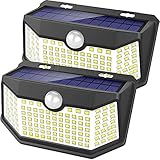
Aootek 120 LED Solar Motion Sensor Light, 2-Pack (Black, Daylight White)
Who it suits: Renters whose outdoor space is a balcony or patio wide enough to need light thrown sideways, not just down — and anyone who knows they will actually use the mode button and wants it reachable.
The Aootek (model AK06, in this black-shell, daylight-white 2-pack listing) answers the HMCITY’s two weaknesses in ways that matter doubly in a rental. The mode selector is on the front face: switching among security (motion-triggered full brightness), permanent-on and smart brightness control (dim all night, full power on motion) is a fingertip press on the mounted light — no peeling adhesive, no unmounting, no deposit risk incurred just to change a setting. Construction is the class standard: IP65-rated ABS plastic, with a maker-claimed 20.5% panel conversion efficiency, and a warm-white version exists on its own listing for renters who find daylight white harsh against a building’s façade. Pricing for this listing can vary by shell color and configuration, so check the current price on Amazon for this exact black-shell, daylight-white 2-pack and confirm it fits this guide’s budget before you buy. When the live price sits within budget, it earns its place on design and usability; when it sits above budget, treat it as a near-miss rather than an under-$15 pick.
The renter-specific cautions are about placement, not the product. The permanent-on mode asks the most of the battery and fades first on short winter days or a partially shaded wall. The housing is plastic and will UV-chalk over years, the detection figures are optimistic at mounting heights above the maker’s recommended 5.6–6.6 feet, and IP65 is a lab code rather than a wet-location listing. None of that changes the verdict: on its design merits, this is the better-engineered of the two proven designs, and for balcony life it is the pick of this guide.
- Front-mounted mode button — change settings on the mounted light, without disturbing an adhesive mount or risking the wall finish.
- Reflector housing with a claimed 270° spread for balcony floors and patio walls, plus a warm-white sibling listing for a softer tone.
- Check the current price on Amazon for the exact configuration — pricing varies, so confirm it fits this guide’s budget before you buy.
Honest limitation: Its live price can sit above this guide’s budget depending on configuration and timing, so check the current price on Amazon before you buy. ABS plastic housing; detection and angle figures are maker claims; a wide sensor reach can over-trigger in dense apartment layouts.
Choose it if the current price on Amazon fits this guide’s budget, your space is a balcony or patio, or reachable mode-switching matters to you. Skip it if the live price sits above budget and you need exactly two lights on a hard budget — the HMCITY above is the more consistently budget-positioned alternative — or if you need four lights, where the pack below is the smarter buy.

GlowGarden Solar Up-and-Down Wall Sconce, 2-Pack
Who it suits: Renters who cannot repaint, re-side or rewire a façade — and want the one upgrade to a rental entry or balcony that visitors actually notice: a warm wash of light on the wall itself.
Every other pick in this guide is a security light. For a renter, that is not a frivolous distinction. You cannot change your building’s siding, your door color or your landlord’s porch fixture, but a matched pair of these flanking your own door or washing a balcony wall is reversible, battery-free-of-wiring décor that moves out when you do. There is no motion sensor: the mechanism is a photocell, charging by day, switching on at dusk and running until the battery fades or dawn switches it off, with a maker-claimed runtime of up to 12 hours that assumes a full day of strong sun. Check the current price on Amazon before you buy. The buying rule is the budget itself — if the live price for the 2-pack fits this guide’s under-$15 budget, it is a fair fit for the look; if it sits materially above that, it belongs to a higher-budget guide.
The limitations are the mirror of the charm, and renters should read the placement one twice. Six LEDs produce accent light: enough to read a wall’s texture and mark a doorway’s position, nowhere near enough to find a keyhole, read a house number or light a step — as a doorway’s only light it fails the job, and its honest role is companion to a motion light, not substitute. The dusk-to-dawn mechanism spends the battery every night whether anyone is outside or not, so in winter or on a shaded balcony the charge runs out before dawn and the light simply goes dark in the small hours; there are no modes to fall back on. The brand is a generic-label storefront rather than an established lighting maker, which matters when a battery dies in year two and you want the same fixture again for the next address. Bought as jewelry for a wall whose working light is sorted, it is the one pick here a guest might compliment — and the one your landlord is least likely to even notice, in the good way.
- The only true sconce shape in this guide: three LEDs up, three down, warm-white wall wash — curb appeal a renter is actually allowed to install.
- Photocell dusk-to-dawn operation with no modes or buttons to manage: it simply comes on at night.
- Sold as a 2-pack, so a door or balcony gets the matched, symmetrical look the style depends on.
Honest limitation: Check the current price on Amazon — buy only if the live price fits this guide’s budget. Accent output only (six LEDs), no motion sensor, the battery is spent every night regardless of need, and no specific IP rating could be verified, so mount it somewhere sheltered.
Choose it if your door already has working light (or a motion pick from this guide beside it) and what the entry lacks is looks. Skip it if it would be the doorway’s only light, if your winters are dark and your balcony shaded, or if the live price sits above this guide’s budget.
CLAONER 452 LED Solar Motion Sensor Light, 2-Pack
Who it suits: Renters drawn to the newest, highest-diode-count version of the solar motion light — and willing to check a live price before buying, because this pick requires a live price check before buying.
CLAONER is one of the volume names of this category, and this 2-pack is its current flagship pitch: 452 LEDs — the count is the headline — with a PIR motion sensor, three lighting modes of the now-standard kind (motion-triggered full brightness, a constant setting, and a dim-with-boost setting), an upgraded solar panel the maker promotes for faster charging, and an IP65-rated housing. Check the current price on Amazon for this specific 2-pack before you buy, because pricing in this category varies by listing and configuration and we do not print a fixed figure here. The buying rule is the budget itself: this pick earns its place if the live listing fits this guide’s under-$15 budget; above that, it belongs to the next guide up, and the HMCITY and Aootek above deliver the same architecture in this tier.
For renters, the deeper point is the headline number itself. Spreading a fixed energy budget across more, smaller diodes can improve evenness — more points of light, fewer dark gaps — and on a balcony or beside a door that evenness is a real, visible benefit. It cannot repeal the arithmetic that a day’s sun on a playing-card-sized panel yields a few watt-hours, spent as a bright burst on motion or a thin glow all night — and on a shaded rental balcony it yields less than that. The housing is the class’s standard plastic with an IP65 code rather than a location certification. Judge it as a doorway-and-balcony burst light with an unusually dense diode field, buy it only when the live price fits this guide’s budget, and it is a reasonable pick; buy it expecting 452 of anything and it will disappoint.
- The densest diode field in this guide — 452 LEDs across the 2-pack’s fixtures — for the most even spread of light this architecture offers.
- The standard, proven three-mode PIR architecture with an upgraded panel, from one of the category’s volume makers.
- Included with a clear buying rule: check the current price on Amazon and buy only if it fits this guide’s budget.
Honest limitation: Check the current price on Amazon before you buy, as this listing’s pricing can sit above this guide’s budget. Newest listing in the guide, thinnest owner record — the least proven pick to carry across multiple leases.
Choose it if the live price fits this guide’s budget and you value the denser, more even light field. Skip it if the live price is above this guide’s budget — the HMCITY delivers the same architecture as a budget-positioned alternative — or if a deep owner record matters more than the newest design.

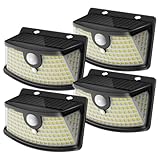
Aootek 120 LED Solar Motion Sensor Light, 4-Pack (Black, Daylight White)
Who it suits: Renters of a whole house — front door, back door, garage and side gate — who would rather consider a larger pack that sits just above the headline budget than buy two separate 2-packs at a less favorable per-light rate, and who want every mounting point covered in one design that all comes down together at move-out.
This pick is labeled plainly as a near-miss, and the guide keeps that label in the open: it sits just above this guide’s under-$15 budget. The justification is pack value. In a 4-pack, the cost is spread across four fixtures, which can make covering a whole rented house more economical than buying multiple smaller packs. Nothing about the individual light changes; only the pack, and therefore the unit economics, does. Check the current price on Amazon for this exact 4-pack and judge it against the total number of mounting points you actually need. The broader pattern in this tier is that solar motion lights are a per-light product, and pack size, not brand, is often how you approach better value.
The honest limitation is the obvious one, stated without decoration: this pick sits above the under-$15 budget, and if your budget is a hard line, the HMCITY 2-pack is your pick. The renter-specific cautions scale with the count. Four mounting points means four mounting decisions, and the deposit logic multiplies: four adhesive mounts are four clean removals, while four screwed mounts in siding are a move-out argument — the pack rewards the renter who mounts reversibly everywhere. Four panels each need their own patch of direct sun, and a rented house’s north side will underperform no matter how good the deal was. One color temperature is committed across the whole property, and daylight white that looks crisp on a garage can look clinical at a front door — warm-white versions exist on their own listings, and choosing deliberately matters more when it is multiplied by four. None of that dents the value case: for a whole rented house, this is the smartest money in the guide.
- Larger-pack format spreads the cost across four lights — strong per-light value for whole-house coverage; check price on Amazon.
- Identical AK06-family hardware to the 2-pack pick: reflector housing, front button, three modes, IP65 — just four of them.
- Labeled as a near-miss just above this guide’s budget, which is itself useful information about how this tier is positioned.
Honest limitation: It sits just above this guide’s budget, so check the current price on Amazon and decide whether the larger-pack value justifies the step up. One color temperature across four mounting points, four panels each needing direct sun, four mounts that must all be reversible to protect the deposit, and the class’s plastic construction throughout.
Choose it if you rent a house needing three or four lights and can treat the under-$15 budget as a guideline. Skip it if the budget is a hard line (buy the HMCITY 2-pack), you rent a flat with only a door and a balcony to light, or per-light value you never install would just sit in a drawer.
LIT-PaTH Outdoor LED Wall Lantern, 1-Pack (LT-WL01350K)
Who it suits: Nobody in this guide as a purchase — and every renter as a piece of information. This is the landlord’s lantern, included so you have a concrete reference point to put in a maintenance request.
The LIT-PaTH LT-WL01350K is a proper exterior wall lantern: a painted aluminum housing with a glass shade — metal and glass, in a guide otherwise made of ABS plastic — hardwired to a junction box, with an integrated LED board rated by the maker at 9.5 watts and 800 lumens (a maker figure, like every brightness number in this category, though hardwired figures at least describe a device with unlimited power behind them). Check the current price on Amazon for this single pack. It sits in a higher tier than this guide’s under-$15 solar budget, as hardwired fixtures generally do, and that positioning is the point: no hardwired fixture in this research sits in the same budget tier as the solar picks above.
For a renter, the reasons not to buy it are structural, not financial. Anything hardwired becomes a fixture of the property — when you move, it stays, and your purchase plus any installation cost stays with it. And the fixture itself carries the hardwired trade: the LED board is integrated and non-removable, so when it fails the whole lantern is replaced — a maintenance fact that belongs in the landlord’s budget, not yours. The correct renter move, if your entry is dark and a junction box is already there, is a written maintenance request that does the landlord’s homework for them: name the problem (dark entry, safety), name the fix (a hardwired lantern at the existing box), and reference the current listing — check the current price on Amazon — plus an electrician’s visit if the box needs work. Landlords respond to specific requests far better than to complaints, and if yours agrees, the light that goes up is theirs to maintain forever. If the box does not exist or the answer is no, the five solar picks above are not the consolation prize; they are the layer of outdoor lighting that was always yours.
- Aluminum housing and glass shade — the construction your landlord’s fixture should have, and the reference point for a maintenance request.
- Hardwired and switch-controlled: full light all night, every night, with no sun, battery or sensor in the chain — which is exactly why it is the landlord’s purchase, not yours.
- Hardwired category reference point — check the current price on Amazon so your request to the landlord can reference the current listing.
Honest limitation: It sits in a higher tier than this guide’s budget, so check the current price on Amazon, and for a renter the real limits are legal and structural: installing it yourself means electrical work on the landlord’s property and a fixture that stays when you leave. The integrated LED is not replaceable, and 5000K is the only color temperature.
Choose it if you are the landlord reading a tenant’s link — or a homeowner who wandered into the renters’ guide. Skip it if you rent: send the maintenance request, keep your money, and buy solar.

Comparison Table
| Product | Type | Best renter use | Link |
|---|---|---|---|
| HMCITY 120 LED Solar Wall Light, 2-Pack — check price on Amazon | Solar PIR motion light, 3 modes, IP65 ABS | The default pair: front door plus balcony or patio | Check on Amazon |
| Aootek 120 LED Solar Motion Sensor Light, 2-Pack — check price on Amazon | Solar PIR motion light, reflector housing, front button | Balconies and wide patio walls; reachable mode-switching on an adhesive mount | Check on Amazon |
| GlowGarden Solar Up-and-Down Wall Sconce, 2-Pack — check price on Amazon | Solar dusk-to-dawn accent sconce, no motion sensor | Decorative wall wash for a rental entry or balcony where working light exists | Check on Amazon |
| CLAONER 452 LED Solar Motion Sensor Light, 2-Pack — check price on Amazon | Solar PIR motion light, 452 LEDs, 3 modes | The densest, most even light field — buy only if the live price fits this guide’s budget | Check on Amazon |
| Aootek 120 LED Solar Motion Sensor Light, 4-Pack — near-miss, just above budget; check price on Amazon | Solar PIR motion light, reflector housing, 4-pack | Whole rented house coverage with larger-pack per-light value | Check on Amazon |
| LIT-PaTH Outdoor LED Wall Lantern, 1-Pack — check price on Amazon | Hardwired integrated-LED lantern, aluminum and glass | The landlord’s purchase — quote it in a maintenance request, do not install it yourself | Check on Amazon |
How to Choose
Start with what the lease allows, not what the wall needs. Every renter outdoor-lighting decision flows from one fact: the wired layer belongs to the landlord. Your layer is the one that needs no junction box, no electrician and no one’s permission for electrical work — solar — and under $15 that is also the only layer the budget buys, so the filters align. Read your lease’s alterations clause, and when in doubt, ask in writing; a landlord who says yes to adhesive-mounted solar lights in an email has just removed the entire deposit question from your move-out.
Mount reversibly, and match the mount to the surface. These lights weigh a few ounces, which is why the reversible toolbox works: outdoor-rated adhesive pads on smooth, sound surfaces (painted wood, metal railings, smooth trim); hooks that slip under vinyl siding courses without piercing them; clamps, ties and brackets on balcony railings and fence posts. Avoid adhesive on crumbling paint or rough stucco, where it will either fail or take the surface with it. And remember the button rule when choosing the mount: a back-button light on adhesive is a light whose mode you will never change, so mount back-button picks with a hook or clamp you can lift off, or commit to the set-and-forget mode before it goes up.
Audit your sun — especially the balcony problem. A solar wall light is a bet on its mounting point, and rental geometry stacks the bet. Balconies add a renter-specific trap — the balcony above is a roof over yours, and a lower-floor balcony can sit in permanent shade while the top floor bakes. Makers recommend six to eight hours of direct sun and mounting heights around 5.6–6.6 feet for the sensor geometry. Before mounting anything semi-permanently, prop the light in place for a day and watch what the shadow does. If the spot fails the sun test and the light matters, that is a case for the maintenance-request route, not for a more expensive solar light.
Match the sensor to the space — and to the neighbors. A PIR motion sensor watches for moving heat: dark until someone approaches, then full brightness — right for your own door and gate, and kind to the battery because darkness is free. A photocell dusk-to-dawn light burns from nightfall until the charge or the dawn gives out — right for a decorative sconce, wrong for a doorway you want lit on arrival. Angle sensors into your own space, prefer dim-with-boost modes where a glow reads as ambience, and keep security-strobe settings for doors and gates that are unambiguously yours. Shared hallways and stairwells, however dark, are the landlord’s legal responsibility — report them in writing rather than lighting them yourself.
Ignore lumens; interrogate the energy budget instead. Brightness is the specification this category lies about most fluently, because it can: there is no shared measurement standard behind the numbers, and the same 120-LED product family is listed in different places at 800, 960, 1,200 and 2,200 lumens. LED counts are the same trick in another unit — 452 diodes share the same small battery as 120, and total light is set by stored energy, not diode census. Set expectations by job: a solar motion light will light a doorstep, a lock and the face of the person in front of it; it will not light a yard, and no listing’s lumen figure changes that.
Think in mounting points, and plan for the next address. Every listing in this category is priced for a configuration — pack size, shell color, color temperature, button style are separate listings. Check the current price on Amazon for the exact configuration you need, then think in terms of coverage: a 2-pack covers a door plus a balcony, while a larger pack can cover a whole rented house and may offer better per-light value. Count your mounting points first — door, balcony, patio, gate — then buy the pack that covers them sensibly. Keep the boxes and the spare mounts; future you, standing in a new doorway at dusk, will be glad.
Common Buying Mistakes
Drilling into siding, stucco or brick to mount an inexpensive solar light. The most expensive mistake in this guide has nothing to do with light output. These fixtures weigh ounces: adhesive, hooks and clamps exist precisely for them. If a mount needs a drill, the mount is wrong for a rental.
Installing — or paying for — a hardwired fixture in a home you rent. A wired lantern needs the landlord’s junction box, becomes the landlord’s property the moment it is wired in, and may put you in breach of the lease’s electrical clause in the process. The renter’s version of this purchase is a specific maintenance request that references the current listing for the lantern in this guide — check price on Amazon — let the owner buy the owner’s fixture.
Mounting a solar light where the sun never reaches. The most common failure in this category is geographical, not electrical. Audit the spot’s sun for a day before committing the adhesive; the best solar light in this guide loses to a mediocre one mounted in full sun.
Lighting the shared hallway yourself. It feels helpful and it is a trap: common areas are the landlord’s or HOA’s to maintain, your light can be removed without notice, and modifying shared space can itself breach community rules. A dark shared stairwell deserves something stronger than your small solar light anyway — a written report, which in many places the landlord is legally required to act on.
Believing the lumen figure — or the LED count. Brightness claims here are maker numbers with no shared standard: one product family is listed at 800, 960, 1,200 and 2,200 lumens in different places. Architecture, sensor behavior, mounting and pack math are the specifications that differ for real.
Buying a decorative sconce to do a security light’s job. The GlowGarden’s six LEDs paint a wall beautifully and light a doorstep barely at all. Accent and illumination are different purchases sharing a search term; a doorway needs a PIR motion light’s burst, and a sconce is what you add after that need is met — listings that show a glowing façade photo for a six-diode fixture are selling the photo.
Final Recommendation
For most renters, the answer is the HMCITY 2-pack: one light beside the door, one on the balcony, in a single budget 2-pack — check price on Amazon — mounted reversibly, mode chosen before it goes up, and both in a box marked “lights” when the lease ends. If your outdoor life happens on a balcony wide enough to sit on, step to the Aootek 2-pack when its current price on Amazon fits this guide’s budget — the reflector’s side-throw and the front button are real advantages in a space you live in; if the live price sits above budget, it stops being an under-$15 pick. Add the GlowGarden pair when the entry has its working light and lacks only welcome. Rent a whole house and the 4-pack’s larger-pack per-light value is the smartest arithmetic here, just over the headline budget and worth considering if you need four mounting points. And keep the LIT-PaTH reference where it belongs — in a polite, specific, written maintenance request, the one renter tool that turns a landlord’s dark doorway into a landlord’s solved problem. The through-line of every pick is the renter’s rule itself: own the layer you are allowed to own, mount it so it leaves no evidence, and take it with you when you go.
FAQ
Can a renter install outdoor wall lights at all?
Yes — the solar kind in this guide, because they involve no electrical work: no junction box, no wiring, nothing spliced into the landlord’s system. What leases restrict is electrical modification and, separately, alterations to the building’s exterior surfaces. When your lease has a general no-modifications clause, a short written OK from the landlord removes all doubt.
Will solar lights work on an apartment balcony?
It depends entirely on the balcony’s sun, and balconies are the hardest case in this category. Test before you commit: prop the light where it would mount for a full day and see how many hours of direct sun the panel actually gets. Six or more, and any pick here works as rated. Two or three, and motion-only mode is the honest setting — bursts are affordable on a small charge in a way an all-night glow is not. A permanently shaded balcony is the one spot where solar genuinely fails, and no pick in this guide pretends otherwise.
How do I mount a solar light without risking my deposit?
Match the mount to the surface and keep it reversible. Outdoor-rated adhesive pads hold these few-ounce fixtures on smooth, sound surfaces like painted trim and metal railings. Hooks made for vinyl siding slide under a course without piercing it. Balcony railings take clamps and ties. Photograph the surface before mounting and after removal, keep the light’s original screws unused in a bag, and if you ever do get written permission to screw into wood trim, you have both the hardware and the paperwork.
My rental’s porch light is dead or missing. Isn’t that the landlord’s problem?
Yes — the fixture, its bulb in many leases, and certainly its wiring are the landlord’s to maintain, and a dark entry is a safety issue worth raising in writing. Make the request specific: a proper hardwired aluminum-and-glass lantern (the LIT-PaTH LT-WL01350K) is the type of fix to reference — check the current price on Amazon — which helps show the landlord the fix is a standard, readily available fixture, and tells you the same thing if you are tempted to do it yourself — do not. While the request is pending, a solar motion light beside the door covers the gap with your own property, on your own authority.
What about the shared hallway or stairwell — can I light that?
Not with your own fixtures, in most cases. The effective move is a written report of the dark area, which creates the paper trail landlords act on. Your own lights belong on your own territory: your door, your balcony, your patio.
Are these lights bright enough to matter, honestly?
For the jobs they are built for, yes; for the jobs listings imply, no. In practice, a motion pick here throws a useful pool of light over a doorway, a lock, a gate latch and the face of whoever triggered it. It will not light a yard, a driveway end to end, or a balcony dinner party, and a dusk-to-dawn sconce like the GlowGarden is accent only — six LEDs washing a wall. Buy them as doorway-and-balcony tools and they perform; buy them as floodlights and they will read as broken.
Can I take these lights when I move?
That is their structural advantage over everything wired: yes. Keep the original box and any spare adhesive pads or hooks, note which mode each light is set to (it matters most for the back-button HMCITY, whose mode you will not want to change mid-move), and the pair you bought for this flat’s door and balcony becomes the next flat’s starter kit at zero additional cost.