Where to buy
Check the latest price, availability and delivery on Amazon. Orders are placed on Amazon. We may earn a commission from qualifying purchases.
- Best overall for renters: Aootek Solar Motion Sensor Lights, 120 LED, 4-Pack — Check on Amazon
- Best fixture to request from your landlord: Maxxima LED Outdoor Wall Light with Dusk-to-Dawn Photocell, Black — Check on Amazon
- Globe Electric Charlie 1-Light Outdoor Wall Sconce, Oil Rubbed Bronze — Check on Amazon
- Maxxima LED Outdoor Wall Wash Light, Up/Down, Photocell — Check on Amazon
- LUTEC 6222B Dual-Head LED Floodlight, Black — Check on Amazon
- LIT-PaTH Outdoor LED Wall Lantern, 2-Pack, Black — sold on Amazon, but its listing would not hold a price we could verify to our standard, so it is covered in prose below with no link; search the exact name on Amazon.
Read the full guide ↓
Disclosure: As an Amazon Associate, dailyhomedecorating.com earns from qualifying purchases. Links to Amazon on this page are affiliate links; they cost you nothing extra. Listing details such as price and availability change often, so check the current Amazon listing before you buy.
Renting rewrites the outdoor lighting question completely, and it is worth saying plainly before any product names appear: the wall outside your door is not yours. The first is the layer you own outright: solar lights that need no wiring, mount with screws into wood you are allowed to mark or with no-drill hardware, and come down in minutes when you leave, leaving the wall exactly as you found it. The second is the maintenance request: a written, specific ask that names an exact fixture and lets the landlord’s own electrician or handyman install it. Five of the six picks below are hardwired, and every one of them is reviewed here as a request — the fixture you ask for by name, with the reasons a landlord would say yes — because an approved, ETL-listed lantern is worth far more to a renter than any fixture installed in secret.
The budget math is different for renters too, and this is the second thing to understand before shopping. Researching the homeowner version of this tier turned up a surprising fact: the verified market for a quality single outdoor wall light sits well within this budget. An ETL-listed, wet-location-rated lantern in aluminum and real glass, with a dusk-to-dawn photocell, sits in the lower part of this tier — check price on Amazon — and a matched pair of aluminum-and-glass lanterns sits in a similar position in the tier. So a renter holding $75 should not spend it the way a homeowner would. Your best split looks like this: a small share on the solar layer you own and control, a small amount on mounting hardware that leaves no trace, and the rest held in reserve — either as the exact model numbers in a maintenance request your landlord pays for, or as your contribution if the landlord agrees in writing to split or reimburse a fixture. This guide will keep pointing at that line, because it is the most expensive mistake in the whole category for tenants.
One more renter reality shapes every pick below: your outdoor space is probably a balcony, and a balcony is a trap for solar lighting. The unit above you is a roof over yours. Everything else follows the same honesty rules as our homeowner guides: each pick is tied to a named configuration and verified from at least two sources before a product earns a link (one pick failed that test and appears in prose with no link, on purpose). For current pricing, check price on Amazon. Every lumen figure is a maker figure with no common testing standard behind it and is labeled as such, location ratings come from maker documentation rather than listing adjectives like “waterproof,” and integrated LED is called out every time it appears, because a fixture whose light source cannot be replaced is a fixture with an expiration date.
Quick Picks
Short on time? Each row names a renter situation and the product that fits it. Note the column that matters most in this guide: who is allowed to install it.
| Renter situation | Pick | Why it stands out | Link |
|---|---|---|---|
| Best overall for renters — install it yourself today | Aootek Solar Motion Sensor Lights, 120 LED, 4-Pack — check price on Amazon | The only pick that needs no permission: no wiring, mounts in minutes, comes down clean at move-out | Check on Amazon |
| Best fixture to name in a maintenance request | Maxxima LED Outdoor Wall Light (MEL-6150), Black — check price on Amazon | ETL-listed, wet-location rated, aluminum and glass, automatic dusk-to-dawn — an easy yes for a landlord | Check on Amazon |
| Best request for a covered balcony or porch | Globe Electric Charlie 1-Light Sconce (44127) — check price on Amazon | Seeded glass and a replaceable bulb — and covered mounting is exactly what a balcony under the unit above provides | Check on Amazon |
| Best value pair to request | LIT-PaTH Outdoor LED Wall Lantern, 2-Pack, Black | Two aluminum-and-glass hardwired lanterns in a value position in this tier — an inexpensive upgrade for a landlord to approve | Search Amazon by name (see review) |
| Best request for a modern building | Maxxima LED Outdoor Wall Wash Light — check price on Amazon | Architectural up/down light with a photocell, at a value position in this tier that a landlord is unlikely to object to | Check on Amazon |
| Brightest — for house and duplex renters, by request | LUTEC 6222B Dual-Head Floodlight, Black — check price on Amazon | 3,500 lumens (maker figure) over a driveway or yard; switch-controlled, and we say so | Check on Amazon |
How These Picks Were Chosen
The first filter was permission, which no homeowner guide has to think about. That is why this guide contains exactly one solar pick and five hardwired ones. The hardwired five are the menu you order from when you ask, and each review states the request case for that fixture: what it costs the landlord, what it saves them, and where it is allowed to live.
The second filter was verification, applied exactly as strictly as in our homeowner research. A product had to be confirmed from at least two independent sources, tied to one named configuration — this pack size, this finish — before the product earned a link, because lighting listings love to headline the cheapest variant and photograph a different one. One pick, the LIT-PaTH lantern pair, failed that test: its listing could not be pinned to the same standard, so it appears in prose with no link and instructions to search its exact name. For every linked pick, check the current price on Amazon, because that live listing is the place to confirm current pricing before anyone buys.
The third filter was the location rating, read from maker documentation rather than listing copy. Listings blur this with words like “waterproof” and “weather resistant,” which are adjectives, not ratings, so we favored makers who publish a real position: an ETL listing and wet-location statement, an IP rating, or — in one case below — a manual that honestly tells you to keep the fixture under cover. Finally, control honesty: “dusk to dawn” must mean a photocell, “motion sensor” must mean a PIR sensor with a stated range, and where a popular fixture has neither — one famous floodlight below is switch-controlled only, whatever the category around it implies — the review says so in plain words.
The Balcony Sun Trap, and the Five-Minute Audit That Beats It
Before the reviews, the renter-specific problem that decides whether the one self-install pick in this guide works at all. A solar wall light is a small battery with a panel on top, and it can only spend at night what the panel collected during the day. On a house, you choose a sunny wall. In an apartment, the walls choose you — and the geometry is hostile. Your balcony ceiling is the floor of the balcony above, so direct sun reaches your railing only when the sun is low and angled toward your side of the building, if it ever gets there at all. A north-facing balcony in a mid-rise may receive zero hours of direct sun in winter. The panel does not care that the balcony feels bright at noon; bright shade is still shade, and a panel in shade charges at a trickle. The result is the classic renter complaint — “solar lights are junk” — from lights that were fine and placements that were starved.
The audit costs nothing and takes one day of occasional glances. On a day you are home, note where direct sun — the kind that casts a hard shadow — actually lands on your balcony railing, door frame and walls at breakfast, midday and late afternoon. You are looking for a mounting spot that collects at least four to six hours of direct sun in the season you are in now; winter is the honest test, because the sun is lower and the days shorter. If a railing end or a door-side strip of wall passes, solar will work there and the Aootek pick below is a genuine solution. If nothing passes — and in many apartments nothing does — believe the audit, not the product photos. Your outdoor light then has to come from the second tool: the maintenance request, aimed at the hardwired picks below, or from indoor light spilled through the balcony door. Spending money to learn what the audit tells you for free is the most common renter mistake in this category, and it is entirely avoidable.
The 6 Best Outdoor Wall Lights for Apartments Under $75
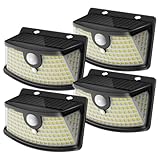
Aootek Solar Motion Sensor Lights, 120 LED, 4-Pack
Who it suits: Almost every renter, as the first and possibly only purchase: balcony doors, entry alcoves, shared-fence lines, the dark corner by the parking spot — anywhere you need light and have no right to touch wiring.
Start with the legal fact, because it is this product’s whole case: there is nothing to ask permission for. No junction box, no wires, no fixture swap. Four solar motion lights — check price on Amazon — each carrying 120 LEDs behind a PIR motion sensor rated to 26 feet across a 120° arc (maker figures), in an IP65 plastic housing with a PET-laminated panel, held up by screws. Where screws themselves are a problem — metal railings, lease clauses about holes, masonry you cannot drill — renters mount these with heavy-duty outdoor adhesive pads, zip ties around a railing baluster, or clamp hooks, and every one of those methods reverses in minutes at move-out with no trace for an inspector to photograph. That reversibility is the feature. A homeowner buys a light; a renter buys a light they can take to the next apartment, and the one after that.
The three working modes map neatly onto apartment life. Motion-only keeps the light dark until someone approaches — the setting for a balcony door or entry, where it lights your arrival and otherwise leaves the neighbors alone. A permanent-on mode holds roughly 10% brightness through the night, a soft marker glow. That neighbor discipline matters in dense buildings in a way it never does on a suburban lot. A motion light that fires at full brightness into facing windows all night generates complaints, and complaints generate a management email telling you to take it down — the one outcome worse than no light at all.
Now the fine print, unchanged from our homeowner research because physics does not care about your lease. Aootek publishes no lumen figure for this model; third-party estimates land around 600 lumens per light, and an estimate is all that is — treat these as strong path-and-door lights, not floodlights. The listing contradicts itself about how long each burst lasts — 15 seconds in one section, 25 to 30 in another — which tells you how carefully budget solar copy is written. The battery is sealed and not user-replaceable, so each unit is a consumable with a life of a few years of charge cycles; at this pick’s low position in the tier, that is an acceptable trade, but know that you are buying a few years, not a decade. And everything in the sun-trap section above applies with full force: a shaded or north-facing balcony will starve these lights no matter how many you buy. Audit first, mount on the sunniest surface you found, and these four lights will do more for a renter’s evenings than any hardwired fixture you are not allowed to install.
- The only pick in this guide a tenant may install without asking anyone — no wiring, no fixture swap.
- Four lights in one pack (check price on Amazon); adhesive, zip-tie and clamp mounting all work, and all reverse cleanly at move-out.
- Three modes including a dim-standby with motion boost — the neighbor-friendly setting for dense buildings.
Honest limitation: Plastic housing, a sealed battery that cannot be replaced, no maker-published lumen rating, and performance that lives or dies on the direct sun your mounting spot actually receives.
Choose it if your sun audit found a spot with real direct sun and you want light this week without a conversation with management. Skip it if your balcony is shaded or north-facing — skip solar entirely and go straight to the request picks below.
Maxxima LED Outdoor Wall Light (MEL-6150), Black
Who it suits: Renters whose entry or porch light is dead, dim, or a bare bulb in a cracked fixture — as the exact model to name in a written maintenance request.
Understand what this review is for. You will probably never buy this light with your own money, and you should not install it yourself. Its job in this guide is to be the most approvable sentence in a maintenance request: “The porch fixture has failed; a suitable replacement is the Maxxima MEL-6150, ETL-listed — check the current price on Amazon.” Landlords approve requests that are cheap, specific and safe, and this fixture is all three in a way that makes the property manager’s decision take ten seconds. It is a hardwired lantern with an aluminum base and a real glass shade — clear water glass, not acrylic — an integrated LED rated at 580 lumens (maker figure) in 3000K warm white drawing just 8.25W, and a photocell that switches it on at dusk and off at dawn with no tenant discipline required. The manual rates it suitable for wet locations, so it can live on an exposed wall in direct rain, and it carries an ETL/CETL listing and a 3-year warranty — the two credentials that tell a landlord this is a real lighting manufacturer’s product, not a listing-farm gamble that becomes next year’s second work order.
The request case writes itself, and renters should feel free to borrow its logic. A dusk-to-dawn light at the entry is a safety and liability feature for the property, not a decoration for the tenant — it lights steps, locks and faces every night without anyone remembering a switch, which is precisely what a landlord wants from a fixture they own. The 8.25W draw costs almost nothing to run across roughly 4,000 hours of darkness a year. The published operating range, minus 22°F to 113°F, is the kind of unglamorous specification that separates a manufacturer from a marketplace brand. And at about 11.7 inches tall it is a standard entry-lantern size that fits the junction box already on the wall of most units, which keeps the install to a simple swap the landlord’s handyman can do in one visit.
The trade-offs are the integrated-LED ones, and they land differently when you are the tenant rather than the owner. The LED is not replaceable; when the light source eventually fails, the whole fixture is replaced — but for a renter, that failure is the landlord’s cost and the landlord’s work order, not yours, and the maker’s 50,000-hour life claim (a maker figure, like every lifetime claim in this category) plus the 3-year warranty make it unlikely to be your problem during any normal lease. The 580 lumens (maker figure) is door-and-steps light — enough for keys, locks and faces — not yard light, and no request should oversell it as security floodlighting. If your building’s entry light is the thing standing between you and a dark stairwell, this is the name to put in writing.
- ETL-listed and rated suitable for wet locations — the credentials that make a landlord’s yes easy.
- True dusk-to-dawn photocell: the entry lights itself every night with no switch discipline from anyone.
- Aluminum and real glass with a 3-year warranty, in a modest position in this tier — check price on Amazon — so cost is rarely the objection.
Honest limitation: The LED is integrated and not replaceable — when it fails, the fixture is replaced — and as a hardwired fixture it is the landlord’s property and the landlord’s install, never a tenant DIY job.
Choose it if you are writing one maintenance request for a failed or inadequate entry light. Skip it if your spot is a covered porch and you would rather have a replaceable bulb — that is the Globe Electric Charlie below, and the request case differs.
Globe Electric Charlie 1-Light Outdoor Wall Sconce (44127), Oil Rubbed Bronze
Who it suits: Renters with a covered balcony or porch whose existing fixture is ugly or dead — and any renter whose lease makes the tenant responsible for bulbs, which is more common than people think.
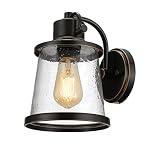
The Charlie is a metal sconce in an oil-rubbed bronze finish with a clear seeded glass shade, sold with an LED bulb in the box — check price on Amazon — and positioned in the lower part of this tier. Its defining specification is the one no integrated-LED fixture can offer: a standard screw-in socket. The bundled bulb is rated at 469 lumens in Amazon’s own spec field — the listing title rounds that to 500, and both are maker figures — at roughly 7W with a 15,000-hour claimed life. Why does a socket matter so much to a renter? Because of how leases divide the world. The fixture belongs to the landlord, but in a great many leases the bulb is the tenant’s consumable — when the porch bulb dies, replacing it is your job and your errand. At about 9.5 inches tall it is also a modest, apartment-scaled size — right for a balcony wall or a unit doorway in a way a grand entry lantern is not.
Its limitation is printed in its own manual, which is exactly why we trust the product: Globe Electric instructs you to protect the Charlie against heavy rainfall and mount it beneath a covered location. Translate the marketing — the listing says weather resistant and indoor/outdoor — into rating language and this is a covered-location fixture: damp-location reality, not an exposed-wall fitting. For homeowners that is a restriction. The one configuration to avoid is the top-floor or end-unit balcony with no cover above it, where this fixture would sit in direct rain outside its maker’s instructions; there, the wet-rated Maxxima above is the correct request. The Charlie is also switch-controlled with no sensor of its own, though the socket answers that too — a sensor bulb in that same socket can add automatic operation without any wiring change. As a request, its case is charm plus cost: it makes a dated unit look cared for, for a modest outlay of the landlord’s money.
- Standard socket with a bulb in the box — the one fixture where the replaceable part is legitimately the tenant’s to choose.
- Seeded glass and a metal frame at an apartment-appropriate 9.5-inch scale.
- Covered-location requirement matches the typical roofed balcony almost exactly.
Honest limitation: The maker’s own manual restricts it to covered locations protected from heavy rain — not for an exposed top-floor wall — and it has no built-in sensor; automation arrives via a sensor bulb, not the fixture.
Choose it if your balcony or porch is covered and the existing fixture needs replacing. Skip it if the mounting wall takes direct rain — request the wet-rated Maxxima lantern instead.
LIT-PaTH Outdoor LED Wall Lantern, 2-Pack, Black
Who it suits: Renters in townhouses, duplexes and garden-style complexes where two positions need matching light — both sides of a garage, a front door and a back door — again, as a request rather than a purchase.
The value is the review: two hardwired lanterns in one value-positioned pack, and each one is an aluminum housing with a glass shade and an integrated LED rated at 800 lumens (maker figure) in 5000K daylight white, drawing 9.5W. For a landlord, a matched pair in this value position in the tier is one of the most inexpensive visible upgrades in this entire guide — the kind of line item that refreshes a unit’s photos for the next listing. For the tenant, a matched pair means the two doors you actually use get the same light instead of one working lantern and one dead socket. The 5000K color is the cool, blue-leaning daylight that security-minded people prefer and porch-sitters often find harsh; there is no warm version of this lantern, so if your request is about evening comfort on a patio rather than visibility at a garage, the Maxxima or the Charlie is the better name to write down.
Two caveats, one about control and one about us. The control caveat: this lantern has no sensor of any kind — no photocell, no motion sensor. It is on when the wall switch is on. The caveat about us: we could not pin the pair’s own listing to the two-source standard this guide requires before printing a link — so there is deliberately no link here. Search Amazon for the exact name, “LIT-PaTH Outdoor LED Wall Lantern 2-Pack,” confirm you are looking at the black 2-pack (the same lantern is also sold singly), and paste that search into your request so the landlord lands on the right configuration. A pair of real aluminum-and-glass lanterns in a value position in this tier is the value high point of this category, for owners and landlords alike.
- Two aluminum-and-glass hardwired lanterns in one value-positioned pack.
- 800 lumens (maker figure) per lantern at 5000K daylight, 9.5W each.
- Standard junction-box install; the cheapest matched-pair request a landlord will ever see.
Honest limitation: No photocell and no motion sensor — switch-controlled only — the 5000K daylight color is fixed with no warm option, and this guide could not verify the pair’s listing to its linking standard, so it carries no link.
Choose it if two positions need matching light and the request is about visibility and value. Skip it if you want automatic dusk-to-dawn operation in the fixture itself — the Maxxima lantern above has the photocell this pair lacks.
No link for this pick, by the verification policy explained above — search the exact product name on Amazon.
Maxxima LED Outdoor Wall Wash Light, Up/Down
Who it suits: Renters in newer, modern-styled buildings whose balcony or entry wall is flat, clean and design-conscious — as the request that matches the architecture, or as the reference for what to ask for when a building refreshes its fixtures.
The wall washer is the design pick: an 8-inch aluminum-alloy fixture with a glass lens that throws light upward and downward in the twin-beam pattern modern facades are built around, rated at 1,000 lumens (maker figure) in 3000K warm white from 12W, with a photocell for true dusk-to-dawn operation and an IP65 rating that Maxxima backs with a wet-location statement, so unlike the Charlie it can live on an exposed wall. In a modern apartment building this is the one fixture type that looks native — the same up/down silhouette the architect specified for the lobby and the parking court — which makes it a surprisingly easy request in newer properties, where management cares about a consistent look and a tenant suggesting the matching fixture is doing them a favor. For pricing, check the current price on Amazon before anyone buys. In its position in the lower part of this tier, an aluminum, glass-lensed, photocell-equipped up/down light is remarkable value in any guide.
The caveats are about what a wall wash is, and renters should hold them clearly. The 1,000 lumens (maker figure) split between two beams aimed at the wall itself, so the usable light on the floor of a balcony or at a door lock is a fraction of the headline number — this is accent and orientation light, beautiful and genuinely helpful for finding a step, but it will not light a parking area or substitute for a lantern over a busy entry. On a small balcony it has a second personality worth knowing: washing your own wall with light also means living inside the glow, which many people love as ambient evening light and some find intrusive beside a sliding door — stand in the space and imagine it before requesting it. It is also integrated LED, like its sibling lantern: no bulb to change, and the fixture is the consumable, which again is the landlord’s balance sheet rather than yours. And a wall wash models every bump and crack in the surface it grazes; on a pristine modern facade that is the point, on a tired stucco wall it is an honest spotlight on the landlord’s maintenance backlog.
- Up-and-down architectural beams from an aluminum body with a real glass lens — the native look for modern buildings.
- Photocell dusk-to-dawn operation, IP65, stated suitable for wet locations.
- 1,000 lumens (maker figure) at a warm 3000K — check price on Amazon.
Honest limitation: Most of its output washes the wall rather than lighting the ground, so it is accent light, not task light.
Choose it if your building is modern and the request should match its architecture. Skip it if the position needs to genuinely illuminate steps or a lock — the Maxxima lantern is the functional request.

LUTEC 6222B Dual-Head LED Floodlight, Black
Who it suits: Renters of houses, duplexes and townhouses with a driveway, yard or dark side path — the tenants whose “outdoor wall light” problem is really an outdoor area problem, solved by request.
Apartment towers do not have driveways, but a large share of renters live in houses and duplexes, and their dark spot is the parking pad, the side gate, the run to the bins. That is floodlight territory, and this is the floodlight to name. The 6222B is a hardwired dual-head floodlight in an aluminum housing, rated at 3,500 lumens (maker figure) in 5000K daylight from 32W, with two heads you aim independently — one down the drive, one across the yard. In the black version (check price on Amazon), it delivers roughly six times the Maxxima lantern’s output while sitting in a similar, modest position in this tier. The IP65 rating suits exposed mounting in real weather, and floodlights are the one corner of this category where the big lumen numbers are at least plausible, because the fixture is a pair of open LED arrays rather than a shaded lantern shining through glass. The request case for a landlord is safety in its bluntest form: a dark driveway and an unlit side path are trip-and-fall territory, and a fixture in this modest position in the tier is among the cheapest risk reductions they will buy all year.
Now the honesty this pick exists to demonstrate, because it decides whether the installed result matches what you asked for. The 6222B has no motion sensor and no photocell. Price-comparison listings state it plainly: neither feature is specified for this model. It turns on when the wall switch turns on, full stop; LUTEC sells separate motion-sensor and dusk-to-dawn floodlight models for buyers who want them. Floodlight listings across Amazon blur exactly this line, borrowing sensor language from sibling models, so a request that just says “floodlight” can end with a landlord’s handyman installing whatever was on the shelf. Write the model number, and if you want it to react to movement, say in the same sentence that a sensor model or a switch-side timer is part of the ask. Judged as what it is — a switch-controlled, aimable, weather-sealed floodlight — it is superb value, and the combination of this fixture plus a timer still lands far under this budget.
- 3,500 lumens (maker figure) at 5000K from two independently aimable heads.
- Aluminum housing, IP65-rated for exposed mounting on driveways and side walls.
- The most light in this guide for its position in the tier — check price on Amazon — and an easy safety case in a written request.
Honest limitation: Switch-controlled only — no motion sensor and no photocell on this model, whatever the surrounding category copy implies — and 5000K daylight is a work light’s color that will annoy neighbors if it is aimed carelessly in a dense complex.
Choose it if you rent a house or duplex and the dark area is a drive, yard or side path. Skip it if you live in a tower or mid-rise — you have no such wall, and the Aootek plus a request for the entry lantern covers your real needs.

Comparison Table
| Product | Power and control | Output (maker figure) | Build and rating | Who installs it | Link |
|---|---|---|---|---|---|
| Aootek Solar Motion Sensor Lights, 4-Pack — check price on Amazon | Solar, PIR motion sensor | Not maker-published (est. ~600 lumens) | Plastic, IP65 | You — no permission needed | Check on Amazon |
| Maxxima LED Outdoor Wall Light (MEL-6150) — check price on Amazon | Hardwired, dusk-to-dawn photocell | 580 lumens, 3000K | Aluminum and glass, wet-location rated, ETL | Landlord, by written request | Check on Amazon |
| Globe Electric Charlie Sconce (44127) — check price on Amazon | Hardwired, switch-controlled, replaceable bulb | 469 lumens (included bulb) | Metal and seeded glass, covered locations | Landlord installs; the bulb is yours | Check on Amazon |
| LIT-PaTH Outdoor LED Wall Lantern, 2-Pack | Hardwired, switch-controlled | 800 lumens each, 5000K | Aluminum and glass, outdoor rated | Landlord, by written request | Search Amazon by name |
| Maxxima LED Wall Wash Light — check price on Amazon | Hardwired, dusk-to-dawn photocell | 1,000 lumens, 3000K | Aluminum and glass lens, IP65, wet locations | Landlord, by written request | Check on Amazon |
| LUTEC 6222B Dual-Head Floodlight — check price on Amazon | Hardwired, switch-controlled | 3,500 lumens, 5000K | Aluminum, IP65 | Landlord, by written request | Check on Amazon |
How to Choose an Outdoor Wall Light as a Renter
- Read your lease before you read listings. Most leases prohibit altering fixtures or wiring without written consent, and many prohibit drilling exterior surfaces. Knowing your exact clause turns every later decision into a simple one: solar and adhesive-mounted lights are almost always inside the rules; anything with a wire is a request.
- Run the balcony sun audit first. Solar is the only layer you fully own, but only where direct sun actually lands for four to six hours a day. Check your railing and walls at three times of day, in the current season, before spending anything. A failed audit is not a shopping problem — it is the signal to put your energy into a maintenance request instead.
- Spend your $75 like a renter, not an owner. The sensible split: a small share on the Aootek 4-pack you control — check price on Amazon — a small amount on no-drill mounting (outdoor adhesive pads, railing clamps, zip ties), and the remainder unspent — held against the day a landlord agrees in writing to a fixture you split or they fund. The full homeowner menu at this ceiling, if you want to see what owners do with the same money, is in Best Outdoor Wall Light Under $75; your version of that budget buys mobility and permission, not fixtures.
- Make the request written, specific and cheap to approve. “The porch light is broken” competes with every other ticket. “The entry fixture has failed; the Maxxima MEL-6150 is an ETL-listed replacement — check the current price on Amazon” is a decision a manager can make in seconds. Name the model and the safety listing and invite the manager to check the current price on Amazon. Mention the dark steps or the unlit lock, and keep the email — a paper trail is a renter’s best tool.
- Never pay for a landlord’s fixture without a written agreement. If you offer to fund an upgrade yourself, get the arrangement — permission, who owns the fixture, whether it stays or leaves with you, any rent credit — in writing before money moves. Verbal yeses evaporate at move-out, and an undocumented improvement is a donation.
- Choose your consumable with the lease in mind. Integrated LED fixtures are replaced whole when the light dies; as a tenant that cost is the landlord’s, which quietly makes integrated picks like the Maxxima pair of fixtures easier to live with as a renter than as an owner. A socketed fixture like the Charlie flips it: the fixture lasts, and the bulb — often the tenant’s responsibility — is yours to choose, warm, brighten or make automatic.
- Match the fixture to the cover you actually have. A standard balcony, roofed by the unit above, is a covered location — which is why the Charlie’s covered-only limitation fits apartment life so well. An exposed top-floor wall needs a wet-location rating: the Maxxima lantern, the Maxxima wall wash or the LUTEC floodlight. Let the maker’s rating, never the listing’s adjectives, make this call.
- Be a good neighbor with motion light. In dense buildings, a motion sensor sees other people’s doors, walkways and windows. Prefer the Aootek’s dim-standby mode over full-blast motion-only, aim sensors along your own space rather than across a shared landing, and remember that the goal is light you keep — a light that draws complaints gets removed. If the dark spot is beside a bedroom — yours or a neighbor’s — the gentler strategies are collected in Best Outdoor Wall Light For Bedrooms Under $75.
- Small spaces need small light. A balcony is a few square feet of outdoor room; floodlight output that suits a driveway will flatten it and spill into the unit. One warm lantern’s worth of light, or a wall wash’s glow, is the right scale — the compact-space cases are worked through in Best Outdoor Wall Light For Small Rooms Under $75.
- Design-led buildings deserve a design-led request. If your complex is modern and management guards its look, the up/down wall wash is the request that flatters the architecture — more angles on that approach live in Best Outdoor Wall Light For Modern Homes Under $75.
- Plan the exit on the day you install. Photograph the wall before you mount anything. Keep the adhesive pads’ removal instructions, the zip ties’ snips, the original fixture’s photo. The goal at move-out is a wall indistinguishable from the day you arrived — that is what “no trace” has to mean when a deposit is attached to it.
What $75 Actually Buys a Renter
It is worth pausing on the strange shape of this tier, because renters arrive with homeowner expectations. In outdoor wall lights, the verified quality market for a single fixture sits well within this budget — that is the position an ETL-listed, wet-rated, aluminum-and-glass dusk-to-dawn lantern from a real manufacturer occupies, and a pair of aluminum lanterns from a value brand sits in a similar place. Above that position, within this budget, there is no better lantern; there are only different things — multi-packs, bigger floodlights, and the first rung of smart lighting, which itself sits just over the line: the category’s one household-name smart fixture, the Govee Outdoor Wall Light, sits above this budget at its regular position, and reaches under $75 only on deal days — and even then it is hardwired, which for a renter means it is a request, not a purchase, and its motion sensor is sold separately on top.
For a renter, then, the honest reading of $75 is that most of it should stay in your pocket. Your controllable spend is the solar layer — check price on Amazon — plus mounting hardware. Everything above that is either a landlord’s line item you influence by asking well, or a written cost-share you negotiate deliberately. If even the solar layer is more than the moment calls for, the tighter ceiling is covered in Best Outdoor Wall Light For Apartments Under $40 — and the discipline is the same at any number: own the layer you can remove, request the layer you cannot, and never confuse the two.
Common Buying Mistakes
- Swapping a hardwired fixture yourself because “it’s just three wires” — it is the landlord’s property, and the lease violation plus restoration cost dwarfs any light you gained.
- Drilling into masonry, stucco or siding for a solar light when adhesive pads, railing clamps and zip ties exist — holes are what deposits are deducted for.
- Buying solar lights for a shaded or north-facing balcony without a sun audit, then blaming the lights for a starving panel.
- Running a motion light on full-blast motion-only mode facing a shared landing or a neighbor’s windows, and losing the light entirely to a management complaint.
- Paying out of pocket to upgrade the landlord’s fixture with only a verbal okay — undocumented improvements are donations.
- Writing a vague maintenance request (“porch light broken, please fix”) instead of naming the exact model and safety listing, and pointing to the current price on Amazon, that make approval effortless.
- Assuming “waterproof” in a listing title is a rating. It is an adjective; the maker’s manual and the IP or location rating are the evidence.
- Comparing lumen numbers across brands as if they were measured the same way — they are maker figures, and one brand’s 580 and another’s 3,500 are different dialects, not a six-fold truth.
- Leaving your solar lights behind at move-out because the adhesive felt permanent. They are yours; removal instructions and a few minutes are all that stand between you and taking them to the next balcony.
- Forgetting the pack-count trap: ordering a single when the photo showed a pair, or ordering a multi-pack configuration when you meant a single fixture. Check the exact configuration, every time.
Final Recommendation
- Every renter, first move: Aootek Solar Motion Sensor Lights 4-Pack — light you own outright, installable today, removable without a trace — check price on Amazon.
- One written request, one dark entry: Maxxima LED Outdoor Wall Light (MEL-6150) — ETL-listed, wet-rated, automatic at dusk, the landlord’s money spent well — check the current price on Amazon.
- Covered balcony or porch: Globe Electric Charlie — seeded glass, a bulb in the box, and a socket whose consumable part is legitimately yours to choose.
- Two positions, one request: LIT-PaTH Outdoor LED Wall Lantern 2-Pack — two aluminum-and-glass lanterns in a value position in this tier, on a switch or timer.
- Modern buildings: Maxxima LED Outdoor Wall Wash Light — the up/down architectural look with a photocell, in the lower part of this tier — check price on Amazon.
- House and duplex renters with a dark drive: LUTEC 6222B Dual-Head Floodlight — 3,500 lumens (maker figure), switch-controlled and requested by exact model number — check price on Amazon.
Our top two for renters are the Aootek 4-pack — because it is the only pick whose installation requires nothing from anyone, and in a rental that freedom is the product — and the Maxxima MEL-6150, because as a written request it is close to unrefusable: a real manufacturer’s ETL-listed, wet-rated, self-switching lantern in a modest position in this tier. Start with the sun audit, mount the layer you own, write the request for the layer you do not, and keep every agreement in writing. Do that, and $75 stops being a smaller version of a homeowner’s budget and becomes what it should be for a tenant: a small amount of your money, spent only on what leaves with you, plus a well-aimed ask that spends the landlord’s money on the rest.
Frequently Asked Questions
Can a renter legally replace a hardwired outdoor light?
In almost all leases, no — not without the landlord’s written permission. A hardwired fixture is part of the property, and replacing one is an alteration, not maintenance; doing it anyway risks a lease violation and a move-out deduction for restoring the original. If a landlord does agree to let you arrange an install yourself, get that agreement in writing first, with who owns the fixture spelled out.
Will solar lights work on an apartment balcony?
Only if the balcony gets real direct sun — roughly four to six hours a day landing on the panel — and many balconies do not, because the unit above acts as a roof and the building shades itself. If a railing end or door-side wall passes, a light like the Aootek 4-pack will work well. If nothing passes, no solar light fixes the geometry; put the effort into a hardwired request instead.
How do I write a maintenance request a landlord will actually approve?
Make it short, specific and cheap to say yes to. State the problem in safety terms (a dark entry, unlit steps), name the exact replacement — model and its safety listing, with a prompt to check the current price on Amazon — and note that it is a standard swap onto the existing junction box. “Entry fixture has failed; the Maxxima MEL-6150 is an ETL-listed, wet-rated replacement — check the current price on Amazon” gets approved faster than “porch light broken.” Send it in writing through whatever channel your lease specifies, and keep a copy; if the light is a genuine safety issue and requests stall, that paper trail is what local tenant-resource offices will ask to see.
My lease says I supply the bulbs. Does that change what I should want?
Yes — it makes socketed fixtures like the Globe Electric Charlie disproportionately valuable to you. The fixture is the landlord’s, but the bulb is your consumable, so a standard socket lets you choose the color temperature, brightness, or even a dusk-to-dawn sensor bulb that adds automatic operation to a switch-controlled fixture, all without touching wiring. With integrated-LED fixtures there is no bulb for you to supply — which also means nothing for you to fix when the light dies; that work order belongs to the landlord.
How do I mount a solar light without drilling, and will it stay up?
Heavy-duty outdoor adhesive mounting pads, railing clamps and zip ties around balusters all hold a small solar light — these units weigh very little — through normal weather, and all three reverse at move-out with no trace: pads peel with a slow pull and adhesive remover, ties snip off, clamps unscrew. Prepare the surface properly (clean, dry, full cure time before hanging the light), avoid mounting adhesive on crumbling paint, and photograph the wall before and after. Screws into a wooden railing or fence you are permitted to mark remain the sturdiest option where the lease allows them.
What happens to my outdoor lights when I move out?
The solar ones leave with you — that is the point of owning that layer. Remove them, clean any adhesive residue, and the wall should look as it did on arrival; your before-and-after photos are the proof if a deposit dispute arises. Anything hardwired that was installed during your tenancy belongs to the property unless a written agreement says otherwise, which is why this guide insists on paper before a renter funds any fixture: without it, a light you paid for becomes a gift to the next tenant.