Where to buy
Check the latest price, availability and delivery on Amazon. Orders are placed on Amazon. We may earn a commission from qualifying purchases.
- Best overall: PAUTIX CCT COB LED Strip Light Kit, 16.4 ft, Tunable White 2700K–6500K, 24V with RF Remote — Check on Amazon
- Govee LED Strip Light M1, 16.4 ft, RGBICW with Matter — Check on Amazon
- Philips Hue Solo Lightstrip Base Kit, 10 ft, White and Color Ambiance — Check on Amazon
- PAUTIX Addressable CCT Smart IC COB LED Strip Lights, 32.8 ft, 2700K–6500K, Alexa Voice Control — Check on Amazon
See 2 more Amazon options
- Govee RGBIC LED Strip Lights, 65.6 ft, Wi-Fi App Control with Alexa and Google Assistant — Check on Amazon
- Govee RGBIC LED Strip Lights, 100 ft (2 x 50 ft), Wi-Fi App Control — Check on Amazon
Read the full guide ↓
Disclosure: As an Amazon Associate, dailyhomedecorating.com earns from qualifying purchases. Listing details such as price and availability change often, so check the current Amazon listing before you buy.
Every other light you can buy for a small room charges rent. A floor lamp takes a corner. A desk lamp takes the desk. Even a table lamp takes the surface it stands on, in a room where surfaces are the scarcest resource you own. That single fact should reorganize how a small room spends $75 on strips, because the arithmetic of this tier runs in the opposite direction to a big room’s. A large room needs footage, and footage is cheap. A small room needs almost none: ten to sixteen feet covers one or two complete features — a headboard wall, a desk run, a kitchenette’s cabinets, a television — and even a full ceiling perimeter in a genuinely small room measures only about 36 to 44 feet. Which means that at $75, the small-room buyer should be spending nearly the whole budget on the quality of a short line of light, not on a long one.
That is this guide’s whole argument, and it cuts against the way this tier is usually sold. The general guide for this budget — Best Led Strip Lights Under $75 — splits the market in two: long Wi-Fi color reels that sell footage cheaply, with spaced emitters, and dense, honest light that costs far more for every foot you get. In a small room the first of those purchases mostly evaporates. The reason density matters more here than anywhere else is distance. In a large room you stand ten feet from the strip and spaced emitters blur into a line. In a small room you are never more than a few feet from anything — you read beside it, sleep under it, cook in front of it — and at that range every individual diode announces itself, in direct view and again in every glossy reflection. Dotless is not a luxury finish in a small room. It is the difference between light and a string of dots.
The second small-room principle is that the light should be indirect wherever possible, because indirect light is how a small room cheats its own dimensions. The room quite literally looks bigger, because the eye measures a room by its lit surfaces, not by the position of the lamp. Direct-view strips do the opposite: they draw the eye to the line itself and shrink the visual field to the fixture. Two picks need their labels before we start. The Govee M1’s list positioning sits above this tier; it earns its place here at the lower level its recurring promotions reach, and at full list it belongs to a higher guide — check the current price on Amazon before building a plan around it. And the Hue Solo’s headline offer buys the strip alone — its full feature set needs a Bridge sold separately, which pushes the true system cost well beyond this tier, a fixed overhead that is genuinely hard to justify for a single small room and genuinely easy to justify if a Bridge already lives in the home. Both sides of that are argued in its review, not hidden.
Quick Picks
Short on time, or comparing several options at once? Each row below names a buyer type and the strip that suits it, with a link to the listing.
| Buyer type | Pick | Why it stands out | Link |
|---|---|---|---|
| Best overall for small rooms | PAUTIX CCT COB LED Strip Light Kit, 16.4 ft | Dotless COB white at 640 LEDs per meter — invisible as a fixture even at arm’s length — in a complete kit that sits comfortably inside this tier; check price on Amazon | Check on Amazon |
| Best short color feature | Govee LED Strip Light M1, 16.4 ft | 60 LEDs per meter with a real warm-white channel and Matter — the smoothest color run a desk or headboard can wear, when its promotion brings it into this tier; check the current price on Amazon | Check on Amazon |
| Best color quality | Philips Hue Solo Lightstrip, 10 ft | Hue’s unmatched color consistency and a maker-rated 1,700 lumens in ten feet — if a Bridge is already in the home | Check on Amazon |
| Best full-perimeter white | PAUTIX Addressable CCT Smart IC COB Strip, 32.8 ft | One dotless, animated white line long enough to ring a small room’s whole ceiling, positioned in the upper part of this tier when its live price cooperates; check price on Amazon | Check on Amazon |
| Best color perimeter, with surplus | Govee RGBIC LED Strip Lights, 65.6 ft (Wi-Fi) | A whole ceiling of segmented color near the top of this tier — but a small room uses barely half the reel; check the current price on Amazon | Check on Amazon |
| Only for several rooms at once | Govee RGBIC LED Strip Lights, 100 ft (2 x 50 ft) | The tier’s cheapest footage per foot — and the classic small-room mistake if one room is the whole plan; check price on Amazon | Check on Amazon |
How These Picks Were Chosen
The budget filter was the same as the general guide’s: every strip below has a real Amazon listing and was positioned at or under the $75 tier line for the exact length named in its review at research time, with two labeled exceptions carried over honestly. The Govee M1’s list positioning is over the line; it is included at the level its recurring promotions reach, and its review is written for that promoted level — check the current price on Amazon, because at full list it belongs to the next guide up. The PAUTIX 32.8 ft strip’s pricing is volatile and has spent time above this budget, so it is included with an explicit instruction to buy only when the live price sits at or under the tier line. Everything else sits inside the budget at its ordinary or list positioning.
What changed is the scoring. A small room reorders this tier’s priorities, and the picks were re-ranked against four tests that a general guide does not apply. The first is the surplus test: how much of the reel will a small room actually light? A 10 by 12 foot room has a ceiling perimeter of about 44 feet; a desk wall, headboard or cabinet bank needs 8 to 16. Any footage beyond the plan is not stored value — because cutting is one-way on all six picks and the offcut cannot be reconnected, surplus footage is waste you paid for. The second is the close-range test: at the distances a small room imposes, does the light read as a line or as dots? The fourth is the fixed-cost test, and it exists because of one pick: an ecosystem overhead like a Bridge is a rounding error spread across a large home’s twenty lights and a serious tax on a small room’s one. It is scored as such below.
The research method did not change. We did not install these strips ourselves. Brightness figures were treated as maker figures throughout: Philips Hue’s 1,700 lumens over ten feet is the only total-output rating published in a first-party specification among the six, and it is reported as a maker’s rating, not a measurement. The PAUTIX kits’ CRI figures above 90 are likewise the maker’s claims, attributed every time they appear; Govee publishes no CRI figure we could verify for any of its three picks, so none is printed. Adhesive honesty carries over too: peel-and-stick backing is the weakest component in this category, owner reviews fault even Hue’s by name, and in a small room — where runs are short and every run matters — clips or channel are treated as part of the install, not an accessory.
The Small-Room Math: Feet, Walls and the One Outlet
Before the reviews, the numbers a small room actually runs on. A typical small bedroom or studio corner measures 10 by 12 feet, which makes its ceiling perimeter about 44 feet — the longest single run most small rooms will ever ask for. A headboard wall is 8 to 10 feet. A desk and monitor setup wants 8 to 12. A kitchenette’s under-cabinet run is 6 to 12. A television’s back edge is under 10. There is one more piece of small-room math, and it is electrical: most small rooms have two to four accessible outlets, all of them already spoken for. Every strip kit needs one outlet for its adapter, near the run, with the control box somewhere it can see a remote or reach the Wi-Fi. Plan the route from the outlet outward — the strip starts where the power is, not where the light looks best — and if the only free outlet is behind the bed, the headboard run is your feature and the ceiling ring is not happening without an extension the listing does not include.
The 6 Best LED Strip Lights for Small Rooms Under $75
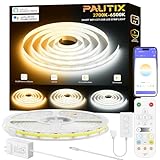
PAUTIX CCT COB LED Strip Light Kit, 16.4 ft
Who it suits: Most small-room buyers — anyone lighting a kitchenette’s cabinets, a desk wall, a vanity or a shelf run in white light they will actually work under, at distances where dotted strips look cheap.
This kit wins the small-room guide for the reason the whole guide exists: at close range, its light has no visible source. COB construction packs some 3,200 chips along the five meters — 640 per meter — under one continuous phosphor surface, so what comes out is a single unbroken line of light. Mount it under a small kitchen’s cabinets and there are no diodes to reflect in the countertop. Run it above a desk and there is no dotted line hovering at the edge of your vision while you work. Put it in plain sight along a shelf and it still reads as a fixture, not as tape. No other pick in this guide can be looked at directly, from three feet away, and pass. The kit is complete in the way small rooms need: the strip, a 24V power supply sized for the run, and an RF remote with its receiver. That remote matters more here than in a big house — it works through cabinet doors, needs no Wi-Fi, no account and no phone, and in a room where the strip is always within a few feet, a physical remote on the counter beats an app on a phone in another room. Its pricing is the steadiest in the guide and sits in the lower half of this tier — check price on Amazon — comfortably inside the budget, for the strip whose light looks the most expensive, leaving real room in the budget for the channel or clips a permanent install deserves.
The compromises are scope and one labeling caveat. Scope first: this strip makes whites — all of them, beautifully — and nothing else. No color, no scenes, no chasing, no party modes. If the small room’s plan includes color, this is the wrong pick no matter how good its white is, and the M1 below is the answer instead. The control this guide can stand behind is the remote; buyers who need voice should confirm the smart-controller configuration on the live listing before ordering. And the family’s general rules apply: output and CRI figures are the maker’s own, and cutting is at the printed marks with the offcut unusable afterward — at 16.4 feet in a small room, though, there is rarely much offcut to mourn.
- Truly dotless white: 640 LEDs per meter under a continuous phosphor — the only pick that survives being looked at from three feet away.
- Tunable 2700K–6500K in a complete kit: strip, 24V supply and RF remote included, positioned in the lower half of this tier — check the current price on Amazon.
- Sized for the room: 16.4 ft is one or two complete small-room features, with almost nothing wasted.
Honest limitation: White only — no color or effects of any kind; the verified in-box control is the RF remote (the listing’s voice-assistant claim needs the smart configuration confirmed), and its brightness and CRI figures are the maker’s own.
Choose it if the job is cabinets, a desk, a vanity or shelves in a room where the strip will always be close. Skip it if you want any color at all — that is the M1’s entire reason for being here.
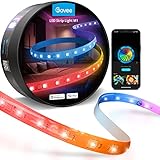
Govee LED Strip Light M1, 16.4 ft
Who it suits: Small-room buyers whose one feature deserves color — a gaming desk, a television wall, a headboard — and who want the smoothest, densest color strip made, in exactly the length a small room uses.
If the PAUTIX is the small room’s white answer, the M1 is its color answer, and it earns the slot on density. Its four-in-one RGBICW chips pack 60 LEDs into every meter — double the standard strips in this guide — and add a dedicated warm-white emitter beside the color ones, so its whites are made by a white diode instead of by red, green and blue negotiating. At small-room distances that density is the whole game: colors blend along the line instead of beading, gradients look like gradients, and the strip behind a monitor or above a headboard reads as a wash of light rather than a dotted border. Sixteen point four feet is the right amount of it: one complete feature, headboard to desk to television, with the strip cuttable at its marked points and extendable with Govee’s kits toward 32.8 feet if a second feature ever justifies it. The pricing carries its label openly: its list positioning sits above this tier, and the level that puts it in this guide is a promotional one. When a promotion brings it within the tier, it belongs here — check the current price on Amazon. At full list, it belongs to the under-$100 guide, and this review is written for the promoted level.
The compromises are the Matter fine print, the one-way cut, and the promotion dependency. A buyer who runs everything through Apple Home or SmartThings and never opens vendor apps is paying flagship money for a very bright plain strip. The cut is final in the usual way: the manual is explicit that detached pieces cannot be reconnected, so the 16.4 feet must be planned, not trimmed hopefully. Govee publishes no CRI figure we could verify, even for its flagship. And the whole pick rests on the promotion being live when you shop — check the current price on Amazon before building a plan around it. None of that changes what it is: the best-made short color strip in this guide, in the exact footage a small room needs.
- Densest color here: 60 LEDs per meter of RGBICW chips, with a real warm-white channel — color that blends at arm’s length instead of beading.
- Matter over Wi-Fi for every major platform, with the full scene library in the Govee app; 24V adapter included.
- Right-sized at 16.4 ft, extendable toward 32.8 ft with Govee kits if a second feature ever earns it.
Honest limitation: Over Matter it is a single-color strip — the segmented effects live only in Govee’s app; cut pieces cannot be reconnected; and the pick depends on its recurring promotion, since its list positioning is over this budget.
Choose it if one desk, television or headboard deserves the best color strip made and your smart home speaks Matter. Skip it if the strip will be seen up close in direct view and dots are the enemy — even 60 per meter blends rather than disappears, and the COB picks above and below erase the dots entirely.
Philips Hue Solo Lightstrip Base Kit, 10 ft
Who it suits: Two opposite small-room buyers: the one who already owns a Hue Bridge, for whom this is simply the best short strip in the guide — and the color purist furnishing one room who has decided, with eyes open, that Hue’s color is worth an ecosystem tax.
Start with what the strip itself is, because it is excellent. Ten feet of RGBWW strip — physically the same strip as the long-running Lightstrip Plus, by Hue coverage’s own account — producing the deep, accurate colors and clean whites Hue is known for, rated by the maker at 1,700 lumens over the ten feet. Ten feet is also, not coincidentally, the size of the jobs a small room actually has: behind one television, along one headboard, under one bank of cabinets. It is cuttable to fit and deliberately not extendable, which removes the extension math the Plus line invites. Out of the box it runs over Bluetooth in the Hue app — dimming, color, basic scenes, within range of your phone — and the strip kit on its own sits inside this tier; check price on Amazon. What that buys is exactly that and no more.
Now the other side, argued as plainly as the case for. Everything beyond Bluetooth — control from outside the home, real schedules and routines, grouping with other Hue lights, entertainment sync, Matter and full voice-assistant integration — is unlocked by the Hue Bridge, sold separately at a premium of its own. Strip plus Bridge therefore lands well beyond this tier’s budget. Spread across a whole home of Hue lights, that overhead is trivial. Charged to one ten-foot strip in one small room, it more than doubles the effective cost of the light — and a small room, with its one or two features, is precisely where the Bridge is hardest to justify on arithmetic. The format limits are simpler: the Solo shows one color along its whole length at a time — no segments, no chasing gradients — so buyers picturing the RGBIC light show should take a Govee. And Hue strips carry this category’s most documented adhesive complaints in owner reviews, so plan on clips or channel from the start. The verdict this guide gives small rooms is conditional, and deliberately so: with a Bridge in the home, buy it without hesitation; without one, buy it only if Hue color itself is the point.
- The best color in the guide: Hue’s RGBWW output with a maker-rated 1,700 lumens over 10 ft — premium per-foot positioning at the top of this tier; check the current price on Amazon.
- Ten feet is the small-room feature size: one television, one headboard, one cabinet bank, nothing wasted.
- Bluetooth control with no hub at all; a 2-year warranty and a decade of software support behind it.
Honest limitation: The full feature set needs a Bridge sold separately, which pushes the true system cost well beyond this tier — a heavy fixed tax on a single small room; the strip is single-color along its length, cannot be extended, and its adhesive is the line’s most-complained-about part.
Choose it if a Hue Bridge already lives in your home, or Hue color is worth the ecosystem entry fee. Skip it if this one room is the whole project and no Bridge exists — the M1 above delivers its color without the toll.

PAUTIX Addressable CCT Smart IC COB LED Strip Lights, 32.8 ft
Who it suits: The small-room buyer with the ambitious plan: one continuous, dotless line of white light around the whole room — a ceiling cove, a crown-line perimeter, a full kitchenette — that can move, chase and answer to voice.
Recall the perimeter math from earlier: a 10 by 12 foot room’s ceiling measures about 44 feet around, and most small rooms are smaller than that. And it is COB: 560 LEDs per meter under a continuous phosphor, so the entire ring is one unbroken line of light with no dots at any distance — the install that makes visitors ask where the fixture is. What separates it from the cheaper PAUTIX kit above is the addressable IC control: the white itself can move, in chasing, flowing and gradient effects rendered in whites from 2700K to 6500K, run through the maker’s smart controller and app with Alexa voice control on top. For a small room this combination is quietly perfect. A cove ring of dotless white is the single most effective size-cheat in small-space lighting — the ceiling plane lights up, the walls wash evenly, and the room’s boundaries recede — and the animation, kept in shades of white, reads as architecture rather than as a party trick. Its per-foot cost sits far below the Hue’s premium positioning, for a run more than three times as long — check the current price on Amazon, because this pick’s pricing moves around more than any other in the guide.
The compromises are price volatility and platform size. Volatility first, because it decides whether the pick is in this guide at all: this strip’s pricing has ranged from comfortably inside this tier to clearly above it. It has spent real time above this budget, and this review is written for the times its live price sits inside the tier. Above the tier line, the correct move is the 16.4 ft kit above for the feature wall and patience for the rest — do not stretch. It is a white-only strip — its motion is done in shades of white, elegant in a cove and a limitation at a party. Output and CRI figures are maker figures, as throughout. And a 32.8 ft run deserves mounting clips or an aluminum channel rather than faith in peel-and-stick backing — in a small room the ring is the room’s main light feature, and a sagging section at eye level undoes the entire effect.
- A whole small room in one line: 32.8 ft of dotless COB — approximately a full ceiling perimeter — at a per-foot cost well below the premium picks; check price on Amazon.
- Animated white: addressable chasing and flowing effects across 2700K–6500K, with smart controller and Alexa voice control in the kit.
- The size-cheat install: a lit ceiling plane and washed walls make the room’s boundaries recede.
Honest limitation: The most volatile pricing in the guide — it has ranged above this budget, so buy only when the live price is at or under the tier line; effects live in PAUTIX’s app rather than in the voice assistants, and it is white-only.
Choose it if the plan is a full cove or perimeter in white and the live price is at or under the tier line — check the current price on Amazon. Skip it if one feature wall is the whole job — the kit two reviews up does the same light, shorter, for noticeably less within this tier.
Govee RGBIC LED Strip Lights, 65.6 ft (Wi-Fi)
Who it suits: The small-room buyer whose plan really is a full ceiling perimeter in color — a gaming room, a studio’s sleeping-and-streaming corner — and who accepts paying for footage the room will partly waste.
Let the case for it be made fairly first, because there is one. The adapter is included and mains-powered; there are no USB compromises. Its pricing record is genuinely good for the footage offered: it sits in the upper part of this tier and has often been available well inside it — check the current price on Amazon. If a small room’s ceiling ring in flowing color is the dream, this is the kit that does it in one box, and a perimeter of about 44 feet sits comfortably inside its length.
Now the small-room accounting, which is why it ranks fifth here rather than first. Start with the surplus: 65.6 feet bought for a 44-foot perimeter leaves more than twenty feet with nowhere to go, and because cutting is one-way — trim at the marks and the offcut can never be reconnected or lit — that surplus is not savings, it is waste included in the price. The effective cost of the feet you actually light is therefore well above the bargain the headline per-foot figure suggests. Continue with the dots: the emitters are spaced, exposed diodes, and in a small room every viewing distance is a close one. Govee publishes no total lumen figure and no CRI figure we could verify, and its white is mixed from the color emitters, bought as atmosphere rather than as light to read or cook by. Control is app-or-voice only, with no handheld remote to fall back on. None of this makes it a bad strip — in the general guide it is the best overall pick at this budget. It makes it a big-room answer that a small room can use, at a small-room discount for waste and dots that the picks above it do not charge.
- A whole ceiling of segmented RGBIC color with app and voice control, positioned in the upper part of this tier — check price on Amazon.
- Mains adapter included, cut marks printed along the strip; one box covers any small room’s full perimeter.
- The deepest scene library and music sync in this guide.
Honest limitation: A small room lights barely half the reel and the one-way cut makes the rest waste; spaced emitters read as dots at small-room distances and in reflections, white is mixed rather than from a dedicated channel, and no lumen or CRI figure is published.
Choose it if a full color perimeter is genuinely the plan and the surplus is a price you accept. Skip it if the plan is one or two features — every pick above it lights those better for the same budget or less. The renter’s version of this trade-off, where the footage question meets the deposit question, is worked through in Best Led Strip Lights For Apartments Under $75.

Govee RGBIC LED Strip Lights, 100 ft (2 x 50 ft)
Who it suits: Honestly, almost no single small room — this pick is in the guide to be argued with. It suits the buyer lighting a small room plus the hallway, the next room and the room after that from one kit, and nobody else.
The kit itself is exactly what its sibling above is, extended: two rolls of 50 feet of RGBIC strip, one control box and one 24V, 48W adapter per the maker’s manual, with the same Govee Home app, Alexa and Google voice control, scene library and music sync. Its per-foot cost is the lowest in this guide — check the current price on Amazon. For a large room, a basement or a whole-ceiling project, that arithmetic is the argument, and the general guide makes it. In a small room, the arithmetic inverts. The two-roll format adds a small-room absurdity of its own: both rolls must work outward from the single control box, so a one-room install either runs the second roll back over the first’s territory or coils it, lit, behind furniture — a glowing surplus heating the dust behind a wardrobe.
The remaining compromises are inherited and compounded. Its pricing also needs watching in the other direction — it has spent real time above this guide’s budget entirely; when its live price sits inside the tier it is in, and when it climbs above the tier it is out, and the listing must be checked rather than assumed. The standard-strip caveats apply unchanged: spaced emitters that dot at close range and in reflections, mixed white with no dedicated channel, no published lumen or CRI figure, peel-and-stick adhesive that wants clips on anything but smooth paint. The bedroom version of the footage question — where the extra roll sometimes earns its keep as a second zone — is covered in Best Led Strip Lights For Bedrooms Under $75; for a small room standing alone, the verdict is simpler. Buy the footage your room measures. This kit measures somebody else’s house.
- The cheapest footage in the tier: 100 ft as two 50 ft rolls, at the lowest per-foot cost in this guide — check price on Amazon.
- One kit, one app: a single control box and 24V/48W adapter, with app, voice and music sync throughout.
- Genuinely useful when the project is secretly two or three small rooms, not one.
Honest limitation: For one small room, most of the reel is unusable surplus — the one-way cut means it can never be recovered; a single adapter feeding 100 ft invites far-end voltage drop, and the kit’s pricing has ranged above this budget.
Choose it if the project is a small room plus its neighbors, all fed from one controller location. Skip it if one room is the whole plan — it is the most common way to overspend in this tier, and the picks above exist to prevent it.

Comparison Table
| Product | Format & length | Light & control | Best use in a small room | Link |
|---|---|---|---|---|
| PAUTIX CCT COB Strip Kit | COB strip, 16.4 ft, 640 LEDs/m | Tunable white 2700K–6500K; RF remote, supply included | Dotless cabinets, desk and vanity light at close range | Check on Amazon |
| Govee LED Strip Light M1 | Dense strip, 16.4 ft, 60 LEDs/m | RGBICW with real white channel; Matter + Govee app | One premium color feature: desk, TV or headboard | Check on Amazon |
| Philips Hue Solo Lightstrip | Standard strip, 10 ft, not extendable | Single-color RGBWW; Bluetooth app, full features via Bridge | Hue color quality for one feature, in existing Hue homes | Check on Amazon |
| PAUTIX Addressable CCT Smart IC COB | COB strip, 32.8 ft, 560 LEDs/m | Addressable tunable white with chasing effects; app + Alexa | A full small-room cove or perimeter in dotless white | Check on Amazon |
| Govee RGBIC LED Strip Lights (Wi-Fi) | Standard strip, 65.6 ft | Segmented RGBIC color; app + Alexa/Google voice, music sync | A full color ceiling perimeter, surplus accepted | Check on Amazon |
| Govee RGBIC LED Strip Lights, 100 ft | Standard strip, 2 x 50 ft rolls, one 24V/48W adapter | Segmented RGBIC color; app + voice, music sync | Several small rooms from one kit — not one room alone | Check on Amazon |
How to Choose an LED Strip Light for a Small Room Under $75
- Measure features, not the room. List the actual runs — headboard, desk, cabinets, television, cove — and add their lengths. That number, not the budget, decides which reel size is even a candidate.
- Price the feet you will light, not the feet in the box. A long kit of which you light only part of the reel costs far more per lit foot than its headline per-foot figure suggests — and the unlit remainder cannot be saved, because on every pick here a cut section is dead forever. Surplus is waste with a price tag; divide honestly.
- Make density the first specification. In a small room you live at reading distance from your lights. If the strip or its reflection will be visible — and in a small room it will be — density is the purchase, ahead of scenes, apps and footage.
- Default to indirect. Light thrown onto a wall or ceiling from a hidden strip makes the room read larger and hides the hardware completely. Plan the hiding place — cove, lip, cabinet underside, furniture back — before choosing the strip.
- Ask where the white comes from. If the strip will light faces, food or a desk, mixed RGB white will disappoint: it is an effect, not illumination. A dedicated white channel (the M1), dedicated white emitters (the Hue) or a white-only COB strip produces whites worth working under at close range.
- Score the fixed costs against one room. A Bridge, a hub or a second kit is a household investment; charged to a single small room it can more than double the real cost of the light. The Hue’s arithmetic is the worked example: one strip inside this tier, and a full system that lands well beyond it once the Bridge is counted. Fine if the system grows; hard to defend if it never does.
- Plan the outlet before the route. Small rooms have few outlets and all are contested. A beautiful plan that begins two feet beyond the adapter’s reach is not a plan.
- Climb the control ladder only as high as you will use. In a room where everything is within arm’s reach, an RF remote is not a compromise — it is the fastest control there is, and it never needs the Wi-Fi password. Match the control to the reach.
- Treat adhesive as a starting suggestion. Peel-and-stick backing is the most-complained-about component in this category, Hue’s owner reviews included, and a fallen strip in a small room falls at eye level. Clean, smooth, cured surfaces hold; anything else wants the maker’s clips or an aluminum channel — which also straightens the line of light and hides the strip’s back.
- If the budget pinches, step down a tier before stepping down in density. A small room’s needs are short, and the picks in Best Led Strip Lights For Small Rooms Under $40 cover a desk or a bed frame with the same close-range logic at a lower tier. What you should not do is protect the budget by buying footage — trading density for length is the one trade a small room always loses.
What $75 Buys a Small Room — and When $100 Buys More
Seventy-five dollars in a small room buys concentration. Because the footage requirement is so small, the whole budget lands on the part of the strip you actually see: a dotless COB line for the cabinets with budget to spare, the densest color strip Govee makes for the desk wall, ten feet of the best color in the business for the television, or a full animated-white perimeter that turns the ceiling into the room’s light fixture. Philips Hue’s Lightstrip Plus base kit — 80 inches, extendable, the Solo’s sibling — is positioned above this tier at list: an excellent strip that this guide cannot call an under-$75 strip at list. Govee’s COB Strip Light Pro, 1,260 LEDs per meter of dotless smart color in a short length that also lists above this tier, is the small-room temptation in its purest form — its length is exactly a small room’s feature length, at exactly the density a small room wants — and it belongs here only on the days a promotion brings it within the tier; check the current price on Amazon before counting on it.
The step to $100 buys those two at their list positioning and retires the promotion-watching, and for a permanent cove in a renovated small kitchen that permanence may be worth it. The step sideways matters more: the same $75 reads differently in a room that is also a bedroom, where standby glow and dimming floors join the scoring, which is what Best Led Strip Lights For Bedrooms Under $75 is for; and it reads differently again in a design-led interior where the strip is the only visible light source, the subject of Best Led Strip Lights For Modern Homes Under $75. It is also, for once, a discount: the room that needs the least light gets to buy the best light.
Will an LED Strip Light Fit Your Small Room?
Fitting is the one question strips always answer yes — the strip itself is a quarter-inch of tape that lives in seams and shadow gaps. The real fits are electrical and optical. Optical: ask, for each planned run, whether you will see the strip, see its reflection, or only see its light. Only-see-the-light is the goal and any pick achieves it from a cove or behind furniture. See-the-reflection — under cabinets over a glossy counter, above a television — demands density. See-the-strip, in direct view at arm’s length, demands COB. In a small room you will cycle through all three relationships with the same run across a single evening, which is why this guide scores the strictest one.
Two installation rules protect both the strip and the household. Second, respect the cut marks and the voltage: cut only where the strip says to cut, never power a strip from a supply that did not come with it or match its voltage, and keep adapters and control boxes out of sinks’ splash zones and steam — none of the six picks here is waterproof, and the kitchen picks belong under cabinets, not inside showers.
Common Buying Mistakes
- Buying footage for a room that needs features — the 100 ft kit for a 12-foot desk wall is this tier’s signature small-room error.
- Dividing the price by the footage in the box instead of the footage you will light. The surplus is cut off and dead; it was never a bargain.
- Judging a strip at showroom distance. In your room you will live three feet from it; spaced emitters that blurred across the store are dots across the desk.
- Mounting a dotted strip in direct view or over a glossy surface, then blaming the strip. The reflection shows every diode twice.
- Forgetting the Bridge in the Hue math — and, in a small room, forgetting that one room carries the whole fixed cost alone.
- Buying the M1 at its full list positioning inside an under-$75 plan. At list it belongs to the next guide up; the pick is the promotion — check the current price on Amazon.
- Cutting first and reading the manual second. Cut sections cannot be reconnected on these strips; the offcut is waste, permanently.
- Planning the route from the prettiest wall instead of from the outlet. The strip starts where the power is.
- Trusting adhesive on textured paint, warm cabinet undersides or downward runs. Clips and channel are cheap; a fallen ring at eye level is not a good look in any size of room.
- Confusing color temperature range with color. A 2700K–6500K range is shades of white; RGB color is a different feature on a different strip.
Final Recommendation
- Most small rooms: PAUTIX CCT COB LED Strip Light Kit, 16.4 ft.
- One color feature, done properly: Govee LED Strip Light M1, 16.4 ft — when its promotion brings it into this tier.
- Hue homes and color purists: Philips Hue Solo Lightstrip, 10 ft.
- A whole perimeter in white: PAUTIX Addressable CCT Smart IC COB Strip, 32.8 ft.
- A whole perimeter in color, surplus accepted: Govee RGBIC LED Strip Lights, 65.6 ft (Wi-Fi).
- Several rooms, one kit: Govee RGBIC LED Strip Lights, 100 ft (2 x 50 ft).
Our top two are the small room’s two honest answers. The M1 is the color answer: the densest, smoothest color strip here, in exactly the footage a small room uses, with a real white channel for the hours when color is not the point — check the current price on Amazon and buy it when its promotion puts it in this tier if the room needs a feature. Between them, the Hue serves the homes that already speak its language, the long PAUTIX rings the room in white, and the two big Govee reels wait for the rare small room whose plan is genuinely a perimeter — or genuinely several rooms. Measure the features, count the density before the footage, price the whole circuit including any hub, and mount it like you expect it to stay. In a small room, the best strip is the one you never notice — only the light it leaves behind.
Frequently Asked Questions
How many feet of LED strip does a small room actually need?
Far fewer than the reels suggest. Two features total roughly 16 to 24 feet. A full ceiling perimeter in a 10 by 12 foot room is about 44 feet, and most small rooms are smaller. That is why this guide’s top picks are 10 to 16.4 feet long, why its whole-perimeter pick is 32.8 feet, and why a 100 ft kit for one small room is paying for footage that will be cut off and thrown away.
Why do LED strips look dotted in my small room when they looked smooth in photos?
Distance and construction. A standard strip spaces its emitters at roughly 30 per meter, and at the ten-foot viewing distance of a showroom or a listing photograph those dots blur into a line. The fixes are density (60 LEDs per meter blends at most angles) and COB construction (560–640 per meter under a continuous phosphor, which erases the dots entirely), or hiding a standard strip so only its light is seen.
Can I save the leftover strip for another room later?
No — and this is the fact that should shape the purchase. Leftover footage still attached to the reel is fine, but the moment a run is trimmed to fit, the remainder is waste. Buy the length that covers your measured features, and treat any surplus in a bigger kit as part of its price, not as a future asset.
Is the Philips Hue Solo worth it for one small room?
It depends entirely on the Bridge. If your home already has one, yes: the Solo is the best short color strip in this guide at its in-tier positioning, full stop. If it does not, the honest cost of the full Hue experience is well beyond this tier once the Bridge — sold separately — is counted, and a single small room carries that entire fixed cost by itself. Buyers who expect to add more Hue lights over time are making a down payment, not paying a tax; buyers lighting one room and stopping should take the M1 or a PAUTIX instead.
Will a strip light make my small room look bigger?
It is the one light that genuinely can, if it is installed indirectly. A strip mounted in direct view does the opposite: it draws the eye to a bright dotted line and makes the fixture, not the room, the subject. Hide the source, light the surfaces, and choose dotless COB for any run you cannot hide.
Do I need Wi-Fi control in a room this small?
Often not, and that is a real saving. Wi-Fi and voice earn their place for ceiling rings you cannot reach, for schedules and routines, and for rooms inside a larger smart home. What you should not do is pay a premium for a control ladder you will never climb, or accept app-only control for a strip you will adjust from the chair beside it.
Will the adhesive hold, and will it damage the wall?
On clean, smooth, fully cured paint, the backing can hold for years; on textured, dusty, warm or downward-facing surfaces it lets go — owner reviews fault even Hue’s adhesive by name — and removal can take paint with it. Channel also hides the strip’s back and straightens the line of light, which in a small room is half the point.