Where to buy
Check the latest price, availability and delivery on Amazon. Orders are placed on Amazon. We may earn a commission from qualifying purchases.
- Best overall for modern homes: Govee LED Strip Light M1, 16.4 ft, RGBICW with Matter — Check on Amazon
- PAUTIX CCT COB LED Strip Light Kit, 16.4 ft, Tunable White 2700K–6500K, 24V with RF Remote — Check on Amazon
- Philips Hue Solo Lightstrip Base Kit, 10 ft, White and Color Ambiance — Check on Amazon
- PAUTIX Addressable CCT Smart IC COB LED Strip Lights, 32.8 ft, 2700K–6500K, Alexa Voice Control — Check on Amazon
See 2 more Amazon options
- Govee RGBIC LED Strip Lights, 65.6 ft, Wi-Fi App Control with Alexa and Google Assistant — Check on Amazon
- Govee RGBIC LED Strip Lights, 100 ft (2 x 50 ft), Wi-Fi App Control — Check on Amazon
Read the full guide ↓
Disclosure: As an Amazon Associate, dailyhomedecorating.com earns from qualifying purchases. Links to Amazon on this page are affiliate links; they cost you nothing extra. Listing details such as price and availability change often, so check the current Amazon listing before you buy.
A strip light in a modern interior is judged twice. Traditional rooms forgive both failures — there are shades, pelmets, picture rails and visual noise to absorb them. A modern room forgives neither, because the whole point of the style is that nothing in it is accidental. That double standard is what reorganizes the under-$75 tier. In the general market this budget splits into two purchases: length (65 to 100 feet of Wi-Fi color strip at the lowest cost per foot in the tier) and light quality (dense COB lines, a flagship strip with a real white channel, and a Philips Hue strip at the highest cost per foot in the tier). In a modern home the split sharpens into something closer to a verdict. What appreciates instead is density, honest white, and ecosystem: a line that disappears into a cove or a channel, white made by a white emitter rather than mixed from colors, and control that leaves no hardware in the room at all.
So this guide applies three tests that a general guide does not. Brightness figures in this category are maker figures with no common measurement standard behind them; where a maker publishes one — Philips Hue rates the Solo at 1,700 lumens over ten feet — we report it as the maker’s rating, and where none exists we print none and judge by density and direction instead. And three picks carry a price caution. The Govee M1 below sits at the upper end of this tier when its current price fits the budget; at a higher price point it belongs to the under-$100 guide, so check the current price on Amazon before anything else. The PAUTIX 32.8 ft strip has also moved above this budget at times and is a pick only while its current price still fits the under-$75 budget — check price on Amazon. The Hue Solo buys the strip alone — its full feature set waits behind a Bridge sold separately, so the honest system cost is strip plus Bridge, well above the strip alone. For most modern homes we would start with the Govee M1 when its current price fits this budget: the densest color light in the tier, a real white channel, and Matter, the closest thing strip lighting has to an architectural standard. Below you will find the quick picks, detailed notes on all six strips, a comparison table, a buying checklist written for this style, the mistakes modern interiors punish hardest, and answers to the questions that come up again and again.
Quick Picks
Short on time, or comparing several options at once? Each row below names the modern-home job and the strip that does it, with a link to the listing.
| Buyer type | Pick | Why it stands out | Link |
|---|---|---|---|
| Best overall for modern homes | Govee LED Strip Light M1, 16.4 ft | 60 LEDs per meter, a real warm-white channel beside the color, and Matter over Wi-Fi — check price on Amazon | Check on Amazon |
| Best dotless white line | PAUTIX CCT COB LED Strip Light Kit, 16.4 ft | 640 LEDs per meter under one phosphor surface: no dots to hide, tunable 2700K–6500K, complete kit — check price on Amazon | Check on Amazon |
| Best ecosystem | Philips Hue Solo Lightstrip, 10 ft | Hue’s color discipline and whole-house scenes, maker-rated 1,700 lumens — but the full feature set needs a Bridge | Check on Amazon |
| Best long cove | PAUTIX Addressable CCT Smart IC COB Strip, 32.8 ft | Thirty-two feet of dotless white that can move — chasing and flowing effects in tunable white — check price on Amazon | Check on Amazon |
| Best concealed color | Govee RGBIC LED Strip Lights, 65.6 ft (Wi-Fi) | A whole room of segmented color — check price on Amazon — legitimate in this style only when fully hidden in a cove | Check on Amazon |
| Most footage | Govee RGBIC LED Strip Lights, 100 ft (2 x 50 ft) | The most strip in the tier, at the lowest cost per foot here — check price on Amazon — and therefore the most strip to hide | Check on Amazon |
How These Picks Were Chosen
The budget filter came first, applied to verified listings at the configuration each review actually recommends: every strip below has a real Amazon listing for the length named, positioned to fit the under-$75 budget. Because listing prices change, check the current price on Amazon for each pick before you buy. The M1 sits at the upper end of the tier and can move into the under-$100 tier at a higher price point, so its review depends on its current price still fitting this budget — check price on Amazon before anything else in this guide matters. The PAUTIX 32.8 ft strip and the 100 ft Govee have both lived on both sides of this budget line at different times, so they are included only while their current prices still fit the under-$75 budget. Everything else sits more comfortably inside the budget at its usual positioning in the tier.
The second filter was this guide’s own: the three tests. The line test is a density test, because density is the specification that decides what a strip looks like. The standard color strips space their emitters at roughly 30 per meter, and at that spacing the eye reads dots — in direct view, and doubled in any glossy reflection. The M1 doubles that to 60 per meter and the dots begin to merge. COB construction — hundreds of chips per meter under a continuous phosphor — ends the argument: there are no dots, only a line. A dotted strip that passes concealment completely can still serve a modern room; a dotted strip mounted in the open cannot, whatever its scene library. Budget for it as part of the fixture, because on any run that matters, it is.
We did not install these strips ourselves. We read the maker listings, manuals and specification pages, price trackers and the independent coverage of this category, and compared the things that decide whether a strip survives a modern interior: emitter density and whether the light reads as dots, a blend, or a line; where the white comes from — mixed from red, green and blue (which lands cold and flatters nothing in a neutral palette), a dedicated white channel (the M1’s RGBICW chips), dedicated white emitters alongside color (the Hue’s RGBWW), or a white-only COB strip; the control ladder and what each rung leaves in the room — an RF remote in a drawer, an app on a phone, voice and schedules that leave nothing visible at all, or Matter, which lets a strip join whole-house scenes across platforms; whether the strip trims at printed cut marks — all six do — with the universal rule that the cut-off piece cannot be reconnected and lit again; and whether the power supply is in the box and sized for the kit, which all six here satisfy. Brightness claims were treated as maker claims throughout, and color-rendering claims the same way: the PAUTIX kits publish maker CRI figures of 90+ and we attribute them every time; Govee and Hue publish no CRI figure we could verify, so we print none. Adhesive got no free pass either — it is the weakest component in every kit here, Hue’s owner reviews fault it by name, and in this guide clips or channel are treated as the mounting plan, not an upgrade.
The 6 Best LED Strip Lights for Modern Homes Under $75
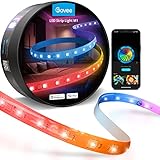
Govee LED Strip Light M1, 16.4 ft
Who it suits: Modern homes with one run that matters — a media wall, a floating cabinet bank, a headboard wall, a desk bay — where the light will be seen, judged, and expected to behave like part of the house’s systems rather than a gadget plugged into it.
The M1 earns the top of this guide because it is the only color strip here that takes the line test seriously. Colors blend along the line instead of beading, and in the testing coverage this strip has earned, its output is the class benchmark — The Verge called the M1 the brightest strip it had tested. Then there is the architecture. The Govee Home app remains the home of its 64-plus scene modes, segmented DIY effects and music sync. The strip runs on 24V with the adapter included, trims at its marked points, and can be extended with Govee’s kits toward a 32.8 ft maximum per the manual. Its positioning wears the caution the Quick Picks table gave it: it sits at the upper end of this tier, and this review is written for the times when its current price fits the under-$75 budget — at a higher price point, it is the under-$100 guide’s pick, not this one’s, so check the current price on Amazon.
The compromises are the Matter caveat, the footage, and the one-way cut. The footage is the second cost: 16.4 feet at the upper end of this tier makes for a high cost per foot, so this is a feature run, not a room outline. And cutting is final — the manual is explicit that detached pieces cannot be reconnected — so the route gets measured twice and the offcut is waste. Govee publishes no CRI figure we could verify, flagship or not. None of that dethrones it for its brief: it is the best-made short strip in the tier, and the only one whose smart-home credentials are a standard rather than a brand.
- The densest color light here: 60 LEDs per meter of RGBICW chips, with a real warm-white channel for honest whites in a neutral palette.
- Matter over Wi-Fi joins Apple Home, Alexa, Google and SmartThings — strip scenes inside whole-house scenes — with the full effect library in the Govee app.
- 24V adapter included; cuttable at the marks and extendable with Govee kits toward 32.8 ft.
Honest limitation: Over Matter it is a single-color strip — the segmented effects live only in Govee’s app; cut pieces cannot be reconnected; and it sits at the upper end of this tier, so the pick depends on its current price still fitting this budget — check price on Amazon.
Choose it if one short run deserves the best light in the tier and your home speaks Matter. Skip it if its current price does not fit this budget, or you need to outline a whole room — the concealed-color picks below cover four to six times the length and sit lower in the tier.
PAUTIX CCT COB LED Strip Light Kit, 16.4 ft
Who it suits: Kitchens, cabinet runs and calm living spaces in modern homes — anyone whose strip is white light that will sit in plain sight, under a floating cabinet or along a shelf, and be looked at every day.
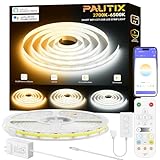
If the M1 wins the color argument, this kit wins the line argument outright, and it is not close. COB construction packs 3,200 chips along the five meters — 640 per meter — under a single continuous phosphor surface, so the output is one unbroken ribbon of light. The white tunes from 2700K warm to 6500K daylight, so the same run is evening-soft and noon-crisp, and PAUTIX claims a CRI above 90 for it — a maker figure this guide attributes rather than endorses, but one that at least exists, where the big color brands publish nothing we could verify. The kit is complete in the way this category rarely manages: the strip, a 24V power supply (2A) sized for the run, an RF remote and its receiver, per the maker’s own package list. Its positioning is at the lower end of the tier — check price on Amazon — which makes this one of the lowest-cost picks here, for the strip whose light looks the most expensive. In channel, it is the closest thing under $75 to architectural lighting.
The compromises are color, voice and proof. Color first: this strip makes whites, all of them, and nothing else — no scenes, no chasing, no party modes; buyers who want color should take the M1 above. Voice second, and stated plainly because the listing does the opposite: its title advertises Alexa and Google Assistant, but the verified box contents are the strip, the supply, the RF remote and a receiver. The control we can stand behind is the remote. If voice control decides your purchase, confirm the smart-controller configuration on the live listing before ordering, because the plain kit’s virtue is precisely that it is not a network device. In its brief none of that counts against it: for visible white light in a modern kitchen or living space, it is the most disciplined product in this guide, positioned at the lower end of the tier.
- Truly dotless white: COB at 640 LEDs per meter under a continuous phosphor — a line of light that can sit in direct view and in glossy reflections.
- Tunable 2700K–6500K with a maker-claimed CRI above 90, in a complete kit: strip, 24V/2A supply and RF remote included.
- Positioned at the lower end of the tier: a complete kit without the premium positioning of the flagship picks — check price on Amazon.
Honest limitation: White only — no color, scenes or music modes; the verified in-box control is the RF remote (the listing’s voice-assistant claim needs the smart configuration confirmed on the live listing), and the brightness and CRI figures are the maker’s own.
Choose it if the run is a kitchen, cabinet bank, desk or shelf and the light must look like a fixture, not a gadget. Skip it if you want any color at all — this strip refuses to, on principle.
Philips Hue Solo Lightstrip Base Kit, 10 ft
Who it suits: Hue households and modern homes run as one system — buyers who want the strip to take its orders from the same scenes, schedules and switches as every other light in the house, and who value color consistency over effects.
Hue’s proposition in a modern interior is not the strip; it is the discipline. Ten feet of strip — physically the same strip as the long-running Lightstrip Plus, by Hue coverage’s own account — with RGBWW emitters that produce the deep, accurate colors and clean whites the brand is known for, rated by the maker at 1,700 lumens over the ten feet, the only total-output figure in this guide published in a first-party specification. Out of the box the Solo runs over Bluetooth in the Hue app — dimming, color, basic scenes, within range of your phone, for up to about ten lights — and check the current price on Amazon for what the strip alone buys — exactly that. The Bridge, sold separately, is part of this pick’s true cost, stated here as plainly as in the introduction: strip plus Bridge is a system well above the cost of the strip alone, whether you buy the Bridge from Hue’s own store or from Amazon. Buyers who already own a Bridge owe none of that, and for them this is simply the best short strip in the guide.
The compromises are the ecosystem toll, the format and the adhesive’s reputation. The format is the second limit, and it cuts both ways: one color at a time is discipline if your design is discipline, and a dead end if you wanted the light show — buyers who want gradients moving along the line should take the M1 above. The two-year warranty and a decade of software support stand on the other side of the ledger. Judged as a strip, it is superb and short. Judged as architecture, its true cost is the strip plus whatever of the Bridge you still owe — check price on Amazon for both.
- The best color discipline in the guide: Hue’s RGBWW output with a maker-rated 1,700 lumens over 10 ft — the highest cost per foot in the tier, reflecting its short, premium format.
- Whole-house value: with a Bridge, the strip joins the same scenes, schedules and switches as every other Hue light you own.
- Cuttable to fit, backed by a 2-year warranty and the deepest support ecosystem in smart lighting.
Honest limitation: The full feature set needs a Bridge sold separately, making the true system cost strip plus Bridge, well above the strip alone — check the current price on Amazon for both; the strip is single-color along its length with no segments, it cannot be extended, and its adhesive is the line’s most-complained-about part — plan on channel.
Choose it if you already own a Hue Bridge, or your home is becoming a Hue home and the strip is one room of a larger plan. Skip it if you want a complete smart setup for $75 all-in, or effects along the strip — the M1 and the Govee reels below do those jobs without a toll.

PAUTIX Addressable CCT Smart IC COB LED Strip Lights, 32.8 ft
Who it suits: Modern homes with a long architectural run — a full ceiling cove, a long hallway line, a big room’s crown edge — where the strip is part of the architecture and white is the whole palette, but a static line feels like a missed opportunity.
Take the kit above, double the footage, and let the white move: that is this strip. The kit carries a 24V supply and the maker’s smart controller, with Alexa voice control on top of the app, so the run can join schedules and scenes without leaving hardware in the room. The cost per foot sits where the proposition says it should: far under the Hue’s per-foot toll, well above the bulk color reels, buying density and white quality across a length long enough to be architecture rather than accent — check price on Amazon. For the long cove that defines so many modern living spaces, this is the tier’s most complete answer.
The compromises are price volatility and the smart layer’s terms. Price movement first, because it decides whether this pick is in the guide at all: it has spent real time above this budget at different times, and this review is written for the times when its current price fits the under-$75 budget. If check price on Amazon shows it no longer fits, buy the 16.4 ft kit above — twice, if the run demands it — rather than stretching. And the family caveats carry over: output and CRI figures are maker figures, and a 32.8 ft run deserves channel or clips rather than faith in adhesive — doubly so in this style, where a sagging line is a visible line. Within its terms — dotless, animated, long, white — nothing else in the tier does what it does.
- Dotless and animated at once: 560 LEDs per meter of addressable COB, with chasing and flowing effects in tunable white.
- A real architectural run: 32.8 ft in the middle of the tier for cost per foot, with 24V supply, smart controller and Alexa voice control in the kit.
- The cove pick: fixture-grade white across a whole room’s edge, with motion that stays inside a white palette.
Honest limitation: Its price is the variable one — it has moved above this budget at times, so buy only while check price on Amazon confirms it still fits the under-$75 budget; the effects live in PAUTIX’s app rather than in the voice assistants, and it is white-only like its sibling.
Choose it if you are lighting a long cove or perimeter in white and want it smart and quietly animated. Skip it if its current price no longer fits the under-$75 budget, or if 16.4 ft covers your run — the kit above does the same light and sits lower in the tier.
Govee RGBIC LED Strip Lights, 65.6 ft (Wi-Fi)
Who it suits: Modern homes with a real cove to fill — a full ceiling perimeter, a long media wall — where the strip will be completely concealed and its job is a wash of segmented color over a large room, run by app or voice.
This is the mainstream room kit of the tier, and in this guide it comes with a condition attached, stated before its virtues: in a modern interior it is legitimate only when hidden. Its virtues are real. It is mains-powered through an included adapter, trims at its printed cut marks (the offcut is scrap, as everywhere here), and it is positioned in the middle of the tier for a room of color, at a low cost per foot for its length — check price on Amazon. Hidden in a proper cove, where the wall and ceiling do the diffusing, the wash it throws is genuinely beautiful, and the color discipline is yours to impose: one color, one gradient, held — the scenes are a library, not an obligation.
The compromises are exactly the ones this guide’s tests exist to catch. No scene mode fixes spacing; only concealment does, which is why this pick’s review is written for coves and behind-lip installs and no other kind. The adhesive is the category’s standard peel-and-stick, the part most likely to fail first, and a falling strip in a modern room is not a maintenance issue, it is a composition emergency: budget for clips or channel. And the app is the remote — there is no handheld fallback when the Wi-Fi is down or a guest wants the lights changed. Judged on what can be checked — footage, effects and control — it is the most complete room kit in the guide. Judged by this guide’s tests, it passes only in hiding, and it is ranked here, fifth, for exactly that reason.
- A whole room in one kit: 65.6 ft of segmented RGBIC color at a low cost per foot for the tier — check price on Amazon.
- Full mainstream control: Govee Home app over Wi-Fi, Alexa and Google voice, scene modes and music sync.
- Mains adapter included and cut marks printed along the strip; no USB power compromises.
Honest limitation: Spaced emitters read as dots in direct view and double in glossy reflections — in this style it must be fully concealed; white is mixed rather than from a dedicated channel, no lumen or CRI figure is published, and control depends on the app and your 2.4GHz Wi-Fi.
Choose it if your room has a real cove or lip that will hide every inch of it, and you will impose one-color discipline on its scenes. Skip it if any part of the run will be visible — that is what the COB and M1 picks above exist for.

Govee RGBIC LED Strip Lights, 100 ft (2 x 50 ft)
Who it suits: The largest modern rooms and longest coves — open-plan spaces whose ceiling line genuinely measures past what a 65 ft kit covers — and buyers who would rather hide one long kit well than join two ecosystems at a corner.
The 100 ft kit is the length play of the tier, and its manual is admirably plain about the box: two rolls of 50 ft of RGBIC strip, one control box, one power adapter. The cost per foot is the lowest in the guide, reflecting how much footage the kit bundles — check price on Amazon. The strip trims at printed cut marks, and the adapter is a proper 24V, 48W mains supply sized by the maker for the kit. For a genuinely enormous room with a genuinely continuous cove, it is the only single-kit answer here.
The compromises are physics, price movement, and the arithmetic of hiding. Physics first: one 48W adapter feeding 100 feet is the textbook setup for voltage drop, and reviewers of long runs document the far end running slightly dimmer or shifting color against the end near the controller. Price movement second: this kit has spent real time above this guide’s budget at different times; it belongs here only while its current price fits the under-$75 budget, and the listing gets checked rather than assumed — check the current price on Amazon. The standard caveats from the pick above apply unchanged — spaced emitters, mixed white, no published lumen or CRI, adhesive that wants clips. It is ranked last in this guide deliberately: not because it is a bad kit, but because in this style the most strip is the most liability, and it earns its place only where the room is big enough to make the others too short.
- The most footage in the tier: 100 ft as two 50 ft rolls, at the lowest cost per foot in the guide — check price on Amazon.
- One kit, one app: a single control box and 24V/48W adapter run the whole hundred feet, with app, voice and music sync.
- Same RGBIC scene library as the 65.6 ft pick — the upgrade is length, not features.
Honest limitation: A single adapter feeding 100 ft invites far-end voltage drop — dimmer, color-shifted far ends are the documented failure mode, and an uneven line fails this style outright; the kit has moved above this budget at times, so verify its current price still fits the under-$75 budget before buying.
Choose it if your measured, concealable run is genuinely 70 to 100 feet. Skip it if your room needs 40 feet — the 65.6 ft kit covers it while sitting lower in the tier, with a shorter electrical path, less drop to manage and less tape to hide.

Comparison Table
| Product | Format & length | Light & control | Modern verdict | Link |
|---|---|---|---|---|
| Govee LED Strip Light M1 | Dense strip, 16.4 ft, 60 LEDs/m | RGBICW with real white channel; Matter + Govee app | The feature run: dense enough to be seen, smart enough to be architecture | Check on Amazon |
| PAUTIX CCT COB Strip Kit | COB strip, 16.4 ft, 640 LEDs/m | Tunable white 2700K–6500K; RF remote, supply included | The visible line: dotless white that passes in direct view | Check on Amazon |
| Philips Hue Solo Lightstrip | Standard strip, 10 ft, not extendable | Single-color RGBWW; Bluetooth app, full features via Bridge | The system play: one color, perfectly matched to the whole house | Check on Amazon |
| PAUTIX Addressable CCT Smart IC COB | COB strip, 32.8 ft, 560 LEDs/m | Addressable tunable white with chasing effects; app + Alexa | The long cove: dotless white that can move, at architectural length | Check on Amazon |
| Govee RGBIC LED Strip Lights (Wi-Fi) | Standard strip, 65.6 ft | Segmented RGBIC color; app + Alexa/Google voice, music sync | Concealed color only: a room of wash, if the cove hides every inch | Check on Amazon |
| Govee RGBIC LED Strip Lights, 100 ft | Standard strip, 2 x 50 ft rolls, one 24V/48W adapter | Segmented RGBIC color; app + voice, music sync | The footage play: only for rooms big enough to hide all of it evenly | Check on Amazon |
How to Choose an LED Strip Light for a Modern Home Under $75
- Run the line test before anything else. If the strip or its reflection will be visible — under open shelves, along a stair, around a mirror, in a stone countertop’s shine — density is the purchase: COB at 560–640 LEDs per meter disappears, the M1’s 60 per meter blends, and a standard strip’s spaced emitters dot. If the strip will be completely concealed in a cove, the wall does the diffusing and a standard strip passes. Decide which install you actually have before comparing prices.
- Judge the off state. At noon the strip is an object on your architecture. Dotted tape on a white wall fails a modern room even when its light is lovely. Channel, a cabinet lip or a cove makes it vanish; if none of those exists on your run, that is a design problem to solve before it is a shopping problem.
- Budget the channel as part of the fixture. Aluminum channel with a diffuser straightens the line, spreads it, protects the strip and reads as a deliberate detail when off. It is also a real second cost on top of any reel in this guide — on a long run it can rival the strip itself. A reel plus channel is a different purchase from a reel alone, and comparing a channelled install against a bare strip without counting the channel is how budgets quietly double.
- Ask where the white comes from. In a neutral palette, mixed RGB “white” — cold, blue-leaning, unflattering to skin, food and paint — is a light-quality error, not a compromise. A dedicated white channel (the M1), dedicated white emitters (the Hue) or a white-only COB strip makes white worth living under. If white is the main job, this question outranks every scene mode in the guide.
- Treat the ecosystem as architecture. A strip that joins whole-house scenes — one schedule, one voice command, one switch behavior across every light — is worth more in a modern home than a strip with a bigger effect library, because the house reads as one system. Matter (the M1) and Hue (with its Bridge) are the two architectural options here; know that on the M1, Matter carries a single color while the segmented effects stay in Govee’s app.
- Impose color discipline. The modern rule is one line, one color, one place. Saturated color has exactly one licensed role in most modern interiors — the media wall, behind the television — and a second, quieter one as a held, single-color wash in a cove. Rainbow cycling is a screensaver, not a design decision; every RGBIC pick here can be disciplined, and the discipline is the buyer’s job.
- Measure the run, then think in cost per foot. The six picks span from the long reels at the lowest cost per foot to the short premium strips at the highest. Tape-measure the actual path, including the drop to the outlet, and weigh cost per foot for the density you have chosen — check price on Amazon for each pick. Footage you do not need is not value; in this style it is tape you must hide.
- Do the true-cost check. The Hue Solo’s full feature set is behind a Bridge sold separately — a system well above the strip alone. The M1 sits at the upper end of this tier and can belong to the under-$100 tier at a higher price point. The PAUTIX 32.8 ft and the 100 ft Govee have both moved above this budget at times. Compare the current price you will actually pay — check price on Amazon — for an installation that actually passes the tests, on the day you shop.
- Plan the cut before you buy. Every pick here trims at printed marks, and on all of them the cut-off section is dead — it cannot be reconnected and lit. Buy the length that covers the run with the offcut as waste. Corners, gaps and split runs are connector-and-planning questions to settle before ordering, not during.
- Treat adhesive as a starting suggestion, not the mounting plan. Peel-and-stick backing is the most-complained-about component in this category, Hue’s owner reviews included. On smooth, clean, cool surfaces it can hold for years; on textured paint, warm cabinet undersides or downward runs, start with clips or channel — which this style usually wants anyway, for the line it makes.
What $75 Buys a Modern Home — and When $100 Buys More
Seventy-five dollars, spent with this style’s discipline, buys the two things a modern interior actually needs from strip light: invisibility and honesty. Invisibility, because the tier contains genuinely dotless white (the PAUTIX kits) and a color strip dense enough to sit near furniture without beading (the M1). Philips Hue’s Lightstrip Plus base kit — 80 inches, extendable, the Solo’s longer-running sibling — sits above this tier at its usual positioning: an excellent strip this guide cannot call an under-$75 strip. Govee’s COB Strip Light Pro — 1,260 LEDs per meter of dotless smart color in a short 9.8 ft format, positioned as a premium pick above this tier — is the strip this style would design for itself, and it belongs here only if its current positioning ever fits this budget. Both are named without links, deliberately: a guide that stretches its budget for beautiful objects stops being a guide.
The wider shortlist in Best Led Strip Lights Under $75 ranks this same tier without the style filter — footage scores higher there, and some of its reasoning will look upside-down from here, which is the point of a lens. The step to $100 is where the boundaries move for modern homes specifically: the M1 and the Lightstrip Plus sit naturally in that higher tier, the COB Pro becomes an ordinary purchase there rather than a stretch for this budget, and long smart COB runs stop requiring the same price-checking against a tighter budget. If your install is a permanent cove in a renovated kitchen — channel recessed, plaster finished, a decade of evenings ahead — the extra money buys permanence-grade density and is honestly spent. If the job is a media wall, a cabinet bank or a first whole-house scene, the strips above do it properly. And if the honest answer is that one short, simple run is all the room needs, the step down is equally real: the shortlist in Best Led Strip Lights For Modern Homes Under $40 covers a desk or a cabinet run for less, with the same tests applied at a smaller budget.
Will an LED Strip Light Fit Your Room?
Physically, strips fit anywhere a route exists — the questions that matter are concealment and control. Concealment first: walk the route and name, out loud, what hides each section. A ceiling cove hides everything and forgives a standard strip. A floating cabinet hides its underside run completely and shows the light only in the countertop — where density decides whether the reflection is a line or a dotted echo. A media wall hides the strip behind the panel and licenses the room’s one saturated color. An exposed run along a wall or stair hides nothing, and only the COB picks and the M1 survive it. Renters weighing adhesive against deposits will find the trade-offs scored for their situation in Best Led Strip Lights For Apartments Under $75; the modern answer and the renter’s answer agree more than either expects — clips and channel over faith in tape.
Control second, because in a modern room control is a furnishing decision. Every visible remote, control box and dangling adapter is an object in the composition. Voice and schedules leave nothing in the room at all; an RF remote lives in a drawer; an app lives on a phone that is already there. In bedrooms the calculus adds a 2 a.m. clause — a control box’s standby glow and a brightness floor that will not go low enough are design flaws there, and the bedroom-specific shortlist in Best Led Strip Lights For Bedrooms Under $75 weighs exactly those. In small rooms the geometry tightens: you are always close to the strip, always inside its viewing distance, so density stops being a preference and becomes the whole purchase — the dedicated picks in Best Led Strip Lights For Small Rooms Under $75 lean on COB and the M1 for precisely that reason. Two installation rules protect both the strip and the room. Prepare the surface like you mean it — clean, dry, fully cured paint, a test section before the full run — because most “defective adhesive” stories are unprepared-surface stories. And respect the cut marks and the voltage: cut only where the strip says to cut, never power a strip from a supply that did not come with it, and keep adapters and control boxes out of splash zones and steam — none of the six picks here is waterproof.
Common Buying Mistakes
- Buying footage instead of density — paying for 100 feet when the room needed 16 good ones, then hiding the surplus badly.
- Mounting a dotted strip in direct view because it was cheap. In a modern room the dots are the design now, and they were not the design you wanted.
- Judging a strip only switched on. The off state — tape on a white wall at noon — is half the purchase in this style.
- Forgetting the channel in the budget. Reel plus channel plus diffuser is the real price of the photographed look; the reel alone is not.
- Believing the biggest lumen claim. Most listings publish no total at all; the one first-party rating here (Hue’s 1,700 lumens) is a maker’s figure like all the others, and density plus direction tells you more.
- Assuming Matter means full features. On the M1, Matter carries a single color; the gradients and music modes stay in Govee’s app. Check what your platform actually receives.
- Forgetting the Bridge in the Hue math. A strip plus a separately sold Bridge is a system well above this budget — a good system, but not an under-$75 purchase.
- Trusting a listing title over its box contents. The PAUTIX CCT kit’s title advertises voice assistants; its verified box holds an RF remote. Read the package list, not the headline.
- Cutting first and reading the manual second. Cut sections cannot be reconnected on these strips; the offcut is waste, permanently.
- Letting the scenes choose the room. Rainbow cycling in a neutral interior is a screensaver running on your architecture. One line, one color, one place.
- Powering a long run from wherever the outlet happens to be. One adapter feeding 100 feet from one end is how far ends end up dim and off-color — and how an even line, the whole point, is lost.
Final Recommendation
- Most modern homes: Govee LED Strip Light M1, 16.4 ft — when its current price fits this budget; check price on Amazon.
- Visible white light: PAUTIX CCT COB LED Strip Light Kit, 16.4 ft.
- Hue homes and whole-house scenes: Philips Hue Solo Lightstrip, 10 ft.
- Long coves in white: PAUTIX Addressable CCT Smart IC COB Strip, 32.8 ft.
- Concealed color for a whole room: Govee RGBIC LED Strip Lights, 65.6 ft (Wi-Fi).
- The biggest rooms only: Govee RGBIC LED Strip Lights, 100 ft (2 x 50 ft).
Our top two frame this tier’s real decision for a modern home. The Govee M1 is the feature answer: the densest color light here, a real white channel, and Matter — a strip that behaves like part of the house’s systems, provided check price on Amazon confirms it still fits this budget and you accept that its effects live in its maker’s app. The PAUTIX CCT kit is the line answer: no color, no app, no scenes — one unbroken ribbon of tunable white from a complete kit positioned at the lower end of the tier, and the one whose light looks the most expensive, in direct view, in reflections, at noon and at night. Measure your run, name what hides every inch of it, count the density before the lumens, weigh the whole installation including channel and any hub, check the current price on Amazon, and mount it like you expect it to stay — because in a modern room, everything that stays is design.
Frequently Asked Questions
If the strip is hidden in a cove, do the dots really matter?
Less — that is precisely what concealment buys you. Inside a proper cove, the wall and ceiling diffuse the light and a standard strip reads as a wash. If every inch is hidden and nothing glossy sits beneath it, a standard strip passes. If either condition fails, density is the fix, not a better scene mode.
COB or high-density — which is right for a modern interior?
They solve the same problem at different strengths. COB (the two PAUTIX picks, at 560–640 LEDs per meter under a continuous phosphor) erases the dots entirely and is the safe choice for any run in direct view — but both COB picks here are white-only. The M1’s 60 LEDs per meter in conventional form blends noticeably better than a standard strip and keeps full color plus a real white channel, but it is a blend, not an erasure, and at close range in a hard reflection you can still read its spacing. Visible and white: COB. Visible and color: the M1. Hidden: either, and the cheaper reels besides.
Does Matter actually give me the M1’s effects in Apple Home or Alexa?
No — and this is the caveat that decides the pick for platform-purist households. Over Matter, the M1 presents as a single-color strip: one color along its length, brightness and white temperature adjustable, fully joinable into cross-platform scenes and schedules. If you bought the M1 for its light show, you will be opening Govee’s app to run it.
What is the true cost of the Philips Hue pick?
Check the current price on Amazon for the strip, which works out of the box over Bluetooth in the Hue app — dimming, color and basic scenes within range of your phone. The full feature set — out-of-home control, routines, grouping with other Hue lights, entertainment sync, Matter and full voice integration — needs a Hue Bridge, sold separately on Hue’s own store and on Amazon. Strip plus Bridge is therefore a system well above the cost of the strip alone — check price on Amazon for both. If you already own a Bridge, the true cost is just the strip, and the Solo becomes arguably the easiest recommendation in this guide.
Can I install these strips in aluminum channel?
Yes — and in a modern interior you usually should. Three practical notes: check the strip’s width against the channel’s inner width before ordering (COB strips and standard strips differ); the cutting rule is unchanged — trim only at the printed marks, and the offcut stays dead; and budget honestly, because channel and diffuser are a real second cost that can rival a budget reel on a long run. Mount channel with its clips or screws as the maker intends rather than trusting the strip’s adhesive inside it.
The PAUTIX kit’s title says Alexa. Does it do voice control?
The title advertises Alexa and Google Assistant, but the verified package contents for the 16.4 ft CCT kit are the strip, a 24V power supply, an RF remote and its receiver — and the RF remote is the control this guide can stand behind. Bought as what it verifiably is — a complete, remote-controlled, dotless white kit positioned at the lower end of the tier — check price on Amazon — it is this guide’s best value in qualitative terms. Bought on its title, it can disappoint.
RGBIC or white for a living room cove?
Decide what the cove is for. If the cove is a media-room feature that changes with films and games, RGBIC earns its place — the M1 for a short run, the 65.6 ft Govee for a full perimeter — with the discipline rule applied: one color or one slow gradient, held. What does not work is buying the color strip and using its mixed “white” as your everyday light; in a neutral room you will see the compromise every night.