Where to buy
Check the latest price, availability and delivery on Amazon. We may earn a commission from qualifying purchases.
- Best overall for modern homes: Philips Hue Play Gradient Lightstrip, 65 inch, Smart TV Light Strip with Flowing Multicolor Sync — Check on Amazon
- Govee COB LED Strip Light Pro, 9.8 ft, RGBICW with Matter — Check on Amazon
- Govee LED Strip Light M1, 16.4 ft, RGBICW with Matter — Check on Amazon
- Govee RGBIC LED Strip Lights, 100 ft (2 x 50 ft), Wi-Fi App Control — Check on Amazon
See 2 more Amazon options
- PAUTIX Addressable CCT Smart IC COB LED Strip Lights, 32.8 ft, 2700K–6500K, Alexa Voice Control — Check on Amazon
- Govee TV Backlight 3 Lite, 11.8 ft for 55–65 inch TVs, RGBICW Camera Sync with Voice and App Control — Check on Amazon
Read the full guide ↓
Disclosure: As an Amazon Associate, dailyhomedecorating.com earns from qualifying purchases. Links to Amazon on this page are affiliate links; they cost you nothing extra.
A modern home is the hardest room a strip light will ever work in, and the reason is not taste — it is exposure. That is why this guide exists separately from the general shortlist in Best Led Strip Lights Under $500. The products overlap; the standard does not. Here, every pick is scored against the three tests a minimalist interior actually applies, and the budget question is answered the way a modern home forces you to answer it.
Start with the budget, because the honest headline of this tier survives every lens: no single LED strip light costs anywhere near $500. We verified the flagship lines of Philips Hue, Govee, Nanoleaf and the professional COB makers, and even the flagship strip kits at the top of those lines sit well below the budget on their own — the Philips Hue Play Gradient below and Hue’s Gradient Lightstrip Ambiance sit at the top of the tier, with Govee’s COB Strip Light 2 Pro and Hue’s 33 ft Solo lightstrip just behind them. So $500 in a modern home is not a product budget. It is a whole-home lighting plan, and in a modern home a plan is exactly the right unit, because the discipline that makes these interiors work.
Three honesty rules govern everything that follows, and each matters more in a modern interior than anywhere else. First, brightness: this category has no shared measurement standard, most makers publish no total output figure at all, and a lumen headline you cannot audit is decoration, not data. Second, the fixture is not the strip. In a modern room the aluminum channel and its diffuser are what turn a flexible circuit board into an architectural line, so channel is budgeted as a line item in every plan here — channel of the Muzata U1SW type, sold in packs of 1 m lengths — and a plan that pretends peel-and-stick tape is the installation is a plan to redo the room in year two. Third, ecosystem costs are real money and are counted: Hue’s strips reach their full feature set only behind a Bridge, sold separately, and the Play Gradient’s screen sync needs a sync path on top of that — the one stack in this guide whose true cost pushes past the $500 budget once every component is counted, examined in full below. Cutting, finally, is one-way on every smart strip here: a section trimmed at the cut marks cannot be reconnected and lit again, so in a room where a visible splice would fail the concealment test anyway, footage is bought to cover the run, never tailored afterward.
Quick Picks
Short on time, or comparing several options at once? Each row names the modern-home job and the strip that passes it, with a link to the listing.
| Modern-home job | Pick | Why it stands out | Link |
|---|---|---|---|
| Best overall for modern homes | Philips Hue Play Gradient Lightstrip, 65 inch | The reference media wall: a gradient that blends instead of segmenting, inside the one ecosystem that can run a whole modern home invisibly — check the current price on Amazon | Check on Amazon |
| Best visible line | Govee COB LED Strip Light Pro, 9.8 ft | 1,260 LEDs per meter under a silicone sleeve — the only pick that reads as a drawn line of light with no channel at all — check the current price on Amazon | Check on Amazon |
| Best concealed feature run | Govee LED Strip Light M1, 16.4 ft | 60 LEDs per meter and a real warm-white channel for cove washes that stay even; Matter control keeps the layer invisible — check the current price on Amazon | Check on Amazon |
| Best perimeter engine | Govee RGBIC LED Strip Lights, 100 ft (2 x 50 ft) | A hundred feet of footage at the lowest cost per foot in the guide — the footage that fills ceiling reveals across two rooms, where it is never seen directly — check the current price on Amazon | Check on Amazon |
| Best architectural white | PAUTIX Addressable CCT Smart IC COB LED Strip Lights, 32.8 ft | Dotless tunable white at 560 LEDs per meter — the kitchen and cove line a modern interior actually lives under — check the current price on Amazon | Check on Amazon |
| Best TV wall without a stack | Govee TV Backlight 3 Lite, 11.8 ft (55–65 inch TVs) | Camera sync with no hub, no bridge and no box to hide — check the current price on Amazon | Check on Amazon |
How These Picks Were Chosen
The first filter was the tier’s central fact, applied as a rule: because no strip legitimately costs $500, no pick earns its place as an expensive object. Each of the six had to justify itself as a component of a $500 whole-home plan for the exact configuration named, and each had to survive the three tests this lens applies — set out in the next section — in at least one clearly defined job. Prices in this category move between sellers and over time, so this guide does not print a fixed figure for any pick: for linked picks, check the current price on Amazon, and judge each component by its role in the plan rather than by a headline number.
The second filter was coverage of the jobs a modern home actually contains. A media wall, judged two ways: the Play Gradient for households building inside Hue, the Govee TV Backlight 3 Lite for everyone else — the same wall at two very different true costs and two very different concealment profiles. One or two runs that will be seen directly, where density alone decides whether the light reads as architecture or as decoration (the COB Pro, and the M1 behind a lip or in a cove). Perimeter footage for ceiling reveals and shadow gaps, where the strip is never seen and coverage per kit is the honest metric (the 100 ft Govee). And white light for the kitchen and the coves. Hue’s Gradient Lightstrip Ambiance (80 inch), Hue’s 33 ft Solo lightstrip and Govee’s COB Strip Light 2 Pro (sold through Govee’s store) are all real and all relevant. A guide that links only what it can stand behind is worth more than one that links everything.
We did not use these strips ourselves. We read the maker listings, manuals, specification sheets and price records, and compared the things that decide whether a strip survives in a modern interior: the footage in the box and the coverage it implies; the emitter density and whether the result reads as dots, as a blend, or as one continuous line; whether white is mixed from red, green and blue or produced by a dedicated white channel — a distinction a neutral palette exposes mercilessly; the power arrangement (every pick here runs on a proper mains adapter included in the box; nothing at this level begs a television’s USB port for 5 volts); how control actually works — app, voice, Matter, a hub — and what each layer leaves visible in the room; and the true system cost, counting every bridge and box a pick needs to do the thing on its packaging. Brightness and color-rendering claims were treated as maker claims throughout: the PAUTIX publishes maker CRI figures, attributed wherever they appear; the Govee and Hue strips publish none we could verify, so this guide prints none for them. Adhesive got the same pass it gets in every guide in this series: it is the weakest component of every strip sold, and in a modern interior — smooth plaster, lacquer, stone — it is also the component most likely to fail in public.
The Modern Test: Line, Disappearance, Off-State
Every review below scores its pick against three tests. They are not metaphors; they are the three ways a strip installation actually fails in a minimalist room, and a buyer who runs them mentally before ordering will not need this guide’s regrets.
The line test. When a strip is on and visible? Density decides. Spaced emitters dot. COB construction at 560 to 1,260 LEDs per meter under a diffuser or a silicone sleeve disappears into a line. A modern interior doubles the stakes because its surfaces are reflective and its sightlines are long: a strip that passes in a cluttered room fails across a polished concrete floor.
The disappearance test. The light is allowed to be seen; the machinery is not. This is also where ecosystems diverge: a control layer that lives in one hub and one app (Hue, or Matter across platforms) disappears in a way that five kits with five control boxes and five apps never quite does, and the plans below are scored on exactly that difference.
The off-state test. A modern room is photographed, and lived in, mostly in daylight with the lights off. Any run you can see while it is off must be in channel, or must be a sleeved COB strip whose off-state is a clean matte ribbon — and any run that cannot meet that standard belongs somewhere it cannot be seen at all.
The 6 Best LED Strip Lights for Modern Homes Under $500
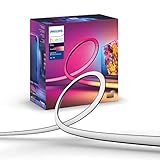
Philips Hue Play Gradient Lightstrip, 65 inch
Who it suits: Modern homes building a media wall inside the Hue ecosystem.
On the line test, this is the reference product in the category. The Play Gradient is a fixed 65 inch strip shaped for the back of a 65 inch television, and along its length colors do not sit in segments. Its listing’s own title concedes what the box omits: it requires the Hue Bridge, and its screen sync requires a sync path — the Hue Play HDMI Sync Box 8K for HDMI sources, or Hue’s Sync TV app on supported televisions. Counted together, the strip, the sync hardware and the Bridge form the one stack in this guide that pushes past the $500 whole-home budget, and Amazon’s own bundle of the Sync Box 8K with this strip still needs the Bridge on top before the system is complete.
Seller choice matters on this listing. Offers vary between sellers, so check the seller as well as the current price on Amazon before buying, and favour a reputable seller over an unfamiliar marketplace offer. Judged as a purchase, it is a commitment to a stack, and the final pick in this guide exists to argue the other side.
- The reference TV gradient: multiple colors flowing along the strip at once, cut to size for its TV class, mounting brackets included.
- A flagship-tier strip sized for its TV class — check the current price on Amazon.
- One control layer for the whole home: with a Bridge it groups, schedules and scenes with every Hue light you own — the strongest disappearance story in smart lighting.
Honest limitation: The strip requires a Hue Bridge, sold separately, and screen sync requires the Sync Box 8K or the Sync TV app, so the full stack costs substantially more than the strip alone; and its Amazon offers vary by seller, so check the current price on Amazon and the seller before buying.
Choose it if your home is, or is deliberately becoming, a Hue home and the media wall is the room that matters most. Skip it if you want the TV wall synced without buying an ecosystem — the Govee TV Backlight 3 Lite below does it in a single kit with nothing else to hide — check the current price on Amazon.
Govee COB LED Strip Light Pro, 9.8 ft
Who it suits: Buyers with one short run that will be looked at directly.
This is the only pick that passes the line test naked. COB construction packs 1,260 LEDs into every meter beneath a continuous phosphor and a soft silicone sleeve, so there are no diodes to see, count, or catch doubled in a glossy countertop — the output is a ribbon, full stop, in direct view and in reflection alike. For its 9.8 ft length it sits in the mid tier of this guide while delivering flagship density — check the current price on Amazon.
The compromises are footage and paperwork. Nine point eight feet is one feature, not a room: outlining a ceiling in this strip would take several kits, which is why the plans below give it the run that gets looked at and hand the perimeter to the bulk footage kit, where cost per foot is far lower. Within its brief.
- The densest light here: 1,260 LEDs per meter of COB under a silicone sleeve — no dots in direct view, none in reflections.
- RGBICW chips give segmented color plus a dedicated warm-white channel; Matter, Alexa, Google and HomeKit with no hub to conceal.
- Flagship density in a short 9.8 ft kit at a mid-tier position in this guide — check the current price on Amazon.
Honest limitation: Only 9.8 ft in the box, so coverage at this density gets expensive fast; and Govee publishes no verifiable lumen or CRI figure, so the quality case rests on density rather than measured output. Confirm the live US listing under this ASIN when you buy — if it cannot be confirmed, the M1 below is the fallback feature run.
Choose it if one short run will be seen every day and must look like a fixture, not a product. Skip it if the run is long or hidden — footage you never see belongs to the 100 ft kit below, where bulk footage is the better use of the budget.

Govee LED Strip Light M1, 16.4 ft
Who it suits: Buyers lighting a concealed feature.
The M1’s modern-home job is disappearance of a different kind: not a visible line, but light with no visible source at all. Its four-in-one RGBICW chips pack 60 LEDs into every meter. The Govee Home app remains the home of its 64-plus scene modes, segmented DIY effects and music sync. The strip is 24V with the adapter included, cuttable at its marked points, and extendable with Govee’s extension kits toward a 32.8 ft maximum per its manual. It sits in the mid tier of this guide for its length — check the current price on Amazon — and the plans below treat it as a single feature-run component within the $500 whole-home budget.
The compromises are the Matter caveat, the footage and the finality of the cut. The footage is the second cost: 16.4 feet covers one cove beautifully and a room perimeter not at all. None of that dethrones it for its brief: beside the COB Pro it is one of the two feature strips in the plan, trading a little surface smoothness for double the footage and the strongest conventional-strip light in the guide.
- Dense, even wash: 60 LEDs per meter of RGBICW chips with a real warm-white channel — no beading in a cove, no false white on pale walls.
- Matter over Wi-Fi joins Apple Home, Alexa, Google and SmartThings; the full scene library lives in the Govee app.
- 24V adapter included; cuttable at the marks, extendable with Govee kits toward 32.8 ft; check the current price on Amazon.
Honest limitation: Over Matter it is a single-color strip — the segmented effects stay in Govee’s app; cut pieces cannot be reconnected; and 16.4 ft is a feature run, not a room.
Choose it if the run is concealed, the wash must be even, and your smart home speaks Matter. Skip it if the strip will be seen directly — that is the COB Pro’s brief — or if footage matters more than finish, which is the 100 ft kit below.

Govee RGBIC LED Strip Lights, 100 ft (2 x 50 ft)
Who it suits: Whole-home planners filling ceiling reveals, shadow gaps and perimeters across two rooms.
Every modern plan needs a component that is allowed to be ordinary, because it will never be looked at. The box, per its manual, holds two rolls of 50 ft of RGBIC strip, one control box and one 24V, 48W mains adapter; run outward from the controller, the two rolls deliver a hundred feet of segmented color. The cost per foot is the lowest in this guide by a wide margin, because the kit pairs bulk footage with a single control box and adapter — check the current price on Amazon. Placed there, its spaced emitters are a fact about a component nobody sees.
The compromises are what happen if it is placed anywhere else, plus physics. The physics is the single adapter: one 48W supply feeding 100 feet is the textbook setup for voltage drop, and reviewers of long runs note far ends running slightly dimmer or shifting color against the end near the controller. Check the current price on Amazon before counting it in a plan; even allowing for movement, its bulk footage keeps it the plan’s value engine.
- The most footage in the guide: 100 ft as two 50 ft rolls — the lowest cost per foot in the guide; check the current price on Amazon.
- One kit, one app: a single control box and 24V/48W adapter run the whole hundred feet, with app, voice and music sync.
- The plan’s engine: fills the reveals of two rooms for less than one flagship feature strip.
Honest limitation: A single adapter feeding 100 ft invites far-end voltage drop; spaced emitters fail both the line test and the off-state test anywhere they can be seen; so check the current price on Amazon before counting it in a plan.
Choose it if your measured concealed runs total 60 to 100 feet. Skip it if any part of the run will be visible — visible footage belongs to the COB Pro or the M1, and no scene mode repairs a dotted line.

PAUTIX Addressable CCT Smart IC COB LED Strip Lights, 32.8 ft
Who it suits: Kitchen, cove and perimeter buyers in design-led homes.
If the color strips in this guide are the evening, this strip is the house itself. It runs 32.8 ft of COB at 560 LEDs per meter — a continuous, dotless line with no diodes to catch in a stone countertop or a lacquered cabinet face — built on addressable IC control, so the white itself can move: chasing, flowing and gradient effects rendered in whites from 2700K to 6500K rather than in colors. It is the only pick here that offers both the fixture look and animated light across a run long enough for a real room, powered by a 24V supply with the maker’s smart controller in the kit and Alexa voice control on top of the app. On the line test it passes at distance and at arm’s length; on the off-state test it passes the way the guide insists visible runs must. Its position in the tier sits exactly where the proposition says it should: above the bulk color reels and well below the Hue flagship’s tier, buying density and white quality across 32.8 feet — check the current price on Amazon. In the plans below this is the kitchen line and the cove — the light the household cooks, works and lives under, while the color strips handle the evenings.
The compromises are the smart layer’s terms and the need to check the live figure on the day. Check the current price on Amazon before finalising any plan total, since movement in any single component moves the plan with it. The strip earns its place on density and white quality rather than on any single figure. The family’s standing caveats carry over — output and CRI figures are the maker’s own, attributed rather than endorsed — and a 32.8 ft run deserves its channel rather than faith in adhesive. Within its terms, nothing else in the guide does what it does.
- Dotless and animated at once: 560 LEDs per meter of addressable COB, with chasing and flowing effects in tunable white, 2700K–6500K.
- A real run: 32.8 ft, with 24V supply, smart controller and Alexa voice control in the kit — check the current price on Amazon.
- The plan’s working light: fixture-grade white for the kitchen and coves a modern household lives under daily.
Honest limitation: Check the current price on Amazon and re-add any plan total on the day; its effects live in PAUTIX’s app rather than in a cross-platform standard, and it is white-only by design.
Choose it if you are lighting a long cove, perimeter or cabinet run in white and want it smart and animated. Skip it if that run needs color — take the M1 or the COB Pro for the feature wall and let this strip do the rooms you live in.
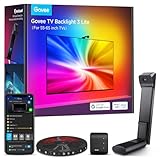
Govee TV Backlight 3 Lite, 11.8 ft (for 55–65 inch TVs)
Who it suits: Media-room buyers outside the Hue ecosystem.
This pick is the disappearance test’s answer to the first pick’s stack. The job is identical — a strip around the back of a 55–65 inch television extending the picture’s colors onto the wall — and the mechanism differs in the way that matters: a camera. Govee’s Envisual system watches the screen through a small camera with fish-eye correction, reads the colors at the edges, and drives the 11.8 ft RGBICW strip — four-in-one beads with a dedicated warm-white emitter alongside the color ones — to match in real time. There is no hub, no bridge, no sync box and no subscription to conceal: the kit — strip, camera, control box and mains adapter — is the whole purchase — check the current price on Amazon. Control is the Govee app and voice assistants, and with the TV off the strip is a perfectly good RGBICW backlight with the full scene library — its off-state, like every backlight’s, is simply invisible behind the panel.
The compromises are the camera’s terms, and they are visible ones. Hue’s stack, for all its cost, reads the actual signal and extends sync to every light in the room, while the 3 Lite syncs its own strip only. The strip is sized to its television class — 11.8 ft fitted for 55–65 inch sets, with the 75–85 inch version a separate, pricier kit — and it is a backlight, not a room light: its white channel makes it pleasant bias lighting, not illumination to read by. For most modern homes this is the TV wall done properly in one box — and the standing rebuke to every plan that begins with a sync box.
- Screen sync with no stack: the camera reads the picture itself, so built-in TV apps sync too — no Bridge, no sync box, nothing extra to hide.
- RGBICW four-in-one beads with a real warm-white emitter; app and voice control; adapter included.
- The whole media wall in one kit, with no Bridge or sync box to add — check the current price on Amazon.
Honest limitation: Camera sync is an interpretation of the screen, not the HDMI signal.
Choose it if you want the TV wall synced this weekend in one kit with one small camera. Skip it if you are building a Hue entertainment area with many lights moving together — that is the Play Gradient’s expensive, genuine specialty.
Comparison Table
| Product | Format & length | Light & control | Modern verdict | Link |
|---|---|---|---|---|
| Philips Hue Play Gradient Lightstrip, 65 in | Diffused gradient strip, 65 in, cut to size | Flowing multicolor gradient; Hue app via Bridge, sync via Sync Box or TV app | Passes line and disappearance inside the room; the stack behind it is the price | Check on Amazon |
| Govee COB LED Strip Light Pro | COB strip, 9.8 ft, 1,260 LEDs/m | Segmented RGBICW color with real white; Matter + Govee app | The cleanest visible line in the guide — passes all three tests without channel | Check on Amazon |
| Govee LED Strip Light M1 | Dense strip, 16.4 ft, 60 LEDs/m | RGBICW with real white channel; Matter + Govee app | Built to disappear: even concealed washes, standards-based control | Check on Amazon |
| Govee RGBIC LED Strip Lights, 100 ft | Standard strip, 2 x 50 ft rolls, one 24V/48W adapter | Segmented RGBIC color; app + Alexa/Google voice, music sync | Passes only where it cannot be seen — a reveal component, not a surface | Check on Amazon |
| PAUTIX Addressable CCT Smart IC COB | COB strip, 32.8 ft, 560 LEDs/m | Addressable tunable white with chasing effects; app + Alexa | Fixture-grade white line; its app-only control layer is the one discipline gap | Check on Amazon |
| Govee TV Backlight 3 Lite | TV strip kit, 11.8 ft for 55–65 in TVs, camera included | RGBICW screen sync by camera; app + voice, no hub | The least machinery of any sync option; the camera is the one visible object | Check on Amazon |
How to Choose an LED Strip Light for a Modern Home
- Assign every run a visibility class before you price anything. Seen directly, seen in reflection, or never seen. The class, not the room, picks the product: direct view demands COB density or a diffused channel; reflection demands nearly as much; a concealed reveal forgives a bulk strip. Most overspending in this category is a visibility class misjudged in one direction or the other.
- Treat channel and diffuser as the fixture, and budget them. The strip is a light engine; the aluminum channel is the housing that makes it architecture. A six-pack of 1 m channel of the Muzata U1SW type is the typical way to buy it. A modern-home plan without a channel line is unfinished.
- Compare value by footage. Check the current price on Amazon for each pick and weigh it against the footage in the box. Neither end of the range is a mistake — the Play Gradient buys gradient sync inside an ecosystem in a short TV-sized strip; the 100 ft kit buys concealed coverage in bulk.
- Decide what each room’s light is for: color, white, or sync. Segmented RGBIC strips make scenes and atmosphere. A modern plan usually contains all three jobs in different rooms.
- Read density before brightness. Lumens in this category are maker figures with no common standard, and most listings publish no total at all. Density is checkable and decides what you see: spaced emitters dot, 60 LEDs per meter blends, COB at 560–1,260 per meter disappears. If the strip or its reflection will be visible, density is the purchase.
- Ask where the white comes from. RGB strips fake white by mixing colors, and a neutral palette exposes it instantly — on white walls, pale stone and skin, mixed white reads blue-grey and cheap. A dedicated white channel (the M1’s and COB Pro’s RGBICW, the TV Backlight’s four-in-one beads) or a white-only COB strip produces whites a modern interior can live under.
- Choose the control layer like infrastructure, because it is. One hub and one app for the whole home (Hue), or a cross-platform standard (Matter), keeps the layer invisible for years. Note the proven caveat: on the M1, Matter carries a single color while its segmented effects stay in Govee’s app — check what your platform actually receives before you standardize on it.
- Count the ecosystem toll before the strip. Hue’s strips are components of a system: the Bridge, sold separately, unlocks the system, and the Play Gradient’s sync needs a sync box or sync app beyond that. Compare the working, hidden system as a whole — check the current price on Amazon for each component — never the strip alone.
- Plan the cut before you buy. The smart strips here trim at printed marks, and the cut-off section is dead — it cannot be reconnected and lit. In a modern room a splice or a dead tail has nowhere to hide, so buy the length that covers the run with the offcut counted as waste, and settle corners and gap jumps with connectors and planning before ordering.
- Confirm the power supply is in the box, and sized for the strip. All six picks include a mains adapter matched to the kit, and every adapter needs a named hiding place. Much of this category — especially bare COB reels — ships without one, and a strip plus a correctly sized 24V supply plus a controller can cost more than the kit that included all three. Price the whole circuit, not the reel.
What $500 Buys a Modern Home — Three Plans, Scored for Discipline
Plan one: five rooms, mixed ecosystems — the most light within the budget, with a discipline bill. Take the COB Pro for the feature wall, the M1 for the desk or headboard run, the 100 ft Govee for two rooms’ concealed perimeters, the PAUTIX 32.8 ft for the kitchen and the TV Backlight 3 Lite for the media wall — check the current price on Amazon for each kit. Add aluminum channel in packs plus a small allowance for clips and connectors, and the combination is designed to land inside the $500 whole-home budget. This is the plan the general guide recommends, and for most homes it is right; a modern home simply pays its one tax openly.
Plan two: the all-Hue living level — the most modern plan here. Spend the budget inside one ecosystem and the disappearance test stops being a per-product question: the Gradient Lightstrip Ambiance (80 inch) for the living-room feature run, the 33 ft Solo lightstrip for the long perimeter, and the Bridge that makes both of them a system, plus channel. Two of the three components are discussed rather than linked, because their current US Amazon listings could not be pinned to this guide’s verification standard; they sit in the upper tier of this category, so check availability and current pricing with the maker or retailer before finalising the total. One specification earns its sentence even in prose: Signify rates the Solo line at 1,700 lumens at 4000K — a maker figure — in every length, so the 33 ft strip is not brighter than the 10 ft; the same rated output is spread over three times the length, and length is what the longer strip buys. Discipline versus breadth — that is the real choice at this tier, and Best Led Strip Lights For Modern Homes Under $300 shows how far the same discipline goes on a smaller budget.
Plan three: the one way to overshoot — a single TV wall. The Play Gradient plus the Sync Box 8K plus the Bridge totals more than the $500 whole-home budget before any other room is lit, and Amazon’s bundle of the sync box with the 65 inch strip still needs the Bridge on top before the system is complete. It is genuinely the best TV sync money buys: pixel-signal analysis, the whole room’s lights in the entertainment area, 4K/120 and 8K support. If the honest answer is that the whole home matters more, the step down is real: the media wall in plan one is a single complete kit.
Will an LED Strip Light Fit a Modern Room?
Physically, strips fit anywhere — that is their appeal — so the real questions are geometric, optical and budgetary. Geometric first: a modern room’s light slots are designed, not improvised; the 100 ft kit’s two rolls both work outward from one control box, so its outlet wants to be near the middle of the project. Households optimizing for a single small space rather than a whole level will find the density-first shortlist in Best Led Strip Lights For Small Rooms Under $500 leans on the same tests at closer range. Renters in design-led buildings face the sharpest version of the adhesive question — removal, deposits, and how much of a $500 plan is portable to the next home — and the apartment-specific picks in Best Led Strip Lights For Apartments Under $500 score exactly those trade-offs. In bedrooms the audit softens and sharpens at once: a cove wash above a headboard is the gentlest light in this guide, but a control box’s standby glow and an app’s brightness floor matter at 2 a.m., which is why the bedroom-specific picks in Best Led Strip Lights For Bedrooms Under $500 are chosen with sleep in the room. And where the same budget is being weighed room by room rather than as one plan, the full shortlist in Best Led Strip Lights Under $500 considers every component on its own terms.
Two installation rules protect both the strips and the architecture. First, prepare the surface like you mean it: clean, dry, fully cured paint or lacquer, and a test section before the full run. Second, respect the cut marks and the voltage: cut only where the strip says to cut, never power a strip from a supply that did not come with it or match its voltage, and keep adapters, control boxes and the TV backlight’s camera out of sinks’ splash zones and steam.
Common Buying Mistakes
- Shopping for a $500 strip. There is not one — even flagship strip kits sit well below the budget on their own — so any listing that seems to be one is a bundle, a marketplace markup, or a different product wearing the name.
- Leaving a bare dotted strip visible on a white wall. It fails the line test when lit and the off-state test all day; visible runs get COB density or channel with a diffuser, or they get moved somewhere they cannot be seen.
- Skipping the channel to save a small line item. In a modern interior the channel is the fixture — it is what makes the installation read as architecture instead of as a product stuck to architecture.
- Overpaying for the Play Gradient through an unfamiliar seller. Check the seller and the current price on Amazon before paying a marked-up figure for a flagship-tier strip.
- Forgetting the Bridge — and the sync box — in the Hue maths. The strip plus Bridge plus sync hardware is a multi-component system; a good one, but not a single-strip purchase.
- Stacking two loud features in one room. A gradient TV wall and a rainbow perimeter in the same space cancel each other; the discipline is one deliberate element per room, and restraint everywhere else.
- Buying an RGB strip as white light. Mixed RGB “white” is a special effect that a neutral palette exposes on sight — kitchens, desks and mirrors need a white channel or a white strip.
- Assuming Matter means full features. On the M1, Matter carries a single color; the gradients and music modes stay in Govee’s app. Check what your platform actually receives before standardizing the house on it.
- Comparing strips by headline price without dividing by footage — buying a short 9.8 ft feature strip when the job needed 60 concealed feet, or a bulk 100 ft kit to light a mirror that needed density.
- Cutting first and reading the manual second. Cut sections cannot be reconnected on these smart strips; in a room with nowhere to hide a dead tail, the offcut is waste, permanently.
Final Recommendation
- Most modern homes: plan two’s discipline at plan one’s coverage is the ideal, and plan one is the practical route — COB Pro, M1, 100 ft Govee, PAUTIX 32.8 ft and TV Backlight 3 Lite, with channel in the budget — check the current price on Amazon for each kit.
- One ecosystem, invisibly run: the all-Hue plan — Gradient Ambiance, Solo 33 ft and Bridge, before channel.
- Hue households, media wall first: Philips Hue Play Gradient Lightstrip, 65 inch — with the Bridge and sync components counted — check the current price on Amazon.
- Best-looking single visible run: Govee COB LED Strip Light Pro, 9.8 ft.
- Best concealed feature run: Govee LED Strip Light M1, 16.4 ft.
- Kitchens and coves: PAUTIX Addressable CCT Smart IC COB Strip, 32.8 ft.
- The TV wall without the stack: Govee TV Backlight 3 Lite, 11.8 ft.
Our top two frame the decision this tier actually offers a modern home, which is not which strip to buy but what kind of system to live inside. Between them sit the honest specialists: the COB Pro’s seamless ribbon, the M1’s even concealed wash, the PAUTIX’s animated white. None of the strips above pretends to cost $500, to be verified in brightness, or to be waterproof. Decide the rooms first, classify every run by whether it will be seen, weigh the current price on Amazon against the footage in the box, count every hub before the strip that needs it — and mount it like architecture, because in a modern home that is what it is.
Frequently Asked Questions
Is there really no LED strip light that costs $500?
Not as a single strip kit from a major maker, as far as this guide’s research could verify. Even the flagship kits at the top of the category — Philips Hue’s Play Gradient and Gradient Ambiance lightstrips, Govee’s COB Strip Light 2 Pro (16.4 ft, sold through Govee’s store) and Hue’s 33 ft Solo lightstrip — sit well below the budget on their own. Marketplace offers from individual sellers can run higher than maker pricing, but those are seller markups on flagship-tier strips, not $500 products. The only ways to genuinely spend $500 are a whole-home plan across several kits, or an ecosystem stack like Hue’s strip plus Bridge plus Sync Box 8K, where most of the spend buys hardware that is not a strip at all.
Why does the control system matter so much in a modern home?
Because in these interiors the lighting is the decor, and the control layer is what you actually live with daily. Neither answer is wrong; the mistake is choosing the mixed plan’s coverage while expecting the single system’s invisibility.
Do I really need aluminum channel in a modern interior?
For any run you can see, yes — it is the difference between a product and a fixture. Budget for a six-pack of 1 m channel of the Muzata U1SW type for each visible run. The exceptions are runs that are structurally invisible.
Does the Philips Hue Play Gradient lightstrip need a sync box?
For screen sync, yes — or Hue’s Sync TV app on a supported television. The strip itself requires a Hue Bridge to join your Hue system at all; with a Bridge alone it works as a gradient strip in the Hue app, with scenes and routines, but it does not follow the picture. The Sync Box 8K analyzes HDMI sources — consoles, streamers, players — and cannot see apps running inside the TV itself, which is the camera-based Govee backlight’s structural advantage: its camera reads the screen, so everything the TV displays syncs, in a single complete kit — check the current price on Amazon.
Can I cut these strips to fit, and rejoin the pieces?
You can cut the smart strips here at their printed cut marks — and on them, the piece you cut off cannot be reconnected and lit again. The Play Gradient is sized and cut for its television class rather than tailored freely, and the TV Backlight 3 Lite is a fitted kit for its TV size — buy the size that matches your set. If a layout needs a corner turn or a gap jump, settle the connectors before ordering rather than improvising with a cut piece that will never light.
Are LED strip lights bright enough to light a whole modern room?
As the room’s designed light, yes. The honest caveat is measurement: most makers publish no verifiable total output, and the figures that exist are maker ratings — Signify, for instance, rates its entire Solo line at 1,700 lumens at 4000K in every length, which tells you a 33 ft strip spreads the same rated output three times thinner than a 10 ft one. Judge a room plan by density, coverage and the white quality of the strips doing the work, and keep a layered plan.
What is the best way to spend $500 on strip lights in a modern home?
Decide first whether you are buying coverage or discipline. Coverage: the five-kit plan — one dense feature strip for the wall you look at (the COB Pro or M1), one bulk color kit for concealed perimeters (the 100 ft Govee), one white architectural strip for the kitchen or cove (the PAUTIX 32.8 ft), one TV backlight (the Govee 3 Lite), and channel and mounting hardware — arranged to land inside the $500 budget across five spaces; check the current price on Amazon for each kit before ordering. Discipline: the all-Hue living level, one ecosystem throughout, also planned inside the same budget before channel. The third option, one Hue sync stack on one TV wall, is a legitimate home-theater purchase — chosen knowingly, not by accident — even though it pushes past the whole-home budget on a single room.