Where to buy
Check the latest price, availability and delivery on Amazon. Orders are placed on Amazon. We may earn a commission from qualifying purchases.
- Best overall for modern homes: Philips Hue Solo Lightstrip Base Kit, 33 ft, White and Color Ambiance — Check on Amazon
- Govee COB LED Strip Light Pro, 16.4 ft, RGBICW with Matter — Check on Amazon
- Philips Hue Play Gradient Lightstrip, 65-inch TV — Check on Amazon
- Govee RGBWWIC Strip Light 2 Pro with Matter, 16.4 ft — Check on Amazon
See 2 more Amazon options
- Govee LED Strip Light M1, 16.4 ft, RGBICW with Matter — Check on Amazon
- PAUTIX Addressable CCT Smart IC COB LED Strip Lights, 32.8 ft, 2700K–6500K, Alexa Voice Control — Check on Amazon
Read the full guide ↓
Disclosure: As an Amazon Associate, dailyhomedecorating.com earns from qualifying purchases. Links to Amazon on this page are affiliate links; they cost you nothing extra. Listing details such as price and availability change often, so check the current Amazon listing before you buy.
A modern interior judges light more harshly than any other style, because in a modern interior the light is often the decoration. That is why this guide scores every pick against three tests. The line test: does the light read as one continuous line, in direct view and in reflections? The concealment test: can the wires, adapters, control boxes and control layer disappear, so the room shows light and nothing else? The off-state test: judged as furniture in daylight, switched off, does the installation still look deliberate? Keep those tests in mind, because they reorder the usual priorities: at this budget, the aluminum channel and diffuser you mount the strip in are closer to being the real fixture than the strip is, and any honest $300 plan has to leave room for them.
Now the finding that shapes the whole budget, stated before any product names: there is effectively no general-purpose LED strip light on Amazon that fills the $200 to $300 range on its own. We swept the flagship lines of every major brand looking for one, and the verified ceiling of the ordinary market sits lower than this tier. The only family positioned above that ceiling is Hue’s Play Gradient line for televisions — and as its review below shows in full, that strip cannot perform its headline job inside this budget at all once its required hardware is counted. Which means $300, in a modern home, is not a strip. It is a system budget: a strip plus its hub, its extensions, its second room, or the channel that turns it into architecture. Every pick below is assessed as the system it actually is, and the guide’s central section sets out five complete $300 plans. Check price on Amazon before you order, because listing prices in this category move often.
Three honesty notes before the picks. First, brightness: this category has no common measurement standard behind its lumen figures, and most makers publish no total at all, so this guide judges brightness by density, direction and footage, and attributes every lumen figure to its maker. Second, density is the specification the line test actually measures: spaced emitters read as individual dots up close and break into beads in glossy reflections; the 60 LEDs per meter of the premium conventional strips blend far better; COB strips, with hundreds to over a thousand chips per meter under a continuous phosphor, erase the dots entirely. Third, control is a ladder: a Bluetooth app works across one room; Wi-Fi and Matter widen the reach; and Hue’s full feature set lives behind a Bridge that is a separate purchase. The reviews mark exactly where that control line falls for each pick.
Quick Picks
Short on time? Each row names a buyer type and the strip that suits it. Check the current price on Amazon before deciding.
| Buyer type | Pick | Why it stands out | Link |
|---|---|---|---|
| Best overall for modern homes | Philips Hue Solo Lightstrip, 33 ft | One unbroken, single-color line in the longest format here — and with a Bridge, bought separately, the light disappears into whole-house scenes; check price on Amazon for the complete system | Check on Amazon |
| Best visible line | Govee COB LED Strip Light Pro, 16.4 ft | 1,260 LEDs per meter of RGBICW COB — the only pick that passes the line test in plain sight, no cove or channel required; check price on Amazon | Check on Amazon |
| Best for the media wall | Philips Hue Play Gradient Lightstrip, 65-inch | Seven blended color zones shaped for a 65-inch TV — the one sanctioned spectacle in a modern room, but screen sync needs a Bridge and a Sync Box, assessed honestly in its review; check price on Amazon | Check on Amazon |
| Best build-out platform | Govee Strip Light 2 Pro, 16.4 ft | 60 LEDs per meter of RGBWWIC with Matter, positioned so this budget buys the run, its extensions and its channel, or two rooms of the same light language; check price on Amazon | Check on Amazon |
| Best whole-house allocation | Govee LED Strip Light M1, 16.4 ft | Govee’s proven Matter flagship — two kits repeat one disciplined light language across two rooms inside this budget; check price on Amazon | Check on Amazon |
| Best white architecture | PAUTIX Addressable CCT Smart IC COB Strip, 32.8 ft | Thirty-two feet of dotless, animated tunable white — two runs can wrap a kitchen perimeter and a hallway cove inside this budget; check price on Amazon | Check on Amazon |
How These Picks Were Chosen
The first filter was the budget, applied the way this tier forces it to be applied. Every strip below has a real Amazon listing, but the test each pick had to pass was systemic: either it is one of the most premium single strips that genuinely exists (the Hue Solo 33 ft, the Govee COB Pro, the Hue Play Gradient), or it is a premium strip whose honest role at this budget is as the anchor of a $300 plan — extended, doubled across two rooms, or paired with the hub and hardware that complete it (the Govee Strip Light 2 Pro, the Govee M1, the PAUTIX 32.8 ft). Because prices change constantly, this guide prints no fixed prices; check the current price on Amazon, and judge each plan by its structure — what is included, what is bought separately, and what is left for channel and mounting.
The second filter was this guide’s lens: the three tests. For the line test we compared density and diffusion: conventional strips at 60 LEDs per meter blend well behind a lip or inside channel, while COB removes the dots altogether. For the concealment test we traced every wire, adapter and control box and asked where it would live in a room with open sightlines. For the off-state test we considered the installation as furniture: an exposed strip is a gray-green ribbon on the wall all day, which is why this guide treats aluminum channel with a diffuser — a modest share of the leftover budget — as the visible fixture, not an accessory. Matter and the Hue Bridge earn their place in these plans because they fold a strip into that single layer; a strip whose best effects require opening a vendor app every evening fails the discipline even when its light is beautiful, and the reviews mark exactly where that line falls for each pick.
We did not use these strips ourselves. We read the maker listings, manuals, datasheets and specification pages, and compared the things that decide whether a strip works in a real room: the footage in the box and the coverage it implies — which at this tier ranges from a single short television run to more than thirty feet of room strip, the widest coverage spread in this entire guide series; whether white is produced by a dedicated channel or mixed from color emitters; the control path, from Bluetooth to Wi-Fi, Matter and bridged ecosystems; and whether the strip can be cut at marked points — with the universal caveat on the smart strips here that a cut-off section cannot be reconnected and lit again. Adhesive got the same honesty pass: peel-and-stick backing is the weakest part of every strip here, owner feedback faults Hue strips’ adhesive by name, and at this budget mounting clips or channel are treated as part of the purchase.
The 6 Best LED Strip Lights for Modern Homes Under $300
Philips Hue Solo Lightstrip Base Kit, 33 ft
Who it suits: Modern households building a whole-home light system — anyone who wants one long, disciplined line of light that answers to the same scenes as the rest of the house, with the budget to finally buy the Bridge in the same order and stop treating the ecosystem toll as a warning.
The Solo 33 ft is the pick this tier exists for, and its review has to start with a configuration warning: this recommendation is for the 33 ft size — select it on the listing before ordering. The same listing family also sells shorter kits; those are fine strips that belong to lower-budget guides. Check price on Amazon for the 33 ft configuration specifically. What that configuration buys is the longest one-piece run in this guide: ten meters of RGBWW strip in a silicone sleeve that softens the emitters into a continuous wash, rated by Signify at 1,700 lumens at 4000K (1,500 at 2700K) — a first-party figure, reported here as the maker’s rating like every other number in this category. The strip trims at marked intervals of about 13 inches, and runs over Bluetooth in the Hue app out of the box — dimming, color, scenes, within range of your phone. In a cove, under a cabinet lip or inside channel, that sleeve produces the calm, even wash modern rooms ask for.
Then the Bridge, and this is where the modern-homes lens reverses the usual verdict. In every lower-budget guide in this series, the Bridge appears as a toll: a separate purchase standing between the strip and its full feature set. That is still true in structure — the strip alone, on Bluetooth, is a single-room product, while the Bridge unlocks routines, grouping, out-of-home control and integration with the rest of a Hue home. What changes at this tier is that the budget can absorb both purchases together, with room left for channel — the first budget in this series that can buy the invisible version outright: one control layer for the whole house, and light that behaves like part of the building rather than a gadget attached to it.
The compromises are the format, the finality of cutting, and the adhesive. The format first: one color at a time means no segmented effects, ever — buyers who want light that moves along the line should take either Govee below. Cutting second: the Solo is not extendable — Hue’s own materials are explicit — and a trimmed-off section cannot be reconnected, so 33 ft is a ceiling as well as a length; a project needing a longer continuous run needs two kits or a different strip. Adhesive third: plan on channel or clips as part of the installation. Judged as a system — the only honest way to judge anything here — it is the most complete purchase on the page, and the one whose control disappears most completely.
- The longest premium room strip: 33 ft of RGBWW in a diffusing silicone sleeve, maker-rated at 1,700 lumens — the most single-run coverage in this guide.
- One color, whole length, perfectly matched — the disciplined light a modern interior actually wants, with produced (not mixed) whites.
- The Bridge fits the budget: strip plus Bridge, bought together, folds the strip into whole-house scenes, routines and Matter — check price on Amazon for both items before ordering.
- Cuttable at roughly 13-inch marks, 24V adapter included, backed by a 2-year warranty and the deepest support ecosystem in smart lighting.
Honest limitation: One color along its whole length — no segments or gradients; it cannot be extended, cut sections cannot be reconnected, and its adhesive is the line’s most-complained-about part, so plan on channel or clips. Order the 33 ft configuration specifically; the shorter sizes on the same listing family are different purchases.
Choose it if you want one long, consistent run that disappears into your home’s scene layer inside one budget. Skip it if you want effects along the strip — the Govee COB Pro and Strip Light 2 Pro below do segmented color the Solo refuses to.

Govee COB LED Strip Light Pro, 16.4 ft
Who it suits: Design-first buyers with one short, visible run — a floating shelf line, a mirror edge, a media console backdrop — who need the light itself to survive direct view in a room with nowhere to hide it.
Every other pick in this guide passes the line test with help: a cove, a channel, a diffuser sleeve. This one passes it naked. COB construction packs 1,260 LEDs per meter under a continuous phosphor layer, so there are no individual diodes to see and no beaded reflections to catch on glass tabletops, stone counters or lacquered doors. The light is RGBICW — segmented color effects, with a dedicated warm-white channel — and control runs through Matter over Wi-Fi, the Govee app and voice assistants. In a modern interior, where the run so often is the visible feature, that is the whole argument. Check the current price on Amazon before ordering. Stated plainly, its positioning is premium for its footage: the fewest feet among the room strips here, the finest line.
The compromises are flexibility, finality, and one honest tension with this guide’s own lens. Flexibility first: unlike the M1 and the Strip Light 2 Pro, this line has no extension path — 16.4 ft is what there is, so a run that measures longer is not this strip’s job no matter how good the light is. Finality second: it trims at its cut marks, and as with every smart strip here, the cut-off piece cannot be reconnected and lit — measure twice, because an offcut from a premium strip is waste you cannot recover. The tension third: its richest effects live in Govee’s app, and over Matter it behaves as a single-color strip. Within its brief — one short run, in direct view, that must look built into the room — nothing else here touches it.
- Truly dotless color: COB construction at 1,260 LEDs per meter under a continuous phosphor — no diodes to hide, and no beaded reflections on glass or stone.
- RGBICW chips with a real warm-white channel, segmented effects, and Matter over Wi-Fi alongside the Govee app and voice control.
- Complete kit: strip, control box and 24V adapter in the box; cuttable at the marks.
Honest limitation: Sixteen feet is the whole run — no extensions exist for this line; cut pieces cannot be reconnected; and over Matter it is a single-color strip, with the segmented effects reserved to Govee’s app. Check price on Amazon before ordering.
Choose it if one visible run deserves the finest line Govee makes. Skip it if your run measures past 16 ft — the Strip Light 2 Pro below extends, and the Solo above starts at 33.

Philips Hue Play Gradient Lightstrip, 65-inch
Who it suits: Television and gaming-room buyers who already own a Hue Bridge and a Play HDMI Sync Box — or who are told, in this review and in plain terms, exactly what else they must buy before this strip does the thing it is famous for.
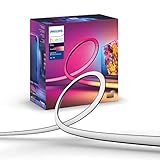
Every modern room is allowed one loud element, and in most modern homes that element is the media wall. This strip is shaped for it: a diffuser-sleeved gradient strip, sized and bracketed for a 65-inch television, that washes the wall behind the screen in seven simultaneous blended colors. As static ambient light it is superb — smooth, rich and free of visible dots — and it carries the full Hue app and voice ecosystem once on a Bridge. It is the only strip family here positioned as a genuine flagship television product. Check price on Amazon for the strip itself — and then hold that thought, because the next paragraph is the review.
The compromise is not a limitation of the strip; it is the cost of its purpose, and it is disqualifying for anyone starting from zero. Screen sync — the feature in every photograph of this product — requires a Hue Bridge and a Play HDMI Sync Box, both sold separately. The Sync Box is a substantial second purchase in its own right, of the same order as the strip itself. Add the boxes honestly and the working system lands well beyond this budget: within $300, the Play Gradient cannot do the thing it is sold for. The strip alone buys beautiful static gradients and app-controlled color — a promise the budget cannot keep. Buyers who own neither box should read this pick as the strip plus two boxes, and compare it against the complete systems elsewhere on this page.
- The best TV light there is: seven simultaneous blended colors from a diffuser-sleeved strip shaped and bracketed for a 65-inch TV.
- A flagship television strip in Hue’s premium Play Gradient line — check the current price on Amazon.
- Power supply and mounting brackets in the box; full Hue app and voice control once it is on a Bridge.
Honest limitation: Screen sync — its headline feature — requires a Hue Bridge and a Play HDMI Sync Box, both sold separately; the complete working system costs well over this budget. It also lights only the top and sides of the TV, not the bottom edge.
Choose it if you already own the Bridge and Sync Box, or are budgeting for them separately. Skip it if $300 is your whole TV-lighting budget — the Solo system above is complete and working within it.
Govee Strip Light 2 Pro, 16.4 ft
Who it suits: Phased renovators and builders-out — buyers whose modern interior is a project in stages, who want near-flagship light now and a run that can grow with the room, without paying flagship per-kit positioning.
The Strip Light 2 Pro is Govee’s current mainstream flagship in conventional form: RGBWWIC chips at 60 LEDs per meter — double the density of standard strips, with a dedicated white channel alongside the color emitters — segmented effects, the full Govee Home scene and music library, DreamView sync with other Govee lights, and Matter over Wi-Fi for cross-platform households. Check price on Amazon for the kit. Its positioning is precisely why it belongs in a $300 guide: it is the pick the budget can build with. The 16.4 ft base splices with Govee’s extension sections, sold separately, up to a 32.8 ft maximum run, so a complete long build — base, extensions and the channel that turns it into a fixture — fits comfortably inside this budget. Or the same budget buys two complete kits for two rooms, repeating one light language across the home. Either way, what $300 buys here is a project finished, not a strip admired — and the light is a small step down from the COB Pro’s line and a large step up from everything in the under-$75 guide.
The compromises are the familiar Govee ones, plus the arithmetic of building. The emitters are spaced, not continuous: behind a lip or inside channel the line blends beautifully, but in direct view the diodes still register where the COB Pro’s do not — that difference is what the COB Pro’s premium positioning charges for. Extensions are proprietary and capped, and the richest effects live in Govee’s app. Judged as a platform, it is the most flexible purchase in the guide.
- Near-flagship light: 60 LEDs per meter of RGBWWIC with a real white channel, segmented effects and Matter — check price on Amazon for the 16.4 ft kit.
- Built to build: extends with maker sections toward a 32.8 ft maximum, or doubles as two complete rooms of matching light inside this budget.
- DreamView sync with other Govee lights, the full scene and music library, and voice control in the kit.
Honest limitation: Segmented effects live in Govee’s app — Matter sees a single-color strip; extensions are proprietary and capped at 32.8 ft; and at arm’s length its emitters still bead where the COB Pro’s do not.
Choose it if your $300 is a project — a long run, two rooms, a growing Govee house. Skip it if one short visible run is the whole job and it must be flawless — that is the COB Pro above.

Govee LED Strip Light M1, 16.4 ft
Who it suits: Whole-house buyers and proven-product shoppers — anyone whose honest answer to “what should $300 of strip lighting look like in a modern home?” is the same disciplined light in two rooms, finished, rather than one spectacular one.
The M1 earned its place in the under-$75 guide as that tier’s quality pick, and it returns here in a different role: as the unit of the clearest allocation in this guide. Check the current price on Amazon — this model’s listing price moves often, so judge the two-kit plan on the live figure on the day you shop. Two M1 kits put two rooms in the same light language: same density, same whites, same color behavior, each independently controlled, comfortably inside this budget, with room left for the channel that makes both installs read as architecture. That is why the M1 is one of the most honest answers a $300 guide can give a modern home: the budget was never really about one strip, and consistency across rooms is worth more than a flagship in one. The strip itself is Govee’s proven Matter flagship of its generation — 60 LEDs per meter of RGBICW with a dedicated white channel, Matter over Wi-Fi, and an extendable format.
The compromises carry over from its under-$75 review, and this guide repeats rather than revises them. Over Matter it is a single-color strip; the segmented effects that justify the density live in Govee’s app. Cut pieces cannot be reconnected. Its per-kit positioning sits at the premium end for its footage, so buyers planning a single long build-out should compare it carefully against the Strip Light 2 Pro above, which was designed for exactly that growth pattern. None of that changes the verdict for its brief: it is the proven flagship, positioned so that $300 buys it twice.
- The proven flagship: 60 LEDs per meter of RGBICW with a real white channel, Matter, and the deepest testing coverage in its class.
- The allocation pick: two kits repeat one finished light language across two rooms inside this budget — check price on Amazon for the current kit price.
- Extendable with Govee kits toward 32.8 ft per run; 24V adapter included; cuttable at the marks.
Honest limitation: Over Matter it is a single-color strip — the segmented effects live only in Govee’s app; cut pieces cannot be reconnected; and for a single long build-out, the Strip Light 2 Pro above is the more purpose-built platform.
Choose it if two rooms of proven, matching light beat one room of ultimate light. Skip it if the run must be dotless in direct view — the COB Pro is the same company’s answer to that, at a higher per-kit positioning.

PAUTIX Addressable CCT Smart IC COB LED Strip Lights, 32.8 ft
Who it suits: White-light modernists with long runs — a full kitchen perimeter, a hallway cove, a ceiling reveal — who want the dotless COB look, smart control, and a $300 budget spent on coverage: two complete runs, installed in channel, with room to spare.
Take the white-light argument of the under-$75 guide and give it this tier’s scope — and this guide’s lens, because the PAUTIX is arguably the most modern pick here in the strictest sense: it refuses color entirely. The strip is addressable COB at 560 LEDs per meter, producing tunable white from 2700K to 6500K with chasing and flowing effects that travel along the run, all without a single visible diode. It is powered by a 24V supply with the maker’s smart controller in the kit and Alexa voice control on top of the app. Check the current price on Amazon before ordering; this model’s pricing has historically been among the most variable in the guide, so price any plan on the live listing rather than from memory. Its positioning is the coverage end of this tier: the longest footage per kit here, at the most accessible end of the guide’s premium range. Which is the point of including it at $300: two of these runs fit inside the budget with substantial room left for the aluminum channel that is this strip’s natural home. No other pick turns $300 into that much finished, fixture-grade light. For coves, reveals and perimeters, it remains the most complete white answer at any tier we have covered.
The compromises are platform size and the white-only brief. The effects and voice control run through PAUTIX’s own controller and app, a smaller ecosystem than Govee’s or Hue’s — so its control layer is the least invisible here, a real cost under this guide’s lens. Maker output figures are attributed rather than independently verified. Within its terms — dotless, animated, long, white, positioned to be bought twice — nothing else in the tier does what it does.
- Dotless and animated at once: 560 LEDs per meter of addressable COB, with chasing and flowing effects in tunable white, 2700K–6500K.
- The coverage pick: 32.8 ft per kit — two complete runs fit inside this budget with room for channel; check price on Amazon.
- 24V supply, smart controller and Alexa voice control in the kit; the cove-and-perimeter specialist.
Honest limitation: White-only by design; effects live in PAUTIX’s app rather than in the voice assistants, which handle basics only; and its listing price varies, so confirm the live price before planning a two-run purchase.
Choose it if you are lighting long coves, perimeters or cabinet runs in white and want them smart, animated and bought twice over. Skip it if you want any color at all — every other pick in this guide does color; this one refuses to.
Comparison Table
| Product | Format & length | Light & control | Modern verdict | Link |
|---|---|---|---|---|
| Philips Hue Solo Lightstrip, 33 ft | Diffused strip, 33 ft, not extendable | Single-color RGBWW; Bluetooth app, full features via Bridge | The invisible system — one disciplined line folded into whole-house scenes | Check on Amazon |
| Govee COB LED Strip Light Pro | COB strip, 16.4 ft, 1,260 LEDs/m | Segmented RGBICW with real white channel; Matter + Govee app | Passes the line test in plain sight — the visible run that needs no cove | Check on Amazon |
| Philips Hue Play Gradient Lightstrip | Shaped TV strip, 65-inch size | Seven blended zones; sync requires Bridge + Sync Box | The one sanctioned spectacle — complete only in homes that already own the sync hardware | Check on Amazon |
| Govee Strip Light 2 Pro | Standard strip, 16.4 ft, 60 LEDs/m | Segmented RGBWWIC; Matter + Govee app, extendable to 32.8 ft | The phased-renovation platform — grows run by run, room by room | Check on Amazon |
| Govee LED Strip Light M1 | Dense strip, 16.4 ft, 60 LEDs/m | RGBICW with real white channel; Matter + Govee app | One light language, two rooms — consistency bought by the kit | Check on Amazon |
| PAUTIX Addressable CCT Smart IC COB | COB strip, 32.8 ft, 560 LEDs/m | Addressable tunable white with chasing effects; app + Alexa | White architecture — coves and perimeters as part of the building, not decor | Check on Amazon |
How to Choose an LED Strip Light for a Modern Home Under $300
- Start from the finding: you are buying a system, not a strip. No general-purpose single strip fills the $200 to $300 range on Amazon — the ordinary market’s premium ceiling sits below this tier. Decide first which system your $300 is: strip plus hub, base plus extensions, two rooms in one light language, or strip plus the channel that makes it a fixture. Every checklist item below serves that decision. Check price on Amazon for each component before committing, because the live total is the only total that counts.
- Run the line test before you read a single lumen figure. Lumens here are maker figures with no common standard. Ask instead: what is the density, is there a diffuser, and will the run be seen directly, reflected, or only as glow?
- Budget the channel as the fixture, because it is. A meaningful share of this budget belongs to channel and clips; a plan that spends all $300 on strip has bought a gadget, not an installation.
- Measure the run, then compare coverage honestly. Length is the first specification and the one listings make hardest to compare. Tape-measure the actual path — including drops to the outlet — and compare picks by coverage and light quality, not headline positioning.
- Decide what the light is for: color, white, or both. The Solo makes one flawless color or white at a time, everywhere at once. The Govee color strips segment their effects along the run. The PAUTIX refuses color and perfects white. A strip bought for the wrong job is wrong at any price, and at $300 the wrong job is an expensive one.
- Ask where the white comes from. RGB strips fake white by mixing colors, and it shows on skin, food and paint. Picks with a dedicated white channel — RGBWW, RGBWWIC, RGBICW, or a tunable-white COB — produce white directly, and in a modern interior that distinction decides more evenings than any effect library.
- Score the control layer by how invisible it is. A bridged scene system disappears into switches, routines and voice; an app-first strip asks for your phone every time. Matter narrows that gap for basic control, but on the Govee flagships here it carries a single color only.
- Do the true-cost check for ecosystems — this is the tier where it decides. The Solo becomes a complete system only with its Bridge, bought separately; the Play Gradient needs that same Bridge plus a Sync Box, which takes its working system outside this budget entirely. The newer Bridge Pro, a premium hub above the standard Bridge, would consume a disproportionate share of this budget — the standard Bridge remains the value route. Compare complete systems, not strips alone.
- Plan the cut and the extension path before you buy. Every pick here cuts at marked points, and on every pick the cut-off piece cannot be reconnected. Some lines extend with maker sections, some cannot extend at all. Buy the configuration that covers the run as designed, not the one that requires rejoining.
- Apply the off-state test to the plan, not just the product. Picture the installation at noon, switched off: ribbon, adapter, control box, cable drops. If any element reads as clutter, the plan needs channel, clips or a different route.
What $300 Actually Buys a Modern Home: Five Plans
Because no single strip fills this budget, the honest way to shop it is by plan. Here are the five this guide’s research supports, scored against the three tests. Each plan is described by its structure; confirm every total against live listings on the day, and check price on Amazon for each component.
Plan 1 — The invisible system. The Solo 33 ft, plus a Hue Bridge bought in the same order. What you own: 33 feet of the best-matched color in the business, fully unlocked — routines, grouping, out-of-home control — disappearing into the same scenes as the rest of the house, with budget left for the aluminum channel the strip’s adhesive reputation demands. This is the plan this guide recommends to most modern homes; every lower budget had to choose between the strip and the hub.
Plan 2 — One light language, two rooms. Two M1 kits, one per room. What you own: the same proven light repeated across two spaces, each independently controlled, with budget left for channel in both rooms. The Strip Light 2 Pro variant — two of its kits instead — lands in the same spirit with a newer, more extendable strip. For homes where two rooms genuinely need light, this beats one flagship every time.
Plan 3 — The seen line and the unseen line. The COB Pro for the one run that will be looked at directly — the shelf line, the mirror, the console wall — plus one PAUTIX 32.8 ft run for the cove or perimeter that will only ever be seen as light. What you own: the smoothest color line Govee makes where eyes go, and a long run of dotless animated white where they do not, with budget left for channel and clips for both. This plan spends by visibility — flagship positioning where the line test is hardest, coverage positioning where only the glow registers.
Plan 4 — The white house. Two PAUTIX 32.8 ft runs. What you own: a whole kitchen perimeter and a hallway cove, or one very large room wrapped, in fixture-grade white — the most disciplined plan here, and the one with the largest leftover: it spends well under the budget because white light, done well, simply does not need $300. The plan survives this model’s variable pricing comfortably. Spend the remainder on channel without guilt; here the channel genuinely is most of the fixture.
Plan 5 — The TV trap (still not working). The Play Gradient 65-inch, plus the Bridge — and the strip still cannot sync to the screen, because the Sync Box is a further substantial purchase of the same order as the strip. This plan is printed as a warning, not a recommendation: it is the only way to spend this budget on strip lights and not get the thing you paid for. If the Bridge and Sync Box already live in your home, strike this paragraph — for you, the strip alone is Plan 1’s equal, and the media wall is the one place this guide’s discipline happily steps aside.
Two further products belong in this section precisely because they are not picks. The first is the strip this budget seems designed for: Philips Hue’s Gradient lightstrip — 80 inches of blended, multi-color gradient light, extendable with 40-inch sections toward 33 feet, maker-rated at up to 1,800 lumens, positioned at the very top of the ordinary room-strip market. Built out with its extensions, it forms a genuine $300 system and the natural best-overall of this tier. It appears in prose only because its current US listing could not be pinned to this guide’s verification standard. The second is Govee’s COB Strip Light 2 Pro — 1,344 LEDs per meter, the densest strip in this series, with maker figures of 540 lumens per meter and CRI 92+, positioned as a premium flagship in Govee’s own store range — prose-only here for the same reason.
Will an LED Strip Light Fit Your Room?
Physically, strips fit anywhere — that is their entire appeal — so at this budget the real questions are electrical, optical and domestic. Electrical first: every run has to start within reach of an outlet, because the adapter’s lead is short and the strip cannot be powered from its far end. Optical second: a strip hidden in a cove or behind a cabinet lip can be a spaced-emitter model and still look like a line; a strip in direct view — along a stair stringer, under open shelving, around a mirror — shows every diode it owns, and modern interiors add a second audience: the reflection. In compact modern rooms the distances shrink and the diodes get closer to the eye — the dedicated shortlist in Best Led Strip Lights For Small Rooms Under $300 leans even harder on density and on the COB picks above. In bedrooms the questions soften and sharpen at once: light washes a ceiling beautifully from a headboard cove, but a control box’s standby glow and an app’s brightness floor matter at 2 a.m. — the bedroom-specific picks in Best Led Strip Lights For Bedrooms Under $300 are chosen with sleep in the room. Renters should read the plans with a deposit in mind: channel mounts with screws, adhesive removes with heat and patience — the apartment trade-offs are scored in Best Led Strip Lights For Apartments Under $300.
Two installation rules protect both the strip and the household. First, prepare the surface: clean, dry, fully cured paint, and a test section before the full run — most “defective adhesive” stories are unprepared-surface stories, and the rest are gravity stories the channel you can finally afford would have solved. Second, respect the cut marks and the voltage: cut only where the strip says to cut, never power a strip from a supply that did not come with it or match its 24V rating, and keep adapters and control boxes out of sinks’ splash zones and steam — none of the six picks here is waterproof, and the kitchen picks belong under cabinets, not inside showers.
Common Buying Mistakes
- Shopping for a $300 strip. There isn’t one — there are premium flagships below this tier and the systems built around them.
- Spending the whole budget on the strip and nothing on the install.
- Comparing strips by headline positioning without dividing by footage — paying flagship money for a few feet of TV strip when the same budget buys a long room run, or the reverse, without knowing which you did.
- Believing the biggest lumen claim.
- Judging a strip only on the wall it lights.
- Buying the Play Gradient as a complete purchase. Its sync needs a Bridge and a Sync Box; the strip alone is a down payment on the system, and within $300 the complete system does not exist.
- Forgetting the Bridge in the Hue math — in either direction. A Solo bought with its Bridge is a complete system that fits this budget; judging either item alone misleads.
- Assuming Matter means full features — or full invisibility. On both Govee flagships, Matter carries a single color; the gradients and music modes stay in Govee’s app.
- Ordering the wrong Solo. The listing family sells 10 ft, 16 ft and 33 ft kits; this guide’s pick is the 33 ft, and the smaller sizes belong to lower-budget guides.
- Cutting first and reading the manual second. Cut sections cannot be reconnected on these strips; the offcut of a flagship strip is expensive waste, permanently.
- Trusting the adhesive on textured paint, warm surfaces or downward runs.
Final Recommendation
- Most modern homes: Philips Hue Solo Lightstrip, 33 ft — bought with its Bridge, as Plan 1.
- Finest line for a visible run: Govee COB LED Strip Light Pro, 16.4 ft.
- Media walls, for existing Hue sync homes: Philips Hue Play Gradient Lightstrip, 65-inch.
- Long builds and growing systems: Govee Strip Light 2 Pro, 16.4 ft.
- Two rooms, one light language: Govee LED Strip Light M1, 16.4 ft — bought twice.
- White architecture, maximum coverage: PAUTIX Addressable CCT Smart IC COB Strip, 32.8 ft — bought twice.
Our top two frame the tier’s real decision, which in a modern home is not which strip but which kind of invisibility. The Solo-plus-Bridge plan is the disappearance answer: the longest premium run in the guide, folded into the house’s scenes, installed in channel, complete and working inside this budget all-in — the first budget in this series at which a Hue purchase can be made without an asterisk. The two-M1 plan is the consistency answer: the same proven light in two rooms — app-dependent for its effects, Matter-limited — with the rest of the budget still in your pocket. Check price on Amazon for both plans before choosing. Readers whose rooms need less than a system — one cove, one shelf line, one room — will find the same picks’ smaller siblings and the step-down plans in Best Led Strip Lights For Modern Homes Under $200, and the full tier below that in Best Led Strip Lights Under $300.
Frequently Asked Questions
Is there actually an LED strip light that costs $300?
For rooms, effectively no — and that is the most useful fact in this guide. The most premium general-purpose strips we could verify on Amazon all sit below this tier: Philips Hue’s Gradient lightstrip at the top of the ordinary market, Govee’s COB flagships in its own premium range, and Hue’s 33 ft Solo just below them. The one family positioned above that ceiling — Hue’s Play Gradient strips for televisions — needs two further boxes to do its headline job, which takes its working system beyond the budget. The five plans in this guide set out each of those systems in full; check the current price on Amazon for any strip you are considering.
What is the best way to spend $300 on LED strip lights in a modern home?
For most modern households, the complete Hue system: the 33 ft Solo lightstrip bought together with a Hue Bridge, leaving room for the mounting channel that turns the strip into architecture. For households that value consistency over ecosystem, two Govee M1 kits put the same flagship light in two rooms inside the same budget. Both plans are set out in the “What $300 Actually Buys” section above — check price on Amazon for each component and compare the complete systems, not the strips alone.
Why does the channel matter more than the strip in a modern interior?
Because the channel is what you see. At lower budgets the channel is an upgrade buyers skip; at $300, skipping it is the single most common way to make expensive light look cheap. The strip hides inside it, the diffuser smooths the line, and in daylight the channel’s finish is the fixture.
Does the Philips Hue Play Gradient lightstrip work without a Bridge and Sync Box?
It lights up, and the Hue app can drive its colors and gradients — but it does not sync. Screen sync requires both boxes, sold separately, and together they carry the true system cost well past $300. If you already own both boxes, the strip on its own — check price on Amazon — is an excellent purchase. If you own neither, treat it as a down payment on a larger system and compare it against the complete systems in this guide instead.
What is the difference between the Hue Solo and the Hue Gradient lightstrip?
They are opposite answers to the same money. The Solo (this guide’s pick, 33 ft) is one color along its whole length — no segments, no gradients — but it is long, consistent, and complete with a Bridge inside this budget. The Gradient (80 inches) blends several colors along its length at once and extends with 40-inch sections toward 33 feet, so a full gradient cove becomes a multi-part system purchase — but it starts at six and a half feet, and every added foot is another purchase. Buy the Solo for coverage and completeness; buy the Gradient for the blend itself, and budget for its extensions from the start.
Can I cut these strips to fit, and rejoin the pieces?
You can cut all six at their printed cut marks — and on all six, the piece you cut off cannot be reconnected and lit again. If your layout needs a corner turn, a gap jump or two separately powered sections, settle the connectors and second kit before ordering rather than improvising with a cut piece that will never light.
Are LED strip lights at this level bright enough to light a whole room?
As ambient light, yes — a ceiling-perimeter run of the 33 ft Solo gives a room a complete, even glow, and Hue’s maker rating of 1,700 lumens for that strip is roughly a 100-watt incandescent’s worth of light. Makers’ lumen figures have no common standard behind them, so judge by density, direction and footage rather than by headline numbers.