Where to buy
Check the latest price, availability and delivery on Amazon. Orders are placed on Amazon. We may earn a commission from qualifying purchases.
- Best overall: Govee RGBIC LED Strip Lights, 16.4ft, Bluetooth App Control (H617A) — Check on Amazon
- Maylit TV LED Backlight, 8.2ft USB Powered Strip for 40–60in TVs, with Remote — Check on Amazon
- Lepro LED Strip Lights, 16.4ft RGB 5050 with 44-Key IR Remote and Power Adapter (410082-RGB-US) — Check on Amazon
- Tenmiro LED Lights for Bedroom, 100ft (2 Rolls of 50ft), App and Remote — Check on Amazon
See 2 more Amazon options
- KSIPZE 100ft LED Strip Lights, RGB Music Sync with App and Remote
- DAYBETTER LED Strip Lights 100ft (2 Rolls of 50ft), 5050 RGB, App and Remote
Read the full guide ↓
Disclosure: As an Amazon Associate, dailyhomedecorating.com earns from qualifying purchases. Links to Amazon on this page are affiliate links; they cost you nothing extra. Listing details such as price and availability change often, so check the current Amazon listing before you buy.
A modern room is edited. Every object in it either earns its place or disappears, and light is no exception: the fixtures you notice in a well-composed modern interior are the ones designed to be noticed, while everything else is expected to vanish into the architecture — a glow from a cove, a wash under a cabinet, a halo behind a screen, with no visible source. It is a ribbon. It has no shade, no socket, no stem. And yet most strip installations in real homes announce themselves instantly: a dotted line of exposed diodes stuck along a wall, a white tape edge with printed copper pads showing against dark paint, a controller brick dangling on a cable that is two inches too short. The strip did not fail. The installation philosophy did — the strip was treated as a decoration instead of as raw light that still needs an architecture to live in.
That is the lens this guide applies, and it changes the rankings. Under $15, the LED strip shelf splits into a fork, not a ladder: short-and-clever or long-and-plain. One verified pick is genuinely clever — Govee’s 16.4ft RGBIC strip — check price on Amazon — the only addressable strip we could verify under $15, capable of running as one calm, single-color line if you have the discipline to set it that way. Three picks sell plain single-color RGB by the yard — KSIPZE’s 100ft, Tenmiro’s two 50ft rolls and DAYBETTER’s 100ft, each at the low end of this budget — check price on Amazon for each live figure — useful raw material for exactly one modern move, the hidden ceiling cove, and a visual liability anywhere the tape itself can be seen. One pick, Lepro’s app-free 16.4ft kit — check price on Amazon — publishes its own weakness: 150 LEDs over five meters is 30 diodes per meter, a dotted line at arm’s length, which in a modern room is not a quirk but a disqualification anywhere the strip is visible. And one pick, Maylit’s USB TV backlight, is included as a clearly labeled check-price option — we could verify the listing but not a price we trusted, so check price on Amazon and buy only while the live price sits within this guide’s $15 budget.
One honesty note belongs at the top, because it decides whether this guide is even for you. No strip under $15 produces it. Every color strip here fakes white by mixing colored diodes, and the cheapest verified genuinely-white strip we found sits in the next budget tier up. If the job is one disciplined line of colored light that disappears into the room’s geometry, read on. The general shortlist, ranked without the modern filter, is Best Led Strip Lights Under $15. Renters working around lease rules will find a different set of trade-offs in Best Led Strip Lights For Apartments Under $15; the same budget viewed from the bed is in Best Led Strip Lights For Bedrooms Under $15; and tight footprints are handled in Best Led Strip Lights For Small Rooms Under $15.
Quick Picks
Short on time, or comparing several options at once? Prices change often and vary by length, so check price on Amazon for the exact configuration in each product’s name — and one of these six listings, the Maylit backlight, is a check-price option where you should confirm the live price sits within this budget before you buy.
| Buyer type | Pick | Why it stands out | Link |
|---|---|---|---|
| Best overall | Govee RGBIC LED Strip Lights, 16.4ft (H617A) | The only addressable strip verified under $15 — and the only one that can be disciplined into a single calm line — check price on Amazon | Check on Amazon |
| Best invisible install | Maylit TV LED Backlight, 8.2ft USB | Lives entirely behind the screen and switches with it — when it is off, nothing exists; check the live price before buying | Check on Amazon |
| Best hidden utility light | Lepro LED Strip Lights, 16.4ft RGB (410082-RGB-US) | App-free, remote-only, complete kit — check price on Amazon — honest 30 LEDs/m that must be concealed, not displayed | Check on Amazon |
| Best for a ceiling cove | Tenmiro LED Lights, 100ft (2 Rolls of 50ft) | Two rolls, two runs — check price on Amazon — the raw material for one continuous hidden line of light | Check on Amazon |
| Best for maximum coverage | KSIPZE 100ft LED Strip Lights | A hundred feet of app-and-remote RGB — check price on Amazon — footage for coves and reveals, not for exposed runs | Check on Amazon |
| Best-known budget brand | DAYBETTER LED Strip Lights 100ft (2 Rolls of 50ft) | 5050 RGB with app and remote — check price on Amazon — the volume seller, with the bluest fake white of the group | Check on Amazon |
How These Picks Were Chosen
The category definition comes first, because it excludes most of what a search page shows. Every pick below arrives as a working kit. Within that definition sit the three power architectures that coexist under $15, and telling them apart matters more than any brand comparison: 5V USB strips that sip power from a TV and are dim by design; adapter-powered 12V/24V strips, the general-purpose default; and the by-the-yard plain-RGB kits whose value only makes sense once you see what was traded away to reach this budget.
On top of that baseline, this version of the guide applies the modern-home test to every pick, in three parts. First, the disappearance test: can the strip, its controller and its cable all be fully concealed in a normal installation — inside a cove, under a cabinet lip, behind a screen, inside an aluminum channel — so that the room shows light and nothing else? Second, the switched-off test: at noon, with the strip dark, does the installation leave a visible tape line, printed circuit board and dangling hardware across a composed wall? Density is therefore judged as an aesthetic specification here, not a brightness one. Where a maker publishes an LED count, we do the division in the open. Where none is published — true of all three 100ft kits — we say so and assume the sparse end of the scale, because at this budget there is no other possibility.
The verification rules are the same ones this site applies everywhere. A product appears below only if it is a real, orderable kit with a verifiable Amazon listing, and no static price is printed here — check price on Amazon for the live figure for the exact length configuration you need, because a strip’s price means nothing without its length. One pick, the Maylit TV backlight, is a labeled check-price option: its listing and specifications verified in detail, and its review states the budget test it must pass — buy only while the live price sits within this guide’s budget. What we favored, in order: a kit that can disappear; light that reads as a line rather than a row of points; controls that survive a dead app; and a maker likely to exist in three years.
The 6 Best LED Strip Lights for Modern Homes Under $15
Govee RGBIC LED Strip Lights, 16.4ft, Bluetooth App Control (H617A)
Who it suits: The modern-home buyer who wants exactly one designed line of light — behind a media console, along a shelf reveal, tracing a headboard — and is willing to exercise restraint, because this strip’s party tricks are precisely what a composed room does not need.
The technology in the name is the whole story. A plain RGB strip shows one color along its entire length at any moment; an RGBIC strip carries an independent control chip that lets different segments show different colors at once, which is what makes gradients, chases and layered scenes physically possible. The budget shelf is not supposed to have this at this tier at all, yet this 16.4ft Bluetooth model sits within this guide’s budget — check the current price on Amazon, since listings move — which is what makes it the standout here. For a modern interior, though, the headline capability is not the rainbow. It is the opposite: segment control means you can light only the portion of the run the architecture calls for, set one static color, dim it low, and leave it there — a single intentional line, run at a fraction of its brightness, that reads as part of the room rather than as an event. Govee’s app, with its scene library and DIY segment painting, is maintained as part of the largest smart-lighting business in this category, which matters for a product whose brain lives in software. Sixteen feet covers a media wall, a long shelf run or a bed frame with length to spare.
The limitations need stating in modern terms. Discipline is a setting, not a property: out of the box this strip wants to perform, and a modern room requires you to decline — one color, low brightness, no music sync, or the composition is gone. Control is Bluetooth only; the maker’s own listing note states that the H617A supports Bluetooth and does not work with Alexa or Google Assistant, so there is no voice control, no schedules through a hub, and no control from another room. There is no remote in the box — the phone is the remote. Independent roundups note the strip is not cuttable, because trimming an addressable strip severs the segment addressing its effects depend on, so the 16.4ft length is a fixed canvas you design around. The adhesive is effectively one-shot: dry-fit the entire route, in its channel or cove, before peeling anything. And like every brand in this guide, Govee publishes no lumen figure for this strip measured to a standard shared with any rival — judge it as accent light, which is what it is. None of that dethrones it. It is the only pick whose light can be composed, from the maker least likely to orphan its app.
- True RGBIC addressable color with segment control — the only pick that can run as one restrained, partial, single-color line.
- Sits within this guide’s budget at the length listed — check price on Amazon for the live figure.
- Govee Home app with scene library and DIY segment painting, from the category’s biggest and most durable maker.
Honest limitation: Bluetooth only — no Alexa or Google voice control, per the maker’s own listing note — and no remote in the box; the strip is not cuttable, its adhesive is one-shot, and its effects must be deliberately restrained or they overwhelm a composed room.
Choose it if you want one designed line of light and will set it once, calmly, and leave it. Skip it if you need voice control (the Wi-Fi version sits above this budget) or a room-length architectural run — that is cove footage, below.

Maylit TV LED Backlight, 8.2ft USB Powered Strip for 40–60in TVs, with Remote
Who it suits: Anyone whose television floats on a clean wall — which is to say, most modern living rooms — and who wants the screen’s halo without a single visible component, cable decision or second remote entering the room.
This is the only pick in the guide that passes the disappearance test perfectly, because disappearance is its entire design. The 8.2-foot strip lives on the back panel of the television, where no sightline in the room can reach it. It plugs into the TV’s own USB port, draws a modest 2.5 watts at 5 volts, and turns on and off with the screen — no outlet hunted behind the console, no adapter brick, no controller box on display, nothing to see at noon and nothing to see at night except the halo itself, which is exactly the effect modern media walls are built around: the screen appears to float in a field of soft light, and eye strain in a dark room drops because the eye is no longer jumping between a bright rectangle and a black wall. The kit carries 60 LEDs, sixteen colors, four dynamic modes and eight brightness levels, driven by a 24-key infrared remote, and the length is sized for 40- to 60-inch screens. It is also this guide’s check-price pick, stated as plainly here as anywhere: during our November 2026 research, Amazon’s page for this long-running listing showed no featured offer we could price from a source we trusted, so we print no price rather than repeat a stale one. The rule is simple — while its live price sits within this guide’s $15 budget it is the obvious TV pick; materially above that budget, the Govee above backlights a screen with better effects — check price on Amazon for both before you decide.
The limits are the physics of its elegance. A USB port’s power budget caps brightness at bias-light levels — for a halo that cap is harmless, even desirable, but it disqualifies this strip from any job where actual illumination is wanted. Its white is mixed from colored diodes rather than produced by white ones, so the reference 6500K bias white that home-theater purists specify is approximately right here rather than right. The infrared remote must see its receiver, and behind a television is precisely where line of sight goes to die — independent roundups of this kit flag exactly that, and the fix is to leave the receiver eye peeking below the screen’s lower edge when you stick the strip down, a small compromise with the invisible ideal. The strip is not water resistant, it is an indoor product, and it fits only screens with a powered USB port — most TVs, some monitors, no projectors. Within those bounds it is the most architecturally literate product in this guide: ten minutes, one cable, zero visible hardware.
- 5V USB power from the TV itself — switches on and off with the screen, no adapter, outlet or visible controller.
- 8.2ft sized for 40–60in TVs: 60 LEDs, 16 colors, 8 brightness levels, 24-key remote included.
- The longest-running TV-backlight listing in this guide, sold by the maker’s own storefront.
Honest limitation: Check price on Amazon — buy only while the live price sits within this guide’s budget. USB power caps brightness at bias-light levels, white is mixed-diode rather than true 6500K, and the IR receiver needs a line of sight from behind the TV.
Choose it if the job is a floating screen on a clean wall. Skip it if you need real brightness, your screen has no USB port, or the live price has climbed past the point where the Govee argues back.

Lepro LED Strip Lights, 16.4ft RGB 5050 with 44-Key IR Remote and Power Adapter (410082-RGB-US)
Who it suits: The buyer who wants utility light that behaves like a built-in — under a kitchen cabinet lip, inside a shelf carcass, behind a pelmet — with a physical remote, no app, no account, and nothing glowing visibly anywhere in the room.
The Lepro inverts the category’s control philosophy, and for a composed home the inversion has real merit: this is a classic analog RGB kit — 16.4 feet of 5050 strip, a 44-key infrared remote with six DIY keys that memorize your own colors, and a power adapter in the box — with no Bluetooth, no Wi-Fi, no cloud and nothing that can be discontinued. Lepro is a lighting brand with a decade-plus history, which shows in the documentation: a real model number, a published manual, and a specification table that states its LED count outright — 150 diodes on the 5-meter strip. This guide follows the maker’s honesty with its own: 150 LEDs over 16.4 feet is 30 LEDs per meter, the sparse end of the density scale, half the density of the 60-per-meter strips sold for close-up work. In modern terms that number is a placement law. Viewed directly, or reflected in a glossy countertop, 30-per-meter spacing reads as a row of individual points with scalloped shadows between them — the single most common way a cheap strip betrays itself in an expensive-looking room. Fully concealed behind a cabinet lip or a frosted cover, throwing its light onto a wall or counter from hiding, the same spacing is invisible and the strip becomes what it should be: a source you never see. Check price on Amazon for the live figure, and set-and-forget is a fair description of its ownership experience — there is no software in its life at all.
Two further warnings come from the maker’s own materials. The strip is non-waterproof — the manual says so directly — so it is an indoor, dry-location product; keep it away from sink splash zones even in a kitchen run. And the listing’s own fields contradict each other on the power supply: the title advertises a 24V adapter while the kit contents in the same listing describe a 12V adapter. We flag the contradiction rather than resolve it; practically, it means using only the adapter in the box and never substituting one from another kit on the assumption that voltages match — the rule that should govern every strip in this guide. The infrared remote needs line of sight to its receiver eye, with a working range of about 26 feet when it has one; bury the receiver deep inside a cabinet and the remote becomes a flashlight you wave at furniture, so plan the eye’s small, honest peek into the room. Judged by the modern test, this is a concealment-only product — and concealed, it is the most appliance-like pick here.
- Remote-only control by design: 44-key IR remote with six DIY memory keys, no app, no account, no cloud dependency.
- Complete kit with adapter included, from an established lighting brand with a published manual — check price on Amazon.
- Maker states its LED count openly: 150 diodes over 16.4ft — and this review states plainly what that density means for placement.
Honest limitation: 30 LEDs per meter is sparse — visible, reflected diode points anywhere the strip can be seen, so concealment is mandatory, not optional; the strip is non-waterproof; the listing contradicts itself on adapter voltage (24V in the title, 12V in the contents), so use only the adapter in the box; IR remote needs line of sight.
Choose it if the run will be fully hidden and you want light with no software in its life. Skip it if any part of the strip will be visible — density this low cannot be displayed — or if you want app scenes and effects, which is the Govee.

Tenmiro LED Lights for Bedroom, 100ft (2 Rolls of 50ft), App and Remote
Who it suits: The buyer with a real cove, pelmet or ceiling recess to fill — the one architectural situation where a hundred feet of plain strip becomes a single, calm, room-defining line of light instead of a decoration.
The Tenmiro kit delivers its hundred feet as two rolls of fifty, and the packaging is its real feature. The listing’s own contents line confirms the box: two 50ft rolls of strip, one power supply, one controller and a manual. For the modern application — a continuous cove line — two rolls mean the run can be fed from the middle outward or split across two ceiling zones, and the longest single feed is fifty feet rather than a hundred, which softens, though it does not erase, the far-end dimming every long budget run suffers. Run inside a recess, aimed at the ceiling, a plain RGB strip set to one warm color at moderate brightness produces the effect high-end lighting designers charge for: the ceiling floats, the source is nowhere, the room’s geometry does the talking. It sits at the same low end of this budget as the KSIPZE below — check price on Amazon for the live figure for the two-roll configuration.
The caveats are strict, and this lens makes them stricter. The moment this tape is stuck visibly along a wall-ceiling junction — the installation in most of the photos that sell it — it fails every modern test at once: exposed dotted diodes, a white tape edge against the paint, and at noon a printed circuit board decorating your ceiling line. The cove is not a suggestion; it is the product’s only composed use, and if your room has no recess, pelmet or furniture top to hide the run, this kit is not for your room. The app deserves the plain statement independent coverage has given it: Tenmiro’s app download is served from another budget brand’s domain — these kits share white-label app backends maintained by no one in particular — so the included remote is the control path you can count on in five years. The strip is plain RGB: one color at a time, mixed-diode white that runs cool, and an LED density the maker does not publish, so assume sparse spacing and keep the run out of sightlines. Adhesive follows the budget pattern — treat it as positioning help and add clips inside the cove, where gravity works on it every hour. Both rolls draw on the one included power supply and controller, so the two runs are a pair, not independent systems. Inside a cove, none of that is visible, which is rather the point.
- Hundred feet delivered as two 50ft rolls — two runs from one kit, with a shorter maximum feed distance per run.
- Sits at the low end of this budget in its two-roll configuration — check price on Amazon.
Honest limitation: Plain RGB with cool mixed-diode white and unpublished LED density; the tape must live inside a cove or reveal — visibly applied, it fails the modern test outright; the app is shared white-label software (its download is served from another budget brand’s domain), so the included remote is the durable control path; both rolls share one power supply and controller.
Choose it if you have a genuine cove or recess and want one long, hidden, single-color line. Skip it if the strip would be stuck visibly to a wall — no price makes that a modern installation — or if the two runs need to be independent systems.
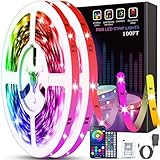
KSIPZE 100ft LED Strip Lights, RGB Music Sync with App and Remote
Who it suits: Buyers furnishing a first modern space on a hard budget — a long cove, a media-wall reveal, a run behind a floating shelf — who need maximum hidden footage for minimum money and understand they are buying raw material, not a finished effect.
The kit includes app control plus a physical remote, a built-in microphone for music sync, and the standard plain-RGB repertoire: sixteen million claimed colors, which in practice means one color at a time along the entire run, with brightness, flash and fade modes around it. For the modern use case, the relevant number is not the color count but the footage: a hundred feet lines a full ceiling cove in a mid-size room with enough left for a second reveal, and as a way to learn whether you like living with indirect strip light — before committing to denser, better-built systems — nothing teaches the lesson cheaper. Set to one color, dimmed, and hidden, it produces the same floating-ceiling effect as its rivals; the light itself does not know what it cost.
The physics and the finish are where the price shows. A run this long is fed from one end, and voltage drops along a hundred feet of thin flexible board: the far end glows measurably dimmer and slightly warmer than the near end, an effect no listing in this class mentions — plan the feed point at the corner you look at least. The LED density is not published for this kit, and at this budget the spacing is necessarily sparse; hidden in a cove that is irrelevant, but reflected in a polished floor or a lacquered console the dots will show, so keep glossy surfaces out of the reflection path. White is the mixed-diode approximation all plain RGB strips produce, cool and slightly blue beside a real white bulb — in a modern palette built on whites and neutrals, that blue cast is the loudest thing in the room, so treat this strip as a color instrument only. The adhesive is the category’s number-one failure point in owner reports across the budget shelf: clean the surface, warm the strip to room temperature, and budget for mounting clips on any run you care about. The app is shared white-label software of the kind several budget brands license rather than build — functional, generic, and not something to compose a home around. As hidden raw material, remarkable value. As a visible installation, it was never going to be one, and it does not pretend otherwise — check price on Amazon for the live figure.
- A hundred feet at the low end of this budget — the most footage in this guide — check price on Amazon.
- App control plus a physical remote and microphone music sync included in the kit.
Honest limitation: Plain RGB only (one color at a time), LED count unpublished and density necessarily sparse at this price, far-end dimming on a single-feed 100ft run, blue-leaning fake white, and budget adhesive that should be backed up with clips.
Choose it if hidden coverage is the whole point and the budget is firm. Skip it if any run will be visible or reflected in gloss, if you want multi-color effects, or if believable white matters — the step-up in the closing section is the honest route.

DAYBETTER LED Strip Lights 100ft (2 Rolls of 50ft), 5050 RGB, App and Remote
Who it suits: Shoppers who want the budget 100ft format — for the same hidden cove work as the two kits above — from the name that sells the most of it, with a persistent storefront and a model number behind the listing.
DAYBETTER is the volume brand of the budget strip shelf, and this is its standard-bearer: a hundred feet of 5050-chip RGB strip delivered as two rolls of fifty, with app and remote control, music sync, and the full plain-RGB repertoire. The 5050 designation is one of the few honest specifications in this class — it names the LED package size, 5.0 by 5.0 millimeters, the larger diode format the budget tier uses when it is not cutting that corner too. Check the current price on Amazon before anything else: this listing’s price is more volatile than its rivals’, so confirm it still sits within this guide’s budget — above that budget it belongs to the next guide up. Toward the upper end of this budget it is a fair rival to the Tenmiro. What you get over the KSIPZE and Tenmiro is mostly provenance: a maker with a persistent Amazon storefront, a printed model number (FLSL-DB-501115RGBUS), and a listing that has carried the same identity for years — the things that matter when a controller dies in month nine and you want the same kit again.
For a modern interior, one limitation outweighs the class-standard list, and independent testing coverage singles this brand out for it: white light that runs cold and blue. All plain RGB strips fake white by running their three diodes together, but roundups of this category flag the DAYBETTER’s white as noticeably icy even by that standard. In a gaming setup that is a footnote; in a modern living room — a palette of warm whites, pale oak and stone, where every light source is judged against the others — a blue-tinged line in the cove does not read as accent, it reads as error. Use this strip for color, in a hidden run, or not at all. The remaining caveats are the class caveats: LED count unpublished for the 100ft kit, so density is the usual sparse spacing and concealment is mandatory; the two rolls share the kit’s controller and supply; music sync hears the room through a microphone rather than the audio signal; and the adhesive needs the same clip backup as every budget run, especially overhead. Within this budget, hidden and on a color, it is a rational purchase. Asked to produce the room’s white, it is the wrong product at any price in this guide.
- The budget tier’s most established name: persistent storefront, printed model number, years-long listing identity.
- 5050-chip RGB in two 50ft rolls, with app, remote and music sync in the kit.
- Sits toward the upper end of this budget when on offer — check price on Amazon and buy only while it sits within budget.
Honest limitation: White runs cold and blue even by plain-RGB standards, per independent roundups — disqualifying for white duty in a neutral modern palette; the price is volatile — check price on Amazon, and if the live price sits above this guide’s $15 budget it leaves this guide; LED count unpublished, so concealment is mandatory.
Choose it if you want the 100ft format with the most accountable seller behind it, while it sits within this budget, for hidden color work. Skip it if the live price has climbed past this guide’s $15 budget — the Tenmiro delivers the same format at the low end of this budget — or if the run must ever pass for white light.

Comparison Table
| Product | Type | Best use | Link |
|---|---|---|---|
| Govee RGBIC LED Strip Lights, 16.4ft (H617A) — check price on Amazon | Addressable RGBIC strip, Bluetooth app | One composed line of light: media walls, shelf reveals, headboards | Check on Amazon |
| Maylit TV LED Backlight, 8.2ft USB — check price on Amazon | 5V USB strip, IR remote | The fully invisible TV halo on a clean media wall | Check on Amazon |
| Lepro LED Strip Lights, 16.4ft RGB (410082-RGB-US) — check price on Amazon | Plain RGB strip, 44-key IR remote only | Concealed utility light under cabinets and inside joinery | Check on Amazon |
| Tenmiro LED Lights, 100ft (2 Rolls of 50ft) — check price on Amazon | Plain RGB strip, app and remote, two rolls | A continuous hidden ceiling cove, fed as two runs | Check on Amazon |
| KSIPZE 100ft LED Strip Lights — check price on Amazon | Plain RGB strip, app and remote, single long run | Maximum hidden footage in this budget | Check on Amazon |
| DAYBETTER LED Strip Lights 100ft (2 Rolls of 50ft) — check price on Amazon | Plain RGB 5050 strip, app and remote | The 100ft format from the category’s volume brand — color only | Check on Amazon |
How to Choose
Apply the switched-off test before anything else. Stand in the room at noon and imagine the installation dark. In a modern interior, that daytime state is the product. If your planned run cannot be concealed, the honest conclusion is not a different strip at this price — it is a channel, a different location, or a different budget, which is what Best Led Strip Lights For Modern Homes Under $30 exists for.
Give color one job, in one place. The composed use of a color strip is singular: one line, one color, one architectural gesture — the halo behind the screen, the wash in the cove, the reveal along a shelf. Addressable strips like the Govee earn their premium in a modern home not by showing more colors but by letting you choose precisely where light exists along the line and then stopping. Restraint is not a compromise with these products; it is the entire technique.
Read density as an aesthetic specification. The smoothness of a strip’s light is set by diodes per meter, and this is the number budget listings most often hide. Where a maker publishes a count, do the division: the Lepro’s stated 150 diodes over 5 meters is 30 per meter — dotted at arm’s length, doubled in any glossy reflection. Denser 60-per-meter strips are what close-up and reflected installations actually want, and they start above this tier. Length is the number on the box; density is the number that decides whether the room believes the light.
Budget for the channel, because the channel is the fixture. An aluminum channel with a frosted diffuser — sold everywhere these strips are sold — converts dotted tape into a continuous line of light, gives the adhesive a clean metal surface to hold, and gives the installation a finished edge that survives the switched-off test even in semi-visible locations like shelf undersides. The honest total cost of a composed installation is the kit plus the channel plus mounting clips — still far below what a single architectural fixture costs — which is the real reason strips belong in modern rooms at all.
Match the power architecture to the architecture. A 5V USB strip like the Maylit is capped by its port — a few watts, bias-light brightness, perfect sync with a screen, useless as room lighting. Adapter-powered strips are the general-purpose default; every kit here that needs one includes it, and the adapter in the box is the only adapter that kit should ever meet — listings in this class contradict themselves about voltage often enough (the Lepro’s title and contents disagree) that swapping bricks between kits is a genuinely bad idea. Plan where the controller and feed point will hide before you plan the run: in a composed room, the cable route is part of the design, and a controller that lands mid-wall with a short lead will dictate an ugly compromise.
Choose controls the room can live with. Infrared remotes need line of sight but answer to no server and outlive every app — the Lepro’s entire design is this bet, and a remote in a drawer is more modern than a phone in your hand. Bluetooth apps add scenes and segment control but work only within a room’s range and depend on the maker’s software surviving; Govee’s app is a core business, while the budget kits share white-label backends that no single brand is responsible for — one of them is literally served from another brand’s domain. Whatever you buy, keep the physical remote somewhere findable. It is the control path that cannot be discontinued — and the one a guest can use.
What $15 Actually Buys a Modern Home
It is worth understanding why the footage is so cheap, because the same math explains what the modern buyer must supply. A strip is a flexible circuit board with diodes soldered at intervals, a matchbox controller and a small power brick. That low cost is not a pricing miracle; it is the bill of materials with the fixture deleted. That is not a complaint. It is the reason a budget kit plus an inexpensive channel can imitate a far more expensive architectural detail, and also the reason the same kit stuck bare to a wall looks like exactly what it cost.
What $15 does not buy, anywhere we could verify, matters more in a modern home than in any other kind of room. It does not buy white light you would cook, read or judge color by — every strip here fakes white from colored diodes, one of them (the DAYBETTER, per independent roundups) fakes it bluer than the rest, and in a neutral modern palette a blue-tinged line is the loudest object in the space. The verified starting point for a genuinely-white strip sits in the next budget tier up: Govee’s 32.8ft cool-white strip, 600 LEDs over two 16.4ft rolls — about 60 per meter, dense enough for close-up work — dimmable from a control box. That product is mentioned here in prose, without a pick slot or a link, because it belongs to the next budget up; but for the modern buyer whose actual brief is a clean white cove, it is the honest purchase and this entire guide is a detour. Nor does $15 buy a safety certification we could verify for the strip itself, as opposed to occasional claims about an adapter, or density above the sparse end, or voice control. Buy expecting architectural white, and the same boxes become the disappointed reviews.
Common Buying Mistakes
Sticking the strip where it can be seen. The installation in the listing photos — tape applied along an exposed wall-ceiling junction — is the one installation a modern room cannot absorb. Conceal the run in a cove, a reveal, a channel or behind the object it lights, or do not install it.
Letting the rainbow out. Multi-color modes are a demo, not a design. Buyers who run chasing gradients across a living room have not bought lighting; they have bought a screensaver, and the room will tire of it in a week.
Expecting white from a color strip. “White” on a plain RGB strip is three colored diodes running together — a cool, thin approximation that makes skin look tired and food look wrong, and in a palette of warm neutrals it reads as a mistake. If the run’s main job is white light, buy a white strip — a genuinely-white strip starts in the next budget tier up — and no setting on a color strip closes that gap.
Ignoring reflections. A sparse strip above a lacquered console, a glass table or a polished floor does not appear once — it appears twice, the second time as a row of reflected points that no dimming fully hides. Either raise the density, diffuse the run in a channel, or move the strip out of the reflection path.
Comparing prices without lengths. Two strips at similar prices are not rivals until their lengths are on the table: the KSIPZE buys 100 feet, the Govee buys 16.4. Read the size selector, not the banner — and check price on Amazon for the exact length you are comparing.
Trusting the tape — and the headline numbers. The most common budget-strip failure is gravitational: foam adhesive lets go of texture, heat and ceilings on its own schedule, and a fallen strip across a composed wall is worse than none. Architecture, density, control path and power are the specifications that actually differ.
Final Recommendation
For most modern homes, the answer is the Govee RGBIC 16.4ft: the only strip under $15 whose light can be composed — one color, one line, segments lit only where the architecture asks — check price on Amazon — and backed by the one app in this guide that is somebody’s core business. Buy it with a channel, dry-fit the route before you peel anything, set it once and leave it alone. If the screen is the room’s focal point, the Maylit backlight is the purest disappearance in the guide, provided its live price sits within this guide’s $15 budget — check price on Amazon. If the job is a whole ceiling cove, the answer flips to footage: the Tenmiro’s two rolls feed a long run more gracefully than the KSIPZE 100ft in the same part of this budget, and both belong strictly inside the architecture. And if what your room actually needs is white light — as most modern rooms do — accept this guide’s central finding and step up to the next budget tier for a real white strip. Fifteen dollars buys a line of color that can vanish beautifully. It was never going to buy the white, and now you know exactly where that starts.
FAQ
Can an LED strip ever look right in a modern, minimalist room?
Yes — when it is treated as raw light rather than decoration. Applied visibly to a wall, the same strip is a dotted tape line that fails the room both lit and dark. The product is identical; the architecture decides.
What is the difference between RGB and RGBIC strips?
An RGB strip shows one color along its whole length at a time. An RGBIC strip has an independent control chip that lets different segments show different colors simultaneously, enabling gradients and layered scenes. RGBIC strips cost more per foot and generally cannot be cut; RGB strips are cheap by the yard and trim at marked points.
Why does density matter so much in a modern room?
Because smoothness is the whole illusion. Denser strips around 60 LEDs per meter read as a continuous line at close range, which is why they are the under-cabinet and mirror standard — and why they start above this budget.
Can I get clean white light from a strip under $15?
No verified option exists. The cheapest verified genuinely-white strip we found is Govee’s 32.8ft cool-white model, in the next budget tier up, at roughly 60 LEDs per meter. For a modern palette built on whites and neutrals, that step-up is the honest purchase.
How many feet of strip do I need?
Measure the run, then add the corners. A media wall or headboard is usually one 16.4ft strip. A TV needs only its own size class: 8.2ft wraps most 40–60in screens. Buying by the room’s geometry rather than the box’s headline is the whole trick.
Why is the end of my long strip dimmer than the start?
Voltage drop. It affects every long budget kit, is worst on single 100ft runs, and is softened by two-roll kits fed over shorter distances. In a cove the gradient is visible against a white ceiling, so place the feed point at the least-viewed corner.
Can I cut an LED strip to fit?
Plain RGB strips, yes — at the marked copper pads, and only there. Addressable RGBIC strips like the Govee in this guide, no — cutting breaks the segment control. In a concealed installation, plan lengths so cuts land in hidden corners.
Are budget LED strips safe in a finished interior?
They are low-voltage devices — 5V USB or adapter-fed 12V/24V — which removes the mains from the strip itself; the mains live in the power brick. We could not verify a UL or ETL listing for the strip itself on any pick in this guide, and some brands market a certified adapter, which covers the brick only. Use only the adapter in the kit’s box, never substitute one from another kit (listings in this class contradict themselves about voltage), and do not run strips inside walls or ceilings where codes require listed fixtures.