Where to buy
Check the latest price, availability and delivery on Amazon. Orders are placed on Amazon. We may earn a commission from qualifying purchases.
- Best overall for apartments: Govee RGBIC LED Strip Lights, 16.4ft, Bluetooth App Control (H617A) — Check on Amazon
- Maylit TV LED Backlight, 8.2ft USB Powered Strip for 40–60in TVs, with Remote — Check on Amazon
- Tenmiro LED Lights for Bedroom, 100ft (2 Rolls of 50ft), App and Remote — Check on Amazon
- Lepro LED Strip Lights, 16.4ft RGB 5050 with 44-Key IR Remote and Power Adapter (410082-RGB-US) — Check on Amazon
See 2 more Amazon options
- KSIPZE 100ft LED Strip Lights, RGB Music Sync with App and Remote
- DAYBETTER LED Strip Lights 100ft (2 Rolls of 50ft), 5050 RGB, App and Remote
Read the full guide ↓
Disclosure: As an Amazon Associate, dailyhomedecorating.com earns from qualifying purchases. Links to Amazon on this page are affiliate links; they cost you nothing extra. Listing details such as price and availability change often, so check the current Amazon listing before you buy.
Renting changes what a good LED strip is. In a house you own, a strip is a small renovation: you stick it once, maybe add a channel, and forget it for a decade. In an apartment, every strip is a temporary guest in someone else’s property, and it will be judged twice — once by you, on the night you install it, and once by your landlord, on the day you hand back the keys. That second judgment is the one this guide is written for. A rental-friendly strip has to do four things a homeowner never thinks about: go up without drilling, screws or any modification a lease could call damage; come down without taking paint with it; run without needing an outlet that does not exist in the corner you want lit; and pack into a moving box when the lease ends, because a strip you abandon is money you donated to the next tenant.
The good news is that under $15, the budget shelf is accidentally well suited to renters — because the category’s most notorious flaw works in your favor here. The weak foam adhesive on inexpensive strips, the thing that drops a homeowner’s ceiling run at 3 a.m., is also adhesive that lets go of painted drywall without a fight when you remove it slowly. Weak glue is a defect in a forever installation and a feature in a twelve-month one. The catch is that the same weakness applies while the strip is up, not just when you want it down, so this guide treats every run as a two-part problem: where the strip sticks (ideally to furniture you own, not walls you rent), and what quietly holds it when the tape gives up (removable clips, not faith). One more rental reality shapes the picks: apartments are short on outlets and long on rules about extension cords, so the strip that powers itself from a TV’s USB port, or runs a whole room from one adapter, earns a ranking here that it would not get in the general guide, Best Led Strip Lights Under $15.
The six picks below are the same verified sub-$15 shelf as that general guide — an addressable Govee strip, three 100ft plain-RGB kits, an app-free Lepro kit, and one USB TV backlight included as a labeled check-price option — but they are ranked by rental logic instead of raw specifications: reversibility first, power practicality second, spectacle third. If your apartment is also your design statement, Best Led Strip Lights For Modern Homes Under $15 weighs the same budget differently; if square footage is the binding constraint, Best Led Strip Lights For Small Rooms Under $15 is the tighter fit; and Best Led Strip Lights For Bedrooms Under $15 covers the room most renters light first. When the budget can grow, Best Led Strip Lights For Apartments Under $30 is this guide’s own next rung.
Quick Picks
Short on time, or comparing several options at once? Each row below names a renter type and the product that suits it, with a link to the listing. Check the current price on Amazon before you buy, because pricing is tied to the exact length in the product’s name, and one of these six listings has at times shown no featured offer at all.
| Renter type | Pick | Why it stands out | Link |
|---|---|---|---|
| Best overall for apartments | Govee RGBIC LED Strip Lights, 16.4ft (H617A) | Addressable multi-color effects in a one-room length — check price on Amazon — mount it on furniture you own and it moves out with you | Check on Amazon |
| Best zero-install pick | Maylit TV LED Backlight, 8.2ft USB | Sticks to your TV, not the landlord’s wall; runs off the TV’s own USB port and switches with the screen — check the current price on Amazon before buying | Check on Amazon |
| Best for a whole rental | Tenmiro LED Lights, 100ft (2 Rolls of 50ft) | Two 50ft rolls in one kit — check price on Amazon — one roll per room, one kit for the apartment, one box when you leave | Check on Amazon |
| Best no-app, no-fuss kit | Lepro LED Strip Lights, 16.4ft RGB (410082-RGB-US) | A 44-key IR remote and an adapter in the box — check price on Amazon — no account, no app, nothing to set up again at the next apartment | Check on Amazon |
| Best coverage per dollar | KSIPZE 100ft LED Strip Lights | A hundred feet of app-and-remote RGB — check price on Amazon — treat it as party infrastructure you never have to feel precious about | Check on Amazon |
| Best-known budget brand | DAYBETTER LED Strip Lights 100ft (2 Rolls of 50ft) | 5050 RGB with app and remote — check the current price on Amazon and buy only when it sits within this budget | Check on Amazon |
How These Picks Were Chosen
The first filter was the category definition the general guide uses: a complete kit — strip, controller and a way to power it — that works the day it arrives, with a real, orderable Amazon listing for the exact length it buys. One pick, the Maylit TV backlight, is a labeled check-price option: its listing and specifications verified in detail, but its page has at times shown no featured offer, so check the current price on Amazon — it earns its place only when that live price sits within this guide’s budget.
The second filter was rental-specific, and it reordered everything. We asked four questions of each kit. Does it touch the landlord’s property? A strip stuck to the back of your own television, headboard or desk never contacts a rented surface at all, which is the only installation that is deposit-proof by construction; strips that must go on walls or ceilings were scored on how gently they come off. Where does its power come from? USB strips borrow an existing port; adapter kits need one free outlet near the feed point, and in a rental that outlet often does not exist where the strip starts. How long is the run, honestly? A typical rental room’s ceiling perimeter is roughly 45–60 feet, so the 100ft kits are two-room purchases and the 16.4ft strips are one-feature purchases — both useful, neither interchangeable. What survives the move? Remotes, adapters and controllers that are standard and replaceable travel well; app ecosystems tied to shared white-label software travel badly, because the app may not outlive your lease.
We did not use these strips ourselves. We read the maker listings, manuals and specification pages and compared the numbers that actually separate products in this tier: length and roll configuration, LED count and density where the maker publishes one, chip architecture (plain RGB versus addressable RGBIC), control path (infrared remote, Bluetooth app, Wi-Fi), power architecture (USB 5V versus an included wall adapter), and whether the strip can be cut.
The Renter’s Test: Four Rules Before Anything Sticks
Rule one: stick to things you own. The single most useful sentence in this guide is that the best rental mounting surface is not a wall. Three of the six picks below are at their best mounted this way. Wall and ceiling runs are the second choice, not the first, and when you do make one, you are borrowing against your deposit and should install like it.
Rule two: the tape is temporary in both directions. Budget foam adhesive is weak — that is documented across the category’s owner reports and it cuts both ways in a rental. It will release from smooth painted drywall with slow, steady pulling and a little warmth, which is exactly what you want on moving day. It will also release, uninvited, from textured paint, warm surfaces and ceilings, which is exactly what you do not want in month three.
Rule three: no holes, no exceptions worth making. Nothing in this guide needs a drill, and nothing under $15 justifies one. Screw-in clips, channel screwed to a ceiling, a strip stapled along a baseboard — every one of those converts a low-cost decoration into a patching-and-painting conversation at move-out. If a run cannot be held by adhesive and removable clips, the run is in the wrong place; move it to furniture and the problem disappears.
Rule four: plan the exit on the day you install. Photograph each wall before the strip goes up (your move-in photos should already exist — add the strip routes to them). Keep the remote, the adapter and the spare clips in one labeled bag. And decide now which strips are coming with you and which are consumables: a budget 100ft kit is rationally abandoned or gifted to the next tenant with the landlord’s permission, while a branded strip and its controller are worth the five minutes it takes to peel them down carefully. Renters who decide this in advance do not decide it in a hurry, on a deadline, with a truck downstairs.
The 6 Best LED Strip Lights for Apartments Under $15
Govee RGBIC LED Strip Lights, 16.4ft, Bluetooth App Control (H617A)
Who it suits: Renters whose strip is a feature — behind the TV stand, around a headboard, along a desk wall — and who want the flowing multi-color effects from setup photos in a length sized for one rental room, from a brand whose app will still exist at their next address.
What makes this strip different from everything else under $15 is in its name: RGBIC. A plain RGB strip shows one color along its whole length at any moment; an RGBIC strip carries an independent control chip that lets several segments show different colors at once, which is what makes rainbow flows, chases and layered scenes physically possible. Check the current price on Amazon for this 16.4ft Bluetooth model — it is positioned at the upper end of this budget tier. For a renter, the length is the quiet virtue: 16.4 feet is one feature, done properly — the back of a large TV and its stand, a headboard with both bedposts, a desk and the wall above it. It is not a whole-apartment kit, and in a rental that restraint is a virtue, because every foot you install is a foot you will one day remove.
The rental-specific advice is about where it sticks. Govee’s adhesive is effectively one-shot — repositioning a stuck run is how strips end up held by hope — and one-shot tape belongs on furniture you own, where a mistake costs you a strip, not on a rented wall, where a mistake can cost you paint twice: once when the misaligned run comes off, and again if it takes the finish with it. Dry-fit the route with painter’s tape first (the one tape that is always deposit-safe), then commit. The limitations from the general guide stand unchanged: control is Bluetooth only — the maker’s own listing note states the H617A does not work with Alexa or Google Assistant — so there is no voice control and no control from the hallway; there is no remote in the box, which matters in a shared apartment where a roommate or guest cannot change the light without your phone; and the strip is not cuttable, because trimming an addressable strip severs the segment addressing its effects depend on. Plan around 16.4 feet rather than planning to shorten it. Govee publishes no lumen figure measured to a standard shared with rivals, so judge it as accent light, which is what it is. It remains the only pick here whose effects the others cannot copy, and the one most worth peeling down carefully and taking with you.
- True RGBIC addressable color — multiple colors on one line — a capability no other verified pick in this budget tier offers.
- Positioned at the upper end of this budget tier — check price on Amazon before you buy.
- A one-room length that installs on your own furniture and moves out with you — the rental ideal.
Honest limitation: Bluetooth only — no Alexa or Google voice control, per the maker’s own listing note — and no remote in the box; the strip is not cuttable, and its one-shot adhesive punishes a mis-measured first attempt, so dry-fit on furniture before it ever touches a wall.
Choose it if one polished feature run is the goal and you will mount it on things you own. Skip it if you need voice control, a roommate-proof physical remote, or footage for several rooms — the kits below sell length this strip does not pretend to.

Maylit TV LED Backlight, 8.2ft USB Powered Strip for 40–60in TVs, with Remote
Who it suits: Renters who want the single most lease-friendly installation in this guide: a strip that sticks to the back of their own television, draws power from that television, and leaves the apartment exactly as it found it.
Every other pick here asks something of the apartment — a wall to stick to, an outlet to occupy, a ceiling to ring. The Maylit asks for nothing, because it is built around the third power architecture: 5V USB. Its 8.2-foot strip plugs into the TV’s own USB port, draws a modest 2.5 watts, and turns on and off with the screen. There is no adapter brick hunting for a free socket behind the media console — a real constraint in rentals, where the living-room outlet is usually already spoken for by the TV, a console and a router — and no second remote ritual before a film: the halo appears when the picture does. The length wraps the back of a 40- to 60-inch TV, and the kit carries 60 LEDs, sixteen colors, four dynamic modes and eight brightness levels on a 24-key infrared remote. Crucially for a renter, the adhesive’s entire contact patch is the back panel of a television you own. When the lease ends, the strip leaves with the TV, and the wall behind it has never been touched. This is also the guide’s check-price pick, stated as plainly here as in the general guide: Amazon’s page for this long-running listing has at times shown no featured offer, so check the current price on Amazon before you buy. The rule is the budget itself — it earns this ranking only when its live price sits within this budget; materially above that, the Govee above backlights the same TV with better effects.
The limits are the physics of five volts and the geometry of infrared. A USB port’s power budget caps brightness well below an adapter-fed strip’s — harmless for a bias halo, which is meant to be gentle, and disqualifying for any job that needs real illumination. Its white is mixed from colored diodes rather than produced by white ones, so the reference bias white is approximate rather than exact. The infrared remote must see its receiver, and behind a TV is where line of sight goes to die — roundups of this kit flag exactly that, and the fix is to leave the receiver eye peeking below the screen’s lower edge as you stick the strip down. The strip is not water resistant, and it needs a screen with a powered USB port: most TVs, some monitors, no projectors. None of that dents its rental case. Ten minutes, one cable, zero contact with the landlord’s property — and on moving day it is not an installation you remove, it is a television you carry.
- 5V USB power from the TV itself — no outlet needed, no adapter, switches on and off with the screen.
- Sticks only to your own television: the one pick whose installation a landlord never sees.
- 8.2ft sized for 40–60in TVs: 60 LEDs, 16 colors, 8 brightness levels, 24-key remote included.
Honest limitation: Check the current price on Amazon — buy only when it sits within this budget. USB power caps brightness at bias-light levels, white is mixed-diode rather than true white, and the IR receiver needs a line of sight from behind the TV.
Choose it if the job is a TV halo and you want the apartment untouched. Skip it if you need real brightness, your screen has no USB port, or the live price has climbed past this budget — the Govee is the better-documented buy at that point.

Tenmiro LED Lights for Bedroom, 100ft (2 Rolls of 50ft), App and Remote
Who it suits: Renters furnishing more than one room — the classic first-apartment brief of a glow in the living room and a ring in the bedroom — who want to buy once, install twice, and carry one small box out at the end of the lease.
The Tenmiro’s hundred feet arrive as two rolls of fifty, and in a rental that packaging is the product. The listing’s own contents line confirms the box: two 50ft rolls of strip, one power supply, one controller and a manual. Two rolls mean the apartment’s two natural runs — living-room ceiling line and bedroom ceiling line, or one room’s ceiling and the other room’s headboard wall — without cutting, joining or a second purchase, and the longest run fed from one end is fifty feet rather than a hundred, which softens (without erasing) the far-end dimming that long budget runs suffer: voltage fades along a strip, so the far end glows dimmer and warmer than the near end, and a shorter feed is a gentler fade. It delivers two rooms of light in a single budget kit — check price on Amazon — which is precisely the budget logic of a first rental.
The renter’s caveats start with the ceiling itself. A ceiling ring is the largest possible contact patch with the landlord’s paint, and it is the run where gravity tests budget adhesive every hour of every day — so if you ring a rented ceiling, removable clips are not optional insurance, they are the installation, with the tape merely positioning the line. The second caveat is specific to the budget-app ecosystem and worth stating plainly: independent coverage of this category has noted that Tenmiro’s app download is served from another budget brand’s domain — these kits share white-label app backends maintained by no one in particular, so across a two- or three-year tenancy the remote in the box is the control path you can count on, and the app is a bonus with an unknown expiry date. Third: both rolls draw on the one included power supply and controller, so the two runs are a pair that shares a feed point, not two independent systems — plan the apartment around one outlet where both runs can begin. The strip is plain RGB with cool mixed-diode white, and the maker does not publish an LED count, so assume the sparse spacing normal at this budget end of the category: a clean line from across the room, visible points at arm’s length. Bought with those limits understood, it is the most flexible budget kit in this guide, and the kit most likely to be reinstalled, in a different shape, at your next address.
- Hundred feet delivered as two 50ft rolls — one kit covers the two rooms a rental actually has.
- Full two-roll kit in one box — check the current price on Amazon.
Honest limitation: Plain RGB with cool mixed-diode white and unpublished LED density; the app is shared white-label software (its download is served from another budget brand’s domain), so the included remote is the durable control path; both rolls share one power supply and controller; ceiling runs need removable clips, not tape alone.
Choose it if two rooms need light from one budget kit. Skip it if the two runs must be fully independent systems, or if you are unwilling to clip a ceiling run — a single-room pick above will serve you better.
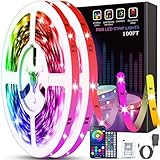
Lepro LED Strip Lights, 16.4ft RGB 5050 with 44-Key IR Remote and Power Adapter (410082-RGB-US)
Who it suits: Renters who want light with no software in it at all — under a kitchen cabinet, along a shelf, behind a monitor — controlled by a remote that works on day one of the lease and day one of the next lease, with no account to recreate and no app to reinstall.
The Lepro inverts the category’s usual priorities, and for a tenant the inversion is practical rather than nostalgic. This is a classic analog RGB kit: 16.4 feet of 5050 strip, a 44-key infrared remote with six DIY keys that memorize your own custom colors, and a power adapter in the box — no app, no Bluetooth, no Wi-Fi, nothing in a cloud that can be discontinued between this apartment and the next. Lepro is a lighting brand with a decade-plus history — check price on Amazon — and that history shows in the documentation: a real model number (410082-RGB-US), a published manual, and a specification table that states its LED count outright — 150 diodes on the 5-meter strip. That honesty cuts both ways, and we follow the maker’s example: 150 LEDs over 16.4 feet is 30 LEDs per meter, the sparse end of the density scale, half the density of the 60-per-meter strips sold for close-up under-cabinet work. From a sofa it reads as a line of light; standing at the counter beneath it, you can see the individual points and the scallops between them. Know which distance you are buying for. For rental kitchens specifically, one mounting note matters more than any specification: the cabinets are the landlord’s, so this strip goes on with removable clips or on the underside lip where adhesive contact is minimal — not foam-taped flat across a finished cabinet underside you will have to scrape later.
Two more warnings come from the maker’s own materials. The strip is non-waterproof — the manual says so directly — so it is a dry-location product: keep it away from the sink’s splash zone, which in a small rental kitchen means the run above the counter’s dry half, not the half over the sink. And the listing’s own fields contradict each other on the power supply: the title advertises a 24V adapter while the kit contents in the same listing describe a 12V adapter. We flag the contradiction rather than resolve it, and print no voltage as fact. The practical rule is the one that should govern every strip in this guide, and matters doubly when you own several kits across several moves: use only the adapter in the box, and label it with the strip it belongs to before it goes into the moving box, because two similar bricks from two kits are not interchangeable on a listing’s say-so. The infrared remote needs line of sight to its receiver eye, with a working range of about 26 feet when it has one — tuck the eye where the remote can see it. Within those bounds, this is the guide’s set-and-forget pick: the one whose controls cannot be switched off by a server, an app store or a lapsed domain, in this apartment or any other.
- Remote-only control by design: 44-key IR remote with six DIY memory keys, no app, no account, no cloud dependency.
- Complete kit with adapter included, from an established lighting brand with a published manual — check price on Amazon.
- Maker states its LED count openly: 150 diodes over 16.4ft — and the review above states what that density means.
Honest limitation: 30 LEDs per meter is sparse — visible diode points at close range; the strip is non-waterproof; the listing contradicts itself on adapter voltage (24V in the title, 12V in the contents), so use only the adapter in the box; IR remote needs line of sight; cabinet runs should be clipped, not taped, because the cabinets are rented too.
Choose it if you want app-free light that survives every move unchanged. Skip it if you want app scenes, music sync or multi-color effects — that is the Govee — or a dense, close-up under-cabinet wash.

KSIPZE 100ft LED Strip Lights, RGB Music Sync with App and Remote
Who it suits: Renters treating strip light as an event rather than an installation — a lease-year of parties, game nights and holiday perimeters — who want the maximum glowing footage for the minimum money and intend to feel zero guilt about its eventual fate.
The kit includes app control plus a physical remote, a built-in microphone for music sync, and the standard plain-RGB repertoire: sixteen million claimed colors, which in practice means one color at a time along the entire run, with brightness, flash and fade modes around it. For a renter, the honest way to frame this purchase is as a consumable with an unusually long life: as one of the lowest-positioned kits in this budget tier, it changes the move-out calculus completely. A branded strip is worth peeling down gently and packing; a budget hundred-footer is worth exactly the minutes its removal takes, and no more — if a section resists, the rational renter cuts their losses, removes it cleanly, and leaves nothing behind, which is the only part of the exit the landlord actually grades.
The physics of this budget level are the class physics, stated in the general guide and repeated here because a hundred feet is where they bite hardest. A run this long is fed from one end, and voltage drops along a hundred feet of thin flexible circuit board: the far end glows measurably dimmer and slightly warmer than the near end. Route the feed from the corner you look at least. The LED density is not published — the listing states no LED count we could verify — and at this budget level the spacing is necessarily sparse: a continuous line from across the room, individual points from two feet away. White is the mixed-diode approximation all plain RGB strips produce, cool and slightly blue next to a real white bulb. And the adhesive is the budget category’s standard foam tape, with the renter’s double edge in its purest form: it will let go of a ceiling on its own schedule (clips, if the run matters), and it will let go on moving day without taking the ceiling with it (slowly, with warmth, if you do your part). The app is shared white-label software of the kind several budget brands license rather than build — functional, generic, and not a foundation for a smart home. Judged as a year of glow on a tight budget, it is remarkable. Judged as an heirloom, it never claimed to be one.
- A hundred feet in a single kit — among the most coverage-focused options in this budget tier — check price on Amazon.
- App control plus a physical remote and microphone music sync included in the kit.
Honest limitation: Plain RGB only (one color at a time), LED count unpublished and density necessarily sparse at this budget level, far-end dimming on a single-feed 100ft run, and budget adhesive that should be backed up with clips on any run you care about.
Choose it if coverage is the whole point and the budget is firm. Skip it if you want multi-color effects, believable white, or a run you will inspect up close — climb to the Govee, or accept the KSIPZE for what it cheerfully is.

DAYBETTER LED Strip Lights 100ft (2 Rolls of 50ft), 5050 RGB, App and Remote
Who it suits: Renters who want the budget 100ft format from the name that sells the most of it — buyers who prefer the category’s most documented listing, with a persistent seller storefront and a printed model number, over the very cheapest anonymous kit.
DAYBETTER is the volume brand of the budget strip shelf, and this is its standard-bearer: a hundred feet of 5050-chip RGB strip delivered as two rolls of fifty, with app and remote control, music sync and the full plain-RGB repertoire. The 5050 designation is one of the few honest specifications in this class — it names the LED package size (5.0 × 5.0 mm), the larger chip format the budget tier uses when it is not cutting that corner too. The two-roll format carries the same rental virtues as the Tenmiro’s: two rooms from one kit, a fifty-foot maximum feed per run instead of a hundred, and one controller to pack when you leave. What sets it apart from the Tenmiro is provenance: a maker with a persistent Amazon storefront, a printed model number (FLSL-DB-501115RGBUS), and a listing that has carried the same identity for years — the things that matter when a controller dies in month nine of a lease and you want the same kit again, shipped to the same address, without a research project.
Pricing, however, needs the bluntest label in this guide. This kit’s live price can move in and out of this budget, so check the current price on Amazon first. When it sits within this budget, it is a fair rival to the Tenmiro; when it sits above this budget, it has left this guide’s tier entirely and the Tenmiro delivers the same format within budget. The remaining limitations are the class limitations, with one that independent coverage singles out for this brand: white light that runs cold and blue. All plain RGB strips fake white by running their three diodes together, but roundups flag the DAYBETTER’s white as noticeably icy even by that standard — fine for a party perimeter, wrong anywhere faces or food are judged. The LED count is not published for the 100ft kit, so density is the class’s usual sparse spacing; the two rolls share the kit’s controller and supply; and a rented ceiling run needs removable clips behind the tape, as with every overhead run in this guide. Bought when its live price sits within this budget, by a renter who has read the white-light warning and does not care, it is a rational purchase. Bought above this budget, it no longer belongs in this guide — check the current price on Amazon.
- The budget tier’s most established name: persistent storefront, printed model number, years-long listing identity.
- 5050-chip RGB in two 50ft rolls, with app, remote and music sync in the kit.
- Check price on Amazon — worth considering only when its live price sits within this budget tier.
Honest limitation: Pricing can move above this budget — check the current price on Amazon first and skip it if it sits above this tier; white runs cold and blue even by plain-RGB standards, per independent roundups; LED count unpublished.
Choose it if you want the 100ft format with the most accountable seller behind it, when its live price sits within this budget. Skip it if the live price has climbed past this budget — the Tenmiro above delivers the same format within this tier — or if white light quality matters at all.

Comparison Table
| Product | Type | Rental verdict | Link |
|---|---|---|---|
| Govee RGBIC LED Strip Lights, 16.4ft (H617A) — check price on Amazon | Addressable RGBIC strip, Bluetooth app | Mount on your own furniture; one-shot adhesive, so dry-fit first — travels to the next apartment | Check on Amazon |
| Maylit TV LED Backlight, 8.2ft USB — check price on Amazon | 5V USB strip, IR remote | Zero landlord contact: sticks to your TV, needs no outlet, leaves with you | Check on Amazon |
| Tenmiro LED Lights, 100ft (2 Rolls of 50ft) — check price on Amazon | Plain RGB strip, app and remote, two rolls | Two rooms, one kit; ceiling runs need removable clips behind the tape | Check on Amazon |
| Lepro LED Strip Lights, 16.4ft RGB (410082-RGB-US) — check price on Amazon | Plain RGB strip, 44-key IR remote only | No app to die between leases; clip it under rented cabinets rather than taping | Check on Amazon |
| KSIPZE 100ft LED Strip Lights — check price on Amazon | Plain RGB strip, app and remote, single long run | A budget consumable: maximum footage, zero guilt at move-out | Check on Amazon |
| DAYBETTER LED Strip Lights 100ft (2 Rolls of 50ft) — check price on Amazon | Plain RGB 5050 strip, app and remote | Same two-roll virtues as the Tenmiro — only when its live price sits within this budget | Check on Amazon |
How to Choose
Start with the surface, not the strip. In a rental, the mounting surface decides the product before any specification does.
Audit your outlets before you measure your walls. Every adapter-powered kit needs one free outlet near its feed point, and rental outlets are scarce, fixed in place, and usually already committed. A USB strip like the Maylit sidesteps the audit entirely by borrowing the TV’s port.
Buy the length of one rental, not of a house. A typical apartment room’s ceiling perimeter runs roughly 45–60 feet; a feature run behind furniture is 8–17 feet. The 100ft kits are therefore two-room purchases — good value if both rooms will actually be lit, wasted footage and wasted removal time if not. The 16.4ft strips exist in this guide because one room, done well and removed in five minutes, is the most common real rental brief.
Decide the architecture as the general guide teaches — then apply the rental discount. Addressable RGBIC (the Govee) shows many colors at once and cannot be cut; plain RGB (the other kits) shows one color at a time, trims at marked copper pads, and sells by the yard; true white is not sold in this budget tier by anyone — genuinely-white strips, such as a longer Govee white strip, sit in a higher tier above this budget, a step up we name here in prose because renters planning under-cabinet or vanity light deserve a true-white option, not a color strip’s blue-tinged imitation of it. The rental discount applies to permanence: the fancier the effect, the more it depends on an app, and the shorter a tenancy is, the more weight the app-free and remote-first picks (Lepro, and every kit’s included remote) deserve.
Treat the adhesive as positioning, and clips as the mount. Clean the surface, let the strip warm to room temperature, and dry-fit with painter’s tape before peeling anything — the Govee’s adhesive is effectively one-shot, and on a rented wall a repositioning is a paint risk, not an inconvenience. Textured paint and fresh paint are less forgiving — another reason furniture mounting wins.
Keep the kit together, labeled, from day one. Remote, controller, adapter and spare clips in one bag, with the adapter labeled for its strip — listings in this class contradict themselves about voltage (the Lepro’s title and contents disagree), so bricks from different kits are never assumed interchangeable. A kit that travels as a unit reinstalls in minutes at the next apartment; a kit scattered across three junk drawers is a new purchase.
Common Buying Mistakes
Sticking the first run straight onto a rented wall. The classic deposit mistake: an enthusiastic ceiling ring, foam-taped flat, removed in a hurry eighteen months later with strips of paint attached. Furniture first; walls second, with clips; ceilings last, with clips everywhere — and a slow, warm, patient removal whatever the surface.
Using stronger adhesive to fix a falling strip. When budget tape lets go mid-lease, the temptation is permanent mounting tape or glue. That converts a lighting problem into a guaranteed deduction.
Drilling for a low-cost decoration. Screw-in clips and screwed channels work beautifully — in a house you own.
Forgetting the outlet. Measuring the ceiling, ordering a hundred feet, and discovering the only free socket is behind the sofa on the wrong wall. Audit first, order second.
Buying footage for rooms you will not light. A hundred feet sounds like value until it is sixty feet of installation, sixty feet of removal, and forty feet still on the roll. Match the kit to the rental you have — one feature, or two rooms — and let the per-foot arithmetic go.
Trusting the app to outlive the lease. Budget kits share white-label app backends — one pick’s app download is literally served from another brand’s domain — and apps get abandoned on timescales shorter than tenancies. The Lepro’s remote-only design is this lesson sold as a product.
Expecting white light for the kitchen. Every color strip here fakes white by mixing diodes — cool, thin, sometimes blue (the DAYBETTER is flagged for it by roundups) — and a rental kitchen is where that fakery is most visible, on food and faces. True-white strips sit in a higher tier above this budget; in this budget tier, light the kitchen with the bulbs the apartment came with and spend the strip budget where color is the point.
Final Recommendation
For most renters, start with the Govee RGBIC 16.4ft: the only addressable effects in this budget tier — check price on Amazon — in a length that maps onto one piece of your own furniture and peels down in minutes when the lease ends. If the television is the room’s center, the Maylit USB backlight is the even safer first purchase — provided its live price sits within this budget — because it touches nothing the landlord owns and needs no outlet at all. For a whole apartment on one receipt, take the Tenmiro 100ft (2 Rolls of 50ft) — check price on Amazon — and clip its ceiling runs properly. And whatever you install, install it like someone who will personally remove it: furniture before walls, clips behind tape, no holes, no permanent glue. Do that, and strip lighting is what it should be in a rental — the cheapest dramatic change you can make to a room, and the only one that hands the room back exactly as you found it.
FAQ
Will LED strip adhesive damage my landlord’s walls?
It can, but budget strips are among the safer things you can stick up: their foam tape is weak, which is a flaw mid-lease and a virtue at removal. On smooth, fully cured painted drywall, slow removal — pulling low and parallel, with gentle warmth on stubborn sections — usually releases cleanly. Risks rise on textured paint, fresh paint and ceilings. The fully safe route is mounting on your own furniture (TV back, headboard, desk), where the question never arises, and backing any wall or ceiling run with removable clips so the tape is never the only thing holding — or the only thing you have to rip.
Do I need my landlord’s permission to install strip lights?
Adhesive-only, furniture-mounted strips modify nothing and are the kind of temporary decoration most leases never contemplate. Anything that drills, screws or hardwires is a modification and needs written permission in most leases. This guide deliberately contains no pick that requires either: every kit plugs into an outlet or a USB port and mounts with adhesive and removable clips. If your lease has an explicit clause about adhesives or wall attachments, that clause governs — read it before the strip arrives, not after.
Can I take my strips with me when I move?
Yes, and most of these are worth taking. Branded and remote-only kits (the Govee, the Lepro) reinstall at the next apartment in minutes — keep each kit’s remote, controller and adapter together and labeled, because adapters are not interchangeable between kits. The hundred-foot kits travel too, but weigh the minutes: carefully removing a budget kit is worth it only if it comes down easily. A strip that resists is a strip you remove cleanly and leave behind — what you may not do is leave it half-attached for the landlord to bill you for.
My strip keeps falling down. What is the rental-safe fix?
Not stronger glue. Clips peel off at move-out the way picture-hanging strips do. If a run still will not stay, move it to the underside or back of a piece of furniture, where gravity and the surface both work in your favor.
Are USB strip lights a good idea in a rental?
For a TV or monitor, they are the best idea in this guide: no outlet consumed (a genuine constraint in apartments), no adapter, automatic on-off with the screen, and an installation that sticks only to your own equipment. Their limit is power — a USB port supplies a few watts, so brightness is bias-light gentle and will not illuminate a room. For anything beyond the screen, an adapter-powered kit is the right architecture.
How much strip does a typical apartment room need?
Measure the run, then add the corners. A feature run — headboard, desk, TV stand — is one 16.4ft strip. A ceiling perimeter in a typical rental bedroom or living room is roughly 45–60 feet, which is why the 100ft kits are sold as two 50ft rolls: one roll per room, or one room’s ceiling plus its feature wall. Buying by your rooms’ actual perimeters, rather than by the box’s headline, is the whole trick — and in a rental, every unnecessary foot is a foot you will later have to remove.
Are budget LED strips safe to use in a rental?
They are low-voltage devices — 5V USB or adapter-fed — so the mains electricity lives in the power brick, not in the strip on your wall. We could not verify a UL or ETL listing for the strip itself on any pick in this guide; occasional “certified adapter” claims cover the brick only. Use only the adapter in the kit’s box (listings in this class contradict themselves about voltage), never substitute a brick from another kit, keep strips out of walls and ceilings where codes require listed fixtures, and unplug any strip that runs hot, flickers or smells of warm electronics.