Where to buy
Check the latest price, availability and delivery on Amazon. Orders are placed on Amazon. We may earn a commission from qualifying purchases.
- Best overall: Govee COB LED Strip Light Pro, 9.8 ft, RGBICW with Matter — Check on Amazon
- Govee LED Strip Light M1, 16.4 ft, RGBICW with Matter — Check on Amazon
- Philips Hue Solo Lightstrip Base Kit, 16 ft, White and Color Ambiance — Check on Amazon
- Philips Hue Lightstrip Plus V4 Base Kit, 80 in, White and Color Ambiance — Check on Amazon
See 2 more Amazon options
- PAUTIX RGB Smart IC COB LED Strip Lights, 20 ft, Addressable, 24V Kit with SP548E Controller — Check on Amazon
- Govee RGBIC Neon Rope Light 2, 16.4 ft, with Matter and Shape Mapping — Check on Amazon
Read the full guide ↓
Disclosure: As an Amazon Associate, dailyhomedecorating.com earns from qualifying purchases. Links to Amazon on this page are affiliate links; they cost you nothing extra. Listing details such as price and availability change often, so check the current Amazon listing before you buy.
A modern interior is the hardest room a strip light will ever work in, because a modern interior has nowhere to hide a mistake. There is no crown molding to tuck a dotted tape behind, no lampshade to forgive a harsh emitter, no ornament to compete with a plastic control box taped to the wall. In a room built from flat planes and negative space, light is not an accessory — it is one of the materials, and it is judged like the others: by whether the line it draws is clean, by whether the hardware disappears, and by what the installation looks like at noon with everything switched off. That is the standard this shortlist applies, and it is a stricter standard than brightness. A strip can be powerful and still fail a modern home completely, because power was never the question. The question is whether the light reads as architecture — a reveal in a ceiling plane, a wash under a floating shelf, a single deliberate line of glow — or whether it reads as electronics stuck to a wall.
The good news is that $100 is exactly the tier where strips start passing that test. This is the flagship shelf: the picks below sit at the top of this budget tier, and this guide says so rather than rounding them into comfort. What the money buys is density and construction rather than footage. At the top of this list, 1,260 LEDs per meter are sealed under silicone so the output is one unbroken band of light — the closest thing a strip can be to a built-in fixture. White stops being faked from color channels and starts coming from dedicated white emitters. And control stops being a remote you have to look at: Matter and the Hue platform move the whole system onto a layer you never see, which in a modern home is not a convenience feature but a design requirement. What $100 does not buy is length at that quality — the dense picks here run 9.8 to 20 feet — and it does not buy freedom from fine print, which the next paragraph itemizes before any pick is praised.
Three honesty notes govern everything below. First, brightness figures: there is no common measurement standard behind lumen claims in this category. Philips Hue publishes first-party ratings for its two strips here — 1,600 lumens for the Lightstrip Plus, 1,700 for the Solo — and this guide reports them as maker ratings, because that is what they are. Govee publishes no total lumen figure for its flagships that we could verify, so none is printed; their light is judged by emitter density, which is checkable, instead of by a number that is not. Second, the Hue toll: both Hue strips run in a limited Bluetooth mode out of the box, and the full feature set — routines, grouping, out-of-home control, entertainment sync, Matter — sits behind a Bridge sold separately — check the current price on Amazon. A Hue strip bought from zero is therefore a strip-plus-Bridge system, and the reviews below repeat that extra cost wherever it matters. Third, one price could not be pinned at all: the PAUTIX kit’s US price resisted verification from two independent sources, so its review prints no price and tells you to buy only if the live listing shows $100 or less. In a guide about visual honesty, a labeled gap beats an invented number.
Quick Picks
Short on time, or comparing several options at once? Each row below names a buyer type and the strip that suits it, with a link to the listing.
| Buyer type | Pick | Why it stands out | Link |
|---|---|---|---|
| Best overall for modern homes | Govee COB Strip Light Pro, 9.8 ft | 1,260 LEDs per meter under silicone — a continuous line of light with no visible diodes, in color and real white — check price on Amazon | Check on Amazon |
| Best concealed feature run | Govee LED Strip Light M1, 16.4 ft | 60 LEDs per meter, a dedicated warm-white channel and Matter over Wi-Fi — the balanced flagship for coves and reveals — check price on Amazon | Check on Amazon |
| Best ecosystem line | Philips Hue Solo Lightstrip, 16 ft | Sixteen finished feet of Hue color discipline with a maker-rated 1,700 lumens — check price on Amazon; Bridge extra, and it cannot be extended | Check on Amazon |
| Best extendable platform | Philips Hue Lightstrip Plus V4, 80 in | The only pick that grows — 40-inch extensions reach 32 feet — with a maker-rated 1,600 lumens; Bridge extra — check price on Amazon | Check on Amazon |
| Best long dotless color | PAUTIX RGB Smart IC COB Strip Kit, 20 ft | Twenty feet of addressable COB color with controller, RF remote and 24V supply in the box — sold on a check-price basis in this guide | Check on Amazon |
| Best deliberate object | Govee Neon Rope Light 2, 16.4 ft | The one pick designed to be seen: a bendable silicone line for wall shapes and outlines, with shape mapping, Matter and screws and clips in the box — check price on Amazon | Check on Amazon |
How These Picks Were Chosen
Every pick below was chosen to sit inside the under-$100 budget for this guide — check the current price on Amazon before you buy, as listing prices change. Every fact in these reviews — densities, box contents, control paths, cutting rules — comes from maker listings, manuals and specification pages read for this guide.
The second filter was the modern test, and it has three parts, because a modern room examines a strip three ways. The disappearance test asks where the hardware goes: the strip should live inside a channel, a cove or a reveal, the adapter and control box should have a planned hiding place, and nothing about the installation should announce itself as a gadget. The off-state test asks the question most guides never ask: what does this look like at noon, switched off? A cheap tape with visible copper and dotted phosphor fails a white wall in daylight even if it glows beautifully at night.
Control was scored the same way: as invisibility. A modern home does not want a remote on the coffee table, a control box with a glowing standby light, or a strip that only works inside one vendor’s app. A buyer whose home runs strictly on Matter and who never opens a vendor app is buying a very good plain strip at flagship money, and the reviews say so at the pick, not in a footnote.
We did not install these strips ourselves. We compared the things that decide whether a strip survives contact with a real interior: footage in the box; emitter density and whether the light reads as dots, blend or line; whether white comes from a dedicated channel or from mixing color; the voltage and power arrangement (every pick here includes its mains adapter — none is a bare reel); how control actually works and what each path leaves behind; and whether the strip can be cut — five of the six trim at marked points, with the near-universal caveat that a cut-off section cannot be reconnected and lit again, while the rope is a fixed length shaped with clips rather than trimmed.
The Modern Test: Line, Disappearance, Off-State
It is worth pausing on why density — not brightness, not color count, not app features — is the specification that decides this shortlist. A modern interior lights its planes, not its objects. At 30 LEDs per meter, each emitter is a visible point and the plane gets a dotted border — decoration, of the wrong kind. At 60 per meter, the points blend into a wash when the strip is concealed, which is why the M1 is this guide’s concealed-run pick. At 1,260 per meter under silicone, there are no points at all: the line is continuous in direct view, at reading distance, in reflection on a stone countertop.
Disappearance has a budget consequence that this guide refuses to hide: the channel is the real fixture. An aluminum channel with a frosted diffuser costs real money per foot, takes real time to fit, and is what turns a strip into the architectural line the photographs promise. Buyers should therefore think of the cost twice — once as the strip, and once as the installed line: check the current price on Amazon for the strip, then allow for the channel. The COB Pro’s silicone sleeve already does half the diffuser’s job, which is why a short COB Pro run in a channel can still be an efficient way to buy a genuinely dotless visible line. Modern design permits exactly one loud object per room. The rope is a way to spend that allowance on light — and the review below treats it as such, not as a strip that failed to hide.
The off-state test eliminates more products than any other. Switched off, a strip is a strip: a band of substrate, visible contacts, printed cut marks. Every pick below can pass the off-state test when it is installed the way this guide assumes — channel, cove or reveal, hardware concealed — and every pick can fail it when it is taped bare to a white surface and left there. Installation discipline is the buyer’s half of the bargain; the picks are ranked by how completely the product holds up its half.
The 6 Best LED Strip Lights for Modern Homes Under $100
Govee COB Strip Light Pro, 9.8 ft
Who it suits: Modern-home buyers whose strip will be looked at — along a stair stringer, under open shelving, around a mirror, down a media wall — and who want the light to read as a continuous architectural line rather than as a product.
The COB Pro is what this lens exists to find. Its 1,260 LEDs per meter are packed onto the board and sealed in a soft silicone sleeve, so there is no viewing distance at which individual emitters appear: the output is a single unbroken band, in full RGBICW color with a dedicated warm-white channel, so whites are made by a white diode rather than approximated by mixing color. Check the current price on Amazon for the 9.8 ft version, which sits at the top of this guide’s budget tier. The strip trims at marked points, reported as every 8 cm, and runs on the included adapter, indoors only.
The compromises are footage and the Matter fine print. Nine point eight feet is one gesture, not a room, and a run that measures twelve feet faces the longer 16.4 ft version — outside this guide’s budget — because there is no extension path that keeps this strip within the under-$100 tier. The Matter caveat applies with full force: over Matter, this is a single-color strip with brightness and white control, while the segmented effects that justify its price live in the Govee app. Govee publishes no total lumen figure we could verify; the 1,260-per-meter density is the specification, and it is a maker’s figure.
- The line itself: 1,260 LEDs per meter under silicone — no visible diodes at any distance, in color or in white.
- Real white from a dedicated channel (RGBICW), with Matter, app and voice control layered behind it.
- Cut points every 8 cm and an adapter in the box — check price on Amazon.
Honest limitation: Only 9.8 ft in this configuration, with the longer version outside this budget; Matter carries basic single-color control while effects live in Govee’s app, and no verifiable total lumen figure is published.
Choose it if the strip will be in direct view and the line is the design. Skip it if your run is longer than ten feet or fully hidden — hidden strips do not need density, and the M1 below covers more length in this tier.

Govee LED Strip Light M1, 16.4 ft
Who it suits: Buyers with one short, important concealed run — a ceiling reveal, a headboard cove, a cabinet bank, the plane behind a media console — who want the most complete strip in the guide: dense blended light, honest white, and smart-home credentials that do not depend on one vendor’s cloud.
The M1 is the flagship for runs that will be hidden, and concealment is where its specification is exactly right. Its four-in-one RGBICW chips pack 60 LEDs into every meter — double the density of standard smart strips — with a dedicated warm-white emitter beside the color ones. Its control layer is the most standards-complete here: Matter over Wi-Fi joins Apple Home, Alexa, Google Home and SmartThings, while the Govee Home app holds its 64-plus scene modes, segmented DIY effects and music sync. The strip runs on 24V with the adapter included, trims at its marked points, and extends with Govee’s kits toward a 32.8 ft maximum per the manual. Check the current price on Amazon before you buy; the hardware is the same whichever listing you buy from.
The compromises are the Matter caveat, the footage limit and the finality of cutting. The Matter caveat, in plain words: over Matter the M1 behaves as a single-color strip — one color along its length, with brightness and white temperature adjustable — while gradients, segments and music modes live only in the Govee app. But the buyer should know the division before paying flagship money. The footage is the second limit: 16.4 feet is one feature run, not a room outline, and bulk reels cover far more length in this tier, so spend this pick on the run that matters most. Cutting is one-way — the manual is explicit that detached pieces cannot be reconnected. And no CRI figure is published that we could verify.
- The concealed-run flagship: 60 LEDs per meter blending to an even wash, with a real warm-white channel.
- Matter over Wi-Fi for the invisible control layer, with the full scene library in the Govee app behind it.
- 24V adapter included; cuttable at the marks and extendable with Govee kits toward 32.8 ft.
Honest limitation: Over Matter it is a single-color strip — segmented effects live only in Govee’s app; cut pieces cannot be reconnected; and its 16.4 ft length makes it a one-run purchase, not a whole-room one.
Choose it if one hidden run deserves the best all-round light and your smart home speaks Matter. Skip it if the strip will be visible up close — that is the COB Pro above — or if you need to outline a whole room on this budget.
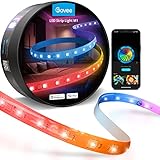
Philips Hue Solo Lightstrip, 16 ft
Who it suits: Buyers with one long, finished run — a full ceiling cove, a staircase wall, a complete cabinet run — who want Hue’s color discipline and a published output rating over the longest finished run Hue offers in this tier, inside the most mature control ecosystem in the category.
The Solo earns its place in a modern home on restraint. Check the current price on Amazon before you buy. For its length it sits comfortably in this tier, and on paper it offers more rated output than the Plus over a much longer finished run. Out of the box it runs over Bluetooth in the Hue app — roughly ten lights, within range of your phone — and the Bridge unlocks the rest: routines, grouping, out-of-home control, entertainment sync and Matter, with the Bridge sold separately — check the current price on Amazon — so a buyer starting from zero should count strip plus Bridge as one system, while a household that already owns a Bridge adds nothing at all.
The compromises are finality, format and the toll. Finality first: the Solo is cuttable to fit a run and deliberately not extendable. Sixteen feet is the ceiling forever, and the offcut cannot be reattached the way the Plus’s can — a run that might grow is the Plus’s job, below. And the Bluetooth ceiling deserves its sentence at this length in particular: a 16-foot cove is exactly the kind of permanent installation a buyer will eventually want on a schedule and grouped with the rest of the house — which is to say, on a Bridge.
- The ecosystem line: 16 finished feet of disciplined, single-color Hue light — check price on Amazon.
- Maker-rated 1,700 lumens from RGBWW emitters — the highest first-party output figure in the guide.
- Bluetooth control in the Hue app with no hub; a Bridge unlocks routines, grouping, sync and Matter.
Honest limitation: It cannot be extended — 16 ft is the lifetime maximum — its adhesive is the line’s most-complained-about component, and the full feature set needs a Bridge, so a buyer starting from zero should count strip plus Bridge as the true system cost.
Choose it if your run measures 16 feet or less, is finished, and you want one quiet plane of Hue light. Skip it if the run might grow — that is the Plus below — or if you want segmented effects, which no Hue strip here offers.

Philips Hue Lightstrip Plus V4, 80 in
Who it suits: Hue households and long-term planners — buyers who want the one strip in this guide that can grow with the room, who value Hue’s color consistency and published output rating, and who accept that the full feature set lives behind a Bridge.
The Lightstrip Plus is the platform pick: 80 inches (about 6.6 feet) of RGBWW strip rated by the maker at 1,600 lumens — a first-party figure, one of only two in this guide, reported as a maker’s rating like every other number in this category. Its defining feature is the one no other pick offers: it extends. Check the current price on Amazon for the base kit, and note that everything beyond Bluetooth — out-of-home control, schedules and routines, grouping, entertainment sync, voice assistants and Matter — is unlocked by the Bridge, sold separately — check the current price on Amazon. Buyers who already own a Bridge add nothing, and for them this is simply the best platform strip in this guide.
The compromises are the short base length, the toll and one listing discipline. The base kit covers only about 6.6 feet, and every 40 inches of growth is another purchase, so the 32-foot maximum is a phased plan of its own rather than a box content. The adhesive carries the Hue line’s documented complaints, and channel or clips belong in the plan. The listing discipline belongs in the review rather than a footnote: crawls of this kit’s Amazon page have at times shown no featured offer, so confirm a live, orderable offer and check the current price on Amazon before ordering — this is the first recheck any buyer should make in this guide. The two-year warranty and a decade of software support stand on the other side of the ledger.
- The only growing pick: extendable from 80 inches to 32 feet with 40-inch extensions on one supply and controller.
- Maker-rated 1,600 lumens with Hue’s RGBWW color consistency — a first-party figure, reported as one.
- Bluetooth control with no hub at all; a Bridge unlocks out-of-home control, routines, grouping, sync and Matter.
Honest limitation: The full feature set needs a Bridge sold separately — check the current price on Amazon — so count strip plus Bridge as the true system cost; the base kit’s short 80 in length makes it the guide’s most concentrated purchase, and its featured offer should be confirmed live before ordering.
Choose it if you already own a Hue Bridge, or your run will grow in phases and you want one system to grow with it. Skip it if the run is finished and measured — the Solo above gives you sixteen feet of the same light in one finished run — or if you want a complete smart setup for $100 all-in.

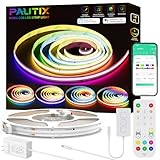
PAUTIX RGB Smart IC COB LED Strip Lights, 20 ft
Who it suits: Buyers with a long run that must be dotless and must do color — a full room perimeter in a channel, a long media-wall reveal — who want addressable COB at genuine length from one complete specialist kit, and who will check a live price before buying, because this guide could not pin one.
It is included on a check-price basis — if the live listing shows $100 or less for the 20 ft kit described here, it belongs in this guide; if it shows more, it does not, and the honest move is to take the COB Pro or the M1 above instead. The box is a genuine kit, per the maker’s own package list: the strip, a 24V 3.5A power supply sized for it, the PAUTIX SP548E pixel controller, an RF remote and a manual. Control runs through the controller’s app, with Alexa and Google Assistant compatibility per the listing, and the RF remote works with no network at all. The strip family is cuttable at marked points along the run. This guide deliberately prints no density figure for this pick: the family’s documented density belongs to a different length in the same line, and a modern guide does not borrow specifications across configurations.
The compromises begin with the missing price, which is not a formality — a pick you cannot price is a pick you must verify, and this kit’s siblings have shown wide price ranges, so the check is the purchase discipline, not a courtesy. Note too that listings for this product family include a longer 32.8 ft version; it is a different configuration from this kit, so check that the listing you open is the 20 ft kit described here. In a modern interior, where warm white is the default state and color is the exception, that ordering matters: if white light is the main job, the white-only COB kits in the under-$75 guide do that job better. Brightness and color figures are the maker’s own throughout.
- Dotless color at length: 20 ft of addressable COB — chasing effects rendered as one smooth band.
- A complete kit: strip, 24V/3.5A supply, SP548E controller and RF remote in the box, per the maker’s package list.
- App control with Alexa and Google Assistant per the listing; the listing states UL listing and a six-year warranty.
Honest limitation: Its US price could not be verified for this guide — buy only if the live listing shows the 20 ft kit at $100 or under; whites are mixed RGB rather than from a dedicated channel, and the controller’s app ecosystem is a specialist’s, smaller than Govee’s or Hue’s.
Choose it if your run is 17 to 20 feet, must be dotless, and must do color effects — and the live price checks out. Skip it if you want a price this guide can stand behind today, white light as the main job, or a platform that disappears into your smart home.
Govee Neon Rope Light 2, 16.4 ft
Who it suits: Buyers who want the one loud object in the room to be light — a single drawn line above a desk, an outline on a bedroom wall, a glowing contour along a shelf edge — and who understand that in a quiet interior, one deliberate gesture is design and two are clutter.
Every other pick in this guide is trying to disappear. Judged by the modern test, it fails disappearance on purpose and passes a different examination: as the room’s single visible gesture, its line is unbroken, its profile is clean, and its off state is a deliberate matte cord rather than an apology. It carries Matter alongside the app, Alexa and Google Assistant, matching the flagships’ smart credentials. Check the current price on Amazon for the 16.4 ft version. The box contents deserve emphasis because they break this category’s worst habit: alongside the rope, adapter and control box, Govee includes ten bend clips, fifteen clips and thirty-five screws.
The compromises are form and finality. A modern room can absorb one such gesture; a rope plus visible strips elsewhere is a theme, and themes are what this lens exists to prevent. Its whites are a rope’s whites — mixed, atmospheric, not task light — and Govee publishes no lumen figure we could verify for it. The smart layer carries the family caveat: Matter brings basic control into every platform, while the shape-mapped effects live in the Govee app. Judged as what it is, it has no rival in this guide; its honest competition is not the strips above but an actual neon sign.
- The deliberate object: a silicone rope with a continuous glow, bendable into shapes with app shape mapping.
- The mounting exception: bend clips, clips and screws included — hardware, not just adhesive.
- Matter, app and voice control; 16.4 ft in this configuration — check price on Amazon.
Honest limitation: A fixed, untrimmable length with a thick visible profile — wrong for hidden coves and wrong as a second loud object; whites are atmospheric rather than task light, and the shape effects live in Govee’s app while Matter carries basic control.
Choose it if the run is the decoration — one wall shape, one outline, one line the room is organized around. Skip it if the light should disappear into architecture; every flat strip above hides better.

Comparison Table
| Product | Format & length | Light & control | Modern verdict | Link |
|---|---|---|---|---|
| Govee COB Strip Light Pro | COB strip, 9.8 ft, 1,260 LEDs/m | RGBICW dotless color; Matter + app + voice | The line itself — passes in direct view, no channel required to look finished | Check on Amazon |
| Govee LED Strip Light M1 | Dense strip, 16.4 ft, 60 LEDs/m | RGBICW with real white channel; Matter + Govee app | The concealed flagship — even wash from a cove, invisible control layer | Check on Amazon |
| Philips Hue Solo Lightstrip | Standard strip, 16 ft, not extendable | Single-color RGBWW; Bluetooth app, full features via Bridge | The quiet plane — one disciplined color inside the Hue system | Check on Amazon |
| Philips Hue Lightstrip Plus V4 | Standard strip, 80 in, extendable to 32 ft | Single-color RGBWW; Bluetooth app, full features via Bridge | The phased plan — the only line that can grow with the room | Check on Amazon |
| PAUTIX RGB Smart IC COB Kit | COB strip, 20 ft, addressable | Chasing RGBIC effects, dotless; SP548E app + RF remote | The long line — dotless color at real length, price to be verified live | Check on Amazon |
| Govee Neon Rope Light 2 | Silicone rope, 16.4 ft, fixed length | RGBIC glow with shape mapping; Matter + app + voice | The one loud object — a drawn line, permitted exactly once per room | Check on Amazon |
The True Cost: Channel, Diffuser and the Invisible Layer
A modern installation is never just the strip, and this guide counts the whole object. Budget for channel alongside the strip — check the current price on Amazon for the strip itself — and notice what it does to the rankings: the COB Pro’s silicone sleeve already performs half the diffuser’s work, which is part of why the shortest, densest pick can be an efficient route to a finished line. The M1 plus channel is the reference installation — concealed, even, invisible — and the Hue Solo plus channel belongs in the same comparison once the Bridge is counted for buyers who need one.
Then count the control layer. The Govee flagships are complete in the box: strip, adapter, and a Matter connection that joins the platform you already run. The Hue pair are not complete on their own for a buyer starting from zero — the Bridge, sold separately, is part of the working system, so check the current price on Amazon for both pieces. Whether it is worth it depends on whether the strip is the only Hue product the home will ever own. One strip, one room, no ambitions: the toll is hard to defend. A home already lit by Hue, or planning to be: the Bridge is bought once and shared across every light that follows.
Finally, count permanence. Five of the six picks trim at marked points, and on nearly all of them the cut-off section is dead — it cannot be reconnected and lit — so the offcut is waste, and the correct purchase is the length that covers the run, not the length that almost does. The Hue Plus’s reattachable offcut is the exception, and it only rejoins another base unit. The rope cannot be trimmed at all. A modern installation is also the least forgiving of adhesive failure: a sagging strip in a minimal room is not a minor fault, it is the room’s most visible object. Clips, channel and preparation are therefore not upgrades in this guide’s arithmetic — they are line items, and a budget that cannot carry them should buy a shorter run of a better strip rather than a longer run installed on hope. The general tier guide, Best Led Strip Lights Under $100, covers these same six products by footage and features; this shortlist judges them as finished objects in a finished room, which is why its rankings differ.
How to Choose an LED Strip Light for a Modern Home Under $100
- Apply the line test first. Decide whether the strip will ever be seen directly. If yes, only COB construction passes: 1,260 LEDs per meter under silicone reads as one line at any distance, while spaced emitters read as a dotted border — decoration of the wrong kind. If the strip will always be concealed, density still matters, but as evenness: 60 LEDs per meter throws a wash without banding.
- Apply the off-state test second. Picture the installation at noon, switched off. Bare tape on a white surface fails; a strip recessed in a channel with an opaque diffuser reads as a slim metal line; the COB Pro’s sleeve reads as a finished cord. If you cannot picture the off state looking intentional, change the mounting plan before you change the strip.
- Count the installed line, not just the strip. Add channel and diffuser, clips where the run faces down, and — for Hue — the Bridge if you do not own one — check the current price on Amazon for each piece. Rankings move when the whole object is counted: the densest pick can be an efficient route to a finished line, while a Hue strip without a Bridge is not yet a complete system.
- Ask where the white comes from. A modern interior lives in warm white and uses color as an event. Three picks here make white from a dedicated channel — the two Govees’ RGBICW chips, the Hues’ RGBWW emitters. The PAUTIX mixes its whites from color, smoothly but by mixture, and the rope’s whites are atmosphere. If the strip will light faces, food or fabric, this question outranks every scene mode.
- Make the control layer disappear. The goal is a wall with nothing on it: schedules, scenes and voice running through Matter or a platform hub, no remote in sight. For a disciplined modern scheme that is usually enough; know it before you pay for effects.
- Allow exactly one loud object. The rope is a drawn line of light — a gesture. It works as the single visible feature in a quiet room and fails as one of several. If the rope is the gesture, every other run in the room should be concealed; if the room already has its gesture, buy a strip that hides.
- Decide about growth before you buy. Exactly one pick extends (the Hue Plus, at extra cost per 40 inches), one extends within its maker’s kit system (the M1, toward 32.8 ft), one is a finished length forever (the Solo), and one cannot be trimmed at all (the rope). A phased renovation and a finished room are different purchases.
- Read density before brightness. Lumens in this category are maker figures with no common standard. Hue publishes first-party ratings — 1,600 and 1,700 lumens for its two picks — and Govee publishes no verifiable total for its flagships. Density is checkable and decides what you actually see; treat it as the brightness specification that exists.
- Verify the live offer, not just the live price. Several picks here sit at the top of this tier, one pick’s listing has at times shown no featured offer, and one pick is in this guide on a check-price basis. Confirm the exact model, the exact length, and an orderable offer at or under $100 — in that order — before ordering. The room-by-room shortlists apply the same discipline to different constraints: renters should start from Best Led Strip Lights For Apartments Under $100, and anyone fitting a cove into a bedroom’s sleep-first rules should read Best Led Strip Lights For Bedrooms Under $100.
Common Buying Mistakes
- Judging a strip only switched on. The off state is half the product in a modern room — bare dotted tape on a white wall fails at noon no matter how it glows at night.
- Comparing strips by headline alone without checking footage — at this tier, one pick covers 6.6 feet and another covers 16.4 feet, and the difference is density, not value.
- Skipping the channel in the budget. The channel and diffuser are the fixture; the strip is the lamp inside it. Pricing one without the other produces a room that looks unfinished for the life of the install.
- Assuming Matter means full features. On the Govee picks, Matter carries a single color; the gradients, segments and shape effects stay in the maker’s app. Check what your platform actually receives.
- Forgetting the Bridge in the Hue math. A Hue strip plus a separately sold Bridge is a system purchase. It is a good system, but it is not a $100 purchase on its own.
- Buying the Solo for a run that might grow. It cannot be extended — ever. Growth is the Plus’s entire reason to exist.
- Buying color when the job is white. Mixed RGB white reads cold against a neutral palette; if warm white is the default state, buy a dedicated white channel.
- Making the rope the second loud object. One drawn line is design; a rope plus visible dotted strips is a theme. Choose which object speaks.
- Cutting first and reading the manual second. Cut sections cannot be reconnected on these strips; the offcut is waste, permanently — the Hue Plus’s reattachable offcut is the exception, and it only rejoins another base unit.
- Trying to trim the rope. It is a fixed length shaped with clips; design around the full 16.4 feet or choose a strip.
- Trusting adhesive on a downward-facing run. Peel-and-stick is the category’s most-complained-about component, Hue’s owner reviews included. In a minimal room a sagging strip is the most visible object you own — mount it like you expect it to stay.
Final Recommendation
- Most modern homes: Govee COB Strip Light Pro, 9.8 ft.
- Concealed feature runs: Govee LED Strip Light M1, 16.4 ft.
- One quiet plane, Hue system: Philips Hue Solo Lightstrip, 16 ft.
- A run that will grow: Philips Hue Lightstrip Plus V4, 80 in.
- Long dotless color, price checked live: PAUTIX RGB Smart IC COB Strip Kit, 20 ft.
- The one loud object: Govee Neon Rope Light 2, 16.4 ft.
Our top two divide the modern brief between them. The COB Pro is the visible answer: the densest line in the guide, a finished object switched on or off, for the runs a room is meant to look at — buy it when the line is the design. The M1 is the invisible answer: the most complete concealed strip here, with an even wash, honest white and a Matter control layer that leaves the wall blank — buy it when the light should be felt and the hardware never seen. Between them sit the Hue pair, which trade effects for discipline and platform: the Solo for the finished run, the Plus for the phased one, both counted honestly with the Bridge included. The PAUTIX offers dotless color at genuine length once its live price is verified, and the rope spends the room’s one allowance for a loud object on light itself. If the budget tightens, the same flagships also appear in Best Led Strip Lights For Modern Homes Under $75, and in genuinely small rooms, where you are always close enough to see the construction, the shortlist in Best Led Strip Lights For Small Rooms Under $100 leans even harder on density. None of the strips above pretends to be verified, waterproof or immortal. Measure the run, decide whether the strip will be seen, count the density before the lumens, price the channel and the hub with the strip, check the live offer, and mount it like architecture.
Frequently Asked Questions
Why does density matter more than brightness in a modern interior?
Because a modern room lights planes, and evenness is what a plane shows. A strip’s lumen figure — where one is published at all — is a maker figure with no common standard behind it, while emitter density is checkable and decides what you see: spaced emitters draw a dotted border, 60 LEDs per meter blend into an even wash from a cove, and 1,260 per meter under silicone draw one continuous line in direct view.
What does $100 buy in an LED strip that $75 doesn’t?
Density and construction. In the $75 tier, flagship-level density and dedicated white channels are much harder to find together in one strip. At $100 the picks here are dense, diffused or rope-built rather than spaced-emitter reels, and Hue’s extendable Lightstrip Plus joins the tier. What the extra budget does not buy is length at that quality, verified brightness, or freedom from ecosystems — the Hue Bridge requirement and the app-dependence of effects survive this tier intact.
What is the difference between the Govee COB Strip Light Pro and the Govee M1?
Density and footage, traded directly, and visibility decides between them. The COB Pro packs 1,260 LEDs per meter under a silicone sleeve and gives you 9.8 feet of it — a line that can be looked at directly. The M1 packs 60 LEDs per meter in conventional chip form and gives you 16.4 feet — a wash that excels concealed in a cove or reveal. Both are RGBICW with a dedicated white channel, both speak Matter, and both keep their segmented effects in the Govee app. Seen up close: COB Pro. Hidden and longer: M1.
Does a Philips Hue strip really need a Bridge at this price?
Not to light up — and yes for everything that makes Hue a system. The Bridge unlocks out-of-home control, real schedules and routines, grouping with other Hue lights, entertainment sync, and full voice-assistant and Matter integration. Budget honestly: both strips need the Bridge, sold separately, for the full system — check the current price on Amazon for the strip and the Bridge together before you buy, and remember that a household that already owns a Bridge adds nothing.
Is an aluminum channel really necessary, or is it an upsell?
For a concealed run in a cove, it is optional — the cove does the hiding. Count it with the strip — check the current price on Amazon for the strip and allow for channel as a separate line item; on short visible runs it is a modest part of the install, and it is the reason the COB Pro — whose sleeve does half the diffuser’s work — can be an efficient route to a finished line here.
Can I cut these strips to fit, and rejoin the pieces?
Five of the six trim at printed cut marks — and on nearly all of them, the piece you cut off cannot be reconnected and lit again. The exception is the Hue Lightstrip Plus, whose trimmed section can be reattached to another Lightstrip base unit with its included connector clip. The neon rope cannot be trimmed at all; it is a fixed 16.4 ft shaped with its included clips.
Why does one pick in this guide have no price?
Because its price could not be verified, and an invented price would be worse than a missing one. The PAUTIX 20 ft kit’s listing, model, box contents and specifications were all confirmed, but no current US price could be pinned from two independent sources — so the guide includes it on a check-price basis: buy it only if the live listing shows the full 20 ft kit at $100 or under, and take the COB Pro or the M1 instead if it shows more. For every pick in this guide, check the current price on Amazon before you buy.