Professional tile saw buying guide
The best commercial tile saws combine the cut capacity your crew actually uses with dependable alignment, manageable water or dust control, and a setup that fits the jobsite. A larger blade alone does not guarantee a better result. Daily installers need to think about the longest straight rip, diagonal capacity, plunge cuts, tile thickness, transport, cleanup, and whether a wet or dry system suits the rooms where the crew works.
This guide compares four professional-oriented examples: the DEWALT D36000S for high-capacity wet cutting, the DEWALT D24000S for a lighter wet-saw package, the DELTA 96-110 Cruzer for long cuts and rail travel, and the iQTS244 for integrated dry cutting and dust collection. The best fit depends on material, room conditions, production volume, and service support. Confirm current specifications, bundle contents, warranty terms, and seller details before ordering.
Affiliate disclosure: Daily Home Decorating participates in the Amazon Services LLC Associates Program. As an Amazon Associate, we earn from qualifying purchases.
Quick picks: commercial tile saws for different crews
| Model | Best fit | System | Published advantage |
|---|---|---|---|
| DEWALT D36000S | Large-format cuts and higher rip capacity | Wet | 37-inch rip capacity, 8.5-inch crosscut capacity, 91-pound saw, per manufacturer |
| DEWALT D24000S | Mobile contractors wanting a lighter wet package | Wet | 25-inch rip capacity, 18-inch diagonal capacity, 69-pound saw |
| DELTA 96-110 Cruzer | Long cuts with rail-guided movement | Wet | 34-inch maximum rip, 15-amp motor, 12-bearing rail system |
| iQTS244 | Dry cutting with integrated dust collection | Dry | 24-inch rip capacity, 18-inch diagonal capacity, integrated cyclone collection |
These are not laboratory rankings. We compare published features and intended uses rather than claim long-term hands-on tests. Capacity figures come from manufacturers and may describe different cuts. Rip capacity, plunge capacity, crosscut, and diagonal capacity are not interchangeable. A model that handles one long rip may still have a smaller practical crosscut. Sketch the actual tile sizes and cut directions used on your jobs, then compare that drawing against the manual.
What “commercial” should mean in a tile saw
Commercial use describes workload and service expectations, not one universal motor rating. A remodeler making occasional cuts for a bathroom has a different duty cycle from a crew processing porcelain all day across several large-format installations. The latter needs repeatable alignment, a cart or rail that stays smooth under slurry, durable fittings, quick access to the pump and tray, and replacement parts that can be sourced without excessive downtime.
Start with the cutting envelope. Record the maximum length and diagonal of tile you regularly install. Then add the workpiece support needed to keep a large slab level throughout the cut. A nominal 24-inch diagonal capacity may suit common square tiles but may not support long plank tile at an offset. Large-format products create leverage on the table and can sag or shift if extension surfaces are inadequate. Ask whether extensions come in the box or are optional accessories.
Evaluate accuracy over the length that matters to your work. Manufacturer accuracy claims often specify a distance and tolerance. They do not mean every user will produce that result under every condition. A dirty roller, misaligned guide, worn bearing, deflected stand, or poorly supported tile can change the result. The manual’s alignment procedure and service parts availability are therefore meaningful buying criteria.
Power and blade size matter, but they are not the only determinants of cut quality. The blade must match the material and saw speed. A porcelain blade, a natural-stone blade, and a general-purpose continuous-rim blade can behave differently. Confirm blade diameter, arbor, maximum speed, and permitted material with the saw and blade manufacturers. A blade that fits physically may still be unsuitable for the material or operating speed.
Commercial buyers should examine transport. A saw may roll easily across a smooth floor yet be awkward to load into a van. Check assembled weight, folded dimensions, handles, wheel size, center of gravity, and whether the table or tray can be removed for cleaning. When one person must load it, total weight and grip points may matter more than a product’s “portable” label. Ask how many lifts are needed between storage, vehicle, and cutting station.
Finally, consider the crew’s service routine. A busy shop benefits from simple daily checks and parts diagrams that are easy to find. Record the saw’s exact model and serial number, keep compatible blades and pump parts organized, and make alignment checks part of setup. A powerful machine that runs without scheduled inspection can still produce inconsistent work. Commercial suitability includes the practices surrounding the tool, not just the motor.
Wet versus dry tile saws: choose for the work environment
Wet saws: water-fed cutting with slurry to manage
A wet tile saw circulates water at the blade to cool the cutting area and control airborne debris. A good setup sends water where needed and returns splash to a tray rather than a client’s finished floor. The operator still has to manage slurry, inspect the pump, keep the tray reasonably clean, and protect nearby surfaces. Wet cutting can be a strong fit for porcelain, ceramic, and many stone jobs when the saw and blade are designed for the material.
Water management is a production issue. A tray that is hard to empty can turn ordinary cleanup into lost time. A pump filter or tray divider may help keep larger debris away from the pump, but it does not eliminate cleaning. Consider whether the saw works with a bucket or only its own tray, whether hoses and nozzles are accessible, and whether splash trays are included. For indoor cuts, plan a stable, level station and protect finished flooring, walls, cabinets, and electrical connections.
The water delivery system should be checked before work. Verify that water reaches the blade as the manual specifies and that return paths are unobstructed. A plugged nozzle can reduce flow even if the pump is running. Keep a spare pump or compatible fittings only if the manufacturer recommends them. Do not alter the water system in a way that bypasses a guard or sends water toward electrical parts.
Dry saws: less water handling, a separate dust-control decision
A dry tile saw may suit a finished interior, a location with limited water access, or a crew that wants to avoid wet slurry. The iQTS244 combines a dry-cutting saw and an integrated cyclone vacuum system according to its manufacturer. Published specifications list a 24-inch rip capacity, 18-inch diagonal capacity, and 93-pound saw weight. It has its own filter and collection maintenance requirements, so it is not a zero-maintenance shortcut.
Dry cutting silica-containing materials can create a serious airborne hazard if equipment and work practices do not control dust. Do not assume a built-in vacuum or product-page phrase is a substitute for checking applicable workplace requirements. Employers should identify the task, follow the manufacturer’s instructions, and use engineering controls and respiratory protection required for their circumstances. OSHA describes stationary tile saws as stationary masonry saws for its construction silica standard and explains the control framework. The exact setup and work duration matter.
Do not choose a method on cleanup alone
Water can create slip, electrical, and property risks when poorly controlled. Dry dust can create respiratory risks and spread through occupied spaces. A professional comparison weighs the whole process: where the saw can operate, how the work is isolated, how dust or water is controlled, what the employer’s safety plan requires, and how the area will be cleaned. A neat-looking station is not proof by itself that exposure controls are sufficient.
Teams sometimes benefit from owning both a wet and a dry setup, but it is not automatically cost-effective. Compare the types of work the crew actually books, not only the range of projects it might accept. If wet cutting is required for most stone and porcelain work and dry cutting is occasional, renting a specialty dry saw could make sense. If the crew frequently works in finished rooms and has a well-defined dust-control program, the economics may be different. Ask a dealer or rental company to demonstrate setup and cleaning before investing.
How to choose a commercial tile saw
1. Translate tile sizes into actual cut requirements
List the largest square tile, longest plank, thickest stone, and most common notch or diagonal cut. Check each against rip, diagonal, crosscut, plunge, and depth capacities. A spec sheet may publish several numbers because each describes a different configuration. Plunge capacity can exceed ordinary rip capacity, but that does not automatically mean an entire cut can be completed in one pass through every material.
Measure finished dimensions rather than relying only on nominal labels. A nominal 24-inch tile may have slightly different actual dimensions, while clips, edge profiles, or a required bevel can change how it sits on the saw. If a product is too large for the working envelope, do not improvise a support arrangement that leaves it unstable. Use a machine designed for the work or consult the manufacturer for an approved configuration.
2. Match blade and motor capacity to your material
Read the tile maker’s recommendations for cutting and the saw’s blade limits. Porcelain can be demanding on a blade, while some natural stone needs careful handling to avoid chipping or heat-related damage. Motor horsepower or amperage tells only part of the story. Blade quality, feed rate, water delivery or dust collection, and support influence the result. Use a sharp blade specified for the material, and dress or replace it only as the blade manufacturer directs.
Electrical supply deserves attention. Verify voltage, current draw, circuit requirements, extension-cord guidance, and whether a pump or vacuum shares an outlet. iQ lists a 17-amp total system draw for the iQTS244 because the saw and vacuum operate together. Do not assume every outlet or generator can support a tool merely because its voltage matches. Check the manual and power plan for the jobsite.
3. Evaluate accuracy, rigidity, and adjustment
Look for a stable frame, predictable cart movement, positive fence stops, and adjustment points that do not drift easily. A guide that moves smoothly when clean may bind when slurry or grit accumulates. If possible, inspect how the rail is protected, whether rollers are accessible, and how the manufacturer instructs owners to check alignment. A usable calibration procedure can help restore a saw after transport or routine service.
Check alignment before a production run using an appropriate sample and the manual’s procedure. Do not judge only by the first inch of a cut. A small error can become more visible along a long edge, and the finish can reveal problems not obvious on scrap. Document the setup and verify it again after the saw is moved, the blade is changed, or a component is serviced.
4. Check the stand, extensions, and footprint
A stand affects both cut quality and worker comfort. A stable stand reduces movement as a large tile travels, while a folding or wheeled design may reduce setup time. A stand adds weight and cost, so confirm its working height, footprint, locking points, load support, and compatibility with the exact model. A saw-only configuration can be better when the crew already has a suitable workbench or dedicated cutting station.
Measure entrances, elevators, hallways, and the storage vehicle. DEWALT says the D36000 can fit through standard 30-inch door frames when configured as specified; still measure your own passage and check the assembled dimensions. A “portable” claim depends on orientation and included cart. For a van-based crew, compare the longest component and how easily one technician can secure it.
5. Calculate downtime and support costs
Purchase price is only one part of commercial cost. Estimate blade replacement, pump or filter maintenance, tray cleaning, dry-collection consumables, service labor, and the cost of interrupted work. Ask a dealer about local service and parts for rails, rollers, pump fittings, guards, switches, and stand components. A familiar brand may have a broad dealer network, but check current availability rather than assume it.
Warranty details can differ between the saw, accessories, and wear items. Confirm whether registration is required, whether commercial use affects terms, and what documentation is needed. Read return terms and shipping costs, especially for a large machine. An Amazon listing can represent an authorized product, marketplace seller, bundle, or separate configuration; check the seller and exact model number before checkout.
6. Consider the whole crew, not a single operator
A productive tool is one the crew can set up and maintain consistently. Clear controls, understandable adjustments, protected storage for guides, and accessible cleaning points help when operators share equipment. A higher-capacity saw can still slow a team if it takes too long to set up or move. Ask the people who will transport, clean, and calibrate the machine to evaluate it alongside the lead installer.
Training matters as much as hardware. Review the operator’s manual, explain approved work practices, and make sure users understand blade limits, guarding, water or dust controls, and emergency shutdown. Make the manufacturer’s documentation available at the worksite. Do not rely on memory for electrical, service, or blade-change instructions.
7. Compare product support where you work
Commercial equipment eventually needs service. Before purchase, find the nearest authorized repair provider and ask whether the model has parts support for components most likely to wear. Rails, pumps, motors, bearings, switches, and collection filters can affect downtime. A brand with a nearby service center may be preferable to a machine with more headline capacity but slow parts access.
Check whether the manufacturer sells replacement components directly and whether the manual has exploded diagrams and clear adjustment procedures. Keep a small record of maintenance dates, blade changes, and alignment work. These notes help identify repeated issues, support a warranty claim, and prevent a second operator from unknowingly using a machine that needs attention.
Best commercial tile saws: four models to compare
The descriptions below summarize current manufacturer information and do not claim hands-on testing. Fit, price, bundle contents, and Amazon availability can change. Verify the model number and compare the listing to the manufacturer page and operator’s manual before buying.
1. DEWALT D36000S — best high-capacity wet saw for large-format work

Check exact configuration, seller, and availability.
View on Amazon
The D36000 family is aimed at installers who need more capacity than a compact homeowner saw provides. DEWALT lists a 37-inch rip capacity, 8.5-inch crosscut capacity, and a plunge capacity that can extend the rip number to 41 inches. The maker says the saw weighs 91 pounds and notes its width can pass through a standard 30-inch door frame in the specified configuration. A 15-amp motor is intended for demanding applications; the package includes a water pump, trays, guides, and a porcelain blade per the product page.
The high capacity helps when work includes oversized tile or repeated long cuts. The crosscut figure is the limiting spec for certain narrow pieces, so do not buy based on the 37-inch rip number alone. The saw also needs room to operate; confirm its stand and tray footprint in the intended setup. Long cuts reward careful support and a clean cart. Check alignment rather than assuming a large saw automatically delivers a straight finished edge.
This model can suit a tile contractor regularly handling large-format porcelain and requiring a wet system with an integrated stand. It may be excessive for a crew whose common work is small backsplash pieces or occasional repairs. Compare it with the lighter D24000S if one-person loading matters more than added capacity. Review the DEWALT D36000 manufacturer page and manual for full details.
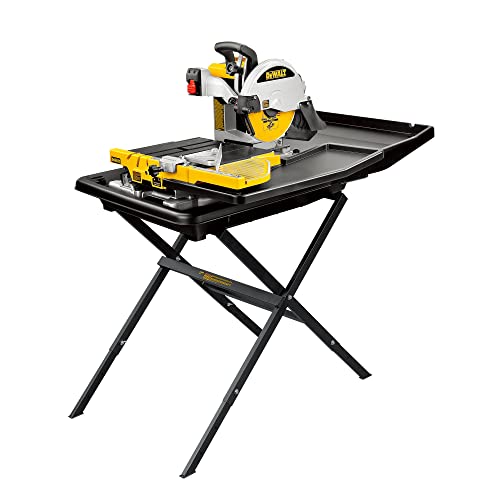
2. DEWALT D24000S — best lighter wet setup for mobile contractors
Verify the saw and stand are included in the listing.
View on Amazon
For a crew that moves between smaller or medium jobs, the D24000S offers a more compact alternative in DEWALT’s wet-saw range. DEWALT publishes a 25-inch rip capacity, 18-by-18-inch diagonal capacity, and 28-inch plunge capacity. The saw itself is listed at 69 pounds. The S configuration is a stand package with a sliding cart, pump, water pan, splash trays, guides, and other accessories. These details may appeal to a contractor who wants a relatively complete wet station without the larger D36000 cut envelope.
Do not confuse the saw-only D24000 with the stand bundle D24000S. Marketplace listings can vary, and the linked Amazon ASIN should be checked for the exact package before checkout. A lighter machine still needs a stable setup and space for water handling. If the crew regularly cuts wide slabs or long plank tile, a higher-capacity saw may reduce repositioning. If daily tasks are closer to standard field tile, the lower carry weight may be a more useful tradeoff.
DEWALT says the D24000 can cut dense porcelain, ceramic, granite, marble, and glass with a suitable blade. Confirm current blade compatibility and operating instructions. A lighter machine may simplify loading, but it does not remove the need for safe lifting or a second person when the task calls for it. See the D24000S manufacturer specifications for current bundle and capacity information.
3. DELTA 96-110 Cruzer — best wet saw for long cuts and rail movement
Confirm whether the stand is part of the selected configuration.
View on Amazon
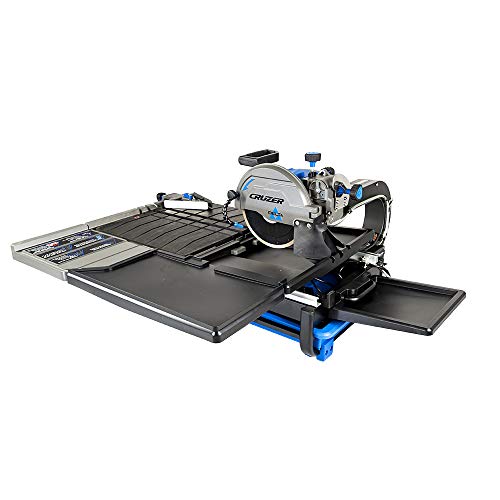
The Delta Cruzer stands out for its rail design and long rip rating. Delta lists a 15-amp, 120-volt motor, 10-inch diamond wheel, 34-inch maximum rip cut, 24-inch square-tile diagonal capacity, and 3-3/8-inch maximum depth of cut at 90 degrees. The maker describes a rail with 12 bearings designed for smooth movement. Flexible water nozzles and front tray access address the water-management side of daily use.
Its long straight capacity helps on plank tile and large workpieces, but a rail number does not guarantee every slab is fully supported. Use suitable extensions and follow the manufacturer’s limits. The listed 96-110 may be sold without a stand; Delta also has a 96-110FS version with a folding stand. Verify the exact suffix, included accessories, and weight before comparing marketplace pages.
The Cruzer may suit a contractor who values longer rip cuts and an accessible water tray. Consider the footprint and local parts service. Delta lists a one-year warranty on its product page; review current terms. The Delta 96-110 official product page and owner’s manual library help confirm the configuration.
4. iQTS244 — best dry-cut system with integrated dust collection
Check included blade, stand, filter, and current configuration.
View on Amazon
The iQTS244 takes a different approach: dry cutting with an integrated cyclone vacuum system. iQ Power Tools lists a 24-inch rip capacity, 18-inch diagonal capacity, 1-inch cutting depth, 93-pound saw weight, 120-volt power, and a 17-amp total system draw for the saw and vacuum together. Its official page describes cutting ceramic, porcelain, marble, granite, and stone with the Q-Drive blade. It is a specialized system rather than a generic substitute for every wet-saw job.
Its main appeal is reducing water and slurry on sites where wet cutting is inconvenient or risky for nearby finished surfaces. The dry chamber and filter still need routine maintenance, and the saw needs adequate electrical capacity. Consider replacement filters, the approved blade, and service-parts availability in the total cost. Integrated collection does not make exposure disappear; evaluate the actual task and controls required at the worksite.
Before using a dry saw on silica-containing material, read the manual, use the collection system as specified, and follow the employer’s exposure-control plan. Do not use product marketing alone to decide legal compliance or respirator needs. The official iQTS244 product page gives current specifications, accessories, and support details.
Compare total jobsite cost, not just checkout price
Two tile saws with similar headline capacity can have very different costs over a year. Estimate how many days the saw will be used, how far it travels, and how many minutes the crew spends on setup and cleaning. A wet saw may have lower equipment complexity but require tray and floor cleanup. A dry system can reduce water handling while requiring filter care and a careful dust-management plan. Track actual time on representative jobs rather than relying on generalized savings claims.
For a high-volume installer, small time savings across multiple jobs can matter more than a lower purchase price. A specialty saw that sits idle between projects may be better rented or sourced through a local tile supplier. Rental also lets a crew assess a large-format model before committing. Ask about blade condition, alignment, accessories, and return cleaning; a poorly maintained rental saw can misrepresent what a model is capable of.
Consumables should be part of the comparison. Include compatible blades, pump filters, nozzles, trays, extensions, splash guards, and dry-system filters where applicable. Keep the manual and parts diagram accessible. Use only parts and lubricants approved by the manufacturer. Avoid adapting fittings or bypassing guards to keep production moving.
Compare retailer price with warranty, delivery, service, and return terms. Large saws can be expensive to ship back. Confirm whether the listing is new, used, refurbished, or bundled with an accessory kit. Check the product identifier on the box against the order, and retain the receipt, serial number, and registration details. Ask the manufacturer or dealer how warranty support applies to business use.
Planning for storage and transportation
A saw that is stored wet or dirty may develop corrosion, clogged pumps, or residue that affects later work. Ask the crew where the equipment will be cleaned and dried, and whether the tray can be drained without carrying a full load of slurry. A model with accessible cleanout points can simplify maintenance. For dry equipment, identify a place to empty and service the collection system according to its manual rather than allowing dust to accumulate in a vehicle.
Measure the transport space before buying. Include the folded stand, extension tables, water tray, blade case, and tools needed for setup. Secure the machine against movement during transport and protect delicate rails and alignment surfaces. When the crew shares a truck with tile and installation materials, a compact footprint may improve the overall workflow even if the saw has lower capacity.
Jobsite safety, water, and silica considerations
Tile and stone cutting calls for attention to electrical safety, guarding, stable support, water management, and dust exposure. Set up on a level surface that supports both the machine and workpiece. Keep cords and plugs protected from water, use the electrical protection required by the manual and jobsite plan, and do not operate damaged equipment. Never bypass a guard, switch, or other safety feature to force a cut.
Silica exposure is a workplace hazard when cutting certain tile, stone, and masonry. OSHA’s construction guidance says stationary tile saws are treated as stationary masonry saws for its silica standard and points employers to Table 1 controls or an alternative exposure-control method. Requirements depend on task, exposure, and circumstances. Employers should consult the rule, assess work, and train workers; this guide is not a compliance plan or a substitute for professional safety advice. See the OSHA construction silica FAQ.
Wet cutting may help reduce airborne dust when the saw’s water delivery system operates as designed, but water must also be contained and electrical components protected. Dry systems need their specified collection components and maintenance. Do not sweep dry silica dust or blow it with compressed air where that could contribute to exposure; OSHA identifies housekeeping controls and restrictions for covered construction tasks. Use cleaning methods and protective equipment according to the worksite plan.
Before each shift, inspect the blade, guards, water or collection system, cart, rail, stand, and cable. Make sure the workpiece is supported and that the operator can move it without reaching across the blade. Follow the manual for blade changes and service, disconnecting power as directed before maintenance. If a saw vibrates unusually, leaks, stalls, or loses alignment, stop work and inspect rather than forcing the cut.
Use hearing and eye protection as appropriate to the manual and site assessment. Keep bystanders clear, especially when handling large-format tile. Plan lifting for heavy or awkward slabs; a second person or material-handling aid may be necessary. Proper training and safe work procedures are essential for commercial crews.
Wet and dry models side by side
| Consideration | DEWALT D36000S | DEWALT D24000S | DELTA 96-110 | iQTS244 |
|---|---|---|---|---|
| System | Wet | Wet | Wet | Dry, integrated collection |
| Published rip capacity | 37 in. (41 in. plunge) | 25 in. (28 in. plunge) | 34 in. | 24 in. |
| Diagonal/crosscut figure | 8.5 in. crosscut; verify tile orientation | 18 in. square tile | 24 in. square tile | 18 in. |
| Published weight | 91 lb. | 69 lb. | Confirm exact saw/stand configuration | 93 lb. |
| Main tradeoff | High capacity, larger footprint | Lighter, more limited envelope | Long rail-guided cut | Less water handling, dust controls required |
Use this table to shortlist rather than decide. Verify every figure for the exact configuration you plan to buy. In particular, weights can refer to saw-only models while bundles include stands and accessories. Diagonal, rip, and plunge figures describe different orientations. For crews who cut other construction materials, our guides to concrete saws, chop saws, and saws for cutting plywood cover distinct machines and applications. A 10-inch miter saw guide may also help with separate wood trim work.
Frequently asked questions
What size tile saw do commercial installers usually need?
There is no single size for every installer. Match rip, diagonal, crosscut, plunge, and depth capacity to the tile and cuts on actual work orders. Large-format porcelain may justify a higher-capacity machine, while a mobile repair crew may prioritize weight and setup. A wider table, support extensions, and accurate alignment matter alongside blade diameter.
Is a 10-inch tile saw professional grade?
A 10-inch blade is common in professional wet and dry systems, but blade size alone does not define suitability. Frame rigidity, cart alignment, capacity, duty cycle, water or dust management, service support, and the correct blade all matter. Compare the full saw and manual rather than judging only by blade diameter.
Should a commercial crew buy wet or dry?
Choose based on the work environment and task. Wet saws manage cutting with water but create slurry and need containment. Dry saws can reduce water handling but require effective dust controls, filter upkeep, and a site-specific silica plan. A company may need both types for different projects.
Does a built-in dust collector make a dry saw OSHA compliant?
Do not infer compliance from one product feature. OSHA requirements depend on the task, material, exposure, controls, and how the system is operated and maintained. Employers should review the silica standard and guidance, use specified controls or assess exposure using an allowed method, and provide required training and protection.
Are Amazon listings reliable for checking configuration?
Use the listing to review current availability and seller information, but confirm the model number and included accessories with the manufacturer. Saw-only models and stand bundles can look similar. Check whether the blade, pump, tray, stand, extension table, and fence are included. Marketplace sellers and bundles can change.
How often should a commercial tile saw be realigned?
Follow the manual’s inspection and calibration instructions. Recheck after transport, major adjustment, repair, blade replacement if specified, or whenever a test cut indicates drift. Keep rails and rollers clean and inspect them for wear. Check alignment with a stable setup and an appropriate sample before production cutting.
What accessories should I budget for?
Common costs include blades matched to the material, stands, extension tables, water trays, pumps or hoses, filters, splash guards, and transport protection. Dry systems may need specialized blades and filters. Confirm compatibility by exact model number; accessories from a similar model may not fit safely.
Final recommendation
For a commercial crew, the best tile saw is the one that matches the material, cut envelope, work locations, and safety program without adding unnecessary downtime. The DEWALT D36000S targets larger wet cuts; the D24000S trades capacity for lighter handling; the DELTA Cruzer emphasizes long rail-guided rips; and the iQTS244 offers integrated dry cutting and collection. Verify specifications and bundles, then consider a rental or dealer demonstration before a high-cost purchase. Whichever system you choose, keep the manual, inspect the equipment routinely, use the specified blade and controls, and train every operator.
Certain content that appears on this site comes from Amazon. This content is provided “as is” and is subject to change or removal at any time. Product examples and images are supplied through Amazon Creators API; confirm specifications and availability on the current listing.