Best Concrete Saws: How to Choose the Right Saw for Concrete and Masonry
The best concrete saws match the scale and shape of a cut to the machine that can make it with suitable control. A handheld cut-off saw can handle many short cuts in concrete block, pavers, and slabs. A walk-behind saw makes straighter, deeper, repeatable cuts across flatwork. A specialized wall saw, ring saw, or concrete chain saw may be required when an opening or cut must go deeper than a conventional disc can reach. The word “concrete saw” covers several distinct tools, so choosing by name alone can result in buying equipment that is too small, too heavy, or poorly matched to the work.
This guide explains how to compare saw types, blade compatibility, rated cutting depth, wet and dry operation, power source, dust and slurry controls, and practical limits. It is a research-based buying guide, not a report of hands-on tests. Manufacturer models and configurations change, and specifications differ by tool, blade, guard, and region. Verify the current manual and product documentation for the exact model before purchase or operation.
Affiliate disclosure: DailyHomeDecorating.com may earn a commission from qualifying purchases through links in this article. This does not affect the price you pay.
Amazon product examples to compare

ASIN: B0F22M62ZY

ASIN: B0H6NP4ZJL
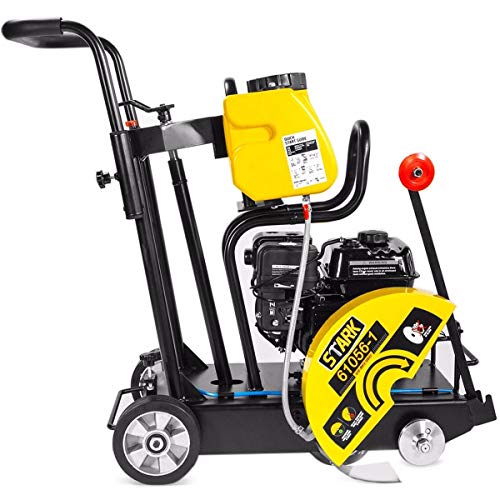
ASIN: B07W2YB1W8

ASIN: B097Z79XZF
Certain content that appears on this site comes from Amazon. This content is provided “as is” and is subject to change or removal at any time. Product examples and images are supplied through Amazon Creators API; confirm specifications and availability on the current listing.
Table of contents
- Quick guide to concrete saw types
- Handheld, walk-behind, and specialty saws
- How to choose a concrete saw
- Diamond blades and material compatibility
- Wet cutting, dry cutting, dust, and slurry
- Gas, corded electric, and battery power
- Planning and setup
- Safety and maintenance
- How to compare tools and what this guide covers
- Frequently asked questions
Quick guide: which kind of concrete saw fits the work?
| Tool category | Typical strength | Important limitation |
|---|---|---|
| Handheld cut-off / power cutter | Portable short cuts in block, pavers, masonry, and some slab work | Depth is limited by blade diameter and guard; the operator must control the tool and material |
| Walk-behind floor saw | Straight, repeatable cuts and joints in slabs, pavement, or flatwork | Requires access, stable ground, a suitable blade, and careful control of water or dust |
| Wall saw, ring saw, or concrete chain saw | Specialty cuts, openings, flush cuts, or greater depth in walls and structural elements | Cost, training, anchoring, utilities, and structural planning can be substantial |
| Tile saw | Accurate controlled cuts in tile on a table or with a tile-specific handheld design | Not a general slab saw; capacity and guarding are intended for tile work |
For a small number of short cuts, renting a suitable handheld tool may make more sense than purchasing a professional saw. For long, straight cuts in a driveway or floor, a walk-behind saw is easier to guide consistently than a handheld cutter. For a structural wall opening or a cut deeper than the safe, rated reach of a disc, get advice from a qualified concrete-cutting contractor and engineer as needed. Reinforcement, post-tensioning, embedded services, and the structure’s load path are not details to discover with a blade.
Handheld, walk-behind, and specialty concrete saws
Handheld cut-off saws for portable masonry work
A handheld cut-off saw—often called a power cutter or concrete saw—uses a large abrasive or diamond disc. Its portability makes it useful for cutting masonry units, pavers, openings, and edges that a floor saw cannot reach. Depending on model and blade, it may cut concrete, asphalt, stone, or metal. These materials are not interchangeable from a blade perspective: use the blade specifically approved for the material and operating method.
Handheld cutters can be gas-powered, corded electric, or battery-powered. Their size and power do not remove the need for two-handed control, an intact guard, correct blade installation, and secure support for the workpiece. They are not the right tool for every home project. A masonry saw used for a few cuts may be better rented, and work involving thick reinforced concrete or a structural opening should be scoped by a specialist. Husqvarna describes its power cutters as handheld machines for concrete, masonry, asphalt, metal, and related construction materials; its own documentation also emphasizes operator qualification, application limits, and manual-specific operating directions. See the manufacturer’s power cutter overview and consult the manual for the selected product.
Walk-behind saws for slabs and pavement
Walk-behind saws carry the blade and engine or motor on a wheeled chassis. The operator guides the machine along a marked path, often using a pointer, guide, or track feature. They are designed for slab and pavement work where a straight, controlled groove is more useful than handheld maneuverability. Some machines are intended for contraction joints in fresh concrete, while others cut cured concrete or asphalt. “Walk-behind” alone does not tell you the right timing, blade, depth, or water system.
Compare the saw’s rated blade diameter, maximum depth, arbor, guard, water connection, machine weight, and path-guidance method. A large machine may need a trailer or ramp for transport and substantial room to turn. The slab may need adequate support on both sides of the cut; an unsupported section can shift or pinch the blade. The operator must also plan where the cut will end and how the offcut will be supported. Worksite rules and the manufacturer’s procedures apply.
Specialty wall, ring, and concrete chain saws
When the cut must go deeper than a disc can reach, specialty equipment can make a different cut geometry. Ring saws, wall saws, and concrete chain saws each have their own systems and limitations. A concrete chain saw can be useful for openings, corners, or cuts where a circular disc would leave an uncut radius, but it is not a homeowner chainsaw with a masonry chain. It is a specialized machine and chain system. A wall saw may be rail-mounted and anchored; this can improve control for a planned cut but requires careful installation and structural assessment.
Do not buy a specialty saw based only on a headline maximum depth. The usable cut depends on the specific tool, bar or blade, guide, approach angle, and whether the cut is made from one or multiple faces. Existing reinforcement, embedded conduits, plumbing, post-tension cables, and structural conditions may determine whether cutting is appropriate at all. For work on a load-bearing wall, foundation, retaining wall, or post-tensioned slab, involve qualified professionals before cutting.
How these differ from tile saws and ordinary circular saws
A concrete saw uses a blade and guard designed for the machine’s speed, material, and load. A tile saw is configured around tile dimensions and controlled cuts, commonly using a water-fed table. It may be suitable for some small tile jobs but is not a substitute for a floor saw on a slab. Read our tile saw guide for tile-specific capacity, water management, and blade considerations.
A standard woodworking circular saw uses a toothed blade and is not designed to cut concrete with an arbitrary masonry disc. Some handheld power cutters resemble large circular saws, but their spindle, guard, speed, water system, and blade compatibility are specific. Never put an accessory on a tool unless its manual explicitly permits that accessory and application. Our circular saw guide discusses wood-cutting circular saws, while a chop saw guide covers a different stationary cutting category.
How to choose among the best concrete saws
1. Define the material, cut path, and job volume
Start with the work rather than the tool’s marketing category. Record what you are cutting: cured or fresh concrete, mortar block, brick, pavers, asphalt, stone, or a composite material. Note whether it contains reinforcement or surface coatings. Identify the cut type: a short notch, a long straight joint, a flush cut, an opening, or repeated cuts of the same length. Estimate total cutting length, frequency, access, and how clean the surrounding area must remain. A handful of small cuts and daily production cutting call for different equipment.
Also determine whether you can use water safely, how the machine will reach the site, and where slurry or dust will go. If there are plans or utility drawings, review them. For buildings and slabs, locate hidden services and reinforcement using appropriate methods before work. A consumer stud finder is not a complete utility-locating system. If uncertainty remains, stop and hire qualified locating and cutting professionals.
2. Match the saw type to cut direction and workpiece
Choose a handheld saw for portable access and short, controlled cuts. Choose a walk-behind saw for longer, straight cuts in supported flatwork. A rail or wall saw may be more appropriate for large vertical openings or repeatable structural cuts, while ring saws or concrete chain saws may address specific corners and depth requirements. When the job is a simple straight cut in suitable tile, a tile cutter or tile saw may be the right category instead. For wood, use a wood saw.
The geometry matters. A disc blade leaves a rounded termination where the cut meets an edge; it cannot make a perfectly square inside corner without another method. A concrete chain saw or secondary chipping operation may be used for certain details, but the choice depends on the project. Avoid improvising multiple overlapping cuts unless the machine maker and project plan permit the technique.
3. Check depth in realistic terms
Manufacturers generally describe maximum cutting depth alongside compatible blade sizes or tool configurations. Do not treat the blade’s full diameter as cut depth. The spindle and guard occupy space, the blade has a radius, and the tool’s design constrains how far it can enter material. Actual reach also depends on approach angle, blade wear, and whether the cut can be made from one or both sides. A listed maximum may not be appropriate for every material or operating condition.
For a deep cut, compare not only the maximum figure but the process required: multiple passes, flipped work, a larger machine, an alternative system, or a contractor. Each pass may change the kerf, dust control, and stability demands. If a cut must pass through a wall or slab, confirm the far side is clear and supported. Never force a smaller saw beyond its rated capacity. A deeper capacity is not a substitute for knowing what is inside or what the cut will do to the structure.
4. Compare power source, mobility, and duty cycle
Gas power cutters are mobile and can suit outdoor work without an electrical supply. They produce exhaust, require fuel and engine maintenance, and can be noisy. They should not be operated in enclosed spaces where exhaust can accumulate. Corded electric saws avoid engine exhaust but require a correctly rated electrical supply, suitable protection, and careful cord routing; water use makes electrical setup especially important. Battery cutters reduce cord management and exhaust at the point of use, but runtime, battery cost, charging, and platform availability matter.
Consider how long the saw will operate under load, not just whether it can start. A tool intended for occasional short cuts may not be suitable for sustained production. Verify duty-cycle guidance, cooling intervals, battery limits, and maintenance requirements in the manual. Tool weight matters during a short handheld cut and during transport; with a walk-behind saw, machine weight may contribute to stability but also affects loading, turning, and surface protection.
5. Compare the blade system and arbor details
Confirm blade diameter, arbor size, rotation direction, guard clearance, maximum rated speed, and material rating for the exact saw. The blade must be compatible with the saw’s rotational speed and mounting hardware. For diamond blades, compare the segment design, bond hardness, wet or dry rating, and the material for which the blade is intended. Reinforced concrete, abrasive masonry, asphalt, and hard tile can require different blade designs.
Do not infer compatibility from a blade fitting physically. A blade can have the right diameter but the wrong arbor, speed rating, segment design, or operating requirement. Some blades are designed for wet cutting; some permit dry use with limits and exposure controls. Follow the manufacturer’s instructions for inspection, installation, direction, break-in, and replacement. Never use a damaged or visibly worn blade, and never remove a guard to fit an oversized accessory.
6. Evaluate guidance, visibility, and operator control
For handheld work, look for a secure grip, a clear view of the cut line, a predictable guard, and controls that can be reached without changing hand position. A guide, track, or cutting shoe can help where the tool supports it. For a floor saw, consider how the cut line is tracked, how the blade is lowered, whether the handle position suits the operator, and whether the machine can be moved across the actual surface. The operator must maintain a stable posture and avoid twisting the blade in the kerf.
Vibration, noise, and reaction forces can affect control and fatigue. Product weights and vibration values are not directly comparable unless test conditions and measurement methods match. If possible, inspect the actual machine or ask a qualified rental shop to demonstrate its setup. A training demonstration does not replace the manual or formal instruction for commercial work.
Diamond blades and concrete saw compatibility
Why most concrete cutting uses diamond blades
Concrete, brick, stone, and many masonry materials are abrasive and hard. A diamond blade uses exposed industrial diamonds held in a metal matrix to grind through the material. The blade does not work like a wood saw with teeth that slice fibers. It must be matched to both the material and the machine. Manufacturers may offer blades for general concrete, hard or reinforced concrete, abrasive materials such as asphalt, masonry, or specialized tasks. The proper choice can affect cutting speed, blade life, heat, and the risk of binding.
Segmented rims commonly provide spaces that help clear debris and cool the blade; continuous or specialized rims may be intended for different finishes or materials. This is only a general description: the blade maker’s label and instructions determine its intended use. Do not choose solely by segment appearance or price. Check whether the blade is rated for wet or dry cutting, whether it is approved for the saw’s maximum speed, and whether the arbor and guard match. If a tool manufacturer specifies a particular blade category, follow that guidance.
Wet-cut and dry-cut blades are not interchangeable by assumption
Wet cutting supplies water to the blade and cut. Water can cool the blade and suppress airborne dust, but it creates slurry and wet surfaces. Dry-cutting blades and machines may be designed for intermittent operation, dust shrouds, or a compatible extractor. A “dry” label does not mean dust is harmless or that a standard shop vacuum is adequate. Some blades are rated for both methods only under stated limits. Follow the exact blade label and saw manual.
Keep the blade aligned with the cut and avoid twisting or side-loading it. Let the saw and blade cut at the designed rate; pressing harder can raise heat and increase binding. If the blade stalls, vibrates unusually, loses segments, or makes a new sound, stop and inspect after the machine has been isolated. A worn or inappropriate blade may cut slowly, but forcing it can create a hazard. Replace blades based on condition and manufacturer instructions, not just a calendar schedule.
Arbor, rotation, speed, and guard checks
Before purchase, verify that the blade’s arbor fits the saw as specified and that required flanges or bushings are included and approved. Confirm the blade’s maximum rated RPM meets or exceeds the saw’s operating speed. Install it in the marked direction if directional, and make sure the guard covers the blade as designed. A blade that physically mounts but is not rated for the saw can fail at high speed. Do not substitute hardware-store spacers or adapters unless the saw maker approves them.
Also check blade availability in the local market. A specialized diameter or arbor can make replacement inconvenient. For professional use, the cost of the correct consumable and the dealer’s support may matter more than a lower upfront tool price. If your work includes both asphalt and concrete, check whether changing blades is needed and how to prevent contamination or wrong-blade installation.
Wet cutting, dry cutting, dust, and slurry
Silica dust is a major selection and setup issue
Cutting concrete, stone, mortar, brick, and other silica-containing materials can release respirable crystalline silica. These very small particles can be inhaled deep into the lungs. Dust control should be part of the tool and job plan, not an accessory considered after the saw is purchased. OSHA’s construction silica standard lists specific control methods for tasks including handheld power saws and walk-behind saws. The exact requirements depend on the task, tool, location, and work context; employers must follow the applicable rule and implement the controls correctly. Read the current OSHA respirable crystalline silica standard and its construction silica information. These are workplace requirements and general information, not a substitute for a job-specific safety plan.
For handheld power saws, OSHA’s fact sheet explains an integrated water-delivery system that continuously feeds water to the blade as a control method for covered construction tasks. OSHA’s Table 1 separately lists requirements for walk-behind saws, including use of a saw with integrated water delivery and other conditions. The exact table entry and any respiratory protection requirements depend on duration, location, machine category, and implementation. Read the OSHA handheld power saw fact sheet and standard rather than assuming every wet system meets every requirement.
Wet cutting: manage water, electricity, and slurry
Wet cutting can reduce dust and help cool a compatible blade, but the water supply must be designed for the saw. Check the flow connection, nozzle placement, minimum supply, drainage, and whether the saw can operate with the intended source. Do not improvise a hose arrangement that can catch, leak onto electrical components, or block the operator’s view. Keep water away from electrical connections unless the tool and supply are specifically rated and protected for the environment. Use cords, ground-fault protection, and power sources as required by the manual and applicable rules.
Slurry contains fine cementitious solids and may be alkaline. Collect and dispose of it according to local requirements; do not wash it into a storm drain or allow it to harden on finished surfaces. Wet floors create slip hazards. Protect nearby landscaping, drains, doors, and electrical equipment. Husqvarna’s manufacturer material describes water delivery as a dust-suppression and blade-cooling method for compatible cutters and notes that slurry and wet conditions need management. See the manufacturer’s hardscaping equipment information and the exact manual for product-specific setup.
Dry cutting: use a designed system and control the exposure
Dry cutting may be necessary where water would damage the work area or where the machine is designed around a dust extraction shroud. The shroud and extractor must be approved for that saw and material. Check required airflow, filter class, hose diameter, and maintenance instructions. A vacuum that fits the port may still have inadequate filtration or airflow. Dry cutting can also involve duty-cycle limits to manage heat; follow the blade and saw directions and do not infer that any dry-rated blade can run continuously at any depth.
Husqvarna’s dry-cutting guidance describes a specific power-cutter configuration with dust extraction and emphasizes selecting an extractor with enough airflow. That is a useful example of why dry cutting depends on a matched system rather than simply omitting water. See Husqvarna’s dry-cutting guidance. For workplace tasks, follow OSHA’s relevant silica control provisions, including any requirements not captured by a generic product description. Respirators, when required, must be selected and used within an appropriate respiratory protection program; a disposable mask is not a replacement for engineering controls.
Choosing water or dust extraction for a real job
Ask what surface and surroundings can tolerate. A wet system may be preferable on an outdoor slab with drainage and slurry collection. A dry system may be more practical in some interior renovations only if the saw, blade, shroud, extractor, and work practices are rated and planned for that job. If neither approach can control the exposure or protect the building, stop and bring in a qualified contractor. Never make dust control decisions based only on the visibility of dust; respirable particles can be difficult to see.
For repeated cuts, plan the water source or extractor before mobilizing. Verify hose routing, power, drainage, filter cleaning, replacement bags, and the location of bystanders. Do not position another worker in the dust plume. Keep the cutting zone isolated from occupants and avoid blowing dust around with compressed air. Cleanup should use wet methods or a suitable filtered vacuum, as appropriate to the material and applicable rules.
Gas, corded electric, and battery power
Gas-powered cutters
Gas cutters offer mobility and can be useful where a power outlet is unavailable. They require fuel handling, engine maintenance, air filtration, spark plug and starting-system care, and exhaust management. Operate them only in locations allowed by the manual; gasoline exhaust creates a serious hazard in enclosed or poorly ventilated spaces. Noise, heat, vibration, and fuel storage also shape the work plan. Confirm that local restrictions allow the tool and that the operator has suitable training and protective equipment.
Compare displacement or rated output only within a model’s stated test framework. These figures do not by themselves establish productivity in a particular material. The blade, operator, cut depth, concrete composition, reinforcement, water, and maintenance all matter. Use the correct fuel and mix, if applicable, and observe warm-up and shutdown instructions. Do not transport or store fuel in a way that violates the manual or local fire rules.
Corded electric cutters
Corded models avoid engine exhaust and can suit indoor or stationary work where the electrical supply and dust or water controls are appropriate. Check voltage, current draw, circuit capacity, plug, cord condition, grounding, and any required ground-fault device. A long or undersized extension cord can cause voltage drop and heat; use only cords permitted by the manual and applicable standards. Route the cord away from the blade, water, vehicle paths, and cut line. Never handle a damaged cord or connector while energized.
Water and electricity require deliberate separation. Use the specified water system and electrical protection, keep connections out of wet areas, and do not use the tool in conditions beyond its rating. If you are uncertain about circuit requirements or protection, ask a qualified electrician. A convenient outlet is not necessarily an adequate supply.
Battery-powered cutters
Battery equipment can make setup simpler where outlets and fuel are inconvenient. Consider the battery platform, pack capacity, number of packs needed, charger availability, and charging time. Cutting dense or reinforced material places a different demand on a battery than light, intermittent work. Runtime claims are tied to test conditions and should not be treated as guaranteed hours on a job. Check whether the saw is designed for wet cutting, what battery protection applies, and whether water exposure is permitted around the tool and pack.
Battery models can still be heavy, loud, and capable of severe injury. Remove or isolate the battery before installing a blade or performing maintenance. Keep packs dry and use only the specified charger. If the motor, battery, or saw overheats, follow the maker’s shutdown and cooling guidance. The absence of a cord does not make an indoor dust-producing cut safe.
Planning and setup before the first cut
Confirm the cut is safe and permitted
Before cutting an existing slab or wall, determine whether it contains reinforcement, post-tension cables, electrical conduits, plumbing, radiant heating, or other embedded elements. Consult construction records and use qualified locating methods. If the structural function or internal layout is unknown, do not proceed. A saw can sever an energized cable or pipe, damage a tensioned tendon, weaken a structural element, or cause a slab section to drop unexpectedly. For structural modifications, consult an engineer or qualified contractor as appropriate.
Mark the cut path clearly on both sides where possible and verify the dimensions. Establish an exclusion zone for bystanders and protect adjacent finishes. Confirm that the section being removed will remain supported and can be handled safely. Large cutouts can be heavy, unstable, and sharp-edged. Plan lifting and disposal before starting, not after a section is free.
Inspect the saw, blade, guard, and controls
Read the complete operator manual and accessory instructions. Inspect the guard, handle, blade flange, arbor, water line or extraction connection, trigger, lockout, and power source. Check the blade for cracks, missing segments, warping, glazing, or damage. Verify its direction, material rating, speed limit, and mount. Make sure the guard is positioned as instructed and moves freely. For electric tools, inspect cords and connections; for gas tools, inspect fuel lines and filters; for battery tools, check packs and contacts.
Install or change a blade only after the tool is fully isolated: unplug the cord, remove the battery, or shut down and follow the gas tool’s isolation steps. Use the specified wrench and flange components. Tighten as instructed without improvising. Reinstall the guard and any water or dust attachment before testing. Start the machine in a clear area as directed by the manual and confirm it runs without abnormal vibration or noise.
Support the work and plan the path
Secure blocks and pavers so they cannot tip or roll. Support slab sections to prevent the kerf from closing on the blade, while avoiding a setup that causes the offcut to fall. For a handheld saw, stand in a stable position with a clear retreat path and keep both hands on the intended handles. For a floor saw, prepare a level route and ensure the machine can roll without hitting hoses, cords, debris, or uneven edges. The tool should be guided with controlled pressure; do not force it through the material.
Follow the maker’s recommended cutting sequence, depth increments, and blade feed. Some jobs require a pilot cut or multiple passes. Do not rely on generic advice to determine the pass depth; concrete strength, reinforcement, blade type, and saw design differ. If the saw binds, stalls, pulls, or shifts, release the control as directed, wait for the blade to stop, isolate power, and resolve the cause before restarting. Never pull a spinning blade out of a trapped kerf unless the manual provides a safe procedure.
Safety, operator protection, and maintenance
Use guarding and task-appropriate protective equipment
Wear eye and hearing protection, suitable footwear, gloves appropriate to the operation, and task-specific protective equipment specified by the manufacturer and worksite plan. Loose clothing and jewelry can catch. Keep hands away from the blade path and never defeat a guard. A face shield may supplement eye protection but does not replace safety glasses or goggles. The operator should be trained for the specific machine and blade system, especially for professional and structural work.
OSHA’s hand and power tool hazards guidance discusses guarding and common tool hazards. The applicable requirements vary between workplaces and consumer use; the saw’s manual and local rules remain essential. For silica-producing construction tasks, use the control method specified for the exact category of work and establish the applicable respiratory protection program when required. Keep the public, coworkers, and pets away from the cutting area.
Control kickback, blade binding, and dropped sections
A concrete blade can bind in a closing kerf, catch on reinforcement, or react to an unstable workpiece. Maintain the tool’s intended position, avoid twisting the blade, and never cut with a damaged or incompatible accessory. Do not reach across the blade or stand where a shifting section can fall onto you. Use support and cutting sequence appropriate to the material and machine. A large saw can carry significant momentum; do not try to stop it with your body or hand.
When cutting overhead or from a ladder, reassess the plan. Handheld cut-off saws are heavy and can produce substantial reaction forces; overhead use may be prohibited by the manual or unsafe for the operator. Use proper platforms and tools designed for the position. If the cut requires an awkward reach or unstable stance, change the access method or hire a specialist.
Maintain the blade and machine
Clean slurry and concrete dust from the saw after use according to the manual. Inspect hoses, fittings, guards, filters, air intake, blade flanges, fasteners, and controls. Allow the blade and machine to cool before handling. Replace a blade when damaged, worn, or no longer cutting as intended; do not dress a blade with a method the manufacturer does not approve. Keep water channels and nozzles clear. Store blades dry and protected from impact, and keep the machine in a clean, secure location.
Maintenance schedules differ across gas, electric, battery, and walk-behind equipment. Follow the service intervals, lubrication, filter replacement, fuel storage, battery care, and winterization instructions for the specific product. Record service for equipment used frequently. If a machine develops excessive vibration, leaks, loose hardware, damaged wiring, a sticking control, or unusual heat, remove it from service until repaired by a qualified technician.
Plan cleanup and waste handling
Concrete slurry and dust should be treated as job waste. Keep wet slurry out of storm drains and waterways; let it settle or use approved collection and disposal methods where permitted. Use appropriate vacuuming or wet cleanup rather than dry sweeping or compressed air that disperses dust. Do not wash fine cement material onto finished surfaces, soil, or landscaped areas without checking local requirements. Secure blade guards and isolate power before transporting the machine.
How to compare tools and what this guide covers
For a disciplined comparison, make a short worksheet for each candidate saw. Record the exact model and region, tool category, power source, approved blade diameter and arbor, maximum rated speed, stated cut depth, wet or dry capability, guard type, water or extraction connection, machine weight, and required accessories. Add the manufacturer manual, service availability, replacement blade options, warranty terms, and what it costs to rent the same category of saw. Do not compare a handheld cutter’s depth with a floor saw’s depth as if the tools share one operating method.
Next, test the fit against the actual job: material, cut length, cut direction, required finish, number of cuts, indoor or outdoor location, water tolerance, transport access, dust plan, and operator skill. Identify what would make you stop: unknown utilities, structural uncertainty, unavailable water or extraction, inadequate electrical supply, or cut depth beyond the model’s rated capacity. If the tool cannot meet a requirement with the approved accessories and controls, move to a different category or a professional service.
This guide uses manufacturer documentation to explain saw categories, cutting systems, blade compatibility, and operating limits. OSHA materials provide workplace silica and hand-tool context. It does not rank named saws based on laboratory measurements or hands-on testing, and it does not make current price claims. Product specifications and availability change, so confirm them on the exact manufacturer page and manual before purchase. Useful primary references include the Husqvarna power cutter range, the maker’s dry-cutting system guidance, the OSHA construction silica standard, and its handheld saw dust-control fact sheet.
Where a product has an Amazon listing, an image or product card should be added only after verifying the exact model and its identifier through the authorized product API. The card should not imply independent testing or endorsement. Where a candidate is not sold through Amazon, a search link should identify the full, verified product name and model rather than pointing to an unrelated item.
Frequently asked questions
What is the best type of concrete saw for a homeowner?
It depends on the cut. A handheld cutter can suit a small number of short masonry cuts, while a walk-behind saw is better for longer straight cuts in flatwork. Renting the correct tool can be more practical than buying it for one project. If the cut affects a structural slab or wall, includes possible embedded services, or needs significant depth, use qualified professionals.
Can I use an ordinary circular saw to cut concrete?
Do not attach a concrete blade to an ordinary circular saw unless the saw manufacturer explicitly approves that blade and application. Concrete cutting requires a compatible machine, guard, speed rating, dust or water control, and operating method. A woodworking saw may not be designed for the load, exposure, or accessory. Use a purpose-built masonry cutter or another approved system.
How deep can a handheld concrete saw cut?
Depth depends on the saw design, blade diameter, guard, approach, and material. Check the manufacturer’s stated maximum for the exact model and blade. A blade’s diameter is not the same as usable depth, and a maximum rating may require a particular configuration. For deeper cuts, a specialty saw or a cut from multiple faces may be needed, subject to structural review.
Is wet cutting always safer than dry cutting?
Wet cutting can suppress dust and cool a compatible blade, but it creates slurry and slippery surfaces and requires the right water and electrical setup. Dry cutting requires a saw and blade designed for the method and effective dust extraction or other controls. Neither method is automatically safe in every setting. Follow the manufacturer instructions and applicable silica requirements.
Can a concrete saw cut rebar?
Some machines and blades may be rated for reinforced concrete, but reinforcement changes the work and may affect blade choice, cutting rate, heat, and tool reaction. Never assume that a general concrete blade can safely cut every embedded metal. Identify the reinforcement, check the manufacturer’s approved application, and consult a qualified contractor or engineer when the structural implications are unclear.
Do concrete saws require a special blade?
They require a blade compatible with the saw, arbor, speed, guard, material, and wet or dry method. Diamond blades are common for concrete and masonry, but blade construction and ratings vary. Check the saw and blade manuals together. A blade that fits physically may still be unsafe or unsuitable.
Should I buy gas, corded, or battery power?
Gas offers mobility outdoors but produces exhaust and needs fuel and engine service. Corded electric avoids engine exhaust but needs an adequate protected supply and careful cord routing. Battery saws offer cordless convenience but require enough packs, charging, and battery-platform investment. Compare the actual work duration, setting, dust plan, and operator needs rather than choosing by power source alone.
When should I hire a concrete-cutting contractor?
Hire a qualified contractor when the cut is structural, unusually deep, overhead, near uncertain utilities or post-tensioning, or too large for the tool and operator you have. A specialist can evaluate access, locating, support, dust control, and removal sequencing. If the cut’s consequences are not clear, pausing to get professional advice is part of the project plan.
Conclusion
The best concrete saw is the machine that fits the material, cut path, required depth, access, and exposure controls. Handheld power cutters prioritize portability; walk-behind saws support long, straight slab cuts; specialty wall, ring, or chain systems address particular depth and geometry problems. Blade fit, water or extraction, workpiece support, and the location of hidden services matter as much as the motor. Compare exact manufacturer documentation, plan the dust and slurry controls, and treat unknown structural conditions as a reason to stop and consult a qualified professional.
Always follow the saw and blade manuals, applicable workplace requirements, and local rules. This article is general buying information and does not replace training, engineering review, or a job-specific safety plan.