Where to buy
Check the latest price, availability and delivery on Amazon. Orders are placed on Amazon. We may earn a commission from qualifying purchases.
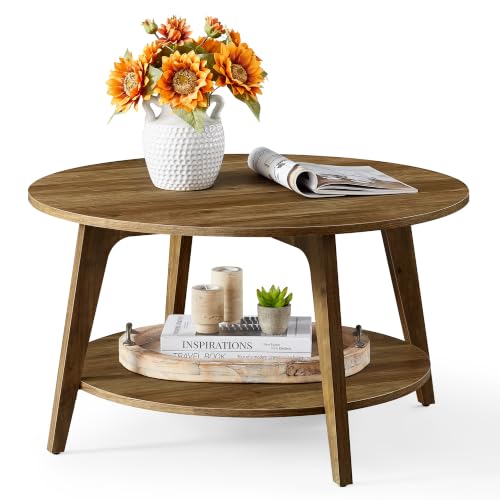
- Best overall for small spaces: VASAGLE MAEZO Round 2-Tier Coffee Table, Honey Brown — Check on Amazon
- Yaheetech Lift Top (Espresso) — Check on Amazon
- WLIVE Mid-Century Lift Top (Grey) — Check on Amazon
- Nathan James Asher Glass Top — Check on Amazon
See 2 more Amazon options
- WLIVE 39-Inch Lift Top (Rustic Brown) — Check on Amazon
- Rolanstar 41.7-Inch Lift Top with Baskets — Check on Amazon
Read the full guide ↓
Disclosure: As an Amazon Associate, dailyhomedecorating.com earns from qualifying purchases. Links to Amazon on this page are affiliate links; they cost you nothing extra. Listing details such as price and availability change often, so check the current Amazon listing before you buy.
The best coffee table for small spaces under $400 is chosen by subtraction. In a compact room — a small living room, a den, a snug in a shared house, the seating corner of an open-plan flat — every inch of floor is already spoken for, so the question is never just what a table does, but what it costs the room to do it. A table that is three inches too deep steals the walkway. A table with the wrong shape turns a tight seating group into an obstacle course. And a table that cannot hide the remote-and-charger layer forces a small room to look untidy even when it is clean, because in a small space there is nowhere for clutter to be out of sight except inside the furniture itself.
This guide compares six verified tables under $400 purely on small-space performance: footprint efficiency, shape behaviour in tight gaps, storage per square foot, visual weight, and how easily each table moves when the room needs to change shape. Every dimension, material and load rating was checked against a manufacturer or retailer listing. The ordering will surprise readers of our general roundup — the simplest table here takes first place, because in a small space, the discipline of a 31.5-inch round with a shelf beats a feature list attached to a footprint the room cannot afford. Larger picks are included with their measurements stated plainly, so you can rule them in or out with a tape measure rather than a guess.
In short: start with the VASAGLE MAEZO if the room is genuinely small; take the Yaheetech if you also need the table to work as a desk; and let the tape measure, not the photographs, arbitrate everything else. The tier below is covered in Best Coffee Table For Small Spaces Under $300, and the same tables ranked without the space lens are in Best Coffee Table Under $400.
In this guide
Quick Picks
Small-space maths at a glance: footprint first, storage per inch second, looks third. The round table wins this table because it is the only pick that shrinks the gaps around it as well as its own size.
| Pick | Best for | Size | Storage | Link |
|---|---|---|---|---|
| VASAGLE MAEZO Round 2-Tier | Best overall for small spaces | 31.5″ diameter x 17.7″H | Open lower shelf | Check price on Amazon |
| Yaheetech Lift Top (Espresso) | Best lift top for small spaces | 38.6″L x 19.7″W x 16.5″H closed, top lifts to about 22″H | Hidden compartment + open lower shelf | Check price on Amazon |
| WLIVE Mid-Century Lift Top (Grey) | Best compact work-from-sofa | 39.4″W x 19.7″D x 16.9″H closed, top lifts up and forward | Hidden compartment + adjustable side shelf | Check price on Amazon |
| Nathan James Asher Glass Top | Best for visual space | 39″W x 20″D x 18″H | Open lower shelf | Check price on Amazon |
| WLIVE 39-Inch Lift Top (Rustic Brown) | Best compact storage | 38.6″W x 18.9″D x 17.9″H | Hidden compartment + drawer + 2 open shelves | Check price on Amazon |
| Rolanstar 41.7-Inch Lift Top with Baskets | Best for small-but-mighty storage — measure first | 41.7″W x 19.7″D x 18.9″H closed, top lifts to 23.8″H | Hidden compartment + 2 shelves + 2 rattan baskets | Check price on Amazon |
How These Picks Were Chosen
Verification came first, as always — dimensions, materials and load ratings confirmed from manufacturer or retailer listings — because small-space buying is measurement buying, and a listing that cannot state its own size cannot be trusted with yours. The small-space screen then scored four things. Footprint efficiency: surface and storage delivered per square foot of floor taken. Gap behaviour: whether the shape lets you tighten the sofa gap and walkway — rounds score, rectangles with hard corners do not. Storage density: hidden volume matters more in small rooms, because visible clutter shrinks a room faster than furniture does. And mobility: in a compact room the table will be moved for guests, cleaning and rearrangement, so weight and simplicity counted.
We kept the Rolanstar in the list deliberately, flagged, because some ‘small spaces’ are small in one dimension only — a narrow but long room can take a 41.7-inch table against a long wall-side sofa where a wide one would fail — and because its baskets solve a storage problem nothing else here touches. But the ordering follows the median small room, and the median small room should stop reading at the third pick. The Asher’s inclusion is the other judgement call worth explaining: it is not small, at 39 inches wide, but its glass top returns visual space, and in small rooms perceived space is a real resource, spent and saved like the physical kind.
What we excluded matters too: nesting tables and C-tables are excellent small-space tools, but they are different product categories with their own guides in this series — Best Nesting Tables For Small Spaces Under $400 covers the most flexible of them — and mixing them here would have blurred the comparison. This list is for households that want one proper coffee table, sized and shaped correctly.
A word about the numbers small-space buyers should trust least and most. Trust dimensions measured in inches from the listing’s specification table — all six picks publish them, and we have quoted them exactly. Trust per-part load ratings for the surface you will load. Distrust staged photographs, ‘fits small spaces’ claims in titles (the Rolanstar’s own marketing says it, about a 41.7-inch table), and any size described only in adjectives. Small-space shopping is the most measurement-dependent buying in the home, and the listings that respect that — full dimensions, honest ratings, stated weights — are the ones this guide is built from. If a model you love elsewhere will not state its size plainly, that silence is itself a measurement: of the maker’s confidence.
The 6 Best Coffee Tables for Small Spaces Under $400
VASAGLE MAEZO Round 2-Tier Coffee Table, Honey Brown
The VASAGLE MAEZO is what small-space discipline looks like: a round two-tier table, 31.5 inches in diameter and 17.7 inches high, that asks the room for the smallest possible centre and gives back more than its size suggests. The round form is the key technology. It lets the sofa gap close to the comfortable minimum because there are no corners for knees to negotiate; it lets a walking line pass diagonally across the seating area without a hip-check; and it can sit slightly off-axis in an awkward room — a bay, a corner arrangement, a room with a fireplace stealing one wall — without looking misplaced, which no rectangle can do. The lower shelf carries the books and the remote basket, so the top stays a clear disc for drinks and a laptop.
Specification honesty: particleboard and MDF in a honey brown finish, rated to 66 pounds, 25 pounds in weight, assembly quoted at around 20 minutes. None of that is luxurious, and all of it is appropriate. The light weight is a small-space feature in itself — this is the table you can lift aside one-handed when the room becomes a guest room, a workout space or a play floor, and put back without thinking about it. The tapered legs and curved transitions keep the floor visible underneath, preserving the sightline that makes a compact room read as calm. As part of VASAGLE’s MAEZO collection it can also match side pieces later, when the room evolves.
Who it suits: genuinely small living rooms, dens, snug seating corners, and any room where people walk through the seating area rather than around it. The honest limitations are the open shelf — storage is visible, so it rewards tidy households — and the fixed height, which offers no desk mode. Choose it when the room’s problem is space itself. Skip it if the table must hide a work kit or feed a family dinner; those jobs belong to the lift tops, and the Yaheetech does them in the next-smallest footprint here.

Yaheetech Lift Top Coffee Table with Hidden Compartment, Espresso
If the small space must also contain a home office, the Yaheetech is the answer that fits. Its footprint is the most efficient of the lift tops — 38.6 inches long by 19.7 deep — and it converts: closed, it is a tidy table at 16.5 inches high; lifted to about 22 inches, it is a desk at sofa height; and underneath, a hidden compartment of 33.9 by 15.4 by 4.2 inches holds the entire work kit, so the small room never has to look at the office after hours. That concealment is the small-space superpower. In a compact room, visible clutter does not just look messy, it measurably shrinks the perceived space — and a compartment this size, plus an open shelf for the console and books, removes the whole layer in one motion.
The ratings support real use: 44 pounds on the closed top, 22 lifted, 33 in the compartment, 40 on the shelf. The MDF panels and metal mechanism build to 42 pounds — planted in place, movable by one determined adult when the room changes shape. The dark espresso finish is the one aesthetic caution: in a very small, pale room a dark block can advance toward the eye, so pair it with a light rug and keep its surface clear, which the compartment makes easy. Assembly is an hour in place; build it where it will stand, because a finished lift top is an awkward thing to carry through a small room’s doorways.
Who it suits: small rooms that double as offices, dens with a sofa bed, anyone whose clutter problem and space problem are the same problem. The honest limitations are the raised top’s light load and slight play — a typing surface, not a draughting table — and the visual weight of the dark finish. Choose it when the space is small but the job list is long. Skip it when the room needs visual lightness above all; that is the Asher’s brief, below.
WLIVE Mid-Century Lift Top Coffee Table with Adjustable Shelf, Grey Wood
The grey WLIVE is the compact worker’s alternative, and its small-space credential is proportion: at 39.4 inches wide, 19.7 deep and only 16.9 inches high closed, it is the lowest table in this group, and low is a strategy in small rooms. A lower table keeps the sightline across the room unbroken, sits correctly against the low sofas and futons compact rooms favour, and never crowds a low ceiling. Its lift top rises and pulls toward you — the ergonomic version of the mechanism, bringing the work surface over your lap instead of leaving it at arm’s length — so a small room gains a desk without gaining a desk’s footprint, and the hidden compartment plus adjustable side shelf hide the evidence afterwards.
The grey wood finish helps the cause: cool, pale-adjacent tones recede in small spaces where warm dark finishes advance, and the mid-century lines — clean, tapered, unadorned — carry less visual weight than the blockier storage models. At about 42 pounds in engineered wood it is as stable as the Yaheetech. The side shelf’s adjustability is a genuine small-space asset, reconfiguring around a console, upright books or a taller object as the room’s needs change, rather than fixing the storage geometry on day one. Dust shows on grey sooner than on mid-brown; in a small room the table is always in reach, so the weekly wipe costs nothing.
Who it suits: small rooms with low seating, studio corners, work-from-sofa households in pale, modern schemes. The honest limitations: storage volume trails the drawer-equipped WLIVE, and the raised top is a light-load surface like all lift tops. Choose it for low profile and ergonomics in a tight footprint. Skip it if maximum storage per inch is the priority — the next pick, its rustic sibling, packs more into a similar outline.
Nathan James Asher Mid-Century Coffee Table, Glass Top with Rustic Oak Shelf, Gold
The Asher is the counterintuitive pick, included because small-space thinking that only counts inches misses half the problem. At 39 inches wide, 20 deep and 18 high it is not the smallest table here — but its top is tempered glass, and glass returns what the tape measure cannot count: sightlines. You see the rug through it, the floor through it, the light through it, so the room’s centre stops reading as occupied territory. In a compact room, that perception is worth several real inches. The slim brass-toned legs and the rustic oak lower shelf draw only the horizontal lines, and at 31 pounds the table is light enough to slide aside whenever the room changes purpose — a daily event in small spaces.
The material suits the life, too: tempered glass is furniture-grade and strong, never stains or warps, and wipes perfectly clean, so the one surface a small room cannot hide always looks intentional. The full-width shelf below holds the styled layer — books, a tray, a basket for the remotes — visible by design, which disciplines a small room into keeping only presentable things at its centre. Assembly is legs and shelf, minutes of work, no mechanism to install in a cramped corner. Nathan James lists it as model 31201 in the Asher line.
Who it suits: small rooms with good light, pale schemes, and households whose clutter lives in other furniture. The honest limitations are absolute: no hidden storage, no lift, and a surface that displays every mark until wiped — in a small room, you will always be close enough to notice. Choose it when the space problem is visual rather than functional. Skip it if the table must hide anything at all; in this list, that means the Yaheetech or a WLIVE.
WLIVE 39-Inch Lift Top Coffee Table with Hidden Compartment and Drawer, Rustic Brown
The rustic WLIVE makes the storage-density argument: in a similar outline to the Yaheetech — 38.6 inches wide, 18.9 deep, 17.9 high — it packs three storage systems where most tables offer one. A hidden compartment under the lift top, rated to 49 pounds, for the laptop and games; a slide-out drawer for the small daily objects that otherwise colonise every surface in a small room; and two open shelves for books and the console. The overall rating is 200 pounds with the lifted top at 11 pounds. In a compact home without a hall cupboard or spare drawer, that architecture is not a luxury — it is the difference between a room that resets in two minutes and one that never does.
The lift frame is designed to lower slowly, the MDF top carries a waterproof, scratch-resistant finish in rustic brown, and wide flat legs keep it steady on the thin rugs small rooms use. The maker quotes around 35 minutes of assembly with labelled parts — feasible solo, in place, which is how small-space assembly always happens. The costs are proportion and tone: at 17.9 inches it is the tallest of the compact picks, and the warm rustic finish plus partitioned front give it more visual presence than the grey model, so in the very smallest pale room it will feel like a guest who takes up more chair than expected.
Who it suits: small homes short on drawers and cupboards, gadget-heavy households, one-room-living arrangements. The honest limitations: the 11-pound lifted rating is the lightest working surface here, and the look is rustic, not minimal. Choose it when storage per square foot is the metric that matters. Skip it for the tiniest, palest rooms, where the VASAGLE’s circle or the Asher’s glass will serve the space better. For flexible overflow storage, Best Storage Ottoman For Small Spaces Under $400 pairs naturally with any pick here.
Rolanstar 41.7-Inch Lift Top Coffee Table with Hidden Compartment and 2 Rattan Baskets, Rustic Brown
The Rolanstar closes this list under the same flag it carried in our apartment guide, and in a small-spaces guide the flag is bigger. The facts: 41.7 inches wide, 19.7 deep, 18.9 high closed, lifting to 23.8; a hidden compartment; two partitioned shelves with two rattan baskets included; engineered wood on a metal frame, rated to a maximum recommended 88 pounds, about 43 pounds built. The case for it in a small space is narrow but real: a room that is small in width but long — a gallery-shaped living room, a converted sunroom — can place this against a long sofa where its length runs with the room instead of across it, and its baskets then solve the soft-clutter storage that small homes struggle with most, in the footprint of the table itself.
Every other small-space scenario should pass. In a square small room, this table plus its necessary gaps consumes the centre entirely; its assembly is the longest here, in the room least able to host a build; and its warm, busy frontage advances visually in pale compact schemes. The tape test is not a suggestion with this model, it is the decision: outline 41.7 by 19.7 inches, add 14 to 18 inches on the sofa side, walk the remaining lines, and let the floor tell you. If it passes, you gain the best blanket-and-toy storage in the series. If it fails — and in most small rooms it will — the Yaheetech delivers the same lift-and-hide concept in a footprint four inches narrower and noticeably lower.
Who it suits: long, narrow small rooms with a full-length sofa and a soft-clutter problem. The honest limitation is that it is a large table being discussed in a small-spaces guide, and it knows it. Choose it only on the tape test’s authority. Skip it in square or tiny rooms without a second thought — the top of this list exists for you.
Comparison Table
In a small space, sort by the size column and be ruthless: a table that fails the footprint test fails entirely, whatever its storage. Then compare storage — in a compact room, hidden volume is worth more than open shelves.
| Model | Size | Top type | Storage | Link |
|---|---|---|---|---|
| VASAGLE MAEZO Round 2-Tier | 31.5″ diameter x 17.7″H | Fixed round top, particleboard/MDF | Open lower shelf | Check price on Amazon |
| Yaheetech Lift Top (Espresso) | 38.6″L x 19.7″W x 16.5″H closed, top lifts to about 22″H | Lift top, engineered wood | Hidden compartment + open lower shelf | Check price on Amazon |
| WLIVE Mid-Century Lift Top (Grey) | 39.4″W x 19.7″D x 16.9″H closed, top lifts up and forward | Lift top, engineered wood | Hidden compartment + adjustable side shelf | Check price on Amazon |
| Nathan James Asher Glass Top | 39″W x 20″D x 18″H | Fixed tempered glass top | Open lower shelf | Check price on Amazon |
| WLIVE 39-Inch Lift Top (Rustic Brown) | 38.6″W x 18.9″D x 17.9″H | Lift top, engineered wood | Hidden compartment + drawer + 2 open shelves | Check price on Amazon |
| Rolanstar 41.7-Inch Lift Top with Baskets | 41.7″W x 19.7″D x 18.9″H closed, top lifts to 23.8″H | Lift top, engineered wood | Hidden compartment + 2 shelves + 2 rattan baskets | Check price on Amazon |
How to Choose a Coffee Table for a Small Space
Measure the room’s truth, not its estate-agent dimensions. Note the seating group’s real footprint: sofa length and depth, where chairs actually sit, the walking lines that must survive — door to sofa, sofa to kitchen, the route a guest takes at night. Then the table’s allowance is whatever remains, minus 14 to 18 inches of gap on the sofa side. In most small rooms that arithmetic lands between 31 and 40 inches of table length, which is why this list is ordered the way it is. Tape the finalist’s footprint on the floor and perform the room’s daily life around it — sit, stand, carry, pass — before any money moves. Small rooms forgive many purchases, but not a wrong footprint.
Choose shape by traffic. If people pass through the seating area, or the gap is tight, a round table is not a style preference but a flow device: the VASAGLE’s 31.5-inch circle lets bodies and knees curve past where a rectangle’s corners would catch. If the seating is a self-contained island nobody crosses, a rectangle returns more surface and storage per inch. Corner rooms, bays and L-shaped sectionals almost always vote round; long narrow rooms vote for a rectangle run along the sofa’s length. Let the room’s movement pattern decide, and the aesthetics will follow surprisingly well.
Then spend the space budget on the function the room lacks. Small spaces fail in specific ways: no desk (answer: a lift top — Yaheetech or grey WLIVE), no drawers (the rustic WLIVE’s three-way storage), no visual room to breathe (the Asher’s glass), no floor to spare at all (the VASAGLE). Name the failure before shopping, because a small room cannot afford a table that solves a problem it does not have while ignoring the one it does. Check the per-part load ratings for the surface you will actually load — lifted tops here run from 11 to 22 pounds — and confirm the tabletop height against your compressed seat cushions, within an inch or two.
Finally, favour tables that can change their mind. Small rooms get rearranged — for guests, seasons, new sofas, new lives — so weight and simplicity are long-term features: the 25-pound VASAGLE and 31-pound Asher will be repositioned a hundred times without resentment, while a 43-pound storage table is a commitment to one layout. Keep the assembly hardware, build in place, and choose the table your room can grow around rather than the one it must grow around. More flexible small-space pieces live in Best End Table For Small Spaces Under $400.
Leave, as the last check, a margin for the room to change. Small spaces get redecorated by life constantly — a new sofa, a baby, a desk job moving home — and the table that survives those changes is the one whose size is moderate, whose style is quiet and whose weight one person can shift. That is a final, quiet argument for the top of this list: the VASAGLE, the Yaheetech and the grey WLIVE are all, in different ways, easy to forgive. The dramatic, the huge and the fussy all demand the room stay as it is. In a small space, it will not — so choose the table that can come along for the changes.
Visual Space: The Other Half of a Small Room
A small room has two sizes: the one on the floor plan and the one your eye reports. Furniture choices move the second as surely as walls move the first. Tables you can see under and through — the Asher’s glass, the VASAGLE’s tapered legs and open shelf, the grey WLIVE’s low profile — keep the floor in the picture, and a visible floor is the strongest signal of spaciousness a room can send. Dark, blocky tables ground a room; that is a virtue in a large one and a cost in a small one, which is why this guide pairs its darkest pick, the Yaheetech, with the advice to keep its surface ruthlessly clear and its rug light. Neither approach is wrong; mismatching approach to room is.
The same logic governs clutter. In a large room, a messy coffee table is a local problem. In a small room it is a whole-room condition, because the table is always in the frame. That is why hidden storage earns its footprint here out of proportion to its volume, and why the two display-style picks — glass and round — come with the discipline that everything on them must deserve to be seen. Choose the table whose relationship with clutter matches your household’s honesty, and a small room will feel considered rather than compressed. For the floor beneath it all, Best Living Room Rug For Small Spaces Under $400 covers the sizing that makes a compact seating group read as one calm unit.
There is a psychological dividend to getting the centre right that deserves the last word in this section. A small room with a correctly sized, clear-topped table does not merely look bigger; it behaves calmer — people move through it without negotiation, sit down without shuffling, and stop apologising for the space when guests visit. Hosts relax, guests relax, and the room’s size quietly leaves the conversation. That transformation is available at every point in this guide’s price frame, and it is never bought by features. It is bought by proportion, by honesty about clutter, and by a tape measure used before a card. Small rooms do not need more space. They need fewer apologies — and the right table is where the apologies end.
Pairing the Table With the Rest of a Small Room
A coffee table never sits alone, and in a small room its relationships decide whether the space coheres or crowds. Start with the rug, because the rug is the room’s true floor plan. In a compact seating group, the rug should extend under the sofa’s front legs and give the table a border on all sides where possible; a table centred on its rug reads as a composition, while a table larger than its rug reads as an incident. The VASAGLE’s 31.5-inch circle suits the smaller rugs small rooms use, and the Asher’s glass earns a special dividend here — the rug’s pattern stays visible through the top, so a beautiful rug can be smaller and still do its work. If the rug and table fight for the same inches, shrink the table before the rug; the rug’s border is what makes the group look intentional.
Side pieces should repeat the table’s logic at smaller scale. A small room rarely needs two end tables; one, placed where the main seat’s drink actually lands, plus a floor lamp behind it, usually completes the group — and every un-bought end table is floor the room keeps. Choose side pieces that share the table’s visual weight: leggy with leggy, glass with open, so the group reads as one decision. Storage should be distributed by frequency — daily things in the coffee table’s compartment or drawer, occasional things in a storage ottoman or a hall piece — rather than concentrated in one maximal unit, because in a small room the thing you need is always behind the thing you do not. Nesting tables, covered in their own guide in this series, are the flexible alternative when the group must expand for guests and vanish afterwards.
Height choreography is the subtle part. A small room feels calm when its furniture forms a descending landscape: sofa back highest, table low and central, lamps drawing the eye up at the corners rather than the middle. That is why the low picks here — the 16.5-inch Yaheetech, the 16.9-inch grey WLIVE — settle so well into compact rooms, and why a tall table in a small space feels like a fence even when its footprint is modest. Keep the table’s surface below the sofa’s arm line where you can, keep tall objects off its centre, and let one plant or lamp carry the vertical accent at the group’s edge. The room will read as designed, at exactly the same square footage.
And keep the group’s population under review. Small rooms drift: a side table arrives, a footstool follows, a plant stand appears, and one day the seating group is a furniture crowd with a person-shaped gap. The coffee table, as the centre and the largest piece, sets the discipline — if it is compact, clear-topped and doing two jobs, it argues by example for every other piece to justify itself the same way. Audit the group twice a year with the tape measure and the walking routes, and let pieces that no longer earn their footprint go. A small room maintained like that does not feel small; it feels finished — which is the entire point of choosing its centrepiece this carefully.
One final small-space habit separates the rooms that stay calm from the ones that slowly fill: the one-in-one-out rule applied to the table itself. Every object that earns a permanent place on or in the coffee table displaces something else back to a cupboard, a bedroom or out of the home entirely. The picks in this guide make that rule livable — a compartment with fixed dimensions is a budget you cannot overspend, a shelf that shows everything shames accumulation before it starts, a basket that is full is full. Let the table’s capacity be the room’s capacity policy, reviewed each season when you clean underneath and behind it (another small-space ritual the lighter picks here make painless). A compact room is not a storage problem waiting for a bigger home; managed this way, it is a finished answer — and the coffee table, chosen with the discipline this guide has argued for, is the piece that keeps it finished.
Common Buying Mistakes
Scaling by the photograph. Styled product shots use cavernous rooms. A table that looks modest online can be the largest object in your actual room. The tape test — exact footprint, real gaps, a walked route — is the only reliable scale reference you own.
Leaving no walking line. A small room still needs a path through it that does not involve turning sideways. If the table forces a shuffle past its corners, go round or go smaller; daily friction compounds into hating the room.
Buying open storage for hidden clutter. Open shelves display what they hold. Chargers, paperwork and remotes on an open shelf make a small room look smaller and messier. If your clutter is not display-worthy, pay for a compartment, not a shelf.
Ignoring visual weight. Two tables of identical size can differ enormously in how much room they seem to take. Dark blocks advance; glass and pale, leggy designs recede. In a small space, choose recession unless the room needs an anchor.
Bolting the layout down. Heavy, complex tables freeze a small room’s only advantage — flexibility. If you rearrange for guests, films or seasons, weight and assembly simplicity belong on your checklist beside size, or every rearrangement becomes a two-person chore you stop doing.
Final Recommendation
For a genuinely small space, the VASAGLE is the buy: the smallest claim on the floor, the friendliest shape to live around, and enough shelf for a tidy household. If the room must also hold your work life, the Yaheetech hides an entire desk inside a compact footprint, and the grey WLIVE does it at the lowest profile. Let the Asher handle the rooms whose problem is light, and let the tape measure protect you from everything larger.
Measure twice, tape once, check the live listing before ordering — in a small space, the right table does not just fit the room, it gives some of it back.
Our first look: VASAGLE MAEZO Round 2-Tier — Check on Amazon. Our runner-up: Yaheetech Lift Top (Espresso) — Check on Amazon.
Frequently Asked Questions
What is the best coffee table size for a small space?
Most small rooms land on a table between 31 and 40 inches long with a depth under 20 inches — in this group, the 31.5-inch round VASAGLE at the compact end and the 38-to-39-inch lift tops at the generous end. Keep 14 to 18 inches between table and sofa, preserve a clear walking line, and verify the choice with a taped footprint before ordering.
Is a round or rectangular coffee table better for a small space?
Round, if people walk through or around the seating area: a circle has no corners to catch knees and hips, lets gaps run tighter, and tolerates off-centre placement in awkward rooms. Rectangular wins when the seating group is self-contained and you need maximum surface and storage per inch — the lift-top models here are all rectangles for that reason.
Can a lift top coffee table work in a small room?
Yes — it is often the smartest use of the footprint, because the table doubles as a desk and hides the work kit afterwards. The Yaheetech does it in 38.6 by 19.7 inches with the largest hidden compartment here; the grey WLIVE adds a pull-toward-you top at the lowest closed height. Just respect the lifted load ratings, which run from 11 to 22 pounds across these models.
How do I make a small living room feel bigger with a coffee table?
Choose visual lightness: a glass top like the Asher’s, or a leggy, open design like the VASAGLE, so the floor and rug stay visible; keep the table’s surface clear, using hidden storage or a single tray; and match the table’s height to your sofa so nothing looms. Perceived space responds to sightlines as much as to square feet.
What should I avoid when buying a coffee table for a small space?
Avoid footprints you have not tape-tested, open shelves for clutter that is not display-worthy, dark blocky tables in pale tiny rooms unless you will keep them clear, and any table over about 42 inches long — the Rolanstar’s size — unless the room is long and narrow and the tape test proves it. Also avoid heavy, complex builds if you rearrange often.
Where can a small room hide remotes and chargers if the table has no storage?
Use the table’s lower shelf with a single lidded basket, as on the VASAGLE or Asher, so the clutter is contained and looks deliberate; or move the charging kit to an end table with a drawer. The rule for small spaces is that everything at the room’s centre must be either hidden or chosen — there is no third category at this scale.
Should a small room’s coffee table sit on the rug?
Yes, centred on it where the rug allows, with a visible border of rug around the table — that border is what makes the seating group read as one composed unit. Size the rug to the seating group rather than the table, and if rug and table compete for inches, shrink the table first. A glass top like the Asher’s is a useful cheat: the pattern shows through, so the rug does its visual work even under a modest size.
How many side tables does a small living room need?
Usually one, placed where the main seat’s drink and book actually land — or none, if the coffee table’s surface and a floor lamp cover the need. Every additional side table costs floor a small room cannot spare. If you need flexible extra surface for guests, nesting tables that tuck away beat a second fixed end table at this scale.
Related Guides
More small-space pieces that earn their footprint:


