Where to buy
Check the latest price, availability and delivery on Amazon. Orders are placed on Amazon. We may earn a commission from qualifying purchases.
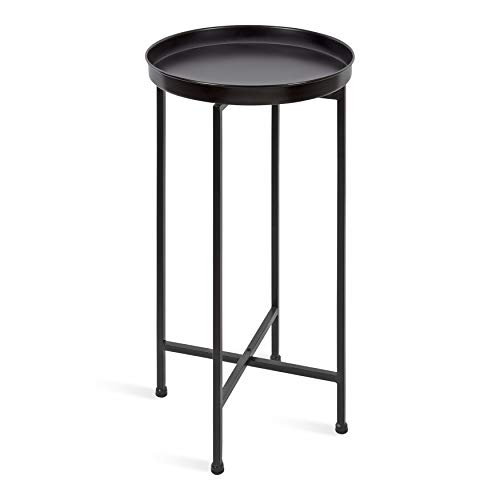
- Best overall for small spaces: Kate and Laurel Celia Round Foldable Tray Accent Table — Check on Amazon
- VASAGLE 3-Tier End Table with S-Shaped Steel Frame — Check on Amazon
- Nathan James Amalia End Table with Solid Wood Legs — Check on Amazon
- VASAGLE Side End Table with Charging Station and 2 Drawers — Check on Amazon
- Walker Edison Maya Modern Oak Veneer Side Table with Storage — Check on Amazon
See 1 more Amazon option
- SIMPLIHOME Warm Shaker Solid Wood End Table — Check on Amazon
Read the full guide ↓
Disclosure: As an Amazon Associate, dailyhomedecorating.com earns from qualifying purchases. Links to Amazon on this page are affiliate links; they cost you nothing extra. Listing details such as price and availability change often, so check the current Amazon listing before you buy.
The best end table for small spaces under $400 is chosen by a stricter arithmetic than any other furniture decision in the home. A small space — a compact living room, a bedroom corner, a hallway-adjacent reading nook, the strip beside a sofa in a room that also does two other jobs — does not forgive a table that is two inches too wide or one shelf too proud. Every candidate in this guide was measured against the tight spots where end tables are actually needed: the 12-to-18-inch gaps, the corners behind doors, the chair-side slivers where a standard table’s footprint simply does not exist. The under-$400 budget matters here in a specific way: it buys the engineering that small spaces require — folding frames, tiered vertical storage, slim powered profiles — rather than the miniaturized, flimsy versions of big tables that the cheapest tier offers. Small should never mean lesser; in this guide, small means designed.
Small spaces also punish visual bulk more than floor bulk. A solid, dark, boxy table in a tight corner does not just occupy its footprint; it darkens the corner, shortens the sightline and makes the whole room feel like storage. The tables that succeed in small spaces share a set of tricks: open frames the eye can pass through, legs that lift the body off the floor so the floor plane reads continuous, round tops that shave the corners circulation needs, and — the ultimate trick — the ability to fold away and return the space entirely. We judged all six picks on both arithmetics, the tape measure’s and the eye’s, and on the third test small spaces impose: the table must still do a real end table’s job, holding a drink, a book and a light source at a usable height, or its smallness is just absence.
It helps to name the kinds of small space this guide serves, because they fail differently. There is the small room in an ordinary home — the snug living room, the box-room study — where the challenge is proportion: furniture must shrink without looking like dollhouse stock. There is the multi-use space, where the challenge is conversion: the floor must empty and refill on a daily rhythm. And there is the found space — the landing, the alcove, the wide hallway, the corner behind a door — where the challenge is that no standard furniture was ever designed for the coordinates at all. The picks below map onto those three failures: proportionate permanent tables for the small room, a folding table for the converting space, and light, small-footprint perches for the found corners. Identify which small space you actually have before choosing; the right table for one is a daily annoyance in another, and the reviews flag the mapping for every pick.
Our short answer: the Kate and Laurel Celia leads this guide because it is the only pick that can reduce its footprint to zero — a genuine table when deployed, nothing at all when folded. The VASAGLE 3-tier is the permanent-storage champion at about 15.7 inches square, and the Nathan James Amalia is the lightest permanent perch for the tightest corners. Apartment-specific layouts are treated in depth in Best End Table For Small Apartments Under $400; the reviews below give each pick its small-space verdict with measurements up front, because in this guide the measurements are the review’s first paragraph, not its footnote.
In this guide
Quick Picks
For tight spots, matched to the shape of the problem.
| Buyer type | Pick | Why it stands out | Link |
|---|---|---|---|
| Best overall for small spaces | Kate and Laurel Celia Round Foldable Tray Table | Footprint drops to zero — folds flat when the space is needed back | Check on Amazon |
| Best permanent storage, tiny footprint | VASAGLE 3-Tier End Table with S-Shaped Steel Frame | Three tiers in a roughly 15.7-inch square | Check on Amazon |
| Best light corner perch | Nathan James Amalia End Table | Round, under nine pounds — the corner table that never crowds | Check on Amazon |
| Best slim powered option | VASAGLE Side End Table with Charging Station and 2 Drawers | Narrow profile turns a sliver of space into a charging station | Check on Amazon |
| Best hidden storage, compact | Walker Edison Maya Oak Veneer Side Table | Enclosed storage in an 18.25-inch square keeps tight rooms calm | Check on Amazon |
| Best full-size, if the space allows | SIMPLIHOME Warm Shaker Solid Wood End Table | Complete drawer-and-shelf storage for the roomier end of small | Check on Amazon |
How These Picks Were Chosen
Every pick is a genuine listing within this guide’s under-$400 budget — check the current price on Amazon before buying. The selection then ran on small-space rules. Footprint came first and was treated as a hard filter: every pick’s stated dimensions were checked, and anything whose “compact” marketing dissolved under its own measurements was cut. Storage was scored against floor consumed — vertical tiers, drawers and enclosed volumes on small footprints scored highest — and visual weight was scored alongside physical size, because a small room experiences both.
We did not hands-on test these tables. We compared manufacturer specifications — dimensions, weight, materials, folding and storage configuration — and judged each design against the recurring geometry of small spaces: the sofa-side gap, the reading-chair corner, the bedside-adjacent strip, the multi-use room that must clear its floor. Height was checked against the seats these tables actually serve in compact rooms, which include low lounge chairs and daybeds as well as standard sofas. We also favored designs that move well: in small spaces furniture is repositioned constantly, so one-hand carries, folding frames and flat disassembly all counted as core features rather than conveniences.
We also scored a quality small spaces reward disproportionately: top usability per inch. A small top is not automatically a bad top — what matters is whether its whole area is usable. Raised lips that keep objects from sliding off, surfaces without decorative ridges eating into the flat area, and shapes that meet the wall or the sofa without leaving a dead wedge of unreachable space all raise a small table’s real capacity well beyond its diameter. Several larger tables score worse on this measure than the smallest picks here, which is why this guide’s ranking will surprise anyone who assumes bigger is automatically more useful.
One filter deserves naming because it removed the most candidates: honesty of scale in listing photography. Small-space furniture is routinely photographed in large, empty rooms that make a 20-inch table look like a side stool. We worked exclusively from stated dimensions, and each review below tells you what the numbers mean in a real tight spot — what fits beside it, what passes it, what it can and cannot hold — so the table that arrives is the table the space was measured for.
The 6 Best End Tables for Small Spaces Under $400
Kate and Laurel Celia Round Foldable Tray Accent Table
Who it suits: Any small space that is only sometimes a sitting space — multi-use rooms, studio corners, guest-adjacent chairs — where a permanent table would tax the room every day for a part-time job.
Start with the number that wins this guide: zero. Folded, the Celia occupies no floor at all. It is a round metal tray table — about 14 inches across and 25.75 inches tall in use — whose tray top lifts off its frame and whose frame folds flat, so its storage address is the two inches behind a sofa, the gap beside a bookcase, the wall of a closet. Every other pick in this guide asks a small space for a permanent grant of floor; the Celia asks for a loan, repayable on demand. In rooms that convert — the living room that becomes a workout space, the study that becomes a guest room, the studio that becomes everything in rotation — that reversibility is not a feature among others. It is the whole product, and nothing else here offers it.
In use, it is a better table than its vanishing act suggests. The tray’s raised lip contains drinks and small objects at its edge, the magnetic connection keeps the tray seated on the frame when a hand catches it, and the tall, narrow stance is proportioned for the low, deep chairs small spaces favor, bringing a drink up to a reclined reader’s hand rather than down at standard table height. The black finish in the linked listing reads as a deliberate modern note; the wider Celia line offers lighter and metallic pairings for rooms that want the deployed table to warm the corner it temporarily occupies.
Its small-space limits are about permanence, not size. It stores nothing — when folded, it is not even furniture — and it should not be assigned a heavy lamp’s permanent custody or expected to anchor a room’s storage plan. It sits at the accessible end of this guide’s budget; check the current price on Amazon. The pattern we recommend for genuinely small spaces is the Celia plus one anchored pick: the anchor handles the main seat’s daily storage, and the Celia serves every other seat the room occasionally creates. Together they furnish a small space more completely than any single table at this budget can.
- Folds completely flat — the only zero-footprint pick in this guide.
- Raised tray lip and magnetic top keep it composed in use.
- Tall, narrow stance suits low chairs and reclined reading in tight corners.
Honest limitation: An occasional table — no storage, no permanent lamp duty, and a tray’s inherent lightness.
Choose it if your space must regularly return to empty. Skip it if you need one permanent table to do everything.
VASAGLE 3-Tier End Table with S-Shaped Steel Frame
Who it suits: Small spaces with one permanent sofa-side spot and more things than floor — readers and collectors whose storage problem is vertical opportunity, not horizontal room.
Where the Celia wins by disappearing, this VASAGLE wins by stacking. Its footprint is about 15.7 by 15.7 inches — smaller than many of the objects it will hold — and inside that square it stacks three open tiers to a height of about 23.6 inches, the useful band beside most seating. The S-shaped steel frame is the enabling design: steel sections carry book-weight loads without the bulk wooden uprights would need, so nearly all of the table’s small volume is storage rather than structure, and the open sides let sightlines pass through, which in a small room is the difference between a corner that holds a table and a corner that is a table.
Consider how this table behaves across a small space’s whole day, because that is the test its size class must pass. In the morning it is the coffee’s landing strip beside the chair where the day starts. At midday, in a work-from-home corner, its middle tier holds the notebook and its top takes the water glass that the desk has no room for. In the evening it resumes its main post beside the sofa, lamp on, book waiting. Nothing about it needs to change for any of those jobs — no unfolding, no conversion — because open tiers at hand height are the most job-agnostic storage furniture makes. In a small space, where a piece that does one job is a luxury, a piece that does every job at 15.7 inches square is close to a necessity, and it is why this table, rather than any cleverer mechanism, is the permanent-storage recommendation of this guide.
The tiers organize a small space’s beside-seat life with surprising completeness. Top: the lamp and the drink, at sitting height. Middle: the current book, the glasses, the phone — the hand-height shelf a seated person actually uses most. Bottom: the heavy stack, the basket, the stored weight that also anchors the frame. Households that have been balancing a book pile on the floor beside the sofa — the universal small-space symptom — will find those three tiers absorb the pile, the basket and the lamp in one 15.7-inch claim. The rustic brown and black finish is a mid-tone that recedes in compact rooms rather than advancing.
The limits are the familiar open-shelf ones, sharpened by small-space visibility: in a compact room, open shelves are never out of sight, so their contents must be the kind that can be seen — books and baskets, yes; the household’s homeless clutter, no, unless a basket contains it. There is no drawer and no charging. It sits at the budget end of this guide; check the current price on Amazon. As a permanent resident of a small space, it returns more function per inch than any other pick here — the Celia included, on the days the Celia is folded away being nothing at all.
- Three storage tiers inside a roughly 15.7-inch-square footprint.
- Open steel frame preserves sightlines and light in tight corners.
- Bottom tier takes heavy stacks, anchoring the frame.
Honest limitation: Open shelves are always on show in a small room; no concealed storage or charging.
Choose it if you have one permanent spot and vertical storage solves it. Skip it if your beside-sofa contents need a door.
Nathan James Amalia End Table with Solid Wood Legs
Who it suits: The tightest permanent corners — beside a reading chair in a small living room, at a daybed’s end, in the nook where the choice is this table or no table.
The Amalia is the smallest permanent citizen of this guide: a round top about 18 inches across, a height of about 18 inches, solid wood legs, and a total weight under nine pounds. Those numbers describe the table for the corner that defeats cabinet furniture — where a drawer unit would block the path, where the floor turns a corner, where what is needed is simply a surface at a seated hand’s height and nothing more. Its round top is a small-space feature in itself: no corners protrude into circulation, hips pass it without negotiation, and in a tight room that daily forgiveness accumulates into real comfort.
Its lightness is functional, not just convenient. In small spaces, furniture migrates — the reading chair follows the light, the corner becomes a desk nook in winter — and a table one hand can carry migrates with the room instead of anchoring it to a first guess. The faux marble-look top over solid wood legs keeps the piece visually quiet and bright, an advantage in the darker corners small rooms tend to assign to reading chairs; it will not darken a nook the way a solid dark cabinet does. At the budget end of this guide — check the current price on Amazon — it is also the pick a small-space household can buy experimentally, live with, and reassign to another room without regret if the corner’s job changes.
Its limits must be respected precisely because small spaces tempt overloading. The top holds a drink, a book and a phone — not a lamp plus a library; assign it a small lamp only if the lamp’s base is compact, or let the corner’s light come from elsewhere. At 18 inches it sits low beside standard sofa arms, so its seat should be a chair, a daybed or a low loveseat. And under nine pounds means it should stand out of the main traffic line, where bumps are rare. Within those honest bounds, it is the best tight-corner perch in this guide.
- Smallest permanent footprint here, with a corner-free round top.
- Under nine pounds — migrates as the small room’s layout evolves.
- Bright, quiet styling that does not darken tight corners.
Honest limitation: Low height, minimal top capacity and no storage — a perch, not a station.
Choose it if your corner fits nothing bigger. Skip it if the seat it serves is a tall-armed sofa or needs storage.
VASAGLE Side End Table with Charging Station and 2 Drawers
Who it suits: Small spaces with a narrow sofa-side sliver and a device habit — compact rooms where the gap is thin but the need for power and drawers is full-size.
Small spaces have a characteristic dead zone: the narrow slot between sofa and wall, too thin for ordinary furniture, exactly where a dropped remote goes to be forgotten. This VASAGLE is dimensioned for that slot, and it brings two things small spaces chronically lack. The first is power: a built-in charging station with AC outlets and USB ports, which in a compact room — where outlets are few and rarely beside the seat — turns the sliver into the room’s device station, with the lamp plugged in at table height and no cord crossing the room’s only walkway. The second is drawers: two of them, absorbing the small-object load that in a small space has literally nowhere else to live.
The combination is what earns its footprint. A narrow table alone would be a surface; a narrow table with power and two drawers is infrastructure — it replaces the table, the power strip and the storage basket that a small room would otherwise have to find three separate homes for. Its slim, two-tone form also reads light against a wall, and in the sofa-side sliver it effectively disappears into the room’s edge, which is where small-space furniture does its best work: at the perimeter, leaving the center open.
Plan the outlet geometry before ordering — the table must sit within its cord’s reach of a socket, and in small rooms that constraint can dictate which end of the sofa it serves. The engineered-board construction keeps it light enough for one person to manage on stairs and through tight doorways, a small-space virtue in itself, though it will not shrug off as many reassemblies as solid wood. It sits mid-budget in this guide; check the current price on Amazon. For the narrow-gap, outlet-poor compact room, it converts the least usable inches in the home into the most useful ones.
- Slim profile engineered for the sofa-side sliver other tables cannot enter.
- Charging station plus two drawers — infrastructure, not just a surface.
- Light enough for one person to carry through tight stairs and doors.
Honest limitation: Placement is dictated by outlet reach; engineered board prefers fewer disassemblies.
Choose it if your gap is narrow and your outlets are scarce. Skip it if the sliver is far from any socket.
Walker Edison Maya Modern Oak Veneer Side Table with Storage
Who it suits: Compact modern rooms where the end table’s storage must be invisible — because in a small space, visible clutter is the space problem wearing a disguise.
The Maya’s small-space case rests on a perceptual truth: a compact room feels smallest when its contents are all on display. Its enclosed storage — a cabinet volume behind a flush oak-veneer front, in a footprint of about 18.25 inches square and a height of about 20 inches — removes the beside-sofa accumulation from view entirely, and a small room with clear surfaces and hidden storage reads as a larger room with the same floor plan. The low profile suits the low seating compact rooms favor, and the pale oak tone brightens corners instead of weighting them, the opposite of what a dark solid block does to a tight space’s light.
Functionally it is the calm anchor: the top holds the lamp and the drink in a composed arrangement, the interior holds everything else, and at around 17 pounds it repositions easily when a compact room rotates between its day and evening layouts — a rotation small spaces perform constantly and heavy furniture refuses to join. For households whose small space must also present well — video calls, guests, the simple daily wish for a room that looks finished — the Maya is the pick that makes a tight room look intentional.
The veneer asks for the usual discipline — coasters, prompt wiping — which matters more in small spaces because the end table often doubles as overflow surface during gatherings; protect the top and it will keep the room’s calm for years. Its 18.25-inch footprint is honest mid-size: bigger than the VASAGLE sliver options, so measure the gap rather than assuming “compact” from the styling. It sits in the upper-middle of this guide’s budget; check the current price on Amazon.
- Enclosed storage removes visual clutter — small rooms read larger.
- Compact square footprint with a low profile for compact seating.
- Pale oak finish brightens tight corners.
Honest limitation: Veneer needs surface discipline, and the footprint is mid-size — measure before assuming it fits a sliver.
Choose it if hidden storage is how your small space stays calm. Skip it if your gap is a true sliver — the VASAGLE charging table is built for those.
SIMPLIHOME Warm Shaker Solid Wood End Table
Who it suits: The roomier end of small — compact living rooms with one honest corner — and small-space households buying a single, permanent, do-everything table.
Every small-space guide needs one pick for the household whose space is small but whose intent is permanent, and this is it. The Warm Shaker is a solid pine table, 20 inches wide, with a drawer above an open shelf: the complete end-table layout, in solid wood, at a footprint that a compact living room — as opposed to a studio sliver — can genuinely offer. Its small-space virtue is consolidation. One Warm Shaker replaces the end table, the storage box and the book pile’s floor claim in a single 20-inch square, and its solid build means the consolidation is permanent: this is the table a small household buys once, instead of cycling through light pieces that each solve two-thirds of the problem.
Its weight, usually an apartment caveat, has a small-space benefit too: in tight rooms furniture gets bumped, and a planted solid table absorbs the bumps that send light tables skidding and their contents sliding. The drawer takes the full concealed load; the shelf takes the books and the basket; the top takes the lamp with room for the drink — the complete job, in the footprint of one modest square.
The honesty: 20 inches square is the largest claim in this guide, and in a true sliver or studio corner it is the wrong claim — choose the 3-tier VASAGLE and keep five inches of your life back. It is also the heaviest carry here, and its assembly is a proper project. It sits mid-to-upper in this guide’s budget; check the current price on Amazon. But for the compact room with one real corner and a household done with temporary furniture, it is the end of the search — which is, in a small space, the most valuable feature of all.
- Drawer plus shelf consolidates three furniture jobs into one footprint.
- Solid wood permanence — the buy-once pick for compact rooms.
- Planted weight absorbs the bumps tight rooms deliver.
Honest limitation: The largest footprint and heaviest build here — not a sliver or studio-corner pick.
Choose it if your compact room has one real corner and you are done with temporary furniture. Skip it if every inch is contested.
Comparison Table
| Product | Space strategy | Best use | Link |
|---|---|---|---|
| Kate and Laurel Celia Tray Table | Disappears entirely | Multi-use rooms, part-time seats | Check on Amazon |
| VASAGLE 3-Tier End Table | Stacks vertically | Books and baskets on 15.7 in | Check on Amazon |
| Nathan James Amalia End Table | Shrinks to a perch | Tight corners beside chairs | Check on Amazon |
| VASAGLE End Table with Charging Station | Uses the sliver | Powered drawers in dead space | Check on Amazon |
| Walker Edison Maya Side Table | Hides the clutter | Compact modern calm | Check on Amazon |
| SIMPLIHOME Warm Shaker End Table | Consolidates everything | One permanent corner table | Check on Amazon |
How to Choose an End Table for a Small Space
Start with the space’s job, not the table’s looks. Is the spot a permanent seat’s companion, or a part-time surface in a room that converts? Permanent jobs want anchored storage — tiers, drawers, a cabinet. Part-time jobs want the Celia’s disappearing act. Most small-space disappointment comes from assigning a permanent table to a part-time job and resenting its footprint on all the days it is not working.
Measure three dimensions, not two. Footprint decides whether the table fits; height decides whether it works beside the seat; and the third dimension — the swing and passage around it — decides whether it survives daily life. Walk the route past the intended spot with a laundry basket in your arms. If the table’s corner enters that walk, choose round, choose slimmer, or choose folding.
Count storage as negative furniture. Every cubic foot an end table stores is a cubic foot that does not need another piece of furniture. In small spaces, a tiered or drawer table that absorbs the book pile and the basket can be smaller in total effect than a bare accent table plus the storage box the accent table made necessary. Judge the system, not the piece.
Keep the eye’s arithmetic in your favor. Open frames, legs that show floor beneath, pale or mid-tone finishes and round tops all make a small room read larger. If two tables tie on tape-measure dimensions, pick the one you can see through or under. In a small space, perceived room is real room — it is the room you experience.
Respect the height of the actual seat. Small spaces mix seating — a low daybed, a lounge chair, a standard sofa — and an end table serves the seat beside it, not the room in general. Match the table to that seat’s arm or seat height: low perches like the Amalia for lounge chairs, the taller tray stance of the Celia for reclined reading, standard heights for standard sofas.
Tape the footprint before you buy. The single most reliable small-space technique costs nothing: mark the candidate table’s footprint on the floor with painter’s tape, at full size, and live with the outline for a day. Walk past it with laundry. Open the door it stands near. Sit in the seat it will serve and reach for the taped corner where your drink would be. Tape reveals what dimensions on a screen cannot — the swing conflicts, the shin-level surprises, the reach that is two inches too far — and it does so while the decision is still free. Every pick in this guide has survived tape tests in our evaluation of its dimensions; do your own before the box arrives, because in a small space a return is a week of living around the wrong object.
Common Mistakes When Buying an End Table for a Small Space
Trusting the word “compact” instead of the dimensions. Compact is a marketing direction, not a measurement. A table can be the smallest in its maker’s line and still be five inches too wide for your gap. The dimensions are the product; measure your space, then read them.
Buying a miniature of a big table. Scaled-down cabinet tables often keep the visual bulk and lose the storage — the worst of both. Small spaces reward purpose-built designs: folding frames, vertical tiers, slim powered profiles. If the design was not thinking about small spaces, its size is an accident, not a feature.
Forgetting that the floor must come back. In multi-use rooms, a permanent table in the conversion zone is a daily tax. If the room exercises, hosts sleepovers or becomes a workspace, the honest options are a table that folds, a table light enough to migrate in seconds, or a layout that keeps the conversion zone empty from the start.
Letting the end table become the room’s only storage. Even the best tiered table has a capacity, and a small space that loads all of its overflow onto one piece will look cluttered at exactly its most visible point. Pair the table with one other storage home — a basket system, a wall shelf where the lease allows — so the end table’s tiers stay at the composed level they were bought for.
Ignoring the lamp’s footprint. Small tops vanish under standard lamp bases. Add the lamp base’s diameter to your layout before choosing a top size, or plan the corner’s light from a wall or floor source and keep the small top for the drink and book it can actually hold.
Filling the found space with the wrong job. An alcove or landing corner that gets a table often gets assigned storage it cannot hold, and within a month the small table is a small pile. Found spaces work best with the lightest jobs — a drink, a book, a plant, a landing strip for keys — because their gift to the home is a moment of function in a dead corner, not a new storage frontier. Match the job to the scale and the corner stays charming instead of becoming the house’s smallest junk room.
Choosing dark and solid for a dim corner. Small spaces frequently assign their darkest corners to occasional seating, and a dark, boxy table deepens the gloom it was meant to relieve. Pale finishes, open frames and even a tray table’s thin profile return light to the corner; in a small space, brightness is a dimension too, and it can be bought with a finish choice.
Final Recommendation
For the small-space brief in its purest form, buy the Kate and Laurel Celia and pair it with the VASAGLE 3-tier table at your main seat: one table that stores vertically on 15.7 inches, one that vanishes entirely — together they furnish a small space more completely than any single piece in this guide. If only one table is possible, choose by your space’s job: the 3-tier for permanent storage, the charging VASAGLE for a powered sliver, the Amalia for a tight corner perch, the Maya for hidden calm, and the Warm Shaker where a compact room offers one real corner to a permanent piece.
Frequently Asked Questions
What is the smallest useful end table size? A top of roughly 14 to 16 inches across is the practical floor for a drink, a book and a phone — the Celia’s tray and the VASAGLE’s square live at that scale. Below that, a surface becomes a drink stand only, which may still be exactly what a tight corner needs.
Are folding tray tables a real alternative to end tables? For part-time seats and multi-use rooms, yes — they provide a genuine surface with zero permanent footprint. For a main seat’s daily use, a permanent table with storage serves better; most small spaces do best with one of each, as this guide’s final recommendation describes.
Where else in a home do small end tables earn their keep? Entryways (a tray or perch for keys and mail where no console fits), landings and wide hallways (a reading light and a chair’s companion), bathrooms with the floor space for a stool-side table, and guest corners in rooms that are offices the rest of the month. The found-space logic of this guide applies anywhere a standard table’s footprint does not: measure the coordinates honestly, assign the lightest sufficient job, and let the smallest adequate table do it.
What is the best shape for a table in a walkway-adjacent spot? Round, without much contest: the absence of corners is a daily kindness in passing traffic, and a round top on a slim or folding base — the Celia and Amalia’s formula — takes the least visual and physical room. Reserve square tops for wall-backed spots where their geometry is an asset rather than an obstacle.
How do I make a small room feel bigger around an end table? Choose open or leggy designs you can see through and under, keep the top composed rather than loaded, and let storage hide or stack vertically. Visual clutter at the room’s edges shrinks it more than the furniture’s actual dimensions do.
Can a small end table hold a lamp? Yes, if the lamp’s base fits the top with room left for a drink — measure both. Compact lamps pair with the tiered and cabinet picks here; on the smallest perches, consider letting a floor or wall light serve the corner instead.
Round or square tops for small spaces? Round tops forgive circulation — no corners in walkways — and suit chair-side corners. Square tops use corner geometry fully and hold more per inch, suiting sofa-side spots against walls. Let the spot’s traffic, not a general rule, decide.
How do I stop a small end table from looking lost or toy-like? Scale the objects on it, not just the table: a compact lamp, a standard book and a normal mug read as a real station, while miniature accessories make the whole arrangement look like a model. Weight also helps — a table with a book stack on its lower tier or a plant with presence reads as furniture, not as a placeholder.
Is one small end table enough for a living room? For the main seat, yes — especially paired with a folding option for occasional seats. Small spaces rarely need two permanent tables; they need one right table at the seat used daily and a flexible answer for every other seat the room sometimes creates.
How tall should a small-space end table be? The same rule as anywhere — at or just below the arm of the seat it serves — applied to the seats small spaces actually contain. Lounge chairs and daybeds sit low and pair with the 18-to-20-inch picks here; standard sofas pair with the low-to-mid-twenties; and a reclined reading chair can happily use the Celia’s taller tray stance. Measure the seat, not the category.
What is the best first purchase for furnishing a small space’s seating area? The table at the seat you use daily, with the most storage its footprint can honestly hold — in this guide, the tiered VASAGLE for most small spaces. Chairs and lamps can follow; the anchor table defines the seat’s territory, absorbs its clutter from the first day, and tells you, by what it cannot hold, exactly what the room still needs.
Can a small end table work beside a sofa bed? Yes, and it is one of the best small-space assignments: a folding table serves the sofa by day and the bed by night from the same spot, then leaves entirely when the room needs its floor. A slim drawer model is the permanent alternative when the sofa bed is the room’s main bed.


