Where to buy
Check the latest price, availability and delivery on Amazon. Orders are placed on Amazon. We may earn a commission from qualifying purchases.
- Best overall for modern homes: Walker Edison Maya Modern Oak Veneer Side Table with Storage — Check on Amazon
- Nathan James Amalia End Table with Solid Wood Legs — Check on Amazon
- VASAGLE Side End Table with Charging Station and 2 Drawers — Check on Amazon
- Kate and Laurel Celia Round Foldable Tray Accent Table — Check on Amazon
- VASAGLE 3-Tier End Table with S-Shaped Steel Frame — Check on Amazon
See 1 more Amazon option
- SIMPLIHOME Warm Shaker Solid Wood End Table — Check on Amazon
Read the full guide ↓
Disclosure: As an Amazon Associate, dailyhomedecorating.com earns from qualifying purchases. Links to Amazon on this page are affiliate links; they cost you nothing extra. Listing details such as price and availability change often, so check the current Amazon listing before you buy.
The best end table for modern homes under $400 has to pass a test that traditional tables never sit: it must look intentional in a room where every object is visible. Modern interiors run on restraint — low, horizontal furniture, uncluttered surfaces, a limited palette of wood, metal, glass and matte finishes — and that restraint is unforgiving. A table with the wrong silhouette, a fussy detail or a finish half a tone off does not blend into a modern room; it stands there explaining itself. At the same time, modern living makes the same practical demands as any other kind: a drink at arm’s height, a lamp, a charger, somewhere for the remote to live that is not the sofa cushions. The end tables that succeed in modern homes are the ones that solve the practical problem in the modern visual language — clean geometry, honest materials, storage that disappears — and this guide compares six of them across the full under-$400 range.
Modern, in this guide, means the living mainstream of the style rather than any single school: the low-slung sofas and pale oak of Scandinavian rooms, the black metal and warm wood of contemporary industrial spaces, the mid-century lines that have become the default furniture language of new homes, and the minimal, gallery-calm rooms where a side table is closer to a plinth than a cabinet. Those rooms share requirements. Proportions run low and wide rather than tall and narrow, because modern seating sits low. Storage, where it exists, hides behind flush fronts. Surfaces stay clear enough that the few objects on them — a sculptural lamp, one book, a ceramic piece — read as composition rather than accumulation. And technology is expected to integrate invisibly: a modern room with a power strip on the floor is a room whose furniture has failed it.
Our short answer: the Walker Edison Maya is the modern brief executed most completely — oak veneer, flush enclosed storage, a low compact profile that matches modern seating heights. The Nathan James Amalia brings mid-century geometry at the friendly end of the budget, the VASAGLE charging table integrates power the way modern rooms demand, and the Kate and Laurel Celia offers the minimalist’s favorite trick, a table that can leave the room entirely. The full under-$400 field, judged without the style filter, is compared in Best End Table Under $400; the pages below make the modern case for each pick, including the one traditional table we kept — and why we kept it.
In this guide
Quick Picks
The short version, matched to the kind of modern room you are building.
| Buyer type | Pick | Why it stands out | Link |
|---|---|---|---|
| Best overall for modern homes | Walker Edison Maya Oak Veneer Side Table | Flush enclosed storage and pale oak calm — the complete modern package | Check on Amazon |
| Best mid-century accent | Nathan James Amalia End Table | Splayed solid wood legs and a round top — modern geometry, budget tier | Check on Amazon |
| Best tech-integrated | VASAGLE Side End Table with Charging Station and 2 Drawers | Power built into the furniture — no floor strips, no cable trails | Check on Amazon |
| Best minimal footprint | Kate and Laurel Celia Round Foldable Tray Table | A surface that folds away — negative space on demand | Check on Amazon |
| Best industrial-modern storage | VASAGLE 3-Tier End Table with S-Shaped Steel Frame | Curved black steel and open tiers for styled display | Check on Amazon |
| Best warm transitional bridge | SIMPLIHOME Warm Shaker Solid Wood End Table | Solid wood warmth for modern rooms that lean organic | Check on Amazon |
How These Picks Were Chosen
Every pick is a genuine listing within this guide’s under-$400 budget — check the current price on Amazon before buying, since finish options move furniture prices around. We then applied the modern filter in three passes. The first pass was silhouette: low, geometric, free of applied ornament — no turned legs with decorative rings, no distressed farmhouse hardware, no faux-rustic anything, unless the piece earned its place as a deliberate warm contrast. The second pass was proportion: modern sofas and sectionals sit lower than traditional seating, with arms commonly in the low-to-mid twenties of inches, so we favored tables in the roughly 18-to-24-inch height band and marked down tall, narrow tables that would tower over a low sofa line.
We did not hands-on test these tables. We compared manufacturer specifications — dimensions, weight, materials, storage configuration — and judged each design against how modern rooms actually function. Storage had to disappear: flush cabinet fronts and drawers scored over open clutter, with open shelving admitted only where it reads as display, styled and sparse, rather than storage overflow. Technology integration counted heavily, because the modern room’s dirtiest secret is its cables; a table that routes power invisibly solves a design problem, not just a practical one. Materials were judged on honesty of appearance: real wood surfaces, real metal, matte finishes — and we say plainly in the reviews where a surface is a look-alike rather than the material it suggests.
A note on what modern costs, because this budget band hides it well. Under $400, modern design is available at three honest levels. At the first, geometry does the work: a round top, splayed legs, a clean tray — form without expensive material, which is the Amalia and Celia’s level, and there is no shame in it; most iconic modern furniture began as an exercise in achieving the look with modest means. At the second level, surfaces improve: real wood veneer, better metal finishes, drawers and doors that close flush and stay that way. At the third, construction improves: solid timber, joinery, weight. This guide contains all three levels deliberately, because modern rooms are built at all three — and because the right question is never “which level is best” but “which level does this spot in this room actually reward.” A guest-corner accent rewards level one. The table beside the main sofa, touched daily for a decade, rewards everything you can give it.
The last filter was photographic honesty. Modern furniture listings are the most aggressively styled in the category, with tables photographed in vast white rooms that make a 14-inch top look monumental. We worked from stated dimensions throughout, and every review below gives you the real numbers and what they mean beside real seating, so the table that arrives matches the table you imagined. What survived is a set of six tables that each speak modern fluently, at different volumes and price points within the budget.
The 6 Best End Tables for Modern Homes Under $400
Walker Edison Maya Modern Oak Veneer Side Table with Storage
Who it suits: Scandinavian, contemporary and minimalist living rooms — anyone whose end table must store like a cabinet and read like a plinth.
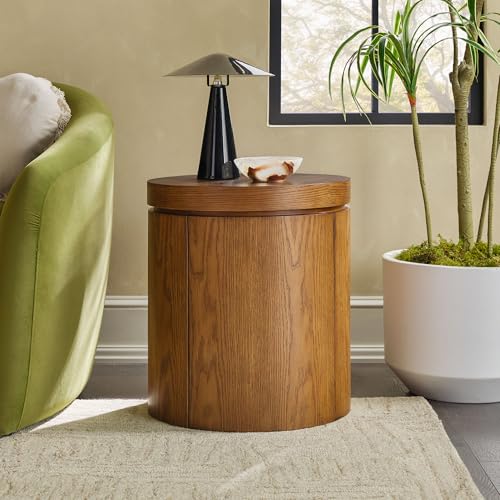
The Maya understands the modern assignment at a level most of its price tier does not reach. Its form is a clean volume: an oak-veneer body with a natural wood finish, enclosed storage behind a flush front, and a smooth, uninterrupted top. Nothing projects, nothing decorates, nothing apologizes. At about 18.25 inches square and 20 inches tall, its proportions are tuned to modern seating — low sectionals, low lounge chairs, platform-style sofas — where it lands at or just below arm height instead of hovering awkwardly above the sofa’s line. In a room built from horizontal planes, the Maya is another horizontal plane, and that is exactly the compliment modern furniture wants.
The enclosed storage is what elevates it from a styled cube to a working end table. Modern rooms fail in practice when their surfaces become the storage — when the remote, the charger, the notebook and the mail accumulate on the one clear plane the room’s calm depends on. The Maya gives that accumulation a door to disappear behind. What stays on top can then be the modern composition the room was designed for: the lamp, the drink, one beautiful object. At around 17 pounds, it is also easy to float into a new arrangement when the room’s layout evolves, which modern rooms do more often than most — the style rewards re-composition, and furniture that resists moving resists the style itself.
The caveats are material and scale. Oak veneer presents as wood because its surface is wood, but it is a surface: protect it from standing water and hot vessels with the coaster discipline modern rooms usually already practice, because a ring mark on that calm plane will be the only thing you see. And its 20-inch height, perfect beside low seating, will sit noticeably low beside a traditional high-armed sofa — this is a table for modern rooms, and it does not pretend otherwise. It sits in the upper-middle of this guide’s budget; check the current price on Amazon. For the modern brief — store invisibly, sit low, stay calm — it is the most complete answer under $400 that we found.
- Oak veneer volume with flush enclosed storage — clutter disappears, surfaces stay composed.
- Low 20-inch height and compact footprint proportioned for modern seating.
- Light enough to reposition as the room’s arrangement evolves.
Honest limitation: Veneer needs coaster discipline and cannot be refinished like solid wood; the low height suits modern sofas only.
Choose it if your room is modern and your storage must be invisible. Skip it if your seating is traditional height or your household is rough on surfaces.
Nathan James Amalia End Table with Solid Wood Legs
Who it suits: Mid-century-leaning modern rooms, first apartments furnished with intent, and anyone who wants the modern look at the budget end of this guide.
Mid-century modern survives as the friendly dialect of modern design — warmer, rounder, more forgiving than minimalism — and the Amalia speaks it fluently. A round top with a faux marble-look finish rests on splayed solid wood legs in a light brown tone, a silhouette that has read as “modern” for seventy years because it solves the visual problem perfectly: the round top softens a room of rectangles, the splayed legs give a small table graphic energy, and the whole piece occupies almost no visual weight. At about 18 inches across and 18 inches tall and under nine pounds, it is the lightest presence in this guide, a table that suggests itself rather than insisting.
That lightness is a design strategy in modern rooms, where the space between objects is part of the composition. The Amalia is the pick for the spot where a cabinet table would close the room down: beside a sculptural lounge chair, at the end of a low loveseat, in the reading corner where the chair, the lamp and the table form a small constellation with air around it. Its faux marble-look top deserves an honest sentence: it is a printed finish, not stone, and at conversational distance it reads as a pale stone-look surface that pairs with modern palettes — while costing and weighing a fraction of the real material, which is precisely why it can sit at the budget end of this guide. Check the current price on Amazon; many modern rooms will buy two, flanking a sofa with matched geometry for less than one premium table.
Its limits are functional, and in a modern room they are manageable precisely because the style assigns it a light job. There is no storage — the top is the whole offer — and at 18 inches it is a low perch for a drink and a book, not a lamp-and-library station. Households wanting it as a main sofa table beside tall arms should measure first. But as modern rooms actually use accent tables — a composed surface at the right point in the room’s geometry — the Amalia is the best value in this guide, and the easiest way to make a room read modern by Friday.
- Mid-century silhouette: round stone-look top on splayed solid wood legs.
- Minimal visual weight — preserves the negative space modern rooms depend on.
- Budget-tier pricing makes matched pairs realistic.
Honest limitation: No storage, a low 18-inch perch, and a printed stone-look finish rather than real stone.
Choose it if you want modern geometry beside a chair or low sofa. Skip it if you need storage or a taller main table.
VASAGLE Side End Table with Charging Station and 2 Drawers
Who it suits: Tech-forward modern homes — media rooms, smart-home households and anyone whose modern aesthetic keeps being sabotaged by cables.
Every modern room has a photograph version and a real version, and the difference is usually on the floor beside the sofa: a power strip, three chargers and a lamp cord, trailing. This VASAGLE is the pick that closes that gap. Its built-in charging station — AC outlets and USB ports integrated into the table — moves power up into the furniture where modern rooms assume it lives, so the lamp plugs in invisibly, phones charge at the seat rather than across the room, and the floor returns to being a clean plane. In design terms, it is the difference between a room that is styled and a room that is solved.
The rest of the design respects the brief. Two drawers with flush faces swallow the small technology of modern sitting — remotes, earbuds, chargers, the streaming stick’s spare remote — keeping the top clear for composition. The slim profile fits the narrow flank of a modern sectional, the spot where a full-width table crowds the room’s lines, and its two-tone finish pairing sits comfortably in contemporary palettes of warm neutrals and dark frames. It is, in effect, the modern room’s utility infrastructure disguised as its furniture.
There is a longer argument for this table that modern homeowners increasingly make: the smart home runs on charged devices, and a room designed around them should not pretend otherwise. A household with a voice assistant on the end table, phones that live beside the sofa and a lamp on a smart plug has already made the end table its technology dock; the only question is whether the dock is designed or improvised. This VASAGLE is the designed version — power at the seat, cables in drawers, surfaces clear — and in homes where the technology is permanent, designing for it is not a compromise of the modern aesthetic but its current, honest form. The improvised version, a strip on the floor and a nest of adapters, is the only genuinely unmodern option on the table.
The honest notes: the body is engineered board rather than timber or veneer-cabinet construction, so its surfaces read modern-flat rather than material-rich — in a room chasing an organic, all-natural palette, the Maya’s oak will satisfy more. The charging feature also fixes placement near an outlet, so plan the room’s power geography before the furniture geography. It sits mid-budget in this guide; check the current price on Amazon. For households whose modernism is lived-in and device-heavy — which is to say, most modern households — it may be the most practically modern table here, whatever the purists say about the Maya.
- Integrated charging station removes power strips and cable trails from the room.
- Two flush drawers hide the small technology of modern sitting.
- Slim profile designed for sectional flanks and narrow gaps.
Honest limitation: Engineered-board surfaces are less material-rich than veneer or solid wood, and placement is tied to an outlet.
Choose it if cables are your modern room’s weak point. Skip it if you want an all-natural materials palette.
Kate and Laurel Celia Round Foldable Tray Accent Table
Who it suits: Minimalists, gallery-calm rooms and modern spaces that host — a table for the hours it is needed, and no table at all the rest of the time.
The most modern object in this guide might be the one that disappears. The Celia is a round metal tray table — about 14 inches across and 25.75 inches tall — whose tray top lifts from its frame and whose frame folds flat, so the table stores behind a sofa or in a closet and the room keeps its empty floor. Minimalism’s hardest problem is hospitality: guests need surfaces, and permanent guest surfaces are permanent clutter. The Celia resolves it the way modern design prefers, with an object that performs on demand and then stops performing. Between uses, your room is exactly as composed as you designed it.
As an object, it earns its appearances. The tray’s raised lip gives it a graphic, deliberate edge — it reads as a designed tray table, not a folding compromise — and the magnetic connection between tray and frame keeps the composition seated and quiet. Its tall, narrow stance suits modern lounge chairs, whose occupants sit low and reclined and benefit from a drink arriving at a higher, closer point than a standard end table offers. In black, as in the listing we linked, it drops into contemporary palettes as a punctuation mark; the Celia line’s other color pairings let it play accent instead, for rooms whose modernism runs warmer or more playful.
Its discipline is that it must be used as the occasional piece it is. It offers no storage, and its tray top — however well seated — is a tray, happiest with drinks, a phone and a paperback rather than a heavy lamp and a library. It sits at the accessible end of this guide’s budget; check the current price on Amazon. The modern rooms that use it best own it alongside a permanent anchor like the Maya: daily life at the anchor, gatherings and quiet reading hours with the Celia deployed. Flexibility, in a modern interior, is not a compromise of the aesthetic — handled this well, it is the aesthetic.
- Folds completely flat — a guest surface with zero permanent footprint.
- Raised tray lip and magnetic top give it a designed, deliberate presence.
- Tall, narrow profile pairs with low modern lounge seating.
Honest limitation: An occasional table only — no storage and not a heavy lamp’s home.
Choose it if your minimal room still needs to host. Skip it if you need an everyday anchor table.
VASAGLE 3-Tier End Table with S-Shaped Steel Frame
Who it suits: Industrial-modern and eclectic-modern rooms that treat open shelving as display — art books, objects, plants — rather than storage overflow.
Industrial modern runs on a different material palette — blackened steel, warm wood tones, open structure — and this VASAGLE is its native speaker in this guide. Three tiers ride inside an S-shaped steel frame, the curve giving a rectilinear room one sculptural gesture, in a footprint of about 15.7 by 15.7 inches and a height of about 23.6 inches. Where the Maya hides everything, this table displays — and in the industrial-modern dialect, display is the point: the art book’s spine, the ceramic vessel, the trailing plant are the room’s color and texture, and open steel shelving is the gallery system that holds them.
Used with that discipline, it is a genuinely strong modern piece. The tiers divide by visual weight — lamp and drink on top, the beautiful heavy books in the middle, a basket or a sculptural object anchoring the bottom — and the steel frame’s openness keeps a compact room from accumulating visual bulk; you see through this table, so it costs the room almost no light or air. The rustic brown and black finish pairing is the standard industrial-modern chord, warm wood against dark metal, and it pairs with the leather, concrete and black-frame elements those rooms are built from.
The discipline cuts both ways, and we will be plain: open tiers in a modern room are a styling commitment. The moment the shelves become overflow — mail, chargers, the household’s homeless objects — the table stops reading as display and starts reading as the room’s junk drawer with the drawer removed. If your household cannot keep three open shelves composed, choose the Maya’s door or the charging VASAGLE’s drawers and let your storage be invisible instead. At the budget end of this guide — check the current price on Amazon — it is the strongest industrial-modern statement here, for the households who will style it like they mean it.
- Sculptural S-curve steel frame — a gesture piece, not just shelving.
- Three open tiers for styled display of books, plants and objects.
- Open structure keeps compact modern rooms feeling light.
Honest limitation: Open shelves demand styling discipline; as overflow storage it undermines the modern look it was bought for.
Choose it if your modern runs industrial and your shelves stay composed. Skip it if your storage reality is clutter that needs a door.
SIMPLIHOME Warm Shaker Solid Wood End Table
Who it suits: Modern rooms that lean organic — Japandi, warm minimalism, modern farmhouse — where one honest wooden piece keeps the calm from turning cold.
We kept one traditional table in a modern guide on purpose, because the most livable modern rooms are rarely pure. The Warm Shaker is a solid pine table, 20 inches wide, with a drawer, an open shelf and Shaker styling — and Shaker design is, historically, modernism’s ancestor: functional, unornamented, built from honest material with nothing applied for show. In a Japandi or warm-minimal room, that ancestry reads correctly. The solid wood brings the tactile warmth that veneer and metal cannot, the clean Shaker lines do not fight the room’s geometry, and the drawer-and-shelf layout gives a modern household the mixed storage — some hidden, some displayed — that real life requires.
Its modern credentials are proportion and restraint. The square top composes well with a single lamp and one object. The mid-tone wood finishes sit inside the warm neutral palettes these rooms use. And the solid construction gives the piece the one quality modern rooms quietly prize above novelty: permanence. A room built on restraint does not want its furniture replaced every few years; a solid-wood table that will hold its place for a decade is, in that sense, the most sustainable and the most modern purchase in this guide. It sits mid-to-upper budget; check the current price on Amazon.
The boundary is equally clear. In a strict minimalist or high-contrast contemporary room — white, black, chrome, glass — the Warm Shaker’s framed drawer front and traditional proportions will read as the room’s one traditional object, and if that is not a deliberate choice, it will look like a mistake. Buy it as the warm note in a warm modern room, not as a compromise in a cold one. Judged on those terms, it earns its place here: not the most modern table in the guide, but the one that makes modern rooms feel like homes.
- Solid pine construction with Shaker restraint — modernism’s own ancestor.
- Drawer plus open shelf suits warm-minimal and Japandi storage habits.
- Built for a decade of permanence in rooms that dislike replacement cycles.
Honest limitation: In strict high-contrast minimalism it reads traditional; choose it only where warmth is the intent.
Choose it if your modern leans organic and warm. Skip it if your room is strict, cool-toned minimalism — the Maya is your table.
Comparison Table
| Product | Modern dialect | Best use | Link |
|---|---|---|---|
| Walker Edison Maya Side Table | Scandinavian / minimal | Enclosed storage, low seating | Check on Amazon |
| Nathan James Amalia End Table | Mid-century modern | Accent perch, matched pairs | Check on Amazon |
| VASAGLE End Table with Charging Station | Tech-integrated contemporary | Invisible power, drawer storage | Check on Amazon |
| Kate and Laurel Celia Tray Table | Minimalist / flexible | Guest surface that disappears | Check on Amazon |
| VASAGLE 3-Tier End Table | Industrial modern | Styled open display | Check on Amazon |
| SIMPLIHOME Warm Shaker End Table | Warm modern / Japandi | Solid wood warmth, mixed storage | Check on Amazon |
How to Choose an End Table for a Modern Home
Match the height to modern seating, not to tradition. Modern sofas sit low, and their arms commonly measure several inches lower than traditional rolled arms. A table that would be perfect beside a classic sofa can loom over a low sectional like a bar stool. Measure your arm height and aim for the table to land at or just below it; in modern rooms the 18-to-22-inch band does most of the work, which is why the Maya and Amalia’s lower profiles are features here, not compromises.
Decide where the clutter goes before you buy the look. Modern rooms are not rooms without stuff; they are rooms where stuff has an assigned, invisible home. If your beside-sofa life includes remotes, chargers and notebooks, buy the disappearance first — the Maya’s cabinet, the charging VASAGLE’s drawers — and let the styling follow. Buying a bare accent table for a clutter-heavy seat is how modern rooms end up with a beautiful table buried under the evidence.
Keep the palette to the room’s existing chord. Modern interiors typically run two or three materials in repeat. Add your end table inside that chord — oak where oak already lives, black metal where black metal already lives — rather than introducing a fourth material for one small table. A single new material at end-table scale does not read as an accent; it reads as an interruption. The exception is a deliberate sculptural piece, and deliberate means everything else stays quiet.
Treat cable routing as a design decision. Sketch where the lamp plugs in and where phones charge before the furniture is placed. A table with integrated power, a sofa positioned to hide a cord run, a lamp chosen with its cord length in mind — these are the unglamorous decisions that separate modern rooms that photograph well once from modern rooms that live well daily. Compact modern apartments face the same puzzle at smaller scale; the approach in Best End Table For Small Apartments Under $400 is a useful companion.
Buy the pair, or buy the flexibility. Symmetry is a load-bearing element of modern composition, and one end table beside a modern sofa often looks like half a decision. Either commit to the matched pair — the Amalia’s pricing makes this genuinely feasible — or choose asymmetry deliberately with a flexible piece like the Celia that appears only when the room’s composition calls for it.
Let one material lead each sightline. Stand where you enter the room and look at the sofa wall: the eye takes in the sofa, the tables and the lamps as one composition. Modern rooms feel resolved when one material clearly leads that view — oak, say — and everything else supports in metal, textile or matte neutrals. If your sofa is a strong color, let the tables go quieter; if the sofa is neutral, a table can carry the room’s one warm or dark note. The mistake is not any particular material; it is three materials competing at equal volume in a four-foot view, which no amount of individual quality can rescue.
Test the composition before the second purchase. Modern symmetry tempts households to buy the pair immediately, but the disciplined route is to live with one table for a week: check its height against the arm at the hour you actually sit, watch where the lamp’s cord wants to travel, and see whether the finish’s tone shifts against your floor between morning and evening light. A modern room is a long commitment to a small number of objects; a week of evidence before the matching purchase is the cheapest design consultation you will ever get.
Common Mistakes When Buying an End Table for a Modern Home
Judging by the styled photograph. Modern listings are shot in enormous white spaces that flatter small tables into sculpture. Work from dimensions: an 18-inch table beside your 90-inch sectional is a perch, and a 14-inch tray is a punctuation mark. Neither is wrong — unless you imagined the other one.
Mixing modern dialects at random. Mid-century legs, industrial steel, Scandinavian oak and high-gloss minimalism are all “modern,” and a room that samples all four at end-table scale reads as a showroom, not a home. Pick the dialect your seating already speaks and let the table join the conversation.
Forgetting the lamp’s silhouette. In a modern room the lamp is half the end table’s visual presence. A sculptural lamp on a busy table, or a plain lamp on a sculptural table, works; two statements stacked reads as clutter with good intentions. Choose the table and lamp as one composition.
Letting open shelving become open storage. The styled shelf and the stuffed shelf are the same furniture on different days. If your household will not maintain the composition, buy the door. Modern rooms forgive many things, but visible overflow is not one of them.
Ignoring finish temperature. Pale oak, walnut tones and warm whites each pull a room in a direction. A table half a shade too orange against a cool-toned floor will bother you daily in a way you cannot quite name. Compare finish names against your floor and sofa in daylight terms before ordering, and when in doubt choose the neutral already present in the room.
Treating the end table as an afterthought purchase. Modern rooms expose sequencing errors: the sofa and rug are chosen with care, and the end tables are whatever remained in the budget and the cart. But at eye level from the sofa — the view the room is actually lived from — the end table and its lamp occupy more of your visual field than the coffee table and media unit combined. Budget and choose accordingly: in a modern room, the smallest furniture often carries the largest share of the impression, and a deliberate end table beside a modest sofa outperforms the reverse arrangement every time.
Over-accessorizing the top. A modern end table’s top is a composition of two or three elements: light source, drink, one object. The fourth object is where composition becomes storage, and the fifth is where the room’s calm quietly ends. If your daily life genuinely needs more than three things at your seat, the answer is storage inside the table — a drawer, a cabinet — never a fourth and fifth thing on top of it.
Final Recommendation
For the modern brief stated plainly — low, calm, stored invisibly — buy the Walker Edison Maya. It is the most complete modern end table under $400 in this guide, and beside low modern seating it simply looks like the room was designed around it. If your modernism is mid-century and your budget is at the friendly end, the Nathan James Amalia, bought as a pair, achieves the look for the least money. Route power through the VASAGLE charging table if cables are your room’s recurring failure, keep the Celia folded for guests, style the 3-tier VASAGLE if your modern runs industrial, and let the Warm Shaker warm the rooms that need it.
Frequently Asked Questions
What height end table suits a modern low sofa? Aim for the table to meet or sit just below the sofa arm. Low modern seating often pairs best with tables in the 18-to-22-inch range — lower than traditional guidance — so measure your specific sofa rather than applying standard rules.
Is veneer acceptable in a quality modern end table? Yes — veneer is a standard material in modern furniture at many price levels, and it delivers consistent grain and color that solid wood cannot guarantee. Its limits are repairability and water discipline, not appearance or legitimacy.
Do modern end tables need drawers? Only if your seat’s life generates objects that need hiding — and for most households it does. A drawerless modern table is a commitment to a genuinely minimal beside-seat life; be honest about whether your evenings match it. Where they do not, a flush drawer or cabinet front preserves the look while absorbing the reality, which is precisely the compromise the Maya and the charging VASAGLE were chosen for.
What is the fastest way to make an existing room read more modern via an end table? Replace a visually heavy, ornamented table with a low, quiet one and clear its top to three elements. The swap changes the sofa wall’s entire geometry — lower lines, more visible floor, calmer surfaces — for the price of the smallest furniture in the room, which is why designers renovating on a budget so often start exactly here.
How do modern rooms hide charging cables? By moving power into furniture — charging-station tables like the VASAGLE in this guide — or by routing cords behind seating to a single concealed strip. The principle is one planned power path per seat, never a strip on open floor.
How much should a modern end table cost within this budget? Spend in proportion to the seat it serves. Beside the main sofa, the upper half of the under-$400 range buys the flush storage and surface quality the room’s calm depends on. At secondary seats — a reading chair, a guest corner — the budget end of this guide delivers the modern look honestly, and overspending there buys little the eye can detect. The common error is the reverse allocation: premium accents and a compromised main table.
Can a traditional wood table work in a modern room? Yes, when the room’s modernism leans warm and organic — Japandi, warm minimalism, modern farmhouse — and the piece itself is restrained, like the Shaker-styled Warm Shaker. In strict cool-toned minimalism, it will read as a traditional object; choose it only when that warmth is deliberate.
Should modern end tables match on both sides of a sofa? Symmetry is the modern default and the safer composition, especially with identical low-profile seating. Deliberate asymmetry works when one side is intentionally different in kind — a folding tray table, a plant stand — rather than merely a different table that happened to be available.
How do I style a modern end table top? Use the rule of three: a light source, a functional item (the drink, the book in progress) and one object chosen purely for form. Vary the heights — lamp tallest, object mid, book flat — and leave visible empty surface; in modern styling, the empty part of the top is an element of the composition, not a failure to fill it.
What materials define a modern end table? The working palette is pale and dark woods (often as veneer), blackened or brushed metal, matte finishes, and stone or stone-look accents — used sparingly and in repeat with the room’s other pieces. Gloss, ornament and distressed finishes pull a table out of the modern category faster than its silhouette can save it.
Can a modern end table have open shelving? Yes, when the shelving is treated as display: a few books, one or two objects, visible intention. Open shelving used as general storage breaks the modern contract, because the style’s calm depends on surfaces — including shelf surfaces — looking chosen rather than accumulated.


