Where to buy
Check the latest price, availability and delivery on Amazon. Orders are placed on Amazon. We may earn a commission from qualifying purchases.
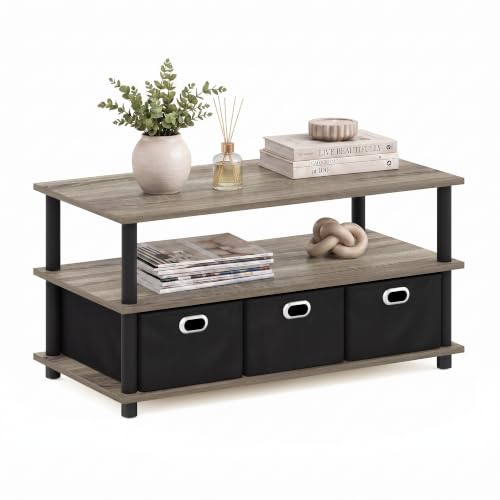
- Best overall for small spaces: Furinno Turn-N-Tube Coffee Table with 3 Bins, French Oak Grey — Check on Amazon
- VASAGLE Small Coffee Table Set of 2, Round Nesting Tables, Charcoal Grey and Ink Black — Check on Amazon
- VASAGLE MAEZO Round Coffee Table, 2-Tier, Honey Brown — Check on Amazon
- Nathan James Paloma Round Coffee Table with Raised Tray Edge, Dark Oak — Check on Amazon
- WLIVE Lift Top Coffee Table with Hidden Compartment and Adjustable Shelf, Grey — Check on Amazon
- Furinno Modern Simplistic Criss-Crossed Coffee Table, French Oak Grey — Check on Amazon
Read the full guide ↓
Disclosure: As an Amazon Associate, dailyhomedecorating.com earns from qualifying purchases. Links to Amazon on this page are affiliate links; they cost you nothing extra. Listing details such as price and availability change often, so check the current Amazon listing before you buy.
The best coffee table for small spaces under $300 is a study in proportion. A small space — a compact living room, a den, a reading corner, a guest room that doubles as a lounge — punishes a table in two directions at once: too large and it swallows the floor and blocks the walkway; too small and it strands your drink out of reach and looks like an afterthought. The tables that succeed share a set of tricks. Their footprints run from about 20 to 32 inches in their longest dimension. Their shapes protect circulation, with round tops and rounded corners where feet actually travel. Their structure stays open — lower tiers, slim legs, nesting halves — so light and sightlines pass through instead of stopping at a solid block. And they store things, because in a small space the floor is not a storage plan.
Our overall pick is the Furinno Turn-N-Tube: a 31.2-inch table with rounded corners, three storage bins and a 60-pound rating that covers real use at the budget tier. The VASAGLE nesting set offers the only footprint in this guide that changes size on demand. The round VASAGLE MAEZO adds a lower tier and a warm finish for corner-heavy rooms. The Nathan James Paloma brings a raised tray edge to a 32-inch round top for small spaces that host game nights. The WLIVE lift-top is the largest pick here, included because a table that replaces a desk saves more space than a smaller table that does not. And the Furinno Criss-Crossed closes the list with an open X-frame that keeps a 35-inch table feeling light. Whole-apartment readers should also see our guide to the Best Coffee Table For Small Apartments Under $300; this one is for any room where square footage is the constraint.
In this guide
Quick Picks
Short on time, or comparing several options at once? Each row below names a buyer type and the product that suits it, with a link to the listing.
| Buyer type | Pick | Why it stands out | Link |
|---|---|---|---|
| Best overall for small spaces | Furinno Turn-N-Tube Coffee Table with Bins | 31.2-inch footprint, rounded corners, three bins, 60 lb rating | Check on Amazon |
| Best adjustable footprint | VASAGLE Nesting Coffee Table Set of 2 | Nests to one table’s footprint, splits to two for guests | Check on Amazon |
| Best round with storage | VASAGLE MAEZO Round Coffee Table | 31.5-inch two-tier round top, 66 lb capacity, warm finish | Check on Amazon |
| Best for small-space game nights | Nathan James Paloma Coffee Table | Raised tray edge keeps pieces and drinks contained on a 32-inch round top | Check on Amazon |
| Best space-saving multi-tasker | WLIVE Lift Top Coffee Table | Replaces a desk and storage unit — saves more space than a smaller table | Check on Amazon |
| Best open, airy design | Furinno Criss-Crossed Coffee Table | X-leg frame keeps a 35.4-inch table visually light — check price on Amazon | Check on Amazon |
How These Picks Were Chosen
Every product below is a real Amazon listing, and every ASIN was cross-checked against maker specifications during research. This guide prints no fixed prices; check price on Amazon for the current figure. All six picks sit inside the under-$300 framing. The small-space filter then measured three things. Footprint: the longest dimension of every pick but one is 35 inches or less, and the exception — a 39-inch lift-top — had to prove it deletes other furniture. Shape and structure: round tops, rounded corners and open frames scored over solid blocks, because circulation and sightlines are a small room’s real currency. Capacity honesty: small tables get leaned on like big ones, so we favored published ratings of 60 pounds or more and flagged the specialist picks clearly.
We did not use these tables ourselves. We compared published dimensions, materials and capacities, and we treated each maker’s specification as the authority on its own product. Where a compact design trades away surface, dining ability or load rating, the review names the trade rather than letting the footprint charm you past it.
The 6 Best Coffee Tables for Small Spaces Under $300
Furinno Turn-N-Tube Coffee Table with 3 Bins, French Oak Grey
Who it suits: Small living rooms, dens and corners where the table must store as much as it surfaces — and anyone who wants the whole problem solved at the budget tier.
The Turn-N-Tube earns the lead because it answers the small-space question completely in 31.2 x 15.5 inches. The top holds drinks, a book and a laptop at 15.8 inches high. Three non-woven bins in the frame take the clutter that otherwise spreads across a small room’s every surface — remotes, chargers, games, mail, craft supplies. The corners are rounded, which matters more in a tight room than anywhere: the table sits in the traffic, and its edges are the ones your shins and your children’s foreheads will meet. The maker’s 60-pound maximum rating is genuinely sturdy for the size, and the Turn-N-Tube assembly needs no tools, so the table can be built in the room it will live in, however tight the stairs were.
Its limits are the honest shape of its size. At 15.5 inches deep it will not dine two people or spread a large board game; the fabric bins are for light things; and the low height pairs best with low, compact seating. None of that diminishes the core achievement: this is the most storage per square inch in the guide, at its budget end — check price on Amazon. For a small space that needs order more than acreage, it is the first table we would order.
- Three bins of hidden-away storage in a 31.2-inch footprint.
- Rounded corners for rooms where the table sits in the traffic.
- 60 lb maximum rating — sturdy beyond its tier.
- No-tools assembly, ideal for tight rooms and stairs.
Honest limitation: Narrow and low — a store-and-perch table, not a dining or games surface.
Choose it if storage per square inch is your metric. Skip it if you need to dine or work across the table daily.
VASAGLE Small Coffee Table Set of 2, Round Nesting Tables, Charcoal Grey and Ink Black
Who it suits: Small spaces with a social life — rooms that sit quiet all week, then host six people on Friday and need surfaces everywhere.
Every other pick has a fixed footprint; this set has a negotiable one. The large table is 23.6 inches across at 17.7 inches high, the small one 19.7 inches at 15.7 inches, and nested together they occupy the large table’s circle alone. Split them and the small table serves an armchair, a guest, or the far end of the sofa. Each top carries a 66-pound static rating, the set weighs about 21.6 pounds in charcoal grey and ink black steel-and-particleboard construction, and the round shapes keep a small room’s circulation unbruised.
The compromises are continuity and care: two circles cannot merge into a dining surface, work spreads split awkwardly across two heights, and the particleboard tops want coasters. But for the small space whose problem is variability — sometimes one reader, sometimes a crowd — no fixed table solves it at all, and this set solves it elegantly. It is the same flexibility that earns it a place in our apartment guide; in a small room of a larger home, it is often the piece that makes a den or guest lounge actually work.
- Only variable footprint here: one circle daily, two on demand.
- 66 lb rating per table; about 21.6 lb for the set.
- Round tops protect circulation in tight layouts.
- Charcoal and black palette suits modern small rooms.
Honest limitation: No continuous surface for dining or wide work spreads.
Choose it if your small space changes population often. Skip it if you need one unbroken work surface.
VASAGLE MAEZO Round Coffee Table, 2-Tier, Honey Brown
Who it suits: Corner-heavy small rooms — bay-window nooks, L-shaped layouts, seating areas threaded by a walkway — that need storage without a rectangle’s corners.
The MAEZO pairs the round top’s flow with the storage round tables usually surrender. Its 31.5-inch top at 17.7 inches high carries a 66-pound rating, and a full second tier below holds the basket, the books and the folded throw that a small room has nowhere else to put. Tapered legs and curved transitions keep the silhouette soft, and the honey brown finish brings warmth that small, north-facing rooms especially lack. At about 25 pounds it is settled but movable.
Against the Turn-N-Tube above, the MAEZO trades bins for beauty and a wider, more usable top; against the Paloma below, it trades the tray lip for a lower price tier and a warmer finish — compare current figures on Amazon. Its circle still will not host a laptop spread gracefully, and 31.5 inches is a ceiling on group use. As the small room’s calm, warm centerpiece, though, it is the most finished-looking storage table at its tier, and it doubles as our family guide’s lead pick for toddler households — see Best Coffee Table For Families Under $300 — because a corner-free table is a kindness at every age.
- Two full tiers: surface above, storage below.
- 66 lb top capacity in a 31.5-inch round footprint.
- Curved transitions and tapered legs soften a small room.
- Warm honey brown finish suits traditional and transitional decor.
Honest limitation: A lounging and reading surface, not a workstation.
Choose it if your small room needs warmth, flow and storage together. Skip it if daily laptop work happens at the table.

Nathan James Paloma Round Coffee Table, Dark Oak and Matte Black
Who it suits: Small spaces that entertain — dens and compact living rooms where game night, puzzles and snacks happen on the coffee table because there is no other table.
The Paloma’s raised tray edge is a small-space feature disguised as a detail. On a 32-inch round top in a room with no dining table, everything lives closer to the edge — dice, puzzle pieces, a drink near the rim — and the Paloma’s lip keeps all of it in play instead of on the floor. The two-tier build adds a lower shelf for the game boxes themselves, the height is 18 inches, and at about 26 pounds in dark oak and matte black it looks like a deliberate piece of furniture rather than a compromise, which matters in a small room where every object is always visible.
Compared with the MAEZO, the Paloma is the entertainer’s variant: same round logic, plus containment, minus nothing but a little sliding ease — large books and laptops do not glide across a lipped top. Its 32-inch surface remains a circle’s modest acreage, so a four-person game with a big board may still outgrow it. For the small room whose table is its social center, the containment is worth more than the glide.
- Raised tray edge contains games, crafts and drinks.
- Two-tier 32-inch round design with lower shelf.
- Dark oak and matte black — a grown-up look for small rooms.
- 18-inch height; about 26 lb assembled.
Honest limitation: The lip interrupts sliding items on and off, and the surface stays modest.
Choose it if your small space hosts game nights. Skip it if you slide a laptop across the table all day.
WLIVE Lift Top Coffee Table with Hidden Compartment and Adjustable Shelf, Grey
Who it suits: The smallest brief of all: a single room that must be living room, office and dining room — a studio corner, a spare-room lounge, a den that works weekdays.
The WLIVE is the biggest table in this guide at 39.4 x 19.7 inches, and it is here on a deliberate argument: space is saved by furniture deleted, not by inches shaved. Its top lifts from about 16.3 to 22.6 inches, so the desk disappears into the coffee table; its hidden compartment and adjustable shelf absorb the storage unit; what remains on the floor plan is one honest rectangle doing three jobs. At about 41.8 pounds it is the most substantial piece here, in a grey finish that suits the multi-use rooms it serves.
The counter-argument is equally honest: if your small space is only a lounge — no work, no sofa dining — then 39.4 inches is simply a large table in a small room, and the 31-inch picks above serve you better. The lift mechanism also asks for two-handed use and light loads when raised, and assembly is the longest here. Judge by jobs, not by tape measure alone: three jobs, choose the WLIVE; one job, choose smaller.
- Deletes a desk and a storage unit from the floor plan.
- Lift range about 16.3 to 22.6 inches for work and dining.
- Hidden compartment plus adjustable open shelf.
- Grey finish suits multi-use rooms and dens.
Honest limitation: The largest footprint here — only a space-saver if it replaces other furniture.
Choose it if your small space works three jobs. Skip it if it only lounges — go smaller.
Furinno Modern Simplistic Criss-Crossed Coffee Table, French Oak Grey
Who it suits: Small rooms that feel dark or crowded, where the table must take up visual space as sparingly as physical space.
The Criss-Crossed is a 35.4 x 19.6 inch top at 16 inches high on an X-frame, and the frame is the point: you can see through this table from every angle, so the rug, the floor and the light continue underneath it, and a small room keeps its depth. A lower shelf surface carries books without closing the structure in. The French oak grey finish is pale and modern, the table weighs about 18.9 pounds for easy rearranging, and it sits at the budget end of this guide — check price on Amazon.
Entry-tier honesty applies: engineered panels at this tier are light-duty, dislike standing water, and the 16-inch height runs low beside tall seating. Treat it as the airy, affordable answer for a small room’s next few years rather than a decade’s anchor — the Nathan James picks above are the step-up. For a bright, open feel at a gentle price, it earns its place.
- Open X-frame preserves sightlines and light in small rooms.
- 35.4-inch top with a lower shelf for books.
- Pale French oak grey finish brightens compact spaces.
- About 18.9 lb; budget tier of this guide.
Honest limitation: Light-duty engineered construction and a low profile — verify height against your sofa.
Choose it if visual lightness matters most. Skip it if you need heavy-duty load capacity.
Proportion Rules That Actually Work in a Small Space
Advice for small spaces usually dissolves into vibes — “keep it light,” “don’t overcrowd” — so here are the rules with numbers attached, the ones a tape measure can enforce. Rule one: the two-thirds proportion survives downsizing. A small sofa or loveseat still wants a table near two-thirds of its seating length; a 31-inch table in front of a 48-inch loveseat is proportionate, while a 20-inch table strands drinks at the ends and reads as an accident. Rule two: the gap is sacred. Fourteen to eighteen inches between sofa edge and table edge is the distance at which a seated person reaches a drink without leaning and a standing person passes without turning sideways; in a small room the temptation is to spend that gap on a bigger table, and it is always a bad trade, because the gap is used a hundred times a day and the extra table inches are used at the margins.
Rule three: height is a relationship, not a number. The table top belongs level with the seat cushion or up to two inches below it; in small spaces with low, compact seating, the 15.7- to 17.7-inch picks here land correctly, while an 18-inch table can tower over a low loveseat and make the whole arrangement look top-heavy. Rule four: the rug should outrun the table. A rug that extends beyond the table on all sides — and ideally under the sofa’s front legs — makes the seating zone read as one generous island; a rug the size of the table makes the zone read as a postage stamp, and the room shrinks around it. Rule five: one surface, one job per moment. A small table styled with a permanent forest of objects has no room left to be used; the storage inside these picks exists precisely so the top can stay two-thirds empty, which is the proportion that makes a small surface feel ample.
Applied together, these rules explain the shape of this whole guide: compact lengths that still respect proportion, round and rounded forms that protect the sacred gap, open structures that keep the island feeling large, and storage that defends the empty two-thirds of every top. A small space furnished by rules instead of hope stops feeling like a compromise — it feels like a room that was designed on purpose, at exactly its size.
Comparison Table
| Product | Size and type | Best use | Link |
|---|---|---|---|
| Furinno Turn-N-Tube with Bins | 31.2 x 15.5 x 15.8 in, rounded corners, 3 bins, 60 lb max | Most storage per square inch | Check on Amazon |
| VASAGLE Nesting Set of 2 | 23.6 in + 19.7 in round, 66 lb each | Variable footprint for hosting | Check on Amazon |
| VASAGLE MAEZO Round | 31.5 in diameter x 17.7 in, two-tier, 66 lb top | Flow, warmth and shelf storage | Check on Amazon |
| Nathan James Paloma | 32 in diameter x 18 in, raised tray edge, two-tier | Game nights in small rooms | Check on Amazon |
| WLIVE Lift Top | 39.4 x 19.7 in, lift 16.3–22.6 in, compartment + shelf | Replacing a desk and storage unit | Check on Amazon |
| Furinno Criss-Crossed | 35.4 x 19.6 x 16 in, X-frame, engineered wood | Visual lightness on a budget | Check on Amazon |
How to Choose a Coffee Table for a Small Space
- Tape the footprint first. Mark the table’s outline on the floor with painter’s tape and live around it for a day. Small rooms forgive nothing, and tape is cheaper than returns.
- Protect the gaps. Keep 14 to 18 inches between sofa and table, and never let the table narrow a through-route below comfortable passing width.
- Count deleted furniture. A lift-top that replaces a desk, or bins that replace a storage box, save more space than two inches off a top. Choose by the floor plan after the purchase, not the product photo.
- Round where feet travel. If the table sits in a path, a round top or rounded corners will repay you in unbruised shins every single week.
- Keep the structure open. Lower tiers, slim legs and nesting halves let light and sightlines through; a solid block the same size makes the room measurably smaller to live in.
- Demand a real weight rating. Small tables get sat on, leaned on and loaded like big ones. Ratings around 60 pounds and up forgive real life.
- Scale to the sofa, not the room alone. About two-thirds of the sofa’s length, and a top level with or just below the seat cushion, keeps even a small table looking intentional.
- Plan the delivery path. Narrow doors, stairs and turns decide what can enter a small space. Flat-pack and lightweight picks — most of this guide — travel best.
One Table, Several Rooms: Dens, Nooks and Guest Spaces
Not every small space is a living room, and the secondary rooms of a home have their own table logic. The den or media corner wants a table that serves snacks and remotes without blocking the screen’s sightlines — low profiles like the 15.8-inch Turn-N-Tube, with bins for the controllers and chargers that colonize media furniture. The reading nook wants the opposite emphasis: a round table at seat height, close beside the chair rather than centered in front of it, where the MAEZO’s lower tier holds the book stack and the top holds tea and glasses within an arm’s unhurried reach. The guest room that doubles as a lounge wants flexibility above all — the nesting set again, because guests need surfaces in unpredictable places, and a pair of light tables can be a coffee table by day and two bedside surfaces by night.
The home office’s spare corner — the video-call backdrop zone — wants a table that keeps the frame tidy: the WLIVE’s hidden compartment swallows the work kit before calls, and its closed silhouette reads as furniture, not equipment. A hallway-adjacent sitting area, the strangest small space of all, wants the Paloma treatment: containment, because everything placed in a thoroughfare room eventually gets knocked, and a raised lip is the cheapest insurance in furniture. The pattern across all five rooms is the guide’s thesis in miniature — in a small space, the table’s secondary talents (storage, containment, flexibility, disguise) matter as much as its surface, because there is no spare furniture to supply them.
When one purchase must serve two of these rooms in sequence — the common reality of small homes — rank the rooms by hours. The table belongs, permanently, to the room that uses it daily; the second room borrows the design language, not the object. Lightweight picks are the exception that proves the rule: at 18.9 pounds, the Criss-Crossed can genuinely commute between a den and a guest room, and for some households that mobility is the entire brief.
Common Buying Mistakes
- Scaling down so far the table cannot hold a drink and a book at once.
- Blocking the walkway to save two inches of table length.
- Choosing a solid block that stops light and sightlines in a room short of both.
- Ignoring the weight rating because the table is “only small.”
- Buying open display storage for a room whose problem is visible clutter.
- Forgetting the room’s second job — guests, work, games — until the table fails at it.
- Skipping the tape test and discovering the truth with a return label.
- Matching a low table to a high sofa and reaching down for every sip.
Keeping a Small Space Calm Around the Table
The last small-space skill is maintenance of calm, and it is mostly a storage discipline. A compact room’s visual temperature rises with every object left on a surface, because there are fewer surfaces and each one is always in view. The system that works is a two-minute reset with a designated destination for everything: remotes and chargers into the compartment or a bin, books onto the lower tier, everything else out of the room entirely. The picks in this guide were chosen with that reset in mind — each one gives the daily scatter a home inside its own footprint, so the reset never requires a trip to another room’s storage, which is the trip that never happens. Coasters live on the table, in a small stack or a lidded box, because a coaster in a drawer is a ring on the finish waiting for its moment; in a small space, that ring is also always in view.
Cleaning follows the same logic of little and often. A weekly damp-cloth pass over the top and tier keeps engineered finishes ahead of the dust that small, lived-in rooms generate, and the open structures in this guide — X-frames, slim legs, nesting halves — exist partly so a vacuum and a cloth can pass through the seating zone without moving furniture. The room that can be cleaned in five minutes is the room that gets cleaned, and in a small space the difference between tidy and tired is never more than a week wide.
What to Do When Even These Feel Big
Some spaces defeat even a well-chosen compact table: the true micro-studio, the narrowboat-shaped rental living room, the bedroom corner that must hold a chair and a conscience. The honest fallbacks, in order, are these. First, shrink the concept rather than the quality: a nesting set used as a single small table — the VASAGLE’s 19.7-inch half alone — is a legitimate coffee table for one chair or a compact loveseat, with its partner stored flat-adjacent until guests arrive. Second, borrow the side-table category: a sturdy end table at coffee-table height, placed centrally, serves one seat honorably, and the household that reads and drinks rather than dines at the sofa will not miss the acreage. Third, question the center itself: some very small rooms work better with the table against the sofa’s side and the middle kept open, trading ceremony for floor. What not to do is buy a full-size table and spend years navigating it as an obstacle — the room will win every argument, daily, at shin height.
The reverse problem also exists and deserves a sentence: the small space that is about to become a bigger one. If a move is a year away, the lightweight, lower-tier picks in this guide are the rational bridge — they serve now, travel easily, and retire to a bedroom or den in the next home without a pang. Buying the forever table for a room you are leaving is how good furniture becomes storage-unit furniture.
A Short History of the Small Table, and Why It Works
The compact coffee table is not a shrunken apology for a bigger one; it descends from furniture designed small on purpose. The tea tables of the eighteenth century were light, movable surfaces brought to the chair when needed and cleared away after — the original nesting logic. The mid-century designers who codified the modern living room worked in genuinely small postwar apartments, and their low, open, multi-use tables — surfaces that could serve drinks, books, a typewriter, a meal — are the direct ancestors of every pick in this guide, from the nesting pair to the lift-top that hides a desk inside a coffee table’s silhouette. When you choose a small table with a second talent, you are not compromising on the tradition; you are buying the tradition itself, at the size it was invented for.
That lineage carries one practical moral for the modern buyer: small tables earn their place by being moved, used and adapted, so judge them by those verbs. Can one person shift it? Does it store the room’s actual objects? Does it become the other thing the room needs at 7 p.m.? The six picks here were chosen because each answers at least two of those questions well, in a footprint a tape measure approves. The rest — finish, warmth, style — is the pleasure of the purchase, and it is real, but it rides on the verbs.
Final Recommendation
- Most small spaces: Furinno Turn-N-Tube with Bins — storage, safety and size in balance.
- Hosting flexibility: VASAGLE Nesting Set of 2.
- Warmth and flow: VASAGLE MAEZO Round.
- Game nights: Nathan James Paloma.
- Multi-job rooms: WLIVE Lift Top.
- Airy and budget: Furinno Criss-Crossed.
Start with the tape test and your room’s job list. If storage leads, the Turn-N-Tube is the answer; if jobs lead, the WLIVE deletes furniture; if people lead, the nesting set flexes. Check the current price on Amazon and order the table your floor plan voted for.
Small Spaces in Bigger Lives: Kids, Pets and Hobbies
Small rooms rarely belong to minimalists alone; they belong to households whose lives are larger than their floor plans, and the table must absorb the overflow gracefully. For households with dogs, the small-space virtues reorder themselves: a settled weight matters, because a table that skids under a leaning Labrador becomes a daily rearrangement, and open lower tiers invite investigation — the Turn-N-Tube’s bins and the WLIVE’s closed compartment keep remotes and reading glasses out of the chew economy entirely. For households with cats, the calculus inverts in one respect: the table will be sat upon, by a creature of impeccable balance and no respect for ratings, which is one more argument for the 60-pound-and-up club and against glass in the small room’s center. For hobbyists — knitters, puzzlers, model builders, board gamers — the small table’s lower tier or compartment is not storage but a project dock, the place a work-in-progress lives between sessions without colonizing the dining surface, and the Paloma’s lipped top was practically designed for the puzzler’s thousand small betrayals.
The unifying rule is to inventory the life before the furniture. List what actually crosses the center of your small room in a week — animals, projects, children, instruments, laundry in transit — and choose the pick whose secondary talents cover the list. A small space does not need a smaller life; it needs a table that files the life away at bedtime and returns it, smiling, in the morning.
Measuring a Small Space Without Fooling Yourself
One last discipline, because small-space measurements fail in predictable ways. Measure the room’s usable rectangle, not its wall-to-wall rectangle: subtract radiators, door swings, the fireplace hearth and the bookshelf’s true depth, because the table lives in what remains. Measure the sofa’s seat height with someone sitting in it — cushions compress, and a table matched to an uncompressed cushion sits oddly high all its life. Measure the walkway at its narrowest point, which is rarely where you first put the tape. And measure the delivery path’s tightest turn with the box in mind, not the table, because the box is what actually travels it. Small spaces punish optimistic numbers more than any other rooms in the home; the tape measure, used pessimistically, is the cheapest square footage you will ever add.
Borrowed Space: Corners, Landings and the Foot of the Bed
The smallest spaces in a home are often not rooms at all — the landing wide enough for a chair, the corner under the stairs, the foot of a guest bed — and a compact table can promote each of them from passage to place. The landing reading chair wants a round table at its elbow, the MAEZO’s tier holding the book queue; the under-stair nook wants containment and calm, the Paloma’s lipped circle keeping a tea cup and a notebook in their zone; the guest bed’s foot wants the nesting set’s small half, a surface that appears for guests and vanishes into its partner afterward. The principle is the guide’s whole argument in miniature: a small space becomes a room when it gains a surface at the right height with a place to put things down. Measure the nook’s usable rectangle, respect its walkway, and choose from the compact end of this guide — the smallest picks here were, in a sense, designed for exactly these promotions.
One caution travels with the idea: borrowed spaces usually borrow light and outlets too, so keep the table’s job to the passive virtues — surface, storage, containment — and let the lift-top’s ambitions stay in the rooms with room to raise them.
Frequently Asked Questions
What is the ideal coffee table size for a small space?
For most small spaces, a longest dimension between about 24 and 35 inches, a height level with or just below the sofa seat, and 14 to 18 inches of clearance in front of the sofa. Variable options — nesting tables that shrink to a 23.6-inch circle — beat any fixed size when the room hosts as well as lounges.
Are round coffee tables better for small spaces?
Often, yes. A round top removes corner collisions from walkways, flows better in L-shaped and corner layouts, and two-tier rounds like the MAEZO still store a shelf’s worth of things. Rectangles win only when the table must work as a desk or dining surface, where corners are usable area.
How can a larger table ever save space?
When it deletes other furniture. A 39-inch lift-top that replaces a desk and a storage unit leaves a smaller total footprint than a 31-inch table plus both of those pieces. Judge the floor plan after the purchase, whole, rather than the table’s dimensions alone.
What weight capacity should a small coffee table have?
Aim for a published rating of about 60 pounds or more on the top for everyday confidence — the level most picks in this guide meet. Small tables receive the same leaning, loading and occasional sitting as large ones, so the rating matters just as much at 31 inches as at 44.
How do I make a small space feel bigger around the coffee table?
Choose open structure — lower tiers, slim or X legs, nesting halves — so sightlines pass under and through the table; keep the top mostly clear using bins or a compartment; and let the rug extend beyond the table on all sides. Visual continuity, not smallness alone, is what makes the room breathe.
Should a small-space coffee table have storage?
Almost always. In a small space, the table’s lower half is prime real estate: bins for clutter, a tier for baskets and books, or a hidden compartment for the daily kit. The only exception is a purely decorative corner arrangement — and even there, a lower shelf rarely hurts.
Can a coffee table be too small for a small space?
Yes — undersizing is the quiet failure of small-space buying. A table too short for the sofa strands drinks out of reach at both ends, a top too small for the room’s actual life pushes objects onto the floor and the sofa arms, and the space ends up more cluttered than a correctly sized table would ever make it. The two-thirds proportion and the job list are the guards: size the table to the seating and the work, then let shape and open structure — not further shrinking — supply the feeling of space.
Where should a coffee table sit in a very small room?
Centered on the seating, not on the room. A small room’s geometric center is often a walkway; the table belongs in front of the sofa at the 14-to-18-inch gap, aligned to the seating’s center line, even if that leaves it off the room’s axis. In corner arrangements, a round table at the inside of the L serves both seats without favoring either. Let the rug, centered with the seating, make the arrangement look intentional.


