Where to buy
Check the latest price, availability and delivery on Amazon. Orders are placed on Amazon. We may earn a commission from qualifying purchases.
- Best overall: Vision Home Natural Pinch Pleated Full Blackout Curtains, 40″W x 84″L, 2 Panels — Check on Amazon
- Sun Zero Nordic Theater Grade Extreme 100% Blackout Curtain Panel Pair, 52″W x 84″L, 2 Panels — Check on Amazon
- NICETOWN Full Blackout Curtains, 52″W x 84″L, 2 Panels — Check on Amazon
- Deconovo 100% Blackout Curtains with Black Liner, 52″W x 84″L, 2 Panels — Check on Amazon
See 2 more Amazon options
- MIULEE 100% Blackout Linen Curtains, Natural Beige, 52″W x 84″L, 2 Panels — Check on Amazon
- ChrisDowa Blackout Curtains, Stone Blue, 42″W x 63″L, 2 Panels — Check on Amazon
Read the full guide ↓
Disclosure: As an Amazon Associate, dailyhomedecorating.com earns from qualifying purchases. Links to Amazon on this page are affiliate links; they cost you nothing extra. Listing details such as price and availability change often, so check the current Amazon listing before you buy.
A small room usually has exactly one window, and that changes the blackout-curtain problem completely. In a large bedroom a mediocre curtain is a compromise spread across a big space; in a small room the curtain is a third of one wall, the room’s main light source and its main heat leak, all in a single product. Get it right and the room sleeps dark, holds its temperature and looks taller than it is. The good news is that $75 is a genuinely useful budget here. It is the tier where a small room stops choosing between darkness and appearance: lined constructions that block light completely are available well within this budget, and the rest of the budget buys the things a small room actually feels — a pinch-pleat header that hangs from a ceiling track and stretches the wall upward, a pale linen face that blacks out without darkening the room’s palette, and panel sizes proportioned to small windows instead of borrowed from a living-room listing.
So this guide ranks six pairs for the way small rooms are actually used. Four are priced in the standard configuration — two panels, each 52 inches wide by 84 inches long — and two deliberately break it, because small windows do: the Vision Home pair is built from narrower 40-inch panels, and the ChrisDowa pair is a 42 x 63 inch set made for short windows that an 84-inch drop would drown. Every pick below is pinned to the exact size and panel count linked — check price on Amazon for the current figure in the United States. For most small rooms we would start with the Vision Home pinch pleats, because the header is the small-room feature: hooks that ride a ceiling-mounted track pull the fabric to the top of the wall, seal the worst light gap and make a low ceiling read higher. If the budget matters more than the tailoring, the NICETOWN Full Blackout pair delivers the same lined darkness at the lower end of this budget and leaves room in the budget for the track itself. Below you will find a quick picks table, detailed notes on all six products, a comparison table, a buying checklist, an honest account of what the extra money above $40 does and does not buy, fitting guidance written for one-window rooms, the mistakes small-room shoppers make, and answers to the questions that come up again and again.
Quick Picks
Short on time, or comparing several options at once? Each row below names a buyer type and the product that suits it, with a link to the listing. Check price on Amazon for the exact configuration named in each row.
| Buyer type | Pick | Why it stands out | Link |
|---|---|---|---|
| Best overall | Vision Home Natural Pinch Pleated Full Blackout Curtains, 40″W x 84″L, 2 Panels | Sewn-in blackout lining behind a linen-blend face, on hooks made for a ceiling track — check price on Amazon | Check on Amazon |
| Best total darkness | Sun Zero Nordic Theater Grade Extreme 100% Blackout Curtain Panel Pair, 52″W x 84″L, 2 Panels | The heaviest, most literal light barrier in the guide — check price on Amazon | Check on Amazon |
| Best value | NICETOWN Full Blackout Curtains, 52″W x 84″L, 2 Panels | A lined, true-blackout construction — check price on Amazon — proof the $75 budget does not have to be spent | Check on Amazon |
| Best black liner | Deconovo 100% Blackout Curtains with Black Liner, 52″W x 84″L, 2 Panels | A sewn-in black liner that absorbs light instead of reflecting it — check price on Amazon | Check on Amazon |
| Best linen look | MIULEE 100% Blackout Linen Curtains, Natural Beige, 52″W x 84″L, 2 Panels | A pale faux-linen face with a coated blackout back — a light color that will not swallow a small room | Check on Amazon |
| Best for short windows | ChrisDowa Blackout Curtains, Stone Blue, 42″W x 63″L, 2 Panels | A short, narrow pair sized for small windows — check price on Amazon — honestly an unlined darkener, not a lined blackout | Check on Amazon |
How These Picks Were Chosen
The first filter was the budget, applied to named configurations so the comparison means something. Curtain prices are meaningless without a size and a panel count attached, so each pick below was checked on Amazon.com in the United States in the exact configuration linked, and every one fits the under-$75 budget in that configuration — check the current price on Amazon before you order. Four picks use the standard bedroom configuration — a pair of two panels, each 52 inches wide by 84 inches long. Two picks break it on purpose, and the break is the point: the Vision Home pair is two 40 x 84 inch panels, a narrower cut that suits the smaller windows small rooms actually have, and the ChrisDowa pair is two 42 x 63 inch panels, the short drop a small window over a radiator, desk or low sill needs. Anything sold as a single panel while presented like a pair, or as a blackout curtain that turned out to be a sheer with ambitions, was left out.
We did not hang these curtains ourselves. We read the maker listings and specification pages, compared constructions — sewn liners, coated backings and unlined triple weaves — checked header styles and hardware, and cross-checked configurations against retailer records. Headline light-blocking percentages in this category are maker figures rather than independent test results, and the same brand often quotes different percentages on different listings, so we weighted construction — what is actually layered between the room and the glass — at least as heavily as the number printed on the box. Where a maker’s own listings disagree with each other, we say so in the review. Readers working with an even tighter budget should see Best Blackout Curtains For Small Rooms Under $40, where the same one-window logic is applied at the lower tier.
One divide decided the shortlist, and it should decide your purchase too: lined versus unlined. A lined or coated-backing curtain blocks light with a dedicated layer, which is why it can do it in beige and natural as reliably as in black. An unlined triple-weave curtain blocks light with density and dye, which is why its own maker rates it below 100 percent and why the color you choose changes the result. Five of the six picks below are lined or coated, because at $75 a small room can afford the real construction for its only window. The sixth, the ChrisDowa, is included with its construction stated plainly, because its size — not its fabric — is what some small windows need, and pretending otherwise would be the dishonest version of this guide. The second divide is visual, and in a small room it matters almost as much: the curtain is a major surface in a small space, so face color and header style were treated as functional choices, not decoration. A pale lined pair keeps a small room feeling open while performing like a dark one; a pinch-pleat header on a ceiling track adds apparent height no paint can. Both effects are ranked below, deliberately.
The 6 Best Blackout Curtains for Small Rooms Under $75
Vision Home Natural Pinch Pleated Full Blackout Curtains, 40″W x 84″L, 2 Panels
Who it suits: Small-room owners who want the window to add height instead of bulk — a tailored, ceiling-hugging treatment for the room’s only window, in a pale natural face that keeps the space feeling open.
Start with the pick that spends the budget where a small room can feel it. Vision Home’s pinch-pleat pair is built differently from the grommet crowd: each panel carries seven sewn pinch pleats and hangs from hooks — eighteen are included in the package — which means it can ride a rod with rings or, more importantly for this guide, a ceiling-mounted track. A track at the ceiling line does three things no fabric upgrade can do in a small room: it closes the top gap where light pours over a rod, it runs the fabric from the top of the wall so the wall reads taller, and it lets the panels stack tight against the wall instead of billowing into the room. The blackout construction behind the face is a coated lining sewn in behind a linen-blend face — the listing gives the face as 90 percent recycled polyester and 10 percent linen, with a recycled-polyester lining base and rayon flocking — and the maker sells the line in lengths from 63 to 120 inches, so a short window can take the same tailored header in a 63-inch drop. The pair linked here, two panels each 40 inches wide by 84 long in Natural, sits near the top of this budget; check price on Amazon, because this brand’s pricing moves by color and length.
Two honest notes decide whether this is your pick. The first is width: two 40-inch panels give 80 inches of flat fabric, and gathered at the recommended one and a half to two times fullness that honestly covers a window about 40 to 53 inches wide. That is the right proportion for most small-room windows — and a hard limit for wide ones, where this pair will look starved no matter how good the pleats are. The second is that you are paying for the header and the finish, not for a better blackout layer: the coated lining’s physics are the same as the lower-priced lined pair further down this guide, and a coated lining is the layer that heat and rough washing eventually crack, so the gentle-care rule applies here with a top-of-budget pick at stake instead of a lower-priced one.
- Pinch pleats on included hooks: hangs from a ceiling track, sealing the top gap and adding apparent height.
- Sewn-in coated blackout lining behind a linen-blend face (90% recycled polyester, 10% linen).
- Narrower 40-inch panels, proportioned for small windows; lengths from 63 to 120 inches in the line.
Honest limitation: The pair covers a window only up to about 53 inches wide at proper fullness, the price sits near the top of the budget, and the blackout layer is a coating — effective, but the part of the curtain that heat and hot washing will age first.
Choose it if your small room’s window is standard or narrow, the ceiling is low, and you want the treatment to make the room feel taller. Skip it if your window is wide, or if you would rather choose the lower-priced lined NICETOWN below and put the remaining budget toward the track itself.

Sun Zero Nordic Theater Grade Extreme 100% Blackout Curtain Panel Pair, 52″W x 84″L, 2 Panels
Who it suits: Day sleepers and light-sensitive sleepers in small rooms — anyone whose one window faces a streetlight, a sunrise or a neighbor’s security light, and who needs the heaviest barrier this budget holds.
If the Vision Home spends the budget on tailoring, this pair spends it on mass. Sun Zero’s Nordic Theater Grade line is the legacy name in this category, and its claim is the strongest any maker in this guide prints: the listing says the fabric is third-party laboratory tested to block 100 percent of outside light. Treat that the way this guide treats every percentage — as the maker’s claim, not our measurement — but the construction behind it is visibly serious: this is the thickest, heaviest pair here, a dense theater-grade build that hangs flat and still against the wall, which in a small room is worth more than it sounds, because a sleeper in a small room is usually sleeping close to the window. The gray pair linked here, two panels each 52 x 84 inches with grommets, sits in the middle of this budget — check price on Amazon. Sun Zero also publishes energy and noise figures for the line — up to 50 percent less energy loss through the window, up to 45 percent noise reduction — and both are maker claims, repeated here as claims; the honest version is that a heavy lined pair over a small room’s only window does noticeably blunt both drafts and street sound, without a percentage anyone verified.
The weight is the limitation, in two directions. Physically, this pair wants a properly anchored rod; in a small room with older plaster or a landlord’s walls, that is a real consideration, and it is the pair least suited to a tension rod’s optimism. Visually, a heavy dark pair is a lot of curtain in a small room: in gray it reads as a deliberate, calm wall of fabric, but run it floor-length in a dark colorway in a nine-by-ten room and it will dominate the space it was meant to serve. The fitting advice later in this guide — mount high, keep the color mid-tone or lighter, let the hem just clear the floor — was written with this pair in mind. Buyers outfitting a small bedroom specifically, rather than a small room generally, will find this same pair ranked for sleep-first priorities in Best Blackout Curtains For Bedrooms Under $75.
- The heaviest construction in the guide, with the maker’s lab-tested 100% light-blocking claim.
- Standard 52 x 84 inch pair with grommets — check price on Amazon — mid-budget for the top darkness tier.
- Thermal and noise figures (up to 50% and 45%) are the maker’s claims; the real effect is a small room’s only window properly covered.
Honest limitation: Heavy enough to demand an anchored rod, and visually heavy too — in a dark colorway at full length it can swallow a small room. The lab-test and energy claims are Sun Zero’s, not independent measurements we can confirm.
Choose it if darkness is the whole job and your small room’s window is bright, loud or both. Skip it if your walls will not take a serious rod, or the room needs a pale, light visual touch — take the MIULEE linen below.

NICETOWN Full Blackout Curtains, 52″W x 84″L, 2 Panels
Who it suits: Small-room shoppers who want genuine lined blackout and would rather keep most of the $75 — for a ceiling track, a better rod, or the second room.
Every guide at this budget needs its honesty anchor, and this is it: a lined construction positioned at the lower end of this budget, from the brand that dominates the category — check price on Amazon. The construction is the one that matters — a decorative face backed by a dedicated blackout layer, rather than a single weave hoping density will do — and it is why this pair’s packaging specs measure a half-inch thick where unlined curtains measure a fifth of an inch. In a small room, that layer does double duty: it is the light barrier and, over the room’s only window, a meaningful share of the room’s insulation. The pair hangs from eight metal grommets per panel with the standard 1.6-inch inner diameter, fits rods up to about 1.5 inches, and because the backing does the light work, its darkness holds up across its color range far better than a triple weave’s does — the black colorway linked here is the surest version, but a mid-tone does not collapse the way an unlined curtain’s pale colorway does.
Why is a lower-priced pair in a $75 guide at all? Because the honest answer to “what should a small room buy?” is sometimes “the lower-priced lined pair and a ceiling track bought with what remains of the budget,” and a guide that only recommends spending the whole budget is a sales page, not a guide. What you give up against the picks above is finish: the face is plain, the drape is comparatively stiff and formal, and there is no tailored header — on a rod it looks like what it is, a good budget blackout curtain. The weight deserves the same note as in any lined review: anchor the rod properly, wash cold and gentle, and keep the backing out of a hot dryer, because the backing is the product.
- Lined full-blackout construction — a dedicated blackout layer, not a hopeful weave.
- Check price on Amazon for the standard pair: the lowest tier position here for a true lined blackout.
- Eight metal grommets per panel, 1.6-inch inner diameter for standard rods.
Honest limitation: Plain face, stiff formal drape, no tailored header — and heavy enough, like every lined pair, to want a properly anchored rod and gentle washing.
Choose it if you want the darkness first and the savings second, or you are funding a ceiling track from the same $75. Skip it if the curtain will be the room’s main visual surface all day and you want it to look like furniture — that is the Vision Home above.
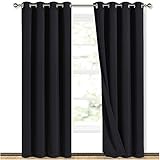
Deconovo 100% Blackout Curtains with Black Liner, 52″W x 84″L, 2 Panels
Who it suits: Sleepers in small rooms who lie close to the window and want the most literal light barrier — a black liner that absorbs light rather than reflecting it — in a standard-size pair.
Deconovo is NICETOWN’s closest rival in this category, and its 100% Blackout line takes the most direct approach of any pick here: the face fabric carries the color, and a black liner sewn in behind it does the blackout work. Black is the one backing color that absorbs rather than reflects, which matters in a small room for a specific reason: the sleeper is near the glass. In a large bedroom a faint glow through a pale backing fades across fifteen feet of floor; in a small room the bed is often three feet from the window, and absorbed light is light that never starts that trip. The pair — two panels, each 52 x 84 inches, grommet-top — sits in the lower-middle of this budget on Amazon in the United States — check price on Amazon, as the figure varies by colorway. Readers comparing this construction against the entry tier will find its physics discussed alongside the cheapest lined options in Best Blackout Curtains Under $40.
Two honest notes come with a black liner. The first is thermal: a black backing facing the glass absorbs heat on a summer afternoon, which is part of why these curtains insulate as well as they do, but it also means the liner lives a harder life than a white one, and the maker’s care guidance — gentle handling, no hot drying — deserves following rather than testing. In a small room the effect cuts both ways with more force: one window is the room’s whole thermal story, so a heat-absorbing liner on a west-facing small window will warm the room it shades. The second note is aesthetic: hold a pale colorway of this line up to a bright window before the liner is in place and the face fabric alone would glow; the darkness you are buying lives entirely in that black layer, so inspect the stitching and the liner’s coverage to the edges when the pair arrives, because a liner that stops short leaks light in bright lines. Fitted on a rod that returns to the wall at both ends, it is as close to a sealed darkroom as this budget gets in a standard size.
- Sewn-in black liner — the most direct light barrier of any construction here.
- Standard 52 x 84 inch grommet pair — check price on Amazon — in a wide color range.
- Strong thermal behavior: the dark backing absorbs at the glass, for better and worse.
Honest limitation: The black liner absorbs heat — a real cost on a small room’s west-facing only window — and wants gentle care; the face fabric alone blocks little, so the liner’s edge coverage is worth inspecting on arrival.
Choose it if you sleep close to the window and want absorbed, not reflected, darkness. Skip it if your small window bakes in afternoon sun and a heat-absorbing layer worries you — take the NICETOWN above or the MIULEE below.

MIULEE 100% Blackout Linen Curtains, Natural Beige, 52″W x 84″L, 2 Panels
Who it suits: Small rooms that need to stay visually light — pale walls, little floor space, a window that should disappear into the room rather than dominate it — without giving up real blackout.
This is the pick for the small room’s central visual problem. A blackout curtain in a small room is a wall-sized object, and a dark one shrinks the space every hour it hangs there, including the daylight hours when it is open and stacked. MIULEE’s linen line answers with the construction trick this category learned a few tiers ago: a pale, textured faux-linen face — matte, woven-looking, nothing like the shiny blackout fabric of a decade ago — with the blackout work done by a coated layer on the back, so the color can stay natural beige while the darkness stays complete. The pair, two panels each 52 x 84 inches with eight grommets per panel at the standard 1.6-inch inner diameter, sits at the lower end of this budget on Amazon — check price on Amazon for the current figure — positioned as the most affordable pick in this guide, and priced like a budget curtain while wearing a much better face.
The honest limitation is care, and this brand makes it harder than it should be. MIULEE’s own materials contradict each other on washing — one line says do not machine wash, another describes steam and a low tumble — and the construction explains the caution: the blackout layer here is a coating bonded to the face, not a separate sewn liner, and coatings are what crack, bubble or peel when heat and agitation get to them. The safe reading, and the one this guide prints, is: treat it as hand-wash or cold-gentle only, never iron the back, and keep it out of a hot dryer. None of that disqualifies it — at the lower end of the budget with a pale face and a real blackout layer, it is the easiest pick here to live with in a bright little room — but it is a curtain to wash like it matters, because its layer is the fragile kind.
- Pale faux-linen face with a coated blackout back: full darkness that does not darken the room’s palette.
- Standard 52 x 84 inch pair, eight 1.6-inch grommets per panel — check price on Amazon.
- The lightest visual footprint in the guide — the pick that makes a small window wall recede.
Honest limitation: The maker’s care instructions contradict each other, and the coated back is the fragile layer — wash cold and gentle, never iron the back, and check the current price on Amazon before you order.
Choose it if your small room is pale, bright and short on visual space, and you want blackout that behaves like décor. Skip it if your household machine-washes everything hot — a sewn liner, the NICETOWN or Deconovo above, survives that life better.

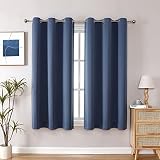
ChrisDowa Blackout Curtains, Stone Blue, 42″W x 63″L, 2 Panels
Who it suits: Small rooms with genuinely small windows — a short window over a radiator, a desk, a kitchenette counter or a low sill — where a standard 84-inch pair would pool, bunch and waste a third of its fabric below the glass.
Every other pick in this guide is priced in a floor-length configuration, because that is the category’s standard. This pick exists because small rooms keep breaking the standard. A 63-inch window in a small room does not need an 84-inch curtain; it needs a curtain that ends at the sill, hangs flat, and does not spend its life puddled on a radiator cover. ChrisDowa’s short pair — two panels, each 42 inches wide by 63 inches long, in Stone Blue — is the size the small-window listings actually sell in volume, and check price on Amazon for it; it is sold by NH tex. Six grommets per panel at the standard 1.6-inch inner diameter keep it on the same rods as everything else here, and the narrower 42-inch width is proportioned for windows roughly 42 to 56 inches wide at proper fullness — the size band most small-room windows live in.
Now the honesty this pick owes you, stated as plainly as the guide can state it: this is an unlined triple-weave curtain, not a lined blackout. ChrisDowa’s own figure for the line is up to 98 percent light blocking, with darker colors doing better — a maker figure with no standard test behind it — and the physics from the top of this guide apply in full: density and dye darken a room very well and black it out only in forgiving conditions. In a bright south-facing small window at noon, this pair will glow at the edges of its performance in a way the lined picks above will not. What it returns for that compromise is the right size, an easy weight for any rod, simple care, and a lower-end position in this budget. If your short window must go truly dark — a day sleeper in a small room is exactly that case — the lined lines above are sold in shorter drops as well, and the NICETOWN’s 63-inch configuration is where to look; buy the size logic from this pick and the construction from those. As a dimming curtain honestly labeled and correctly sized, though, this is the pair most small windows would actually choose.
- Short 42 x 63 inch pair: ends at the sill instead of pooling below a small window.
- Narrower panels proportioned for 42–56 inch windows; six 1.6-inch grommets per panel.
- Check price on Amazon — light enough for any rod and the easiest care in the guide.
Honest limitation: It is an unlined triple weave with a maker-rated figure of up to 98% — a strong darkener, not a true blackout. A day sleeper behind a bright window needs a lined pick in a short drop instead.
Choose it if your window is short, the room needs dimming more than darkness, and correct proportions matter. Skip it if you need to sleep in daylight — step up to a lined construction and order it in the shorter length.
Comparison Table
| Product | Construction | Best use | Link |
|---|---|---|---|
| Vision Home Natural Pinch Pleated Full Blackout, 40″W x 84″L, 2 Panels | Coated blackout lining, pinch pleat on hooks | Tailored height for a small room’s only window | Check on Amazon |
| Sun Zero Nordic Theater Grade Extreme Blackout, 52″W x 84″L, 2 Panels | Theater-grade blackout build, grommet | The heaviest darkness for bright, loud windows | Check on Amazon |
| NICETOWN Full Blackout, 52″W x 84″L, 2 Panels | Lined blackout, grommet | True lined darkness — check price on Amazon | Check on Amazon |
| Deconovo 100% Blackout with Black Liner, 52″W x 84″L, 2 Panels | Sewn black liner, grommet | Absorbed darkness for sleepers near the glass | Check on Amazon |
| MIULEE 100% Blackout Linen, Natural Beige, 52″W x 84″L, 2 Panels | Coated blackout back, grommet | A pale face that keeps a small room feeling open | Check on Amazon |
| ChrisDowa Blackout, Stone Blue, 42″W x 63″L, 2 Panels | Unlined triple weave, grommet | Short windows where an 84-inch drop would pool | Check on Amazon |
How to Choose Blackout Curtains for a Small Room Under $75
- Decide lined or unlined before you look at colors. If the room must go dark at noon — day sleeper, nursery, migraine sufferer — only a liner or a coated backing does it. If the room must merely dim, an unlined triple weave does it in a simpler construction and in sizes the lined lines sometimes skip.
- Fix the configuration, then check the current price on Amazon. Most picks in this guide are a pair of two 52 x 84 inch panels; two picks deliberately are not — the Vision Home pair is 40 x 84 per panel and the ChrisDowa is 42 x 63. A listing that looks cheaper is often a single panel, a shorter drop or a narrower width. Confirm panel count, width and length on the exact option you are ordering.
- Do the fullness math for a small window. Curtains need 1.5 to 2 times the window’s width to gather properly and block edge light. Two 52-inch panels give 104 flat inches and cover a window up to about 52–69 inches wide; the Vision Home’s 80 flat inches cover about 40–53; the ChrisDowa’s 84 cover about 42–56. Small windows often need less curtain than the standard pair sells — which is savings, not a shortage.
- Match the color to the construction, and to the room’s size. In an unlined triple weave, color is performance: dark colors approach the maker’s claim, pale colors glow. In a lined or coated curtain, color is free — and in a small room a pale lined face is the strategic choice, because the curtain is a wall-sized surface that will shrink the room if it is dark.
- Mount for height: ceiling first, frame second. A rod or track mounted at the ceiling line closes the top light gap, runs the fabric the full height of the wall and makes a low ceiling read taller. It is the single most valuable installation decision in a small room, and it is why the pinch-pleat pick leads this guide.
- Choose the length by what is under the window. Floor length seals best and looks calmest — unless a radiator, desk, bed or counter sits under the sill, in which case a 63-inch drop that ends at the sill hangs flatter, gathers no dust and wastes no fabric. Never let a long panel rest on a heat source.
- Weigh the pair before you hang it. Lined and theater-grade curtains are heavy, and small rooms often have the oldest walls in the house. Anchor the rod into studs or proper anchors; be suspicious of tension rods and adhesive mounts under a lined pair.
- Respect the backing in the wash. Liners and coatings share one enemy: heat. Cold, gentle washing and low or line drying keep them intact; a hot dryer is how a blackout curtain becomes a merely dark one. Where a maker’s care lines contradict each other, obey the stricter one.
- Keep the packaging for two weeks. Backings reveal their quality after the first wash and faces reveal their color under your light, not the screen’s. Every pick here is easier to return boxed than folded in a closet — and in a small room there is no closet space to waste on a mistake.
What $75 Buys That $40 Doesn’t — and What It Doesn’t
It is worth being precise about the extra money, because the honest answer is narrower than the marketing. What $75 does not buy is a better blackout layer. The physics of darkness are settled at the tier below: a dedicated liner or coating blocks the light, a weave alone does not, and the lower-priced NICETOWN in this guide blacks out a window with the same mechanism as the top-of-budget Vision Home. No percentage printed at this tier is measured to a standard the tier below lacks, and any guide that tells you $75 of curtain is “more blackout” than $40 of lined curtain is selling, not informing. What the extra money buys is everything around the layer. It buys the header: pinch pleats sewn in and hooks in the box, against grommets stamped through a hem — the difference between a curtain that hangs like drapery and one that hangs like a product. It buys the face: a linen blend with real linen in it and a matte woven texture, against flat polyester that reads as blackout curtain from across the room. And it buys weight and finish in the legacy brands — the Sun Zero’s theater-grade build — for rooms where the curtain will be touched, drawn and looked at every day for years.
It also buys proportion, which in a small room may be the most valuable item on the list. The standard pair exists because standard bedrooms exist; small windows are served by narrower panels and shorter drops that the budget tiers stock thinly and the $40–$75 tier stocks properly, from the Vision Home’s 40-inch panels and 63-to-120-inch length range down to the ChrisDowa’s short pair. Two near-misses from our research mark the tier’s real edges. NICETOWN sells a faux-linen pinch-pleat version of its lined blackout pair — white liner, tailored header, 52 x 84 — through other retailers; we could not pin its Amazon listing to a single stable ASIN, so it is named here as context and not linked as a pick. And above the tier, the market jumps rather than climbs: tailored linen blackout from the direct-to-consumer drapery brands runs well beyond this budget per panel, which is a different purchase for a different room. Within this under-$75 budget, in other words, a small room is shopping in the honest middle of this category — real constructions, real finishes, no custom-drapery money — and readers furnishing a small room in a contemporary style will find the same six ranked by face and header in Best Blackout Curtains For Modern Homes Under $75.
Fitting One Window in a Small Room: Size, Height and the Ceiling Trick
Small-room fitting starts from a fact large rooms can ignore: there is one window, and everything about it is amplified. Its light leak is the room’s light leak. Its draft is the room’s climate. Its curtain, open or closed, is one of the largest colored surfaces in the space. Width first. Measure the window, then buy flat fabric at one and a half to two times that width: a 36-inch window wants 54 to 72 flat inches, which a pair of 42-inch ChrisDowa panels (84 flat) covers with fullness to spare, and which the standard 52-inch pairs (104 flat) cover so generously that the stack of open fabric on each side becomes its own design decision — in a very small room, that stack can eat six inches of wall on each side of the window, which is a real cost in the room’s only natural frame. Narrower panels are not a compromise here; they are the correct engineering. Length second. An 84-inch panel on a ceiling-mounted track in an eight-foot room lands at the floor and draws the eye up the full height of the wall — the ceiling trick, and the reason the pinch-pleat pick leads this guide. The same panel on a rod at the frame in a room with a radiator under the window lands on the radiator, which is a fitting failure and a safety note in one: curtains must hang clear of heat sources, and a 63-inch sill-length drop is the right answer wherever furniture or heating lives under the glass.
Color and weight finish the fitting. A small room’s curtain is too big a surface to treat color as an afterthought: a dark, heavy pair — the Sun Zero in a charcoal colorway, floor-length — turns the window wall into a dark wall, which some small rooms wear beautifully as a deliberate cocoon and most wear as a shrinkage. The safer small-room default is the lined pale face — the MIULEE’s natural beige, the Vision Home’s natural — which performs identically in darkness and leaves the room’s daylight personality intact. Weight is the quiet constraint: lined pairs run heavy, the theater-grade pair heaviest of all, and small rooms in older buildings are where plaster is crumbliest and studs are shyest. Anchor into structure, use brackets rated for the pair’s weight, and if the wall truly will not take it, that is a legitimate reason to choose the coated MIULEE over the lined Deconovo — a slightly more fragile layer on a rod that stays up beats the best liner in the category on the floor. Renters working the same one-window problem under lease rules will find the no-drill and deposit-safe version of this fitting logic in Best Blackout Curtains For Apartments Under $75.
Common Buying Mistakes
- Believing the word “blackout” on the box. Construction decides darkness; the word is marketing, and the same brand sells lined and unlined curtains under near-identical names.
- Buying the standard 52 x 84 pair by default for a small window, then living with a fabric stack that eats the wall on both sides and a hem pooling below the sill.
- Choosing a dark, heavy pair for a tiny room and discovering the window wall now reads as a dark wall — in a small room the curtain is a major surface, not an accent.
- Ordering a single panel, a 63-inch drop or a 40-inch width because the price looked lower — then covering half a window at a bargain. Check the configuration, not the headline price.
- Mounting the rod at the frame when the ceiling was available: the top gap leaks the light, and the lost height is the one thing a small room cannot spare.
- Letting a long panel rest on a radiator or baseboard heater. It fits badly, gathers dust, and puts fabric against a heat source — choose the sill-length drop instead.
- Hanging a heavy lined or theater-grade pair on a tension rod or adhesive hooks, and meeting it on the floor at 3 a.m.
- Washing a lined or coated curtain hot, or tumble-drying it hard, and cracking the layer that made it a blackout curtain — or trusting the gentler of two contradictory care labels.
- Assuming a pale color cannot black out. In a lined or coated construction the layer does the work and the color is free; it is only in unlined triple weaves that pale means glow.
- Judging a curtain’s color and creases in its first hour out of the package, before a steam and a day of hanging have done their work — doubly true of textured linen faces.
Final Recommendation
- Most small rooms: Vision Home Natural Pinch Pleated Full Blackout Curtains, 40″W x 84″L, 2 Panels.
- The darkest, heaviest barrier: Sun Zero Nordic Theater Grade Extreme 100% Blackout Curtain Panel Pair.
- Genuine lined darkness, most of the budget kept: NICETOWN Full Blackout Curtains, 52″W x 84″L, 2 Panels.
- Absorbed darkness for a bed near the glass: Deconovo 100% Blackout Curtains with Black Liner.
- A pale face for a bright little room: MIULEE 100% Blackout Linen Curtains, Natural Beige.
- A short window over furniture or a radiator: ChrisDowa Blackout Curtains, Stone Blue, 42″W x 63″L, 2 Panels.
Our top two are the Vision Home pinch pleats for the small room that wants its window to work visually as hard as it works in the dark — the ceiling-track header is the rare feature that improves the room and the darkness at the same time — and the NICETOWN Full Blackout for every small room that simply needs the dark, because its lined construction is the same physics at a much lower tier position and the remaining budget buys the track, the rod or the second window’s pair. Measure the window, decide the drop by what sits beneath it, mount as high as the wall allows, confirm the size, panel count and color on the listing, and check price on Amazon — curtain prices move with colorways, so confirm the current figure before you order.
Frequently Asked Questions
What size blackout curtains does a small room actually need?
Less than the standard listing wants to sell you. Buy flat fabric at 1.5 to 2 times the window’s width: a 36-inch window needs 54–72 flat inches, so a pair of 42-inch panels is generous and a pair of 52-inch panels is more stack than wall. For length, an 84-inch drop suits a ceiling-mounted track in a standard-height room; a 63-inch drop is the right call when a radiator, desk or bed sits under the sill. Measure from where the rod or track will sit, not from the glass.
Will a heavy blackout curtain make my small room feel smaller?
It can, and the mechanism is surface area: in a small room the curtain is one of the largest colored surfaces in the space, so a dark, floor-length pair reads as a dark wall. The fix is construction, not sacrifice — choose a lined or coated curtain in a pale face color, like the natural linen picks in this guide. The layer blocks the light; the color stays light; the room keeps its size in daylight and loses it only when you close the curtains on purpose.
Do blackout curtains under $75 really block 100% of light?
The lined and coated ones can, through the fabric itself: a dedicated opaque layer does not care what color the face is. The unlined triple-weave ones cannot — their makers rate them below 100 percent, with the result set by color and brightness. Remember that even a perfect fabric leaks around the edges; mounting high and close, with the panels overlapping in the middle, is what turns a blackout fabric into a blackout room — and in a small room, one window means one set of edges to seal properly.
Is a ceiling-mounted track worth it in a small room?
Yes — it is the highest-value installation choice this guide recommends. A track at the ceiling line closes the top gap where light pours over a frame-mounted rod, lets the panels stack flat against the wall instead of into the room, and runs the fabric the full height of the wall, which makes a low ceiling read taller.
Which is better for a small room, a black liner or a white backing?
Both block light completely when the construction is sound; they differ around the edges of the job. A black liner absorbs at the glass — the better choice when the bed is close to the window — but it also absorbs heat, which a small room with one west-facing window will feel. A white or coated backing reflects heat, keeps pale face colors honest, and presents a uniform light face to the street, which some landlords and associations require. Choose on distance from the glass, sun exposure and how pale you want the room side to be.
Can I machine wash these curtains?
Most of these, yes — cold and gentle, and that instruction is doing real work. The blackout layer is the vulnerable part of every lined, fused or coated curtain: hot water and a hot dryer can crack, bubble or separate it, after which the curtain darkens a room and no longer blacks it out. Where a maker’s own care lines contradict each other — it happens in this guide — obey the stricter one.
- Best Blackout Curtains Under $40
- Best Blackout Curtains For Small Rooms Under $40
- Best Blackout Curtains For Bedrooms Under $75
- Best Blackout Curtains For Apartments Under $75
- Best Blackout Curtains For Modern Homes Under $75