Disclosure: As an Amazon Associate, dailyhomedecorating.com earns from qualifying purchases. Links to Amazon on this page are affiliate links; they cost you nothing extra. Prices and availability change often, so check the current Amazon listing before you buy.
The best salt water hot tubs for sale are bought for a feeling and a routine. The feeling is water that reads softer on the skin, without the sharp chemical edge some bathers dislike in conventionally chlorinated spas. The routine is the real prize: a salt system generates its sanitizer continuously from dissolved salt, smoothing out the peaks and crashes of manual dosing, so the water stays steadier with less of the owner’s attention. Two clarifications belong at the top, because the category’s marketing blurs both. A salt water hot tub is not chlorine-free — the system manufactures chlorine from salt, gently and continuously. And “salt water” here means a low, carefully maintained salinity for sanitation, not ocean water in a tub. Buyers who understand those two sentences buy well; buyers who do not, buy a surprise.
The verified pool offers one genuinely salt-ready headline product — the Intex PureSpa, whose listing declares it saltwater system ready — flanked by the two SaluSpa inflatables, which ship with chlorine dispensing and are reviewed here for how they fit a salt-minded household, including the honest limits of conversion talk. The pool’s water-care shelf contributes one pick with a salt-adjacent virtue: the FROG mineral system, which cuts chlorine demand dramatically and is the route many “salt-curious” owners actually land on. Two prose-only picks cover the hard-shell salt formats the pool lacks — factory salt-system spas and aftermarket conversion systems — described by their mechanics rather than by invented listings. The water-care ecosystem behind all of this connects to Best Hot Tubs For Florida, where salt thinking is a household dialect, and to the test discipline in Best Anti Foam For Hot Tubs‘ companion care coverage.
Where to Buy
Every linked pick in this guide is sold on Amazon, where you can check the current price, included equipment, and listing details before you buy. For salt purchases, confirm exactly what “saltwater ready” includes in the box — a ready system, a cell, or compatibility alone — because the words span all three.
- INTEX 28425EH PureSpa Bubble Massage Spa Set — Check on Amazon
- Coleman SaluSpa Miami Energy-Efficient AirJet Inflatable Hot Tub — Check on Amazon
- Bestway SaluSpa Cancun Energy-Efficient Inflatable Hot Tub — Check on Amazon
- FROG @Ease Mineral Cartridge + SmartChlor Cartridges — Check on Amazon
- Factory salt-system hard-shell spa (prose-only pick — see review)
- Aftermarket salt conversion system (prose-only pick — see review)
In this guide
Quick Picks
| Pick | Badge | Why it earns its place |
|---|---|---|
| INTEX 28425EH PureSpa Bubble Massage Spa Set | Best Overall | Saltwater system ready out of the box, with hard water care and a full spa package. |
| Coleman SaluSpa Miami AirJet Inflatable Hot Tub | Best for Year-Round Use | Freeze Shield and efficiency for the salt-minded owner in a cold climate — with conversion honesty. |
| Bestway SaluSpa Cancun Inflatable Hot Tub | Best Compact | The small-patio SaluSpa, for households weighing dispenser care against salt ambitions. |
| FROG @Ease Mineral + SmartChlor System | Best Low-Chlorine Alternative | Up to 75% less chlorine per the maker, for owners whose real goal is gentler water. |
| Factory salt-system hard-shell spa | Best Premium | Prose-only: integrated salt sanitation in a permanent, jetted spa. |
| Aftermarket salt conversion system | Best for Existing Owners | Prose-only: the draindown-and-convert path for spas already in the yard. |
Key Takeaways
- Salt systems generate chlorine from salt continuously — the water is sanitized by chlorine, delivered gently. “Chlorine-free” claims are marketing fog.
- The routine advantage is steadiness: fewer dosing peaks, fewer forgotten-day crashes, calmer water week to week.
- “Saltwater ready” must be interrogated: confirm whether the cell and system are included or merely compatible.
- Salt is corrosive company for some metals and finishes — compatibility with your spa’s components is a purchase criterion, not a detail.
- Testing does not retire: salt owners still test chlorine, pH, and salinity, and clean the cell on schedule.
- Mineral systems like FROG are the honest alternative for owners whose goal is lower chlorine rather than salt itself.
How These Picks Were Chosen
The pool was scored on salt truthfulness. The Intex leads because its verified listing states the thing itself — “Saltwater System Ready” — inside a complete spa package with hard water treatment, which matters because salt systems and mineral-heavy water interact, and a maker who has engineered for both has done the buyer a real service. The SaluSpas were included under explicit framing: they are chlorine-dispenser spas, and their reviews discuss what that means for a salt-minded buyer — including that informal conversions of dispenser spas are a warranty and compatibility conversation, not a weekend hack. The FROG system earned its pick as the pool’s water-care representative because its verified proposition — mineral sanitation with SmartChlor cartridges, using up to 75% less chlorine, for spas up to 600 gallons — serves the underlying desire (gentler, steadier water) that sends most shoppers to salt in the first place.
Excluded: the bromine and chlorine chemical picks as standalone “salt” recommendations — they are alternative sanitation, discussed in the care sections rather than dressed as salt products. The indoor soaking tubs were excluded from picks because fresh-fill tubs have no sanitation system to convert — their water is new at every use, a point the comparison sections make honestly. The cold plunge was excluded (cold-plunge framing only). Two prose-only picks cover factory salt hard-shells and aftermarket conversions, the formats a salt shopper will meet in the wider market, described by mechanics and questions rather than by invented models. No prices appear anywhere; the tier frame for salt purchases lives in Best Hot Tubs Under $6000.
The 6 Best Salt Water Hot Tubs for Sale — Reviewed

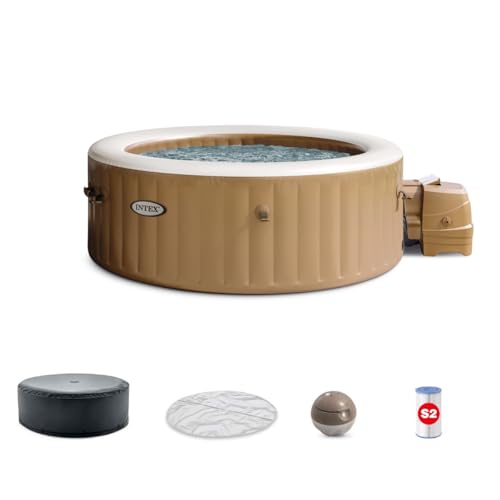
INTEX 28425EH PureSpa Bubble Massage Spa Set
Our badge: Best Overall
The INTEX 28425EH PureSpa Bubble Massage Spa Set is the salt shopper’s headline answer in this pool for one verifiable reason: its listing declares the spa saltwater system ready, in a package that also includes an energy-efficient cover, a built-in hard water treatment system, Fiber-Tech construction, 210 gallons of four-person room, and a 68-to-104-degree temperature range. A salt system is a water-chemistry commitment, and buying it inside a spa designed to host it — rather than improvising it onto a spa that was not — is the difference between a routine and an experiment.
Strengths
- Saltwater system ready by design — the pool’s only native salt platform.
- Hard water treatment complements salt care in mineral-heavy regions.
- Complete package: cover and care systems included from day one.
Trade-offs
- Confirm what the salt readiness includes in the box versus what is added separately.
- Bubble massage only; salt luxury does not add jets.
- No named freeze-protection system in the verified data — cold-climate salt owners should note the winter guidance in Best Portable Hot Tubs For Winter.
| Color | Tan |
| Size | 4-Person |
| Dimensions | 22.25 x 25.375 x 32.75 inches (package); spa outer 77 x 28 inches per features |
| Weight | 99.66 pounds |
Life on a salt routine, once established, has a distinctive calm. The system generates sanitizer at a low, steady rate, so the water’s chlorine level stops oscillating between the post-dose peak that stings eyes and the forgotten-Friday trough that invites cloudiness. The owner’s job becomes supervisory: test on schedule, keep the salt level in the system’s target band — salt is consumed only by splash-out and dilution, not by the generating process itself — balance pH as it drifts, and clean the generating cell when scale asks. Bathers consistently describe the water as softer, a perception tied to the steady low sanitizer level and the salt’s own feel; this guide reports it as comfort, not as therapy, and makes no health claims beyond it.
The hard water treatment deserves its salt-specific paragraph. Calcium scale is the salt cell’s natural enemy — it plates the cell’s surfaces and throttles generation — and in hard-water regions a spa that treats hardness upstream is protecting the salt system’s heart. Florida households, living among salt pools, will find the dialect familiar; the regional guide in Best Hot Tubs For Florida covers their version of this ecosystem. For everyone else, the startup sequence matters: fill, balance, add salt to the target, let it dissolve fully with circulation, then start generation and verify with a test that the system is producing. Patience at startup is the whole learning curve; after it, the routine is the lightest in this series.
Best for: Buyers wanting native salt sanitation in a complete, flexible spa / Not suited for: Hydrotherapy seekers or unattended deep-winter operation
Choose it if salt is the point and flexibility is welcome. Skip it if your salt dream is specifically a permanent jetted installation — the factory hard-shell pick below is that dream’s address.

Coleman SaluSpa Miami Energy-Efficient AirJet Inflatable Hot Tub
Our badge: Best for Year-Round Use
The Coleman SaluSpa Miami Energy-Efficient AirJet Inflatable Hot Tub enters a salt guide under a flag of honesty: it is a chlorine-dispenser spa, with a ChemConnect dispenser that maintains clean water by evenly dispersing chlorine, Freeze Shield protection for cold climates, insulated construction, and 120 AirJets. Its place here is for the salt-curious household in a cold climate, weighing two truths at once — that the Miami is the pool’s best year-round inflatable, and that its sanitation story is dispenser chlorine unless a maker-approved path says otherwise.
Strengths
- Freeze Shield and insulation make it the cold-climate inflatable of record.
- ChemConnect delivers the steady-dosing virtue that attracts people to salt, in chlorine form.
- Power-saving timer supports a disciplined, economical routine.
Trade-offs
- Not a salt system: converting it informally risks warranty and component compatibility.
- Dispenser chlorine lacks the salt water feel some bathers specifically seek.
- Two-to-four-person scale.
| Color | Black |
| Size | Energy Efficient 2.0 |
| Dimensions | 71 x 71 x 26 inches |
| Weight | 101.2 pounds |
The conversion question deserves direct treatment, because it is the question every SaluSpa owner eventually types into a search bar. Aftermarket salt systems exist for portable spas — the prose pick below describes them — but adding salt generation to a spa whose maker designed it around a dispenser raises three issues: warranty coverage for the pump and heater, corrosion exposure of components never specified for saline water, and the simple fact that salt plus the wrong metals is a slow argument the metals lose. The disciplined answer is to ask the maker, in writing, before converting; to consider the FROG route within approved care if gentler water is the goal; or to let the Miami be what it is — an excellent dispenser spa — and put the salt ambition into the next purchase, which the Intex above exists to serve. Many households discover, a season in, that the dispenser’s steadiness was the benefit they actually wanted from salt, and the question dissolves on its own.
For cold-climate families, the supervision and routine framing in Best Hot Tubs For Families pairs with the Miami’s winter craft in Best Hot Tubs For New England to make this the year-round household’s pragmatic pick — salt or no salt.
Best for: Cold-climate households prioritizing year-round use, with salt as a secondary curiosity / Not suited for: Buyers for whom salt water itself is non-negotiable
Choose it if winter capability outranks sanitation format. Skip it if salt is the headline requirement — headlines should be bought directly.

Bestway SaluSpa Cancun Energy-Efficient Inflatable Hot Tub
Our badge: Best Compact
The Bestway SaluSpa Cancun Energy-Efficient Inflatable Hot Tub shares the Miami’s platform — 120 AirJets, Freeze Shield, insulated walls and cover, ChemConnect chlorine dispensing — in the grey wicker finish and compact footprint. In a salt guide it plays the same honest role at a smaller scale: the patio spa for households deciding whether their gentler-water future is salt, mineral, or simply a better-kept dispenser routine, and who want the deciding season to happen in a tub that fits their space.
Strengths
- Full platform virtues — jets, freeze protection, dispensing — in the compact format.
- Small volume makes water experiments (and corrections) fast and inexpensive.
- Wicker finish suits the designed patio where a future permanent spa may land.
Trade-offs
- Pool data lists placeholder dimensions; features confirm 71 x 26 inches — verify on the listing.
- Not a salt system, with the same conversion cautions as its sibling.
- Small volumes swing chemistry faster — testing cadence matters more, not less.
| Color | Grey Wicker |
| Size | Energy Efficient 2.0 |
There is a genuine experimental virtue in the Cancun’s scale for the salt-curious. A compact volume is a laboratory: if you trial a mineral cartridge approach, adjust a routine, or simply learn your household’s bather-load patterns, the feedback arrives in days and the corrections cost a partial refill, not a project. Households that spend this apprenticeship season well arrive at their permanent decision — factory salt hard-shell, native salt inflatable, or contentment with dispenser care — carrying data instead of opinions. The placement that hosts the apprenticeship is covered in Best Place For Hot Tubs; keep the site audition logic in mind, because the permanent spa, if it comes, will inherit the corner the Cancun proves.
Best for: Compact-patio households running a gentler-water apprenticeship / Not suited for: Committed salt buyers — buy the Intex directly
Choose it if you are deciding and want the decision to be pleasant. Skip it if you have already decided; decided buyers should buy the decision.
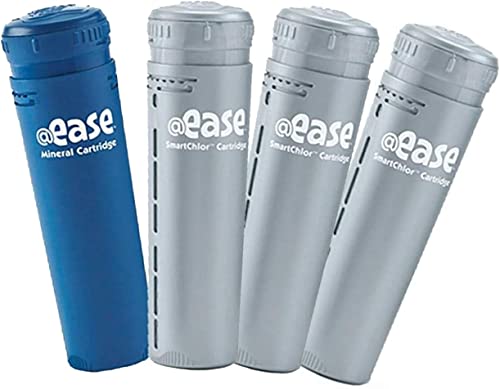
FROG @Ease Mineral Cartridge + SmartChlor Cartridges
Our badge: Best Low-Chlorine Alternative
The FROG @Ease Mineral Cartridge + SmartChlor Cartridges is this guide’s water-care pick, included because it serves the desire underneath most salt searches: gentler, steadier water with less chlorine presence. Its verified proposition is specific — a mineral cartridge lasting four months plus SmartChlor cartridges lasting three to four weeks each, for spas up to 600 gallons, using up to 75% less chlorine while maintaining a consistent low free-chlorine level, with minerals that condition the water and help keep pH balanced. Compatibility is equally specific: it is made for certain hot tub models from named makers, and that specificity is part of the review, not a footnote.
Strengths
- Dramatically lower chlorine presence with a self-regulating delivery.
- Minerals condition water feel and assist pH stability.
- Cartridge rhythm replaces daily dosing judgment with a calendar.
Trade-offs
- Model-specific: fits designated spa brands and models, not universal.
- It is a chlorine system at a low level — not salt, and not chlorine-free.
- Ongoing cartridge costs are the system’s business model; budget them.
| Size | up to 600 Gallons |
| Dimensions | 10 x 10 x 10 inches |
Where does FROG sit in the salt conversation? Adjacent, and honestly so. Owners cross-shop it against salt for three reasons: the water feel (minerals deliver a softness many bathers cannot distinguish from salt’s), the routine (cartridges on a calendar versus salt levels and cell cleaning), and the hardware question (no saline corrosion exposure at all, which matters for spas whose components were never specified for salt). Its limit is the mirror of salt’s limit: salt asks for cell care and salinity checks; FROG asks for cartridge renewals and model loyalty. Neither is “no maintenance” — that product does not exist in standing water — and the household that chooses between them on their actual maintenance shapes, rather than on the word “natural” in either direction, chooses well. Confirm your spa model against the compatibility list before ordering; the system’s specificity is the price of its engineering.
Best for: Owners of compatible spas wanting gentler water without a salt conversion / Not suited for: Incompatible models, or buyers committed to salt specifically
Choose it if your spa is on its list and lower chlorine is the goal. Skip it if salt itself — the system, the feel, the identity — is what you are buying.
Factory Salt-System Hard-Shell Spa
Our badge: Best Premium
This pick is prose-only: the pool holds no hard-shell spa, so the format at the top of the salt market is described rather than listed. A factory salt-system hard-shell integrates the generating cell into the spa’s plumbing and controls from the design stage — the control panel reports salinity and generation status, the components downstream of the cell are specified for saline service, and the warranty contemplates the water you will actually run. Add molded seating, real hydrotherapy jets, and full insulation, and this is the salt experience in its complete form: the water feel, the routine calm, and the hardware honesty, all engineered as one system.
Strengths
- Integrated design: controls, cell, and compatible components under one warranty.
- Hydrotherapy and capacity that no inflatable salt option matches.
- The steadiest water in the category, in a permanent installation.
Trade-offs
- A capital project: pad, electrical, delivery, and the tier discipline of the premium guides.
- Cell replacement is a scheduled cost of ownership, in years.
- Salt’s corrosion vigilance applies to the spa’s surroundings — metal furniture and fixtures nearby included.
| Type | Prose-only — hard-shell salt format, no pool product |
| Format | Permanent spa with integrated salt generation |
| Best pairing | Committed households in long-term homes |
Shopping counsel for the format: ask how salinity is monitored (a readout beats a guess), what the cell’s replacement involves and what it costs, which nearby materials the maker warns against, and whether the control system flags low salt before the water notices. Wet-test the jets, weigh insulation over jet count as the tier guides counsel, and treat the salt system as the spa’s second engine — specified, warrantied, and serviced as seriously as the pumps. The investment frame is in Best Hot Tubs Under $6000; the two-person version of the format’s pleasures is in Best Two Person Hot Tubs For Sale.
Best for: Committed salt households buying the complete, permanent system / Not suited for: The undecided, the mobile, or the budget-bound
Choose this format when salt and permanence have both stopped being questions. Skip it while either is still being explored — exploration has cheaper, excellent tools above.
Aftermarket Salt Conversion System
Our badge: Best for Existing Owners
The final prose-only pick addresses the owners who already have the spa: aftermarket salt conversion systems — typically a control unit and a cell that hangs over the spa’s edge or installs in the plumbing line — promise to bring salt generation to spas that shipped without it. Described as a class, their appeal is real: the water feel and routine of salt, without replacing a spa you love. Their conditions are equally real, and this review’s job is to state them in the order a careful owner should check them.
Strengths
- Brings salt’s steady generation to an existing spa investment.
- Drape-over cell designs avoid plumbing modification entirely.
- Reversible in a way factory permanence is not — the spa can return to its native care.
Trade-offs
- Warranty: conversion may sit outside the spa maker’s coverage — verify in writing.
- Component compatibility: heaters and fittings not specified for saline water are the risk.
- The owner becomes the integrator: salinity, generation, and balance are all manual disciplines.
| Type | Prose-only — conversion system class, no pool product |
| Format | External control unit with drape-over or in-line cell |
| Best pairing | Out-of-warranty or maker-approved spas |
The conversion protocol, done responsibly: confirm warranty and compatibility with the spa maker first; drain and refill to start from known water; add salt to the conversion system’s specified level and let it dissolve completely before generating; verify production with a test; and then watch the spa’s metalwork — heater, fittings, nearby hardware — across the first season with a convert’s vigilance. Keep salinity at the system’s minimum effective level; more salt is not more sanitation, only more corrosion exposure. Owners who follow this protocol generally report the conversion as the best money they spent on an existing spa. Owners who skip the first step occasionally report the most expensive. The difference is paperwork, and it is available before the fact — the same lesson the care guides in this series teach about every system, and the same test-strip discipline that even garden-scale water systems like Best Solar Bird Bath Water Pumps reward at their own size.
Best for: Existing owners with warranty clarity and a tinker’s discipline / Not suited for: In-warranty spas without maker approval
Choose conversion if the spa is loved, the paperwork is clean, and the routine appeals. Skip it if any of the three fails — the native and mineral paths above exist for you.
Comparison Table
| Pick | Salt status | Format | Routine shape | Check price on Amazon |
|---|---|---|---|---|
| INTEX PureSpa | Saltwater system ready | Inflatable spa, 210 gal | Generate, test, top salt rarely | Check price on Amazon |
| Coleman SaluSpa Miami | Chlorine dispenser | Inflatable spa | Dispenser + tests | Check price on Amazon |
| Bestway SaluSpa Cancun | Chlorine dispenser | Inflatable spa, compact | Dispenser + tests | Check price on Amazon |
| FROG @Ease System | Low-chlorine mineral | Cartridges, to 600 gal | Calendar cartridge swaps | Check price on Amazon |
| Factory salt hard-shell | Integrated salt | Prose-only permanent | Generate, monitor, cell care | Check price on Amazon |
| Aftermarket conversion | Added salt | Prose-only add-on | Manual salinity discipline | Check price on Amazon |
How to Choose the Best Salt Water Hot Tubs for Sale
Decide what you actually want from “salt”
Name the underlying desire precisely: softer-feeling water, a steadier routine, lower chemical handling, or the salt identity itself. Each desire has a cheapest honest satisfier — mineral systems for feel, dispensers for steadiness, native salt for the full package — and buyers who skip this naming step routinely buy the most expensive satisfier for a modest desire.
Interrogate “ready,” “compatible,” and “included”
These three words span a universe: a cell in the box, a port waiting for a cell, or a marketing adjective. Read the listing’s included list literally, and price any missing cell or system into the purchase before comparing candidates. The Intex’s readiness, verified against its listing, is the standard to hold others to.
Audit corrosion exposure honestly
Salt water and the wrong metals are slow enemies. Inventory what the saline water touches — heater, fittings, jets, the deck furniture and railings in splash range — and favor systems and spas specified for saline service. Keep salinity at the effective minimum; the water needs a target level, not a taste of the sea.
Keep the testing habit in the budget
Salt ownership still tests: free chlorine, pH, alkalinity, and salinity itself, with strips or a salt-specific tester. The pool’s test-strip options serve the first three; salinity has its own simple tools. A salt system reduces dosing labor, not measurement labor — owners who expect the latter are the ones whose water surprises them.
Plan the cell’s life from day one
Generating cells scale up with calcium and wear out across years. Hard water regions should weight anti-scale features — like the Intex’s treatment system — heavily, descale on the maker’s rhythm, and treat cell replacement as a known future cost, the salt system’s equivalent of a cover replacement in conventional care.
How Do You Start and Run a Salt Water Hot Tub?
Startup, in sequence: fill the spa and balance the base chemistry first — alkalinity, pH, hardness in range — because salt generation is not a substitute for balance. Add the salt quantity your system’s manual specifies for your volume, broadcast it with the jets running, and give it a full day of circulation to dissolve completely; undissolved salt on the floor is both wasted and a finish hazard. Start generation at a moderate output, test free chlorine after a day, and tune the output to hold the target band under your household’s actual bather load. From there the routine is supervisory: test weekly, top up salt only when dilution or splash-out has genuinely lowered it (a salinity check, not a calendar, decides), keep pH in range as it drifts upward in generated systems, and inspect and clean the cell when output fades or the schedule says so.
Problem: Chlorine reads zero despite the system running — Check salinity first (low salt starves generation), then the cell for scale, then the output setting against recent bather load. The cause is almost always one of the three, in that order.
Problem: pH keeps climbing — A known tendency of generated systems. Test and adjust on the weekly rhythm; chronic climbing deserves an alkalinity review, since alkalinity is pH’s anchor.
Problem: Metal fixtures near the spa are tarnishing — Salinity may be running high, or splash is reaching vulnerable metal. Verify the level, rinse nearby metalwork with fresh water routinely, and keep salt at the effective minimum.
Problem: The water feels great but tests confuse you — Salt systems hold low, steady chlorine that can read near the bottom of a strip’s range while being correct for the system. Test with tools matched to the system’s targets, and judge by the maker’s band, not by conventional-spa instincts.
Salt Versus Bromine Versus Chlorine: The Sanitation Map
Every standing hot tub runs on one of a few sanitation philosophies, and salt is best understood among its peers. Direct chlorine — tablets, granules, dispensers like the SaluSpas’ — is the simplest and most manual: effective, inexpensive, and oscillating with the owner’s attention. Bromine, represented on the pool’s shelf by the Leisure Time family, is the gentler-feeling traditional alternative, stable in hot water and kind to sensitive bathers, at higher chemical cost. Salt generation is chlorine with an engine: the same sanitizer, produced continuously at low level, trading dosing labor for cell care and salinity discipline. Mineral assistance, the FROG philosophy, layers minerals under a reduced chlorine residual. None of these is “chemical-free,” and any seller who uses the phrase about standing warm water is telling you something about themselves. The right choice is the routine your household will actually keep — a kept routine on any system beats a neglected routine on the perfect one, a law that the foam troubleshooting in Best Anti Foam For Hot Tubs illustrates from the symptom side.
Salt Water Feel: What Owners Actually Notice
Strip the marketing away and the reported differences are consistent and modest: water that feels smoother on the skin, less of the sharp “pool” sensation after long soaks, hair and swimwear that come out gentler, and — the underrated one — a steadier experience week to week because the sanitizer level stops swinging. Set against them: a startup learning curve, cell maintenance, salinity vigilance, and corrosion housekeeping around the spa. Owners who thrive on salt tend to be routine-keepers who enjoy systems; owners who return to dispensers tend to be minimalists who found the system one gadget too many. Both verdicts are respectable, and the apprenticeship options in this guide — a season on a dispenser SaluSpa, a FROG trial on a compatible spa — exist so the verdict can be earned cheaply before it is bought permanently.
Common Buying Mistakes
Believing “salt water” means chlorine-free
It does not — salt systems manufacture chlorine. Buyers with a true chlorine sensitivity need a clinician’s guidance and a different conversation; buyers who merely dislike chlorine’s peaks and handling will find salt is exactly the relief they wanted, honestly labeled.
Buying “ready” without reading the box contents
Readiness spans from a complete system to an empty port. The missing cell discovered after delivery is this category’s classic ambush. The included list is the contract; read it like one.
Over-salting for “extra” sanitation
Generation is regulated by the system, not by salt surplus. Excess salinity buys corrosion and off-feel, not safety. Hold the specified band and let the cell do its work.
Converting a dispenser spa casually
Warranty, metals, and maker intent all stand in the doorway. Paperwork first, salt second — or choose the native and mineral paths that need no permission.
Retiring the test kit
Salt reduces dosing, not measuring. Owners who stop testing discover drift as cloudiness, scale, or a struggling cell — all more expensive than the strip that would have announced them early.
Final Recommendation
Buy the salt natively where you can: the INTEX 28425EH PureSpa Bubble Massage Spa Set is this guide’s answer — saltwater system ready, hard-water aware, complete in the box, and flexible in every direction a household’s life can move. The runner-up is the honest alternative: the FROG @Ease system — Check on Amazon — for owners of compatible spas whose real desire is gentler, lower-chlorine water without a conversion. Graduate to the factory salt hard-shell when the habit and the house are permanent, and convert an existing spa only with paperwork in hand. The best salt water hot tubs for sale are the ones bought with clear eyes — chlorine’s gentlest delivery system, chosen for its routine as much as its feel.
Salt in the Wider Yard: Pools, Decks, and Splash-Zone Realities
A salt spa does not live alone, and its water chemistry has a geography. Splash-out carries saline water to the surrounding deck, the nearby plantings, and any metal within reach — chair frames, railings, the cover lifter’s hardware. At proper spa salinity the effect is gentle and slow, but it is cumulative, and the households that manage it best build three habits: a freshwater rinse of the splash zone on the weekly rounds, plantings near the spa chosen from the salt-tolerant palette every coastal gardener knows, and drainage that carries drain-downs to a place the household has chosen deliberately rather than to the garden bed that happens to be downhill. Households with salt pools will recognize the entire paragraph as their existing practice, which is precisely why Florida’s pool households adopt salt spas with the shortest learning curves in the country — the spa joins an ecosystem whose rules they already keep.
Drain-downs deserve their own sentence in that ecosystem. A salt spa’s periodic refill discharges a few hundred gallons of mildly saline water, and where it may go is a local question — some municipalities restrict discharge to sanitary sewers or specific areas, and septic households should ask their servicer before the first drain, not during it. The volumes are small and the salinity modest, but the time to learn the local answer is at purchase, alongside the electrical and placement questions every spa asks.
The First Ninety Days on Salt: A New Owner’s Calendar
Salt ownership is learned in a season, and the season has a shape worth sketching. The first week is startup discipline: balanced base water, salt dissolved fully before generation begins, output set conservatively, and daily tests while the household learns the system’s response curve — how fast it produces, how the family’s bather load draws it down, where the pH wants to drift. Weeks two through four convert observation into settings: the output percentage that holds the target band through a normal week, the test day fixed to the household’s rhythm, the first filter rinse, the salinity verified once against the system’s readout so the owner’s instruments agree with each other. The second month is where salt’s promise either materializes or is diagnosed: water that has stayed steady with weekly attention is the system working; water that swings is information — about cell scale, about output, about load — and the troubleshooting ladder in this guide resolves it rung by rung. By the third month, the routine should feel like the dispenser’s never quite did: supervisory, calm, and brief. Owners who reach that point rarely return to manual dosing, and owners who do not reach it have usually skipped the first week’s discipline — which is why this calendar, unglamorous as it is, may be the most valuable section in the guide for a buyer whose spa is already on its way.
Salt Systems and Sensitive Bathers: An Honest Word
Many salt shoppers arrive with a person in mind — a partner whose skin protests conventional spas, a child whose comfort the family is protecting, their own preference after one too many harsh soaks. This guide has kept its claims to comfort deliberately, and this section is where that discipline matters most, so let the position be stated completely. Salt-generated water, held at its steady low sanitizer level, is experienced by many bathers as gentler than manually dosed water, whose peaks are where most discomfort lives. That is a real and purchasable difference, and for many households it fully justifies the system. What salt is not is a medical treatment or a chemical absence: the sanitizer is chlorine, sensitivities vary by person and by cause, and a bather whose reaction is to chlorine itself — rather than to its peaks and byproducts — may find salt’s gentleness insufficient. The responsible path for households where a genuine sensitivity drives the purchase is a trial before the commitment: spas on salt systems can be experienced at a friend’s home, a rental, or a dealer’s wet test, and a single honest soak is worth a season of speculation. Buy the system for its routine and its steadiness, verify the comfort claim on your own skin, and let any health questions travel to the clinician whose subject they are. Salt earns its buyers without borrowing medicine’s authority — and a guide that keeps that line is one whose other claims you can trust.
Salt and the Secondhand Market: Buying or Selling a Used Salt Spa
Salt spas change hands, and the chemistry follows them in ways buyers and sellers should both price honestly. For the buyer of a used salt system, the inspection list has salt-specific entries beyond the usual pumps-and-jets audit: the generating cell’s age and condition head it, because the cell is the system’s consumable heart and its remaining life is a real fraction of the purchase’s value — ask for its history, inspect it for the scale and plate wear that announce its season count, and price a replacement into any offer the way you would price a roof’s remaining years. Salinity hardware — sensors, readouts, the control’s salt reporting — should be demonstrated working, in water, before money moves; a salt system that cannot report its own level is a conversion project wearing a factory badge. For the seller, the symmetric duties are disclosure and demonstration: a spa shown running, balanced, and generating, with its cell’s age stated plainly, sells for the premium that salt ownership genuinely holds, because the buyer is purchasing a proven routine and not merely a vessel. Both parties should note that salt’s virtues transfer only with the routine intact — the manual, the test tools, the settings that held the water steady — and the seller who hands over a one-page log of their working routine gives the buyer the system’s real crown jewels. Secondhand salt, handled this way, is one of the category’s best values; handled casually, it is how a buyer inherits someone else’s neglected cell and calls the whole idea a fraud.
Frequently Asked Questions
Is a salt water hot tub chlorine-free?
No. A salt system generates chlorine from dissolved salt, continuously and at low levels. The experience is gentler and steadier than manual chlorination, but the sanitizer is chlorine. Anyone avoiding chlorine itself should not buy salt under a misunderstanding.
Does a salt water hot tub feel different?
Most owners report smoother-feeling water, less harshness after long soaks, and a steadier experience week to week, thanks to the constant low sanitizer level. This guide treats those as comfort qualities — it makes no medical claims for salt water.
How much maintenance does a salt system need?
Less dosing, different duties: weekly testing, pH management, salinity checks with occasional top-ups, and periodic cell cleaning and eventual cell replacement. It is a lighter routine than manual chlorination, not an absent one.
Can I convert my existing hot tub to salt water?
Often, with an aftermarket system — but verify warranty and component compatibility with your spa’s maker first, in writing. Heaters and fittings not specified for saline water are the risk. The conversion pick in this guide lays out the responsible protocol.
Will salt water damage my hot tub or deck?
Systems and spas designed for salt are built for it. Damage risk concentrates in conversions on unspecified components and in splash-zone metals kept at high salinity. Hold the specified salt band, rinse nearby metalwork, and the risk stays theoretical.
What does “saltwater system ready” mean on the Intex?
Per its listing, the spa is designed to work with a saltwater sanitation system — the pool’s only native salt platform. Confirm on the live listing exactly which salt components are included versus added, so your startup shopping is complete.


