Disclosure: As an Amazon Associate, dailyhomedecorating.com earns from qualifying purchases. Links to Amazon on this page are affiliate links; they cost you nothing extra. Prices and availability change often, so check the current Amazon listing before you buy.
The best heated blankets for camping start with a safety truth that shapes this entire guide: the heated blankets most people own — the corded household models in our verified pool — are indoor appliances, and they must never be used in a tent, on damp ground, or from improvised power at a campsite. Camping heat is a different product family: battery-powered blankets, 12-volt vehicle blankets, and heated throws designed and rated for portable power. This guide ranks those camping-appropriate formats, explains the power math that decides whether a blanket lasts the night, and — because the confusion is so common — includes the pool’s household heated blankets at the end with their correct context: basecamp cabins, RVs with proper hookups where manufacturer guidance allows, and home use, never tent use.
The stakes are real in both directions. Campers who improvise with household electrics risk fire, shock, and ruined equipment. Campers who dismiss heated blankets entirely miss a genuine comfort technology: modern battery blankets with timed heat and washable shells have made shoulder-season camping kinder for thousands of people, especially the car campers, festival-goers, and sideline parents who make up most of this category’s real users. Choose the right format, respect the power budget, and a heated blanket becomes the piece of kit your camping group fights over — politely, and in rotation.
Where to Buy
Camping heated blankets are sold by outdoor and automotive retailers; verify any model’s power source and ratings against its manufacturer documentation before buying. The household heated blankets referenced for cabin and home context are sold on Amazon: Sunbeam Electric Heated Blanket Royal Luxe Microplush — Check on Amazon; Beautyrest Reversible Heated Blanket — Check on Amazon; Degrees of Comfort Full Size Heated Blanket — Check on Amazon. These three are indoor models — see their review blocks for exactly where they do and do not belong.
In this guide
Quick Picks
| Pick | Badge | Why it earns its place |
|---|---|---|
| Battery-Powered Heated Blanket with USB Power Bank (prose-only) | Best Overall for Camping | The format actually designed for tents and campsites: portable, timed, washable. |
| 12-Volt Heated Car Blanket (prose-only) | Best for Car Camping | Runs from the vehicle for sidelines, road trips, and car-camp evenings. |
| Heated Stadium and Sideline Blanket (prose-only) | Best for Spectators | Weather-shedding outer, battery heat — built for bleachers and camp chairs. |
| Sunbeam Electric Heated Blanket Royal Luxe Microplush | Best for Cabins and Home Basecamp | The pool’s household heated blanket, placed honestly: indoor outlets only. |
| Beautyrest Reversible Heated Blanket | Best for RV and Lodge Beds | King coverage with dual-zone potential where hookups and guidance allow. |
| Degrees of Comfort Full Size Heated Blanket | Best for Home Pre-Warming | Warm the bed at home before and after the trip; a household model through and through. |
Key Takeaways
- Household corded heated blankets are indoor-only — never in tents, never on damp ground, never from sketchy power.
- Camping heat means battery or 12-volt formats designed for portable power.
- Runtime is a budget: blanket draw versus battery capacity decides your night, not marketing hours.
- Heated blankets supplement insulation; they never replace a rated sleeping bag and pad.
- Pre-warming is the pro move: heat the sleeping space before entry, then let insulation hold it.
How These Picks Were Chosen
We ranked formats by camping appropriateness first — power source safety, portability, weather tolerance — then by heat control, runtime practicality, and washability. The three prose-only formats are the genuinely camp-suitable classes, described without invented specifications; any specific model must be checked against its own manufacturer documentation. The three pool products are included with explicit placement limits because readers will inevitably ask whether the blanket from their bed works at the campsite — the answer, with their real specifications, is more useful than an omission. Their pool features confirm household positioning (bed sizes, household controllers, indoor auto-off design).
The 6 Best Best Heated Blankets for Camping — Reviewed
Battery-Powered Heated Blanket with USB Power Bank
Our badge: Best Overall for Camping
The camping-native format pairs heating zones sewn into a washable blanket with a rechargeable power bank — commonly USB-powered — so the blanket carries its own supply and its own limits. Heat settings stage the draw, timers prevent the classic dead-battery-at-2-a.m. failure, and the whole package folds into a stuff sack. Used correctly — pre-warm the sleeping bag, then run low or off through the night — one charge covers a weekend’s comfort for car campers and tent campers within reach of a midday recharge.
Strengths
- Designed for the environment: portable power, no cords to outlets, no vehicle required.
- Timers and staged settings make runtime manageable.
- Washable shells (with power components removed per maker instructions) suit outdoor dirt.
Trade-offs
- Runtime is finite and honest shoppers must do the capacity math for their own model.
- Heat output is comfort-grade, not furnace-grade; insulation still does the heavy lifting.
- Power banks need their own charging discipline and eventual replacement.
Verify before buying any model: the maker’s stated runtime at each setting with the included bank, whether standard power banks are supported, and the washing procedure in writing. Choose this format for real tent and campsite use. Skip household models for this job entirely — the next picks explain where they belong instead.
Best for: Tent and car campers wanting designed-for-camping heat / Not suited for: Anyone expecting all-night high heat from a small battery
Choose it for the campsite; skip improvised alternatives.
12-Volt Heated Car Blanket
Our badge: Best for Car Camping
The 12-volt blanket plugs into a vehicle’s accessory socket and turns the car into the power plant: warmth for roadside rest stops, drive-in evenings, sideline spectating from the tailgate, and car-camp nights where the engine’s battery — managed responsibly — is the supply. Many include auto shut-off timers, which matter twice over here: they protect the sleeper and the starting battery alike.
Strengths
- Effectively unlimited runtime while the vehicle system is managed well.
- Simple, proven format with long accessory-market history.
- Doubles as an emergency warmth layer in the winter car kit.
Trade-offs
- Tethered to the vehicle; useless at a walk-in tent site.
- Draws the starter battery if used carelessly with the engine off — know your vehicle’s limits.
- Cord management around sleeping occupants requires deliberate routing.
The disciplined pattern: run it while driving or during the evening, pre-warm the sleeping setup, and switch off for the night rather than draining the battery you need at dawn. Choose the 12-volt for vehicle-centered camping. Skip it for tent sites away from the car.
Best for: Car campers, tailgaters, and road-trippers / Not suited for: Walk-in tent camping
Choose it for the car-based camp; skip it for the backcountry.
Heated Stadium and Sideline Blanket
Our badge: Best for Spectators
A close cousin of the battery camping blanket, the stadium format wraps the heating elements in a weather-resistant shell meant for bleachers, camp chairs, and festival fields — the sitting-still outdoors, where cold attacks fastest because the body is not moving. If your camping reality includes dawn fishing watches, sideline mornings, and star-gazing chairs, this is the format shaped like your life.
Strengths
- Weather-shedding exterior for damp benches and dewy fields.
- Battery portability with wrap-and-sit ergonomics.
- Serves double duty at every cold outdoor event on the family calendar.
Trade-offs
- Sized for sitting coverage, not full sleeping coverage.
- Same battery runtime discipline as all portable formats.
- Shell fabrics prioritize weather resistance over next-to-skin softness.
Choose the stadium format if your cold happens upright — sidelines, blinds, and campfire chairs. Skip it as a sleeping solution, where the battery blanket’s full coverage serves better.
Best for: Spectators, anglers, and campfire sitters / Not suited for: Primary sleeping warmth
Choose it for the bleacher and the chair; skip it for the sleeping bag.

Sunbeam Electric Heated Blanket Royal Luxe Microplush
Our badge: Best for Cabins and Home Basecamp
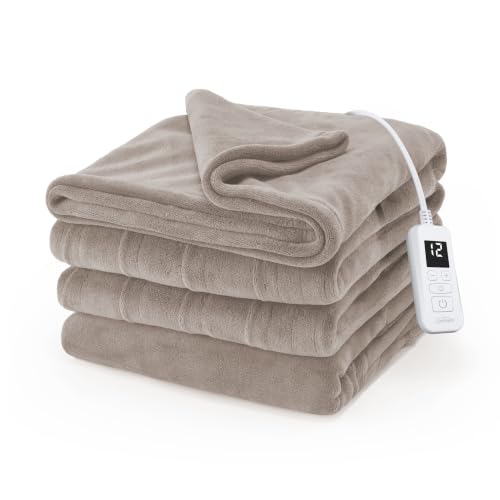
The Sunbeam Electric Heated Blanket Royal Luxe Microplush — full size, 12 heat settings, 1-to-12-hour auto-off, plush microplush — is an excellent household heated blanket, and this guide’s placement of it is precise: cabins, lodges, and home beds with proper indoor outlets, where its warmth is superb before and after the outdoor days. It is not a tent product. Its cord, controller, and indoor design assume a dry, grounded, household environment, and its manual’s world is the bedroom.
Strengths
- Excellent indoor warmth with wide, adjustable settings.
- Programmable auto-off suits overnight cabin use per maker guidance.
- Light for its size — easy to pack for the cabin trip.
Trade-offs
- Indoor only: no tent use, no damp environments, no improvised power.
- Requires a proper outlet at the destination.
- Not a substitute for camping-rated formats outdoors.
| Color | Mushroom |
| Size | Full |
| Weight | 4.63 pounds |
Choose it for the cabin bed and the home basecamp. Skip it — firmly — for tents and campsites. Check on Amazon
Best for: Cabins, lodges, and home use on indoor outlets / Not suited for: Tents, damp ground, or improvised campsite power

Beautyrest Reversible Heated Blanket
Our badge: Best for RV and Lodge Beds
The Beautyrest Reversible Heated Blanket — king at 90 by 100 inches, 20 settings, plush-to-Sherpa reversible — serves the big-bed end of indoor warmth: RVs with proper hookups used strictly per manufacturer guidance, lodge beds, and home king beds where two sleepers want serious coverage. The same indoor-only boundary applies absolutely: hookup power and dry interiors are its world.
Strengths
- Maximum coverage with fine-grained heat control.
- Reversible textures extend its comfort range.
- Established heated-bedding design with long market history.
Trade-offs
- Heavy and bulky — a destination blanket, not a carried one.
- Indoor power and dry conditions only.
- King coverage is wasted on single campers.
| Color | Ivory |
| Size | King (90″ X 100″) |
| Weight | 9.53 pounds |
Choose it for the lodge and the properly-powered RV bed, per its manual. Skip it for anything outdoors or improvised. Check on Amazon
Best for: Lodge and hookup RV beds used per manufacturer guidance / Not suited for: Tents or any outdoor use

Degrees of Comfort Full Size Heated Blanket
Our badge: Best for Home Pre-Warming
The Degrees of Comfort Full Size Heated Blanket — full 72 by 84, 20 settings, long 12.5-foot cord, 10-hour auto-off — completes the household trio as the home-base specialist: the blanket that warms your own bed the night before an early trailhead departure and welcomes you back after the trip. Its generous cord reach suits real bedrooms. Outdoors, it has no role, and this guide assigns it none.
Strengths
- Full-size indoor coverage with a long, practical cord.
- Wide settings range for precise home comfort.
- Auto-off design for overnight home use per guidance.
Trade-offs
- Strictly a household appliance.
- No camping application, by design.
- Full size exceeds single-sleeper needs.
| Color | Blue2 |
| Size | Full (72″ X 84″) |
Choose it for the home bookends of every camping trip. Skip it for the trip itself. Check on Amazon
Best for: Home beds before and after trips / Not suited for: Any campsite use
Comparison Table
| Pick | Power Source | Where It Belongs | Portability | Check price on Amazon |
|---|---|---|---|---|
| Battery-Powered Heated Blanket (prose-only) | Rechargeable bank | Tents, campsites | High | Check price on Amazon |
| 12-Volt Heated Car Blanket (prose-only) | Vehicle socket | Car camps, tailgates | Vehicle-tethered | Check price on Amazon |
| Heated Stadium Blanket (prose-only) | Rechargeable bank | Bleachers, chairs | High | Check price on Amazon |
| Sunbeam Electric Heated Blanket Royal Luxe Microplush | Household outlet | Cabins, home — indoor only | Destination use | Check price on Amazon |
| Beautyrest Reversible Heated Blanket | Household outlet | Lodges, hookup RVs — indoor only | Low | Check price on Amazon |
| Degrees of Comfort Full Size Heated Blanket | Household outlet | Home — indoor only | None (home) | Check price on Amazon |
How to Choose a Heated Blanket for Camping
Match the Power Source to the Campsite
Tent site without power: battery format. Car camp: battery or 12-volt. Cabin or hookup RV: household models per their manuals. Any plan involving extension cords across wet grass, generators of unknown quality, or inverters of unknown rating is not a plan — it is the hazard this guide exists to prevent.
Do the Runtime Math Before the Trip
Take the maker’s runtime claims at each heat setting with the supplied battery, assume real-world performance below the brochure, and plan the night: pre-warm on high, sleep on low or off inside proper insulation, reserve capacity for the coldest hour before dawn. If the math does not cover your night, the answer is more insulation or a bigger battery — never a household blanket and an inverter.
Insulation First, Heat Second
A heated blanket inside an inadequate sleeping system is a candle in a barn. The pad’s insulation from the ground, the bag’s rating for the night’s low, and dry base layers do the survival work; the blanket adds the comfort margin that turns endurance into enjoyment. Pack in that priority order.
Check Washing and Weather Rules in Writing
Camping dirt is guaranteed. Confirm how the specific model washes (components removed, cycles allowed), what moisture it tolerates in use, and its storage requirements. A blanket that cannot be cleaned after a muddy weekend is a one-trip purchase.
Respect Every Safety Boundary, Every Time
Follow the manufacturer’s instructions for the exact model: no use while sleeping unless the maker explicitly designs and rates it for that, no use by children or anyone unable to operate controls safely except as the maker directs, no folding or bunching while powered, and immediate retirement of any blanket with damaged cords, elements, or controls. Outdoor cold management generally — layering, wind, and site choice — is covered in our guide to the Best Outdoor Blankets For Cold Weather.
The Safety Boundary, Stated Without Ambiguity
Because this keyword pairs the words “heated blanket” with “camping,” the most important paragraph in this guide is the one that separates the two product families forever. The heated blankets reviewed here are household appliances: they are designed, certified, and insured for indoor use on household power, on a bed, in a building. They must never be used inside a tent, never run from improvised power arrangements their makers did not specify, never folded, bunched, or slept on top of in ways their instructions forbid, and never left operating unattended. Tents concentrate every risk a heated appliance carries — synthetic fabrics, confined space, no easy exit, power improvised from batteries and inverters — and no warmth benefit justifies importing a household heating appliance into that environment. The legitimate camping question is different: how do you build camp warmth honestly, using insulation, layering, and site craft, reserving electric heat for the places it belongs — the house, the cabin with proper wiring, the RV on shore power used exactly as its manufacturer directs. Everything in this guide flows from that boundary, and any product, video, or fellow camper suggesting household electrics in a tent should be understood as suggesting something outside every maker’s instructions. Warmth is replaceable; the safety margin is not.
Where Electric Heat Legitimately Belongs on a Trip
None of that makes the heated blanket useless to campers — it relocates its usefulness to the trip’s indoor chapters, which are more numerous than the marketing admits. The night before departure, at home, a heated blanket pre-warms the bed and the camper, because starting a cold trip rested and warm is a genuine performance advantage. In a rented cabin with household wiring, a heated blanket used exactly as it would be at home — flat on the bed, controller accessible, auto-off set — is simply home equipment in a different building, and it transforms marginal cabin heating into comfort. In an RV on shore power, the same rule applies with the RV maker’s own electrical guidance as the ceiling. And on the return night, the heated blanket is the trip’s closing luxury. What changes across all of these is nothing about the product and everything about the setting: walls, wiring, exits, and supervision. Judge every use by the setting test, and the category becomes simple. The indoor picks in this guide should also be compared against their pure home context in Best Warm Blankets For Bed, where the same products are evaluated without any camping framing at all.
How to Camp Warm With a Heated Blanket System
The system that works: arrive, pitch, and lay out insulation early. At dusk, run the battery blanket inside the sleeping bag on high for fifteen to twenty minutes while you finish camp chores — entering a pre-warmed bag is the single greatest luxury-per-watt in camping. Through the evening, the blanket serves the camp chair and the lap. For the night, drop it to low or off per the maker’s sleeping guidance, trusting the bag and pad, with capacity reserved for a pre-dawn boost. In the morning, recharge from the car or a solar panel during the day’s activities. Store the battery at partial charge between trips per its guidance, wash the blanket shell as directed after muddy weekends, and inspect cords and connectors each season. Run this way, a camping heated blanket lasts for years of kinder nights.
Problem: The battery died at 2 a.m. — The night was budgeted on brochure runtime at high. Pre-warm, sleep low or off inside real insulation, and reserve a dawn boost instead of spending the charge by midnight.
Problem: The blanket feels barely warm outdoors — Wind and cold air strip surface heat. Use it inside the sleeping bag or under an outer blanket layer, where its heat is trapped against you — never as the outermost layer in wind.
Problem: Condensation dampened the bedding — Warm bodies in cold tents make moisture. Vent the tent, keep the blanket dry per its ratings, and never operate any electric blanket while it is damp.
Problem: The car battery was flat at dawn — The 12-volt blanket ran all night on the starter battery. Use it for pre-warming with the engine’s system managed responsibly, and switch off for sleep.
Pre-Warming and Recovery: The Heated Blanket’s Legitimate Trip Roles in Detail
It is worth spelling out the indoor trip roles, because they are where this purchase quietly justifies itself. The pre-departure night matters more than campers admit: a trip that begins with a short, cold, broken night of sleep starts its first trail day in debt, and the heated blanket’s ability to make the home bed maximally inviting — pre-warmed on a timer, dialed to the sleeper’s exact preference — is a genuine, if unglamorous, contribution to the expedition. At the cabin, the calculus is comfort per watt: a heated blanket warms the sleeper directly for a fraction of the energy of heating a whole room, which matters in rentals with temperamental heating and in shoulder seasons when the cabin is cold only at night. The recovery night at home completes the pattern; anyone who has returned from a week of ground sleeping knows the first night back in a real bed is a small ceremony, and the heated blanket is its officiant. None of these roles requires the product to be anything other than what it is — excellent home equipment — and framing them honestly, as this guide does, is what separates a useful purchase from a dangerous improvisation. Campers who also keep a proper couch rotation will recognize the pattern from Best Cozy Blankets For Couch: the right textile, in the right room, doing the job it was built for.
The Cabin Checklist: Using a Heated Blanket Away From Home, Indoors
Taking a heated blanket to a rented cabin deserves the same thirty-second discipline as using it at home, plus one inspection the home routine skips. On arrival, check the cabin’s outlet and the blanket’s cord together: a blanket that has traveled folded in a car should be unrolled, smoothed, and visually inspected along its full length before it is plugged in anywhere, because travel is when cords get pinched and fabrics get stressed. Lay it flat on the bed, never doubled over a too-small mattress, keep the controller on the nightstand side where it will not be buried under pillows, and set the auto-off before the first evening rather than after the first forgotten night. In cabins with wood stoves or fireplaces, keep the blanket and its cord well clear of the heat source and its traffic path — the combination of electric bedding and open flame heating is manageable precisely by keeping them in separate zones of the room. On departure, unplug, cool, roll loosely, and pack it on top of the load rather than under it. None of this is burdensome; it is the ordinary care of an appliance that happens to be soft, performed in a building that is not yours, where the duty of care runs a little higher. The same inspection habit, applied at home each season, is what keeps a heated blanket in service for years: look at the cord, feel for lumps or stiff sections in the fabric, test the controller’s full range on a cool evening before the cold arrives, and retire the blanket at the first sign of uneven heating. An appliance you inspect is an appliance you can trust; an appliance you assume is one you should not. Build the inspection into the season’s rhythm — the same weekend the camping kit is aired and the cabin bag is packed — and it will never feel like a chore, only like the ordinary competence of a household that uses good equipment well. Competence, in the end, is this guide’s real subject: the heated blanket is a fine tool with a defined place, the tent is a fine shelter with a defined system, and the camper who respects both definitions sleeps warm in each — which is all that anyone searching this keyword ever actually wanted. Warmth at the campsite, warmth at the cabin, warmth at home — three honest versions of the same comfort, each with its own right tool, and no tool asked to be what it is not. Hold that standard and the shopping becomes easy: the best heated blanket is the best home blanket, the best camping warmth is the best camp system, and the guide above has simply given each its proper name. Names matter in safety matters; a household heated blanket called a camping blanket is a misunderstanding with a plug, and this article’s first loyalty is to making sure the misunderstanding never reaches a tent. Everything else — the picks, the settings, the care — is in service of the comforts that remain once that line is held, and they are considerable. A warm bed the night before the trail, a warm cabin at the end of it, and a warm tent in between — earned by insulation, not amperage — is a complete philosophy of outdoor comfort in a single sentence. Pack by it, sleep by it, and come home by it.
Heated Blankets and the Rest of the Camp Kit
Place the heated blanket in the kit hierarchy honestly. Below it: the rated sleeping bag, the insulated pad, dry sleep clothes, and shelter from wind — the non-negotiables. Beside it: the unheated wool or fleece layer for power-free backup (our wool coverage explains why natural layers remain the reliability standard), the hot water bottle — camping’s original heated blanket, still undefeated on simplicity — and the shared campfire. Above it: nothing essential, because the heated blanket is the luxury layer, and treating it as such is what keeps its failures comfortable instead of dangerous. Groups should also settle sharing etiquette at home: whose blanket, whose battery, what rotation. Cold campers are grumpy campers, and grumpy campers litigate. The kit that includes a heated blanket chosen honestly, powered realistically, and backed by real insulation is simply a better kit — kinder mornings, longer seasons, and more people willing to come back next time.
Building Camp Warmth Without Electricity: The System That Actually Goes in the Tent
Since the heated blanket stays out of the tent, the tent’s warmth must come from the unglamorous system that experienced campers actually rely on, and it deserves a full account here. Insulation from the ground is first and largest: the cold that defeats campers rises from below, through compressed sleeping-bag fill, and a properly rated sleeping pad — or two — returns more warmth per ounce than any blanket upgrade. The sleeping bag or quilt is the second layer, chosen for the coldest expected night rather than the average, with the honest knowledge that temperature ratings assume a pad, a fed camper, and dry insulation. Clothing is the third layer: dry sleep clothes reserved for the bag, never the day’s damp layers, with particular attention to feet and head, where comfort is disproportionately decided. The fourth layer is the blanket over or inside the system — and here the traditional materials earn their reputation, the wool of Best Wool Blankets For Survival chief among them, because wool insulates while damp, shrugs off sparks better than synthetics, and serves as the camp blanket, the extra layer, and the emergency wrap in one object. Site craft finishes the system: a tent pitched out of the wind and off the coldest ground, a hot drink and food before bed, and a water bottle of hot water in the bag on the coldest nights — a trick older than electricity and still competitive with it. Campers who master this system stop envying heated products, because they are warm for reasons that cannot run out of battery.
Power Stations, Inverters, and the Temptation to Electrify the Tent Anyway
Portable power stations have made it technically easy to run almost anything at a campsite, and that ease deserves a direct answer rather than a shrug. A power station changes where electricity is available; it does not change what a household heated blanket is certified for, how its controller expects to be used, or what happens if a heating element is folded, sat on, or left running against synthetic tent fabrics through the night. The gap between “the outlet works” and “this is a sanctioned use” is exactly where accidents in this category live. There exist products designed from the ground up for vehicle and outdoor use, with low-voltage systems and outdoor instructions; a camper determined to have electric warmth in a vehicle should shop exclusively in that purpose-built class, follow its maker slavishly, and still keep it out of the sleeping tent. For everyone else, the power station’s legitimate camp jobs are lights, phones, and cameras — the comforts that do not heat. The seasonal-system thinking in Best Blankets For All Seasons has a camp analogue: match each layer to its environment rather than forcing one product across all of them, and both the house and the tent end up warmer for it.
Caring for a Heated Blanket Across a Camper’s Year
A heated blanket owned by a camper leads a double life — heavy use in the cold months at home and at cabins, long storage across the camping summer — and its care should be planned for both halves. In service, the rules are the manufacturer’s, followed literally: keep it flat in use, never fold it back on itself while powered, keep the controller uncovered and reachable, inspect the cord and fabric regularly for wear, and wash only as directed, with the controller detached and the blanket dried completely before it is powered again. A heated blanket that has been kinked, sat on heavily, or stored folded tight under weight can develop damaged wiring invisibly, which is why the inspection habit matters more for this category than for any passive textile. In storage, keep it loosely rolled or folded large, in a breathable bag, away from the garage’s heat and the basement’s damp — and specifically away from the camping kit itself, so that no future trip packing, done in haste, sweeps it into the tent bag by association. That last point is practical, not theatrical: gear stored together travels together, and the cleanest way to guarantee a household appliance never migrates to a tent is to store it with the bedding, where it belongs. Retire a heated blanket when its fabric, cord, or controller shows damage, when it heats unevenly, or when its auto-off behaves inconsistently; electric blankets are replaced on condition, not on nostalgia, and a camper’s household should hold that line without exception.
Common Buying Mistakes
Taking the Household Heated Blanket Camping
The central mistake this guide exists to prevent. Indoor appliances assume dry, grounded, household power. Tents offer dew, uneven ground, and improvised electricity. The mismatch risks fire, shock, and equipment death. Buy the camping format instead.
Believing Brochure Runtime
Maximum-setting hours in marketing are best-case numbers. Plan your night on conservative math with pre-warming and low settings, and carry insulation that makes the blanket optional.
Skipping the Insulation to Save Pack Space
The blanket cannot replace the pad and bag it supplements. Campers who trade insulation for battery weight get colder, not cleverer.
Running a 12-Volt Blanket All Night on the Starter Battery
Dawn jump-starts are not a camping tradition anyone wants. Pre-warm, then switch off, or use a separate auxiliary battery setup designed for the draw.
Ignoring the Washing Instructions
Outdoor blankets get dirty; electric blankets have rules. A model you cannot clean per its manual becomes a one-season purchase — or worse, a damaged one used anyway.
Buying a Household Heated Blanket Specifically to Use in a Tent
This is the mistake the entire guide exists to prevent, so it is named plainly: purchasing a home heated blanket with the intention of running it in a tent — from a power station, an inverter, or a campsite hookup — is buying a product for a use its maker forbids, in the environment least able to forgive the failure modes. The consequence spectrum runs from a ruined trip to outcomes no blanket is worth. The better move costs the same money spent differently: a properly rated pad, a bag matched to the coldest night, and a wool camp blanket will keep a camper warm in the tent for a decade, in all weathers, with nothing to plug in and nothing to supervise.
Final Recommendation
For actual camping, buy the battery-powered heated blanket, learn its runtime honestly, and use it as the comfort layer inside a proper insulation system — pre-warm, sleep low, boost at dawn. Car campers add the 12-volt for evenings and emergencies; spectators add the stadium format. And keep the excellent household heated blankets — the Sunbeam, Beautyrest, and Degrees of Comfort in our pool — where they belong and excel: cabins, lodges, hookup RVs per their manuals, and the home bed that bookends every trip. Right product, right place, right power: that is the whole art of heated camping.
The honest summary of this entire guide fits in one breath: buy the heated blanket for the bed it was built for, build the tent’s warmth from insulation and layers, and never ask either system to impersonate the other. Campers who hold that line get both comforts in full — electric warmth where electricity belongs, and deep, battery-free warmth under canvas — instead of a compromised version of each. That is not a limitation on the camping life; it is the shape the camping life has always had, and the warmest campers you will ever meet are the ones who stopped trying to plug in the outdoors. They sleep in systems, not appliances: pad below, bag around, wool over, site chosen with care — and they come home to a heated blanket that makes the return feel like the best night of the trip. Both comforts, honestly framed, are available to any camper willing to keep them in their places.
Frequently Asked Questions
Can I use a household heated blanket in my tent if I am careful?
No — careful is not the variable that matters. The blanket’s certification, its controller design, and its instructions all assume a bed in a building, and a tent offers none of the conditions those assumptions rest on: stable household power, nonflammable surroundings, room to keep the blanket flat and unbunched, and an easy exit. Use the non-electric camp warmth system in the tent — pad, bag, layers, wool blanket — and keep the heated blanket for the house, cabin, and shore-powered RV nights where it belongs. This is the one question in this guide with no shades of grey.
What about car camping — can a heated blanket be used in a vehicle?
Only products designed and instructed for vehicle use, run exactly as their makers specify, and never while driving or while anyone sleeps unattended in a closed vehicle without ventilation and supervision. Household heated blankets are not vehicle products even in a parked car. Campers who want vehicle warmth should also think about the vehicle itself — it is a metal shelter that benefits from the same protection thinking as in Best Hail Blankets For Cars when storms threaten a trip — and should treat insulation and bedding, not appliances, as the primary warmth plan.
How do I keep an elderly camper warm without electric heat?
With the layered system, applied generously: the best pad you can carry, a bag rated below the expected low, dry sleep layers, a wool or fleece camp blanket as the flexible extra, and a tent site chosen out of the wind. Older campers cool faster and rewarm slower, so the margin should be larger and the hot drink before bed non-negotiable. The manageability and safety thinking in Best Blankets For Elderly transfers directly — warmth equipment an older person can arrange and escape from unaided is the only kind that belongs in their tent.
Is a heated blanket worth owning if it never leaves the house?
For a camper, arguably more than for anyone: it brackets the trip with the two best nights of sleep in the whole expedition — the night before, in a pre-warmed bed, and the night home, when it feels like a hotel amenity — and it serves every cabin and shore-power night in between. Judged as home equipment that also travels to wired destinations, the picks in this guide earn their place honestly, which is more than can be said for any product promising to electrify a tent.
Can I use my regular electric blanket in a tent?
No. Household heated blankets are indoor appliances designed for dry rooms and household outlets. Tent moisture, uneven ground, and improvised power make their use outdoors unsafe. Use a battery-powered camping format instead.
How long do battery heated blankets last per charge?
It depends on the model’s battery capacity and heat setting, and real-world runtime runs below brochure claims. Check the manufacturer’s stated hours for the exact model and plan conservatively: pre-warm on high, then low or off inside good insulation.
Is a 12-volt blanket safe to run all night in the car?
Running it all night on the starter battery risks a flat battery by morning. The disciplined pattern is pre-warming and evening use with responsible battery management, following the blanket and vehicle manufacturers’ guidance.
Can a heated blanket replace a sleeping bag?
No. Heated blankets are comfort layers that supplement insulation. A sleeping bag and pad rated for the night’s temperature remain essential; the blanket adds margin and luxury, not survival capability.
What about heated blankets in an RV?
Household models can serve in RVs with proper hookups and dry interiors when used strictly according to the manufacturer’s instructions for that model. When in doubt, the manufacturer’s documentation — not habit — decides.
How do I wash a camping heated blanket?
Follow the exact model’s instructions: typically the power bank or controller detaches and the blanket washes gently, drying fully before reconnection. Never wash or use any electric blanket with damaged components, and never operate one while damp.


