Disclosure: As an Amazon Associate, dailyhomedecorating.com earns from qualifying purchases. Links to Amazon on this page are affiliate links; they cost you nothing extra. Prices and availability change often, so check the current Amazon listing before you buy.
The best blankets for all seasons make a promise most blankets break by February or July: one layer that stays on the bed all year. The honest version of that promise is not a blanket that is magically warm in winter and cool in summer — physics does not sell that product. It is a blanket whose breathability, weight, and material let it adapt: comfortable alone over a sheet in warm months, and comfortable as the middle layer under a duvet in cold ones, without ever feeling like the wrong blanket. Natural and natural-rich fibers dominate this category for a reason: cotton and wool regulate across the widest range, breathing in heat and insulating in cold, while single-purpose synthetics specialize too hard in one direction.
This guide reviews six verified blankets that genuinely earn year-round duty, ranked by adaptability: a cotton waffle that breathes and layers, a wool blanket that regulates across the calendar, a reversible cooling blanket with a cotton face, a lightweight fleece for heated homes, a dual-texture sherpa for variable rooms, and a hand-knit cotton layer whose airflow adapts it to any season’s stack. We will show you the three-configuration system that makes one blanket work twelve months, and the climates where honesty requires two blankets instead. Compare the extremes in Best Warm Blankets For Bed and Best Blankets For Hot Weather to see what all-season picks are compromising between.
Where to Buy
All six picks are sold on Amazon, where you can check the current price, sizes, and colors. Start with the most adaptable layer, the Bedsure Cooling Cotton Waffle Blanket for Hot Sleepers — Check on Amazon. The other picks: Pendleton National Park Blanket in wool — Check on Amazon; Elegear Double-Sided Cooling Blanket — Check on Amazon; Bedsure Fleece Bed Blanket — Check on Amazon; Bedsure GentleSoft Sherpa Fleece Throw Blanket — Check on Amazon; Bearaby Cotton Hand-Knit Weighted Blanket — Check on Amazon.
In this guide
Quick Picks
| Pick | Badge | Why it earns its place |
|---|---|---|
| Bedsure Cooling Cotton Waffle Blanket for Hot Sleepers | Best Overall | Cotton-rich waffle: solo in summer, breathable middle layer in winter. |
| Pendleton National Park Blanket | Best for Cold Climates | Wool regulates from autumn frosts through spring, and layers into deep winter. |
| Elegear Double-Sided Cooling Blanket for Hot Sleepers | Best for Hot Climates | Cooling face for summer, Egyptian cotton face for the mild months. |
| Bedsure Fleece Bed Blankets Queen Size Grey | Best Budget | Light fleece that serves heated homes year-round and layers under any duvet. |
| Bedsure GentleSoft Sherpa Fleece Throw Blanket for Couch | Best for Variable Rooms | Two textures, two warmth levels — flip it as the room’s temperature drifts. |
| Bearaby Cotton Hand-Knit Weighted Blanket | Best Premium Layer | Breathable weighted knit that joins the stack in every season without overheating it. |
Key Takeaways
- All-season means adaptable, not magical: breathability plus layering is the entire mechanism.
- Cotton waffle and wool regulate across the widest temperature bands of any fibers here.
- Run three configurations — solo, middle layer, weighted or boosted top — and one blanket covers the year.
- Climate honesty matters: very cold or very hot homes still need a seasonal specialist at the extremes.
- Weight in the 3-to-4-pound range for bed blankets is the all-season sweet spot: present in winter, negligible in summer.
How These Picks Were Chosen
We selected from the verified pool for range rather than peak performance: each pick had to be defensible in at least three seasons with sensible layering, using verified sizes and weights. Fibers that regulate — cotton-rich weaves, wool, cotton-backed cooling fabrics — lead the ranking. Single-season specialists (heavy heated blankets, deep winter piles) were excluded as main picks, though the sherpa throw earns its place as the variable-room adapter. We also weighed care: an all-season blanket is washed more than any other textile in the house, so washability counted heavily. No ratings, no prices — just range, construction, and care.
The 6 Best Best Blankets for All Seasons — Reviewed

Bedsure Cooling Cotton Waffle Blanket for Hot Sleepers
Our badge: Best Overall
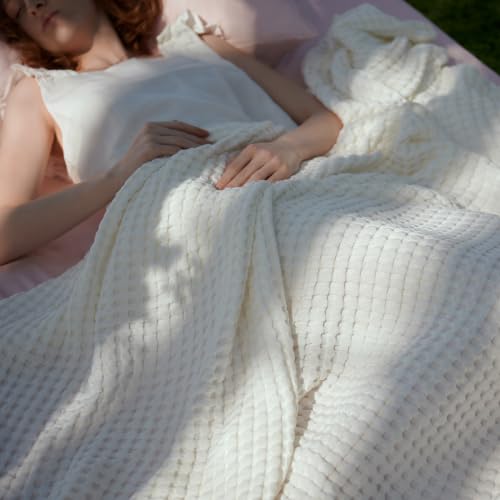
The Bedsure Cooling Cotton Waffle Blanket for Hot Sleepers — 50 percent cotton, 50 percent bamboo-derived rayon, queen size at 90 by 90 inches — is the textbook all-season blanket. In summer it is the bed’s only cover over a sheet, its waffle pockets venting heat. In spring and autumn it pairs with a light duvet. In winter it becomes the breathable middle layer that keeps an all-synthetic stack from feeling sealed. The waffle structure is the mechanism: the same pockets that release heat in July trap a whisper of still air in January.
Strengths
- Genuine three-season solo performance plus a fourth as a layer.
- Breathable, moisture-absorbing cotton-rich face suits the widest range of sleepers.
- Washes easily and often — the all-season workhorse requirement.
Trade-offs
- In unheated cold rooms it is a component, never the whole answer.
- Open weave needs gentle laundry companions to avoid snags.
- Texture is utilitarian rather than plush; luxury seekers should layer it under prettier things.
| Color | 01 – Ivory |
| Size | Queen (90″ X 90″) |
| Weight | 3.8 Pounds |
This is the blanket to buy when furnishing a bed from zero, a guest room, or a first apartment: it will never be the wrong blanket in any given month, and it teaches its owner the layering system by participation. It also travels between bed and couch without looking lost. Choose it as the default all-season foundation. Skip it only if your climate is extreme at both ends and you are committed to specialists.
Best for: Most homes and climates wanting one blanket all year / Not suited for: Unheated rooms in hard winters as a solo blanket
Choose it for year-round adaptability; skip it as a solo arctic layer. Check on Amazon

Pendleton National Park Blanket
Our badge: Best for Cold Climates
The Pendleton National Park Blanket — 100 percent wool, queen, 6.2 pounds — is the all-season pick for the colder half of the map. Wool’s regulation is the widest in nature: its fibers buffer moisture and temperature so effectively that the same blanket serves from the first frost through the last, and on cool summer nights in northern and mountain homes it never leaves the bed at all. In deep winter it layers under a duvet without the clamminess synthetics introduce.
Strengths
- Widest natural temperature-regulation range of any pick here.
- Serious insulation that still breathes — warm without sealing.
- Decades-long service life makes its year-round cost tiny.
Trade-offs
- Too much blanket for hot climates’ summers, full stop.
- Gentler, less frequent washing than cotton or fleece.
- Premium investment tier.
| Color | Grand Canyon Navy |
| Size | Queen (90″ x 90″) |
| Weight | 6.2 pounds |
Cold-climate households run this blanket nine to twelve months a year and wonder what the all-season problem even is. Its summer role narrows as latitude drops — in a southern July it is a beautiful closet resident — which is why it ranks second overall but first wherever winters are real. Choose wool for cold-climate year-round duty. Skip it where summers are hot and long.
Best for: Northern, mountain, and cold-maritime climates / Not suited for: Hot climates’ summer months
Choose it where winters dominate; skip it for southern summers. Check on Amazon

Elegear Double-Sided Cooling Blanket for Hot Sleepers
Our badge: Best for Hot Climates
The Elegear Double-Sided Cooling Blanket for Hot Sleepers adapts by having two faces: an Arc-Chill cool-touch side for peak summer and a 100 percent Egyptian cotton side for the mild months, at 79 by 86 inches and just over three pounds. In hot climates the calendar inverts — summer is the long season of thermal danger, winter a few mild weeks — and this blanket’s range covers that calendar completely, layering under a light duvet for the coolest nights.
Strengths
- Two fabrics in one blanket, matched to hot-climate seasons.
- Feather-light: never the cause of overheating in any month.
- Machine washable for the frequent laundry hot climates demand.
Trade-offs
- No meaningful insulation for genuinely cold rooms.
- Cooling face is synthetic in feel.
- In temperate climates it is a three-season blanket at best.
| Color | Light Grey |
| Size | Full/Queen (79″ x 86″) |
| Weight | 3.26 pounds |
For the Gulf Coast, the desert Southwest with cooled bedrooms, and tropical postings, this is the all-season answer, full stop. Temperate readers should treat it as their summer specialist instead. Choose it where heat is the year’s main event. Skip it where winter is.
Best for: Hot climates and hot sleepers year-round / Not suited for: Cold climates as a primary blanket
Choose it for hot-climate range; skip it for cold winters. Check on Amazon

Bedsure Fleece Bed Blankets Queen Size Grey
Our badge: Best Budget
The Bedsure Fleece Bed Blanket — queen flannel fleece, 3.19 pounds — is the all-season pick for the climate-controlled majority. In homes held near a steady temperature all year, the seasons happen mostly outdoors, and a light, soft, endlessly washable fleece serves as the bed’s constant layer: enough alone in the mild months, a warm middle under the duvet in the cold ones, and the couch’s blanket in between.
Strengths
- Perfect weight for heated and cooled homes where indoor climate barely changes.
- Washes and dries faster than any other pick — vital for a blanket that never rotates out.
- Accessible tier invites multiples for every bed in the house.
Trade-offs
- Breathability ceiling: in uncooled summer rooms it sleeps warm.
- Static in dry winter air.
- Less temperature regulation than cotton or wool across real seasonal swings.
| Color | Grey |
| Size | Queen (90″ X 90″) |
| Weight | 3.19 pounds |
Judge this pick by your thermostat, not your zip code: if your bedroom is 68 to 72 degrees in January and July alike, fleece’s limitations never activate and its virtues — softness, care, price — run all year. Choose it for climate-controlled homes. Skip it where the house itself swings with the seasons.
Best for: Heated and air-conditioned homes with steady indoor temperatures / Not suited for: Uncooled summers or unheated winters
Choose it for steady indoor climates; skip it for swinging ones. Check on Amazon

Bedsure GentleSoft Sherpa Fleece Throw Blanket for Couch
Our badge: Best for Variable Rooms
The Bedsure GentleSoft Sherpa Fleece Throw Blanket for Couch — 220 GSM flannel one side, 260 GSM sherpa the other, 50 by 60 inches — adapts at the scale of a single evening. Rooms that drift (sun-warmed afternoons, chilly evenings; upstairs bedrooms over garages) need a layer that adjusts in seconds: flannel side for mild, sherpa side for cold, folded double for the coldest hour. As the household’s roaming layer — couch, reading chair, foot of the bed — it fills the gaps a fixed bed blanket cannot.
Strengths
- Two warmth levels in one flip — the fastest adaptation in this guide.
- Roams the house solving spot cold in every season.
- Washable and durable enough for daily, year-round handling.
Trade-offs
- Throw size: an adapter and supplement, not a bed’s primary blanket.
- Sherpa side is too warm for summer nights even in mild rooms.
- Pile needs its wash rhythm to stay fresh through constant use.
| Color | 01 – Grey |
| Size | Throw (50″ X 60″) |
| Weight | 2.03 pounds |
Every all-season system needs this piece: the variable layer that absorbs the difference between the forecast and the evening. Keep it where the household sits, and it will be used in all twelve months — the truest test of the category. Choose it as the system’s adapter. Skip it as your only blanket purchase.
Best for: Variable rooms and roaming spot warmth all year / Not suited for: Primary bed coverage
Choose it as the adapter; skip it as the foundation. Check on Amazon

Bearaby Cotton Hand-Knit Weighted Blanket
Our badge: Best Premium Layer
The Bearaby Cotton Hand-Knit Weighted Blanket — organic cotton knit, 15 pounds, 40 by 72 inches — is the all-season pick for weighted sleepers, because its open knit is the only weighted construction that never forces a seasonal exile. In summer it is the bed’s only layer, air moving through it freely. In winter it sits under a duvet, contributing pressure while the duvet contributes insulation. No other weighted blanket in our pool can make both claims.
Strengths
- Weighted comfort with structural breathability in every season.
- Organic cotton, filler-free, machine washable as one piece.
- Beautiful enough to be the bed’s visible layer year-round.
Trade-offs
- Premium tier, and a personal size only.
- Weighted rules apply: correct body-weight sizing, free removal, adults and older teens.
- Provides pressure, not insulation — winter warmth comes from its duvet partner.
| Color | Midnight Blue |
| Size | 15 lbs (40″x72″) |
| Weight | 15 pounds |
For the weighted sleeper, this blanket collapses the seasonal system into one product plus whatever duvet the house already owns — the simplest year-round story in this guide. Its summer credentials are detailed in Best Weighted Blankets For Summer, where it leads for the same structural reasons. Choose it for premium, year-round weighted comfort. Skip it if weight itself is not your preference.
Best for: Weighted sleepers wanting one blanket for all seasons / Not suited for: Non-weighted sleepers or sharing
Choose it for year-round weight; skip it for unweighted sleep. Check on Amazon
Comparison Table
| Pick | Size | Weight | Color | Check price on Amazon |
|---|---|---|---|---|
| Bedsure Cooling Cotton Waffle Blanket for Hot Sleepers | Queen (90″ X 90″) | 3.8 Pounds | 01 – Ivory | Check price on Amazon |
| Pendleton National Park Blanket | Queen (90″ x 90″) | 6.2 pounds | Grand Canyon Navy | Check price on Amazon |
| Elegear Double-Sided Cooling Blanket for Hot Sleepers | Full/Queen (79″ x 86″) | 3.26 pounds | Light Grey | Check price on Amazon |
| Bedsure Fleece Bed Blankets Queen Size Grey | Queen (90″ X 90″) | 3.19 pounds | Grey | Check price on Amazon |
| Bedsure GentleSoft Sherpa Fleece Throw Blanket for Couch | Throw (50″ X 60″) | 2.03 pounds | 01 – Grey | Check price on Amazon |
| Bearaby Cotton Hand-Knit Weighted Blanket | 15 lbs (40″x72″) | 15 pounds | Midnight Blue | Check price on Amazon |
How to Choose the Best Blanket for All Seasons
Map Your Indoor Climate, Not Your Zip Code
List your bedroom’s real temperatures across the year. A Minneapolis apartment with strong heating and cooling may vary less than a San Francisco bedroom with neither. The blanket must cover your indoor range, and that range — not the weather channel — decides whether one blanket suffices or two specialists are the honest answer.
Prioritize Breathability Over Peak Warmth
Warmth can always be added with a duvet, a throw, or a second layer; breathability cannot be added to a sealed fabric. That asymmetry is the whole strategy: choose the most breathable blanket that your coldest month can layer up from, and the calendar is covered.
Weight and Weave Sweet Spots
For bed blankets, roughly three to four pounds in queen size hits the all-season band: substantive in winter stacks, negligible in summer. Open and textured weaves (waffle, knit) adapt better than flat dense ones at the same weight. Wool is the exception that runs heavier and still adapts, thanks to fiber-level regulation.
Demand Washability
An all-season blanket accumulates a year of skin, dust, and life without a rotation partner to rest it. Choose constructions that wash easily and often, and consider owning two of the same blanket to rotate — the professional system for the hardest-working textile in the home, and a natural fit with the routines in Best Cotton Blankets For Beds.
Admit the Extremes
If your winters are sub-zero in an old house, or your summers are triple-digit without cooling, plan a specialist for the extreme season and let the all-season blanket cover the other ten months. That is not failure; it is the correct reading of your climate, and it still saves the cost and storage of a full seasonal wardrobe of bedding.
Climate Honesty: Mapping Your Year Before You Shop
An all-season blanket can only be chosen against an honest map of your actual year, and most households misdraw that map in the same way: they shop in the current season and unconsciously optimize for it. Draw the map deliberately instead. Count the weeks your bedroom is genuinely cold, the weeks it is genuinely hot, and the long shoulder stretches in between, because an all-season blanket earns its keep in the shoulders and survives the extremes with help. A household with ten weeks of real winter, ten weeks of real summer, and thirty weeks of mild weather should buy for the mild majority and layer at both ends; a household in a climate with five months of hard cold should weight the decision toward warmth and accept a dedicated light layer in July. Altitude, coastal fog, upstairs bedrooms that hoard heat, and ground-floor rooms that never warm up all shift the map room by room — the guest room over the garage and the master bedroom under the eaves may honestly need different answers, and pretending otherwise produces one room that is always wrong. Write the map down before opening a single listing: coldest room temperature you sleep in, warmest, and how many weeks of each. Every construction claim in this guide can then be tested against your numbers instead of against a marketing department’s idea of a season.
Weight and GSM: Comparing Warmth Across Different Constructions
Blankets of different constructions cannot be compared by thickness, and barely by total weight, which is why shoppers end up with a featherlight blanket that sleeps warm and a heavy one that sleeps cool and no idea why. The useful mental model is trapped air: warmth comes from still air held in loft, fleece pile, or waffle pockets, and a construction that holds more still air per ounce insulates more. That is why a lofty fleece out-warms a flat, dense cotton blanket of twice the weight, and why the waffle weave punches above its weight in the shoulder seasons — its pockets trap air when you need it and collapse to breathability when you do not. For all-season purposes, think in three working bands rather than absolutes: light layers for summer and hot sleepers, mid-weight versatile constructions for the long middle of the year, and true winter builds that an all-season blanket should imitate only with a partner layer. When a listing gives fabric weight, treat it as a within-material comparison only — a heavy cotton and a heavy fleece are different animals — and when it gives nothing but adjectives, let the construction type carry the judgment. Sleepers whose nights are defined less by the calendar than by sweat should cross-check their choice against Best Blankets For Sweaty Sleepers, because moisture behavior can matter more than nominal warmth in every season, not just summer.
Sizing for a Blanket That Has to Do Everything
An all-season blanket should be sized a touch more generously than a single-season one, for a practical reason: in winter it must cover sleepers plus the partner layer tucked beneath it without pulling short at the shoulders, and in summer it is often folded down to half coverage at the foot of the bed, which only works if there is length to spare. For shared beds, that argues for the larger standard size rather than the exact mattress match — overhang that would be a flaw in a weighted blanket is a feature here, anchoring the blanket against night-time migration and giving both partners margin. For single sleepers and children’s beds, exact sizing keeps the blanket off the floor, where hems collect dust and damage. Also consider the made-bed question honestly: a blanket that will live visibly on the bed all year should be bought with its appearance as a real criterion — a versatile construction in a color that survives both your winter and summer bedding palettes — while a blanket that lives under a duvet can be chosen on performance alone. Neither priority is wrong; confusing them is how households end up with a technically perfect blanket they hide and a beautiful one they cannot sleep under in February.
How to Run One Blanket Through Four Seasons
Spring: blanket over a sheet, duvet folded at the foot or stored; open windows when nights allow and let the breathable layer do the work. Summer: blanket solo (or the cooling face up, for the Elegear), sheets cotton, fan or cooling as your house allows; wash the blanket more often, since it is now the skin-contact layer. Autumn: blanket plus light duvet returns; this is the configuration most sleepers rate the best sleep of the year. Winter: blanket as the middle layer under your warmest duvet, with the sherpa throw as the foot-and-shoulders booster on the coldest nights. Wash and air the blanket thoroughly at each seasonal turn — four natural laundry landmarks — and inspect seams and fabric then, so wear is caught in April rather than discovered in December. Store nothing; the all-season blanket’s storage is the bed.
Problem: The blanket is perfect in October and wrong in January — It is not wrong; the system is incomplete. Add the duvet above it and a booster throw before replacing a good adaptable layer.
Problem: Summer nights still feel warm under a breathable blanket — Check the whole stack: synthetic sheets or a mattress protector may be the seal. Cotton sheets and a fan usually finish what the blanket started.
Problem: The all-season blanket looks tired by year two — Constant duty without rotation wears any textile. Buy the second identical blanket and rotate weekly; both will outlast a single one’s doubled service.
Problem: Partners disagree across seasons — Split the top layer seasonally: shared all-season base, individual throws or weighted layers per person as their temperature demands.
The Seasonal Swap: A Fifteen-Minute Ritual, Twice a Year
The households that succeed with all-season blankets share one habit: a brief, deliberate swap at each end of the year rather than a gradual drift. When the first genuinely cold week arrives, the summer layer comes off the bed, gets washed, dried completely, and stored, and the winter partner layer joins the versatile blanket. When the first warm week arrives, the ritual reverses. Doing it as an event rather than an improvisation matters because the off-season textiles get stored clean — the single strongest predictor of whether a stored blanket smells fresh in six months — and because the swap is the natural moment to inspect seams, check for thinning, and notice damage while it is still a repair rather than a replacement. Put the swap on the same trigger as something you already do: the weekend the clocks change, the first frost warning, the day the heating first runs. Fifteen minutes, twice a year, is the entire administrative burden of the system, and it is what separates a planned rotation from a closet of blankets nobody can quite account for.
The Layering System, Explained Once and Used Forever
Every adaptable bed in this guide series runs the same three-slot architecture. Slot one touches skin and manages moisture: the sheet, ideally cotton. Slot two is the adaptable blanket — this guide’s subject — contributing breathability and moderate insulation in every month. Slot three is the seasonal variable: absent in summer, a light duvet in the shoulder months, the warmest duvet in winter, with throws as spot boosters. The genius of the system is that only slot three changes, so the bed’s familiar feel persists all year and laundry stays simple. When a bed sleeps badly, diagnose by slot: clammy means slot one or two is sealing; cold means slot three is underpowered; hot means slot three overstayed the season. This framework travels across every blanket guide we publish, from Best Blankets For Elderly, where the slots must also be light and safe, to the summer systems for hot sleepers.
All-Season Blankets for Guest Rooms and Rentals
Guest bedding is where all-season logic pays cash. A guest room cannot be re-blanketed per visitor or per month, and guests arrive with unknown temperature preferences. The professional setup: an adaptable cotton or fleece blanket on the bed, a warmer duvet in the closet, a light throw folded visibly, and the guest empowered to adjust. Vacation rentals run the same play at scale, adding washability as the deciding spec — a blanket that survives weekly commercial-style laundry beats a finer one that cannot. For hosts, the waffle and fleece picks in this guide are the industry pattern: neutral, breathable, washable, replaceable. Add a small card noting where extra layers live, and your guests will sleep at their temperature, not yours — the definition of hospitality in bedding form.
All-Season Blankets for Different Household Budgets and Habits
The all-season question is partly a budget question, and it deserves a straight answer: one versatile blanket plus disciplined layering is the economical system, while a dedicated blanket per season is the comfortable one, and neither is a moral failing. The single-blanket household should spend its money in the middle of the range — the versatile constructions, waffle weaves and mid-weight fleeces, that cover the most weeks — and then close the extremes cheaply: a thin cotton layer for the hottest fortnight, the household’s existing duvet for the coldest. The multi-blanket household is really buying back convenience, and should be honest that the third and fourth blankets in the closet are luxury, not necessity. What neither household should do is buy four cheap blankets that each do one season badly; a closet of disappointments costs the same as one good versatile blanket and one good specialist. Households with children multiply the logic: kids outgrow, spill, and claim blankets as permanent personal property, so family all-season strategy usually means durable mid-weight blankets in multiples rather than one precious textile. And in homes where laundry is a shared or paid resource, washability outranks almost every other trait — the best all-season blanket is the one that survives fifty washes a year without thinning, because a blanket washed weekly ages four times faster than one washed monthly, and its replacement cost belongs in the purchase math from the start.
Reading Your Current Blanket: A Mid-Life Audit
Before replacing anything, audit what you own, because many households already possess an all-season system without having named it. Lay out every blanket in the house and sort by construction rather than by room: the breathable weaves, the fleeces, the heavy winter builds, the thin cotton layers. Most homes discover they own the extremes and lack the middle — three winter blankets from various Decembers and a beach towel’s worth of summer coverage, with nothing for the thirty shoulder weeks that dominate the year. That gap, not a total absence of blankets, is what sends people shopping in April. The audit also exposes condition: a fleece whose pile has matted flat has lost the trapped air that made it warm and now sleeps like a sheet with ambitions; a cotton blanket thinned at the center has become a summer blanket whether you planned it or not. Reassign before you replace — the demoted winter blanket may be exactly the guest room’s shoulder-season answer, and the blanket you were about to discard may be the summer layer your system was missing. Only after the audit should new purchases be aimed, and they should be aimed at the missing band of the system, which is also the logic that governs a dedicated summer purchase like the ones in Best Cooling Blankets For Summer: fill the gap the audit found, not the gap the advertising suggested.
All-Season Blankets in Rooms That Refuse to Cooperate
Some rooms defeat blanket logic, and naming them saves money. The bedroom over an uninsulated garage runs colder than the house in winter and bakes in summer; the top-floor room under a dark roof collects a day’s heat and returns it all night; the north-facing room in an old house never quite warms in January. In these rooms the all-season blanket should be chosen for the room’s dominant problem, not the house’s average, and the household’s versatile blanket can serve the well-behaved rooms instead. This is also where small room interventions out-pay blanket upgrades: a door sweep and a rug change a cold floor room more than a warmer blanket does, and blackout curtains on a sun-struck west window reduce the evening heat load that no breathable blanket can fully offset. Think of the blanket as the last adjustment in the room, not the first — after the obvious drafts, sun, and floor problems are handled, the remaining temperature range is usually exactly the range a good versatile blanket was built for. Renters, who cannot renovate, should invert the order: blanket first, then the removable fixes, curtains and rugs and draft stoppers that travel to the next home. Either way, the diagnostic habit is the same — measure the room’s real overnight temperature in its worst month before spending on textiles, because a five-degree room problem will defeat a fifty-dollar blanket upgrade every single time, and the money is better spent once the room’s actual range is known.
Common Buying Mistakes
Believing a Single Blanket Defies Physics
Marketing that promises arctic warmth and tropical coolness in one unlayered blanket is selling a mood. The consequence is a blanket wrong in both extreme months. Buy adaptability and layer; the calendar will cooperate.
Choosing by Winter Alone
Blankets bought in January get tested in July. A heavy winter champion becomes the summer’s closet filler. If you shop in winter, deliberately interrogate the blanket’s summer behavior before paying.
Ignoring the Sheets
An adaptable blanket over sealing synthetic sheets still sleeps hot. The system is only as breathable as its least breathable layer. Cotton sheets are the all-season blanket’s necessary partner.
One Blanket, No Rotation, No Mercy
Twelve months of nightly duty without a spare means laundry-day compromises and accelerated wear. Two mid-tier blankets rotated outlast one premium blanket ridden daily.
Forgetting the Climate-Control Question
Buyers in steady indoor climates overbuy regulation; buyers in swinging climates underbuy it. Your thermostat habits are a specification. Include them in the decision.
Buying for the Season You Are Standing In
Retail timing quietly sabotages all-season buying: the blanket purchased in a January cold snap is chosen with frozen feet, and the one bought in an August heatwave with a sweating back, and both shoppers swear they bought a year-round product. The consequence is a purchase optimized for the extreme week and wrong for the thirty ordinary ones. The better move is to shop from your written climate map — coldest weeks, warmest weeks, and the long middle — and to deliberately discount how you feel on the day. If you must buy during an extreme, buy the versatile middle anyway and let layers handle the week you are standing in; it will pass, and the blanket has to live with the other fifty-one.
Forgetting the Bed’s Other Occupants
All-season calculations are usually made for one sleeper and then applied to a bed shared with a partner, a child who migrates in at dawn, or a pet with strong opinions about the warm spot. Each additional occupant is a heat source and a blanket territorial claim. Households that run warm collectively should bias the versatile choice one step lighter than the single-sleeper math suggests, and households with a resident pet should weight washability and snag resistance accordingly. The blanket serves the bed as it is actually slept in, not as it appears in the listing photograph. Run the honest census of your bed — sleepers, temperatures, pets, and the child-shaped heat source who arrives at 5 a.m. — and let that census, rather than a solitary shopper’s preference, cast the deciding vote between two otherwise equal finalists. It is a small discipline, but it is the difference between a blanket that serves a household and one that serves an idealized version of it — and only one of those households actually has to sleep under the result, in January and July alike, for years.
Final Recommendation
For most homes, the all-season answer is the Bedsure Cooling Cotton Waffle Blanket for Hot Sleepers: breathable enough for July, layerable enough for January, washable enough for every week between. Cold climates should take the wool Pendleton as their foundation — compare it here: Check on Amazon — hot climates the dual-faced Elegear, steady indoor climates the fleece, and weighted sleepers the Bearaby knit. Add the sherpa adapter, run the three-slot system, and one good blanket really can stay on the bed all year.
Frequently Asked Questions
How many blankets does a household actually need per bed?
For most climates, two per bed cover the year honestly: one versatile mid-weight blanket that handles the long shoulder seasons and mild stretches, and one specialist for whichever extreme your climate does harder — a true winter build or a genuinely breathable summer layer. A third, the thin cotton layer, earns its place in homes with real heatwaves. Beyond three per bed you are buying convenience and guest capacity, which is fine, but name it as such so the budget goes to the two blankets that do the daily work.
Can an all-season blanket work for two partners with different temperatures?
It can be the shared base, but it should not be asked to settle the difference alone. The durable pattern is a shared all-season blanket at the cooler partner’s comfort level, plus a personal extra layer — a throw or half-blanket — on the colder partner’s side. Trying to solve a two-body problem with one blanket’s warmth rating produces a compromise both partners describe as wrong, in opposite directions, all year.
When should an all-season blanket be replaced?
When its construction stops doing its job: fleece pile matted beyond what washing restores, cotton woven thin enough to see light through at the center, seams opening, or a persistent odor that survives a proper wash and full drying. Cosmetic fading is not a reason; lost loft and lost coverage are. A well-kept versatile blanket should give years of service, and rotating two blankets through the year roughly doubles the calendar life of each.
Is a duvet with changeable inserts better than an all-season blanket?
It is a different system with the same goal. Inserts give precise seasonal control and a made-bed look, at the cost of storage for the off-season insert and the wrestling match of changing it. A blanket system is simpler, cheaper, and layers more flexibly, but looks and feels more casual. Households that already own and like a duvet system should extend it; households starting fresh usually get more comfort per dollar from blankets, especially across multiple beds.
Can one blanket really work for all seasons?
As the adaptable middle of a layer system, yes for most climates: solo in summer, layered in winter. As a single unlayered product in extreme climates, no — and honest guides should say so, as this one does.
What material is best for an all-season blanket?
Cotton-rich weaves and wool regulate across the widest ranges. Cotton waffle is the most versatile for mixed climates; wool dominates where winters lead; cotton-backed cooling fabrics win in hot climates.
How heavy should an all-season blanket be?
Around three to four pounds in a queen bed size is the adaptable band for woven and fleece blankets. Wool runs heavier while still regulating. Weighted blankets are a separate preference layered into the system.
Do I still need a duvet with an all-season blanket?
In climates with real winters, yes — the duvet is the seasonal variable that lets the blanket stay constant. In mild or climate-controlled homes, the blanket plus a throw may cover the whole year.
How often should an all-season blanket be washed?
Every two to four weeks in its solo and skin-contact seasons, monthly when it sits as a middle layer — and always at the turn of each season. Owning two and rotating is the professional approach.
Are all-season blankets good for guest rooms?
They are the correct guest-room choice: adaptable, neutral, washable, and forgiving of unknown preferences — especially with a warmer duvet stored nearby for guests to add.


