Disclosure: As an Amazon Associate, dailyhomedecorating.com earns from qualifying purchases. Links to Amazon on this page are affiliate links; they cost you nothing extra. Prices and availability change often, so check the current Amazon listing before you buy.
The best blankets for hot weather are an exercise in subtraction: the least insulation, the most airflow, and just enough substance that the bed still feels like a bed. Hot-weather sleepers are not asking for much — a layer that covers without sealing, breathes without billowing off, and absorbs a little moisture instead of turning the night into a plastic-wrap experience. Most blankets fail this brief by construction: fleece traps, microfiber seals, and anything with loft stores the day’s heat and returns it at midnight. The winners are open weaves, natural-rich fibers, and engineered cooling fabrics that start the night below skin temperature and then get out of the way.
This guide ranks six verified blankets for hot climates, heat waves, and warm sleepers in any zip code — from a cotton waffle that has handled summers for generations to a cool-touch performance blanket for the nights when even cotton feels warm. We will also cover the room-and-routine half of hot-weather sleep, because the best blanket in a hot room still loses, while a good blanket in a managed room wins easily. If your heat comes with sweat, go deeper in Best Blankets For Sweaty Sleepers; if it comes with a love of weight, see Best Weighted Blankets For Summer.
Where to Buy
All six picks are sold on Amazon, where you can check the current price, sizes, and colors. Start with the dual-faced specialist, the Elegear Double-Sided Cooling Blanket for Hot Sleepers — Check on Amazon. The other picks: Bedsure Cooling Cotton Waffle Blanket — Check on Amazon; REST Evercool Cooling Comforter Blanket — Check on Amazon; Bearaby Cotton Hand-Knit Weighted Blanket — Check on Amazon; Tache Cotton Patchwork Quilt Blanket — Check on Amazon; Exclusivo Mezcla Fleece Throw Blanket — Check on Amazon.
In this guide
Quick Picks
| Pick | Badge | Why it earns its place |
|---|---|---|
| Elegear Double-Sided Cooling Blanket for Hot Sleepers | Best Overall | Cool-touch Arc-Chill face for heat waves, Egyptian cotton face for warm nights. |
| Bedsure Cooling Cotton Waffle Blanket for Hot Sleepers | Best Natural Choice | Cotton-rich waffle airflow in a true bed size — the traditional summer answer. |
| REST Evercool Cooling Comforter Blanket for Hot Sleepers | Best Premium | Silky Evercool comforter with breathable loft for sleepers who want substance without heat. |
| Bearaby Cotton Hand-Knit Weighted Blanket | Best for Weighted Sleepers | Open knit cotton: real weight, real airflow, no fill to store heat. |
| Tache Cotton Patchwork Quilt Blanket | Best for Naps and Daybeds | Pre-washed cotton patchwork — the light layer for siestas and summer guest beds. |
| Exclusivo Mezcla Soft Large Fleece Throw Blanket for Couch | Best for Air-Conditioned Rooms | A light long throw for the opposite problem: rooms cooled below blanket-free comfort. |
Key Takeaways
- Airflow beats thinness: an open weave of moderate weight sleeps cooler than a sealed film of a blanket.
- Natural-rich fibers (cotton, bamboo blends) manage moisture; pure synthetics need engineered cooling to compete.
- Cool-touch fabrics win the first hour; breathability wins the night — the best picks offer both across two faces or weaves.
- Your sheets and room decide half the outcome: cotton bedding and a fan multiply any blanket’s performance.
- Keep one light layer even in heat: most sleepers rest better with slight coverage than with none.
How These Picks Were Chosen
We filtered the verified pool for hot-weather credibility: open or breathable construction, low insulation, moisture-friendly fibers or verified cooling technology, and bed-realistic sizes. The Elegear’s dual-face design and the REST’s cooling fabric represent engineered approaches; the waffle and patchwork represent natural-fiber tradition; the Bearaby solves the weighted sleeper’s summer; and the light fleece throw covers the air-conditioned-room case honestly rather than pretending fleece is a heat-wave fabric. Heated, sherpa, and heavy filled products were excluded without regret. Construction and verified specifications drove the order — not ratings, not prices.
The 6 Best Best Blankets for Hot Weather — Reviewed

Elegear Double-Sided Cooling Blanket for Hot Sleepers
Our badge: Best Overall
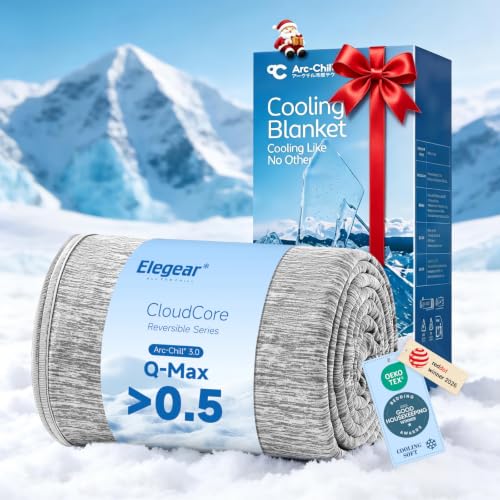
The Elegear Double-Sided Cooling Blanket for Hot Sleepers is built for the two kinds of hot night. Its Arc-Chill 3.0 face, rated Q-Max above 0.5 by the maker, feels distinctly cool on contact and draws heat away as you fall asleep — the phase when hot sleepers struggle most. Its reverse is 100 percent natural Egyptian cotton for the merely warm nights when active cooling is overkill. At 79 by 86 inches and just over three pounds, it covers a queen bed while adding almost no insulation of its own.
Strengths
- Real cool-touch performance for heat waves and un-cooled rooms.
- Cotton second face keeps the blanket useful across the whole warm season.
- Light, washable, and sized like a true bed blanket.
Trade-offs
- The cooling face feels synthetic; natural-fiber purists will live on the reverse.
- Cool-touch effect depends on the blanket starting cool — store it in the coolest room.
- Too light for any genuine cold; it is a warm-season specialist.
| Color | Light Grey |
| Size | Full/Queen (79″ x 86″) |
| Weight | 3.26 pounds |
Use the cotton face as the default and flip to the cooling face when the forecast turns serious. It travels well — hotels and rentals run warm, and this blanket packs like a shirt. In our summer coverage it is the benchmark against which natural options are compared, including in Best Cooling Blankets For Summer. Choose it for the widest hot-weather range. Skip it if you want one fiber, all natural, all the time.
Best for: Hot climates, heat waves, and warm bedrooms without strong cooling / Not suited for: All-natural-only buyers or cold rooms
Choose it for engineered summer range; skip it for purist natural briefs. Check on Amazon

Bedsure Cooling Cotton Waffle Blanket for Hot Sleepers
Our badge: Best Natural Choice
The Bedsure Cooling Cotton Waffle Blanket for Hot Sleepers is the summer blanket your grandparents would recognize: a cotton-rich waffle weave (50 percent cotton, 50 percent bamboo-derived rayon), queen size, whose three-dimensional pockets let air circulate with every small movement you make in the night. It absorbs light moisture rather than filming it against your skin, feels dry and familiar, and asks nothing of you but a gentle wash.
Strengths
- Proven natural-rich breathability with genuine moisture absorption.
- True bed size and weight — coverage without insulation.
- Doubles as the all-season middle layer when the weather turns.
Trade-offs
- No active cooling: in extreme heat it manages, but does not chill.
- Open weave needs snag-aware laundry habits.
- Texture is honest and plain rather than luxurious.
| Color | 01 – Ivory |
| Size | Queen (90″ X 90″) |
| Weight | 3.8 Pounds |
For most hot sleepers in most summers, this is enough — especially with cotton sheets and a fan — and it is the pick with the fewest asterisks. It is also the blanket to buy when the household disagrees about engineered fabrics: nobody objects to cotton. Choose it for natural summer comfort with year-round utility. Skip it only for the worst heat, where the Elegear’s active face earns its place.
Best for: Natural-fiber summer sleep in most climates / Not suited for: Extreme heat waves as the only defense
Choose it for classic cotton summers; skip it for extreme heat alone. Check on Amazon

REST Evercool Cooling Comforter Blanket for Hot Sleepers
Our badge: Best Premium
The REST Evercool Cooling Comforter Blanket for Hot Sleepers answers a specific hot-weather complaint: cooling blankets feel thin, and some sleepers cannot rest under a layer that feels like nothing. The Evercool comforter keeps a cloud-light, breathable loft — Sorona and Tencel-blend filling inside its cool-to-touch fabric — at 90 by 90 inches and 5.5 pounds, so the bed feels made and substantial while the surface stays cool and silky against skin.
Strengths
- Cool-touch surface with real, breathable body — substance without the heat penalty.
- Smooth, silky feel that suits sensitive skin and reads as premium bedding.
- Machine washable and dryer safe; no flat sheet needed per the maker.
Trade-offs
- Premium tier among cooling options.
- Any loft is some insulation; the very hottest sleepers may prefer flat weaves.
- Silky surface can slide on smooth sheets.
| Color | Cool Gray |
| Size | Full / Queen (90″x90″) |
| Weight | 5.5 pounds |
This is the hot-weather blanket for people who love the idea of a comforter and the reality of a cool bed. It anchors a summer bed that still looks dressed for guests and partners who share different temperatures — the hot sleeper gets the cool surface, the household keeps its standards. Choose it for premium substance in summer. Skip it if you want the absolute minimum between you and the air.
Best for: Sleepers wanting comforter substance with a cool surface / Not suited for: Minimalists in extreme heat
Choose it for premium cool substance; skip it for bare-minimum layers. Check on Amazon
Bearaby Cotton Hand-Knit Weighted Blanket
Our badge: Best for Weighted Sleepers
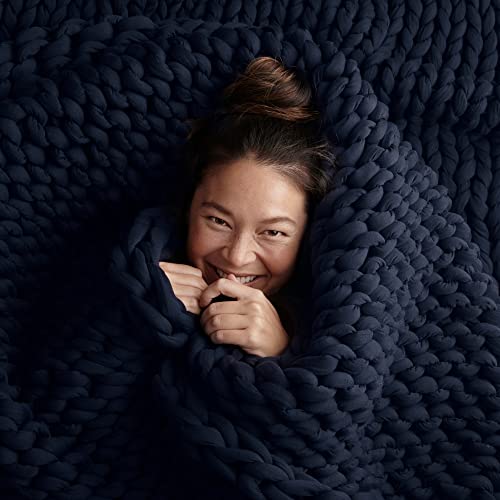
The Bearaby Cotton Hand-Knit Weighted Blanket — organic cotton yarn hand-knit into open loops, 15 pounds at 40 by 72 inches — is the hot-weather answer for sleepers who will not give up weight. Air passes through the knit continuously, so pressure and ventilation coexist in a way no filled blanket achieves. It is a comfort product, sized by the usual body-weight guidance, with no medical claims attached — in summer, simply the coolest way to keep a weighted routine.
Strengths
- Structural breathability: the only hot-weather weighted architecture that truly vents.
- Organic cotton against skin; nothing synthetic, no fill to heat-soak.
- Machine washable as one piece within care guidance.
Trade-offs
- Premium tier and personal size only.
- Weight itself generates some warmth through contact; extremely hot sleepers may still rotate out in heat waves.
- All weighted-blanket sizing and safety rules apply in every season.
| Color | Midnight Blue |
| Size | 15 lbs (40″x72″) |
| Weight | 15 pounds |
Pair it with cotton sheets and nothing else on the bed, aim a fan across the surface, and summer weighted sleep stops being a contradiction. Choose it to keep the weighted routine alive through July. Skip it if weight was a winter experiment you are happy to retire.
Best for: Weighted sleepers in warm rooms and climates / Not suited for: Non-weighted sleepers or sharing
Choose it for hot-weather weight; skip it for unweighted sleep. Check on Amazon

Tache Cotton Patchwork Quilt Blanket
Our badge: Best for Naps and Daybeds
The Tache Cotton Patchwork Quilt Blanket is pre-washed cotton patchwork with a thin poly-cotton fill, 50 by 60 inches — the hot-weather layer for the day’s second sleep: the siesta, the porch nap, the daybed in a warm room. Cotton’s breathability and the quilt’s minimal fill make it the lightest-feeling natural cover here, and its cottage prints suit the summer rooms where naps happen.
Strengths
- Feather-light cotton comfort for daytime rest in warm rooms.
- Pre-washed softness with a handmade look guests and hosts both enjoy.
- Machine washable cold delicate — nap blankets need frequent washing.
Trade-offs
- Throw size only; not a bed blanket for adults.
- Thin fill means it is a warm-weather piece exclusively.
- Busy vintage pattern is a definite style commitment.
| Color | Burgundy |
| Size | 50×60 |
Hot climates run on naps, and the nap blanket is real equipment there. Keep this quilt on the daybed or the shaded couch and it will be used daily from May to September. It also serves as the summer guest-bed topper over a plain cotton blanket. Choose it for daytime and guest summer duty. Skip it as a primary bed purchase.
Best for: Naps, daybeds, and summer guest beds / Not suited for: Primary adult bed coverage
Choose it for summer naps; skip it for the main bed. Check on Amazon

Exclusivo Mezcla Soft Large Fleece Throw Blanket for Couch
Our badge: Best for Air-Conditioned Rooms
The Exclusivo Mezcla Soft Large Fleece Throw Blanket for Couch earns its place in a hot-weather guide by covering hot weather’s mirror problem: aggressively air-conditioned rooms, offices, planes, and cinemas, where the cold is manufactured and a light layer is the difference between comfort and shivering. At 50 by 70 inches and 1.55 pounds of brushed flannel fleece, it is the portable personal climate zone — not a heat-wave bed blanket, and never sold here as one.
Strengths
- Perfect weight for cooled interiors in summer.
- Long enough to cover legs and lap fully while seated or reclined.
- Packs and washes easily — the travel and office staple.
Trade-offs
- Fleece in a hot bedroom is a mistake this guide explicitly warns against.
- Light insulation only; no use in genuine cold.
- Smooth pile slides as a shoulder wrap without tucking.
| Color | Forest Green |
| Size | Throw XL (50″ x 70″) |
| Weight | 1.55 pounds |
Every hot-climate household knows the household member who is cold in the AC while everyone else is finally comfortable; this throw ends that negotiation without touching the thermostat. Keep one at the couch and one at the desk. Choose it for manufactured cold. Skip it for the un-cooled bedroom, where the cotton and cooling picks rule.
Best for: Air-conditioned rooms, offices, and travel in summer / Not suited for: Hot bedrooms without cooling
Choose it for AC comfort; skip it for heat waves. Check on Amazon
Comparison Table
| Pick | Size | Weight | Color | Check price on Amazon |
|---|---|---|---|---|
| Elegear Double-Sided Cooling Blanket for Hot Sleepers | Full/Queen (79″ x 86″) | 3.26 pounds | Light Grey | Check price on Amazon |
| Bedsure Cooling Cotton Waffle Blanket for Hot Sleepers | Queen (90″ X 90″) | 3.8 Pounds | 01 – Ivory | Check price on Amazon |
| REST Evercool Cooling Comforter Blanket for Hot Sleepers | Full / Queen (90″x90″) | 5.5 pounds | Cool Gray | Check price on Amazon |
| Bearaby Cotton Hand-Knit Weighted Blanket | 15 lbs (40″x72″) | 15 pounds | Midnight Blue | Check price on Amazon |
| Tache Cotton Patchwork Quilt Blanket | 50×60 | — | Burgundy | Check price on Amazon |
| Exclusivo Mezcla Soft Large Fleece Throw Blanket for Couch | Throw XL (50″ x 70″) | 1.55 pounds | Forest Green | Check price on Amazon |
How to Choose the Best Blanket for Hot Weather
Define Your Hot: Climate, Room, or Body
Hot climates need season-long solutions (the Elegear, the waffle). Hot rooms in mild climates need a blanket plus ventilation fixes. Hot sleepers in cool rooms need surface cooling more than thinness — the REST’s cool touch over a bare sheet. Naming which hot you have prevents buying a heat-wave blanket for an air-conditioning problem.
Choose Airflow Architecture
Open weaves (waffle), open knits, and flat breathable fabrics move air; piles, lofts, and sealed microfibers store heat. Read construction before claims. If a blanket’s photograph shows a dense, fuzzy surface, it is not a hot-weather blanket regardless of its name.
Fibers: Natural Absorbency vs. Engineered Cool
Cotton and bamboo blends absorb moisture and feel dry; engineered cooling fabrics feel colder on contact but rely on breathability partners for the long night. Many hot sleepers end with one of each — natural for most nights, engineered for the peaks — which is a system, not indecision.
Size and Weight Discipline
Hot-weather blankets should cover fully (a too-small blanket gets kicked and bunched, creating hot spots) while weighing as little as their architecture allows — roughly three to four pounds for flat bed blankets. Excess size in summer is fabric you will fight; excess weight is heat you will store.
Audit the Whole Bed
Mattress protectors, foam toppers, and synthetic sheets can seal a bed more completely than any blanket choice can rescue. Cotton sheets, a breathable protector, and the right blanket work as a unit. Fix the stack in order: skin layer first, blanket second, room third.
Weave Literacy: Why Two Cotton Blankets Sleep Ten Degrees Apart
Cotton is not a temperature; it is a family of constructions, and hot-weather shoppers who buy the fiber name without the weave routinely end up with a blanket that sleeps like a sweater. The weave decides how much air the fabric holds still and how freely it lets air move. Open weaves — waffle, thermal, loose plain weaves, and gauze-like muslin constructions — create channels that vent body heat and let moisture escape, which is why they dominate every honest hot-weather list. Tight weaves and brushed finishes do the opposite: brushing raises a nap that traps air, and trapped air is insulation, so the softest-feeling cotton blanket in the store is frequently the warmest one on the bed. Knits sit between, their warmth set by how open the stitch is. When a listing shows the fabric only in a folded stack, zoom the texture photograph or read for weave words; when it offers neither, treat the omission as information. The cotton-bedding comparison in Best Cotton Blankets For Beds works through the same weave logic for year-round cotton, and the hot-weather buyer should borrow its discipline wholesale: fiber gets you to the right shelf, weave picks the blanket.
The Sheet Question: What Goes Under a Hot-Weather Blanket
A hot-weather blanket never sleeps alone; it sleeps on a sheet, and the sheet can quietly undo it. A breathable waffle blanket over a flannel or microfiber sheet is a cool roof on a warm house. For hot weather the sheet should be the most breathable layer you own — plain-weave cotton or linen-style constructions that feel crisp rather than slick — because the sheet is the layer against the skin where sweat first lands. Many hot sleepers discover that the winning configuration inverts their winter instinct: sheet below, light blanket above, and nothing else, with the blanket chosen as much for how it feels pulled up at 3 a.m. as for how it performs at bedtime. Percale-style crispness is a preference, not a law, but slick synthetic sheets under a cooling blanket are the most common self-sabotage in this category. If you change one thing at a time — and you should, to learn anything — change the sheet first; it is the cheapest layer and the one in direct contact all night.
How to Sleep Cooler: The Room-and-Routine Half
Cool the room before the bed: ventilate or run cooling in the evening so bedding starts the night at room temperature rather than storing afternoon heat. A fan aimed across the bed’s surface — not at your face — multiplies every breathable blanket’s effect and dries light perspiration before it soaks in. Shower lukewarm before bed to lower skin temperature and rinse off the day’s heat and sunscreen, which clog fabric breathability. Keep water at the bedside. Wash summer bedding more often than winter bedding; salt and oils load fabrics and reduce airflow measurably over weeks. And respect the siesta logic of hot climates: the nap blanket and the night blanket are different tools, and using each for its purpose keeps both fresh.
Problem: Cool at midnight, hot at 3 a.m. — Body heat accumulates in any loft. Flatten the stack: cooling or waffle layer only, feet uncovered, fan across the bed.
Problem: The cooling blanket stops feeling cool — It has equilibrated with your skin, which is expected; the breathability is now doing the work. Rest it in the coolest room by day and avoid softener coatings that blunt its surface.
Problem: Your partner is cold while you are hot — Split the bed: cooling layer on your side, light fleece or waffle doubled on theirs. One blanket was never going to serve two climates.
Problem: Humidity makes everything feel damp — Favor absorbent cotton-rich layers, increase airflow, and dry bedding thoroughly between uses; in deep humidity, dehumidifying the room outperforms any fabric change.
Problem: Hotel and rental beds run hot — Travel with your own light layer — the Elegear or a cotton throw — and strip the provided duvet without guilt.
Care in the Hot Months: Sun, Sweat, and Storage Smells
Hot-weather blankets lead harder lives than their winter counterparts in one specific way: they absorb more sweat per night and get washed more often, so their enemies are detergent buildup, incomplete drying, and storage odor rather than wear. Wash them in warm — not hot — water with a measured dose of detergent; the common summer mistake is doubling the detergent for a sweaty load, which leaves residue that makes natural fibers feel stiff and smell stale faster. Dry completely before folding, and in humid climates give line-dried blankets a short tumble or an hour of indoor air afterward, because a blanket put away at ninety-five percent dry will announce the missing five percent within a week. Sun drying is genuinely useful for cotton — it freshens and brightens — but hours of harsh sun fade colors and tire fibers, so bright midday exposure is a treatment, not a storage method. At season’s end, wash, dry fully, and store breathable; the summer blanket that goes away clean returns in May as a pleasure, and the one that goes away “probably fine” returns as a laundering project. None of this requires special products — it requires finishing the drying step, which is where nearly all summer bedding care quietly fails.
Hot Weather Blankets for Different Lives
Apartments without cooling need the full system: engineered cooling for peaks, cotton for the season, blackout curtains doing thermal duty by day — a use our Best Muslin Blankets For Adults readers will recognize from the gauze tradition of hot-climate bedding. Night-shift workers sleeping through hot days should weight room darkening and cooling above blanket subtleties. Older adults in heat need special care — heat tolerance declines with age, and the guidance in our elderly blanket guide about light layers and clinician conversations applies with extra force in heat waves. Children need light cotton layers and rooms checked by an adult’s judgment, never heavy or weighted products in heat. In each case the blanket is the last ten percent of a thermal system whose first ninety percent is the room.
Hot-Weather Blankets Away From Your Own Bed
The hot sleeper’s blanket problem follows them to every other bed they use, and a little planning beats a week of bad sleep. In hotels, the standard duvet is a winter product in a room whose thermostat you half control; the practiced move is to strip the duvet from its cover and sleep under the empty cover as your light layer, with the room fan running — a trick that converts almost any hotel bed into a workable hot-weather setup without packing anything. For stays with family, bringing your own light blanket reads as fussiness for exactly one evening and as genius by the third night; choose the most packable breathable construction you own and let it double as the car and couch layer on the trip. Camping in hot weather is its own discipline — there, the blanket competes with sleeping-bag ratings and tent ventilation, and the lightest open-weave layer usually wins because tents trap a day’s heat long after sunset. The thread through all of it: hot sleepers should treat their light layer the way cold sleepers treat a favorite sweater, as personal equipment that travels, because unfamiliar bedding is almost always warmer than what they have tuned at home. Hosts can return the favor cheaply — a clean, light, breathable blanket folded visibly on the guest bed tells a hot-sleeping guest they were thought of, and costs the host one shelf of storage.
Storing and Rotating the Summer Kit
Hot-weather blankets work hard and wash often; rotate two if you can so neither is ridden daily through the season. Store them clean, dry, and loosely folded in the coolest closet — a cooling blanket stored in a hot attic starts every night pre-warmed, undoing its purpose. At season’s end, wash everything, inspect for the snags and thinning that summer laundry accelerates, and retire what is tired while replacements are easy to find. Keep one light layer accessible all winter for the overheated guest room and the unseasonable warm spell; hot weather no longer respects its calendar, and neither should your linen closet.
Hot-Weather Blankets for Real Schedules: Shift Work, Naps, and Shared Thermostats
Hot-weather advice usually assumes a sleeper who goes to bed at night in a dark, cooling house. Day sleepers live in the opposite world: they sleep through the warmest hours, in rooms the sun is actively heating, often while the household keeps the thermostat set for people who are awake. For shift workers the blanket is a minor player next to light and room heat — blackout curtains and a door that closes matter more — but the blanket choice still follows the same logic with the volume turned up: the most open construction you can find, worn over the lightest sheet, with a fan’s airflow treated as part of the bedding system. Naps invert the problem differently: a nap blanket should be grabbable, light enough to use for forty minutes without overheating, and washable enough to live on the couch, which is why the summer throw and the summer bed blanket are often the same product in hot climates. Shared thermostats produce the third case — the household that will not cool the whole home for one hot sleeper. There, the honest answer is asymmetry: the hot sleeper gets the breathable blanket and the fan, the comfortable sleeper keeps a mid-weight layer on their side, and the couple stops relitigating the thermostat nightly. Designing for the household you have, rather than the synchronized sleepers in the advertisements, is also the spirit of the seasonal planning in Best Blankets For All Seasons: systems beat arguments, in every season.
Heatwaves and Power Outages: When the Room Cannot Help
Every hot-weather system should be stress-tested against the nights the room stops helping: the heatwave week, the outage evening, the rental with a broken air conditioner. On those nights the blanket’s job shrinks to almost nothing — the lightest breathable layer, or none, with the blanket’s real function becoming the psychological one of having something to pull up when the room finally cools toward dawn. Plan for those nights in advance rather than improvising at midnight: keep the lightest layer you own clean and reachable, know which windows create a cross-breeze and when the outside air actually turns cooler than the inside, and keep a spare light blanket for the elderly relative or guest who will suffer the heat most — older adults regulate temperature less efficiently, a point the guidance in Best Blankets For Elderly treats with the seriousness it deserves. A dampened cotton sheet or blanket, wrung out and used as the top layer, is the old, effective trick for the worst nights: evaporation does the cooling that the fabric alone cannot. It will not make a heatwave pleasant, but a household that has rehearsed its hottest-night setup sleeps measurably better than one discovering its options at 2 a.m., and the rehearsal costs nothing but a few minutes in May.
The Two-Week Heat Test: How to Know a Hot-Weather Blanket Is Working
Hot-weather purchases are usually judged on night one, which is the least informative night of all — novelty, a possibly cooler evening, and a freshly washed blanket all flatter the product. Give a candidate two weeks and judge it on three recorded observations: how many nights you woke hot, how many nights the blanket ended the night on the floor or the foot of the bed, and whether you reached for it or avoided it on the warmest night of the fortnight. A blanket that is still on the bed, still being pulled up in the small hours, and never once exiled during a genuinely hot stretch has passed the only test that matters. A blanket that migrates nightly is telling you its weave is warmer than its label, whatever the first evening promised. This small discipline — two weeks, three observations, the warmest night as the examiner — converts hot-weather buying from a sequence of hopeful guesses into a decision, and it works identically for sheets, fans, and every other layer of the summer bed. Keep the note with the stored winter bedding; next spring, it will tell you whether to repeat the purchase, replace it, or finally admit the room needs the fan you kept postponing.
Common Buying Mistakes
Buying Fleece for a Hot Bedroom
Softness in the store becomes a sauna at home. Fleece’s hot-weather role is air-conditioned spaces only. The consequence of ignoring this is the most-returned blanket category of summer.
Choosing by Thinness Alone
A sealed, paper-thin synthetic can sleep hotter than a breathable waffle twice its weight. Airflow, not millimeters, is the metric. Read the weave, not just the weight.
Forgetting the Sheets
The best cooling blanket over flannel or microfiber sheets is a sports car on mud. Cotton bedding is the hot-weather blanket’s mandatory partner.
Expecting a Blanket to Fix a Hot Room
Above a certain room temperature, only cooling the room works. Blankets manage the last degrees gracefully; they cannot repeal the first ten. Budget for the fan or the curtains too.
Washing Cooling Fabrics With Softener
Softener and dryer sheets coat performance surfaces and blunt cool-touch effects. Wash cooling blankets plainly, and let the fabric do its engineered job.
Testing a Blanket at Noon and Judging It for Midnight
Hot-weather blankets are often bought in air-conditioned stores in the middle of the day, conditions engineered to make every textile feel cool and light. The blanket that wins that test may simply be the thinnest object in the shop. Judge instead by construction and by a real night at home during warm weather, using the return window as the trial it is. If the warm nights have not arrived yet, buy the open weave your research supports and keep the packaging until the season votes — a blanket untested by actual heat is a hypothesis, and July is a strict examiner.
Assuming One Hot-Weather Blanket Suits Every Hot Sleeper
The household with two hot sleepers often buys two of the same blanket and discovers the sleepers are hot differently — one overheats at bedtime in a warm room and cools by morning, the other starts fine and wakes sweating at 3 a.m. The first needs the lightest possible layer and a cool room start; the second needs moisture handling above all. Their blankets should differ, and buying them as a matched pair for the sake of the made bed trades two people’s sleep for a photograph. Match each sleeper first; coordinate colors afterward if the bed’s appearance matters. The same principle scales to the whole summer bed: every layer should be chosen for the person sleeping under it and the room it hangs in, tested on the warmest nights rather than the mildest, and replaced only when the evidence — two weeks of honest observation — says the construction, and not the weather or the week, is what failed. Households that buy this way stop churning through summer bedding within a season or two, because each purchase retires a diagnosed problem instead of adding another hopeful layer to the pile — and the pile, in most linen closets, is the true monument to buying by adjective instead of by evidence. Let your next hot-weather blanket be the last one bought on hope for a good while: open weave, honest fiber, a sheet that deserves it, and a fortnight of warm nights to prove the choice before the season moves on and takes the evidence with it. Sleepers who shop that way discover the category’s open secret: the right hot-weather blanket is rarely the most technological one — it is the honest open weave, in the right fiber, over the right sheet, in a room that was given half a chance. Give yours that chance, and hot weather stops being a sleep problem with a product attached and becomes what it should be: a season, slept through.
Final Recommendation
For most hot sleepers, start with the Elegear Double-Sided Cooling Blanket for Hot Sleepers — engineered cool for the peaks, honest cotton for the season — and add the cotton waffle as the natural rotation standard, compared here: Check on Amazon. Premium seekers take the REST, weighted sleepers the Bearaby knit, nap cultures the cotton patchwork, and the AC-chilled the light fleece. Then do the unglamorous half: cotton sheets, a fan, a cooled room. Hot weather sleep is a system, and these blankets are its best final layer.
Frequently Asked Questions
Why do I still feel hot under a blanket sold as breathable?
Usually because breathability is a property of the whole bed, not one layer. Check, in order: the sheet beneath (slick synthetics are the top offender), any mattress protector adding a waterproof film under you, the room’s starting temperature, and whether the blanket’s weave is genuinely open or merely described that way. A truly open construction over a crisp cotton sheet in a room that starts the night reasonable will feel dramatically different from the same blanket fighting two hidden plastic-adjacent layers. Fix the stack before blaming the blanket.
Is it better to sleep with no blanket at all in hot weather?
Many people do — and many then wake at 4 a.m. chilled when the room finally cools and their body temperature bottoms out, which is why the light blanket exists. The practical pattern is the blanket folded at the foot of the bed or covering just the legs, ready to pull up without waking fully. If you sleep through comfortably with nothing, your room is well managed and you do not need this category at all; the blanket is for everyone whose night has a cool second half.
How often should a hot-weather blanket be washed in summer?
More often than feels intuitive — it is sleeping against maximum sweat with minimum clothing between. Every one to two weeks is a reasonable summer cadence for the blanket itself, with sheets weekly. The good news is that hot-weather constructions are the easiest in the closet to wash and the fastest to dry; the open weaves that make them breathable also make them light in the machine and quick on the line. A spare in rotation removes all scheduling friction.
Do darker or lighter blanket colors matter for heat?
Indoors, essentially not at all — color affects radiant heat in sunlight, and your bed at midnight is not in sunlight. Choose the color for the room and for how visibly it shows lint and fading. The one exception is a blanket used outdoors or in a sun-struck afternoon nap spot, where a light color genuinely stays cooler to the touch. Spend your decision energy on weave and fiber, where the degrees actually live.
What is the coolest blanket material for hot weather?
For contact coolness, engineered cooling fabrics like the Elegear’s Arc-Chill face lead. For all-night breathability, open cotton weaves like waffle are the natural champions. Many sleepers own one of each for peaks and season.
Are cotton blankets good for summer?
Yes — cotton in open weaves is the traditional summer blanket worldwide: breathable, absorbent, washable, and kind to skin. Dense cotton flannel is the exception; weave matters as much as fiber.
Do cooling blankets really work all night?
Their cool-touch effect is strongest at first contact and helps you fall asleep; their breathability carries the rest of the night. Paired with cotton sheets and airflow, the combination is genuinely effective for most hot sleepers.
Should I sleep with no blanket in hot weather?
Many people rest better with a light layer — it signals sleep, protects against drafts and AC, and absorbs light moisture. If you try one of this guide’s breathable options and still prefer none, your room may need cooling more than bedding.
How often should summer blankets be washed?
Weekly in heavy use — sweat and oils load fabrics and reduce breathability. Light summer blankets wash and dry quickly, which is part of their design virtue.
What blanket is best for a hot room without air conditioning?
The dual-faced Elegear for its active cool-touch, or the cotton waffle for a natural-only approach — plus a fan across the bed, which no blanket can substitute for.


