Disclosure: As an Amazon Associate, dailyhomedecorating.com earns from qualifying purchases. Links to Amazon on this page are affiliate links; they cost you nothing extra. Prices and availability change often, so check the current Amazon listing before you buy.
The best mattresses for adjustable beds have to flex with the base, not fight it. The moment a bed bends — head up for reading, knees lifted for a tired lower back, feet raised after a long day — a mattress must flex without fighting the mechanism, creasing its comfort layers, or sliding toward the foot of the frame. If you are searching for the best mattresses for adjustable beds, you are really shopping for two compatibilities at once: a mattress that bends gracefully thousands of times, and one whose comfort survives being bent — no lumps at the hinge, no support lost at the incline, no slow migration off the base.
The six picks in this guide approach that brief from the constructions that bend best. Two of them state adjustable compatibility outright in their verified listings — the Lucid and the Ashley Chime — and a third, the Serta, lists adjustable frames among its compatible foundations. The remaining three are all-foam designs, the category adjustable bases are built around, chosen for flexible, hinge-friendly builds; with those, we say plainly in each review that you should confirm the current listing’s compatibility note before pairing, because base warranties and mattress warranties both care about the match. If your adjustable base is really a back-comfort project, pair this guide with Best Mattresses For Back Pain; if your frame is a flat platform instead, Best Mattresses For Platform Bed is the sibling you want.
Where to Buy
Every pick here is sold on Amazon, where the listing carries current pricing, sizes, and compatibility notes. Start with our top pick, the Lucid 10 Inch Gel Memory Foam Mattress — Check on Amazon. The other five picks are the Signature Design by Ashley Chime 12 Inch Hybrid — Check on Amazon; the Serta Perfect Sleeper Ultimate Pillow Top — Check on Amazon; the Nectar 12” Memory Foam Mattress — Check on Amazon; the Casper Sleep Original — Check on Amazon; and the GhostBed Classic — Check on Amazon. Confirm current pricing and the compatibility note on the listing itself before ordering.
In this guide
Quick Picks
| Pick | Badge | Why it earns its place |
|---|---|---|
| Lucid 10 Inch Gel Memory Foam Mattress | Best Overall | Explicitly adjustable-base compatible, with a layered gel build that flexes cleanly and sleeps cool at an incline |
| Signature Design by Ashley Chime 12 Inch Hybrid Full Size Mattress | Best Hybrid for Adjustable Bases | Pocketed coils rated adjustable-compatible — hybrid lift that bends without a connected-coil fight |
| Serta Perfect Sleeper Ultimate 14.5″ Queen Mattress – Medium Pillow Top | Best Premium | Pillow-top plush over zoned coils, with adjustable frames among its listed compatible foundations |
| Nectar 12” Memory Foam Mattress | Best for Back Sleepers | Firm-leaning contouring that makes knee-lift and zero-gravity-style positions genuinely supportive |
| Casper Sleep Original 11″ Memory Foam Queen Mattress | Best for Combination Sleepers | Zoned foam that stays anatomically correct flat or inclined |
| GhostBed Classic 11 Inch Queen Memory Foam Mattress | Best Lightweight | At 50 pounds, the easiest queen here for a base motor — and for the humans who set it up |
Key Takeaways
- Foam and pocketed-coil hybrids bend with a base; connected innersprings and very thick, stiff builds fight it.
- Profile matters: roughly 10 to 12 inches flexes most gracefully; very tall mattresses resist the hinge.
- Weight is a base specification, not a detail — check your base’s capacity against the mattress plus sleepers.
- A mattress retainer bar and non-slip surface keep an inclined bed from migrating south.
- The positions are the point: knee lift for lower backs, head lift for reading, snoring, and reflux-prone sleepers.
- Confirm the compatibility note on the current listing for both mattress and base warranties.
How These Picks Were Chosen
We filtered a verified product pool for adjustable-base life. Documented compatibility came first — the Lucid, Ashley Chime, and Serta state it in their verified materials. Flexible construction came second: all-foam builds and pocketed-coil hybrids that bend at a hinge without a connected spring unit resisting. We weighed profile and weight against base mechanics, comfort at an incline — a mattress must support you differently when the bed is bent — and the usual criteria of pressure relief, cooling, and trial length.
Filtered out: connected-coil innersprings, extremely tall or rigid builds, and products whose verified specifications we could not confirm. For the three foam picks without an explicit compatibility statement in their pool data, the reviews say so and direct you to the listing — we would rather flag a verification step than invent a certification. Method honesty: this guide is built from manufacturer-verified specifications and documented features, not mechanism-cycle testing. Readers whose base purchase is really about restorative sleep generally may also enjoy Best Mattresses For Sleep.
The 6 Best Best Mattresses for Adjustable Beds — Reviewed

Lucid 10 Inch Gel Memory Foam Mattress
Our badge: Best Overall
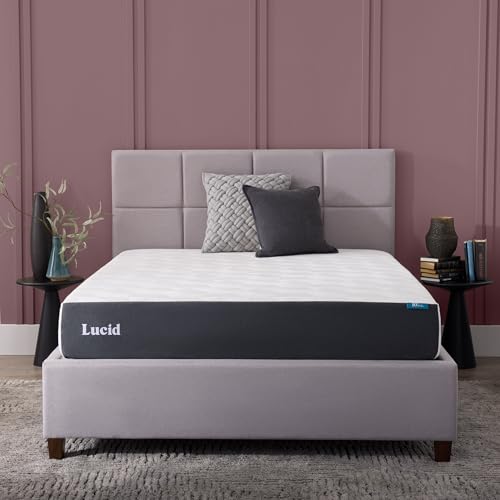
The Lucid 10 Inch Gel Memory Foam Mattress leads this guide on documented merit: its verified listing states compatibility with adjustable bases outright, and its construction is what compatibility engineers would design — three inches of gel memory foam over a 1.5-inch transition layer and a 5.5-inch high-density base, in a ten-inch profile that flexes at a hinge without the stiffness a taller stack resists with. The medium feel balances contour and support in both flat and inclined positions.
Strengths
- Adjustable-base compatibility stated in the verified listing
- Ten-inch layered profile bends cleanly at the base hinge
- Gel foam and bamboo charcoal keep inclined sleeping — warmer by nature — comfortable
Trade-offs
- Ten inches is a moderate depth for heavier sleepers in the flat position
- Medium feel may be soft for strict stomach sleepers
- Cooling gel moderates heat but cannot match coil airflow
| Color | White |
| Size | Queen |
| Dimensions | 79 x 59 x 10 inches |
| Weight | 57.9 pounds |
Inclined sleeping changes pressure geography, and the Lucid’s layering handles it well: raise the head and your weight shifts toward the pelvis, where the transition layer grades the load instead of letting you perch on the base foam; lift the knees and the gel comfort layer fills the lumbar curve that the position opens up. The listing also confirms the mattress works on platform and slatted frames with no box spring needed, so the same bed serves a household that upgrades its base later. It is CertiPUR-US certified, made in the USA with global and US parts, and backed by a 10-year limited warranty.
At 57.9 pounds, the Lucid is kind to base motors and to the people installing it — a queen one person can position carefully with a helper’s brief assist. On the base, use the retainer bar, expect a small amount of initial settling at the hinge, and rotate the mattress on schedule; rotation on an adjustable setup also evens the hinge zone’s extra flex wear.
For shoppers who want the compatibility question answered by the manufacturer rather than by hope, this is the guide’s clearest purchase.
Best for: adjustable-base owners who want documented compatibility and a flexible, cooling foam build / Not suited for: heavier sleepers needing a deeper support core
Choose the Lucid if you want the paperwork and the physics to agree. Skip it if you need maximum profile depth. Check on Amazon

Signature Design by Ashley Chime 12 Inch Hybrid Full Size Mattress
Our badge: Best Hybrid for Adjustable Bases
The Signature Design by Ashley Chime 12 Inch Hybrid proves a hybrid can bend: its support comes from individually wrapped coils — each in its own pocket, free to flex — rather than a connected spring unit, and the listing states adjustable-base compatibility explicitly. Over the coils sits a gel memory foam layer targeting the lower back, which is precisely the zone adjustable positions are usually purchased to help.
Strengths
- Pocketed coils flex independently — adjustable compatibility stated in the listing
- Lumbar gel layer pairs with knee-lift positions for lower back comfort
- Reinforced perimeter keeps edges honest even at an incline
Trade-offs
- Full size in this listing suits solo sleepers and smaller rooms
- Twelve inches of hybrid is heavier work for a base than the foam picks
- Medium-firm lean will not satisfy plush seekers
| Color | White |
| Size | Full |
| Dimensions | 74.4 x 53.3 x 12 inches |
| Weight | 62 pounds |
The hybrid difference at an incline is lift: coils keep supporting when the bed bends, where some foams compress into the hinge and thin out. The 13-gauge wrapped coils are a sturdy specification, the doubled perimeter rows keep the sitting edge — which becomes the getting-out edge at an incline — trustworthy, and pocketing keeps motion transfer low when a partner adjusts their side at a different angle on split setups. The listing describes a 180-night home trial and 10-year warranty, with CertiPUR-US certified foams.
For a solo sleeper building a reading-and-recovery bed in a smaller room, the Chime plus an adjustable base is a lot of ergonomic machinery in a full-size footprint. Confirm your base’s weight capacity for a 62-pound hybrid plus sleeper, and use the retainer system the base provides.
If you believed adjustable bases meant foam or nothing, the Chime is the correction — with the lumbar focus that makes the positions worth having.
Best for: solo sleepers who want hybrid support on an adjustable base, with lumbar focus / Not suited for: couples needing queen width
Choose the Chime if you want coils that bend. Skip it if you need maximum width. Check on Amazon

Serta Perfect Sleeper Ultimate 14.5″ Queen Mattress – Medium Pillow Top
Our badge: Best Premium
The Serta Perfect Sleeper Ultimate Pillow Top is the luxury end of adjustable comfort: a true medium pillow top over a zoned coil system, with adjustable frames listed among its compatible foundations in the verified materials. In a raised-head position — reading, watching, easing into sleep — the pillow top’s cushion becomes the comfort story, cradling shoulders that a flat foam surface leaves to fend for themselves against the incline.
Strengths
- Adjustable frames included in the listed compatible foundations
- Pillow-top cushion excels in raised-head positions
- Zoned coils and BestEdge encasement keep support and edges structured
Trade-offs
- At 14.5 inches, it is the tallest bend in this guide — confirm your base’s hinge behavior with tall mattresses
- At 82.26 pounds, the heaviest load for a base motor here
- Medium plush will feel soft for strict stomach sleepers in flat mode
| Color | Dark Blue |
| Size | Queen |
| Dimensions | 79.5 x 60 x 14.5 inches |
| Weight | 82.26 pounds |
The honest engineering note: height is the tax on this pick. A 14.5-inch mattress bends less willingly than a 10-inch one, and the hinge zone works harder; Serta’s listing of adjustable frames among compatible foundations is your assurance, and your base’s weight and profile guidance is the second check to run. In exchange, you get the guide’s most comfortable incline experience — Cool Twist gel foam inside the cushion for heat, zoned support at the lower back and hips, and an edge that stays put when the head of the bed is up and you are sitting against it.
The foams are CertiPUR-US certified, the trial runs 100 nights per the listing, with a 10-year limited warranty, and the mattress is made in the USA with global components. Compatibility also spans traditional frames, box springs, platforms, and slatted frames, so the mattress survives a future base change in either direction.
For the reader whose adjustable base is a lifestyle purchase — evenings spent reading in bed, mornings eased into — the Serta is the plush flagship that justifies the machinery.
Best for: adjustable-base owners who prioritize plush comfort in raised positions / Not suited for: bases with modest weight limits or low-profile requirements
Choose the Serta if your base is stout and your evenings are spent inclined. Skip it if your base is a lightweight model. Check on Amazon

Nectar 12” Memory Foam Mattress
Our badge: Best for Back Sleepers
The Nectar 12” Memory Foam Mattress is the back sleeper’s adjustable pick: firm-leaning contouring memory foam that fills the lumbar curve, over a dynamic support layer — a combination that makes the classic adjustable positions genuinely therapeutic-feeling. Knee lift on a supportive foam bed relaxes the lower back’s overnight tension; a gentle head raise takes pressure off the shoulders. The Nectar’s all-foam build is the flexible category bases are designed around; confirm the current listing’s compatibility note before pairing, as with any mattress-base marriage.
Strengths
- Contouring foam maximizes the benefit of knee-lift and lumbar positions
- Firm-leaning support keeps inclined postures aligned rather than hammock-like
- Cooling top layer helps, since inclined sleeping concentrates contact
Trade-offs
- Compatibility not stated in the pool data — verify on the current listing
- Seventy-eight pounds is real work for a base and for setup
- Slow foam response plus an incline makes position changes deliberate
| Color | White |
| Size | Queen |
| Dimensions | 80 x 60 x 12 inches |
| Weight | 78 pounds |
The trial terms make the experiment safe: the listing describes a one-year trial and forever warranty, the most patient arrangement in this guide, which suits a purchase whose value only reveals itself across weeks of position experiments. Motion isolation is excellent — a partner can keep their side flat while yours inclines on a split base, with minimal transfer through the foam. The cooling fabric on top keeps the surface composed where inclined contact concentrates warmth.
Twelve inches is at the deeper end of the flexible range; the Nectar bends willingly for foam of its depth, but check your base’s guidance on profile, and always use the retainer bar — firm foam on a smooth base deck will travel south over weeks of inclining without it.
For back-focused shoppers, the combination of this mattress’s lumbar contour and a base’s knee lift is the closest this guide gets to a system rather than a product.
Best for: back sleepers building a position-based comfort system on an adjustable base / Not suited for: shoppers who want compatibility stated without a listing check
Choose the Nectar if positions are your back strategy. Skip it if you need a lightweight mattress. Check on Amazon

Casper Sleep Original 11″ Memory Foam Queen Mattress
Our badge: Best for Combination Sleepers
The Casper Sleep Original brings zoning to the adjustable brief: firmer foam under the hips, waist, and lower back, softer at the shoulders, in an eleven-inch all-foam build. Zoning matters more, not less, when a bed bends — incline shifts your weight distribution, and a mattress whose support varies along its length adapts to the new distribution instead of treating you as a uniform load. Confirm the current listing’s compatibility note before pairing, as the pool data does not state it.
Strengths
- Zoned support stays anatomically sensible flat or inclined
- Eleven-inch foam profile flexes readily at the hinge
- Breathable open-cell foam and strong motion isolation suit couples
Trade-offs
- Compatibility not stated in the pool data — verify on the listing
- Medium-firm may under-support strict stomach sleepers in flat mode
- Foam edges compress, which an incline makes more noticeable when sitting up
| Color | Light Gray |
| Size | Queen |
| Dimensions | 80 x 60 x 11 inches |
Split-base couples are the Casper’s natural household: each side inclines independently, the foam absorbs the mechanical chatter of two motors on different schedules, and the zoning serves a back sleeper on one side and a side sleeper on the other without either surface being wrong. The listing includes a 100-night trial and 10-year limited warranty, with CertiPUR-US certified foams positioned against sinking and sagging — the firmer hip-zone foam doubling as hinge-zone durability, since the bend concentrates near the pelvis.
Rotate without flipping so the zones stay oriented; on an adjustable base, rotation also moves the hinge wear to the mattress’s other end across the years, a longevity trick worth the calendar reminder.
If your household’s positions — sleeping and mechanical — both vary, the Casper is the adaptable middle of this guide.
Best for: combination sleepers and split-base couples who want zoned foam / Not suited for: shoppers wanting stated compatibility without checking the listing
Choose the Casper if your nights involve several positions in every sense. Skip it if you want a coil hybrid’s lift. Check on Amazon

GhostBed Classic 11 Inch Queen Memory Foam Mattress
Our badge: Best Lightweight
The GhostBed Classic closes the guide with the specification base owners forget to check: weight. At 50 pounds, this queen is the lightest pick here by a wide margin, which means less work for the base’s motors on every adjustment, every day, for years — and a setup and rotation a careful solo sleeper can manage. Its high-density core supports spinal alignment while gel memory foam and aerated latex keep the feel responsive. Confirm the current listing’s compatibility note before pairing, as the pool data does not state it.
Strengths
- Fifty-pound queen — the kindest load for base motors and human backs alike
- Responsive latex blend flexes and recovers quickly at the hinge
- High-density core keeps inclined and flat postures aligned
Trade-offs
- Compatibility not stated in the pool data — verify on the listing
- Light build can migrate on a smooth base deck without a retainer and grip
- Firm-leaning feel may be assertive for petite side sleepers
| Color | White |
| Size | Queen |
| Dimensions | 80 x 60 x 11 inches |
| Weight | 50 pounds |
The motor argument deserves expansion, because it compounds. An adjustable base cycles its lift mechanism thousands of times across its life; every pound of mattress is lifted every time. A 50-pound mattress versus an 82-pound one is a third less work per cycle, which is the difference between a mechanism that ages gracefully and one that strains audibly by year three. If your base is a modest model, the GhostBed is not a compromise — it is the correct engineering match.
The feel suits the adjustable use case too: the aerated latex blend rebounds instantly when the base moves, so the surface never holds a crease from the previous position, and the medium-firm support serves back and stomach sleepers in flat mode. The mattress is CertiPUR-US certified and made in the USA and Canada.
Add a non-slip pad between mattress and base deck — light mattresses travel — and keep the retainer bar engaged.
Best for: owners of modest bases who want to protect the mechanism, and solo setup / Not suited for: shoppers wanting stated compatibility or deep plush
Choose the GhostBed if your base’s motor is the weakest link. Skip it if you want maximum contour. Check on Amazon
Comparison Table
| Pick | Compatibility status | Weight | Size listed | Profile | Check price on Amazon |
|---|---|---|---|---|---|
| Lucid Gel Memory Foam | Stated in listing | 57.9 pounds | Queen | 10 inches | Check price on Amazon |
| Ashley Chime Hybrid | Stated in listing | 62 pounds | Full | 12 inches | Check price on Amazon |
| Serta Perfect Sleeper | Adjustable frames listed | 82.26 pounds | Queen | 14.5 inches | Check price on Amazon |
| Nectar Memory Foam | Verify on listing | 78 pounds | Queen | 12 inches | Check price on Amazon |
| Casper Sleep Original | Verify on listing | Not listed | Queen | 11 inches | Check price on Amazon |
| GhostBed Classic | Verify on listing | 50 pounds | Queen | 11 inches | Check price on Amazon |
How to Choose the Best Mattress for an Adjustable Base
Start with the base’s specification sheet
Your base publishes a weight capacity and often a mattress profile range; those two numbers veto more candidates than any comfort preference. Add the mattress weight from our spec boxes to the sleepers’ weights and keep a margin — motors age, and a base at its limit from day one is a base complaining by year two. If your base is a split king, you are shopping for two twin XL mattresses and this guide’s guidance applies per side.
Prefer foam or pocketed coils — never connected springs
A connected innerspring unit is a single springy sheet that resists bending and can be damaged by it. Foam bends by nature; pocketed coils bend by independence. Every pick here is one or the other. If a candidate mattress cannot describe its spring system, assume it is connected and move on.
Keep the profile in the flexible band
Ten to twelve inches is the sweet spot for bending comfort and support depth. Below that, adult support thins; above it — the Serta’s 14.5 inches is the deliberate exception, bought for its plush — the hinge works harder and creasing risk rises. Match a tall mattress only to a base that welcomes it.
Plan the anti-migration system
Inclined mattresses walk toward the foot of the bed. Retainer bars, non-slip pads, and a fitted sheet system that grips are the countermeasures; budget them with the mattress rather than discovering the migration a month in. While you are outfitting the bed, bedding events like Black Friday Bedding Deals 2026 and restful extras such as Best Throw Pillows Under $500 can complete the inclined-reading setup in the same order.
Buy the positions, not the gadget
List the positions you will actually use weekly — knee lift, reading incline, a slight head raise for snoring — and choose the mattress whose comfort story serves those positions, as the reviews above map them. A base used nightly justifies a premium mattress; a base used for a month of novelty justifies the Lucid’s value.
How Should You Set Up and Use an Adjustable Bed Well?
Setup is a two-person job with a sequence: base assembled and tested empty, mattress placed and centered, retainer bar engaged, then a full range-of-motion test with nobody on the bed — watch the hinge zone for creasing, listen for the motor’s strain, and confirm the mattress returns to flat without a ridge. Expand foam fully before this test; a half-expanded mattress bends dishonestly. Fit bedding that tolerates movement: deep-pocket or strapped sheets, and a protector with stretch.
In use, raise and lower in stages rather than full-range slams, and return the bed to flat for the majority of sleep hours unless a position is your prescription — mattresses age best flat, and most sleepers do too. Rotate the mattress seasonally to distribute hinge wear, and re-center it monthly; migration is slow and cumulative. Keep the remote reachable from the bed’s most-used position, because a control you cannot find at 3 a.m. is a position you will not use. Flat-platform households can compare notes with our Best Mattresses For Sleeper Sofas guidance on occasional-bed setups.
Problem: the mattress creeps toward the foot of the bed — engage the retainer bar, add a non-slip pad under the mattress, and check that the base deck is clean and dry.
Problem: a crease or lump forms at the hinge — flatten the bed for a full day, rotate the mattress 180 degrees, and confirm the profile is within the base’s stated range.
Problem: the motor strains or slows — total the load honestly; if mattress plus sleepers approach capacity, a lighter pick like the GhostBed is the engineering fix.
Problem: you slide down when the head is raised — raise the knees slightly as well; the knee break is the body’s seatbelt on an incline.
Problem: sheets pop off when the bed bends — switch to deep-pocket sheets with corner straps rated for adjustable use.
The Positions, Honestly Appraised
Marketing names positions like constellations; your body cares about three. Knee elevation while back sleeping relaxes lumbar tension for many people and is the position with the strongest comfort consensus — it is why the lumbar-focused picks lead this guide’s recommendations for back sleepers. A modest head elevation serves readers, snorers, and reflux-prone sleepers, and turns the bed into the household’s best chair. Full upright sitting is the position to use sparingly: it concentrates your weight on the hinge zone and your pelvis, and no mattress makes an hour of it kind. The zero-gravity preset — head and knees both modestly raised — is a reasonable default worth testing during any trial, because it distributes weight more evenly than flat for many bodies. Experiment during the trial window with a morning log; positions, like firmness, are personal data, not brochure copy.
A word about pillows on an incline, because the mattress gets blamed for the pillow’s geometry. When the head of the bed rises, your pillow’s job changes: too thick a pillow on an incline pushes the head into flexion and manufactures the neck ache you then attribute to the mattress. Most inclined sleepers need a thinner pillow than their flat setup, or none for the reading hour and a modest one for sleep. Tune the pillow after the base arrives, not before, and expect the answer to differ between your reading angle and your sleeping angle. Side sleepers on an incline need the opposite vigilance — the raised head section changes the shoulder’s angle, and a slightly firmer pillow often restores the line.
And a word about time: adjustable positions earn their keep cumulatively, in ten-to-thirty-minute doses of relief distributed across evenings and nights, not in heroic all-night inclines. The households that love their bases in year three are the ones that use them as instruments — a knee lift here, a reading hour there — rather than as a permanent posture. Buy the mattress that serves those doses comfortably, and the base stops being a gadget and becomes the bedroom’s most-used machine.
Adjustable Bases and the Rest of the Household
A base changes a bedroom’s social geometry. Split kings let two sleepers inhabit different angles in one bed — one reading upright, one flat asleep — which is a genuine marital technology, and the reason split-compatible foam picks like the Casper earn their place here. Children and pets treat a moving bed as an amusement ride; most bases have lockouts and all deserve supervision, and the mattress’s weight and the base’s pinch points are adult considerations, not fine print. Guests need a one-sentence orientation or they will sleep flat on a machine built to pamper them. And the bed becomes furniture with a power cord: plan the outlet, the surge protection, and the cord path with the same care as the mattress choice, because a base unplugged by a vacuum cleaner is a flat bed with a remote-shaped regret.
There is also a resale-and-rearrangement reality to acknowledge: adjustable bases commit a room. They are heavy, they dislike stairs, and they outlast several mattresses, which means the mattress you choose today is the first of several that must satisfy the same base’s specifications. That argues for learning your base’s numbers — capacity, profile guidance, deck dimensions — the way you learn your own shoe size, because every future mattress purchase in that room will be filtered through them. It also argues for the mainstream sizes and mainstream constructions in this guide, whose replacements will be easy to find in five years when the current mattress retires and the base is still going strong.
Finally, if the base is new and the mattress is the second purchase, sequence the trials intelligently: most bases have shorter return windows than the mattresses in this guide. Sleep on the combination from the first night the mattress is fully expanded, log the positions as diligently as the mornings, and make the base’s keep-or-return decision inside its own window with real data — not in the mattress’s more leisurely one.
Adjustable-bed ownership adds one maintenance habit flat-bed owners never learn: exercise the range. A mattress that lives at one angle for months takes a set at that hinge, and its foam learns the bend as a permanent crease rather than a visited position. Run the base through its full articulation weekly — head up, feet up, flat — and let the mattress rest flat for a few hours regularly, and the materials keep treating flexion as an event instead of a posture. The habit costs four minutes and preserves exactly the property you bought the mattress for.
Bedding for an articulated bed is its own small discipline, and it rewards the same foresight: deep-pocket or strap-secured sheets that survive the head’s rise without popping a corner, a protector with enough flex to follow the hinge, and pillows chosen for propped reading as well as flat sleeping. Households that solve the bedding in the same purchase as the mattress start enjoying the base immediately; households that defer it spend the first month fighting corners at midnight, and blame the bed for a sheet problem. The picks in this guide flex as designed — dress them so the whole system can.
Common Buying Mistakes
Pairing a connected-coil mattress with a bending base
The spring unit resists, creases, and can be damaged — and the warranty argument afterward helps nobody. Foam or pocketed coils only.
Ignoring the base’s weight capacity
Mattress plus sleepers is the load, and motors keep receipts. Total it honestly and keep a margin.
Skipping the retainer system
An inclined mattress migrates. Bars and grip pads are part of the purchase, not accessories.
Buying maximum height for a bending bed
Tall mattresses bend reluctantly. The flexible band exists for a reason; exceed it only with the base’s blessing.
Never returning to flat
Sleeping fully inclined by default ages the hinge zone and your posture assumptions. Use positions deliberately; rest flat by default.
Verification deserves its own paragraph in this category, because compatibility claims are where adjustable shoppers get hurt. For the picks whose makers state compatibility in their listing materials, the statement is recorded in each review; for every other pick — and for any mattress you consider outside this guide — confirm compatibility on the current listing or with the maker before the base and mattress are married, and keep that confirmation with your purchase records. A mattress returned for incompatibility is a hassle; a mattress whose warranty was voided by an unapproved base is a loss. The thirty seconds of verification is the cheapest insurance in this entire category, and this guide’s structure — documented picks first, verify-the-rest instructions everywhere else — is built around that asymmetry.
Adjustable households should also think about who else the bed serves across a decade, because the base outlasts mattresses and the pairing will be re-decided. A mattress chosen for a reading-and-reflux season may next serve a recovery from surgery, a pregnancy, a partner’s new snore-driven elevation habit, or simply the household’s discovery that zero-gravity evenings are the best seat in the house. Flexibility documented in a listing — the Lucid’s and Ashley’s stated compatibility, the Serta’s listed frame compatibility — is therefore worth more than the same words on a flat-bed mattress: it is permission for the bed’s whole future, not just its first assignment. Buy the mattress whose paperwork lets the base live its full life.
And a word on sequencing the purchase when the base is not yet owned: mattress first, on the flat, judged by the three-week trial in its unarticulated state; base second, added to a surface already proven. Households that buy both simultaneously cannot tell which half of the system owns a disappointment, and end up returning the innocent party. The picks in this guide all sleep honestly flat — the articulation is their second talent — so the sequence costs nothing and buys clean evidence.
Caregivers form a distinct readership for this keyword, and their needs deserve explicit acknowledgment: a mattress that articulates serves the person in the bed, but it also serves the person helping them — raising a back for medication, elevating legs for circulation comfort, bringing a sleeper to a sitting position from which standing is possible. For those households, the mattress’s flexibility is not a lifestyle feature but a care tool, and the documented-compatibility picks in this guide are the ones whose makers have contemplated that duty in print. Choose them with the care plan in view, confirm the pairing with the base maker as well, and treat the bed as the piece of home equipment it has become.
One more adjustable-bed habit separates the delighted from the disappointed: program the positions. Modern bases remember presets, and the household that sets its reading angle, its zero-gravity point, and its flat reset in the first week stops negotiating with the remote nightly. The mattress experiences consistent, intended articulation rather than random hunting, the sleepers find their angles by muscle memory, and the bed becomes furniture with habits instead of a gadget with settings. The picks in this guide flex for exactly that domesticated use — thousands of calm, repeated bends — and they will reward the household that treats articulation as a routine rather than a novelty.
Adjustable-bed shoppers should also weigh the mattress’s behavior in the flat position with fresh honesty, because even the most devoted articulator sleeps flat for part of the night and all of some nights — when the remote’s battery dies, when a partner vetoes elevation, when travel reminds the body what flat feels like. A mattress that only justifies itself at an angle is a part-time bed. Every finalist in this guide was required to sleep honestly at zero degrees first; the articulation is the bonus the base adds, not a crutch the mattress leans on. Judge flat first, elevate second, and the pairing will satisfy in both geometries.
And a practical word about the delivery choreography, which adjustable households get wrong more than any other: the base and mattress should arrive as a planned pair, with the room cleared, the old bed’s exit arranged, and an afternoon reserved for setup and the first articulation test. A mattress flexed for the first time at midnight by an exhausted owner gets judged by that midnight. Give the system its afternoon, run every preset, sleep the first night flat — and let the elevation experiments begin on day two, on evidence.
Judge the pairing, finally, as a pair: the right mattress on the right base, verified in writing, trialed in sequence, and maintained as a system. That discipline — not any single specification — is what the households who love their adjustable beds all share.
Final Recommendation
For most adjustable-base owners, the Lucid 10 Inch Gel Memory Foam Mattress is the safest complete answer: compatibility stated by the maker, a flexible ten-inch build, cooling for inclined contact, and a weight bases appreciate. Hybrid loyalists should take the Ashley Chime, plush readers the Serta, and back-focused sleepers the runner-up — Check on Amazon for the Nectar 12” Memory Foam Mattress and its lumbar contouring. Whichever you choose, run the empty range-of-motion test on day one, engage the retainer, log two weeks of mornings in your favorite positions, and let that data — not the showroom constellation names — decide.
Frequently Asked Questions
What type of mattress works best on an adjustable base?
Memory foam and latex-style foam bend most naturally, and pocketed-coil hybrids bend well because each coil moves independently. Avoid connected innerspring units and very rigid, extra-tall builds unless the maker states compatibility.
How thick should a mattress for an adjustable base be?
Roughly 10 to 12 inches balances flexibility and adult support. Taller mattresses can work when the maker lists adjustable compatibility, as the Serta does here, but they bend less willingly and load the base more.
Will an adjustable base damage my mattress?
A compatible mattress on a correctly rated base should not be damaged by normal use. Damage risk comes from mismatches: connected coils, excessive weight, or profiles beyond the base’s guidance. Confirm both listings’ notes.
Why does my mattress slide on the adjustable base?
Inclining creates a downhill, and smooth decks offer little grip. A retainer bar plus a non-slip pad under the mattress is the standard, effective fix.
Is a hybrid okay on an adjustable base?
Yes, when the coils are pocketed or wrapped rather than connected — the Ashley Chime in this guide states adjustable compatibility outright. The coil core keeps supporting at an incline where some foams thin out.
What position helps lower back comfort most?
For many back sleepers, a slight knee elevation with the head low — the essence of the zero-gravity preset — relaxes lumbar tension best. Test it during your trial with a morning log rather than trusting presets.


