Disclosure: As an Amazon Associate, dailyhomedecorating.com earns from qualifying purchases. Links to Amazon on this page are affiliate links; they cost you nothing extra. Prices and availability change often, so check the current Amazon listing before you buy.
Owners searching for the best vacuum for wool rugs are usually protecting an investment, because wool is the fiber area rugs were judged by for centuries — resilient, warm, naturally stain-shedding — and also the fiber most easily ruined by enthusiastic cleaning. The best vacuum for wool rugs is not the most powerful machine you can buy; it is the gentlest effective one, used with settings and a rhythm that respect how wool is built. Aggressive brush rolls fuzz wool’s surface, tear at its fibers, and shorten the life of a rug that should have lasted decades.
This guide gives wool owners the complete care picture: the settings that matter, the technique that cleans without fuzzing, the shedding timeline that is normal and the one that is not, and — because many wool owners also furnish traffic rooms where wool should not be asked to serve — six verified rugs whose makers specify the same gentle, suction-led care wool demands, for the rooms where practicality outranks prestige. For the general rug-vacuuming framework, see Best Vacuum For Rugs; for the fiber comparison behind these choices, Best Material For Rugs lays out the full landscape.
Where to Buy
Every rug in this guide is sold on Amazon, where you can check the current price and availability and confirm care specifications on the listing before you buy. Start with our top pick, the SAFAVIEH Area Rug 8×10 – Adirondack Collection – Ivory & Sage — Check on Amazon. The other five are the Loloi Layla (Check on Amazon), the Loloi Loren (Check on Amazon), the Unique Loom Sofia (Check on Amazon), the nuLOOM Blythe 5×7 (Check on Amazon), and the Lahome Insect 5×7 (Check on Amazon). None of these is wool — this guide says so plainly — each is here because its specified care matches the gentle regime wool requires, for rooms where you want that regime without wool’s price or fragility.
In this guide
Quick Picks
| Pick | Badge | Why it earns its place |
|---|---|---|
| SAFAVIEH Area Rug 8×10 – Adirondack Collection – Ivory & Sage | Best Overall | Maker-specified for vacuuming without a beater bar — the wool protocol, written into a synthetic rug. |
| Loloi Layla Olive/Charcoal 7′-6″ x 9′-6″ Area Rug | Best Gentle Surface | A printed flat pile that cleans completely with suction alone, at the lightest touch. |
| Loloi Loren Terracotta/Sky 8′-4″ x 11′-6″ Area Rug | Best Large | Printed low profile at near-8×12, for big rooms that want wool’s calm without wool’s care bill. |
| Unique Loom Sofia Collection Area Rug – Salle Garnier (7′ 1″ x 10′) | Best Traditional | Classic looks with a quarter-inch pile that tolerates careful, wool-style vacuuming. |
| nuLOOM 5×7 Moroccan Blythe Area Rug | Best Compact | Light enough for the two-sided gentle routine wool owners know by heart. |
| Lahome Insect 5×7 Area Rugs | Best Washable | For the rooms wool should never enter: thin, gripping, and machine washable. |
Key Takeaways
- Wool wants suction without aggression: brush roll off or at its gentlest, always, no exceptions for “just this once.”
- Early shedding is wool being wool; a full bin in the first weeks is normal, and panic is not a care method.
- Slow passes and clean filters matter more on wool than raw power, because wool releases dirt to patience, not force.
- Vacuum both sides and the floor beneath on a rhythm; grit at the backing is wool’s silent enemy.
- Keep wool out of the highest-abuse zones and let gentle-care synthetics — the picks here — carry those rooms.
- For machine comparisons across rug types, see Best Vacuums For Rugs.
How These Picks Were Chosen
Our verified pool contains no wool rugs, and this guide does not pretend otherwise. The picks were chosen by a single honest criterion: their makers’ specified care matches the gentle regime wool demands — suction-led vacuuming, low profiles that need no aggressive agitation, and constructions that stay calm under a careful hand. They are recommended for the rooms around your wool: the traffic lanes, pet zones, and family spaces where a wool rug would be spent rather than enjoyed. The wool guidance itself — settings, shedding, technique — is standard category knowledge for the fiber, stated as guidance, and your own rug’s care label always outranks it.
The 6 Best Best Vacuum for Wool Rugs — Reviewed

SAFAVIEH Area Rug 8×10 – Adirondack Collection – Ivory & Sage
Our badge: Best Overall
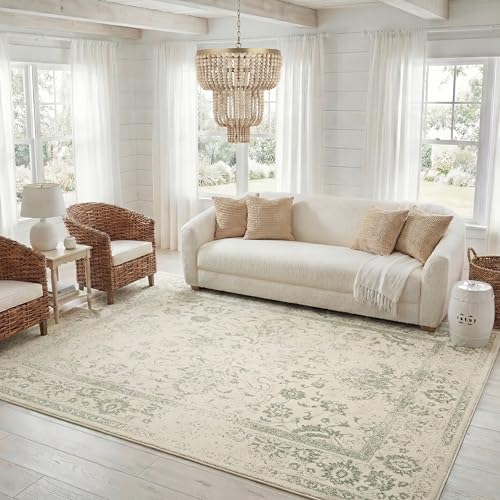
The SAFAVIEH Area Rug 8×10 – Adirondack Collection – Ivory & Sage leads this list because its maker writes the wool protocol into a synthetic rug’s care label: vacuum without a beater bar. Its smooth, low polypropylene pile cleans completely on suction alone, which makes it the perfect training ground for the gentle technique — and the perfect stand-in for wool in rooms where traffic would punish the real thing.
Strengths
- Explicit suction-only care that mirrors wool’s requirements exactly.
- Dense low pile releases dirt without agitation.
- Virtually non-shedding, unlike the wool it substitutes for.
Trade-offs
- Synthetic hand; it will not fool a wool lover’s bare feet.
- Not washable; deep cleans are careful affairs.
- Light palette demands prompt blotting.
| Color | Ivory/Sage |
| Size | 8′ x 10′ (Rectangular) |
| Dimensions | 120 x 96 x 0.38 inches |
| Weight | 6.61 pounds |
Practicing wool technique on the Adirondack is genuinely instructive: slow passes, a third overlap, a second direction on lanes, edges finished by hand tool. Owners who learn the rhythm here often discover their wool rug, cleaned the same way, was never under-cleaned — it was over-brushed, and its fuzzed surface was the machine’s signature, not the dirt’s. The Adirondack’s distressed pattern adds the forgiveness wool owners wish their pale rugs had, hiding the interval between sessions with more grace than any solid. There is also a confidence dividend: owners nervous about practicing on wool — afraid of the first session on an expensive rug — can rehearse the entire protocol here, where the stakes are forgiving and the feedback is visible, until the rhythm is in their hands. Skills learned on the substitute transfer intact to the heirloom, which is how the best care habits are always built: practiced where mistakes are cheap, performed where they are not.
Best for: Traffic rooms beside your wool, and anyone learning gentle vacuuming / Not suited for: Buyers who specifically want natural fiber
Choose the Adirondack for wool-style care without wool’s stakes; skip it if only the real fiber will do. Check on Amazon

Loloi Layla Olive/Charcoal 7′-6″ x 9′-6″ Area Rug
Our badge: Best Gentle Surface
The Loloi Layla Olive/Charcoal 7′-6″ x 9′-6″ Area Rug is the lightest-touch large rug in the pool: a printed design on a pile of about an eighth of an inch, which suction cleans completely because there is nowhere for dirt to hide and nothing for a brush to damage. For wool owners, it is the answer for the room where the vacuum must be fast, frequent, and incapable of harm.
Strengths
- Printed surface cleans fully on suction alone.
- Non-shedding construction; the bin fills with dirt, not fiber.
- Light enough for effortless two-sided cleaning.
Trade-offs
- Flat feel; no pile luxury.
- Pad needed for grip and cushion.
- Spot-clean care only.
| Color | Olive / Charcoal |
| Size | 7’6″ x 9’6″ (Rectangular) |
| Dimensions | 114 x 90 x 0.13 inches |
| Weight | 6.61 pounds |
There is a philosophical comfort in pairing the Layla with a wool rug in the same home: the wool gets ceremony, the Layla gets throughput, and the household stops applying one standard to two different textiles. Its vintage olive-charcoal patterning also coordinates naturally with the traditional rooms wool usually anchors, so the substitution never looks like one. Dining rooms and hallways — wool’s two most dangerous assignments — are where this pick earns its keep. The dining room in particular makes the case: chairs scrape, crumbs fall daily, and the vacuum runs there more often than anywhere else in the house, which on wool would mean the most-handled rug is also the most fragile one. On the Layla, that frequency is free. The hallway argument is simpler still: it is the house’s grit motorway, and every pass of the vacuum there is a pass the wool in the sitting room never has to survive.
Best for: High-frequency vacuuming zones in wool-owning homes / Not suited for: Comfort-first floors
Choose the Layla for effortless gentle cleaning; skip it for plushness. Check on Amazon
Loloi Loren Terracotta/Sky 8′-4″ x 11′-6″ Area Rug
Our badge: Best Large
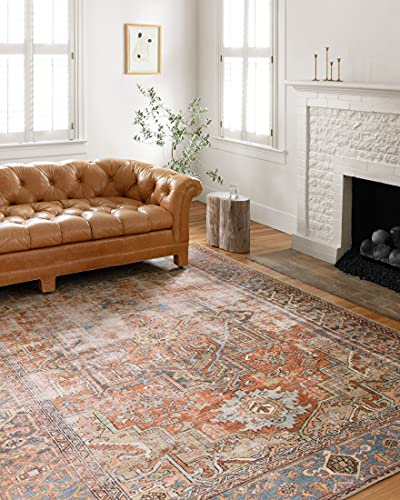
The Loloi Loren Terracotta/Sky 8′-4″ x 11′-6″ Area Rug extends the printed, gentle-care formula to near-8×12: a machine-made polyester design with cotton backing, a low profile that suction handles across a big footprint, and a vintage terracotta-and-sky palette that gives large, traditional rooms the composed look wool usually provides — at a care cost wool never matches.
Strengths
- Large-format coverage with a low, suction-friendly profile.
- Printed construction means no pile to fuzz or shed.
- Cotton backing gives a traditional, settled lay.
Trade-offs
- Pad recommended and not included.
- Printed texture reads flat up close.
- Too large for modest rooms.
| Color | Terracotta / Sky |
| Size | 8’4″ x 11’6″ (Rectangular) |
| Dimensions | 138 x 100 x 0.25 inches |
| Weight | 6.61 pounds |
Large wool rugs are where vacuuming mistakes get expensive, because the area multiplies both the dirt and the damage a wrong setting can do in a single session. The Loren removes that anxiety from the biggest room in the house: vacuum it slowly on suction, let the print forgive the week, and save your vigilance for the wool in the quiet room it belongs in. The maker notes temporary creases on arrival and recommends padding for comfort, longevity, and floor protection — the standard, honest large-rug counsel. The pad deserves a wool owner’s attention for a second reason: on a rug this size, a good pad is what keeps the vacuum’s passes from walking the rug across the floor, and a rug that stays planted gets cleaned in calm, even lanes instead of in a wrestling match of adjustments. Plant the Loren once, properly, and its weekly session becomes the most peaceful large-rug vacuum in the house — which, in a home calibrated to wool’s tempo, is exactly the standard every room should meet.
Best for: Large formal rooms that want wool’s composure without its care / Not suited for: Small rooms or texture seekers
Choose the Loren for gentle care at scale; skip it if the room is compact. Check on Amazon

Unique Loom Sofia Collection Area Rug – Salle Garnier (7′ 1″ x 10′)
Our badge: Best Traditional
The Unique Loom Sofia Collection Area Rug – Salle Garnier (7′ 1″ x 10′) is the pick for wool owners whose other rooms still want a traditional face: a French-inspired pattern on a quarter-inch polypropylene pile with a jute backing. It tolerates the careful, unhurried vacuuming wool teaches — moderate settings, no violence — and rewards it with a settled, inherited look.
Strengths
- Low pile responds well to gentle, methodical vacuuming.
- Jute backing keeps the rug planted during passes.
- Classic patterning suits the traditional rooms wool anchors.
Trade-offs
- Keep wet cleaning rare; the backing dislikes soaking.
- Spot-clean care for stains.
- Formal motif in casual rooms can feel dressed up.
| Color | Beige/Ivory |
| Size | 7’1″ x 10′ (Rectangular) |
| Dimensions | 120 x 85 x 0.25 inches |
| Weight | 15.17 pounds |
The Sofia’s maker allows a carefully used carpet cleaner, dried immediately and evenly — a tolerance wool itself should never be granted at home, and a useful reminder of the hierarchy this guide teaches: know each rug’s permissions individually, and never let the most tolerant rug in the house set the household’s habits for the least tolerant one. Vacuumed gently and kept dry at the backing, the Sofia will hold a traditional room together for years while the wool rests in its sanctuary. Its quarter-inch pile is also a useful teaching surface for the household’s other vacuum operators — the height at which a floating head should ride, the pace at which passes should travel — because it shows streaks when rushed and glows when handled at the wool tempo. A rug that trains the household in gentleness, while asking little for itself, is earning more than its floor space.
Best for: Traditional secondary rooms in wool-owning homes / Not suited for: Wet-cleaning enthusiasts
Choose the Sofia for classic looks with calm care; skip it for washable convenience. Check on Amazon

nuLOOM 5×7 Moroccan Blythe Area Rug
Our badge: Best Compact
The nuLOOM 5×7 Moroccan Blythe Area Rug brings the wool routine — flip it, vacuum both sides, vacuum the floor, replace it — within everyone’s reach, because at 5×7 and eight pounds the full ceremony takes minutes. Its power-loomed polypropylene pile is sleek and durable, and its faded trellis hides the week gracefully.
Strengths
- Light enough for the complete two-sided gentle routine.
- Stain-resistant, durable construction for real rooms.
- Forgiving faded pattern between sessions.
Trade-offs
- Compact coverage only.
- Pad advisable against vacuum creep.
- Grey palette will not suit every scheme.
| Color | Blythe Grey |
| Size | 5′ x 7’5″ (Rectangular) |
| Dimensions | 84 x 60 inches |
| Weight | 8 pounds |
Wool owners know the two-sided routine is where rugs are saved, because the backing side is where grit retires to cut fibers in peace. Most large rugs make that routine aspirational; the Blythe makes it Tuesday. In a study, bedroom, or apartment living space, it delivers the discipline’s full benefit at a size that never argues back — and its synthetic build forgives the occasional forgotten setting change that would mark a wool rug permanently. That forgiveness has a training value of its own: households building the gentle habit need reps, and reps require a surface that tolerates the learning curve. Master the flip, the slow lanes, the edge work on the Blythe across a season, and the wool rug’s sessions stop feeling like defusing something and start feeling like what they are — the same calm routine, performed on a more precious floor.
Best for: Small rooms where the full gentle routine must be realistic / Not suited for: Large seating areas
Choose the Blythe for manageable, thorough care; skip it for big rooms. Check on Amazon

Lahome Insect 5×7 Area Rugs
Our badge: Best Washable
The Lahome Insect 5×7 Area Rugs guard the rooms wool must never enter — the pet’s corner, the kids’ splash zone, the mudroom’s inner door — with the opposite philosophy: ultra-thin, non-slip, and machine washable, so the dirt wool would have absorbed and kept is simply laundered away. Its daily vacuuming is the gentlest in this list, because the pile offers nothing to fight.
Strengths
- Machine washable reset for the highest-mess zones.
- Gripping TPE backing; the vacuum never chases it.
- Ultra-thin pile traps almost nothing below the surface.
Trade-offs
- Thin, minimal cushion.
- Bold pattern is a specific taste.
- Creases on arrival need patience.
| Color | Green |
| Size | 5′ x 7′ (Rectangular) |
| Dimensions | 84 x 60 x 0.19 inches |
Every wool rug survives longer in a house with sacrificial textiles at its borders, and the Lahome is the border guard: it takes the mud, the accidents, and the daily grit that would otherwise migrate toward the good rooms. Vacuum it in seconds, wash it when it has earned it, and let the wool live the quiet life it was woven for. That division of labor — ceremony in the calm rooms, laundry in the wild ones — is the real answer this keyword is looking for. It also reframes the budget conversation honestly: the money a household does not spend replacing a wool rug sacrificed to the mudroom buys a great deal of sacrificial textile, and the Lahome’s whole working life costs less than a single professional rescue of a wool rug that was asked to guard a door. Protection by substitution is not a compromise of the wool ideal; it is how the ideal survives contact with a real household.
Best for: Pet, kid, and entry zones in wool-owning homes / Not suited for: Comfort-led rooms
Choose the Lahome to protect your wool by substitution; skip it as a centerpiece. Check on Amazon
Comparison Table
| Pick | Size | Profile | Gentle-care credential | Check price on Amazon |
|---|---|---|---|---|
| SAFAVIEH Adirondack | 8′ x 10′ | 3/8″ low pile | Maker-specified no beater bar | Check price on Amazon |
| Loloi Layla | 7’6″ x 9’6″ | Printed flat | Suction-only completeness | Check price on Amazon |
| Loloi Loren | 8’4″ x 11’6″ | Printed low | Gentle care at large scale | Check price on Amazon |
| Unique Loom Sofia | 7’1″ x 10′ | 0.25″ pile | Tolerates careful routine | Check price on Amazon |
| nuLOOM Blythe | 5′ x 7’5″ | Medium sleek | Two-sided routine, easily | Check price on Amazon |
| Lahome Insect | 5′ x 7′ | 0.19″ thin | Washable wool-substitute zones | Check price on Amazon |
How to Choose the Best Vacuum Settings for Wool Rugs
Suction yes, agitation no
Wool’s fibers are scaly and resilient, and they release dirt to steady suction while resenting mechanical beating. The brush roll — especially a stiff, carpet-height one — raises wool’s surface into fuzz, pulls fibers loose, and over months can thin a pile that should have outlived its owner. The correct default is brush roll off, or a dedicated hard-floor or delicate head, with height set so the head floats at the pile’s surface rather than plowing it. If your machine cannot disable its brush, it is not the right machine for your wool, whatever its other virtues.
Let pace replace power
Wool cleans by dwell time: slow passes, roughly a foot per second, overlapped by a third, with traffic lanes taken in two directions. This feels unhurried because it is, and it works because wool’s dirt sits in a resilient pile that yields to sustained airflow rather than impact. Doubling your pace halves your result and tempts you toward the aggressive settings that do the damage — the gentlest-looking variable in the system is actually the controlling one. There is a simple test for whether your pace is right: on the final pass, the surface behind the head should look uniformly settled, with no streaks of raised pile or trails of disturbed fiber. Streaks mean the head is plowing; trails mean it is dragging debris rather than lifting it. Both correct with the same prescription — slower, lighter, and with the height raised a notch — and once your hands learn the tempo on one rug, they will keep it on every rug, which is the quiet mechanism by which a wool rug improves the care of an entire house.
Mind the edges, fringe, and backing
Never run a powered head over fringe; it tangles, tears, and can pull stitching. Comb fringe by hand or use a hand tool beside it. Vacuum edges at a shallow angle so the head does not catch and fold them. And keep the flip rhythm: wool’s backing side accumulates the grit that abrades fibers from beneath, so vacuum the underside and the floor beneath monthly at minimum, weekly in traffic rooms, with the rug handled — never dragged — in between. Edges deserve one more habit: inspect them as you finish each session, because fraying caught at the first loose thread is a five-minute binding repair, while fraying discovered at the unraveled corner is a restoration. The vacuum session is also the inspection session, and owners who look while they clean are the ones whose wool rugs reach their second decade looking deliberate rather than lucky.
Respect the shedding calendar
New wool sheds loose fiber for weeks to months; the bin will fill with fluff that looks alarming and is, within that window, the rug settling rather than failing. Vacuum gently and often during the window, never escalating to aggressive settings to “finish” the shedding, which manufactures more. Shedding that accelerates after the early period, or arrives with thinning patches, is a different signal — that is wear or a setting problem, and the answer is gentler care and, if it persists, professional advice. A useful household rule during the window: judge the rug by its surface, not by the bin. If the face looks even and the lanes are not thinning, the fluff in the bin is the past leaving, not the future. Owners who empty the bin without commentary, week after week, arrive at the settled rug with their confidence intact — and confidence, with wool, is half the care system, because the other half is simply showing up gently, on schedule, for years, with the same calm settings in every single session, season after season, without exception or improvisation of any kind at all, ever, on any rug in the house.
How Often Should You Vacuum a Wool Rug?
Weekly in calm rooms, twice weekly where feet and paws concentrate, always gently. The session itself is short because wool, vacuumed on schedule, never accumulates the deep load that makes cleaning heroic. Technique, in order: clear the room’s edges, vacuum the surrounding floor so grit is not tracked on, work the rug slowly in one direction, repeat the lanes crosswise, finish the perimeter with a hand tool, and leave fringe to a comb. Monthly, add the flip. Seasonally, consider professional cleaning rather than any home wet method, because wool and water at home are a negotiation wool usually wins by shrinking, felting, or bleeding dye.
Problem: The wool surface looks fuzzy and tired. — The brush roll has been raising the pile. Switch to suction-only, slow down, and let several gentle sessions re-settle the surface; do not shave or trim a fuzzed rug without professional advice.
Problem: The bin fills with fiber every session, months after purchase. — Check settings first; persistent heavy shedding beyond the settling window usually traces to agitation. Go gentler, and if it continues, have the rug assessed.
Problem: Moth signs in a stored or quiet corner. — Wool out of traffic needs attention: vacuum thoroughly including the underside, air the rug, and treat storage as a cleaning event, not an afterthought. Prevention is the rhythm itself.
Problem: A traffic lane looks darker despite vacuuming. — Grit is at the backing. Do the full flip routine, slow the passes, and shorten the interval; lanes are a schedule diagnosis, not a power diagnosis.
Wool and Water: Why the Vacuum Is Wool’s Main Cleaner
Unlike the synthetics in this list, wool treats home wet cleaning as a hazard class: it can felt under agitation and heat, shrink unevenly, bleed dyes, and hold moisture long enough to sour. That is precisely why vacuuming carries more of wool’s care burden than any other fiber’s — the dry method is not the preliminary, it is the main event, with professional cleaning as the periodic deep chapter. Spot care on wool means blotting with cool water and the mildest wool-appropriate approach, tested hidden, and patience everywhere. Owners who internalize that hierarchy — dry first, dry mostly, professionals for the rest — keep wool rugs for the decades the fiber promises; the deep-pile technique in Best Vacuum For Shag Rugs makes an instructive contrast, since shag’s problem is depth while wool’s is delicacy.
The Mixed-Fiber Household: One Vacuum, Many Rugs
Few homes are wool-only, and the practical skill is switching the machine’s manners as you cross the house: suction-only ceremony on the wool, everyday settings on the synthetics, wash days for the washables. Write the per-rug settings on a card in the vacuum closet; shared households run on written systems, not on one person’s memory. The picks in this guide were chosen to make that card short — every one of them thrives on the same gentle settings as your wool, so a house furnished this way can be vacuumed in a single, calm pass of the dial. That, in the end, is the best vacuum for wool rugs: not a model number, but a household standard of gentleness that the wool sets and every other rug happily obeys. The extraction questions that remain belong to Best Carpet Cleaning Vacuums, where wool’s answer is mostly “professionals only.”
Common Buying Mistakes
Buying maximum suction for wool
Power is not the variable; agitation is the danger. The better move is adjustable, gentle, brush-controllable cleaning.
Vacuuming wool like rental carpet
Fast, aggressive passes fuzz and thin the pile. The better move is slow, suction-led, and scheduled.
Panic-buying settings during the shedding window
Escalating aggression manufactures more shedding. The better move is gentle frequency until the rug settles.
Running the head over fringe
Fringe tangles and tears under powered heads. The better move is hand tools and a comb, every time.
Asking wool to serve the wild rooms
Pet zones and mudrooms spend wool’s life on the wrong enemies. The better move is gentle-care synthetics there, wool in the calm rooms.
Final Recommendation
For your wool itself: suction-only, slow, scheduled, with the brush roll retired — and for the rooms around it, start with the SAFAVIEH Area Rug 8×10 – Adirondack Collection – Ivory & Sage, whose maker-specified no-beater-bar care makes it wool’s natural understudy. The runner-up for big rooms is the Loloi Loren (Check on Amazon), carrying the same gentle regime at near-8×12 scale. Set the household standard at wool’s gentleness, and every rug you own will live longer for it.
Frequently Asked Questions
What vacuum setting is safest for wool rugs?
Suction-only with the brush roll off, height floating at the pile surface, and slow overlapping passes. If your vacuum cannot disable its brush roll, use its gentlest delicate setting or a different machine for the wool.
Why is my wool rug shedding so much?
In the first weeks to months, loose-fiber shedding is normal settling. Vacuum gently and often and let it finish. Shedding that worsens later usually means the settings are too aggressive.
Can I use a robot vacuum on wool?
On low-pile wool with no fringe in its path, a robot’s gentle daily passes can suit the rhythm well. Keep it off fringe and deep pile, and keep your own weekly session for edges and the underside.
How do I clean under a wool rug?
Lift — never drag — the rug, vacuum its underside, vacuum the floor, and replace it, monthly at minimum. The grit beneath is what abrades wool from behind, so this quiet step carries much of the rug’s lifespan.
Should wool rugs ever be wet cleaned at home?
Spot blotting with cool water, tested and minimal, is the home limit for most wool. Deep cleaning belongs to professionals who can control moisture, temperature, and drying; home extraction risks felting, shrinkage, and dye movement.
Does vacuuming direction matter on wool?
Yes, mildly. Wool pile leans in a direction from its making, and vacuuming with the lean lays the surface evenly while crosswise passes lift more dirt from lanes. The settled practice is one full pass with the lean for the finish, crosswise work on traffic lanes when they need it, and never scrubbing motions in either direction — strokes, not friction, are what the fiber answers to.
How do I vacuum wool rugs on stairs?
With a hand tool, slowly, one tread at a time, and the rug’s security checked before the session rather than during it. Stair wool takes compressed traffic, so the grit load is real, but a full-size head on stairs is a hazard to the cleaner more than a help to the rug. The hand-tool session, weekly, is the whole answer — and a reason the calm rooms’ wool should stay off staircases entirely where a household has the choice.
Is a wool rug a bad choice for a busy home?
Not if it is placed honestly: calm rooms, gentle vacuuming, and sacrificial textiles at the borders. Wool fails when it is assigned to mudrooms and pet zones, which is a placement error, not a fiber error.
What pad belongs under a wool rug?
A dense, natural-feel pad that grips the floor without adhesives touching the wool, trimmed an inch inside the rug’s edge on every side. The pad cushions the pile against grit pressure from beneath, keeps the rug planted so vacuuming stays calm, and protects the floor the rug lies on. Avoid sticky tapes and sprays on wool entirely; the pad should hold by friction and weight, and come up cleanly when the rug is lifted for its monthly underside session.
Wool’s Fiber Science: Why Gentleness Works
Wool is not fragile; it is specific. Each fiber carries overlapping scales like roof shingles, and inside, a crimped structure that acts as a spring — which is why wool pile rebounds from furniture marks that crush synthetics flat, and why a wool rug can look young at thirty years. Those same scales are the vulnerability: under heat, moisture, and mechanical agitation they lock together irreversibly, which is felting, and under a stiff brush roll they lift and fray, which is the fuzz that makes owners think their rug is “wearing out” when it is actually being sanded. Dirt behaves differently in wool too: the fiber’s surface repels liquid and holds dry soil loosely at first, releasing it to steady suction — wool practically cooperates with gentle vacuuming, which is why the method works as well as it does.
The scales also explain wool’s famous stain behavior. Liquids bead on the surface long enough for blotting to succeed, a grace synthetics imitate with coatings and wool performs by birth. But the same structure drinks dye readily, which is why wool takes color so richly — and why a bleeding incident during a careless wet clean can print one part of the pattern onto another. Every rule in this guide is just the fiber’s physics translated into housekeeping: keep it dry, keep it calm, keep the air moving slowly through it, and wool’s own architecture does the rest. Owners who understand the “why” stop experiencing the rules as fussiness; they are the operating manual the material came with.
A Wool Rug’s First Year: The Settling Calendar
Month one is shedding season. The rug releases the short and loose fibers left from weaving, and the correct response is frequent, gentle vacuuming — daily in traffic lanes is not excessive — with zero escalation of settings. By month two the volume falls noticeably; by month three most wool rugs have settled into their true surface, and owners who stayed calm are rewarded with the dense, even face the rug will keep for years. Owners who panicked in month one, by contrast, often own a permanently fuzzed rug by month four, having manufactured the damage they feared.
The rest of the first year is about rhythm and rotation. Rotate the rug a half-turn each season so traffic and sunlight distribute across its whole surface rather than engraving one lane and one faded window-side. Keep the flip routine monthly. Note the spots where furniture feet rest and give them pads, since wool’s spring recovers from visits, not from residence. And keep a small care log if the rug is valuable — dates of professional cleaning, incidents, responses — because the professional who eventually services it will work better with a history than with a mystery. None of this is burdensome; it is the modest rent wool charges for decades of service, and it is cheaper, in every currency, than the replacement.
Choosing a Vacuum When Wool Shares the House With Hard Floors
Most wool rugs live on hard floors, which adds a second gentleness to the specification: the machine must be as kind to the wood beneath the rug’s edges as to the wool above them. Soft wheels, a head that does not scatter grit across the boards, and suction control you can drop at the rug’s border are the traits that matter. The mixed-surface framework in Best Vacuum For Rugs And Hardwood Floors covers that pairing in full; for wool owners the summary is simple — buy adjustability, not aggression, and let one calm machine serve the whole floor at wool’s standard. Homes that set the standard at the most delicate surface they own never regret it; homes that set it at the toughest spend their years apologizing to the delicate one.
Weight and handling matter more than spec sheets admit, because wool care is a rhythm and rhythms die when the tool is a burden. A machine you can carry to the quiet room without resentment gets used on schedule; a heavyweight champion stays in the closet while the lanes engrave themselves. Cordless models suit the rhythm beautifully for weekly sessions, with a corded deep session monthly if your household runs one. Whatever the format, test the brush-roll control before the first wool session: find the off switch, the height settings, the hand tool, in daylight, on a synthetic — never discover your machine’s manners on the rug that matters.
When Wool Needs More Than Vacuuming
Vacuuming is wool’s main cleaner, not its only one. Air the rug outdoors on a dry day a few times a year, draped so air moves around it, out of harsh midday sun. Beat it gently — the old way, with a rug beater or tennis racket, on the backing side — only if its construction is sound and its age permits; fragile or antique wool skips this chapter entirely. Address spills by blotting, never rubbing, with cool water and patience, and let professionals own everything deeper: their controlled moisture, temperature, and drying are precisely the variables home cleaning cannot hold. Between professional visits, your vacuum rhythm is not a holding action; it is the substance of the rug’s care, removing the grit that would otherwise do the quiet damage. A wool rug vacuumed gently for twenty years and professionally cleaned a handful of times will out-serve a rug that was power-washed annually and vacuumed in anger — the fiber keeps score in decades, and it rewards the calm.
Antique and Hand-Knotted Wool: The Stricter Protocol
Everything in this guide tightens for antique and hand-knotted wool. These rugs carry age in their foundations: cotton warps that have lost elasticity, dyes from eras with their own chemistry, and knots tied by hands a century gone. Vacuum them with a hand tool or the gentlest suction head you own, never a powered floor head, working with the pile’s direction rather than across it. Skip the flip unless the rug’s condition clearly permits handling; a fragile foundation is injured by enthusiasm, not by dust. Fringe on such rugs is structural, not decorative — comb it, never vacuum it, and never pull a tangle straight. Cleaning beyond dust belongs to specialists in antique textiles, full stop.
The honest corollary for this guide’s picks: no synthetic substitutes for an heirloom, and none is offered as one. What the picks offer the antique owner is relief duty — taking the traffic, the pets, and the daily sessions in every other room, so the heirloom’s own gentle sessions can stay rare and ceremonial. Preservation, in a working household, is mostly traffic management. The antique that only meets feet on quiet evenings and a hand tool on calm weekends will hand itself to the next generation; the one stationed at the front door is being spent, however gently it is vacuumed.
Storing Wool: The Vacuum’s Quietest Job
Wool rugs stored dirty are wool rugs stored as moth habitat, because the larvae feed where soil and skin cells season the fiber. Before any storage, vacuum thoroughly — both sides, edges, the full ceremony — and let the rug air until it is bone dry, since stored moisture is its own catastrophe. Roll it pile-inward around a tube if possible, never folded, wrap it in breathable cotton rather than plastic, and store it off the floor in a dry, temperate place. Twice a year, unroll it, vacuum it gently, air it, and re-roll it in the opposite direction; a stored rug is not a forgotten one, and the ten-minute inspection is what stands between an heirloom and a discovery of damage made years too late. When it returns to service, expect a brief settling shed again — the calendar restarts, gently, and so do you.


