Disclosure: As an Amazon Associate, dailyhomedecorating.com earns from qualifying purchases. Links to Amazon on this page are affiliate links; they cost you nothing extra. Prices and availability change often, so check the current Amazon listing before you buy.
The best vacuum for rugs and hardwood floors has to solve a whole-floor problem, not a single-surface one: one machine crossing from bare boards to pile and back, dozens of transitions per session, without scratching the finish, scattering the grit, or giving up at the rug’s edge. Most buying guides treat that as an appliance question. This one treats it as a system question, because the best vacuum for rugs and hardwood floors performs exactly as well as the rugs beneath it allow — low, anchored, emptible rugs make every dual-surface machine look brilliant, and tall, surfing rugs make the best machine look broken.
So this guide reviews six verified rugs ranked by how they behave inside a mixed-floor vacuuming system — transition profile, anchoring, grit behavior at the border — alongside the technique that ties the system together. For the rug-first framework, see Best Vacuum For Rugs; for the sibling phrasing of this same problem from the hardwood side, Best Vacuum For Hardwood Floors And Area Rugs approaches it from the boards outward.
Where to Buy
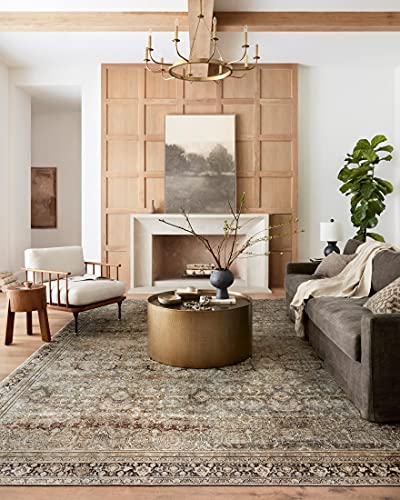
Every rug in this guide is sold on Amazon, where you can check the current price and availability and confirm specifications on the listing before you buy. Start with our top pick, the Loloi Layla Olive/Charcoal 7′-6″ x 9′-6″ Area Rug — Check on Amazon. The other five are the Unique Loom Sofia (Check on Amazon), the nuLOOM Blythe 5×7 (Check on Amazon), the SAFAVIEH Adirondack (Check on Amazon), the SAFAVIEH Madison (Check on Amazon), and the Lahome Insect 5×7 (Check on Amazon).
In this guide
Quick Picks
| Pick | Badge | Why it earns its place |
|---|---|---|
| Loloi Layla Olive/Charcoal 7′-6″ x 9′-6″ Area Rug | Best Overall | A printed near-flat profile the vacuum crosses like a rumor — the smoothest transition in the pool. |
| Unique Loom Sofia Collection Area Rug – Salle Garnier (7′ 1″ x 10′) | Best Anchored | Jute backing plants a quarter-inch pile so the machine never pushes it around the room. |
| nuLOOM 5×7 Moroccan Blythe Area Rug | Best Compact | Eight pounds of cooperation in the small rooms where mixed floors change fastest. |
| SAFAVIEH Area Rug 8×10 – Adirondack Collection – Ivory & Sage | Best Suction-Only | Maker-specified for vacuuming without a beater bar — the gentlest full-size session. |
| SAFAVIEH Madison Area Rug 8×10 – Silver/Ivory | Best Busy Home | Dense patterned pile that empties fully and hides the week’s traffic between sessions. |
| Lahome Insect 5×7 Area Rugs | Best Washable | Gripping, thin, and washable for the entry zones where grit enters the system. |
Key Takeaways
- Mixed-floor vacuuming is a system: the machine’s manners plus the rugs’ profiles, transitions, and anchoring.
- Low, heavy, or gripped rugs make dual-surface machines look good; tall or surfing rugs sabotage them.
- Clean the bare floor around each rug first, or the session tracks grit onto the pile it just cleaned.
- Brush roll off on boards, suction-led on pile, hand tool at every border.
- For machine comparisons across both surfaces, see Best Vacuums For Hardwood Floors And Carpet.
- The second live survey, Best Vacuums For Rugs, covers the rug side of the pairing.
How These Picks Were Chosen
Each pick is a verified pool product, ranked by its behavior inside the mixed-floor system rather than by looks alone: how low its profile sits against the boards, whether its backing or weight keeps it planted under a moving vacuum head, and how completely its pile surrenders grit instead of storing it at the border. Specifications in the mini spec boxes come only from verified listing data. Appliance guidance is category knowledge stated as guidance — no vacuum models are linked or invented here, because the rug side of this system is the half shoppers can actually choose from this page.
The 6 Best Best Vacuum for Rugs and Hardwood Floors — Reviewed
Loloi Layla Olive/Charcoal 7′-6″ x 9′-6″ Area Rug
Our badge: Best Overall
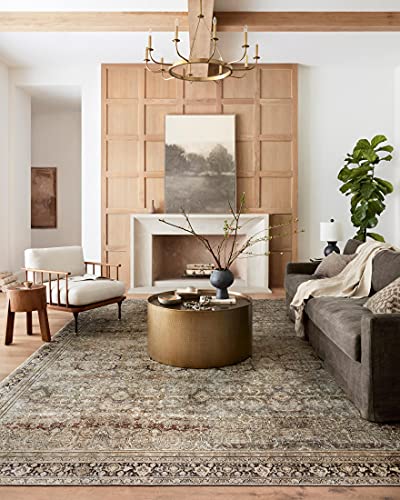
The Loloi Layla Olive/Charcoal 7′-6″ x 9′-6″ Area Rug is the mixed-floor ideal: a printed design on a pile of roughly an eighth of an inch, which the vacuum crosses without a climb, a catch, or a mode change worth the name. Suction that was set for the boards works on the Layla unchanged, and its non-shedding surface empties completely in the same pass rhythm.
Strengths
- Near-seamless transition from hardwood to rug and back.
- Printed surface releases all dirt to suction alone.
- Non-shedding; nothing migrates to the bare floor.
Trade-offs
- Needs a pad for grip and cushion.
- Flat feel underfoot.
- Spot-clean care only.
| Color | Olive / Charcoal |
| Size | 7’6″ x 9’6″ (Rectangular) |
| Dimensions | 114 x 90 x 0.13 inches |
| Weight | 6.61 pounds |
In open-plan rooms — where a single session may cross the same rug six times — the Layla’s flatness compounds into real time saved and real finish preserved, because the machine never has to be caught, lifted, or re-set at its borders. Its olive-charcoal vintage patterning also forgives the border zone visually, the strip where grit lands between sessions. If your floors mix surfaces in one big space, this is the profile the whole system wants to be built around. Consider the border arithmetic: a rug crossed six times a session, fifty sessions a year, presents three hundred border events annually, and at each one a tall or catching profile costs a lift, a re-set, or a scattered trail of grit. The Layla prices each of those events at zero. Over a year that is the difference between a session the household keeps and a session it starts postponing — and postponed sessions, not weak machines, are what actually age mixed floors.
Best for: Open-plan mixed floors and frequent full-home sessions / Not suited for: Plush-comfort rooms
Choose the Layla for the smoothest mixed-floor system; skip it for cushion. Check on Amazon

Unique Loom Sofia Collection Area Rug – Salle Garnier (7′ 1″ x 10′)
Our badge: Best Anchored
The Unique Loom Sofia Collection Area Rug – Salle Garnier (7′ 1″ x 10′) solves the second mixed-floor problem: movement. Its jute backing and fifteen pounds keep a quarter-inch polypropylene pile exactly where it was placed, so the vacuum head works against a stable textile instead of pushing a light rug ahead of itself across the boards.
Strengths
- Jute backing and real weight end rug surfing.
- Low pile transitions cleanly from hardwood.
- Traditional pattern hides border-zone grit between sessions.
Trade-offs
- Keep the backing dry; wet cleaning stays rare and careful.
- Spot-clean care for stains.
- Formal motif in casual rooms.
| Color | Beige/Ivory |
| Size | 7’1″ x 10′ (Rectangular) |
| Dimensions | 120 x 85 x 0.25 inches |
| Weight | 15.17 pounds |
A planted rug changes the border dynamic completely: grit vacuumed off the boards stays off, because the rug’s edge is a fixed line rather than a moving frontier, and the hand-tool pass along that line becomes a quick formality instead of a rescue. The maker’s allowance for a carefully used carpet cleaner, dried immediately and evenly, adds a deep-clean option most jute-backed rugs refuse — used sparingly, it keeps the Sofia’s pale traditional face honest across years of mixed-floor service. The pale face deserves one more word, because shoppers fear light rugs on the borders of busy floors: the pattern’s intricacy does the hiding, not the color’s darkness, and the beige-ivory field breaks up the border strip’s inevitable dust film into something the eye reads as texture. Vacuumed on rhythm, the Sofia looks composed between sessions in a way a solid pale rug never manages — pattern is a cleaning technology, and this rug deploys it fully.
Best for: Formal rooms on hardwood where rugs must stay planted / Not suited for: Frequent wet cleaning
Choose the Sofia for stability with classic looks; skip it for washable convenience. Check on Amazon

nuLOOM 5×7 Moroccan Blythe Area Rug
Our badge: Best Compact
The nuLOOM 5×7 Moroccan Blythe Area Rug serves the rooms where mixed floors change character every few steps — kitchens’ edges, entries, small living rooms — at 5×7 and eight pounds. Its power-loomed polypropylene pile is sleek, durable, and stain-resistant, and its faded trellis pattern is the hardest-working camouflage in the compact class.
Strengths
- Small footprint suits tight mixed-floor rooms.
- Light enough to lift for full border and beneath cleaning.
- Forgiving faded pattern between sessions.
Trade-offs
- Pad advisable to stop vacuum creep.
- Compact coverage only.
- Cool grey palette.
| Color | Blythe Grey |
| Size | 5′ x 7’5″ (Rectangular) |
| Dimensions | 84 x 60 inches |
| Weight | 8 pounds |
The Blythe’s size makes the complete mixed-floor routine — boards around, rug surface, lift, boards beneath, replace — a five-minute ceremony rather than a project, and routines that small are the ones that survive busy households. In apartments especially, where one room is three rooms, a rug that can be fully serviced inside a normal session is worth more than a larger rug serviced in theory. Pair it with a pad and its one weakness, lightness, becomes the system’s most useful feature. The beneath-cleaning deserves emphasis because it is where small rugs quietly outperform large ones in mixed systems: grit migrates under every rug, and under a large rug it can live undisturbed for months, abrading the finish with every footstep above it. Under the Blythe, the entire underside is a two-minute weekly reveal. Multiply that across a year and the finish beneath a small, serviced rug can be in visibly better condition than the finish beneath a grand rug that was only ever vacuumed from above — size, in this system, is a maintenance variable before it is a decorating one.
Best for: Apartments and small mixed-floor rooms / Not suited for: Anchoring large seating groups
Choose the Blythe for full-service cleaning in minutes; skip it for big rooms. Check on Amazon

SAFAVIEH Area Rug 8×10 – Adirondack Collection – Ivory & Sage
Our badge: Best Suction-Only
The SAFAVIEH Area Rug 8×10 – Adirondack Collection – Ivory & Sage simplifies the mixed-floor session to a single setting: its maker specifies vacuuming without a beater bar, and its smooth low pile empties completely on suction — the same gentle mode the hardwood around it wants. One setting, both surfaces, no border negotiations.
Strengths
- Suction-only care matches the hardwood-safe mode exactly.
- Dense low pile releases grit without agitation.
- Virtually non-shedding across both surfaces.
Trade-offs
- Not washable.
- Light palette shows spills promptly.
- Synthetic hand feel.
| Color | Ivory/Sage |
| Size | 8′ x 10′ (Rectangular) |
| Dimensions | 120 x 96 x 0.38 inches |
| Weight | 6.61 pounds |
There is an underrated pleasure in a session with no decisions: the Adirondack’s contract means the operator’s whole attention goes to coverage and pace instead of dial management, and attention is what actually cleans floors. Its distressed ivory-and-sage patterning handles the visual side of the border too, softening the line where board meets textile in rooms that mix the two at scale. For households whose vacuuming is done by several people with varying care levels, a rug that thrives on the gentlest common setting is a quiet form of insurance. It also simplifies the household’s written system, if you keep one — and mixed-floor homes should, on the vacuum closet door: boards gentle, borders by hand, pile slow. On the Adirondack the card can honestly read “same as the boards,” which removes the most common failure in shared households, the setting nobody changed back. Systems survive on the steps they make unnecessary.
Best for: Multi-operator households and gentle full-size cleaning / Not suited for: Washable-rug seekers
Choose the Adirondack for one-setting sessions; skip it for machine washing. Check on Amazon
SAFAVIEH Madison Area Rug 8×10 – Silver/Ivory
Our badge: Best Busy Home
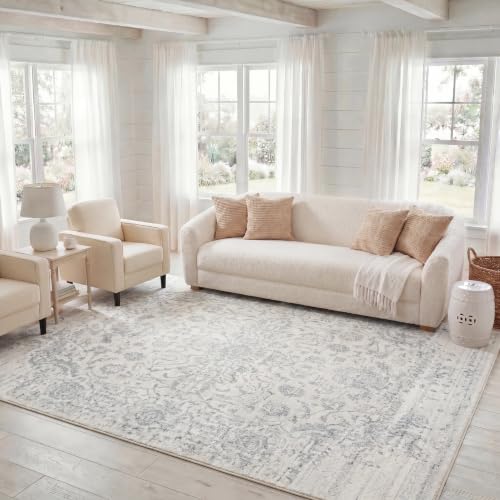
The SAFAVIEH Madison Area Rug 8×10 – Silver/Ivory is the busy household’s mixed-floor workhorse: a dense polypropylene pile at full 8×10, patterned in silver and ivory that camouflages the traffic a family generates between weekly sessions, and heavy enough at over twenty-one pounds to stay where the furniture put it.
Strengths
- Weight and density keep it planted under the vacuum.
- Pattern hides the week’s traffic honestly.
- Full 8×10 coverage for real living rooms.
Trade-offs
- Heavier to lift for beneath-cleaning.
- Not machine washable.
- Busy pattern in minimalist rooms.
| Color | Silver/Ivory |
| Size | 8′ x 10′ (Rectangular) |
| Dimensions | 96 x 120 inches |
| Weight | 21.5 pounds |
The Madison’s contribution to the system is forgiveness at scale: the family room is where sessions get postponed, and its pattern carries the postponement gracefully while its density keeps grit near the surface for the session that eventually comes. Vacuumed on the weekly rhythm, it empties fully; left a fortnight, it still empties — just slower, in lanes, with the borders done by hand tool where the boards have been feeding it grit. Busy homes do not need perfect rugs; they need rugs whose performance degrades gracefully, and that is this one’s design brief. The Madison also anchors the room socially: at full 8×10 under the seating group, it defines the family room’s territory on the hardwood, so the mixed-floor map of the house stays legible — boards for circulation, textile for gathering — and the vacuuming sequence can follow the same legible map without decisions. Legibility is an underrated cleaning feature; a house whose surfaces explain themselves gets cleaned the way it was designed to be.
Best for: Family living rooms on hardwood with weekly rhythms / Not suited for: Washable convenience
Choose the Madison for planted, forgiving coverage; skip it for laundry resets. Check on Amazon

Lahome Insect 5×7 Area Rugs
Our badge: Best Washable
The Lahome Insect 5×7 Area Rugs guard the system’s intake: ultra-thin, non-slip on its TPE backing, and machine washable, stationed where grit first crosses from outside to the hardwood. A vacuum crosses it without noticing it, and the dirt it intercepts never reaches the good rugs deeper in the house.
Strengths
- Gripping backing; zero transition drama at entries.
- Machine washable reset for the grittiest zone.
- Thin pile stores almost nothing below the surface.
Trade-offs
- Minimal cushion.
- Bold pattern is a specific taste.
- Creases on arrival need patience.
| Color | Green |
| Size | 5′ x 7′ (Rectangular) |
| Dimensions | 84 x 60 x 0.19 inches |
Every mixed-floor system is won or lost at its borders with the outdoors, and the Lahome is the border done right: it takes the grit load at the door, surrenders it to a thirty-second vacuum pass daily, and goes through the wash when the season turns. The hardwood behind it stays cleaner, the good rugs deeper in the house stay emptier, and the weekly full session shrinks accordingly. Systems thinking, applied to floors, mostly means spending small effort at the intake to save large effort everywhere else. Measure it once if you doubt it: vacuum the entry rug daily for a week and weigh what the main rooms’ session no longer contains — or simply notice that the border strips of the good rugs stop reloading the boards you just cleaned. The intake rug is the cheapest employee in the house, and the Lahome, washable and gripping and thin enough to ignore, is built to be exactly that.
Best for: Entries and grit intake zones on hardwood / Not suited for: Comfort-led rooms
Choose the Lahome to defend the whole system at the door; skip it as a centerpiece. Check on Amazon
Comparison Table
| Pick | Size | Profile | System strength | Check price on Amazon |
|---|---|---|---|---|
| Loloi Layla | 7’6″ x 9’6″ | Printed flat | Smoothest transitions | Check price on Amazon |
| Unique Loom Sofia | 7’1″ x 10′ | 0.25″ pile | Jute-backed anchoring | Check price on Amazon |
| nuLOOM Blythe | 5′ x 7’5″ | Medium sleek | Fastest full service | Check price on Amazon |
| SAFAVIEH Adirondack | 8′ x 10′ | 3/8″ low pile | One-setting sessions | Check price on Amazon |
| SAFAVIEH Madison | 8′ x 10′ | Dense patterned | Planted forgiveness | Check price on Amazon |
| Lahome Insect | 5′ x 7′ | 0.19″ thin | Grit intake defense | Check price on Amazon |
How to Choose the Best Vacuum Routine for Rugs and Hardwood Floors
Sequence the session: boards, borders, pile
Vacuum the bare floor around each rug first, then the border strip by hand tool, then the pile. The order matters because every pass rearranges a little grit, and the wrong sequence redeposits board grit onto cleaned pile. In open plans, work room by room in that order rather than doing all boards then all rugs; locality beats batching when dirt is mobile.
Set the machine per surface, not per room
Brush roll off or soft roller on hardwood, suction-led settings on the low piles in this guide, and a height that floats rather than plows. The picks here were chosen to narrow the gap between those settings — several thrive on the hardwood mode unchanged — but the discipline of checking at each border is what protects finishes over years. The pads beneath rugs belong to the same discipline; the full pad framework is in Best Padding For Area Rugs.
Anchor everything you own
A rug that moves under the vacuum is a system fault, not a nuisance: it wastes passes, frays edges, and drags grit across the finish it covers. Weight, jute, TPE, or a proper pad — every rug in a mixed-floor home needs one of the four. Audit yours by vacuuming each rug’s edge; anything that travels gets anchored before the next session. The audit has a second reading, too: a rug that anchors well but sheds its border grit onto the boards is telling you its pile is storing more than your rhythm removes, which is a frequency problem wearing an anchoring costume. Read both signals before buying anything — most mixed-floor frustrations are scheduling and anchoring in disguise, and both are cheaper to fix than a machine.
Defend the intake
Entries decide how much grit the system must process. A washable, gripping rug at each exterior door, vacuumed in seconds daily, removes more lifetime dirt from your hardwood-and-rug system than any upgrade to the main machine. Spend the system’s intelligence at its borders. The defense has layers, and they are cheap: an exterior mat for the first scrape, the washable rug inside for the second, and a household habit — shoes off or wiped — for the third. Each layer removes a fraction of what the previous one missed, and by the time feet reach the good rooms, the load arriving is a shadow of what the door received. No vacuum at any price outperforms a door that was defended in layers. The layers also protect each other: the exterior mat keeps the washable rug’s load light, the rug keeps the boards’ load lighter, and the machine inherits a house whose dirt was mostly stopped at the threshold — which is why, in defended homes, even modest vacuums post heroic results year after year. The entry is also where guests form their first impression of the whole system, and a clean, planted, handsome intake rug announces a house that is cared for as a system rather than rescued in panics — an announcement the rest of the floors then spend the visit confirming. Keep the intake rug on the wash calendar even when it looks clean, because its load is structural, not cosmetic: it is the system’s filter, and filters are serviced on schedule or they silently stop filtering, at which point the whole house downstream begins its slow, deniable decline into grittiness. The wash is five minutes of machine time; the decline it prevents is measured in refinishing bills and replacement rugs across the whole house over the many years ahead of you both, together, in full.
The Weekly Mixed-Floor Session, Step by Step
Start at the farthest room and work toward the entry so the machine’s own traffic never crosses cleaned floor. In each room: boards first with the gentle mode, borders by hand tool, pile in slow lanes, edges finished, and a glance under the rug’s lifted corner monthly for the grit audit. Empty or check the bin between rooms in gritty seasons; a full bin quietly taxes every surface that follows. Finish at the entry rug, which gets its daily pass folded into the weekly one, and the house is reset as a system rather than as a series of unrelated surfaces. Time the session once, honestly, and write the number on the card: most households discover their whole mixed-floor system takes less time than the complaining about it did, and a known, small number is what turns a chore into a rhythm that survives busy weeks. Protect the rhythm’s slot the way you would any standing appointment: same day, same rough hour, so the floors’ condition stops depending on motivation, which fluctuates, and starts depending on the calendar, which does not.
Problem: The vacuum scatters grit across the hardwood. — The brush roll is on or the suction is set for pile. Switch to the hard-floor mode at the border, every border, until it is reflex.
Problem: Rugs creep and bunch during sessions. — Anchoring failure. Add pads or choose backed, weighted constructions; do not fight a moving rug with technique.
Problem: The rug looks clean but the boards beside it stay gritty. — Sequence fault: the pile is shedding its border load onto the boards. Reverse the order — boards last around freshly vacuumed rugs in the worst rooms — and hand-tool the strip.
Problem: Sessions take forever in open plans. — The transitions are taxing you. Flatter profiles at the highest-crossing points, like the Layla, repay their cost in minutes per session, forever.
Hardwood Finish Safety: The Rug’s Half of the Bargain
Rugs protect finishes from furniture and traffic, and endanger them in two quieter ways: trapped grit beneath, which abrades with every footstep, and rough backings in direct contact. The system answers both — the monthly lift-and-clean rhythm removes the grit, and pads or finished backings mediate the contact. The kitchen application of the same bargain, where water joins grit as an enemy, is covered in Best Kitchen Rugs For Hardwood Floors. Choose rugs whose undersides you would trust against your palm; your finish experiences them the same way, under load, for years. The palm test sounds folksy and is in fact the fastest screening tool in this guide: a backing that feels abrasive, crumbly, or tacky will behave exactly that way against polyurethane at furniture weight, multiplied by footsteps. Smooth, finished, or naturally grippy undersides pass; everything else gets a pad as a condition of employment. Finishes rarely fail dramatically — they dull in the rug’s silhouette over years, discovered only when the furniture moves — and the palm test plus the monthly grit audit are the two habits that prevent the discovery.
Robots in a Mixed-Floor Home
Robot vacuums love exactly the rugs in this guide: low profiles they can climb, planted edges they cannot bunch, thin piles their brushes can actually empty. They struggle — as every owner learns — with height cliffs, light rugs they push into walls, and deep pile. If a robot runs your daily rhythm, furnish to its abilities: the flatter and heavier your rugs, the more of the house it genuinely maintains, and the more your weekly session can concentrate on borders, beneath-rug audits, and the rooms the robot cannot reach. The machine is a member of the system; furnish for the team you actually field. One caution belongs here: a robot’s map of your home is only as honest as its sensors, and rugs with very dark borders or high-contrast patterns occasionally read as cliffs or obstacles to cliff sensors. Test any new rug under the robot’s supervision for its first crossings, the same advice this guide gives for fringe and for shag, because the first supervised week is when a mixed-floor household learns what its newest member actually does at 2 a.m. After that, the robot’s quiet daily competence is the system’s best friend — it holds the line between your weekly sessions at almost no human cost, and lines held daily rarely need heroes on Saturday.
Common Buying Mistakes
Judging the vacuum without judging the rugs
A dual-surface machine on surfing, deep rugs will disappoint at any price. The better move is to fix the rug side of the system first.
Leaving the brush roll on for the boards
It scatters grit and can mark finishes. The better move is mode discipline at every border.
Skipping the beneath-rug audit
Trapped grit abrades the finish silently. The better move is the monthly lift, vacuum, and inspect.
Buying tall pile for mixed-floor rooms
Height cliffs tax every crossing. The better move is low profiles where surfaces mix, plush where they do not.
Ignoring the entry
Undefended doors feed the whole system grit. The better move is a washable, gripping intake rug at every exterior door.
Final Recommendation
Build the system around the Loloi Layla Olive/Charcoal 7′-6″ x 9′-6″ Area Rug: its near-flat printed profile makes every transition free and every session simpler, on any dual-surface machine. The runner-up for formal rooms is the Unique Loom Sofia (Check on Amazon), planted by its jute backing at a classic quarter inch. Choose rugs that cooperate, set the machine per surface, defend the entries — and the best vacuum for rugs and hardwood floors turns out to be the one you already own, finally allowed to work.
Frequently Asked Questions
Can one vacuum handle both rugs and hardwood floors?
Yes — with a gentle hard-floor mode, honest suction for pile, and rugs chosen to cooperate: low, anchored, and emptible like the picks here. The system matters more than the badge on the machine.
What rug height works best with dual-surface vacuuming?
Low: printed flat up to about three-eighths of an inch crosses cleanly and empties fully. Taller piles belong in single-surface rooms where the machine can be set for them alone.
How do I stop rugs moving when I vacuum?
Anchor them — weight, a gripping backing, or a proper pad. If a rug travels under the head, no setting fixes it; anchoring is a furnishing decision, not a vacuuming one.
Should I vacuum hardwood or rugs first?
Boards around the rug first, border by hand tool, then the pile — in each room as you reach it. In the grittiest rooms, finish with a quick board pass to catch what the pile shed at its edges.
Are robot vacuums good for mixed floors?
On low, planted rugs, genuinely yes — they maintain the daily rhythm well. Furnish to their limits and keep your own weekly session for borders and beneath-rug audits.
How often should the whole system be vacuumed?
Weekly for the full session, with seconds-long daily passes at the entry rugs. Mixed floors reward rhythm over heroics, because grit moves between surfaces every day you wait.
What pad works under rugs on hardwood?
A dense pad that grips by friction, sized an inch inside the rug on all sides, with no adhesive against the finish. The pad anchors the rug for the vacuum, cushions it against trapped grit, and mediates backing contact — three system jobs in one quiet layer.
Why does my vacuum leave a line of grit at the rug’s edge?
That is the border load: grit the pile collected and the head redistributed at the crossing. The hand-tool pass along the border after the pile lanes is the fix, and flatter profiles shrink the load itself.
The Grit Calendar: How Mixed Floors Change With the Seasons
A mixed-floor home does not process the same dirt all year. Winter brings road grit and salt at the entries — abrasive, finish-hungry material that must never be allowed to migrate from the intake rugs to the good boards, which is why winter shortens the entry-rug wash cycle and doubles the border hand-tool passes. Spring adds pollen and mud in alternation, and the system’s answer is frequency: shorter sessions, more often, before loads build. Summer is barefoot season, when skin oils and fine dust dominate and the rugs’ job is mostly to stay planted and forgiving under constant light traffic. Autumn returns leaf grit and the first heating-season dust. Households that adjust the rhythm to the calendar — rather than running one heroic session whenever the floors complain — find the system stays ahead of every season with less total effort, because dirt removed at its daily rate never compounds into the deep load that makes sessions long and finishes vulnerable.
The calendar also governs the beneath-rug audit. Grit accumulates under rugs fastest in winter and slowest in summer, so the monthly lift can stretch in July and should tighten in January. Pads deserve the same seasonal glance: a pad that has gone brittle or slick in winter’s dry heat stops anchoring, and the first symptom is a rug that suddenly travels under the vacuum. Treat the system’s small parts — pads, entry rugs, hand tools — as seasonal equipment with inspection dates, and the big parts, the floors and rugs themselves, will quietly outlast every expectation set for them. There is a budget truth inside the calendar as well: every one of those small parts costs a fraction of a floor refinish or a replacement rug, and the household that replaces pads and entry rugs on schedule is buying decades for its expensive surfaces at the price of its cheapest ones. Seasonal attention is not fussiness; it is the arbitrage that keeps mixed floors affordable.
Small Spaces and Apartments: The Compressed System
In an apartment, the mixed-floor system compresses: one room is three rooms, the vacuum is stored in a closet it shares with everything else, and every rug is crossed constantly. Compression rewards exactly the traits this guide ranked — flat transitions, honest anchoring, sizes one person can lift alone. A compact rug like the Blythe, fully serviced in five minutes, beats a wall-to-wall ambition serviced in theory. Storage argues for a machine that hangs or stands in a corner, and session design argues for the room-by-room sequence, since there is nowhere to stage a half-cleaned home. The apartment dweller’s advantage is feedback: in a small system, every fault announces itself within the week — a traveling rug, a gritty border, a finish losing its calm — and every fix is correspondingly verifiable. Run the compressed system attentively and it will outperform a large house’s neglected one on every measure that matters: cleaner pile, safer finish, shorter sessions.
Noise belongs to the apartment calculus too. Thin walls and hard floors amplify a vacuum’s voice, which pushes session timing toward courteous hours and machine manners toward the gentle modes — another quiet argument for rugs that empty fully on suction-led settings, since they let the whole session run at the machine’s calmest register. The Lahome at the apartment’s single entry does the work of three rugs in a house, intercepting the corridor’s grit before it reaches the one good rug inside. Small systems succeed by concentration: every element chosen, placed, and serviced with intent, because there is no spare square footage to absorb a lazy decision. The apartment also teaches the lesson the big house can borrow: when the whole system is visible at a glance, maintenance stops being a project and becomes a glance-and-act habit — the border looks loaded, so the hand tool comes out while the kettle boils. Mixed floors were never asking for more time. They were asking for the system’s small moments, taken on time.
Teaching the System to Everyone Who Vacuums
A mixed-floor system fails most often at the handoff — the partner, teenager, guest, or cleaner who runs the machine at one setting across every surface. The defense is brevity: a three-line card on the closet door beats a manual nobody reads. Line one: boards get the gentle mode, always. Line two: every rug border gets the hand tool, briefly. Line three: rugs get slow lanes, and anything that travels gets reported, not wrestled. Add the beneath-rug audit date and the entry rugs’ wash day, and the entire system fits on an index card that any operator can honor. Households that write it down discover the system’s performance stops depending on who vacuumed — which is the definition of a system, as opposed to a person’s good habit that leaves when they do.
The card also protects the floors from the most dangerous operator of all: the hurried expert. Speed is the solvent of every rule in this guide — it leaves the brush roll on, skips the borders, and races the lanes — and it tempts experienced hands precisely because they know the house. The written rhythm, followed even by the person who wrote it, is what keeps year five’s floors looking like year one’s. If your household takes one idea from this guide, take that one: the system is the card, and the card is followed by everyone, including its author, especially its author. The card has one more virtue worth naming: it makes the system’s quality auditable. When a finish dulls or a rug starts traveling, the household can ask which line of the card was skipped, and the answer is almost always findable — a border un-tooled for a month, a pad that died unreported, an entry rug whose wash day slipped. Problems with named causes get fixed; problems blamed on the machine get shopped for, expensively and in vain. Write the card, and you have converted floor care from a talent into a procedure, which is the only form in which it reliably survives a busy house.
When a Rug Does Not Belong in the System
Honesty requires the exit criteria. A rug whose pile defeats the machine’s height range, whose backing has gone slick and will not anchor, whose edges curl into trip lips no pad will flatten, or whose grit load permanently exceeds the household’s rhythm does not belong in a mixed-floor system, however loved it is. Relocate it to a single-surface room where it can be the only textile and set the machine for it alone, gift it to a carpeted home, or retire it with thanks. The system is a team, and a member that makes every session longer and every finish less safe is taxing all the others. Most rugs in this guide were chosen precisely because they never trigger those criteria: low, planted, emptible, forgiving. Build the team from members like them, and the weekly session becomes what it should be — twenty calm minutes that keep two kinds of floor young at once, instead of a negotiation nobody wins. The exit criteria cut the other way as well: they tell you when a beloved rug deserves promotion rather than exile. A rug that anchors beautifully, empties fully, and crosses cleanly has earned the high-traffic room, and moving it there — while the difficult rug takes the quiet single-surface room — is often the whole solution, costing nothing but a Saturday rearrangement. Systems thinking is mostly placement thinking, and placement is free.
Buying the Machine Last: The System-First Checklist
If a new vacuum is genuinely in your future, buy it after the rugs, with the system as the specification. The checklist is short: a true hard-floor mode with the brush roll off or a soft roller; suction you can reduce for low piles and borders; a height range that floats over your tallest rug without plowing your lowest; wheels that will not mark the finish; a hand tool you will actually use at borders; and a weight the household’s least enthusiastic operator will still carry weekly. Test candidates against your worst border, not your best rug — the crossing that currently frustrates you is the audition that matters. And keep the receipt until the machine has run the full system twice, because mixed-floor performance only reveals itself across whole sessions, never in a showroom lap. Households that buy this way stop replacing vacuums every few years, because the machine was chosen for the floors they own rather than the floors in an advertisement — and the rugs, chosen first and chosen low, planted, and emptible, make the chosen machine look like the best vacuum for rugs and hardwood floors for a decade.


