Disclosure: As an Amazon Associate, dailyhomedecorating.com earns from qualifying purchases. Links to Amazon on this page are affiliate links; they cost you nothing extra. Prices and availability change often, so check the current Amazon listing before you buy.
Ask what the best material for rugs is and the honest answer begins with a refusal: there is no single best material for rugs, there is only the best material for your room, your traffic, your household and your willingness to clean it. Wool is the connoisseur’s fiber and the toddler’s enemy. Polypropylene is nearly indestructible and faintly apologetic underfoot. Jute is texture you can hear. The best material for rugs in a mudroom will ruin a serene bedroom brief, and the dreamiest bedroom fiber will look exhausted in a hallway by spring. Material is not a ranking; it is a matching exercise — and this guide teaches the matching, then shows it working across six verified rugs.
Each review below leads with the fiber, because fiber decides softness, durability, stain behavior, shedding, cleaning method and lifespan before pattern or color decides anything. You will find polyester chenille that washes like a blanket, hand-woven jute that asks for a gentler life, polypropylene shag built for bare feet, printed low piles that hide a busy household’s evidence, and blends that borrow strengths from two fibers at once. For the outdoor version of this decision, see Best Material For Outdoor Rugs; for the same question narrowed to large pieces, Best Material For Area Rugs goes deeper on scale.
Where to Buy
All six rugs are sold on Amazon, where you can check the current price and availability and confirm fiber content on the listing before you buy. Start with our top pick, the Tumble Lisa Washable Area Rug | 9×12 Living Room Bedroom Area Rug — Check on Amazon. The other five are the nuLOOM Rigo Handmade jute rug (Check on Amazon), the SAFAVIEH Hudson Shag (Check on Amazon), the Loloi Layla (Check on Amazon), the Loloi Loren (Check on Amazon), and the Unique Loom Sofia (Check on Amazon).
In this guide
Quick Picks
| Pick | Badge | Why it earns its place |
|---|---|---|
| Tumble Lisa Washable Area Rug | 9×12 Living Room Bedroom Area Rug | Best Overall | Polyester chenille that is spillproof and machine washable — the most forgiving material story here. |
| Nuloom Rigo Handmade | Best Natural Fiber | 100% hand-woven jute: unmatched texture and durability in dry, adult traffic. |
| SAFAVIEH Hudson Shag Rug 9×12 | Best for Softness | Deep polypropylene shag that delivers plush comfort with synthetic resilience. |
| Loloi Layla Olive/Charcoal 7′-6″ x 9′-6″ Area Rug | LAY-03 Printed Approx. 8×10 Green Livi | Best Low-Pile Print | Printed construction with virtually no pile to trap dirt or trip a vacuum. |
| Loloi Loren Terracotta/Sky 8′-4″ x 11′-6″ Area Rug | LQ-15 Printed Approx. 8×12 Orange Liv | Best Vintage Look | Polyester face with cotton backing, printed to mimic hand-knotted character. |
| Unique Loom Sofia Collection Area Rug – Salle Garnier (7′ 1″ x 10′ Rectangle | Best Budget | Polypropylene face on a jute backing — two honest materials at an easygoing tier. |
Throughout, keep one sentence in mind: the best rug material is the one whose care contract your household will happily sign. Everything below is an expansion of that sentence, with receipts.
Key Takeaways
- Fiber decides care before style decides anything: washable synthetics forgive, naturals demand gentleness, piles trap what flatweaves release.
- Polypropylene is the durability champion for traffic, kids and pets; polyester wins on softness and printed color.
- Jute and other plant fibers deliver texture and strength in dry rooms but fear water and harsh vacuuming.
- Backing is a material choice too — cotton, jute, latex, TPE and included pads each change grip, floor safety and feel.
- Match material to the room’s worst day, not its best: the spill, the muddy paw, the dragged chair.
- Every pick here was chosen to demonstrate a distinct material strategy, not six versions of the same rug — read the set as a material library you can buy from, and the right answer for your room will usually announce itself by elimination.
How These Picks Were Chosen
Because this keyword is a material question, we curated for material diversity within the verified pool rather than for six lookalikes. The set had to include a washable synthetic, a true natural fiber, a deep synthetic pile, printed low piles, and a fiber-plus-backing combination, so that every major material decision a buyer faces appears in a real, purchasable example. Rugs whose material story duplicated a stronger example were set aside. Within each material family we ranked by the maker’s own care instructions and construction notes, since those reveal how the fiber behaves in a home rather than in a showroom.
One more filter shaped the final six: each rug had to be a pick we could defend as the best representative of its material family, not merely an available one. A mediocre washable rug would have taught the wrong lesson about washables, and a fragile jute would have libeled a noble fiber. Where the pool offered two similar constructions, the one with the clearer care instructions and the more complete specification won the slot, because a material guide is only as trustworthy as the examples it teaches from.
Product-specific facts in the reviews — fiber, construction, size, color, care — come only from the verified pool data. The buying-guide sections teach general fiber knowledge that applies to any brand: how wool, synthetics and plant fibers age, stain and clean. Where a beloved fiber such as wool has no representative in the pool, we discuss it honestly in prose without linking a product, rather than pretending a synthetic is something it is not.
The 6 Best Material for Rugs — Reviewed

Tumble Lisa Washable Area Rug | 9×12 Living Room Bedroom Area Rug
Our badge: Best Overall
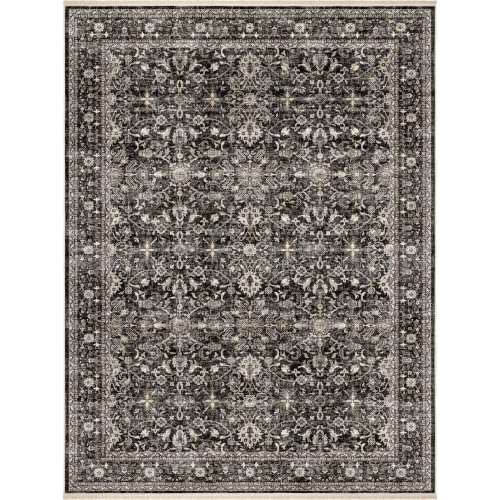
The Tumble Lisa Washable Area Rug | 9×12 Living Room Bedroom Area Rug leads because polyester chenille, engineered this way, solves the material dilemma for the most households: it feels soft like a textile should, yet its spillproof surface beads liquids up for wiping and the whole rug goes through a standard washer and dryer when life gets serious. Add the included cushioned non-slip pad with its corner-pocket anchoring and OEKO-TEX Standard 100 certification, and you have the material package with the fewest asterisks for families and pet homes.
Strengths
- Machine washable — the only material story that fully resets after a disaster
- Spillproof surface turns most spills into a wipe, not a stain
- Included pad removes the separate backing decision entirely
Trade-offs
- Chenille softness is a low-pile softness; it will not feel like deep wool or shag
- Large sizes need a washer routine that suits the rug’s bulk
- Synthetic hand feel will not satisfy buyers who specifically want natural fiber
| Color | Midnight |
| Size | 9×12′ |
Live with it and the material logic keeps proving itself: juice beads, mud dries and shakes out, and the seasonal deep clean is a laundry cycle rather than a professional appointment. The vintage Persian styling with fringe means the practical choice does not look like one. Choose the Tumble when your household’s worst days are frequent; skip it if your heart is set on the organic texture of jute — and then accept jute’s rules, below.
Best for: families, pet homes and anyone who wants cleaning to be a solved problem / Not suited for: natural-fiber purists or lovers of deep pile
Choose this if you want the material that forgives the most. Check on Amazon
Nuloom Rigo Handmade
Our badge: Best Natural Fiber
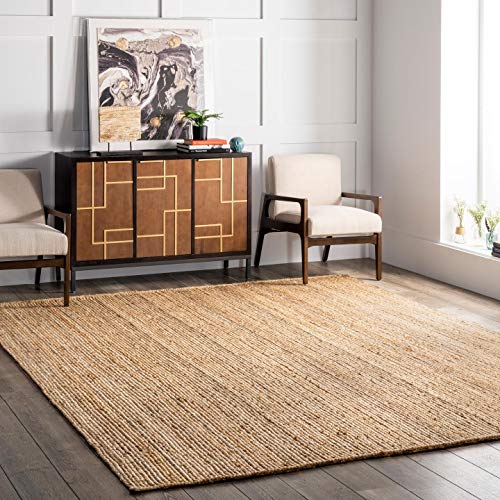
The Nuloom Rigo Handmade is the pool’s honest natural: 100% jute, hand woven in India, with a slim 0.35-inch profile that slides under doors and furniture. Jute’s material virtues are real — strong plant fibers, a warm organic texture no synthetic convincingly copies, and a surface that shrugs off dry grit in entryways and dining rooms. Its rules are equally real: vacuum gently on low power or with a handheld attachment, spot clean with mild detergent, and keep standing water away, because plant fibers drink, swell and stain.
Strengths
- Genuine hand-woven jute texture and warmth
- Durable plant fibers suit high dry traffic
- Slim profile works under doors and dining chairs
Trade-offs
- Not washable and not a friend of spills or pet accidents
- Texture is firm, not plush, under bare feet
- Natural variation means the rug has a rustic, not tailored, finish
| Color | Natural |
| Size | 9′ x 12′ (Rectangular) |
In the right room — a sunlit dining space, a farmhouse living room, a layered base under a smaller wool or vintage rug — jute is unbeatable value in texture per season of service. In the wrong room, a nursery or a dog’s favorite corner, it is a heartbreak scheduled. The material is not good or bad; the match is.
Best for: dry, design-led rooms that want organic texture / Not suited for: pet accident zones, nurseries or damp spaces
Choose this if texture leads and your household runs dry and careful. Check on Amazon

SAFAVIEH Hudson Shag Rug 9×12
Our badge: Best for Softness
The SAFAVIEH Hudson Shag Rug 9×12 demonstrates pile as a material decision: a 1 3/4-inch polypropylene shag that delivers the sink-in softness people associate with far fussier fibers, while keeping synthetic resilience and OEKO-TEX certification. Polypropylene in a shag means the plushness survives kids’ forts and movie nights without the moth, moisture and cost anxieties of natural plush fibers.
Strengths
- Deep, cloud-like pile for genuine barefoot comfort
- Synthetic fiber keeps shag practical in family rooms
- Large 9×12 footprint makes a whole seating zone soft
Trade-offs
- Deep pile traps crumbs and needs low-setting vacuuming and shaking
- Some early shedding and new-rug odor are normal, per the maker
- Chair legs and casters do not love deep pile — keep it in lounge zones
| Color | Ivory/Beige |
| Size | 9′ x 12′ (Rectangular) |
Bedrooms and media corners are its natural habitat — anywhere feet land softly and furniture stays put. If your material priority is comfort theater, this is the pool’s fullest expression of it, and its care routine, while real, is simpler than any natural plush equivalent.
Best for: bedrooms, media rooms and comfort-first living spaces / Not suited for: dining areas, door paths or caster chairs
Choose this when softness is the brief. Check on Amazon
Loloi Layla Olive/Charcoal 7′-6″ x 9′-6″ Area Rug | LAY-03 Printed Approx. 8×10 Green Livi
Our badge: Best Low-Pile Print
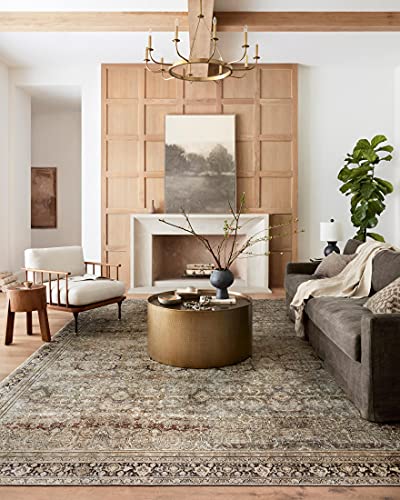
The Loloi Layla Olive/Charcoal 7′-6″ x 9′-6″ Area Rug | LAY-03 Printed Approx. 8×10 Green Livi represents printed construction: the pattern is printed onto a low, soft base rather than woven in, which buys intricate vintage detail at a fraction of hand-knotted cost and a pile so low that dirt has nowhere to hide and doors swing freely. Power-loomed consistency means non-shedding behavior and color that stays where it was printed.
Strengths
- Virtually no pile: vacuums clean fast and completely
- Detailed traditional patterning that woven budgets rarely reach
- Non-shedding, durable surface for high traffic
Trade-offs
- Printed detail is flatter up close than woven texture
- Thin build wants a rug pad for cushion and grip
- Temporary creases on arrival need time to relax
| Color | Olive / Charcoal |
| Size | 7’6″ x 9’6″ (Rectangular) |
For dining rooms, hallways and busy living rooms, the printed low pile is the material pragmatist’s favorite: beautiful from standing height, which is where rooms are actually seen, and nearly maintenance-free. It also layers beautifully over larger naturals when you want pattern on texture.
Best for: dining rooms, hallways and pattern lovers who hate upkeep / Not suited for: buyers who want plush depth underfoot
Choose this if easy living outranks pile depth. Check on Amazon
Loloi Loren Terracotta/Sky 8′-4″ x 11′-6″ Area Rug | LQ-15 Printed Approx. 8×12 Orange Liv
Our badge: Best Vintage Look
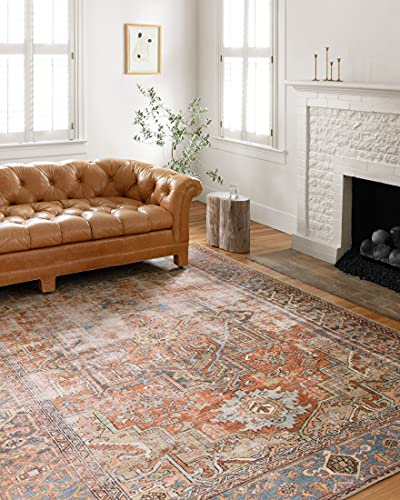
The Loloi Loren Terracotta/Sky 8′-4″ x 11′-6″ Area Rug | LQ-15 Printed Approx. 8×12 Orange Liv adds a backing lesson to the printed story: a 100% polyester face power-loomed in Turkey over a cotton backing. Cotton backing is the traditional rug world’s handshake — it lies flat, feels substantial, and pairs kindly with a separate pad, which the maker recommends for comfort, longevity and floor protection. The printed face portrays individual knots for a textured, hand-knotted illusion in terracotta and sky.
Strengths
- Polyester face holds rich, vintage color
- Cotton backing gives a classic, flat-laying drape
- Large format suits open living and dining spaces
Trade-offs
- Pad is a genuine extra purchase, not an accessory
- Cotton backing dislikes damp floors — keep it dry beneath
- Printed texture will not fool a hand at close range
| Color | Terracotta / Sky |
| Size | 8’4″ x 11’6″ (Rectangular) |
Choose the Loren when the room’s style brief is vintage warmth at scale and the floor is dry, stable hardwood or tile. It is the decorator’s pick of the set — the one that changes a room’s temperature the moment it lands.
Best for: vintage-styled living and dining rooms on dry floors / Not suited for: damp basements or pad-free minimalists
Choose this for color and character with honest construction. Check on Amazon

Unique Loom Sofia Collection Area Rug – Salle Garnier (7′ 1″ x 10′ Rectangle
Our badge: Best Budget
The Unique Loom Sofia Collection Area Rug – Salle Garnier (7′ 1″ x 10′ Rectangle closes the set with the classic workhorse pairing: a 100% polypropylene face at a soft quarter-inch pile over a 100% jute backing that the maker notes is safe for all floor types including hardwood. That combination — synthetic resilience where feet land, natural grip and body where the rug meets the floor — is why this construction has sold in enormous numbers for decades.
Strengths
- Polypropylene face: durable, spot-cleanable, family-proof
- Jute backing lies flat and is floor-friendly
- Soft low pile clears doors and suits most rooms
Trade-offs
- Quarter-inch pile is comfortable, not luxurious
- Jute backing should stay dry like all plant fibers
- Traditional styling is safe rather than distinctive
| Color | Beige/Ivory |
| Size | 7’1″ x 10′ (Rectangular) |
As a first area rug, a rental upgrade, or a dependable layer under a dining set, the Sofia’s material pairing asks little and delivers steadily. It is proof that “budget” in rugs should mean proven construction at scale, not corners cut.
Best for: first rugs, rentals and dependable everyday rooms / Not suited for: buyers seeking a statement texture or deep plush
Choose this when proven and easy is the whole brief. Check on Amazon
Comparison Table
| Pick | Face material | Backing / pad | Cleaning | Check price on Amazon |
|---|---|---|---|---|
| Tumble Lisa | Polyester chenille | Included cushioned pad | Machine washable | Check price on Amazon |
| nuLOOM Rigo | 100% jute | Hand-woven body | Gentle vacuum, spot clean | Check price on Amazon |
| SAFAVIEH Hudson Shag | Polypropylene shag | Woven base | Low-setting vacuum, shake | Check price on Amazon |
| Loloi Layla | Printed low pile | Power-loomed base | Vacuum, spot clean | Check price on Amazon |
| Loloi Loren | 100% polyester print | Cotton backing | Vacuum, spot clean | Check price on Amazon |
| Unique Loom Sofia | 100% polypropylene | 100% jute backing | Vacuum, spot clean | Check price on Amazon |
How to Choose the Best Material for Rugs
Start with the room’s worst day
List what will actually happen on this rug: muddy paws, red-wine evenings, toddler art, chair casters, plant watering, wheelchair or walker traffic. Materials fail against specific events, not in general. Washable synthetics answer spills and accidents; dense low piles answer casters and chairs; naturals answer dry, careful, design-led living. Choosing against your worst day is the single most reliable rule in this entire guide.
Understand the big fiber families
Synthetics (polypropylene, polyester, nylon) trade a little natural soul for a lot of forgiveness: stain resistance, moisture tolerance, color options and easy cleaning. Wool — discussed here in prose because the pool’s picks are synthetic and natural-plant — offers resilience, natural stain resistance and decades of life at a premium, with professional cleaning as its rent. Plant fibers (jute, sisal, seagrass, cotton) offer texture and value with strict water rules. None is universally best; each is best somewhere.
Let pile height arbitrate
Pile is material you can measure. Under a quarter inch: doors clear, chairs glide, vacuums finish fast, dirt has no refuge. A quarter to a half inch: the all-rounder zone. Above an inch: comfort theater that traps debris and resents furniture legs. Match pile to the room’s furniture movement — dining chairs are the strictest test in any home — and half of all rug regret evaporates.
Interrogate the backing
Flip every candidate over mentally. Included pads (Tumble) end the debate. Cotton backing wants a pad and a dry floor. Jute backing lies beautifully flat and stays floor-friendly while dry. Latex and TPE non-slip backings grip hard floors but should be checked against your floor finish and lifted periodically. The backing is where rugs and floors negotiate, and floors always win disputes — choose accordingly, a theme Best Rugs For Family Room also leans on for busy shared spaces.
Price the cleaning, not just the rug
A rug’s true cost includes its care: professional cleaning for large naturals and fine wool, laundry for washables, ten weekly vacuuming minutes for piles. A cheaper rug with expensive care can out-cost a washable one within two years of real family life. Buy the care routine you will actually perform.
How Should You Care for Each Rug Material?
Synthetics: vacuum weekly with the beater bar set for the pile, blot spills immediately (most resist staining if not given time), and wash or deep-clean on the maker’s schedule. Jute and plant fibers: vacuum gently without aggressive brush action, keep liquids brief and blotted, never soak, and use a pad to reduce abrasive grit underneath. Printed low piles: vacuum often and lightly — their virtue is releasing dirt, so let them. Shag: vacuum on low without a spinning brush where the maker advises, shake outdoors monthly, and rake fibers with a carpet rake if they matte. Across all materials, rotate the rug twice a year so sun and traffic wear evenly, and lift it seasonally to clean the floor beneath — grit under a rug is sandpaper with patience.
Problem: a spill on jute has left a watermark — Blot, never rub; dry quickly with airflow; accept that plant fibers record history and position furniture to forgive the spot.
Problem: synthetic rug holds odors — Air it outdoors, vacuum with a deodorizing routine, and wash it if it is a washable model; persistent odor usually lives in the pad or floor beneath, so clean those too.
Problem: shag pile looks flat — Shake it outside, vacuum on low to lift fibers, and brush against the nap; matting accelerates where a favorite chair’s feet rest, so rotate.
Problem: printed rug’s colors look dusty — That is usually surface grit filming the print. A slow vacuum pass and a damp-cloth wipe on low piles restores the contrast.
Wool, Honestly: The Fiber This Pool Does Not Sell
Because material guides owe readers the whole map, wool deserves its paragraph even without a linked pick. Wool is resilient — fibers spring back from furniture dents that flatten synthetics — naturally flame resistant, and kind to air quality, and a good wool rug can serve for decades. Its rents are price, professional cleaning, moth vigilance in storage, and shedding in its first months. If your budget and household suit it, wool remains a legitimate best answer for low-spill, high-pride rooms. If your life includes dogs, toddlers or red wine near the sofa, the washable and polypropylene picks above will make you happier, which is precisely why this pool leans as it does. Readers furnishing a whole living space can see wool’s comfort-first cousins in spirit in Best Rugs For Living Room.
Materials and Floors: What Goes Over What
Hardwood wants a breathable, non-staining interface: pads under cotton or jute backings, caution with latex on delicate finishes, and no rubber against freshly refinished boards. Tile forgives almost everything but adds hardness that argues for a cushioned pad under thin prints. Laminate and vinyl plank dislike trapped moisture and some rubber compounds — the full briefing lives in Best Rugs For Vinyl Plank Flooring. Carpet under a rug (yes, people layer) wants a thin, firm rug that will not ripple. In every pairing the principle is identical: the rug material and the floor material are a system, and the interface between them is where success is decided.
Common Buying Mistakes
Choosing by photograph instead of fiber
Two rugs can share a pattern and share nothing else. The consequence of ignoring fiber is a beautiful rug with the wrong care contract. Read the material line first, the pattern second.
Putting plant fibers in wet zones
Jute under a dog bowl or beside a bathroom door will watermark, swell and odor. Move naturals to dry rooms and give wet zones washable synthetics.
Skipping the pad to save money
Thin printed and cotton-backed rugs without pads creep, wear faster and feel thin. The pad is part of the material system; budget for it with the rug.
Buying deep pile for a dining room
Chairs catch, crumbs vanish into the pile, and cleaning becomes archaeology. Keep dining at low pile and put the plush in the lounge.
Assuming “synthetic” means indestructible
Synthetics forgive spills, not neglect: ground-in grit still abrades them, and heat sources can still mark them. Routine care is cheaper than replacement for every fiber.
The Right Material, Room by Room
Living rooms host everything, so they reward the middle path: a low-to-medium pile synthetic or a washable construction that can absorb movie-night spills, pet naps and rearranged furniture without keeping score. This is the room where the Tumble’s washability and the Layla’s print-hiding pattern both shine, and where a household’s true traffic reveals itself within a month.
Bedrooms invert the priority: bare feet at dawn outrank spill statistics, so pile and softness lead — the Hudson Shag’s polypropylene plush or a chenille’s gentle surface — and cleaning can be gentler because bedrooms generate dust more than disasters. Dining rooms are the strictest material exam in the house: chairs slide dozens of times a week and food falls with intent, so flat, firm and cleanable wins, which is why printed low piles and jute (in adult, dry households) dominate there. Kitchens want washable, low and grippy — materials that treat splashes as routine. Hallways and entries want abrasion resistance above all: dense synthetics and braided constructions that treat grit as a daily commute rather than an insult. Nurseries and kids’ rooms want washable, certified, low-pile softness — a specification the pool’s OEKO-TEX options meet head-on. Home offices add the caster test: chair wheels destroy deep pile and delight in firm low constructions. Read your own rooms this way, one honest paragraph each, and the material shortlist writes itself before you look at a single pattern.
How Construction Changes a Fiber’s Behavior
The same fiber can live three different lives depending on how it is built into a rug. Woven constructions interlace warp and weft into a flat, stable textile — the jute Rigo’s hand-woven body is the artisanal example — and they lie flat, layer well and show their honest texture. Power-loomed rugs trade hand character for consistency and value: uniform pile, reliable color, and the non-shedding manners of the Layla, Madison-style medallions and Sofia. Printed rugs separate pattern from structure entirely, inking the design onto a prepared base; the payoff is detail per dollar that weaving cannot match, the cost is a flatter hand. Tufted and shag constructions push fiber upward for softness, gaining comfort and gaining every cleaning complication that depth implies. Braided rugs build structure from ropes of fiber, draining and flexing in ways flat rugs cannot, which is why braids keep appearing wherever water or heavy grit is involved.
Why does this matter for a material decision? Because “polypropylene” on a label tells you the fiber’s chemistry but not its behavior in your hallway. A polypropylene braid, a polypropylene flatweave and a polypropylene shag are three different ownership experiences wearing one fiber name. When you compare candidates, read fiber and construction as one phrase — “washable chenille,” “hand-woven jute,” “printed low pile” — and you will predict your Saturdays far more accurately than fiber alone ever could. The reviews above are organized on exactly that principle, and the companion guide to larger formats, Best Material For Area Rugs, applies it at 8×10 and beyond.
Sustainability and End-of-Life, Without the Fairy Tales
Material choice has an environmental shadow, and honesty beats marketing here too. Natural fibers are renewable and biodegradable, but a jute rug ruined in eighteen months by a wet placement is not a green outcome; longevity is the first sustainability metric, and a synthetic rug that serves eight years can carry a smaller footprint per year than a natural one replaced three times. Synthetics increasingly arrive with recycled content, and washable rugs cut professional-cleaning chemistry and transport from a household’s footprint. The greenest rug is the one matched correctly to its room, cared for on schedule, repaired or demoted to a utility space when its looks fade, and only then replaced. Buy the right material once — that is the whole sermon, and it happens to be this guide’s thesis from the first paragraph.
Shedding, Fading and Denting: How Materials Age
Every rug ages along three visible axes, and material predicts all three. Shedding is loose fiber leaving the construction: new wool and some cut piles shed noticeably for weeks, power-loomed synthetics like the Layla and Sofia shed very little, and printed rugs have almost nothing to shed. Knowing this in advance turns a normal break-in from a panic (“the rug is falling apart”) into a scheduled expectation that a few thorough vacuumings resolve. Fading is light doing slow chemistry: synthetics with color carried through the fiber fade slowly and evenly, natural fibers mellow and gray, and any rug fades unevenly if half of it lives in a sun stripe — rotation is the only real remedy, and it works. Denting is compression under furniture: resilient fibers spring back, flat constructions barely dent because there is nothing to compress, and deep piles hold footprints longest while also hiding them best. None of these is a defect; each is a personality trait of the material you chose, and a household that knows its rug’s aging style stops fighting it and starts maintaining around it, which is when rugs start lasting as long as their makers hoped.
The First Thirty Days With a New Rug
Month one teaches you your rug’s true care contract if you pay attention. Week one: let creases relax — reverse-roll, weight corners, walk the rug in rather than fighting it — and vacuum thoroughly to clear manufacturing lint. Week two: watch traffic lanes form and notice where grit collects; that map tells you where your weekly vacuum minutes matter most. Week three: perform the first spill drill honestly — blot something small and harmless and learn how this fiber responds while the stakes are low. Week four: lift a corner, check the floor interface for grit or moisture, confirm the pad (if any) is behaving, and rotate the rug if one side is taking all the sun. Households that run this quiet onboarding end up with rugs that look intentional for years; households that skip it meet the same lessons later, taught by stains instead of curiosity. If your new rug anchors the family’s main gathering space, the routines in our family-room guidance extend this first month into a full care calendar, and color-led shoppers can see how material and palette interact in Best Area Rugs For Yellow Walls before committing to a fiber for the hardest-working room in the house.
Five Material Myths That Cost Buyers Money
Myth one: natural is always better. Natural fibers are better at texture and tradition; synthetics are better at surviving children, dogs and grape juice. “Better” without a room attached is marketing. Myth two: thicker means higher quality. Thickness is a comfort choice; some of the most durable rugs ever made are nearly flat, and some deep piles are loosely built and age fast. Density and construction quality matter more than height. Myth three: handmade always beats machine-made. Hand-woven jute has soul and variation; power-loomed synthetics have consistency and manners. They win different rooms. Myth four: a rug that can be washed will never need replacing. Washability extends life enormously, but fibers still abrade, backings still age, and a decade of family life is a full career for any rug. Myth five: stain-resistant means stain-proof. Treatments and synthetic fibers buy you time to blot; they do not repeal chemistry, and a spill left to bake through a sunny weekend can mark almost anything. Each myth survives because it contains a grain of truth; the buyer’s job is to keep the grain and drop the exaggeration.
Blends and Hybrids: When Two Fibers Beat One
Many of the smartest rugs are negotiations between fibers. A polyester face over a cotton backing borrows print-loving softness and traditional drape at once — the Loren’s arrangement. A polypropylene face over jute backing pairs a forgiving surface with a flat, floor-kind foundation — the Sofia’s. Chenille constructions blend softness with a woven stability that keeps edges honest. When you meet a blend, ask what each component is doing there: face fibers meet feet and spills, structural fibers meet floors and time, and a blend that assigns each job to the fiber best at it is engineering, not compromise. Conversely, a blend that exists to dilute cost usually assigns the visible job to the cheaper fiber — which is why reading which fiber is on the face matters more than the blend’s headline. The six picks in this guide were chosen partly as a teaching set of exactly these arrangements, so that whichever construction language your next rug speaks, you have already handled a fluent example here.
A Five-Minute Material Worksheet
Before ordering, answer six questions on paper. One: what is the worst liquid this rug will meet this year, and how often? Two: who walks on it daily — adults, children, pets, wheels? Three: what floor lies beneath, and what does that floor fear (water, rubber, dye, grit)? Four: which cleaning tools do I actually own and enjoy using — a washer, a good vacuum, a hose, none of these? Five: how much pile can this room’s doors and chairs tolerate? Six: how many years do I expect, and what care rent per month will I pay for them? Now translate: frequent liquids plus pets equals washable synthetic. Adults and dry traffic equal naturals allowed. Delicate floors equal pad discipline and backing checks. A big washer equals the Tumble’s contract; no washer equals low-pile synthetics that vacuum clean. Doors that barely clear equal printed flats. A decade of expectation equals dense construction and rotation habits. The worksheet takes five minutes and prevents the two classic errors — buying a fiber for a life you do not live, and buying a care routine you will not perform — more reliably than any single product recommendation, including ours.
Keep the worksheet with your home records. Rugs are bought rarely enough that households forget their own lessons between purchases; the family that writes down “jute failed by the dog door, washable won the kitchen” buys correctly the second and third time without re-litigating the whole material question. That written memory, multiplied across rooms, is how a house gradually ends up furnished in materials that suit its actual life — which was the definition of “best” this guide started with.
Materials for Households With Pets, Specifically
Pet households compress every material question. Hair favors low piles and prints that release fur to a vacuum instead of weaving it into a shag. Accidents favor washable or hose-able constructions and punish plant fibers without appeal. Claws favor dense, loop-resistant surfaces and punish loose weaves that snag. Odor favors materials that can be fully cleaned rather than surface-refreshed. That four-part test is why pet homes keep landing on the same shortlist — washable chenille, low-pile polypropylene, braided synthetics — regardless of style tribe, and why the pet-specific rankings in this program, which apply the same test pick by pick, read like a narrower echo of this material guide. If a seller cannot tell you how a rug handles all four pet stresses, the rug was not designed with your household in mind, whatever its listing photographs show. Choose from the constructions that answer all four, then pick the pattern your room wants; that order of operations is the difference between a rug a dog lives on happily and a rug a dog slowly repossesses.
A Note on Children, Crawling and Floor-Level Life
Households with babies and toddlers evaluate materials at floor level, literally: the rug is a play surface, a nap surface and a snack surface in the same afternoon. Priorities shift toward certified materials (the OEKO-TEX labels on several picks here exist for exactly this scrutiny), low piles that release crumbs instead of storing them, washable constructions that can be reset after illness or art projects, and pads that add cushion for tumbles without adding tripping height at the edges. Softness still matters — a firm flatweave is a poor play mat — but it should come from a pad beneath a cleanable surface rather than from a deep pile that keeps secrets. As children grow, the same rug graduates to homework and hangout duty, and the washable, low-pile choices made for the crawling years keep proving themselves long after the play mat era ends.
Final Recommendation
For the most households, the material answer is the Tumble Lisa Washable Area Rug | 9×12 Living Room Bedroom Area Rug — soft polyester chenille with a spillproof surface and a washing-machine reset button. The runner-up is the fiber-contrast pick: the Check on Amazon nuLOOM Rigo jute for dry, design-led rooms. Between those two poles — washable synthetic forgiveness and natural texture with rules — most homes can furnish every room honestly.
Frequently Asked Questions
What rug material lasts the longest?
Well-made wool and dense polypropylene both offer long service; wool wins on resilience in low-spill rooms, polypropylene wins where moisture and accidents are routine. Care matters more than fiber alone.
What is the easiest rug material to clean?
Machine-washable synthetics, followed by low-pile polypropylene that vacuums completely and spot-cleans without drama.
Is jute a good rug material?
Yes, for dry rooms that value texture: it is strong, affordable and beautiful. It is a poor choice anywhere water, pets or heavy spills are routine.
What material is best for allergy-sensitive homes?
Low-pile, non-shedding synthetics that vacuum thoroughly and wash periodically give dust and dander the fewest places to live; deep piles are the hardest to keep truly clean.
Does backing material really matter?
It decides grip, floor safety, flatness and feel. A great face fiber over the wrong backing for your floor is a daily annoyance; treat backing as half the purchase.
Can I layer different rug materials?
Yes — a large natural base with a smaller patterned or plush rug on top is a classic decorator move indoors. Keep the base firm and flat so the top layer lies calmly.
When should a rug be replaced rather than cleaned again?
When the backing cracks or powders, when odors survive a proper deep clean, when traffic lanes stay visibly crushed after rotation and rest, or when edges fray faster than you can bind them, the material has finished its career. A final demotion to a garage, workshop or pet-corner role often extracts a last useful year before disposal. Replacing on that evidence — rather than on boredom or on the first stain — is how households get full value from good materials without living with tired ones.
Do darker rugs really hide more?
Mid-tones hide the most across all materials, because household dirt is itself mid-toned. Very dark rugs advertise pale lint and pet hair; very pale rugs advertise everything else. Pattern helps every material by breaking up the eye’s ability to spot a single crumb or hair, which is one reason the printed and medallion designs in this guide stay looking composed between cleanings in busy rooms.


