Disclosure: As an Amazon Associate, dailyhomedecorating.com earns from qualifying purchases. Links to Amazon on this page are affiliate links; they cost you nothing extra. Prices and availability change often, so check the current Amazon listing before you buy.
The best office chairs for long term sitting are not the softest chairs in the store — softness is a first-hour quality, and long-term sitting is an eighth-hour test. What survives a ten-hour day is support that does not fade: a seat that does not compress into a bowl, a back that keeps meeting yours after lunch, materials that breathe through the afternoon, and a recline that invites the small position changes which are the real secret of sitting long. This guide reviews six verified chairs against that eighth-hour standard, in comfort terms only — no chair is a medical device, and discomfort that persists beyond a well-fitted chair deserves professional advice.
The six picks span three philosophies of endurance: suspension (the Herman Miller Aeron, whose Pellicle seat cannot pancake), adaptation (the FLEXISPOT ErgoX and Steelcase Series 1, which adjust to you continuously), and honest foam-and-mesh engineering at friendlier tiers (Ticova, Hbada, SIHOO). Each review judges its chair by the long day specifically — heat, compression, support drift, break behavior — rather than by showroom impressions. For the posture mechanics behind these choices, read Best Office Chairs For Comfort And Posture alongside; for back-and-neck-first shopping, Best Office Chairs For Back And Neck Support; and for the desk itself, Best Office Chairs For Computer Work.
Where to Buy
Every pick in this guide is sold on Amazon, where you can check the current price, configuration and availability. Start with the Herman Miller Aeron Classic — Check on Amazon. The other five picks: FLEXISPOT ErgoX — Check on Amazon; Steelcase Series 1 — Check on Amazon; Ticova Ergonomic — Check on Amazon; Hbada P5 — Check on Amazon; SIHOO M18 — Check on Amazon.
In this guide
Quick Picks
| Pick | Badge | Why it earns its place |
|---|---|---|
| Herman Miller Aeron Classic | Best Overall | Pellicle suspension never compresses, breathes all day and moves with your joints — the long-day reference chair, with a 12-year warranty. |
| FLEXISPOT ErgoX | Best Premium | Dynamic lumbar, adjustable seat depth, a nap footrest and a stated 400 lb limit for marathon days with real breaks. |
| Steelcase Series 1 | Best Set-and-Forget | Weight-activated support that never needs re-setting across a long day — or between the people who share the chair. |
| Ticova Ergonomic Office Chair | Best for Precise Fitting | Height-and-depth lumbar and a thick W-shaped seat for workers who fit once, precisely, and sit long. |
| Hbada P5 | Best for Breaks | A footrest and 135-degree recline build genuine recovery pauses into the longest days. |
| SIHOO M18 | Best Budget | Mesh airflow, adjustable lumbar and a stated 330 lb capacity — long-day essentials at a budget tier. |
Key Takeaways
- Compression is the enemy: suspension (Aeron) and high-density foam (Ticova) hold their support into the evening; soft low-density foam does not.
- Heat is the second enemy: mesh and Pellicle backs keep air moving, which is why five of six picks here breathe.
- Position change is the method: recline ranges, dynamic lumbar and footrests exist so that no single posture has to survive the whole day.
- Support drift is real — a chair whose lumbar slips or whose lift sinks by lunch will tax you daily; stated testing and warranties (Aeron 12 years, SIHOO’s parts promise) are long-day features.
- The chair is necessary, not sufficient: hourly standing and a properly set desk complete the long-day system, and the how-to section lays out the rhythm.
How These Picks Were Chosen
Selection weighted the properties that decide hour eight. Seat construction came first — suspension, high-density foam with published thickness, or mesh — because a seat that compresses changes every angle above it. Back support came second, with preference for systems that maintain contact across positions: dynamic lumbar, kinematic tilt, weight-activated recline, or honestly adjustable pads. Breathability came third, since heat build-up is the complaint that grows fastest across a long day. Finally, we checked the durability signals — stated capacities, BIFMA testing, warranty length — because a long-term-sitting chair is also a long-term purchase.
Excluded: plush executive chairs whose comfort is a deep first sit with no support story behind it; gaming chairs with fixed bolsters that punish posture variety (their long sessions are a different shape); and any chair whose listing could not document its seat or support construction. The Hbada’s inclusion is deliberate and explained in its review: for the longest days, the chair that builds in a real break can out-serve a marginally better chair that does not. Readers furnishing the whole room for long workdays may also appreciate the endurance-first thinking in Best Sofas For Older Adults, and those on strict budgets should cross-check Best Office Chairs For 200 before deciding.
The 6 Best Office Chairs for Long Term Sitting — Reviewed

Herman Miller Aeron Classic
Our badge: Best Overall
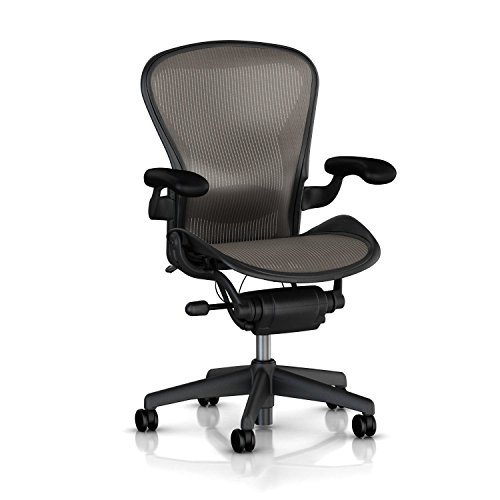
The Herman Miller Aeron Classic is the long-day benchmark because it removes the two things that fail first: foam and heat. Its Pellicle suspension seat and back conform to your shape, distribute pressure and dissipate the body heat that builds while you work — there is no cushion to compress, so the support at hour nine is the support from hour one. The patented Kinemat tilt lets your neck, shoulders, hips, knees and ankles pivot naturally as you shift, a lumbar pad supports the lower back, the waterfall seat front takes pressure off your thighs so circulation stays easy, and tilt limiter, seat-angle adjustment and fully adjustable arms let you tune the system to your day. It is Size B (Medium), under a 12-year warranty.
Strengths
- Suspension seating cannot pancake — the only construction whose long-day comfort is structurally guaranteed.
- Breathability is total: air passes through the seat and back, ending the warm-seat problem entirely.
- Kinemat tilt turns position change from an event into a continuous, supported drift.
Trade-offs
- Premium pricing — justified over a decade, felt today.
- Size B fits the middle of the population; outliers must verify fit or size within the line.
- No headrest, and a firm, floating sit that plush-chair lovers need a week to appreciate.
| Color | Graphite Frame / Lead Classic Pellicle |
| Size | Size B (Medium) |
| Dimensions | 17 x 27 x 42 inches |
| Weight | 48 pounds |
Owners describe the Aeron’s long-day effect in a distinctive way: not that the chair feels wonderful, but that the day does not accumulate. The suspension keeps pressure distributed so no single point ever becomes the story; the tilt keeps your joints in their natural chain so stillness never hardens into stiffness; the airflow keeps the microclimate neutral. By evening, the absence of complaints is the complaint-free review. That is what designing for hour eight instead of minute eight looks like, and it is why this chair, decades after its design, still anchors guides like this one.
The economics follow the engineering. A 12-year warranty and a parts ecosystem mean the Aeron is bought once per career chapter, while lesser chairs are bought once per lease. For the professional whose sitting is measured in years at the same desk, the cost per comfortable hour is the lowest in this guide by a wide margin.
Fit is the one homework item: Size B suits the broad middle, and Herman Miller’s size system exists because suspension fit is personal. Check the listing’s size guidance against your height and weight honestly, and the chair will do the rest for a very long time.
Best for: Professionals sitting 8+ hours who want support that cannot wear out its welcome / Not suited for: Plush-seat lovers or buyers far outside Size B
Choose it for the decade of long days; skip it if you want a headrest and a softer first impression — the ErgoX, next, offers both. Check on Amazon

FLEXISPOT ErgoX Premium Ergonomic Office Chair
Our badge: Best Premium
The FLEXISPOT ErgoX attacks the long day with adaptation. Its dynamic lumbar support maintains contact as you move between typing, calls and reading, so support never depends on returning to one perfect pose. The seat depth adjusts from 17 to 20 inches — critical across long days, because a too-deep seat slowly pulls you into a slouch as the hours pass — and the five-level back, 3D headrest and 3D armrests keep the rest of the fit personal. A nap footrest converts the chair into a genuine recovery seat, the tilt encourages drift, and the stated 400 lb limit for users 5’1″ to 6’2″ makes it the long-day chair for larger bodies as well.
Strengths
- Dynamic lumbar keeps support present through the position changes a long day is made of.
- Adjustable seat depth defends your posture against the afternoon slouch at its root.
- The nap footrest builds a real midday reset into the chair itself.
Trade-offs
- Premium tier — verify the current listing price against your budget.
- Stated fit range ends at 6’2″.
- Mesh and foam seat variants exist; confirm the configuration before ordering.
| Color | Black |
| Weight | 38 pounds |
The ErgoX’s long-day virtue is that it forgives. Real marathon sitting is not a held pose but a slow migration — upright, perched, reclined, crossed-legged, uncrossed — and chairs that support only the first position tax all the others. The ErgoX’s lumbar follows the migration, its headrest meets you when the migration reaches a reclined call, and its footrest dignifies the migration’s endpoint, the deliberate break. Workers who finish long days in this chair tend to credit not any single feature but the absence of the usual 4 p.m. negotiation with their own bodies.
The hardware story supports the hours: a class-4 gas lift that will not sink by lunch, premium materials, and a build FLEXISPOT positions for all-day use across office and home. For larger users, it is also the rare long-day chair whose rating (400 lb stated) exceeds the demand instead of merely meeting it.
If the Aeron is long-day sitting as engineering, the ErgoX is long-day sitting as hospitality — everything arranged, everything adjustable, nothing that requires you to be a particular shape to be comfortable. For most buyers with the budget, it is the most complete answer in this guide.
Best for: Marathon sitters who move through positions and want support that follows / Not suited for: Users over 6’2″ or strict budgets
Choose it for adaptive, all-day support; skip it if you prefer suspension’s permanence — the Aeron above — or a budget answer — the SIHOO below. Check on Amazon

Steelcase Series 1
Our badge: Best Set-and-Forget
The Steelcase Series 1 serves the long day by refusing to drift. Its weight-activated controls sense your body and set the recline behavior automatically, so the support you start the morning with is the support you finish with — no tension knob slowly forgotten, no settings war if the chair is shared between two long-day workers. Adaptive bolstering and flexible seat edges keep the sit pressure-free, optional 4D arms and a headrest exist within the line, and the chair weighs just 29 pounds and assembles without tools in under two minutes.
Strengths
- Automatic support that cannot be mis-set — the long day’s most reliable kind.
- Re-fits instantly between users, ideal for shared marathon desks.
- Compact and light, with Steelcase’s research-driven build.
Trade-offs
- Less manual control than the Ticova offers the precise fitter.
- Compact frame best suits small-to-average builds.
- Headrest is configuration-dependent; verify on the listing.
| Color | Graphite |
| Dimensions | 23.75 x 27 x 41.25 inches |
| Weight | 29 pounds |
Long days punish administration. Every control a chair demands is a control that will, by month three, sit wherever it was left — and a mis-set chair taxes its owner daily in small change. The Series 1 removes the tax. Its support arrives calibrated by physics rather than by memory, which is why shared-desk households and offices keep choosing it for the longest shifts: the chair is equally correct for the morning’s user and the evening’s.
The flexible edges matter across hours, too: pressure concentrates at seat edges during long sits, and Steelcase’s design softens exactly those boundaries. Combined with the adaptive back, the effect is a chair that feels less present at hour eight than most chairs feel at hour two.
For the worker whose long day is also a shared day — or whose patience for knobs is zero — this is the guide’s most frictionless answer, from a maker whose research credentials are the category’s gold standard.
Best for: Shared long-day desks and set-and-forget buyers / Not suited for: Large users or manual-control enthusiasts
Choose it for automatic endurance; skip it if you want to hand-fit every point. Check on Amazon

Ticova Ergonomic Office Chair
Our badge: Best for Precise Fitting
The Ticova Ergonomic Office Chair endures the long day by being fitted to it exactly. Its seat is 3.4 inches of high-density foam in a W shape with a waterfall front edge — density being the property that decides whether a foam seat still supports at hour eight or has become a hammock by lunch. The lumbar support adjusts in height and depth, the headrest in height and angle, the armrests in three dimensions with thick PU padding, and the back is breathable high-tensile mesh with a rocking range to 130 degrees. Ticova lists BIFMA testing and a static pressure test in its data.
Strengths
- High-density foam with published thickness — the foam specification that predicts hour-eight support.
- Lumbar depth control keeps support calibrated as your posture settles through the day.
- Mesh back handles the heat while the foam seat handles the cushioning — a hybrid built for long sessions.
Trade-offs
- Foam, however dense, ages faster than the Aeron’s suspension.
- The fitting process takes a patient week.
- The seat sleeps warmer than a full-mesh design in hot rooms.
| Color | Black |
| Weight | 17.5 kilograms |
The Ticova’s long-day argument is calibration. A long day is not one posture but a slow settling, and a chair whose lumbar can be deepened by a notch at 3 p.m. — when your back has relaxed into the day — meets the day where it actually is. The W-seat’s shaping spreads the load that hours concentrate, and the waterfall edge protects the backs of your thighs through the longest calls.
Ticova’s 30-day return policy suits the method: fit it across a week of real long days, and judge the fitted result. Buyers who do that homework routinely report the chair disappearing under them — the long-day compliment that matters.
At its tier, nothing else in this guide offers this depth of fit. If your long days are solo and your patience is real, the Ticova is your chair.
Best for: Solo long-day workers who fit precisely and sit long / Not suited for: Shared chairs or set-and-forget buyers
Choose it for calibrated endurance; skip it for automatic fit — Steelcase, above. Check on Amazon

Hbada P5 Ergonomic Office Chair
Our badge: Best for Breaks
The Hbada P5 makes the long day’s most underrated argument: the break is part of the chair’s job. Its working hardware is honest — an S-shaped backrest with adjustable lumbar support, a 2D headrest with 3.94 inches of height range and 40 degrees of swivel, adjustable armrests, a 3.35-inch seat-height span and recline to 135 degrees — and its pull-out footrest turns the pauses between work blocks into genuine position resets. Hbada states SGS certification and BIFMA testing, for users roughly 5′ to 5’10”.
Strengths
- The footrest institutionalizes recovery inside the longest days.
- Mesh S-curve back keeps support and airflow together for the working hours.
- Compact footprint fits the small rooms where long home-office days happen.
Trade-offs
- Stated fit range excludes taller users.
- Its seat is narrower than the SIHOO’s wide cushion.
- Break discipline is still yours — the chair offers the reset, you must take it.
| Color | Black |
| Weight | 44 pounds |
Consider two identical long days. In the first, the worker sits in one posture for ten hours in a marginally better chair. In the second, the worker sits in the P5 and takes three real breaks — reclined, feet up, spine unloaded — without leaving the room. The second day ends better, and it is not close. That is the P5’s design thesis, and for students, hybrid workers and anyone whose long days are self-directed, it is the most humane thesis in this guide.
The working hours are not neglected: the lumbar adjusts, the headrest genuinely travels, and the mesh keeps the back cool through the afternoon. Hbada’s installation guidance and repair-service promise round out a package that treats its buyers like long-term owners.
If your height fits its range and your long days include pauses you control, the P5 converts endurance from a test into a rhythm. That conversion is worth more than any single specification in this guide.
Best for: Self-directed long days with real breaks, in compact spaces / Not suited for: Tall users or break-free work cultures
Choose it for the rhythm; skip it if you are tall. Check on Amazon

SIHOO M18 Ergonomic Office Chair
Our badge: Best Budget
The SIHOO M18 proves the long day does not require a premium toll — it requires airflow, adjustable support and a base that will not quit. The M18 offers all three: a breathable mesh back, an adjustable lumbar support and headrest across four support points, 2D armrests and a wide cushion, for users roughly 5’6″ to 6’2″, with a stated 330 lb capacity, BIFMA testing and a three-year parts promise in its data.
Strengths
- Mesh airflow plus adjustable lumbar — the two long-day essentials, at a budget tier.
- Stated 330 lb capacity signals a base and lift built with margin for daily marathons.
- Wide cushion suits the long homework, office and gaming sessions its listing describes.
Trade-offs
- No lumbar depth control; long-day perfectionists will feel the Ticova’s pull.
- 2D armrests only.
- Petite users may find the seat deep across long days.
| Color | Charcoal |
| Weight | 31.53 pounds |
The M18’s long-day case is the absence of the usual budget failures. Its mesh does not heat-soak by hour five. Its lumbar is where you put it at hour one and still there at hour nine. Its cushion is wide enough that position variety — the long day’s method — is available rather than theoretical. And its capacity rating means the mechanism underneath is engineered with the margin that daily marathon use quietly consumes.
Assembly is eight steps, the parts promise covers the years, and the price tier leaves room for the desk-side investments — a riser, a footrest — that complete the long-day system. For students facing long study days and remote workers facing long workdays on real budgets, the M18 is this guide’s most respectful answer.
It will not out-last the Aeron or out-adapt the ErgoX. It will out-sit almost everything else at its tier, which is the comparison its buyers are actually making.
Best for: Budget buyers facing genuinely long days / Not suited for: Petite users or depth-control seekers
Choose it for endurance on a budget; skip it only when premium systems are honestly in reach. Check on Amazon
Comparison Table
| Pick | Seat Construction | Endurance Strategy | Standout | Check price on Amazon |
|---|---|---|---|---|
| Herman Miller Aeron | Pellicle suspension | Nothing to compress; total airflow | 12-year warranty | Check price on Amazon |
| FLEXISPOT ErgoX | Mesh or foam | Dynamic lumbar + depth fit | Nap footrest, 400 lb stated | Check price on Amazon |
| Steelcase Series 1 | Flexible-edge | Automatic, drift-free support | Weight-activated controls | Check price on Amazon |
| Ticova Ergonomic | 3.4 in high-density foam | Precise calibration | Lumbar height + depth | Check price on Amazon |
| Hbada P5 | Mesh | Built-in recovery breaks | Footrest + 135° recline | Check price on Amazon |
| SIHOO M18 | Wide cushion, mesh back | Essentials with margin | 330 lb stated capacity | Check price on Amazon |
How to Choose a Chair for Long Term Sitting
Grade the seat construction first
Ask one question before all others: what will this seat feel like at hour eight of month eight? Suspension answers “the same” (Aeron). High-density foam with a published thickness answers “nearly the same” (Ticova). Mesh answers “cool and consistent” (Hbada, SIHOO). Unspecified soft foam answers honestly too, if you listen: it will not feel like this for long. Buy the answer you can live with daily.
Insist on support that survives your positions
A long day is a migration across postures. Your chair’s support must exist at every stop: lumbar contact upright and reclined (dynamic or well-placed adjustable), arm support at typing and at rest, a headrest where your head lands on calls. Test the reclined positions during any trial — that is where long-day chairs are found out.
Treat breathability as a core spec
Heat is cumulative and distracting, and it grows across exactly the hours this keyword is about. Mesh and suspension backs are the engineering answer; if you choose foam or leatherette for other reasons, choose them knowing the afternoon will be warmer, and prefer them in cooler rooms.
Read the durability signals like a contract
Stated capacity, BIFMA testing, warranty length, parts promises. A chair bought for long days is bought for long years, and those four signals predict the second better than any review of the first. The Aeron’s 12-year warranty and the SIHOO’s parts promise are in this guide’s key takeaways for a reason.
Decide how your breaks will happen
If your breaks are walks and a sofa, buy pure sitting excellence (Aeron, Ticova). If your breaks happen at the desk, buy the chair that builds them in (Hbada’s footrest, ErgoX’s nap footrest). The honest answer to this question is worth more than a tier of price.
How Should a Long Day in a Chair Actually Be Structured?
Fit the chair first — feet flat, lumbar placed, arms at elbow height, recline tension carrying you — then structure the day around movement. A workable rhythm: upright focus blocks for typing; a slightly reclined posture for calls and reading; a genuine break each hour or two, standing and walking, even briefly; one longer midday reset, ideally out of the chair entirely, or in it with the footrest out and the recline open. Change the chair’s angle by task rather than by clock, and let the end of each block be the cue to move. None of this is medical instruction — it is the practical rhythm that the chairs in this guide were designed to support, and the difference it makes by evening is larger than the difference between any two chairs on this page.
Problem: You are comfortable until 3 p.m., then everything aches at once — the classic signature of a day without position change; add scheduled recline shifts and one real break before blaming the chair.
Problem: The seat feels harder every week — foam compression announcing itself; if the chair is young, that is a warranty conversation, and if it is old, it is the replacement signal this guide’s grading section predicted.
Problem: Your back is fine but your neck is not — look up: the screen is too low. Raise it to eye level and let the chair’s support do the job it was fitted for.
Problem: The lumbar pad migrates during the day — set it, then check its locking or strap tension; a pad that will not stay placed is a defect on a new chair, not a personality trait.
Hour One vs Hour Eight: How to Trial a Chair Honestly
Showroom sitting measures the wrong hour. If you are trialing through a return window — the honest way to buy any chair on this page — schedule the verdict properly: fit the chair on day one with the routine in this guide, then work three genuinely long days in it before judging. Notice the specific things hour eight reveals: whether the seat still supports or has become a hammock; whether the lumbar is where you left it; whether the room’s warmth has made the back a liability; whether the recline still invites the position changes that carry a long day. A chair that passes three long days will pass three hundred. A chair that merely charms a first afternoon is a coin you have not finished flipping.
The Desk, the Light and the Clock: Long-Day Allies
The chair’s partners matter across long hours. A screen at eye level removes the slow forward head drift that nine hours would otherwise compound. A footrest, for anyone whose desk height lifts their feet, keeps the pelvis honest into the evening. Side lighting prevents the lean-in squint. And the clock — used kindly, as a reminder to move rather than a warden — is the cheapest long-day accessory in existence. Assemble the whole system and the chair’s job becomes possible; neglect the partners and even the Aeron is fighting with one hand. Long-term sitting is a team sport, and this guide’s six chairs are simply its strongest players.
Long-Term Sitting for Students, Writers and Other Marathon Workers
The longest sitting days do not all wear office clothes. Students in exam season, writers on deadline, dispatchers, editors, programmers in a release crunch and gamers in a long campaign all run the same physiology through different furniture budgets, and the lessons of this guide transfer without translation. The student’s version of the Aeron decision is the SIHOO: mesh that breathes through a library-hot afternoon, a lumbar that can be placed, a rating that promises the chair survives the degree. The writer’s version is the Ticova or the Hbada — precision for the drafting hours, a footrest for the thinking pauses that are secretly part of the work. What none of them should do is the category’s classic error: buying a soft, cheap chair in September and wondering why December feels like a punishment. Long days are a known quantity in these lives; the chair should be bought like it.
Audit Your Current Chair Before You Replace It
Before spending anything, spend ten minutes auditing the chair you own, because a surprising share of “I need a long-day chair” is actually “my chair was never fitted” or “one part has faded.” Run the checks in order. The lift: sit at working height in the morning and measure again at lunch — a sink of an inch or more is a failed lift, replaceable on chairs from real makers. The seat: press and sit — if you can feel the frame’s structure through the cushion, the foam’s career is over, and no accessory restores it honestly. The lumbar: set it, work an hour, check whether it is still where you left it. The bolts: one loose mechanism bolt can impersonate a dying chair for months. The casters: flip and clean them before judging anything that rolls. If the audit finds one failed part on a good chair, order the part. If it finds two or more, or a chair that was never adequate, then shop this guide with a clear conscience — and keep the audit, because it is also how you will judge the new chair in year three.
The Economics of the Long Day: What an Hour of Comfort Costs
Run the arithmetic that purchasing departments run. A professional sitting 1,800 hours a year who buys a budget chair every two years spends, across a decade, a sum that approaches a single premium chair’s price — while spending those ten years in chairs that were each, for part of their short lives, already fading. The premium chair’s decade, warranted and suspension-seated, costs roughly the same money and none of the fade. The budget chair’s honest counter-argument is cash flow and uncertainty: a student or a new remote worker may not know where they will sit in three years, and for them the SIHOO’s strategy — real hardware, real rating, friendly tier, parts promise — is the rational play. The mistake is not buying budget or buying premium; it is buying without the arithmetic, on the strength of a showroom minute. Long-term sitting is the category where cost-per-hour is the only honest price tag, and every chair in this guide was chosen to survive that calculation at its tier.
There is a second ledger, harder to price and impossible to ignore: the quality of the hours themselves. A chair that ends the day with its support intact returns a worker to the evening with something left — for family, for exercise, for the life the work was funding. That return does not appear in any listing’s specification block, but it is the reason this keyword exists, and the reason the guide you are reading grades hour eight instead of minute eight. Buy for the evening, not for the unboxing.
Night Shifts and Irregular Hours: Long Sitting Off the Clock
A growing share of long-term sitting happens outside the nine-to-five: night-shift dispatchers and clinicians charting at 3 a.m., security and operations staff, creators editing through the night, parents working while the house sleeps. Their chairs face the standard long day plus two extra taxes — cold rooms at night, which make breathable mesh feel chilly and argue for the foam-seated Ticova or a chair throw kept at the desk, and irregular sleep, which makes the quality of every seated hour matter more, not less. The fitting and rhythm advice in this guide applies unchanged, with one addition: the midday reset becomes the mid-shift reset, and the Hbada’s and ErgoX’s built-in recline-and-footrest breaks are worth real money to a worker whose break room is a dark kitchen. If your long day is actually a long night, weight warmth and break quality a tier higher in your choice, and know that the support hardware — lumbar, arms, seat that cannot fade — matters exactly as much at 3 a.m. as it does at 3 p.m.
Common Buying Mistakes
Buying the softest chair in the store
Softness is an hour-one quality. By hour eight, unsupported softness is a slouch with upholstery. Grade seat construction by density, suspension or mesh — the properties that persist.
Judging by a short trial
Ten minutes cannot reveal compression, heat or support drift. Use return windows across real long days, and let hour eight cast the deciding vote.
Sitting in one position all day
No chair repeals physiology. The recline, the footrest and the hourly stand are features of the system — use them, or the best chair here will still lose to the clock.
Ignoring the warranty on a long-day purchase
Long days consume chairs faster. Warranty length and parts availability are long-day specifications; weigh them as heavily as the seat.
Blaming the chair for the desk’s sins
A low screen and dangling feet will defeat any chair by evening. Fit the desk partners before concluding the chair has failed.
Final Recommendation
For the longest days, the Herman Miller Aeron Classic remains the answer: suspension that cannot compress, airflow that cannot clog, movement that cannot lock you in — bought once, warranted for twelve years. If you want adaptation and a headrest with your endurance, the runner-up is the modern alternative: Check on Amazon for the FLEXISPOT ErgoX. Precise fitters should take the Ticova, sharers the Steelcase, break-takers the Hbada, and budget buyers the SIHOO — then structure the day with the rhythm above, and let hour eight be as unremarkable as hour one.
Frequently Asked Questions
What type of chair is best for sitting 10 hours a day?
One whose seat cannot compress (suspension like the Aeron, or high-density foam like the Ticova), whose back breathes, and whose support follows your position changes. Then structure the day with movement — the chair is half the system.
Is mesh better than foam for long sitting?
Mesh wins on heat and consistency; high-density foam wins on cushioned feel. Low-density foam loses to both by the afternoon. Choose by your room’s temperature and your honest preference, after the support hardware checks out.
How often should I stand if I have a great chair?
Briefly and regularly — a few minutes each hour or two is the rhythm most long-day workers settle into, with a longer break at midday. The chair makes sitting sustainable; movement makes the day sustainable.
Why does my chair feel worse in month three than week one?
Usually foam compression or a fitting that was never finished. Dense, suspension and mesh constructions resist the fade; if a young chair fades fast, use the warranty while it is a conversation rather than a eulogy.
Do I need a footrest for long days?
Two kinds exist: a small desk footrest if your feet dangle at working height (yes, get one), and a chair footrest for breaks (the Hbada and ErgoX build it in). They solve different problems and both earn their place.
Can a seat cushion rescue a chair that has gone soft?
Briefly, and at a price: a cushion restores height but changes the geometry — you sit higher relative to the lumbar support and armrests, which were fitted for the original seat. As a bridge of a few months on an otherwise sound chair, it is a reasonable tactic. As a strategy, it spends money to preserve a chair whose core has already given its verdict. The honest long-term answer is a seat construction that does not go soft: suspension, mesh, or high-density foam with a published specification.
What about kneeling chairs and saddle seats for long days?
They are legitimate position-changers and poor full-day answers for most people. As a second seat that rotates into the day for an hour at a time, a saddle or kneeling chair adds genuine variety — the currency this guide trades in. As the only chair, their lack of back support and their own pressure points usually lose the hour-eight test that this page grades by. Variety is the principle; no single alternative posture is the exception to it. The workers who sit longest and complain least are rarely the ones with the most exotic chair — they are the ones with a sound chair, honestly fitted, inside a day that includes more than one position. Build that day around any of this guide’s six picks and you have adopted the only long-term strategy the evidence of your own evenings will keep confirming: support that does not fade, in a rhythm that does not freeze, at a desk that does not fight you. Everything else in this long guide is commentary on those three clauses. If you remember nothing else from these pages, remember the order of operations they teach: audit before you buy, fit before you judge, move before you blame the chair. Long-term sitting will always be a demand — bodies were not consulted when the modern workday was designed — but it is a demand that can be met with engineering, patience and rhythm, which is to say, with exactly the six chairs and the handful of habits this guide has put in front of you. Start tomorrow, not with a purchase but with the audit of the chair already under you; let its verdict tell you whether you are shopping for a chair, a part, or merely a fitting you never finished. Whichever answer you get, you will be acting on evidence — and evidence, patiently gathered across a few real days, is the entire difference between the workers who keep buying chairs and the workers who bought one, fitted it properly, and then got on with the work and the life that the chair was only ever meant to support — quietly, comfortably, and for a very long time, which is the whole point of every page of this guide and every hour you will spend in the chair you choose from it, today and for years of long, well-supported days to come.
How does this guide relate to the other long-sitting guides?
This page argues the career and workplace case and leads with the suspended Aeron; its home-office sibling, Best Office Chairs For Long Sitting, argues the same standard through footprints, break design and personal budgets. Read the one that matches your room — the chairs are cousins, but the lives they are fitted to are different.
What is the longest-warranty chair in this guide?
The Herman Miller Aeron, at 12 years — one reason its premium pricing reads differently across a long-day career than it does across a single purchase.


