Disclosure: As an Amazon Associate, dailyhomedecorating.com earns from qualifying purchases. Links to Amazon on this page are affiliate links; they cost you nothing extra. Prices and availability change often, so check the current Amazon listing before you buy.
The best office chairs for long sitting share a secret that showroom sitting never reveals: comfort at hour six is a different product from comfort at minute six. The chairs that win the long sit are the ones whose support does not fade — a lumbar pad that stays where you placed it, a seat whose cushion or mesh holds its geometry, a back that breathes through the afternoon, and a tilt that lets your posture drift instead of locking it into a slow ache. This guide reviews six verified chairs graded by that standard specifically, in comfort terms only. It is the home-office companion to our workplace-wide look at Best Office Chairs For Long Term Sitting, narrowed here to the chairs that suit a home desk, a home budget and a home’s other uses.
Each pick below was checked in its manufacturer’s own listing data for the long-sitting evidence: adjustable lumbar support, seat construction with a durability story, breathability, recline range and stated capacity or testing. The FLEXISPOT ErgoX leads with dynamic support and a footrest; the Herman Miller Aeron in this guide is the aluminum-frame Classic with hardwood-floor casters, the other verified Aeron configuration in our pool; and the budget end is held by a SIHOO that refuses to behave like a budget chair. Back-first readers should cross-shop Best Home Office Chairs For Back Support, and the whole-room planners will find the desk’s context in Best Sofas And Chairs For Small Room.
Where to Buy
Every pick in this guide is sold on Amazon, where you can check the current price, configuration and availability. Start with the FLEXISPOT ErgoX Premium Ergonomic Office Chair — Check on Amazon. The other five picks: Herman Miller Aeron Classic (Aluminum) — Check on Amazon; Ticova Ergonomic Office Chair — Check on Amazon; Steelcase Series 1 — Check on Amazon; Hbada P5 — Check on Amazon; SIHOO M18 — Check on Amazon.
In this guide
Quick Picks
| Pick | Badge | Why it earns its place |
|---|---|---|
| FLEXISPOT ErgoX | Best Overall | Dynamic lumbar that follows you for hours, adjustable seat depth, a nap footrest and a stated 400 lb limit. |
| Herman Miller Aeron Classic — Aluminum | Best Premium | The fully loaded Classic: tension control, tilt lock, forward tilt and lumbar support in the original long-sit design. |
| Ticova Ergonomic Office Chair | Best for Precise Fitting | 3.4-inch high-density foam seat and lumbar in height and depth — a fitted chair that stays fitted. |
| Steelcase Series 1 | Best Set-and-Forget | Weight-activated support that never drifts out of adjustment across a long day — or a long year. |
| Hbada P5 | Best for Breaks | A footrest and 135-degree recline build real recovery into a long home-office day. |
| SIHOO M18 | Best Budget | Mesh airflow, adjustable lumbar and a stated 330 lb capacity — long-sitting essentials at a home-friendly tier. |
Key Takeaways
- Long sitting punishes fade: choose support that cannot drift (dynamic lumbar, weight-activated recline) or that locks honestly (depth-adjustable pads, dense foam).
- Seat depth is the long-sitter’s hidden variable — the ErgoX adjusts it from 17 to 20 inches, and that range is worth more than any cushion.
- Breathability is an hours-long feature: mesh backs dominate this guide because heat is the complaint that grows fastest.
- Breaks are part of the chair’s job description at home, where no meeting room rescues you — footrest models (ErgoX, Hbada) build the reset in.
- Fit the chair across a week of real long days before judging; the return window is the honest showroom for this keyword.
How These Picks Were Chosen
We filtered for long-sitting evidence in the pool’s verified data: lumbar systems described as adjustable or dynamic; seat constructions with a stated density, suspension or mesh story; recline ranges that support position change; and durability signals — stated capacities, BIFMA testing, warranty weight. We then weighted the home-office context: footprints that suit spare rooms, styles that can live in a home, and break features that matter where the chair is also the room’s best seat.
Excluded: plush chairs whose long-sitting story is a thick first sit; gaming chairs whose bolsters ration posture variety; and any chair whose listing could not document its seat or support. One framing note: this guide deliberately overlaps its workplace sibling (Best Office Chairs For Long Term Sitting) on some models, because the best long-sitting chairs are the best in both rooms — but the lead, the Aeron configuration and the home-specific guidance here are this page’s own. Comfort is discussed as comfort throughout. For the strict-budget cut, see Best Home Office Chairs Under $100; for support-first shopping, Best Office Chairs For Support.
The 6 Best Office Chairs for Long Sitting — Reviewed

FLEXISPOT ErgoX Premium Ergonomic Office Chair
Our badge: Best Overall
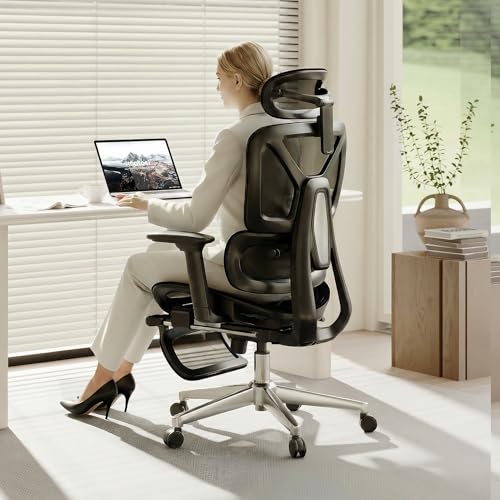
The FLEXISPOT ErgoX leads this guide because long sitting is a moving target and it is built to track it. Its dynamic lumbar support maintains contact as your posture migrates through the day — upright for typing, perched for focus, reclined for calls — while the seat depth adjusts from 17 to 20 inches so your back actually reaches that support at hour six as surely as at hour one. A five-level adjustable back, a 3D headrest, 3D armrests, a tilt system and a nap footrest complete the kit, and the stated maximum of 400 lb for users 5’1″ to 6’2″ gives the whole system a hardware margin that long daily hours quietly consume.
Strengths
- Dynamic lumbar support — the anti-fade technology for the longest sits.
- Adjustable seat depth defends against the afternoon slouch at its mechanical root.
- The nap footrest turns the midday pause into genuine recovery without leaving the room.
Trade-offs
- Premium tier within this guide — verify the current listing price.
- Stated fit range ends at 6’2″.
- Mesh and foam seat configurations exist; confirm the listing’s configuration before ordering.
| Color | Black |
| Weight | 38 pounds |
The home-office long day has a particular shape: no commute to break it, no meeting rooms to migrate to, just one chair and one room from morning to evening. The ErgoX is designed for that shape. Its support follows you so faithfully that the day’s posture changes stop being events; its footrest dignifies the breaks that home workers otherwise skip; its headrest meets you on the long afternoon call. Owners describe the effect cumulatively — not a dramatic sit, but a day that does not accumulate.
The build underneath matches the brief: a class-4 gas lift that holds its height past lunch, premium materials, and a maker who positions the chair for all-day use. For larger users, the 400 lb stated limit makes it the long-sitting chair with headroom to spare.
If your home office is your career’s headquarters and your sitting is measured in years, this is the guide’s most complete answer — the chair the other five are value judgments against.
Best for: Home professionals sitting 8+ hours who want support that adapts all day / Not suited for: Users over 6’2″ or strict budgets
Choose it for adaptive endurance; skip it for the Aeron’s suspension permanence or the SIHOO’s tier. Check on Amazon
Herman Miller Aeron Classic — Aluminum Frame
Our badge: Best Premium
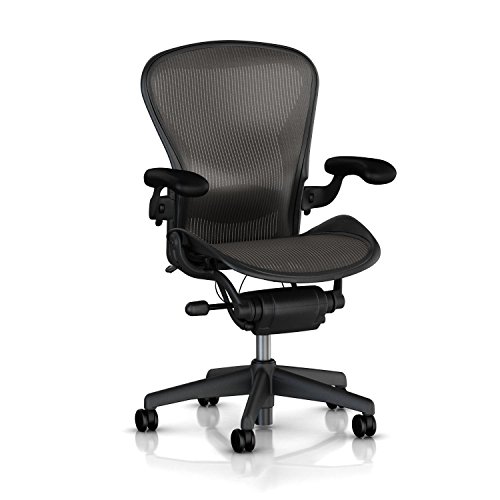
This Herman Miller Aeron Classic is the pool’s second verified Aeron configuration: the aluminum-frame, fully loaded Classic in Size B (Medium), with tension control, rear tilt lock, forward tilt and lumbar support among its listed features, and hardwood-floor casters in this configuration. The long-sitting case is the Aeron case everywhere: a suspension seat and back that cannot compress into a wrong shape, a tilt engineered around the body’s natural pivots, and materials that breathe through the longest afternoon.
Strengths
- Suspension seating removes foam fade from the long-sitting equation entirely.
- Forward tilt is a long-sitter’s specialist tool — it keeps the back engaged during focused, perched work.
- The fully loaded configuration includes the tilt lock and tension control that let you tune the day’s rhythm.
Trade-offs
- Premium pricing — a career-scale purchase.
- Size B fits the population’s middle; verify fit against the listing’s size guidance.
- This configuration’s casters are specified for hardwood floors — carpeted rooms should see our carpet guide or plan a mat.
| Color | Black |
| Size | Size B (Medium) |
| Dimensions | 16 x 27 x 41 inches |
| Weight | 50 pounds |
What the Aeron offers the long sitter is permanence of experience: the chair at hour eight of year five sits like the chair at hour one of week one, because its support is a tensioned membrane rather than a material that tires. The forward tilt deserves its specific praise — most chairs support upright and reclined, but focused computer work lives in the slight forward perch between them, and the Aeron is engineered for exactly that forgotten position.
The aluminum frame and fully loaded mechanism make this configuration the collector-grade version of an already serious chair. In a home office with hardwood floors — the configuration’s stated caster pairing — it is a complete, decade-scale answer to this keyword.
Buy it as infrastructure, fit it once with the routine in this guide, and let the years accumulate in the chair’s favor rather than against it.
Best for: Hardwood-floored home offices wanting the permanent long-sit chair / Not suited for: Carpeted rooms without a mat, or starter budgets
Choose it for the decade; skip it if your floor or budget argues otherwise. Check on Amazon

Ticova Ergonomic Office Chair
Our badge: Best for Precise Fitting
The Ticova Ergonomic Office Chair sits long by being fitted exactly. Its seat is 3.4 inches of high-density foam in a W shape with a waterfall front edge — density being the property that decides whether a foam seat still supports at hour eight — while the lumbar support adjusts in height and depth, the headrest in height and angle, and the armrests in three dimensions with thick PU padding. The back is breathable high-tensile mesh, the rocking range runs to 130 degrees with adjustable resilience, and Ticova lists BIFMA testing and a static pressure test in its data.
Strengths
- High-density foam with a published thickness — the foam spec that predicts long-sit support.
- Lumbar depth control lets support be re-tuned as your posture settles through the day.
- Mesh back plus foam seat: the hybrid construction long home-office days reward.
Trade-offs
- The fitting process takes a patient week of small adjustments.
- Foam ages faster than the Aeron’s suspension, however dense.
- The seat sleeps warmer than a full-mesh design in hot rooms.
| Color | Black |
| Weight | 17.5 kilograms |
The Ticova’s long-sitting argument is calibration across time. A long day is a slow settling of the body, and a chair whose lumbar can be deepened a notch at mid-afternoon meets the day where it has arrived. The W-seat spreads the load that hours concentrate, and the waterfall edge keeps the backs of your thighs out of the pressure story entirely.
Ticova’s listed 30-day return policy suits the method: fit across a week of real long days, then judge. Buyers who do that homework routinely report the chair disappearing beneath them — the long-sitter’s highest compliment.
At its tier, nothing else here offers this depth of fit; the Ticova is the precise instrument among the guide’s philosophies.
Best for: Solo home-office workers who fit precisely and sit long / Not suited for: Shared chairs or impatient fitters
Choose it for calibrated endurance; skip it for automatic fit — Steelcase, next. Check on Amazon

Steelcase Series 1
Our badge: Best Set-and-Forget
The Steelcase Series 1 serves long sitting by refusing to drift out of tune. Its weight-activated controls sense the sitter’s body and set the recline behavior automatically, so the support at 9 a.m. is the support at 6 p.m. — and, in a shared home office, the support for whoever sat down last. Adaptive bolstering and flexible seat edges keep the sit pressure-free, optional 4D arms and a headrest exist within the line, and the chair weighs 29 pounds and assembles without tools in under two minutes.
Strengths
- Automatic calibration — support that cannot be mis-set or forgotten.
- Instantly re-fits between users, ideal for shared long-day desks.
- Compact, light and Steelcase-built, with research behind every curve.
Trade-offs
- Fewer manual controls for the precision-minded.
- Compact frame best suits small-to-average builds.
- Headrest availability depends on configuration — verify on the listing.
| Color | Graphite |
| Dimensions | 23.75 x 27 x 41.25 inches |
| Weight | 29 pounds |
Long days punish administration: every knob a chair demands is a knob sitting wherever it was last left. The Series 1 removes the tax entirely, and across months that frictionlessness compounds into the thing long sitters actually want — a chair that is never the reason the day feels long. Its flexible edges deserve their mention too: pressure concentrates at seat boundaries over hours, and Steelcase softens exactly those boundaries.
For the home office that doubles as a household workstation, the self-fitting behavior is the deciding feature: the chair is equally correct for the morning’s worker and the evening’s student, with no settings war between them.
It is the guide’s most frictionless answer, from the maker whose research program defined the category’s standards.
Best for: Shared desks and set-and-forget long sitters / Not suited for: Large users or manual-control enthusiasts
Choose it for automatic endurance; skip it if you want to hand-fit every point. Check on Amazon

Hbada P5 Ergonomic Office Chair
Our badge: Best for Breaks
The Hbada P5 makes the home long day’s wisest argument: the break is part of the chair’s job. Its working support is genuine — an S-shaped backrest with adjustable lumbar support, a 2D headrest with 3.94 inches of height travel and 40 degrees of swivel, adjustable armrests and a 3.35-inch seat-height span — and its recline to 135 degrees plus pull-out footrest converts the pauses into real recovery. Hbada states SGS certification and BIFMA testing, for users roughly 5′ to 5’10”.
Strengths
- The footrest institutionalizes the midday reset inside a long home day.
- Generous, published headrest adjustment for call-heavy afternoons.
- Compact footprint suits the spare-room offices where long home days happen.
Trade-offs
- Stated fit range excludes taller users.
- Narrower sit than the SIHOO’s wide cushion.
- The chair offers the break; the discipline to take it remains yours.
| Color | Black |
| Weight | 44 pounds |
Consider two identical long home days: in one, the worker sits in a marginally better chair without pause; in the other, the worker sits in the P5 and takes three genuine reclined breaks without leaving the room. The second day ends better, and it is not close. That is the P5’s thesis, and for students, hybrid workers and the self-directed, it is the most humane design in this guide.
The working hours are not shortchanged — the lumbar adjusts, the headrest travels, the mesh breathes — and Hbada’s installation guidance and repair-service promise treat the buyer as a long-term owner.
If your height fits its range and your long days are yours to structure, the P5 converts endurance from a test into a rhythm.
Best for: Self-directed long days with real breaks, in compact home offices / Not suited for: Tall users
Choose it for the rhythm; skip it if you are tall. Check on Amazon

SIHOO M18 Ergonomic Office Chair
Our badge: Best Budget
The SIHOO M18 proves the long home day does not require a premium toll — it requires airflow, adjustable support and a base that will not quit. The M18 offers all three: a breathable mesh back, adjustable lumbar support and headrest across four support points, 2D armrests and a wide cushion, for users roughly 5’6″ to 6’2″, with a stated 330 lb capacity, BIFMA testing and a three-year parts promise in its data.
Strengths
- Mesh airflow plus adjustable lumbar — the two long-sitting essentials at a budget tier.
- Stated 330 lb capacity signals margin for daily marathon use.
- Wide cushion suits long homework, office and gaming sessions alike.
Trade-offs
- No lumbar depth control — the Ticova is the upgrade path.
- 2D armrests only.
- Petite users may find the seat deep across a long day.
| Color | Charcoal |
| Weight | 31.53 pounds |
The M18’s long-day case is the absence of the usual budget failures: its mesh does not heat-soak by hour five, its lumbar is where you left it at hour nine, its cushion is wide enough that position variety — the long day’s method — is actually available. Its capacity rating means the mechanism underneath carries the margin that daily marathons quietly spend.
Assembly is eight steps, the parts promise covers the years, and the tier leaves room for the desk-side investments that complete the home system. For students and remote workers on real budgets, it is this guide’s most respectful answer.
It will not out-adapt the ErgoX or out-last the Aeron. It will out-sit nearly everything at its tier, which is the comparison its buyers are actually making.
Best for: Budget buyers facing genuinely long home-office days / Not suited for: Petite users or depth-control seekers
Choose it for endurance on a budget; skip it only when premium systems are honestly within reach. Check on Amazon
Comparison Table
| Pick | Support System | Seat | Long-Sit Strategy | Check price on Amazon |
|---|---|---|---|---|
| FLEXISPOT ErgoX | Dynamic lumbar | Mesh or foam, depth-adjustable | Adaptation + footrest | Check price on Amazon |
| Herman Miller Aeron | Suspension + lumbar pad | Pellicle suspension | Nothing to fade | Check price on Amazon |
| Ticova Ergonomic | Lumbar height + depth | 3.4 in high-density foam | Precise calibration | Check price on Amazon |
| Steelcase Series 1 | Weight-activated | Flexible-edge | Drift-free automation | Check price on Amazon |
| Hbada P5 | S-curve + adjustable lumbar | Mesh | Built-in breaks | Check price on Amazon |
| SIHOO M18 | Adjustable lumbar | Wide cushion, mesh back | Essentials with margin | Check price on Amazon |
How to Choose an Office Chair for Long Sitting at Home
Grade the seat by its eighth hour
Ask of every candidate: what is this seat made of, and what will it feel like at hour eight of month eight? Suspension answers “identical” (Aeron). High-density foam with a published thickness answers “nearly” (Ticova). Mesh answers “cool and consistent” (Hbada, SIHOO). Unspecified softness answers too, if you listen: it will not feel like the showroom for long. Buy the answer you can live with daily.
Follow the lumbar
Long sitting is a migration, and your support must exist at every stop. Dynamic systems (ErgoX) follow automatically; two-axis pads (Ticova) can be re-placed as the day settles; automatic systems (Steelcase) never leave the correct setting because they never had one. Fixed bumps are the only wrong answer at this keyword.
Count breathability as a core spec
Heat compounds across hours in a way it never does across minutes. Mesh and suspension backs dominate this guide because the long home day — in a spare room, in summer, with the door closed for calls — is a warm environment. Choose foam with your room’s temperature honestly in mind.
Decide where your breaks live
At home, no corridor or meeting room rescues you; the break must be designed. If your breaks are walks and a sofa, buy pure sitting excellence. If they happen at the desk, buy the chair that builds them in — the ErgoX’s nap footrest or the Hbada’s recline-and-footrest combination. The honest answer is worth a tier of price.
Read the durability paperwork like a lease
Stated capacity, BIFMA testing, warranty and parts promises predict year three better than any first sit. A home-office chair is bought for long years as well as long days; the paperwork is the only part of the listing that speaks about the years, so let it speak loudly in your decision.
How Should a Long Home-Office Day Be Structured?
Fit the chair first — feet flat, lumbar placed, arms at elbow height, recline tension carrying you — then give the day a rhythm the chair can support. A pattern that works for most home workers: upright focus blocks for typing; a slightly reclined posture for calls and reading; a genuine stand-and-walk break each hour or two; one longer midday reset, ideally out of the room, or in the chair with the footrest out. Change the chair’s angle by task rather than by clock, and let the end of each work block cue the movement. None of this is medical instruction — it is the practical structure the chairs in this guide were designed to serve, and the difference it makes by evening exceeds the difference between any two chairs on this page.
Problem: Everything feels fine until mid-afternoon, then nothing does — the signature of a day without position change; add scheduled recline shifts and one real break before blaming the chair.
Problem: The seat feels harder every month — foam compression announcing itself; on a young chair that is a warranty conversation, on an old one it is the replacement signal.
Problem: Your neck tires while your back is fine — look up: the screen is too low. Raise it toward eye level and let the fitted chair do its job.
Problem: The lumbar pad is never where you left it — check its lock or strap tension; a migrating pad on a new chair is a defect to report, not a trait to tolerate.
Home Office vs Workplace: Why This Guide Argues Differently
The home long day differs from the office long day in ways that change the purchase. There is no facilities team, so durability and parts promises matter more — the chair’s support system is you. There is no commute or meeting migration, so break design moves into the chair itself. The room is smaller and doubles as something else, so footprints and second lives matter — every pick here can face a guest without apologizing. And the budget is personal, which makes the honest budget pick — the SIHOO, with its rating and parts promise — a first-class citizen rather than a compromise. Readers moving between this guide and its workplace sibling will find the same chairs argued on these different grounds; that is not repetition, it is the same evidence weighed by a different life.
The Fitting Week: A Home Ritual for a Long-Sitting Chair
Keep a note by the desk for the first week — one line a day. Day one: factory settings, honest discomforts noted, nothing fixed yet. Day two: height and depth. Day three: lumbar placement. Day four: recline tension and angle. Day five: armrests. Day six: the headrest, tested on real calls. Day seven: read the week, keep what the afternoons praised, undo what only sounded right. Then re-torque the bolts — the chair has settled under real load — and file the final settings where you can find them after any move. Ninety seconds a day of homework buys the difference between a chair that was assembled and a chair that was fitted, and for long sitting, that difference is the entire product.
The Science of the Seat: Pressure, Time and Why Density Wins
Sitting comfort across hours is, at bottom, a pressure story. Your weight leaves the chair through a few square inches of contact, and everything a seat does — foam density, W-shaping, waterfall edges, suspension tension — is an attempt to spread that load across more area for more hours without the material giving up. Foam spreads load by deforming, which is why its density is destiny: low-density foam deforms generously in week one and permanently by month six, while high-density foam deforms less, later, and recovers between sittings. Mesh spreads load by tension, trading cushion for consistency and airflow. Suspension spreads it by physics — a membrane whose tension answers in proportion to pressure — which is why the Aeron’s seat feels the same in year five: there is nothing in it that knows how to tire. The practical translation for shoppers is the grading habit this guide has used throughout: ask what the seat is made of, ask whether the maker publishes the number that matters (density, thickness, material), and distrust any seat whose entire specification is the word “thick.” Thickness is a photograph; density is a forecast.
Long Sitting in Small Homes: The Chair as the Room’s Second Job
In a small home, the office chair is never only an office chair. It hosts the guest at dinner, holds the laundry on Sunday, becomes the gaming seat at night and the reading chair on the rainy afternoon — and a long-sitting chair bought for a small home should be chosen with that second life in view. The picks in this guide were weighted accordingly: footprints that suit spare rooms, styles that can face a living room without apologizing, and mechanisms simple enough that a guest can sit without a tutorial. The Steelcase’s automatic fit is the extreme case of guest-readiness — it supports whoever sits, immediately, which in a small home is most weeks’ reality. The Hbada’s footrest makes it the room’s best nap seat; the SIHOO’s tidy profile lets it disappear against a wall. Even the Aeron, the most single-minded chair here, earns its footprint by being the room’s one permanent, beautiful object rather than its largest problem. Buy the long-sitting chair your whole home can use, and the hours it spends not being sat in for work stop being wasted space — they become the margin that makes a small home feel furnished instead of stored.
The Home Office’s Other Hours: Reading, Gaming and the Evening Shift
A home-office chair’s long day rarely ends at the end of work. The same seat hosts the evening’s gaming, the weekend’s photo editing, the novel’s last fifty pages — and a chair chosen only for typing posture will be judged, nightly, on everything else. This is the deeper reason the guide’s leaders are versatile machines: the ErgoX’s footrest and recline serve the evening as faithfully as the afternoon call; the Hbada was designed for the double shift outright; even the Aeron’s tilt makes it a surprisingly fine reading chair, because reading is reclining with a book. When you trial a chair during its return window, sit the evening in it too — a film’s length, a game’s session — because the home chair’s real specification is the whole day it will actually live, and the households that test both shifts are the ones still pleased in year two. The work-only chair is a workplace luxury; at home, versatility is a form of durability.
What to Do When the Chair Is Right and the Day Still Hurts
An honest guide ends its advice where its competence ends, and this is that paragraph. If you have fitted a chair from this guide across a patient week, structured the day with movement, raised the screen and supported the feet — and discomfort persists or worsens — the remaining variable is not furniture. Persistent pain is information for a clinician, and this page’s comfort guidance is not a substitute for that conversation. The chair will keep doing its honest part of the job in the meantime: supporting, breathing, enduring. Buy it for comfort, use it with rhythm, and let professionals handle the rest — that division of labor is the most supportive recommendation in this entire guide.
A Year of Long Days: The Chair’s Calendar
Long sitting is measured in years as much as hours, and a chair kept well across its calendar outlasts a better chair neglected. Quarterly, the ritual is five minutes: re-torque the assembly bolts, which loosen under daily load cycles; check the lift by sitting and rising once, listening for the sigh of a weakening cylinder; run a hand over the seat and back for the early signs of compression or mesh slack; vacuum the mechanism and the caster wheels, whose hair-and-grit burden is the home office’s silent friction. Seasonally, deep-clean the upholstery or mesh as the maker directs, and re-check the fitting — bodies change across a year, and the chair’s settings should be re-earned, not inherited. Annually, read the warranty and parts position with fresh eyes: what would a failure cost you today, and does the maker’s parts promise still cover it? The chairs in this guide were chosen partly for how well they survive this calendar — stated capacities, published testing, parts promises, a suspension that cannot sag — but every chair rewards the household that keeps the appointments. The long day is won at the desk; the long year is won on the calendar.
The Long Day, Hour by Hour: A Worked Example
To make this guide’s advice concrete, here is one long home day, sat well. Eight o’clock: upright in the fitted chair, feet flat, lumbar placed, the first deep-work block — the chair invisible, which is its morning job. Ten: a call block, recline eased back a few degrees, headrest meeting the head, notes on the desk — the first deliberate position change of the day. Eleven-thirty: stand, water, a window — the chair empty, doing nothing, which is also its job. One o’clock: the midday reset — footrest out or sofa taken, twenty honest minutes — then back, recline restored, the afternoon’s first block begun on a genuinely rested base. Three: the slump hour, met with the day’s second position change and a lumbar nudge deeper, because the body has settled and the chair that can be re-placed earns its keep precisely now. Five: admin and messages in the reading recline. Six-thirty: done — and the honest test of the whole system is that nothing in the day’s account is owed to the chair: no stiffness to walk off, no seat to escape, just a day’s work, finished. No single feature produced that day. The fitted chair, the rhythm, the breaks and the desk’s half of the geometry produced it together — which is why this guide sells systems and rituals, and only incidentally chairs.
Common Buying Mistakes
Buying the softest chair in the store
Softness is an hour-one quality; by hour eight, unsupported softness is a slouch with upholstery. Grade seats by density, suspension or mesh — the properties that persist.
Judging by one short day
A long-sitting chair must be trialed across long days — three of them, fitted — before the verdict. The return window is this keyword’s only honest showroom.
Sitting in one position all day
No chair repeals the need to move. The recline, the footrest and the hourly stand are features of the system; use them, or the best chair here still loses to the clock.
Ignoring the warranty on a marathon purchase
Long days consume chairs faster than short ones. Warranty length and parts availability are long-sitting specifications — weigh them like the seat itself.
Blaming the chair for the desk’s sins
A low screen and dangling feet will defeat any chair by evening. Fit the desk’s half before concluding the chair has failed.
Final Recommendation
For most home offices, the FLEXISPOT ErgoX is the long-sitting answer: dynamic lumbar, adjustable depth, a nap footrest and a stated 400 lb limit in one adaptive system. For the permanent, hardwood-floored installation, the runner-up is the classic: Check on Amazon for the fully loaded Aeron. Precise fitters should take the Ticova, sharers the Steelcase, break-takers the Hbada, and budget buyers the SIHOO with confidence. Fit the winner across a week, structure the day with rhythm, and let hour eight feel like hour one — that, in a single sentence, is the whole discipline this guide exists to teach, and every chair on this page was chosen because it makes that sentence achievable in a real home office.
Frequently Asked Questions
What makes a chair good for long sitting, specifically?
Support that does not fade: a seat that cannot compress (suspension, dense foam, mesh), a lumbar that stays placed or follows you, breathability for the warm hours, and a recline that invites position change. This guide’s six picks each deliver that package by a different route.
How is this guide different from the long-term-sitting guide?
Same standard, home lens: this page weights footprints, break design, second lives and personal budgets, leads with the ErgoX, and uses the pool’s aluminum Aeron configuration. The workplace sibling argues for shared and career settings.
Is a footrest actually useful for long sitting?
For breaks, genuinely — it converts the pause into a posture reset without leaving the room. For working hours, feet belong flat on the floor (or on a small desk footrest if you are shorter). The ErgoX and Hbada build the break kind in.
How long should a long-sitting chair last?
With daily marathon use, a verified pick should serve years in its prime; suspension designs (Aeron) measure that prime in a decade-plus, backed by warranty. Stated capacity headroom and parts availability are the predictors to shop by.
My chair feels fine in the morning and wrong by evening — is it the chair?
First check the day, then the chair: position variety and one real break fix most evening declines. If the decline survives a structured day, check the lift for sinking and the seat for compression — the two mechanical confessions.
What should I do in the first week with a new long-sitting chair?
Fit it one change per day, keep a one-line diary of the afternoons, and sit your real long days in it — including one evening session — before judging. Re-torque the bolts at week’s end, record the final settings, and only then decide whether the chair has earned its place or the return window should be used. The week is the purchase’s second half; skipping it is how good chairs get returned and mediocre ones get kept by default.
What is the single best habit for long sitting?
Changing position before discomfort asks you to. Every system in this guide — recline, footrest, dynamic lumbar — exists to make that change easy and frequent, and the workers who end long days well are the ones who treat position as a rotation rather than a residence. The chair supplies the options; the habit spends them.
Should I keep my old chair as a backup?
In a home with the space, an old chair demoted to the guest desk or the evening gaming spot is a sensible second act — and a useful control in the first weeks, since sitting one afternoon back in the old chair teaches you more about the new one than any review. In a small home, though, the honest answer is usually to pass it on: the footprint a retired chair occupies is rent paid to the past, and the new chair was bought precisely to end that arrangement.
Does chair color or style matter for long sitting?
Only through the room: a chair you are pleased to live with gets maintained, fitted and kept, while one that irritates the eye gets neglected and replaced early. In a home office that doubles as a living space, that makes style a quiet durability factor — choose the version of the right chair that your room welcomes.
How do I know when a long-sitting chair needs replacing?
By its confessions: a lift that sinks or sighs under you, a seat that has compressed into its frame’s shape, a lumbar that will not hold its setting, a tilt that grinds or lists. Any one of them, confirmed across a week, means the chair’s long days are done — and the replacement should be bought with this guide’s paperwork test in hand, because the chair that confesses earliest is usually the one whose maker published the least. Chairs replaced on schedule, before the slow decline taxes a season of workdays, are cheaper than chairs replaced in surrender.
Can a budget chair really handle long sitting?
The SIHOO M18 in this guide exists to prove it can: mesh airflow, adjustable lumbar and a stated 330 lb capacity with a parts promise. What budget cannot buy is fade-proofing forever — expect a shorter prime, honestly priced.


