Disclosure: As an Amazon Associate, dailyhomedecorating.com earns from qualifying purchases. Links to Amazon on this page are affiliate links; they cost you nothing extra. Prices and availability change often, so check the current Amazon listing before you buy.
The best office chairs for comfort and posture succeed at a subtle job: they make the easy position the right position. Posture is not a pose you hold by willpower for eight hours — it is whatever your chair makes effortless. A seat at the right height, a lumbar support in the curve of your back, armrests that let your shoulders drop, a backrest that moves with you when you lean and think: get those right and good posture stops being a discipline and becomes the default. This guide reviews six verified chairs built around that idea, in comfort terms only — nothing here is medical advice, and ongoing pain belongs with a professional.
Each pick below earns its place with specific, documented fit hardware rather than adjectives, and each is argued for a different kind of sitter, because the restless mover and the still, deep-focus worker need different chairs. For the back-and-neck-first shortlist see Best Office Chairs For Back And Neck Support, for the longest sessions Best Office Chairs For Long Term Sitting, and for the workstation around the chair, Best Sofas And Chairs For Small Room helps with compact room layouts.
Where to Buy
Every pick in this guide is sold on Amazon, where you can check the current price, configuration and availability. Start with the FLEXISPOT ErgoX Premium Ergonomic Office Chair — Check on Amazon. The other five picks: Herman Miller Aeron Classic — Check on Amazon; Ticova Ergonomic — Check on Amazon; Steelcase Series 1 — Check on Amazon; Hbada P5 — Check on Amazon; SIHOO M18 — Check on Amazon.
In this guide
Quick Picks
| Pick | Badge | Why it earns its place |
|---|---|---|
| FLEXISPOT ErgoX | Best Overall | Dynamic lumbar that follows movement, adjustable seat depth and a 3D headrest — posture support that adapts instead of posing you. |
| Herman Miller Aeron Classic | Best Premium | Pellicle suspension and Kinemat tilt make natural movement the chair’s whole design philosophy, backed by a 12-year warranty. |
| Ticova Ergonomic Office Chair | Best for Precise Fitting | Lumbar height and depth, 3D arms and an angled headrest — the chair for people who will dial in every point. |
| Steelcase Series 1 | Best Set-and-Forget | Weight-activated controls set recline behavior automatically — posture support with zero knob management. |
| Hbada P5 | Best for Work-Break Balance | S-curve back and adjustable headrest for work, plus a footrest and 135-degree recline for real breaks. |
| SIHOO M18 | Best Budget | Four support points and adjustable lumbar at a budget-tier position, with a stated 330 lb capacity. |
Key Takeaways
- Comfort and posture are the same purchase: a chair fitted to your body (seat depth, lumbar placement, arm height) makes upright, relaxed sitting the path of least resistance.
- Movement beats stillness — dynamic lumbar (ErgoX), kinematic tilt (Aeron) and weight-activated recline (Steelcase) all support posture by allowing it to change.
- Seat depth is the underrated fit number: the ErgoX adjusts it from 17 to 20 inches, solving the slouch that too-deep seats cause.
- A footrest model like the Hbada P5 supports the other half of posture — genuine breaks that reset your position through the day.
- Budget is no excuse for a posture-free chair: the SIHOO M18’s adjustable lumbar outperforms decorative “ergonomic” shaping at any price.
How These Picks Were Chosen
We selected for fit hardware with documented ranges: lumbar supports that adjust, seat depths that adjust or are honestly sized, headrests that move, armrests that meet the forearms, and recline systems that encourage position change. Marketing language about “ergonomic design” without a single adjustable support point was disqualifying. We also favored chairs whose comfort story survives year two — suspension membranes, tensioned mesh, high-density foam with published thickness — over chairs whose comfort is a soft first week followed by a slow collapse.
The six picks deliberately span philosophies, because posture is personal: adaptive (ErgoX, Steelcase), precise (Ticova), suspended (Aeron), restorative (Hbada) and value (SIHOO). What was excluded: gaming-styled chairs whose bolsters force one posture and punish every other, and executive chairs whose posture story is a thick cushion and a hope. Readers whose needs are primarily about body size rather than posture mechanics should cross-shop Best Office Chairs For Large People, and those furnishing a shared family workspace may like the durability-first thinking in Best Sofas For Homes With Kids.
The 6 Best Office Chairs for Comfort and Posture — Reviewed

FLEXISPOT ErgoX Premium Ergonomic Office Chair
Our badge: Best Overall
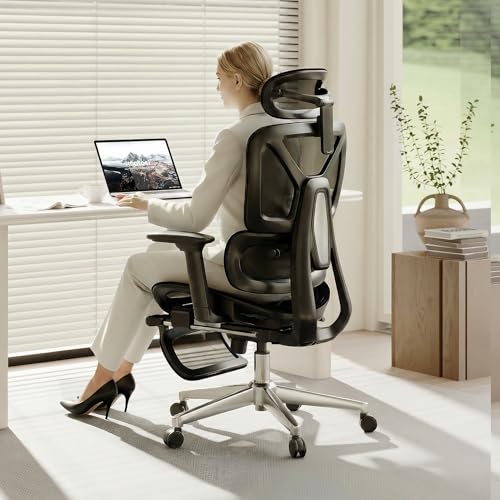
The FLEXISPOT ErgoX leads this guide because it treats posture as something that moves. Its dynamic lumbar support maintains contact as you shift between upright work, forward focus and reclined thinking, instead of supporting exactly one pose and abandoning the rest. The seat depth adjusts from 17 to 20 inches — the single most effective anti-slouch feature a chair can offer — and the five-level back height, 3D headrest and 3D armrests let the rest of the chair meet your body where it actually is. A nap footrest, tilt function and a stated 400 lb limit for users 5’1″ to 6’2″ complete the broadest fit package here.
Strengths
- Dynamic lumbar support keeps the back’s curve supported through natural position changes.
- Adjustable seat depth (17–20 inches) solves the too-deep-seat slouch at its root.
- 3D headrest and 3D armrests finish the fit at the two points most chairs neglect.
Trade-offs
- Premium tier positioning — verify the current listing price against your budget.
- Stated fit range tops out at 6’2″.
- Mesh and foam seat variants exist; confirm the configuration before ordering.
| Color | Black |
| Weight | 38 pounds |
The ErgoX’s daily effect is cumulative rather than dramatic. Because the lumbar follows you, the small posture corrections you make unconsciously — sitting up to type, leaning back to read, perching forward to concentrate — all land on support instead of air. Because the seat depth is right, your back actually reaches the backrest, which is the precondition for every other support feature to work. Owners upgrading from a fixed chair tend to describe the same discovery: they fidget less, not because they are more disciplined, but because the chair stopped giving them reasons to.
The hardware underneath matches the philosophy: a class-4 gas lift, premium materials and a build intended for all-day use across office, bedroom and gaming-room settings. If you buy one chair from this page for a mixed workday of typing, calls, reading and breaks, this is the one whose support system covers all four without asking you to re-pose for each.
Best for: Mixed-posture workers who move through the day and want support that moves with them / Not suited for: Users over 6’2″ or strict budgets
Choose it for adaptive support; skip it if you prefer to dial in a fixed, precise fit — the Ticova below is built for you. Check on Amazon

Herman Miller Aeron Classic
Our badge: Best Premium
The Herman Miller Aeron Classic is the chair that taught the industry the thesis of this guide: posture follows design. Its Pellicle suspension seat and back conform to your shape and distribute pressure without foam, dissipating the heat that builds during long sits, while the patented Kinemat tilt lets your neck, shoulders, hips, knees and ankles pivot naturally as you move. A lumbar pad, tilt limiter with seat-angle adjustment, fully adjustable arms and a waterfall seat front — which takes pressure off the thighs — complete a system designed around the moving body, in Size B (Medium) with a 12-year warranty.
Strengths
- Suspension seating removes foam compression from the comfort equation permanently.
- Kinemat tilt encourages the micro-movement that sustainable posture is actually made of.
- Breathable Pellicle keeps long sessions cool where foam and leather grow warm.
Trade-offs
- Premium pricing — a long-horizon purchase, not a starter chair.
- Size B fits the population’s middle; outliers must verify fit with care.
- The firm, supportive sit surprises buyers expecting a plush cushion.
| Color | Graphite Frame / Lead Classic Pellicle |
| Size | Size B (Medium) |
| Dimensions | 17 x 27 x 42 inches |
| Weight | 48 pounds |
What the Aeron understands is that nobody holds a textbook posture for eight hours, and a chair designed for a statue will punish a human. Its tilt moves the way joints move, its suspension gives under your weight and pushes back in proportion, and its front edge never digs into your thighs when you recline. The result is a chair that quietly keeps you near good posture by making every nearby position comfortable too — the deepest definition of comfort-and-posture design there is.
The 12-year warranty reframes the price: this is office infrastructure with a service life measured in decades of daily use, and its resale and parts ecosystem is unmatched in the category. For the professional whose chair time is measured in years at the same desk, the Aeron remains the benchmark this guide’s other picks are compared against — and the one most likely to end the search permanently.
Best for: Long-horizon professionals who want movement-based posture support that never wears out its cushion / Not suited for: Buyers wanting a soft, plush sit or shopping on a starter budget
Choose it for the decade view; skip it if you prefer foam’s embrace — the Hbada and Ticova serve that taste at friendlier tiers. Check on Amazon

Ticova Ergonomic Office Chair
Our badge: Best for Precise Fitting
The Ticova Ergonomic Office Chair is the choice of the deliberate fitter. Its lumbar support adjusts in height and depth, so the pad can be placed in your back’s curve and then set to meet it firmly or gently. The headrest adjusts in height and angle, the 3D armrests carry thick PU padding in three directions of travel, and the seat is 3.4 inches of high-density foam in a W shape with a waterfall front edge. A high-tensile mesh back and a rocking range to 130 degrees with adjustable resilience finish a chair that assumes posture is personal — and hands you the tools to personalize it.
Strengths
- The deepest adjustment kit in this guide, at a mid-tier position.
- Lumbar depth control solves the “pad feels like a fist / pad feels absent” dilemma.
- BIFMA testing and a static pressure test stated in its data.
Trade-offs
- Rewards patience; a careless first setup undersells it.
- Foam seat sleeps warmer than mesh or suspension alternatives.
- The curved headrest shape is fixed even though its position adjusts.
| Color | Black |
| Weight | 17.5 kilograms |
Where the ErgoX adapts automatically and the Aeron moves philosophically, the Ticova fits manually and precisely — and for a certain kind of buyer, that control is the comfort. If you know your body dislikes generic settings, if one-size lumbar bumps have failed you before, this is the chair that lets you iterate: a notch deeper this week, a finger’s width higher next, until the chair matches a posture map that is yours alone. The process takes days, not minutes, and the guide’s fitting section below is written with exactly this chair in mind.
Ticova’s 30-day return policy suits that iterative approach. Buy it, fit it properly across a week of real work, and judge it on the fitted result rather than the first sit.
Best for: Precise fitters and anyone failed by fixed lumbar bumps / Not suited for: Set-and-forget buyers
Choose it for control; skip it if you want the chair to do the fitting — Steelcase, next, is that chair. Check on Amazon

Steelcase Series 1
Our badge: Best Set-and-Forget
The Steelcase Series 1 makes the opposite bet from the Ticova, and makes it brilliantly: its weight-activated controls sense your body weight and set the recline behavior automatically, so posture support arrives without a single knob being understood. Adaptive bolstering and flexible seat edges keep the sit pressure-free, optional 4D arms and a headrest exist in the line, and the whole chair weighs 29 pounds and assembles without tools in under two minutes.
Strengths
- Automatic recline tension — the control most users mis-set is simply removed.
- Re-fits itself instantly between different users, ideal for shared home offices.
- Compact and light, with Steelcase’s research-driven build quality.
Trade-offs
- Manual-control enthusiasts get fewer levers to love.
- Compact frame best suits small-to-average builds.
- Headrest availability depends on configuration; verify on the listing.
| Color | Graphite |
| Dimensions | 23.75 x 27 x 41.25 inches |
| Weight | 29 pounds |
The Series 1 understands a truth about posture: most people will not maintain a chair’s settings, so a chair that maintains itself wins. Sit down and it reads your weight; lean back and the resistance is already appropriate; share it with a partner of a different size and it re-reads theirs. In real households, that automatic fit produces better average posture across a year than a theoretically superior chair adjusted once and forgotten.
It is also the friendliest chair here to live with — quick to assemble, easy to move, compact in the corner offices where posture problems breed. For the buyer who wants comfort and posture handled rather than administered, this is the answer.
Best for: Shared chairs, knob-averse buyers and small offices / Not suited for: Large users or compulsive adjusters
Choose it for effortlessness; skip it if you crave manual control. Check on Amazon

Hbada P5 Ergonomic Office Chair
Our badge: Best for Work-Break Balance
The Hbada P5 argues that posture is a rhythm, not a position. Its work mode is legitimate: an S-shaped backrest with adjustable lumbar support, a 2D headrest with real height and swivel range, adjustable armrests and a 3.35-inch seat-height span. Its break mode is equally real: recline to 135 degrees, pull out the footrest, and the chair becomes a lounger that lets your body fully reset. Hbada states SGS certification and BIFMA testing, for users roughly 5′ to 5’10”.
Strengths
- The footrest institutionalizes breaks — and breaks are posture’s best friend.
- S-curve back and adjustable headrest cover the upright hours honestly.
- Compact footprint suits small rooms where a separate lounger cannot fit.
Trade-offs
- Stated height range excludes taller users.
- Feet-up working is a temptation to manage, not a posture to adopt.
- Narrower sit than the SIHOO’s wide cushion.
| Color | Black |
| Weight | 44 pounds |
The P5’s philosophy shows in a typical day: focused upright work in the morning, a reclined footrest break after lunch that actually restores you, then upright again with a body that has been somewhere else in between. Chairs that only support working posture leave the reset to a sofa that small homes may not have; the P5 builds the reset in. Students and hybrid workers in compact spaces feel the benefit most, but anyone whose afternoons sag will recognize the design’s wisdom.
Hbada backs the chair with installation guidance and a repair-service promise in its listing — a grown-up touch in its tier. If your height fits the stated range, it is the most complete daily-rhythm chair in this guide.
Best for: Small-space workers who take real breaks in the same chair / Not suited for: Tall users
Choose it for the work-break rhythm; skip it if you are tall — the ErgoX fits you. Check on Amazon

SIHOO M18 Ergonomic Office Chair
Our badge: Best Budget
The SIHOO M18 closes the guide with the essential proof: comfort and posture do not require a premium budget, they require adjustable support — and the M18 has it. Four support points (head, back, hips, hands), an adjustable lumbar support, an adjustable headrest, a breathable mesh back, 2D armrests and a wide cushion, for users roughly 5’6″ to 6’2″, with a stated 330 lb capacity, BIFMA testing and a three-year parts promise in its data.
Strengths
- Real lumbar and headrest adjustment at the friendliest tier in the guide.
- 330 lb stated capacity signals a base and frame with genuine margin.
- Wide cushion and mesh back suit long sessions in warm rooms.
Trade-offs
- No lumbar depth control — the Ticova is the upgrade path.
- 2D armrests only.
- Petite users may find the seat deep.
| Color | Charcoal |
| Weight | 31.53 pounds |
The M18 spends its money where posture lives — the lumbar mechanism, the headrest, the base — and saves where posture does not. Fitted with the routine in this guide’s how-to section, it delivers the daily experience this keyword promises: a back that is met where it curves, a head that can rest on calls, arms that carry their share. For first-time ergonomic buyers and households furnishing two desks, it is the rational starting point of the entire list.
Nothing about it feels like a compromise in the first month, and its capacity rating suggests the second year will feel much like the first. That is all posture ever asked of a budget chair.
Best for: Budget buyers who want genuine posture hardware / Not suited for: Petite users or depth-control seekers
Choose it for value with integrity; skip it only if the premium adaptive chairs are within reach. Check on Amazon
Comparison Table
| Pick | Posture Philosophy | Seat | Standout Adjustment | Check price on Amazon |
|---|---|---|---|---|
| FLEXISPOT ErgoX | Adaptive / dynamic | Mesh or foam | Seat depth 17–20 in | Check price on Amazon |
| Herman Miller Aeron | Movement / suspension | Pellicle suspension | Kinemat tilt, seat angle | Check price on Amazon |
| Ticova Ergonomic | Precise / manual | Foam W-seat | Lumbar height + depth | Check price on Amazon |
| Steelcase Series 1 | Automatic | Flexible-edge | Weight-activated recline | Check price on Amazon |
| Hbada P5 | Work-break rhythm | Mesh | Headrest height + swivel, footrest | Check price on Amazon |
| SIHOO M18 | Value essentials | Wide cushion, mesh back | Adjustable lumbar + headrest | Check price on Amazon |
How to Choose a Chair for Comfort and Posture
Fit the seat first — depth, then height
Posture starts at the pelvis. Set seat height so your feet rest flat and your knees sit near 90–100 degrees, then check depth: a fist’s width between the seat edge and the back of your knee. Too deep, and you slouch to bend your knees, defeating every back feature; the ErgoX’s adjustable depth (17–20 inches) exists because this single dimension varies so much between bodies.
Place the lumbar, do not just own one
The pad belongs in the small of your back, at the curve above your belt line, with pressure you can feel but forget. Height adjustment is the minimum; depth adjustment (Ticova) or dynamic contact (ErgoX) is the refinement. If a chair’s support cannot reach your curve, it is not supporting you, whatever the brochure says.
Let the arms carry their share
Armrests at elbow height, with shoulders fully relaxed, unload the neck and upper back all day. Check that the arms adjust at least in height, that they reach your forearms in your real working position, and that they clear your desk when you pull in.
Choose a recline you will actually use
Posture improves when position changes. A recline range around 100–130 degrees with a lock or well-set tension lets you alternate between task upright and thinking reclined without leaving the chair. Chairs that lock you into one angle — however correct — lose to chairs that support three.
Match the philosophy to your habits
Adapters (ErgoX, Steelcase) fit movers and sharers. Precise manual fit (Ticova) fits patient individuals. Suspension (Aeron) fits the long-horizon mover. Break-driven design (Hbada) fits rhythm workers. Value essentials (SIHOO) fit everyone else’s budget. Your habits, honestly named, pick the chair.
How Do You Set Up a Chair for All-Day Comfort?
Assemble carefully, torque the bolts fully, and keep the hex key taped under the seat. Then fit from the floor up: feet flat, seat depth checked, lumbar placed, recline tension set so the backrest carries you without pushing, armrests at relaxed elbow height, headrest meeting your head only in recline. Work a full day before changing anything; then change one variable at a time across the first week. Re-torque the bolts after week one — chairs settle — and vacuum the casters monthly if your floor is carpeted. The routine takes minutes spread over days, and it is worth more than the difference between any two chairs in this guide.
Problem: You start comfortable and slouch by 3 p.m. — usually seat depth or a too-low screen; check the fist-width rule and raise the monitor before blaming the backrest.
Problem: Your shoulders ache despite a good backrest — armrests are too low, too high or too far apart; your arms’ weight is hanging off your neck all day.
Problem: The seat edge presses the backs of your thighs — the seat is too deep or too high; lower the chair, reduce depth if adjustable, or add a footrest so your feet share the load.
Problem: You feel perched and unstable — the seat may be too small or the tilt tension too strong; soften tension and confirm your full foot rests on the floor.
Posture Is a Rhythm, Not a Pose
The most useful idea in modern seating is also the simplest: the best posture is the next posture. Bodies are built to move, and an eight-hour day in a single textbook position is its own kind of strain. That is why this guide’s leaders are movement machines in different dialects — the ErgoX’s lumbar follows you, the Aeron’s tilt pivots with your joints, the Steelcase re-balances itself, the Hbada builds the break into the chair. When you shop, you are really choosing which kind of movement your day will be made of. Build the rhythm deliberately: upright for typing, slightly reclined for calls, properly reclined for reading, standing for the minutes between. A chair that supports the whole rhythm, fitted with the routine above, delivers more comfort than any throne that perfects a single pose.
Comfort and Posture for Shared and Household Desks
Many home offices are treaties between two bodies sharing one chair, and posture advice that assumes a single user fails both. The practical answers are range and speed: a chair whose lumbar, height and arms can be re-set in under a minute (Ticova, SIHOO), or one that needs no resetting at all because it senses the sitter (Steelcase). Write the household’s two settings on a card taped under the desk for the first month — it sounds fussy and works completely. Where two people differ greatly in size, be honest that one chair is a compromise and consider the two-chair strategy: a primary fitted chair plus a simple secondary seat costs less than years of two people sitting badly. The household framing matters beyond chairs, too — it is the same plan-for-every-user thinking behind Best Sofas For Older Adults when a whole family’s seating is chosen at once.
Materials and Posture: Mesh, Foam and Suspension Compared
The material under you shapes your posture more than most buyers expect. Tensioned mesh holds its geometry for years and breathes, but its support is uniform — it cannot be firmer at the lumbar unless the chair adds a separate pad, which is why mesh chairs live or die by their lumbar mechanisms. Foam can be sculpted — the Ticova’s W-shaped seat is foam used intelligently — but foam ages by compression, and a seat that positioned your pelvis perfectly in month one may sit an inch lower by year two, quietly changing every angle above it. High-density foam slows that story; it does not end it.
Suspension is the third philosophy: the Aeron’s Pellicle membrane distributes pressure by tension rather than by cushioning, so there is nothing to compress and the posture geometry of year ten matches year one. Its trade is feel — a firm, floating sit that some bodies love immediately and others need a week to trust. Leather and PU leather, finally, are presentation materials: handsome, wipeable, and largely neutral for posture, with warmth as their tax. The shopping translation is simple: pick the fit hardware first, then choose the material whose aging curve and climate behavior suit your room, and never let a material’s first-minute softness outvote a mechanism’s decade of placement.
Posture Beyond the Chair: The Workday Around It
A chair, however good, covers only the sitting hours, and comfort across a whole day is a schedule as much as a product. The pattern that experienced home workers converge on is unglamorous: stand for the short calls, walk for the long ones when the work allows, change the chair’s angle by task rather than by hour, and treat the lunch break as a genuine relocation — a different chair, a different room, ideally a short walk. None of this requires equipment, and all of it multiplies the value of the equipment you have, because a body that has moved tolerates the afternoon’s sitting at a completely different price.
It is also worth saying plainly what this guide has implied throughout: persistent or worsening pain is not a shopping problem. The chairs here are comfort products, chosen and described in comfort terms, and they do their honest best within that boundary. If your back or neck complains in ways that survive a properly fitted chair and a corrected desk, that is information for a clinician, not for a product page — and a good chair will still be waiting, doing its part of the job, when you come back to the desk.
What Premium Money Actually Buys in Posture
It is fair to ask what the Aeron’s tier adds over the SIHOO’s, since both promise comfort and posture and one costs a great deal more. The honest answer has three parts. First, materials that do not age out of their geometry: a suspension membrane holds its tension for a decade-plus, while every foam in this guide is on a slow countdown — premium money buys a posture that stays fitted. Second, mechanism refinement: the Kinemat tilt’s pivots, the ErgoX’s dynamic lumbar and the Steelcase’s weight-sensing are engineering programs, not parts-bin choices, and they show up as support that feels anticipatory rather than reactive. Third, service: warranties measured in decades, parts that exist, makers that answer.
What premium money does not buy is a different body. A premium chair fitted carelessly loses to a budget chair fitted patiently, every time — the fitting routine in this guide is the great equalizer, and it is free. So the rational order is: buy the most adjustment and durability your budget honestly allows, then invest the week of fitting that makes any tier perform. Readers who do both rarely shop for chairs again soon, at any price point, which is the actual definition of value in this category.
Two Bodies, One Chair: A Short Case Study in Compromise
Consider a common household: one partner, 5’4″, who works at the desk in the mornings; another, 6’1″, who games there at night. A single chair must serve a short torso and a long one, a light frame and a heavy one. The failure mode is a chair set for neither — lumbar at a diplomatic midpoint, seat height splitting the difference — which both users describe, accurately, as “fine, I guess.” The working solution has three moves. Choose range over refinement: the chair whose lumbar travels furthest and whose seat height spans both users (the ErgoX’s 5’1″–6’2″ envelope and adjustable depth exist for this household). Write both settings down — lumbar height, seat height, arm height — on a card, because memory negotiates and paper does not. And ritualize the thirty-second reset at each handover, the way pilots run a checklist: small, boring, and the entire difference between a shared chair and a contested one.
If the size gap is larger still, the honest answer is the second chair. A household that buys one excellent fitted chair and one simple spare has spent less than the cost of one premium compromise and given both people a seat that is actually theirs. Posture advice tends to be written for individuals; households should feel free to outvote it.
A Brief History of the Office Chair, and Why It Explains Your Shortlist
The modern office chair was born twice. Its first birth was industrial: nineteenth-century task seating for clerks and typists, built for durability and indifferent to the bodies in it, because the bodies rotated and the furniture stayed. Its second birth came when work became sedentary for entire careers and the costs of that indifference came due — in fatigue, in absence, in the slow arithmetic of millions of people sitting badly for decades. The Aeron’s arrival in the 1990s marked the second birth’s maturity: a chair designed from research into how bodies actually sit, move and tire, sold as infrastructure rather than furniture. Steelcase’s weight-sensing controls, FLEXISPOT’s dynamic lumbar and the budget tier’s genuine adjustable hardware — the SIHOO and Ticova in this guide — are that research tradition diffusing down the price ladder, which is the happiest trend in the category.
The history matters to a buyer for one practical reason: it explains the two species on today’s market. Chairs descended from the research tradition publish their adjustments, capacities and test results, because their makers compete on them. Chairs descended from the furniture tradition publish their silhouettes and their upholstery, because that is what they compete on. Both species use the word ergonomic. The species are easy to tell apart once you know to look — count the numbers, as this guide has urged from its first section — and the six chairs reviewed here were chosen, at every tier, from the research side of the family tree.
The Fitting Diary: Seven Days to Your Chair
Keep a notebook by the desk for the first week — or a note on your phone — and log one line per day: what you changed, and how the afternoon felt. Day one is baseline: factory settings, honest discomforts noted without fixing anything yet, because you cannot improve what you have not measured. Day two is height and depth, the foundation. Day three is lumbar placement. Day four is recline tension and angle. Day five is armrests. Day six is the headrest, if your chair has one, tested on real calls. Day seven is the review: read the week’s lines, keep what the afternoons praised, and undo anything that only sounded right in theory.
The diary sounds like homework, and it is — about ninety seconds a day of it. What it buys is the difference between a chair that was fitted and a chair that was merely assembled. Owners who keep it almost always find their chair by day five; owners who rely on memory spend months re-discovering the same almost-right setting. File the diary’s final page — your settings, in numbers where the chair offers them — somewhere permanent. If the chair is ever moved, cleaned or borrowed, that page is the restoration disk for your posture.
Common Buying Mistakes
Confusing softness with comfort
A plush first sit often becomes a slumped third hour. Comfort over a workday is support in the right places plus freedom to move — judge chairs across a week, not a minute.
Buying a fixed “ergonomic shape”
Shaped foam fits the body it was molded around. If that body is not yours, the shape is an obstacle. Adjustable hardware is the only honest version of ergonomic for a varied population of one.
Setting the chair once and blaming it forever
Most “uncomfortable ergonomic chair” stories are unfinished fittings. Run the week’s routine before you return anything; the difference is routinely the whole difference.
Forgetting the desk and screen
A low monitor will pull your head forward through the finest chair ever made. Raise the screen, set the keyboard at elbow height, and give your feet a floor or a footrest — then judge the chair.
Locking the recline and never moving
A chair used at one angle all day wastes its best feature. Unlock, vary the angle by task, and let posture be the rhythm this guide describes.
Final Recommendation
Buy the FLEXISPOT ErgoX if you want posture support that adapts as you move — dynamic lumbar, adjustable seat depth and a 3D headrest in one system. If your horizon is a decade and your taste runs to suspension, the runner-up is the classic: Check on Amazon for the Herman Miller Aeron. Precise fitters should take the Ticova, sharers the Steelcase, break-takers the Hbada, and budget buyers the SIHOO with a clear conscience. Fit whichever you choose with patience — that is where comfort actually comes from.
Frequently Asked Questions
What is the single most important posture feature?
A lumbar support you can place in your own back’s curve — followed closely by correct seat depth. Together they position the pelvis and spine, which is where posture is decided.
Should an office chair force me to sit up straight?
No. A good chair makes a relaxed, supported, slightly reclined position easy and lets you vary it. Forced upright sitting is unsustainable and is not what the chairs in this guide are designed to do.
How reclined should I work?
Most people settle between 100 and 110 degrees for task work, opening further for calls and reading. Use the recline lock or tension to hold your chosen range, and change it by task.
Do I need a footrest?
If your feet do not rest flat once the chair is set for your desk, yes — a footrest completes the posture chain. The Hbada P5’s built-in footrest is for breaks; a small desk footrest is for working hours.
How long before a new chair feels right?
Give it a week of one-change-at-a-time fitting. Chairs that feel merely “different” on day one routinely feel inevitable by day seven — and chairs that still fight you after a fair fitting week are telling you the truth.
Can a great chair make up for sitting all day without breaks?
No, and honest makers do not claim otherwise. A well-fitted chair reduces the cost of sitting; it does not repeal it. The posture rhythm this guide describes — position changes in the chair, standing and walking between sittings — is the other half of the purchase, and it is free. Think of the chair as the best possible place to return to, not as permission never to leave it. Buyers who pair a chair from this guide with even a modest movement routine consistently report the combination outperforms a chair twice the price used as a full-day container.
Is mesh or foam better for posture?
Neither, inherently — placement and fit decide posture. Mesh breathes and holds tension; foam cushions and can be shaped; suspension (Aeron) does a third thing entirely. Choose by climate and taste after the fit hardware checks out. One practical tiebreaker: sit in your shortlisted material for the length of a real meeting before deciding, because materials reveal themselves across an hour, not a minute — mesh grows cooler, foam grows warmer, leather grows familiar. The right material is the one whose hour three you prefer, and the only way to learn that is to give it the hour. Your future self, fitted chair beneath and a full workday ahead, will be quietly grateful for the patience. And if the hour test surprises you — if the material you expected to love is the one you cannot wait to stand up from — believe it. Materials are taste, and taste is data; the posture hardware underneath can be re-shopped, but a chair whose surface you dislike will annoy you at the exact moments you most need it to disappear. Fit first, philosophy second, material third, in that order, and the chair that results will be the rare purchase that improves quietly every single day you own it — a small, daily dividend on one careful decision, paid out in afternoons that end with energy left over for the rest of your life — for family, for projects, for everything the desk was supposed to make possible rather than consume, in the hours that actually belong to you and the people waiting beyond the office door.


