Where to buy
Check the latest price, availability and delivery on Amazon. Orders are placed on Amazon. We may earn a commission from qualifying purchases.
- Best for most small yards: Linkind Smart Solar Spot Lights SL5C, 2-Pack — Check on Amazon
- Best one-fixture system: Gama Sonic GS-214 Stainless Steel Bollard Solar Lamp with EZ Anchor — Check on Amazon
- Best smart path lighting: Ring Solar Pathlight, 4-Pack with Ring Bridge (2nd Gen) — Check on Amazon
- Best starter pair: URPOWER 2-in-1 Solar Spot Lights, 2-Pack — Check on Amazon
- Best coverage value: Linkind StarRayS Solar Spot Lights, 6-Pack, Warm White — Check on Amazon
One further pick — the Gama Sonic Baytown II Bulb solar lamp post — appears in prose only, with no Amazon link, because its full lamp-post listing could not be pinned to the two-source standard this site requires before linking. Its review describes it in qualitative terms from a specialist solar retailer listing, and explains why a full-height post is the wrong shape for a small yard anyway. The other picks are linked — check the current price on Amazon on each listing, as the listing is the authority.
Read the full guide ↓
Disclosure: As an Amazon Associate, dailyhomedecorating.com earns from qualifying purchases. Links to Amazon on this page are affiliate links; they cost you nothing extra. Listing details such as price and availability change often, so check the current Amazon listing before you buy.
A small yard changes the maths of this budget twice over, and both changes point the same way: spend less. The first change is about the market. Solar garden lights on Amazon top out well below $200 per product. We checked the expensive end of the category — smart kits, premium metal fixtures, lamp posts — and the top of the mainstream range is Ring’s four-pathlight kit with its Bridge, in the upper tier of this budget — check price on Amazon. The priciest single solar fixture with a verifiable Amazon presence is a stainless-steel bollard, also in the premium tier. A full solar lamp post from the same maker sits near the top of the budget too, but at a specialist retailer, not in an Amazon offer we could pin. Everything else clusters in the lower tiers, most of it well below the premium end. There is no $200 solar garden light.
The second change is about your yard. A big garden can absorb eighteen spotlights and still have dark corners. A small yard — a townhouse patio, a courtyard, a narrow side garden — saturates at four to eight light points. Past that, extra lights stop adding welcome and start adding clutter: stakes crowding the same bed, beams crossing, glare at eye level where you actually sit. So the honest headline of this guide is that $200 is over-budget for a small yard by design. The right spend for most compact outdoor spaces lands well under the full budget, assembled from the same verified products a big-garden guide would use, just in smaller counts.
Two ground rules apply to every pick below. First, every lumen and runtime figure in solar lighting is a maker’s number: no common test standard governs these listings, and runtime claims assume six to eight hours of strong direct sun that a small, fence-shadowed yard may rarely deliver. Second, a solar light is a battery with a lamp attached, and the battery is the part that dies — so each review states plainly whether the battery can be replaced, and pack counts are always stated plainly, so you can judge value per light on the live listing — check price on Amazon.
Quick Picks
Short on time? Each row names the small-yard job and the product that fits it. Each row is tied to the pack named in the row — check price on Amazon, as the listing is the authority for the current price.
| Small-yard job | Pick | Why it stands out | Link |
|---|---|---|---|
| Best for most small yards | Linkind Smart Solar Spot Lights SL5C, 2-Pack — check price on Amazon | App-controlled color spots sized for a patio’s few real light points — buy two packs and the yard is done | Check on Amazon |
| Best one-fixture system | Gama Sonic GS-214 Stainless Steel Bollard Solar Lamp — check price on Amazon | One real stainless-and-glass fixture at the gate or path corner can be a small yard’s whole lighting plan | Check on Amazon |
| Best smart path lighting | Ring Solar Pathlight, 4-Pack with Ring Bridge (2nd Gen) — check price on Amazon | Grouped motion lighting with replaceable batteries — but a small yard usually needs two singles, not the kit | Check on Amazon |
| Best starter pair | URPOWER 2-in-1 Solar Spot Lights, 2-Pack — check price on Amazon | The cheap, proven pair for testing where spots should go before you commit to anything pricier | Check on Amazon |
| Best coverage value | Linkind StarRayS Solar Spot Lights, 6-Pack, Warm White — check price on Amazon | Six dusk-to-dawn spots at a low per-light cost in its tier — right for a long, narrow yard; surplus for a square one | Check on Amazon |
| Statement piece — wrong scale here | Gama Sonic Baytown II Bulb Solar Lamp Post with EZ-Anchor Base — prose only, upper tier at a specialist retailer | A full-height lamp post swallows a small yard whole; reviewed so you can see the numbers before falling for the form | Prose only — see review |
How These Picks Were Chosen
The first filter was verifiability. Every linked product here is a real Amazon listing whose ASIN we pinned from two independent sources — the maker’s own store, retailer listings, dated deal coverage, or price trackers reading Amazon’s data — before a link was allowed. Where a current price could not be pinned consistently, the pick is still linked but carries only a “check price on Amazon” label. One product failed the test outright: the Baytown II lamp post’s full-post Amazon listing could not be pinned, so it is reviewed in prose in qualitative tier terms and with no link. Anything we could not verify at all was left out.
The second filter was scale. A general under-$200 guide ranks by coverage and system size; a small-yard guide has to rank by fit. We asked of every candidate: how many light points does it assume, and what happens to the spares in a yard with room for five? Products whose value only appears at fourteen or eighteen units were kept — their counts are real and their maths is shown — but their verdicts change, because in a small yard leftover lights are a storage problem and an invitation to over-light.
The third filter was solar-specific, where most roundups in this category go quiet. We required, wherever the data exists: an IP rating from specification fields rather than the word “waterproof” in a title; a battery answer — replaceable, removable, or sealed — stated in the review, including when the honest answer is “the maker does not document one”; a warranty term from the maker’s published terms or a retailer’s spec table, never a review site’s summary; and the full system, meaning any hub the lights need is counted as part of the pick, not footnoted — a rule that bites hardest on small smart systems, where a hub bought for two lights weighs heavily on the per-light value.
The 6 Best Solar Garden Lights Under $200 — Read for Small Yards
Linkind Smart Solar Spot Lights SL5C, 2-Pack
Who it suits: Owners of patios, courtyards and pocket gardens who want a few well-placed accents — one shrub washed warm, one small tree lifted, colour for a holiday — controlled from the phone, at a spend that matches the space.
Start with the pack size, because it is why this pick leads a small-yard guide. Most solar lighting is sold in sixes and twelves, quantities designed for driveways. The SL5C is sold as a two-pack — check price on Amazon — which is the natural unit of a small yard: one pack for the patio’s two focal points, a second if there are two more, and no box of spares ageing in the shed. Two packs, four lights, are a complete lighting plan for most compact spaces, and it leaves most of this budget unspent.
The lights themselves are the smart end of the spotlight market: app-controlled and colour-changing, grouped and scheduled from the AiDot app with no hub or bridge to buy — a point that matters more at small scale, where a separate hub would sharply raise the per-light cost of a two-light setup. The feature that justifies the “smart” engineering is in the panel rather than the app. Linkind’s maker AiDot launched the SL5C as the first smart solar spotlight with MPPT — maximum power point tracking — charge control, a technique borrowed from larger solar systems that extracts more charge from weak, angled or intermittent light. Small yards are exactly where that matters: a patio panel rarely gets a clean southern sky, and a controller that harvests better from partial light is worth more between two fences than in an open field. The size of the benefit is the maker’s claim, but the technology is real. The listing’s spec fields rate the lights IP67, the strongest rating in this guide.
What you do not get is a verified brightness figure. Linkind does not headline a lumen number for the SL5C in the spec data we could verify, and hands-on coverage describes the output as modest. In a big garden that is a demerit; across a three-metre patio it is close to a virtue, because accent light at short range does not need to be bright — a gentle wash on the one plant you look at beats a flood that flattens the space and lands in your eyes. Treat these as wash and accent lights for shrubs, signs and small trees, and use the colour changing deliberately: warm white for everyday, colour for parties.
The battery is this pick’s honest weakness, and at small scale it is a manageable one. No user-replaceable battery is documented for the SL5C in the material we could verify, so plan on the sealed-unit reality: when the cell fades, the light is done. Documentation for the model lists a 12-month warranty. At this pick’s low per-light position in its tier, with four lights total, that is a defensible trade — the whole system’s year-three replacement cost stays modest.
- Two-pack sizing matches small yards — a complete plan is two packs, with no surplus lights to store.
- MPPT charge control — the only pick engineered to charge better in the weak, angled light a fenced patio gets.
- App control, grouping and full colour output with no hub to buy; IP67 rating from the listing’s spec fields.
Honest limitation: No verifiable maker lumen figure, modest output by reviewer accounts, a 12-month warranty, and no documented user-replaceable battery.
Choose it if your yard has two to six real light points and you want them app-controlled. Skip it if you need documented brightness, or a fixture you can service for a decade — that is the bollard below, at a far higher tier.

Gama Sonic GS-214 Stainless Steel Bollard Solar Lamp with EZ Anchor
Who it suits: Small-yard owners who would rather own one real fixture than a scattering of plastic — one bollard at the gate or path corner, doing the whole job alone.
Here is the small-yard reading of the most expensive single solar light with a verifiable Amazon presence. At the top of this guide’s single-fixture tier, the GS-214 costs what a whole coverage plan costs elsewhere in this guide, and in a large garden that trade is hard to defend: one light lights one point. In a small yard the arithmetic inverts. If the space has exactly one point that matters — the entrance, the path corner, the step down from the deck — then one fixture at that point is not an extravagance, it is the entire system, and spending the budget on its materials and serviceability is a coherent plan. A bollard is also the right height: low and downward, marking ground level without putting a bright source at seated eye height.
What the money buys is construction and serviceability, not brightness. The body is black stainless steel with the maker’s GS Solar LED bulb behind thick glass; the retailer spec table for this model (item 214001) rates output at 100 lumens — a maker figure, and a modest one. A wired bollard at this money would out-light it several times over. What wired cannot do is install the way this does: the EZ Anchor base screws into the ground with no concrete, no trench and no cable, and the light then runs dusk-to-dawn on its own panel. In a small yard that means an afternoon, not a project.
The serviceability is documented rather than promised. The integrated lithium-ion battery pack is rated by the maker’s retailer documentation at roughly three years, or about 1,000 charges — and it can be replaced, buying roughly another three years, instead of ending the fixture’s life. The GS Solar bulb is likewise replaceable, though proprietary to Gama Sonic fixtures. The spec table lists a two-year manufacturer warranty, the longest published term among this guide’s Amazon-linked picks. One gap, stated honestly: the verified spec data does not publish an IP rating for this model, so we will not invent one — the bulb is encased in thick glass to keep water out, per the maker’s description, but if a stated IP number matters to you, this fixture asks you to trust construction over a rating.
Now the proportion warning, which is this lens’s whole contribution. A bollard looks right with air around it: place it where it stands against planting or open ground — a gate pier, a path corner with a bed behind it — and it reads as architecture. Wedge it into a crowded corner between the bins and the fence and the same money reads as clutter, because a serious fixture in a squeezed spot draws the eye to the squeeze. If your one important point has no breathing room, the honest move is down this list to the cheap spots. A practical note on buying: when a specialist reviewer read the live Amazon listing, it carried no featured offer — the purchasable offer from the maker’s own Amazon storefront sat under “See All Buying Options.” The same fixture is also sold by a specialist solar retailer. That is why this guide labels the pick check price on Amazon.
- Stainless steel and glass construction — the only pick that reads as a permanent fixture rather than a stake light.
- Replaceable battery pack (about three years or 1,000 charges per pack) and a replaceable bulb, under a two-year maker warranty.
- EZ Anchor installation: no concrete, no wiring, dusk-to-dawn operation — a one-fixture system in an afternoon.
Honest limitation: One hundred maker-rated lumens at a premium tier is accent light at a statement position; the verified spec data publishes no IP rating, and the fixture needs clear space around it to earn its keep.
Choose it if your small yard has one point that matters and you plan to keep the fixture for years. Skip it if that point is cramped, or your budget needs to cover several points — the pairs above and below do that at a far lower tier.
Ring Solar Pathlight, 4-Pack with Ring Bridge (2nd Gen)
Who it suits: Households already in Ring’s ecosystem whose small yard has a short path or gate approach worth lighting as a group — bought in the smaller configuration the yard actually needs.
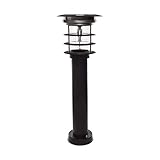
This is the mainstream solar garden product that sits highest in this budget’s tiers on Amazon, and the only pick here whose headline feature is not light but coordination. Each pathlight is a 16.8-inch bollard-style fixture that Ring rates at up to 80 lumens of 3500K light — a maker figure, adjustable downward in the app — triggered by a motion sensor covering 120 degrees out to about 15 feet. When one light in a group detects motion, the group fires together, and the lights can link to Ring doorbells and cameras so a camera event lights the path or a path light wakes a camera. Understand the behaviour before anything else: this is a motion light, not a dusk-to-dawn glow — dark until something moves, then lit for a shut-off interval you set in the app, between 30 seconds and two minutes.
That behaviour has a small-yard consequence most reviews miss. On a garden path, motion triggering is ideal. On a small patio where the evening’s activity is sitting still — dinner, a book, a conversation — a motion light reads your stillness as absence and switches off, then fires again when someone reaches for a glass. As path lighting for a compact front approach, this system is genuinely good. As the ambient light of a tiny outdoor room, it is the wrong behaviour at any tier.
The kit needs its ecosystem arithmetic done in the open, and then downsized. The four-pack with the Bridge included sits in the upper tier of this budget — check price on Amazon, and check Ring’s own store as well, as the two can differ. The Bridge is not optional: Ring states that a Ring Bridge or a compatible hub is required to control its smart lights, unless your home has Amazon Sidewalk coverage or a Sidewalk-capable device already on the network, and the Bridge is also sold separately. Now the small-yard move: expansion singles — the same light, sold one at a time — are available on both Amazon and Ring’s store — check the current price on Amazon. A compact path usually has two points, not four. Two singles plus a Bridge bought separately sit below the four-pack kit in total outlay, with no spare lights. Counted the kit’s way, the per-light value with the hub included is respectable for a big path, and exactly the sort of figure that quietly punishes small systems, whose hub cost spreads over fewer lights.
The detail that earns this system its place in a $200 guide is in the battery door. Each light runs on a removable 18650 lithium-ion cell — one included per light — which can also be topped up over micro-USB when a cloudy week or a shaded yard starves the panel. That answers solar’s two oldest problems at once: a battery you replace instead of landfilling the fixture, and a rescue charge for December. Ring publishes a one-year limited warranty, and the spec fields rate it IP66, a genuinely strong rating for a garden fixture.
- The only genuinely smart system in the guide: grouped motion lighting linked to Ring cameras, doorbells and Alexa routines.
- Removable, standard 18650 battery in every light, with a micro-USB top-up for cloudy weeks — the best battery design here.
- IP66 rating from the spec fields, and a published one-year limited warranty.
Honest limitation: Eighty maker-rated lumens, delivered only when motion triggers it, is pathway guidance light, not illumination — and on a patio where people sit still it will keep timing out on you. The smart features also depend on the Bridge, the app and Ring’s ecosystem.
Choose it if you live in Ring’s ecosystem and your small yard’s job is a short, smart path — bought as two singles plus a Bridge, not the four-pack. Skip it if you want an all-night glow where you sit: the dusk-to-dawn sets in this guide do that job at a far lower tier.

URPOWER 2-in-1 Solar Spot Lights, 2-Pack
Who it suits: Anyone furnishing a small yard test-first — a pair of shrubs, a house number, a small tree — who wants to learn where light should go before spending real money.
Some context first, because it is this pick’s real credential: this listing has been on Amazon since July 2015. In a category where brands appear and vanish with the seasons, a solar spotlight that has sold in the same form for a decade has demonstrated that its design works and its maker answers for it. The design is the classic 2-in-1: each light stakes into the ground or screws to a wall, with an adjustable head and panel, two brightness modes, and dusk-to-dawn operation. The maker’s figures — labelled as maker figures — are about 200 lumens on the high mode from a 2,200 mAh battery, with a working time of six to nine hours on a full charge. Check the current price on Amazon — the listing varies by colour variant, so treat the current listing as the authority and expect this pair to sit in the entry tier, at a low per-light cost.
In a small yard, this pair’s best role is reconnaissance. Placement decides whether solar lighting looks designed or accidental, and it is nearly impossible to judge from a product photo. An entry-tier pair lets you spend two evenings moving real light around a real patio — stake one by the steps, wash the fence, lift the shrub, watch the shadows — and only then commit to the SL5C’s app control or the GS-214’s metal.
Now the spec honesty, because this listing is a small museum of the category’s habits. Amazon’s listing text rates the light IP64 — splash-resistant, the weakest water rating in this guide — while roundups around the web variously describe the same light as IP65 or IP67. Those numbers cannot all be true, and the listing’s own figure is the one to plan around: IP64 is fine under eaves or in open rain for a season, but it is not the rating to bury in a wet bed and forget. The battery is integrated rather than user-replaceable, so the decade this design has survived should not be confused with a decade of service from any single unit — individual units live and die by their cells, like every sealed solar light here.
- A design on sale in the same form since 2015 — the category’s known quantity, and the cheapest way to test placement.
- Adjustable head and panel, stake or wall mounting, two brightness modes, dusk-to-dawn.
- A low per-light cost in the entry tier, varying by colour variant — check price on Amazon.
Honest limitation: The listing’s own IP64 rating is the weakest here and conflicts with higher figures quoted elsewhere; output and runtime are modest maker figures, and the battery is not user-replaceable.
Choose it if you want to learn your yard’s light points for the price of a takeaway, or need a proven pair to finish a plan. Skip it if the spot will live in standing water or you want a decade from a single unit.

Linkind StarRayS Solar Spot Lights, 6-Pack, Warm White
Who it suits: Owners of long, narrow outdoor spaces — a side garden, a terraced strip — where “small” describes the width, not the count of light points along the run.
This is the coverage engine of the wider under-$200 field — and coverage is mostly not a small yard’s problem. Six warm-white (3000K) spotlights, each staking into the ground or mounting on a wall, with three brightness modes and dusk-to-dawn operation: the verified configuration is model L180003-WW-US-6, and Amazon’s listing title for it carries an IP67 rating. Check the current price on Amazon — this guide marks the pick check-price. On a per-light basis this six-pack sits at the low end of the guide, among the lowest respectable per-light costs here.
The design’s signature feature earns its keep in narrow spaces specifically. Each light has a separately adjustable panel and head, so the panel can face the sun while the beam faces the subject — the most useful physical feature a solar spotlight can have, because panel angle and beam angle are rarely the same angle, and in a fenced side yard they almost never are. Run the lights on a lower mode and they trade peak brightness for hours, which in winter is the trade that keeps them lit at midnight. Brightness comes with the standard warning: Linkind markets the wider StarRay family with maker figures running as high as 650 lumens on some versions, and the versions differ in LED count and output — the version confusion is itself a reason this guide refuses to print a single lumen number for the six-pack.
And now the surplus problem, stated plainly. A square patio needs perhaps four of these; the pack contains six. The two spares will tempt you — a light on the compost corner, a second wash on the same shrub — and each temptation makes the space look more lit and less designed, while the honest options are a drawer or a gift to a neighbour. None of that makes the pack bad value: at its low per-light cost, even using four and shelving two beats most pairs on per-light value. It makes the pack a coverage product bought knowingly, best matched to yards small in one dimension and long in the other, where six points along a run is a rhythm, not a crowd.
The compromises are the usual sealed-set ones. No user-replaceable battery is documented for these lights in the material we could verify, and we could not verify a published warranty term for this pack to the standard this guide requires — check the listing’s warranty line before you buy, and treat the purchase as a consumable system: strong coverage now, at a per-light cost low enough that a failure in year three is an annoyance rather than a loss.
- Six dusk-to-dawn spotlights at a low per-light cost — the coverage value of the wider under-$200 field.
- Separately adjustable panel and head — decisive in fenced, narrow spaces where sun and beam angles diverge.
- IP67 in Amazon’s listing title for this exact model; 3000K warm white; three brightness modes.
Honest limitation: Check the current price on Amazon, as this pack’s listing position can shift, the family’s lumen claims vary by version and are maker numbers throughout, no replaceable battery or verified warranty term could be documented — and a compact square yard will not use all six.
Choose it if your small space is long — a side run, a terrace strip — and six points is a rhythm. Skip it if your yard is a compact square: the SL5C pairs light it better, with nothing left over.

Gama Sonic Baytown II Bulb Solar Lamp Post with EZ-Anchor Base
Who it suits: Honestly, in this lens: almost nobody with a genuinely small yard. It is reviewed in full because it is the one single solar object that spends nearly this whole budget, readers will meet it in other roundups, and its numbers make the scale argument better than any warning could.
First, why there is no link. The full lamp-post version’s Amazon listing could not be pinned to this site’s two-source standard, so it is described here in qualitative terms from a specialist solar retailer’s listing of the exact model, in the upper tier of this budget. What that money buys is a full-height lamp post in Gama Sonic’s Baytown II design, built around the maker’s GS Solar LED bulb, with an EZ-Anchor base that installs without concrete. The GS Solar bulb is a replaceable part — proprietary to Gama Sonic, but replaceable — which puts this post ahead of every sealed light here on serviceability, and the same lantern head is sold separately as a three-way mounting kit (post, pier or wall) at a lower tier than the full post from the same retailer. What we could not verify to this guide’s standard: a published warranty term for the lamp-post configuration, and any Amazon offer for it — precisely why it carries no link.
Now hold the two numbers that decide its fate in a small yard side by side. The maker rates the bulb’s output at 130 lumens. And the object itself is a full-height post — the tallest single thing most gardens contain. In a large garden that reads as a furniture purchase, defensible as furniture. In a small yard, the proportions invert. A full-height post in a courtyard is not an accent; it is the dominant object in the space, the thing every sightline ends at, looming over furniture scaled for people sitting down. It consumes the yard’s one vertical allowance to deliver less light than an entry-tier pair of spots, and it cannot be placed subtly — a post is either the centrepiece or in the way. That is not a quality judgement about the product; it is a scale judgement about the match.
If the lamp-post form is genuinely what you love, the honest small-yard version is the lantern head alone, at a lower tier than the full post, on an existing pillar or wall mount, where the height already exists and the head reads as a fitting rather than a monument — bought from a seller whose warranty terms are stated in writing, since we could not verify the term to our standard.
- A full lamp post with tool-free EZ-Anchor installation — no trench, no cable, no electrician.
- Replaceable (proprietary) GS Solar bulb; the lantern head alone sells as a three-mount kit for less.
- The only single solar object that genuinely fills a $200 budget — which, in a small yard, is the problem, not the appeal.
Honest limitation: One hundred thirty maker-rated lumens at the top of this budget is the least light for the outlay in this guide by a wide margin; neither its Amazon offer nor its warranty term could be verified to our standard — hence no link — and its full height dominates a compact space.
Choose it if your “small” yard is actually a large garden’s entrance court with room for a centrepiece. Skip it if the yard is truly small — every other plan in this guide lights it better for less, and leaves the skyline alone.
Prose only — no Amazon link for this pick, for the reasons stated above.
Comparison Table
| Product | Pack | Price | Per light | Output (maker figure) | IP (spec) | Battery | Warranty | Link |
|---|---|---|---|---|---|---|---|---|
| Linkind SL5C Smart Spot Lights | 2 lights | Check price on Amazon | Low — entry tier | No verified maker figure; app-controlled colour | IP67 | Sealed; MPPT charging | 12 months (model documentation) | Check on Amazon |
| Gama Sonic GS-214 Bollard | 1 fixture | Check price on Amazon | Premium — single fixture | 100 lumens, dusk-to-dawn | Not published in verified spec data | Replaceable pack (~3 yrs / 1,000 charges) | 2 years (retailer spec table) | Check on Amazon |
| Ring Solar Pathlight with Bridge (2nd Gen) | 4 lights + Bridge | Check price on Amazon | Upper tier, Bridge included | Up to 80 lumens, motion-triggered | IP66 | Removable 18650, USB top-up | 1 year (maker) | Check on Amazon |
| URPOWER 2-in-1 Spot Lights | 2 lights | Check price on Amazon | Low — entry tier | About 200 lumens (high mode); 6–9 hrs | IP64 (listing) | Sealed, 2,200 mAh | Not verified — check listing | Check on Amazon |
| Linkind StarRayS Spot Lights | 6 lights | Check price on Amazon | Lowest per-light in guide | Maker figures vary by version; 3 modes | IP67 | Sealed | Not verified — check listing | Check on Amazon |
| Gama Sonic Baytown II Lamp Post | 1 post | Prose only — specialist retailer, upper tier | Premium — single post | 130 lumens, dusk-to-dawn | Not verified | Replaceable proprietary bulb | Not verified — buy where stated in writing | Prose only |
How to Choose Solar Garden Lights for a Small Yard
Count light points before you count products. Walk the yard at dusk and name the exact points that need light: the step, the gate latch, the one good shrub, the turn in the path. In a compact space the honest list is almost always between two and eight. That number — not the budget, not the pack sizes on offer — decides what to buy. Two points is a pair of spots or two smart singles; four to six points is two SL5C packs or one StarRayS six-pack; one point that matters more than all others is the bollard. Shopping in the other order is how small yards end up with eighteen lights and a shelf of spares.
Do the sun audit, and expect a small yard to fail parts of it. A solar light is a harvester before it is a lamp: the panel needs roughly six to eight hours of direct sun to fill the battery, and “direct” means sun on the panel, not brightness somewhere in the yard. Small yards are the hardest case in this category, not the easiest — a courtyard between a house wall and a fence may have only two or three spots that see the sun that long, and every shadow lengthens in winter, when the day behind it also shortens. So audit first, at midday and mid-afternoon, and let the sunny positions choose the light points: where a pick offers a separately adjustable panel (the StarRayS and URPOWER designs), angle the panel at the sun and the head at the subject, and never let a shrub’s July growth shade a panel you placed in April.
Match the behaviour to how the space is used. Small outdoor spaces are lived in at close range, which makes behaviour matter more than output. Dusk-to-dawn lights glow steadily all evening — the right behaviour where people sit. Motion lights like the Ring pathlights rest dark and fire when something moves — right on a path or at a gate, and a nightly irritation where people sit still, because stillness reads as absence and the light times out mid-conversation. Decide each point’s behaviour before choosing products.
Respect proportion. In a compact yard every fixture is close to your eyes, so scale errors are unmissable. Low fixtures — bollards, stake spots, ground-level washes — keep light below sightlines and the space feeling larger; tall fixtures spend the yard’s single vertical allowance, as the lamp-post review above shows. Brightness obeys the same logic: at three metres, a modest wash reads as generous and a strong beam reads as glare. Small yards reward dimmer, lower, fewer.
Count cost per light, and count the ecosystem — especially at small counts. Judge every offer on a per-light basis: this guide’s range runs from the StarRayS six-pack at the low end to the Baytown post at the premium end. Then add what the system needs to deliver its headline features. Ring’s pathlights need their Bridge or an existing Sidewalk-capable hub; bought separately the Bridge adds a meaningful extra outlay, and spread over two lights that hub alone weighs heavily per light — the arithmetic that makes small smart systems cost more per light than big ones. App-based lights like the SL5C need no hub, a larger part of their value at small scale than at large. Batteries are the other hidden line: sealed lights carry a full replacement cost in year two or three, while the Ring’s standard 18650 cells and the GS-214’s replaceable pack turn that cliff into a small, plannable expense — and with only a handful of lights, even the sealed cliff is a small bill.
Decide solar versus wired with your eyes open — and notice that small yards strengthen both cases. A wired all-in-one kit from a mainstream Amazon brand such as SUNVIE — in the middle tier of this budget — bundles twelve cast-aluminum spotlights with a 60-watt transformer with photocell and timer, a hundred feet of cable and the connectors. That brand’s own Amazon spec fields rate its 12-watt wired spotlight at 900 lumens and its 3-watt path fixtures at 150 lumens each, and wired output is the same on a December Tuesday as on a June Saturday, all night, on a timer you set once. Those 12-watt wired fixtures are also sold in multi-packs, with the transformer bought separately. In a small yard the wired case strengthens on installation — a hundred feet of cable is several laps of a courtyard, and one outlet often serves the whole space — and weakens on proportion, since twelve fixtures is roughly three times what the space can absorb. Solar’s case inverts: trenching matters less when everything is near an outlet, but buying exactly two or four lights instead of a twelve-fixture kit matters more. Choose wired for security light, shaded lots and set-and-forget behaviour; choose solar for accent light, renters, and precisely-sized counts.
Read IP ratings from spec fields, and match them to the spot. The digits mean specific things: IP64 is splash-proof, IP65 withstands water jets, IP66 powerful jets, IP67 temporary immersion. Titles will call all of them “waterproof.” This guide’s verified spread — IP64 on the URPOWER listing, IP66 on the Ring, IP67 on both Linkind sets, no published figure for the GS-214 — is the category’s real landscape. Put IP67 lights in wet beds and low spots, keep IP64 lights where a roof edge or planting gives some shelter, and treat any unrated fixture as a fair-weather citizen until proven otherwise.
Common Buying Mistakes
Buying the coverage plan for a yard that saturates at six lights. Fourteen- and eighteen-light plans are real arithmetic in the wider under-$200 field — and meaningless in a small yard, where the seventh light onwards is lighting the fence, the neighbour’s wall, or the same shrub from a second angle.
Expecting motion lights to host a dinner party. Motion-triggered pathlights switch off on still people — the shut-off interval is 30 seconds to two minutes — then fire when someone moves. On a path that is the feature; around a table it is a nightly annoyance.
Forgetting the hub, at the scale where it hurts most. Smart pathlights bought as singles can arrive unable to perform a single smart feature: Ring requires a Bridge or compatible hub, absent Sidewalk coverage, but the singles’ boxes do not shout it. Price the ecosystem before the lights.
Placing by daylight and judging by the first week. Batteries ship partially charged and panels peak in summer, so a light bought in June has shown you its ceiling, not its character — and in a small yard, glare and beam overlap only reveal themselves after dark, from the chair you sit in. Place lights at dusk, and give them two or three sunny days before concluding anything.
Final Recommendation
For a small yard, the correct under-$200 plan is usually one that leaves much of the budget unspent. Here are the three worth considering, each built from the picks in this guide — followed by the wider field’s plans, with their arithmetic intact and their verdicts changed, because at this scale they stop making sense.
The right-sized patio plan: two Linkind SL5C two-packs — check price on Amazon — four app-controlled colour spots covering a small yard’s typical four focal points. If your real light points run to six, add one URPOWER pair — check price on Amazon. This is the plan most small yards should buy: no hub, no spares, and much of the budget deliberately unspent.
The smart short-path plan: skip the four-pack kit and build the Ring system at your yard’s size — two Ring Solar Pathlight singles — check price on Amazon — plus the Bridge from Ring’s own store, for two grouped, motion-aware pathlights with replaceable batteries. Built this way, the pair sits below the four-pack kit in total outlay for a two-point path; the kit only earns its place if you genuinely have four points.
The one-fixture plan: one GS-214 bollard — check price on Amazon — alone. For a small yard with a single point that matters — the gate, the path corner, the step — a permanent stainless fixture with a replaceable battery pack is a complete system. Add the URPOWER pair only if a second point proves itself after a few evenings — that is the wider field’s premium plan, bollard plus pair, at a premium combined tier, reached without committing on day one.
And the plans to leave on the shelf. The whole-garden wash — four SL5C two-packs plus a StarRayS six-pack, fourteen spotlights — and the maximum-coverage plan — three StarRayS six-packs, eighteen dusk-to-dawn spots — are honestly counted, and in a small yard they are honestly pointless: the space saturates at a third of those counts, and the surplus buys glare, clutter and a storage problem. The full smart-path build — the Ring kit plus two singles — suits a long front path, not a two-point courtyard. Scale is the whole subject here. Spend only what your yard’s light points actually call for, well under the full budget, insist on replaceable batteries anywhere a fixture is meant to stay, and keep the rest of the $200 — a small yard’s best lighting decision is usually the lights it does not buy.
FAQ
Why does nothing here actually cost $200?
Because the verified Amazon market tops out lower. Ring’s four-pack kit with Bridge sits at the top of the mainstream range — check price on Amazon; the priciest single fixture with a verifiable Amazon presence sits in the premium tier below it; and the one near-budget solar bollard we found is a commercial fixture sold direct by a specialist retailer, not on Amazon. The top of the budget is nearly empty — and a small yard’s needs top out lower still, which is why this guide’s plans leave much of the budget unspent.
How many solar lights does a small yard actually need?
Fewer than the packs want to sell you. Count the points that genuinely need light — a step, a gate, a turn in the path, one or two plants worth washing — and most compact yards arrive at two to eight. Four app-controlled spots (two SL5C two-packs) cover the typical patio; a single well-placed bollard can cover a yard whose only real point is its entrance.
Do I need the Ring four-pack, or can I buy the lights singly?
Singles are the small-yard configuration. The Ring Solar Pathlight single is the same light as the kit’s — check price on Amazon — and two of them plus a Bridge from Ring’s store sit below the four-pack kit in total outlay, with no spares. The catch is the Bridge itself: Ring states a Bridge or compatible hub is required to control its smart lights, unless your home has Amazon Sidewalk coverage or a Sidewalk-capable device already providing it.
How long do solar garden lights stay lit in winter?
Shorter than the box suggests — every runtime claim assumes a full charge from six to eight hours of direct sun, and a small, fence-shadowed yard in winter offers less, at a lower angle, often through cloud. Expect a meaningful drop, sometimes half or worse on the darkest weeks. Designs that fight back have a rescue option: the Ring battery tops up over USB, and the SL5C’s MPPT charging harvests more from weak light. Running multi-mode lights lower also trades brightness for hours.
Can the batteries be replaced?
In the anchor picks, yes: every Ring pathlight uses a standard removable 18650 cell, and the GS-214’s battery pack is replaceable at roughly three-year intervals, as is the Baytown II’s proprietary bulb. The Linkind and URPOWER sets document no user-replaceable battery, so treat them as sealed units whose life is their battery’s life — acceptable at their low per-light positions in their tiers.
Solar or wired low-voltage — which suits a small yard better?
Both cases strengthen at this scale, in opposite directions. A wired kit in the middle tier of this budget brings twelve aluminum fixtures, a timer transformer and cable included, with maker-rated outputs (up to 900 lumens per 12-watt fixture in that brand’s spec fields) that hold steady every night regardless of weather — and a small yard is the easiest wired install there is. Solar buys exact counts — two or four lights instead of twelve — with output that follows the weather. Choose wired for security and shade, solar for sun, renters and precisely-sized accent plans.