Disclosure: As an Amazon Associate, Daily Home Decorating earns from qualifying purchases. If you click an Amazon link and buy, we may earn a commission at no additional cost to you.
Thomasville Sofas: How to Compare Models, Comfort, and Value
Thomasville sofas are often encountered through large furniture retailers and warehouse clubs, where the assortment can change by season, region, and available inventory. That makes shopping by brand name alone difficult: two sofas carrying the Thomasville name may have different frames, cushions, upholstery, dimensions, warranties, and delivery arrangements. This guide explains how to compare the specific model in front of you, what to confirm before ordering, and when a Thomasville sofa may be a practical fit. Product availability changes, so verify every specification on the current seller listing and on the product label.
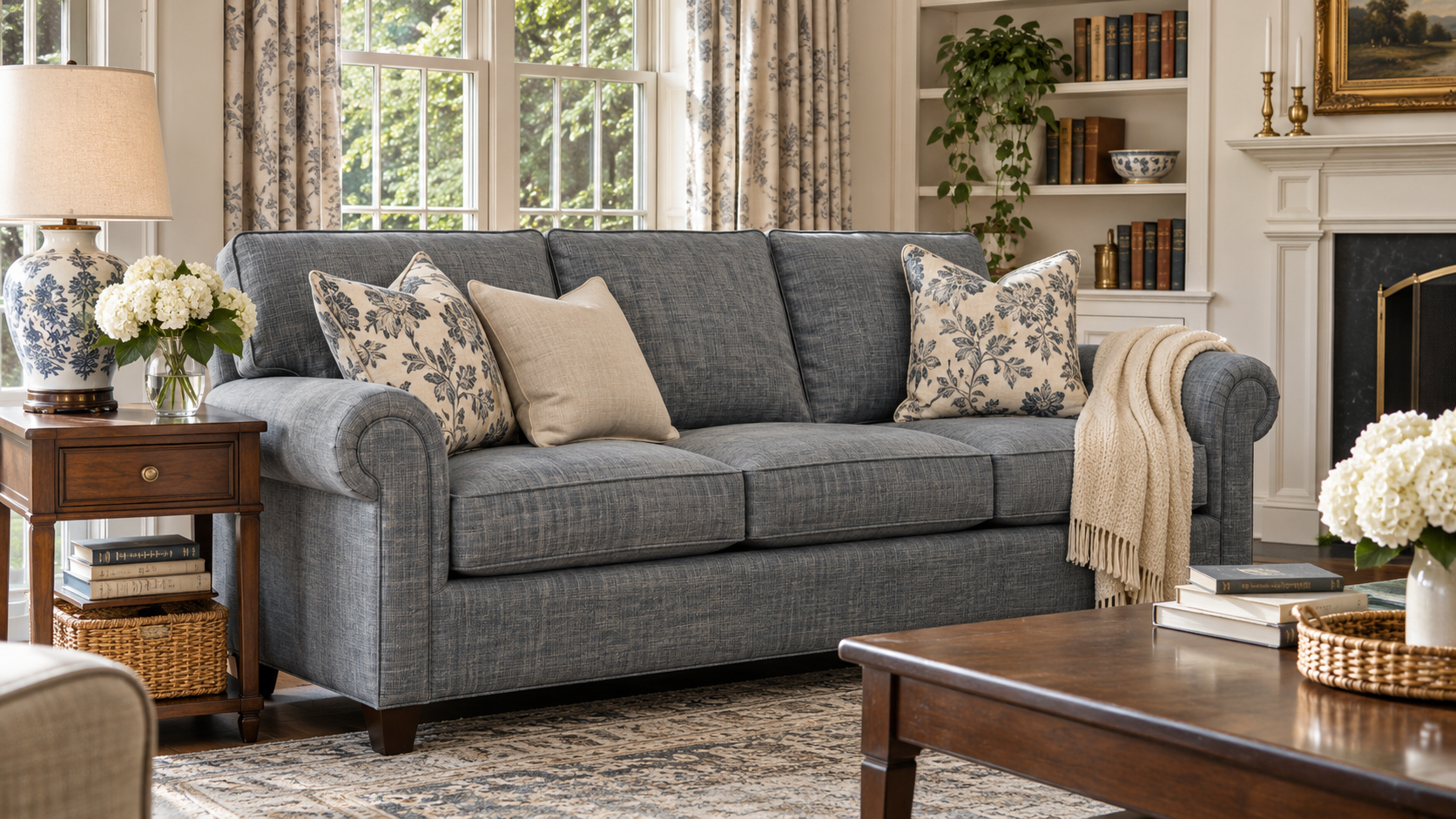
What does “Thomasville sofa” mean for a shopper?
Thomasville is a furniture brand name used across multiple furniture categories and collections. A brand name can help you narrow a search, but it does not describe the construction of a particular couch. The meaningful details live at model level: the frame material, suspension, cushion filling, upholstery composition, dimensions, included pieces, assembly, warranty, and return policy. Retailers may offer a limited assortment, and a model name may not appear at every seller. Start with the exact model name and item number, not a general impression of the brand.
For example, a shopper comparing fabric sofas may see designs such as a standard three-seat sofa, a sofa with storage seats, or a modular sectional. Each configuration answers a different need. A storage seat can add useful space but may change the weight and seat feel. A sectional can seat more people, but its footprint and delivery path need more attention. A conventional sofa can be easier to place and rearrange. A collection name is not a substitute for checking these functional differences.
Retail listings can also change as inventory turns over. A sofa advertised in one season may be replaced by another configuration or fabric. Photos and reviews may represent a different color or package. Save the listing for the exact item number you plan to buy, and check the retailer’s current specifications immediately before checkout. If the order confirmation uses a different model number, contact the seller before accepting delivery.
Start with the exact model and configuration
Record the full model name, seller item number, retailer, fabric color, and package contents. A listing title might describe a “two-piece sofa set” while the product is actually a sofa and ottoman, or refer to a sectional that includes multiple seats and a chaise. Make sure the description says what arrives in the cartons. If a listing offers several colors or configurations, verify that dimensions and included accessories match your selected option rather than assuming every variation is identical.
Some current Costco listings have included Thomasville models such as the Lowell modular sectional, the Yvette fabric sectional with storage ottoman, the Haver fabric sofa, and the Shayna two-piece sofa. These are examples of model-level differences, not a guarantee that any one item is still in stock or offered in your area. Use the retailer’s product page to verify the current item number, materials, dimensions, included pieces, and warranty. See Costco’s Thomasville Lowell product page, the Thomasville Yvette listing, and the current Costco Thomasville furniture assortment where available. Seller pages can change, so treat them as the source for current specifications.
When a model is no longer sold, avoid assuming that a similarly named couch has the same construction. Look for the item label, manual, or archived purchase documents. If you are buying secondhand, ask the seller to photograph tags and measure the sofa. That provides a useful starting point for replacement covers, cushions, and parts, and can help distinguish between lookalike designs.
Measure the room and the delivery route
Measure the intended wall and the total space the sofa can occupy, including end tables, floor lamps, walkways, doors, and cabinet openings. For a sectional, map the full outline on the floor using painter’s tape. Include the chaise projection and any recliner clearance. Keep a clear walking path through the room; a sofa that technically fits can still make a living room feel cramped when it blocks the natural route between a doorway and the rest of the home.
Then measure the route from the curb to the room: exterior door width and height, hallway width, stairwell turns, elevator dimensions, and ceiling height. Ask whether the listed dimensions refer to the assembled sofa or its largest carton. Some pieces can be moved through a doorway vertically or at an angle, while others cannot. Do not rely on a single width measurement. Record the narrowest point on the route, the height beneath light fixtures, and the space needed to make a turn. Confirm whether the delivery team will carry the sofa upstairs, remove packaging, or assemble it, and whether those services cost extra.
Seat dimensions are just as important as outside dimensions. Compare seat height, usable seat depth, and distance between arms. A deep seat may feel relaxing for lounging but less comfortable for a shorter person who prefers feet flat on the floor. A taller seat can make standing up easier for some people, while a low seat may suit a casual, modern room. Try the exact model in person if possible, or compare measurements to a sofa you already find comfortable. Cushion thickness and back pillow shape influence the way those measurements feel.
Understand the frame and support system
Look for a clear description of the frame material and internal support. Product pages may mention hardwood, engineered wood, plywood, metal components, or a combination. Ask which sections use each material and whether the structural frame is covered by a written warranty. “Kiln-dried” or “solid wood” can be helpful descriptors, but they do not by themselves tell you how the joints are assembled or how the sofa should be used. A durable frame also depends on bracing, joinery, fasteners, and how weight is distributed.
Suspension systems may include sinuous springs, webbing, or other support designs. A seller should describe the system rather than relying on a vague claim that a sofa is supportive. Sit near the middle and near an edge if you can: the seat should feel stable and should not tilt, creak, or sag markedly. Ask whether the cushion support is replaceable and how to obtain service if a spring, web, or frame component fails. The details that matter are the ones documented for the exact model, not general claims about every sofa from a brand.
Inspect construction where practical. Check that arms feel firm, joints do not visibly shift, and the sofa sits level on the floor. On a modular sectional, examine how units connect and whether connectors are included. On a sofa with a storage seat, make sure the lid opens smoothly and does not interfere with the surrounding furniture. If a showroom sample feels loose or uneven, ask whether it is a heavily used floor model or whether the same issue is typical of the product.
Use reviews as clues rather than proof. Repeated reports about a particular failure can point to questions worth asking, but reviews can mix colors and configurations. Check that the review is for the same model and item number. Separate comments about delivery damage from reports about the frame or cushion performance. A product rating cannot tell you whether the couch fits your room or whether the cushion feel suits your household.
Compare cushion feel and recovery
Comfort is personal. A firm seat can make it easier to sit upright and may feel supportive to some users; a softer seat may be more appealing for lounging. Foam density, fiber wrap, springs, cushion shape, and cushion depth all influence feel. If the retailer lists foam type or density, note it, but do not infer long-term comfort from a label alone. Sit for several minutes in more than one position. Notice whether your lower back feels supported, whether the front edge presses into your legs, and whether you can rise without pushing hard off the arms.
Ask whether seat and back cushions are reversible, removable, or replaceable. Removable cushions can simplify cleaning and rotation, but a cover that unzips is not automatically machine washable. Follow the care label exactly. If the sofa has attached cushions, ask how the upholstery should be spot cleaned and whether professional cleaning is recommended. Confirm if replacement cushion inserts or covers can be ordered in the future; this can extend the useful life of a couch and keep a favorite frame in service.
For a storage-seat sofa or sectional, try each seat separately. Storage compartments can affect the cushion base, and a lid may make the seat feel different from the others. Compare seat support across the whole configuration. On a modular design, find out whether cushions are specific to a particular module or can be rearranged. Ask about connector hardware and whether it can be repositioned if you change the room layout later.
Households with children, pets, or frequent guests should consider how the cushion construction and upholstery will cope with their routines. A very soft cushion may show impressions sooner; a firm cushion may not feel inviting to everyone. Use model-specific care instructions and avoid treating any material as stain-proof or indestructible unless the manufacturer provides clear documentation. A protective spray can be incompatible with some finishes and fabrics, so check the label before using one.
Choose upholstery for your routine
Fabric choice influences touch, appearance, maintenance, and how a sofa works in a busy room. Check the fiber content, weave, cleaning code, and care instructions. Polyester blends are common in upholstered furniture but can vary widely in texture and performance. A tightly woven fabric may be easier to maintain than a loose boucle, yet pet claws and snagging risks depend on the specific weave. Color can conceal some everyday marks, but dust and lint may show differently on dark or textured upholstery.
Ask for a swatch if the retailer offers one. View it in the room’s daylight and evening lighting. A color that looks neutral online may lean warmer or cooler in person. If you cannot get a swatch, read the color description carefully and look for customer images of the same exact fabric. Photos can be affected by screens and lighting, so use them as an aid rather than a guarantee. For a large purchase, a few days spent comparing swatches is often worthwhile.
Cleaning codes matter. The label may specify water-based, solvent-based, professional-only, or vacuum-only care. Use only the method the manufacturer permits, and test any approved product in an inconspicuous area. Blot spills promptly rather than rubbing, and avoid soaking the fabric or saturating cushion interiors. Keep the care tag and product manual with the receipt. If a stain needs professional attention, tell the cleaner the fabric composition and care code.
Think about how the fabric will age visually. A textured or patterned fabric can disguise small variations but may be harder to match if a cover needs replacement. Smooth fabric can look tailored but reveal pressure marks or wear more easily. A performance label is useful only when supported by a definition and care guidance. Compare warranty coverage and exclusions, and ask what the retailer expects if a defect appears after delivery.
Evaluate storage and modular features carefully
A sofa with storage can keep blankets, toys, or remote controls nearby. Check the volume and shape of the compartments, how they open, and whether the mechanism feels secure. Measure the clearance needed to lift a seat or move an ottoman. Consider whether a storage lid will be blocked by a coffee table or rug. Store only items appropriate for the compartment and follow any weight limits; a storage seat is not a substitute for a heavy-duty trunk.
Modular furniture provides layout flexibility, but it is not automatically easy to rearrange. Confirm the number of modules, the dimensions of each one, the connector type, and whether a left-arm or right-arm piece can be reversed. Some sectionals are sold in a fixed orientation; others allow components to move. The seller’s diagram should match the delivered configuration. If you expect to move homes, compare the size and weight of each module with the likely route and vehicle constraints.
Before buying a sectional, sketch at least two layouts using the actual module dimensions. Include the coffee table, side tables, television sightline, and routes through the room. Leave space behind a reclining seat if the model needs wall clearance. Confirm which pieces can be purchased separately, and whether the retailer can provide replacements for a damaged module. Ask how connector pieces and upholstery colors are handled if you add to the set later.
Storage and modular functions may add value when they solve a real problem, but each moving mechanism adds another feature to inspect. Open and close hinges, test connectors, and listen for rubbing or rattling. Ask whether moving parts are covered under the same warranty as the frame. If a feature is difficult to operate in a showroom, it may be frustrating in a tight everyday room.
Check the written warranty and return rules
Read the warranty before ordering. Identify who provides it, what parts are covered, for how long, and what counts as normal wear. A frame warranty may differ from coverage for springs, cushions, upholstery, stitching, mechanisms, or labor. Find out whether shipping or technician visits are included if a repair is needed. Keep the policy and order confirmation together. A verbal assurance from a salesperson is less useful than a written term that names the specific model.
Return policies vary by retailer and by the type of delivery. Confirm whether a sofa can be returned after assembly, who pays pickup charges, what condition is required, and whether a restocking fee applies. Ask how delivery damage should be reported and how quickly. Photograph the cartons before opening, then photograph any visible damage as you unpack. Do not discard packaging until you have checked the couch and understood the seller’s return window.
Clarify what happens if the delivered color, configuration, or item number differs from your receipt. Check the retailer’s policy for exchanges and backordered parts. If a sofa is marked as a floor sample, ask what warranty remains and whether the price reflects wear. A clear paper trail makes it easier to solve a problem without depending on memory.
When purchasing through a warehouse club, verify membership conditions, delivery, and online versus warehouse terms. A product’s availability can differ by ZIP code. Do not assume a return rule or warranty from one seller applies to another Thomasville listing. The model name may be the same while the seller, package contents, or terms differ.
How Thomasville sofas compare with other options
Compare the total value of the exact sofa, not just its list price or brand. Include delivery, assembly, removal of an old sofa, taxes, protective plans, and any replacement cushion costs. Compare models with similar dimensions, materials, and features. A low-priced sectional with fewer pieces is not directly comparable with a larger configuration that includes an ottoman or storage seats. Build a short checklist so differences remain clear.
Shopping at a retailer with an in-person display can help you evaluate fabric and seat feel. Online buying may offer a broader assortment or delivery convenience. If the model is available only online, look for detailed dimensions, a full materials list, a care label, and a clear return policy. Ask customer service specific questions and save the written answers. Avoid deciding based on styled room photos alone.
We cover similar decision points in our guides to online stores for buying sofas, sofa construction and quality, and sofas with storage. Use those comparisons for general buying questions, then verify the Thomasville model’s own specifications and policies with its seller.
If you are deciding between a Thomasville sofa and another brand, compare the things you can document: materials, dimensions, seat construction, cushion details, delivery terms, warranty, return rules, and service access. Brand reputation can be a starting point, but a model-specific comparison is more useful. If a seller cannot answer basic questions about the frame, care, or coverage, factor that uncertainty into your decision.
Amazon searches for Thomasville models
We could not verify a current Amazon product detail page for the specific Thomasville sofa models discussed here, so we are not assigning an ASIN or presenting an unrelated sofa as a Thomasville product. These tagged searches may help you check whether the exact model or a comparable item is currently listed. Confirm the seller, model, dimensions, fabric, and package contents on the results page before buying. Search results and availability may change.
- Search Amazon for the Thomasville Lowell modular sectional
- Search Amazon for the Thomasville Yvette sectional with storage ottoman
- Search Amazon for the Thomasville Haver fabric sofa
- Search Amazon for the Thomasville Shayna two-piece sofa
- Search Amazon for Thomasville sofas
Amazon search links do not certify that a result is made by Thomasville or matches a retailer’s model. Read the listing carefully and compare seller details. If no matching model appears, use the official retailer page for the exact sofa rather than choosing a lookalike based on a photo. An affiliate link can earn a commission if you buy through it, at no additional cost to you.
A practical showroom and listing checklist
Before making a decision, answer a few practical questions in writing: What is the exact model and item number? What are the assembled dimensions and carton dimensions? Which materials make up the frame and suspension? What is the cushion filling, and can the seat cushions be replaced? What fabric code and cleaning method apply? Which parts are included? Is the configuration reversible? What does the warranty cover, and what are the return conditions? If a product page omits an answer, ask the seller rather than guessing.
At a showroom, sit in your usual positions. Lean back, sit upright, and move from the center to the edge of each cushion. Check that the arms are at a comfortable height. If more than one person will use the sofa, have each person try it. A sample may be firmer or softer than a brand-new sofa after years of use, but it can still reveal seat proportions and fabric texture. Take notes because several sofas can become difficult to distinguish after a day of shopping.
For online listings, enlarge the specification table and save a copy of the details before checkout. Ask for clarification about ambiguous terms such as “performance fabric,” “solid frame,” or “easy assembly.” Look for a cleaning code, not merely a promise that the fabric is easy-care. Verify whether decorative pillows, ottomans, and chaise pieces are included. Read recent reviews for the exact model and separate shipping feedback from product feedback.
On delivery day, inspect the sofa before signing if the delivery service permits. Check upholstery seams, frame alignment, feet, and cushions. If something is wrong, follow the retailer’s damage-reporting process promptly and keep photographs. Assemble only according to the manual, use the supplied hardware, and avoid dragging the sofa across floors in a way that can damage its legs or frame. Keep labels and documents in a safe place.
Who might choose a Thomasville sofa?
A Thomasville model may suit a shopper who finds a particular configuration, size, fabric, and delivery package that fits their home and budget. Retailer-exclusive models can be convenient when the local seller provides a useful display, delivery service, or clear return process. A storage sofa may be appealing in a family room, while a modular sectional may work for a large open space. The decision depends on the model and seller rather than on the brand name alone.
It may not be a fit if the dimensions conflict with the room, the care requirements exceed your routine, the seller cannot clarify essential specifications, or the return policy does not work for your situation. A heavily featured sectional is not automatically better than a simpler sofa. If you need a specific upholstery fiber, cushion firmness, or replacement part, verify that it is available before purchase. Choose the couch that fits how you actually live, not just the one with the most impressive listing.
For households that move often, modularity and carton size may matter more than a particular fabric color. For a formal living room, appearance and seat depth may be top priorities. For a daily family sofa, cleanability, service access, and the cost of replacement cushions may be more important. Make a ranked list of needs before comparing models. That keeps a sale or promotional bundle from distracting from the things you will notice every day.
Final buying advice
The best way to shop Thomasville sofas is to use the exact model number as the anchor for every comparison. Confirm frame and suspension details, measure the room and route, test the seat proportions, read the upholstery care instructions, and inspect the warranty and return policy. For storage or modular designs, test the moving parts and verify every included component. Retail stock and model names change, so confirm current details with the seller before placing an order.
Keep the listing, order confirmation, care tag, warranty, and delivery photos together. If you compare alternatives, use the same checklist for each sofa and calculate the full delivered cost. That process helps you choose based on fit, comfort, construction, service, and the way the couch will be used over time.