Affiliate disclosure: Daily Home Decorating participates in the Amazon Associates program and may earn from qualifying purchases through links in this guide, at no extra cost to you. Product images and listings below were retrieved through Amazon Creators API. We have not physically tested these sofas. Confirm the current model, dimensions, seller, and return terms on the live listing before ordering.
Choosing the best types of sofas for feng shui starts with the room’s purpose and how people move through it. In feng shui traditions, furniture arrangement is often discussed in terms of balance, support, visibility, and an unobstructed flow through a room. These are design principles and cultural practices, not scientifically proven guarantees. You can use them as a framework for creating a living room that feels settled, welcoming, and practical for your household.
The sofa is often the largest seating piece, so its shape influences the room’s visual balance and pathways. A straight sofa, sectional, loveseat, or curved-back sofa can each work depending on the room. The useful question is not whether one silhouette is always “good feng shui,” but whether it lets people see the room, sit comfortably, and move without obstacles.
This guide explains common feng shui-inspired sofa arrangements, how to select a sofa type, and how to adapt the ideas for windows, doors, fireplaces, televisions, and small spaces. Product examples are current marketplace listings to inspect; they are not endorsed as feng shui remedies. A sofa’s shape cannot guarantee health, relationships, prosperity, or any other outcome.
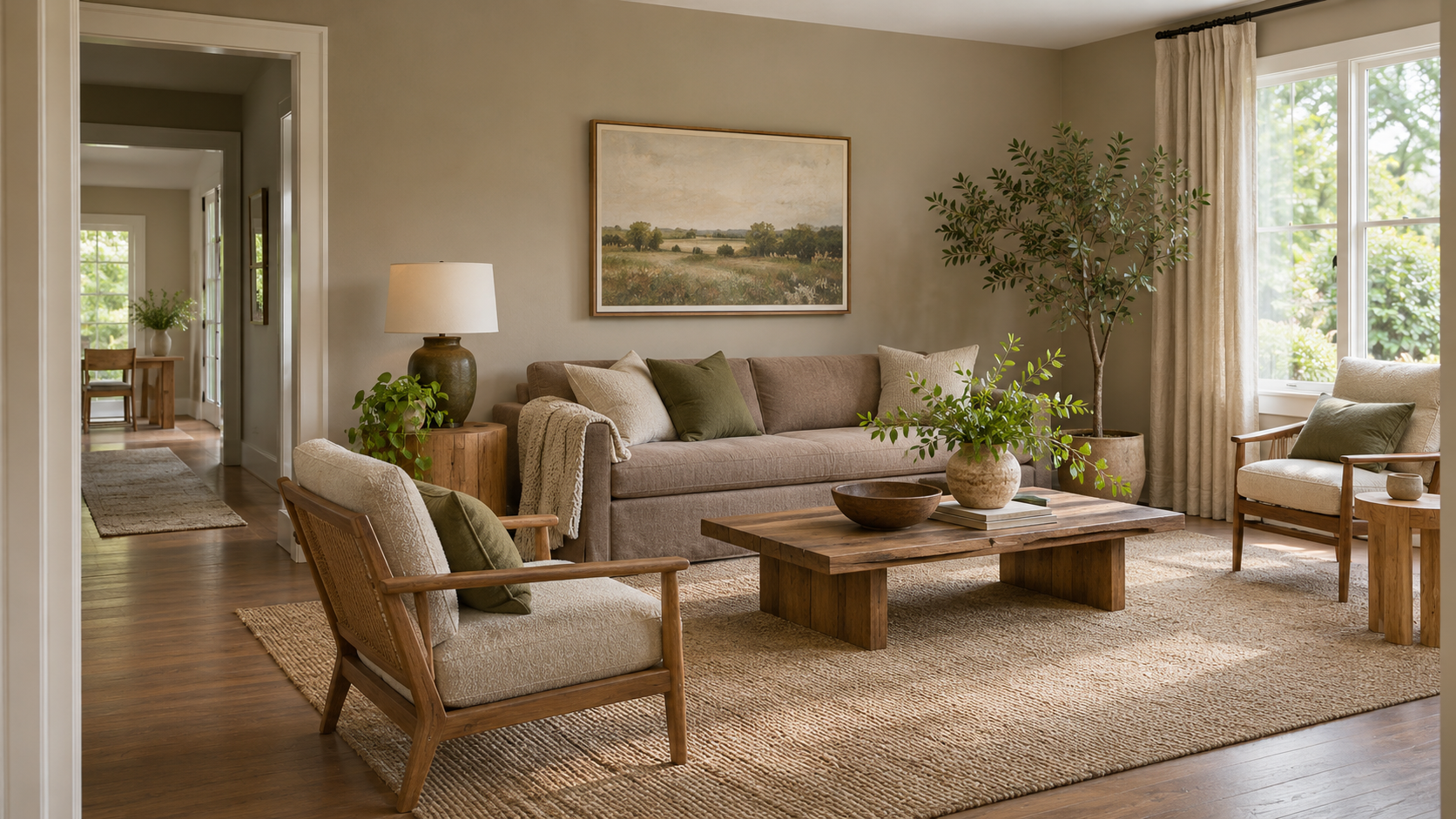
Start with room function and movement
Before choosing a sofa, decide what happens in the living room. Is it mainly a place for conversation, television, reading, family gatherings, or several activities? A layout that supports the room’s real use is more likely to feel comfortable than one arranged only for appearance. Count the usual users and note whether guests need a clear path from the entry to another room.
Mark the doors, windows, fireplace, television, outlets, vents, and fixed furniture on a simple floor plan. Measure the room and the sofa’s full footprint. Then draw the main walking routes. Leave those routes open so people do not have to squeeze between the sofa and a table. A clean path is practical design and also aligns with the feng shui idea of allowing movement through a room.
Use tape on the floor to outline a potential sofa. Include its arms, chaise, and any recliner extension. Walk around the outline and check whether doors can open and windows remain accessible. This helps you avoid buying a shape that looks balanced in a product photo but makes the actual room difficult to use.
What feng shui-inspired sofa placement usually means
Many modern feng shui guides describe a “commanding” position as one where a seated person can see the room’s entrance without sitting directly in line with the doorway. A sofa placed with a stable wall behind it is also commonly recommended because it can feel visually supported. These are traditional design ideas, not universal requirements. Room architecture may make a different arrangement more comfortable or practical.
If the room allows it, place the main sofa where people can see who enters while still having a solid surface behind it. Avoid blocking the front door or forcing the sofa directly against a busy route. A sofa floating in the middle of a room can work if there is enough space behind it and the back looks finished.
Sometimes a window is the only available wall. In that case, consider a lower sofa back, a stable console table behind the sofa, or a different angle that preserves the view and access. Do not cover a window, vent, radiator, or exit just to follow a placement rule. Comfort and safe access remain important.
For a fuller discussion of the command position and practical sofa placement, see this feng shui sofa placement guide. Treat its recommendations as one school of design advice and adapt them to your room.
Choose a sofa shape that suits the plan
Straight sofa
A straight sofa is often the easiest shape to place along a wall or opposite a focal point. It has a clear back and front, so it can define a seating area without occupying a corner. In a small room, a slim-arm model may preserve more usable seat width and walkway space than a bulky frame.
A straight sofa can also float away from the wall to divide an open plan. If you do this, make sure the back looks finished and leave room to pass behind it. A console table may add support visually and provide a place for lamps, but it should not narrow the path.
Sectional sofa
A sectional can create a defined conversation zone and provide several seats. Its L shape may fit a corner, but it can also close off a route or make a room feel boxed in. Measure the chaise side and full footprint. A sectional works best when its shape supports the room rather than forcing all movement around a single large piece.
In feng shui-inspired layouts, some people prefer seating arranged to encourage conversation rather than a large sofa pointed only at a screen. A sectional can support that goal if people can see one another and still move freely. If the room feels crowded, use a smaller straight sofa with movable chairs instead.
Loveseat or two-seater
A loveseat may suit a small room, apartment, or secondary seating area. It can leave more open floor, which helps the room feel less congested. Pair it with an accent chair or ottoman only if the pieces still allow a clear path. If the loveseat is too small for the number of people who use the room, the arrangement may feel less welcoming.
Curved-back sofa
A curved sofa can soften a room dominated by straight walls and rectangular tables. It may work as a central conversation piece in a wide space. Check the full width and depth, as a curved back can need more floor area than the front view suggests. A curved shape should still leave access to doors and corners.
Three sofa examples to inspect
These Creator API listings illustrate a loveseat, straight sofa, and curved-back sofa. Their product descriptions do not establish that the models are appropriate for any particular feng shui practice. They are examples for comparing shape and scale. Confirm the exact dimensions, materials, color, and configuration on the live listing.

This listing describes a 65.2-inch loveseat. Its compact size may suit a small room or secondary seating zone, but check the usable seat width and delivery route. Place it so people can see the room’s main entrance without blocking the door or pushing the sofa into a narrow passage.

This listing describes an 89-inch three-seat sofa with a straight profile. Check the seat dimensions, fabric, frame information, and chosen color. A straight sofa may be easier to align with a wall or focal point, but the actual layout depends on doors, windows, and the room’s traffic path.

This listing describes a curved-back three-seat sofa. Curves can create a softer visual line, but measure the widest and deepest points before ordering. Confirm whether it is a true curved sofa or a sectional configuration and check how it sits relative to nearby tables and walking routes.
Balance the sofa with chairs and tables
Balance does not require identical furniture on both sides of the room. It can come from distributing visual weight, color, and seating so that one corner does not feel overloaded. A large sectional may need a lighter chair or open floor opposite it. A small loveseat might pair with a lamp, side table, and one chair to create a complete conversation area.
Choose a coffee table that people can reach from the sofa without stretching or squeezing past it. Leave enough space for knees and for moving around the table. A round or oval table can soften a layout with many right angles, while a rectangular table may align well with a straight sofa. The shape should support the room’s use.
Side tables and lamps can give each seat a clear function. Avoid filling every open surface with decor. Clutter can make the room harder to clean and move through. Store everyday items in baskets or cabinets so the sofa area feels settled without becoming crowded.
Color and material as part of the atmosphere
Choose sofa color based on the room’s lighting, floor, wall color, and personal preference. In feng shui traditions, colors may be associated with particular elements or moods, but interpretations vary. Treat those associations as a design vocabulary rather than a promise of an outcome. A color that makes the room feel calm and welcoming to you is often a practical starting point.
Material also affects how the room feels and how it is maintained. Leather, cotton, linen, velvet, chenille, and performance fabrics have different textures and care needs. Read the manufacturer’s cleaning instructions. A beautiful fabric that is difficult to maintain may not suit a room used by children or pets.
Consider visual balance. A very dark sofa can anchor a bright room, while a pale sofa can feel lighter against darker walls. Cushions and a rug can connect the sofa with other colors in the room. Avoid choosing upholstery based only on traditional color associations if the shade does not work with the space.
Windows, fireplaces, and television walls
Place a sofa where it does not block natural light or the use of windows. If it must sit near a window, check whether the curtains can open and whether the sofa back obstructs the sill. Follow the window and heater manufacturers’ instructions for access and clearance. A low-back sofa may preserve more of the view than a tall model.
For a fireplace, follow the fireplace manufacturer’s instructions and local code for furniture placement. Do not assume a standard clearance applies to every fireplace type. Keep the mantel and hearth usable and leave a clear path around the seating. If the room has two focal points, decide which one is primary and arrange the other seats so conversation remains easy.
A television can be the focal point without dictating every seat direction. Place the sofa for comfortable viewing while allowing people to interact. Consider glare from windows and lamps. If the television is mounted above a fireplace, check viewing height and the fireplace maker’s instructions before deciding on the sofa position.
Small rooms and apartments
In a small room, choose a sofa whose arms and back do not consume too much space. A loveseat or apartment sofa may leave room for a chair or desk. Exposed legs can make more floor visible, but the best choice depends on your style and cleaning needs. Keep furniture to a scale that fits both the wall and the walking route.
Use a rug to define the seating area, but make sure it does not create a trip edge. Keep the main path from the entrance open. A console table can help organize a floating sofa, but only if there is enough clearance behind it. If the room’s only wall is a window, do not block it simply to follow a placement tip.
For a long or narrow living room, see our sofa layout guide for long rooms. The goal is to create a useful seating area while maintaining access, not to force a particular arrangement.
What feng shui sofa advice cannot do
Feng shui practices offer a cultural and design framework, but furniture placement cannot guarantee health, wealth, relationships, or personal success. If an arrangement feels uncomfortable, blocks an exit, or makes the room difficult to use, choose a more practical layout. Use the ideas as prompts to think about support, visibility, and movement.
Do not spend beyond your budget to obtain a particular sofa shape or material because a source describes it as auspicious. A comfortable, properly sized sofa can support everyday living regardless of its price. Check construction, care, delivery, and warranty just as you would for any major furniture purchase.
Be cautious of advice that treats a room as a rigid formula. Homes differ in orientation, architecture, household needs, and cultural traditions. One practitioner’s recommendation may not fit another family’s layout. Choose the arrangement that gives you a sense of comfort and works in the actual room.
Common layout mistakes
- Placing the sofa directly in a doorway or main walkway.
- Choosing a sectional that leaves no space to move behind or around it.
- Blocking windows, vents, radiators, or fireplace access.
- Buying a sofa by color symbolism without checking dimensions and care.
- Assuming a sofa must always sit against a wall.
- Ignoring how a layout works for conversation and daily activities.
- Overfilling the room with tables, decor, and extra seating.
- Treating design advice as a guarantee of health, wealth, or relationship outcomes.
Measure the room, draw the pathways, and test the arrangement before purchasing. If a suggested placement creates a practical problem, adapt it. A welcoming room supports the people who use it.
Final checklist
Before buying a sofa, decide how the room is used, measure the room and delivery route, identify the main focal point, and mark the main pathways. Choose a sofa type that leaves the room accessible. Check upholstery care, warranty, delivery, and return terms. If you are following feng shui ideas, use them as one lens for thinking about support and visibility rather than a strict rulebook.
The best sofa type for a feng shui-inspired room is the one that helps the space feel balanced, comfortable, and easy to move through. A straight sofa, sectional, loveseat, or curved design can all work. The room’s dimensions, household needs, and personal preferences should guide the final choice.
Use a supportive back without closing the room
A solid wall behind a sofa is commonly described as a supportive position in feng shui-inspired advice. In practical terms, it can make the seating feel settled and keep people from walking immediately behind the person sitting down. A sofa does not need to be pressed against the wall; leaving a small gap can make cleaning or cord routing easier. The appropriate spacing depends on the room and furniture.
If the sofa floats, consider a console or low bookcase behind it to create a visual boundary. Keep the piece stable and avoid putting heavy objects where they could fall onto someone seated below. Make sure the table does not reduce the route behind the sofa. In a narrow room, a floating sofa may create more problems than it solves.
If a wall is not available, you can use another seating orientation or a high-backed chair to create a sense of support. Avoid placing a low sofa where a person sitting down has an exposed, busy path directly behind them if that feels uncomfortable. These are options, not requirements; people experience rooms differently.
Conversation groups and facing directions
A welcoming living room gives people a way to face one another. A sofa with one or two chairs can form a conversation group, while a sectional may bring several seats around the same center. Place seats close enough to speak comfortably but far enough apart to move around. A table can anchor the middle without becoming a barrier.
When seating faces a television, add a chair or angle a loveseat so guests can still talk without turning awkwardly. If the room is used for quiet reading, a chair near a lamp may serve better than adding another sofa. Arrange furniture around the activities that matter, and do not require every seat to point toward the same wall.
For an open-plan home, the back of a sofa can separate the living area from a dining space. Keep an aisle behind it and avoid creating a dead end. A rug can define the lounge zone and tie the seating together. The sofa should help organize the room rather than cut it into disconnected pieces.
Adapt when the door and window positions conflict
Sometimes the door is behind the only practical sofa wall, or the best seating position faces away from the entry. Try rotating the sofa or shifting it off-center before abandoning the layout. A corner placement may let seated people see the room entrance while keeping the sofa away from the direct path. Use chairs to fill the remaining side of the conversation group.
When windows occupy most of the wall, a sofa may sit in front of a window if it does not block access, airflow, or coverings. Consider a lower back and leave room for curtains. If the window is an emergency exit, keep the required access clear. Follow the window manufacturer’s and local safety guidance rather than relying on generalized décor advice.
In a room with a fireplace, a television, and an entry on different walls, prioritize comfort and safe access. You may not be able to give every focal point equal attention. Select the main activity, position the sofa for it, and use chairs that can turn toward the secondary feature.
Choose proportions that feel grounded
A sofa should relate to the room’s scale. A low, small loveseat can feel out of place in a large room with tall ceilings, while an oversized sectional may overwhelm a compact living area. Consider the sofa’s height, arm width, leg visibility, and seat depth together. A balanced room does not require furniture to be identical on both sides.
Use the rug, lamps, and side tables to create visual balance. If the sofa is visually heavy, a lighter chair or open floor on the other side can help. If the sofa is compact, a larger rug and a pair of chairs may keep the seating group from looking scattered. The right proportions depend on the whole room rather than one furniture item.
Take a photo from the entry and from the sofa seat. These views can reveal blocked routes, awkward sightlines, or a sofa that dominates the room. Adjust the layout before ordering a new piece. Sometimes moving a lamp or chair solves the issue without replacing the sofa.
Make a final choice that respects your budget
Do not pay extra for a sofa simply because a salesperson or article labels it “feng shui.” Compare the frame, upholstery, comfort, delivery, and warranty. A sofa that fits your needs and budget is more useful than one that follows a symbolic rule but makes daily life harder.
Product descriptions can use phrases such as “harmonious,” “balanced,” or “energy flow” as marketing language. Those phrases do not prove performance or quality. Focus on measurements and construction. If you like a particular color or shape for personal reasons, it can still be a sound choice as long as it fits the space and the household.
Before checkout, confirm the exact model and selected color, read the care instructions, and check package dimensions. Measure the delivery route and understand the return policy. These practical steps protect your purchase regardless of which design tradition you use.