Disclosure: Daily Home Decorating participates in the Amazon Associates program. We may earn a commission from qualifying purchases made through links here, at no additional cost to you. Colors, product options, and availability can change; verify details on the live listing.
A green sofa can read calm and natural, dramatic and jewel-like, or bright and playful depending on its shade, fabric, light, and surrounding colors. Choosing one is more involved than picking a swatch that looks good online. A large upholstered piece dominates a room, and screens can shift green toward gray, blue, yellow, or black. This guide explains how to compare green shades, fabrics, proportions, and room palettes before you buy.
The examples below are Amazon product listings that currently show green sofa variants through the Creators API. They are not ranked laboratory-tested products. Confirm the exact color, dimensions, configuration, fabric, and current seller information before ordering, and request a fabric swatch if one is available.
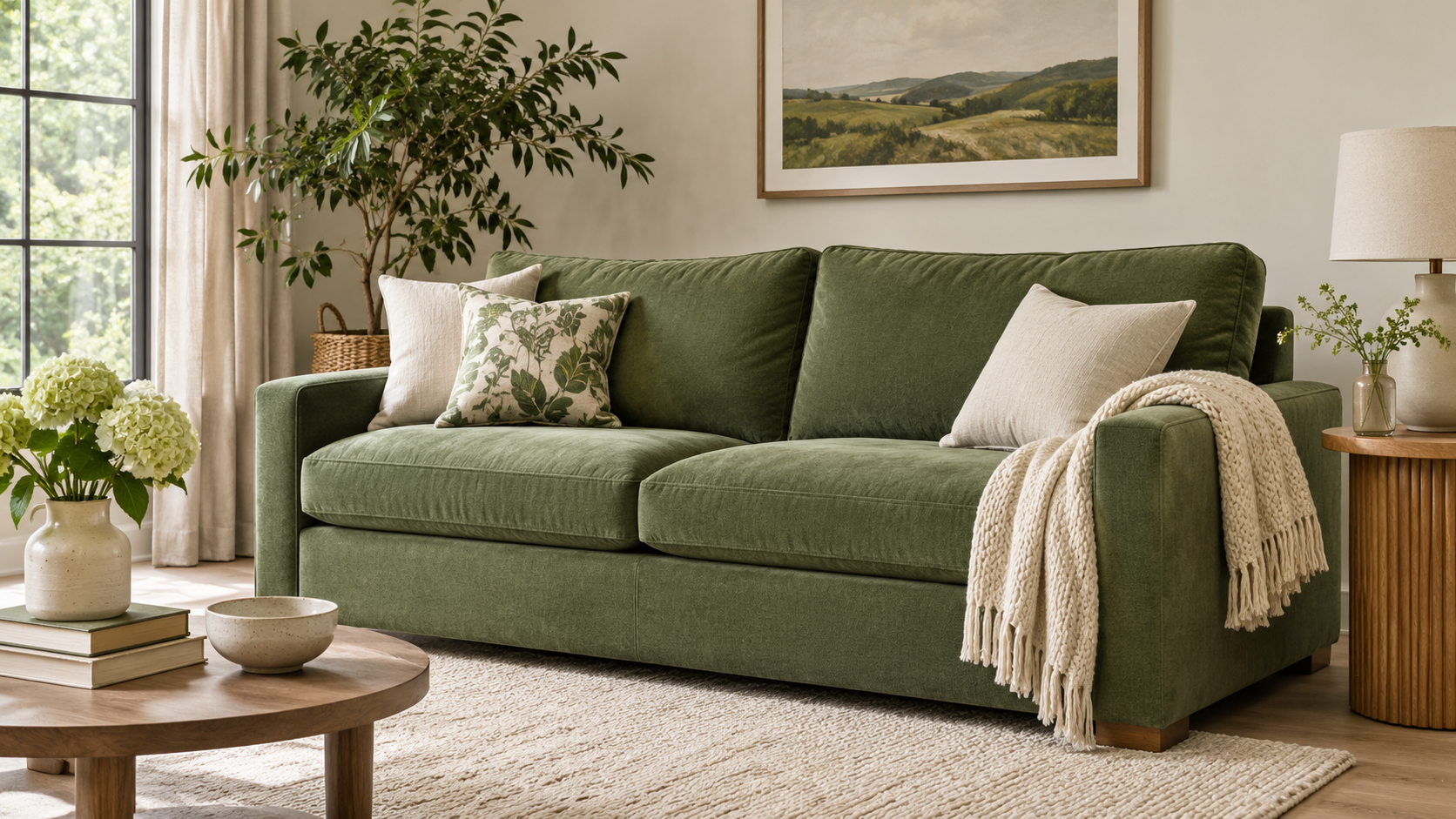
Choose the kind of green that works in your room
Green spans a wide range of undertones. Sage and eucalyptus shades often look muted, with gray or soft blue mixed in. Olive and moss can feel warmer and earthier. Emerald and jewel green appear more saturated and formal, while lime or chartreuse reads energetic and contemporary. Product names are inconsistent, so use the actual photos, swatches, and return policy rather than relying on the shade label alone.
Look at the fixed colors in your room first: flooring, woodwork, stone, tile, curtains, and large rugs. Cool gray floors may pair easily with blue-green or cooler sage, while honey oak and warm beige can work with olive or warmer greens. These are starting points, not strict rules. A green with the opposite undertone can create intentional contrast when repeated elsewhere in the room.
Before choosing a saturated color, decide whether the sofa should blend into the room or serve as its visual anchor. A soft sage can act almost like a neutral when paired with natural textures. Emerald velvet tends to draw attention and can become the main color statement. Either can work if the scale of the room and your tolerance for a prominent sofa match the choice.
Test color in the actual lighting
Green shifts dramatically with light. North-facing daylight can make a shade appear cooler; warm lamps can add yellow; direct sun may brighten or fade how a swatch looks during the day. Review samples in the room at several times, placing them beside the floor and wall. If the store offers only screen images, compare multiple photos, including close-ups and customer images, but understand that phone screens vary.
Use a physical swatch whenever possible. Place it on the sofa’s intended wall, then view it against the flooring and nearby fabrics. Do not judge only by holding the sample in your hand. Upholstery covers a large area, so a color that seems subtle on a small square may feel much stronger across a three-seat sofa.
If you are choosing between two greens, tape both swatches in place and live with them for several days. Check them in daylight, evening light, and the lighting you use for reading or watching television. This small test can prevent a mismatch with the rug, wall paint, or wood tones.
Velvet, chenille, and other green upholstery
Velvet is popular for emerald and jewel greens because its pile reflects light differently as it is brushed, creating changes in depth and sheen. That variation can make the same sofa look lighter in one area and darker in another. Chenille often has a softer, more textured look; woven fabrics can make a green feel quieter and more casual. Fabric construction matters as much as color.
Ask for the fabric content, care code, and cleaning instructions. “Performance” is a broad term and does not describe one universal test. Find out whether the upholstery resists stains, whether a treatment is applied, and what the manufacturer’s warranty excludes. If you have pets, consider how the weave responds to claws and whether the manufacturer provides specific guidance.
Consider maintenance honestly. Velvet may show pile marks and pressure shading; textured fabrics can catch lint; smooth fabrics may reveal spills or scratches. These visual changes are not necessarily defects, but they affect what the sofa looks like in everyday use. Review care instructions and test swatches by touching, brushing, and viewing them from different angles.
Match green to a room palette
Green pairs naturally with many wood tones, but the temperature matters. Olive and moss often complement warm oak, walnut, terracotta, and tan. Sage can sit comfortably with pale oak, warm white, stone, or muted blue. Emerald can work with walnut, brass, deep navy, black, or cream. Repeat at least one sofa-related color in smaller objects such as a throw, artwork, or cushions so the sofa feels connected to the room.
For a calm palette, combine a muted green sofa with warm white walls, natural wood, and a textured neutral rug. For a stronger contrast, use a deeper green with rust, coral, or warm pink accents in smaller doses. A green sofa can also pair with blue, but compare the undertones. Blue-green and yellow-green can feel different when placed side by side; repeat the chosen shades thoughtfully rather than scattering many unrelated colors.
Metal finishes can influence the overall mood. Brass and warm bronze can emphasize the richness of emerald or olive. Black hardware adds a more graphic edge, while brushed nickel can feel cooler and restrained. The legs and frame details matter, but they should coordinate with the room instead of dictating the entire palette.
Scale, silhouette, and room fit
Measure the sofa’s overall width, depth, and height, then compare them with the room and delivery route. Mark the footprint with painter’s tape. Include the clearance for doors, cabinets, radiators, and walkways. A green sectional can look inviting in a photo but overwhelm a small room if the arms, chaise, and back height occupy too much visual space.
Low-profile sofas can make a room feel more open, while a high back may provide more visual structure and support. A curved silhouette softens angular architecture; a boxy sectional can define an open-plan living zone. Think about the sofa’s line from the entry and from adjacent rooms. Color attracts attention, so a large emerald piece may need a simpler silhouette to keep the room balanced.
Check the doorways, stairs, elevators, and narrow turns that the delivery team must use. Ask whether legs, backs, or arms can be removed and whether a sectional ships in separate modules. Confirm delivery, assembly, and return policies in writing. Large furniture can be expensive to return, so access is part of the fit decision.
Comfort is not determined by color
A color guide cannot establish whether a sofa is comfortable. Compare seat height, usable depth, cushion firmness, back angle, and arm height. Ask what the seat cushions contain and whether they can be replaced. Product descriptions such as “plush” and “supportive” are not standardized, so an in-person test or detailed dimension information matters more.
If several people will use the sofa, consider whether the cushions provide enough support for both upright sitting and lounging. Loose back pillows can be repositioned, but they may need regular fluffing. A bench cushion creates a continuous surface, while separate cushions can be rotated more easily if the design allows. Ask the maker which cushions are reversible.
Read reviews for patterns rather than isolated praise. Look for comments about cushion compression after regular use, fabric performance, assembly, and delivery. Customer reviews are individual experiences, not guarantees. Compare them with the manufacturer’s specifications and return policy.
Green sofas in small and large rooms
In a small room, a compact loveseat or apartment-size sofa in sage or muted olive can bring color without overwhelming the space. Narrow arms and raised legs reduce visual bulk. Keep the surrounding palette simple and use a light rug or wall color if you want the sofa to stand out gently. Measure the inside seat width as well as the outside dimensions.
In a larger room, an emerald sectional or deep green sofa can anchor the seating zone. Balance it with a rug that reaches under the front legs and side tables proportionate to the arms. Multiple lighting sources help deep fabric colors remain readable at night. Avoid placing a large sofa against the only source of light if the room already feels dark.
Open-plan rooms benefit from deliberate placement. A green sofa can mark the boundary between living and dining areas, especially when its back faces the next zone. Consider the back upholstery, finish, and profile because it may be visible from many angles. If the back is not fully upholstered, position it accordingly.
Product examples to compare
These listings illustrate different green shades, sizes, and configurations. Verify the chosen variation and current measurements on the live product page. Product images can show a color differently from the item delivered, so use the seller’s return and sample policies as part of your decision.


How to shop online with fewer surprises
Read the complete specifications, not only the title and first image. Confirm which color name corresponds to the variant selected, and whether the fabric changes between sizes. Check the dimensions diagram, seat configuration, arm style, included pillows, assembly requirements, and delivery restrictions. Save the product page or screenshots for your chosen variation.
Check whether the seller is the manufacturer, an authorized dealer, or a marketplace seller. Review the return period and any pickup, restocking, or shipping fees. Determine whether a custom fabric or made-to-order option has different return terms. Ask questions before checkout if the policy is unclear.
For a large purchase, verify that the address can receive the package and that the carrier’s service level matches your needs. Some deliveries stop at the curb; others include room placement or assembly. Ask who removes packaging and what happens if the sofa does not fit through the entry. These details matter as much as the color once a bulky item arrives.
Common mistakes when choosing green
One mistake is choosing solely from an online image. Screens and lighting can shift green significantly. Another is selecting a shade without considering fixed finishes such as flooring, tile, or wood trim. A third is assuming all velvet or performance fabrics clean the same way. Always confirm fabric care instructions and warranty exclusions.
Some buyers add too many accent colors at once. The sofa already provides a strong color field; begin with one or two supporting tones and build from there. You can add more through smaller items that are easy to change. A rug, curtains, and sofa all in competing saturated colors can make the room feel busy.
Finally, do not overlook practical dimensions. A model can have the perfect shade but be too deep for the walkway, too low for comfortable sitting, or impossible to deliver upstairs. Check comfort and access before committing to a color.
Care and long-term color
Follow the maker’s care guidance for the exact fabric. Vacuum with a suitable upholstery attachment and address spills using the recommended technique. Do not apply a general cleaner or steam unless the manufacturer permits it. Test any approved product on a hidden spot and allow it to dry fully before judging the result.
Sunlight can affect upholstery over time. If the sofa sits near a bright window, use curtains or blinds when needed and ask whether the fabric has specific lightfastness information. Rotate loose cushions only when the design permits. Keep the care card, fabric name, and model information so you can request compatible cleaning or repair help.
Green color may look different after the pile is brushed or compressed, particularly on velvet. This directional change is part of the appearance of some fabrics. Brush or maintain the surface only as instructed and do not assume a shade variation is a dye defect without checking the maker’s guidance.
Final checklist
- Compare physical samples under your room’s daytime and evening light.
- Coordinate the green undertone with flooring, walls, rugs, and wood finishes.
- Check fabric content, care instructions, and any performance claims.
- Measure overall dimensions, pathways, and delivery access.
- Review cushion support, seat depth, and return terms.
- Confirm the exact color and configuration at checkout.
The best green sofa is the one whose shade works in your real lighting, whose fabric suits your household, and whose dimensions make sense in your room. Use swatches and measurements to narrow the field, then compare comfort and seller terms with the same care you give the color. A thoughtful choice can bring lasting character without requiring the rest of the room to be redesigned around a screen image.
For related styling ideas, explore our sofa color guide, living room palette guide, and sofa fabric guide.
Choose a silhouette that supports the color
The sofa’s shape changes how a green upholstery reads. A slim mid-century frame with exposed legs can make a dark green look lighter because more floor remains visible. A skirted or fully upholstered base gives a softer, more traditional impression. A bulky modular sectional in emerald feels more substantial than a compact two-seater in the same shade. Think about color and form together rather than treating them as separate decisions.
Details such as button tufting, channel stitching, piping, and nailhead trim add texture and contrast. They can help a plain green fabric feel richer, but too many decorative details may compete with patterned rugs or artwork. If the sofa is already the strongest color in the room, a simpler profile often makes it easier to style around.
Leg finish can shift the mood. Natural wood supports a relaxed, organic palette; dark legs create a grounded outline; brass or gold tones can emphasize a jewel-green look. Make sure the legs coordinate with nearby tables and lighting, but do not force every finish to match exactly. Repeating a finish in one or two smaller accents is usually enough.
Coordinate the rug and floor
A rug can bridge a green sofa with the rest of the room. Cream, beige, and warm ivory create a quieter base. Rust, muted pink, and terracotta bring warmth; blue and gray can make a cooler palette. A patterned rug may contain small amounts of the sofa color, helping the upholstery feel intentional without matching it exactly.
Check the rug’s background color against the green under evening light. A cream rug with a yellow cast can make a blue-green sofa appear colder, while a cool gray rug can flatten a warm olive shade. Lay samples beside one another or view them under the same lighting before ordering. If you already own a rug, use it as a fixed reference when choosing upholstery.
Floor color matters because the sofa sits directly above it. On pale floors, a deep green can create a clear anchor. On dark wood, a lighter sage may provide more separation. If the sofa and floor are both dark, consider a lighter rug beneath the seating area or a brighter wall color to maintain visual balance.
Use walls and artwork to finish the palette
Warm white and soft beige walls provide a flexible backdrop for most greens. Gray walls can work, but compare undertones carefully: a blue-gray wall with a yellow-olive sofa can create tension, while a balanced green-gray combination can look calm. Deep green walls and a green sofa create a layered, enveloping effect, but test samples at large scale because the room may become darker than expected.
Artwork can repeat the sofa’s color in a loose way. Look for a landscape or abstract print that includes green alongside a related neutral, warm red, or blue. You do not need a picture that exactly matches the upholstery. Subtle repetition across a few objects is more natural than a room full of identical green accents.
When choosing curtains, consider whether they should recede or add another color. Neutral curtains keep the sofa prominent; muted patterned curtains can connect it with the wall and rug. If the room has a strong view or large windows, choose a fabric that works with daylight and does not obscure the architecture.
Plan the seating layout before selecting a color
A green sofa can define a conversation area, but the layout should remain usable. Leave comfortable walking paths between the sofa, coffee table, doors, and adjacent furniture. Make sure a chaise does not block an important route. Use painter’s tape to outline the full configuration, including the chaise, ottoman, and side tables.
Consider the view from nearby rooms. If the sofa back faces a dining area or entry, look for a finished back and a profile that looks deliberate from all sides. Some sectionals have a chaise that can be placed on either side; others are fixed. Verify the orientation in the product diagram rather than assuming a reversible layout.
In a shared room, balance the green sofa with seating in a different shape or texture. A wood-frame chair, neutral loveseat, or pair of upholstered accent chairs can prevent the sofa from taking over. Check that the additional pieces do not crowd the room and that there is still enough surface area for lamps and drinks.
Budget for swatches, delivery, and returns
Set aside room in the budget for delivery, assembly, and possible service charges. Ask whether the seller offers free fabric swatches and whether swatches are returnable or credited toward purchase. A small sample is inexpensive compared with the cost of discovering that a large sofa looks different in your room.
Read the return policy before choosing a custom or made-to-order color. Some fabrics and configurations may not be returnable, or the seller may charge pickup and restocking fees. Confirm the policy for the exact color option and keep a record of the terms shown at checkout.
Ask about assembly, packaging removal, and delivery access. A sectional can arrive in multiple cartons; verify whether the carrier brings them into the room or leaves them at the curb. If you live in an apartment, check building restrictions, elevator dimensions, and booking requirements. The best color is not useful if the sofa cannot reach its intended location.
Think about changing tastes
A green sofa can remain versatile when the shade is chosen with the room and your preferences in mind. Muted sage and olive may be easier to combine with changing pillows and art than a highly saturated shade. Emerald can still be flexible if the room uses simple neutrals and the green is repeated sparingly.
If you often redecorate, use lower-cost accessories for trend colors and keep the larger upholstery shade within a range you will enjoy for years. Throws, cushions, lampshades, and artwork are easier to change than a sofa. Conversely, if a bold color is the reason you love the room, choose it intentionally instead of buying a neutral you expect to replace later.
Secondhand value depends on condition, brand, size, and local demand, not only color. Do not assume a distinctive shade will be easy to resell. Buy a size and fabric that suit your actual household and room rather than treating resale as a guaranteed exit strategy.
Pet and family considerations
Green upholstery does not hide every mark. Light sage can show muddy paw prints; dark green may reveal dust, lint, or light-colored pet hair. A textured pattern can disguise small visual changes but may be harder to clean. Ask for the fabric’s specific care instructions and whether the maker provides a performance or abrasion test result.
For children, look at cushion covers, stain care, and the availability of replacement parts. Removable covers are convenient only if they can be cleaned in the manner you need. Some covers require professional care. Before buying, ask if the seller sells replacement covers and whether they can be ordered later in the same fabric.
Pets may interact with the sofa by climbing, scratching, or shedding. No fabric is immune to damage. Choose a weave and color that fit your expectations, then provide pet furniture or throws if you want to protect favorite areas. Confirm that any cleaning product you use is approved for the upholstery.
When a green sofa is not the right answer
A green sofa may be a poor choice if the room already has many competing colors or if you plan to move into a space with fixed finishes that clash with the selected undertone. A neutral sofa with green accents may be a better way to test the palette. You can add a green chair or throw first, then decide whether a larger commitment makes sense.
Another reason to pause is limited access to swatches or unclear product details. If the seller cannot explain the color variation, fabric care, dimensions, or return terms, consider another model with clearer information. A reputable listing should make it possible to understand what will be delivered.
Finally, do not choose a sofa solely because green is currently popular. The color should feel right in your home and work with the people who use the room. A thoughtful shade and well-fitting frame will outlast a trend-driven selection.