Affiliate disclosure: Daily Home Decorating may earn a commission if you purchase through links in this article, at no extra cost to you. As an Amazon Associate, we earn from qualifying purchases. Product images and listing details for the measuring and layout tools below were retrieved through Amazon Creators API; we have not physically tested these products. West Elm product options can change; verify the exact item, fabric, price, and terms on the retailer’s listing.
Searching for the best custom sofas from West Elm? The phrase “custom” can mean choosing among a retailer’s offered fabrics, colors, seat sizes, cushion treatments, or sectional modules. It usually does not mean that every frame can be built to an arbitrary dimension. This guide focuses on how to evaluate West Elm’s current selectable options, with examples from its Haven, Calvin, Dominick, and Harris families, plus practical steps for room planning, comfort, fabrics, delivery, and returns. West Elm pages currently show a custom sofas collection and build-your-own sectional listings, but inventory and selectors change. Treat every detail as a prompt to check the exact product page before ordering.
For broader sofa research, visit our Home & DIY guides.
At a glance
- Best starting point for a component sectional: Haven’s build-your-own page.
- Another build-your-own configuration to compare: Calvin.
- Boxed-cushion sectional family: Dominick.
- Collection with fabric, leather, and slipcovered variants on some listings: Harris.
- Important limitation: selectable sizes and modules are fixed dimensions, not automatically made-to-measure construction.
What “custom sofa” means at West Elm
West Elm uses “custom” for upholstery and sofa pages where shoppers can choose from offered fabrics, colors, sizes, cushion treatments, or sectional components. That can create a piece that feels tailored to a room, but it is not the same as commissioning a maker to draw a new frame to any requested dimension. Before shopping, decide which adjustment matters: a certain length, a chaise on a specific side, a stain-resistant textile, a slipcover, or an entirely unusual silhouette. If you need an exact nonstandard width or seat height, ask West Elm whether that dimension can actually be ordered. The current custom sofa catalog includes selectable pieces and collections; each listing controls which options appear. Choices, names, inventory, and prices can change, so consider this a framework for evaluating the live listing rather than a permanent catalog ranking.
A practical shortlist of West Elm options
The most useful starting points are pieces with explicit choices on their product pages. The Haven family has a “Build Your Own” sectional page showing components such as left-arm, armless, and right-arm seats; the brand page also describes its sofa and sectional collections. Calvin and Dominick also have build-your-own sectional listings. Harris is presented as a sofa and sectional collection, with fabric, leather, and slipcovered options on some listings. These examples illustrate different types of customization rather than a universal menu. A particular configuration may have limited upholstery, an unavailable size, or a longer lead time. Open the exact product page, select the exact finish and components, then save the resulting item and configuration before comparing. Do not rely on a collection landing page alone to confirm which options are available for one specific sofa.
Haven: component flexibility for sectional layouts
Haven can be a sensible place to begin when you need a sectional configuration rather than a standalone fixed sofa. Its build-your-own listing presents components that can be arranged as a multi-piece layout, including armless seating and chaise components. The benefit is the ability to form an arrangement from defined pieces; the limitation is that a component system uses fixed module dimensions. Sketch the layout as rectangles using the dimensions of every piece and include arm widths. Check whether the shown configuration is a complete set or a collection of separately selected pieces. Confirm how left-arm and right-arm are defined from the customer’s viewpoint, and whether the chaise orientation can be reversed after delivery. A sectional that looks symmetrical in a room photo may have a fixed orientation in the selected SKU. Choose the layout only after validating wall lengths, walkway clearance, and delivery access.
Calvin: review the configuration and upholstery together
The Build Your Own Calvin listing is another sectional path. West Elm’s product page indicates fabric and color selection for this family. That is meaningful customization, but it does not establish that every fabric works with every piece or configuration. Select the exact component set first, then review the available upholstery choices for that selection. Write down the fabric name, color, and item identifiers before placing an order. If the retailer offers samples, bring them into the room and compare them beside flooring, drapery, and the wood finish at different times of day. A color tile on a bright phone screen cannot show texture, nap, sheen, or how the textile shifts under warm bulbs. If you need a compact sectional, look closely at outside width and depth instead of assuming “small” in a product title means it fits your wall.
Dominick: understand the boxed-cushion model
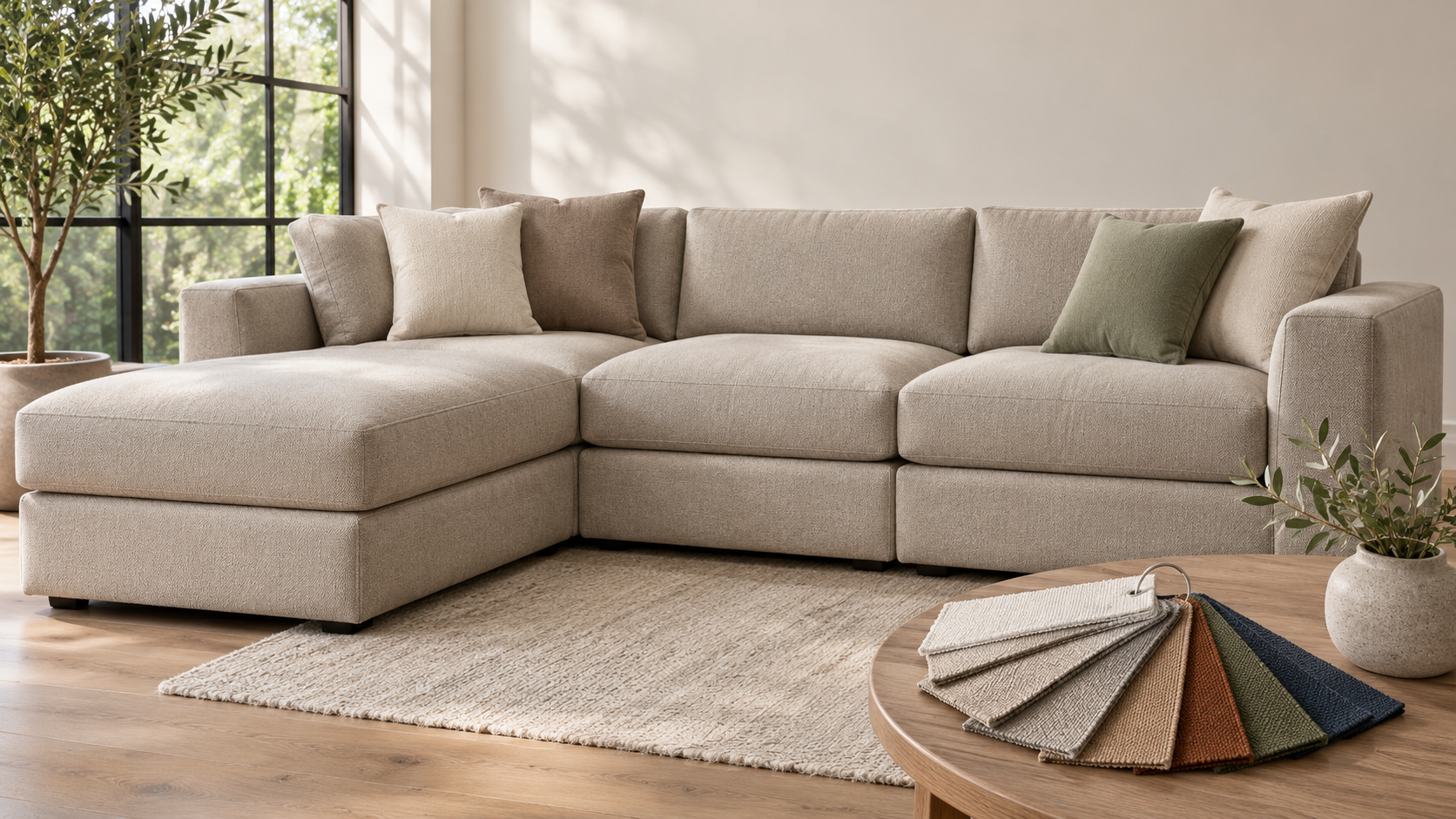
West Elm’s current Build Your Own Dominick page describes a boxed-cushion sectional arrangement with a left-arm sofa bench and right-arm chaise in a named performance basket slub upholstery example. Use this page as a way to inspect how the model is assembled from components. Boxed cushions tend to create a more tailored visual line than loose pillow backs, but the feel depends on the cushion fill and construction specified for that exact item. Review seat count and cushion count, since a chaise component can affect how many people sit upright versus lounge. Confirm whether the backs are removable, whether the cushions can be flipped, and what care code applies to the selected fabric. The styled image is only one example; use the live selector and checkout summary to verify the color and pieces you intend to buy.
Harris: compare the sofa and sectional variants
Harris appears as a broader sofa and sectional collection. West Elm describes available fabric, leather, and slipcovered variants on some listings, and calls out different seat-cushion choices in the collection description. Treat those as collection-level clues, not confirmation for every Harris configuration. A slipcovered version may be more practical if you want a removable cover, while leather and woven fabric have different care needs and visual character. Check the arm shape, back height, seat depth, leg finish, and cushion fill on the specific item page. If choosing a cushion style, compare the exact description and whether it is available in the size you want. A shopper drawn to Harris because one product photo looks relaxed should test the actual floor sample or seek detailed measurements before assuming every configuration feels the same.
When a West Elm sofa is a fit
A West Elm configurable sofa may suit a buyer who values modern silhouettes and wants to coordinate dimensions, fabric, or sectional orientation from a defined menu. It can also be attractive when a room needs one of several offered widths or a compatible module combination. The model-specific options matter more than the retailer name: one collection may give you several sizes and fabrics while another gives fewer choices. Read the specification for the exact item and record the full configuration. If you have a standard living room and can work within the listed sizes, menu-based customization can simplify the decision. If the room has a narrow stair turn, a precise alcove, or an unusual accessibility requirement, ask for additional measurements and delivery constraints before paying. Custom selections can also have different return terms from in-stock merchandise, so read the current policy.
When another maker may fit better
If you want a sofa built to a drawing, with a nonstandard arm width, unusual seat height, or an exact total length that is not in West Elm’s selector, menu-based customization may not be enough. A custom furniture maker or upholsterer can discuss those requirements directly, although the service, engineering, and price vary. Compare an actual written quote, including frame, suspension, upholstery, cushion construction, delivery, warranty, and completion time. A phrase such as “custom upholstery” may mean choosing fabric for a standard frame rather than changing the frame dimensions. Ask vendors to state what they can change and what stays fixed. Our guide to custom-made sectional sofas explains how to compare these distinctions.
Start with the room plan, not the fabric
Record the room’s usable dimensions before browsing swatches. Measure the wall where the sofa will sit, but also note windows, radiators, floor vents, outlets, door swings, and the route between the sofa and other furniture. A piece may fit against a wall but leave an awkward path through the room. Draw the sofa footprint at full scale with painter’s tape or paper. Include the chaise projection, side tables, and coffee table. Sit in the taped outline or walk around it to notice tight passages. For an L-shaped sectional, draw each module and label its arm and orientation. A component plan avoids the common mistake of comparing overall width while ignoring depth or chaise extension. Keep a written record so measurements remain consistent across product pages.
Measure the delivery route separately
A sofa’s room dimensions do not tell you whether it can reach the room. Measure the narrowest door opening, hallway, stairwell, landing, elevator, and turn. Account for baseboards, handrails, light fixtures, and door hardware. Ask the retailer whether the listed dimensions describe the assembled item and whether legs or backs can be removed for delivery. A modular sectional may arrive in several boxes or components, but do not assume that makes every component easy to carry. Confirm package dimensions and any delivery service restrictions for your building. If a measurement is close, ask for the delivery team’s clearance requirements before ordering. Keep photos of tight corners and provide them to customer service. A tape and laser measure can assist with planning; products below are tools, not furniture recommendations.
Compare the overall dimensions consistently
Retailers may show width, depth, height, seat width, seat depth, arm height, and leg clearance. Use overall outside dimensions to see if the piece fits the room, and seat dimensions to judge how it may work for people. Do not compare the seating width of one sofa with the overall width of another. Measure current furniture that feels comfortable and compare its seat height and depth with the candidate listing. A deep seat can be pleasant for lounging but may require a pillow for upright sitting. A shallow seat may feel more supportive for a formal living room. Arm height and width affect how much usable sitting area remains. If a specification is missing, ask the retailer before purchasing rather than estimating from a photograph.
Select upholstery with care needs in mind
Choose the fabric after narrowing the frame and configuration. A West Elm product selector may offer several textile families, and the exact palette can vary by model. Request swatches if available, then inspect them in the room’s daylight and evening light. Consider whether the fabric shows lint, pet hair, water marks, or wear at the locations where people sit most. Look for cleaning codes and care instructions rather than relying on “performance” as an absolute guarantee. If your household includes pets or young children, ask what common spills require and whether cleaning can cause a visible ring. Keep the swatch label or order code after purchase. If you are deciding between leather and cloth, compare how each material feels in hot and cool seasons and whether the surface patinas or shows scratches.
Color and texture can shift in real rooms
Online product images are useful for shape but imperfect color references. Screens vary, room lighting changes, and natural textiles can show shade variation. A pale neutral can look warmer beside cream walls and cooler next to gray flooring. Textured weaves can appear lighter or darker depending on which direction the fibers face. Compare swatches with the rug, curtains, and adjacent wood tones. Look at the fabric from a few feet away and close up. If the sofa is a high-cost purchase, visit a showroom to see a floor sample where possible. Photographing a swatch can help document the comparison, but the camera can also alter color. Make the final choice from a physical sample and the retailer’s official color name, not a saved screenshot alone.
Cushion feel is separate from the cover choice
Fabric and cushion construction are two different decisions. Before ordering, identify the fill or cushion package listed for the selected sofa and ask whether a showroom sample uses that same fill. Sit for several minutes, then stand up and sit again. Notice if the seat supports your thighs and if the back height works for your posture. People who prefer upright seating may dislike a deep, soft lounge design; people who nap on the sofa may want a longer seat or chaise. Check whether cushions are reversible and whether replacement inserts can be ordered later. Ask how to maintain the cushions, whether rotating them is recommended, and whether the fill compresses with use. Product titles often emphasize fabric and silhouette; comfort depends on the complete construction and personal preference.
Fixed pieces versus made-to-measure dimensions
Build-your-own products usually let a shopper combine established modules. That is useful, but it is not necessarily a way to request any dimension. Before purchasing, add the listed widths of each component and confirm whether connectors or gaps change the total. Check whether an end arm, corner, or chaise adds more width than expected. If the wall allows exactly 90 inches, a 90-inch product may leave no room for baseboards, cords, or placement tolerance. Leave practical clearance if the room permits. If exact outside width is critical, ask whether an alternative size exists or whether an item can be modified. A seller may not alter a frame even if its upholstery menu looks extensive. Keep the item’s measurement table in your records in case the online listing later changes.
Customization, lead time, and inventory
A selected fabric or built configuration can have different availability from an in-stock standard item. Check the displayed delivery estimate after every option is selected. Confirm whether the estimate covers production, transit, and room-of-choice delivery, and whether backordered components can arrive separately. If buying a sectional, ask what happens when one module is delayed. For a move-in deadline, avoid relying on the broadest estimated window without written confirmation. Save the order summary, confirmation, and promised delivery details. If a swatch or component is discontinued before checkout, re-check the color and item number. Inventory and lead times change, so a previously saved review or blog post cannot guarantee what can be ordered today. Ask customer service to confirm the exact combination before submitting payment.
Returns, exchanges, and warranty terms
Before ordering any made-to-order or custom-selected upholstery, read the current returns and exchanges policy for that specific item. Determine whether a selected fabric, customized configuration, or final-sale item can be returned. Ask how a fabric defect, transit damage, or a comfort concern is handled and which warranty covers the frame, cushions, and upholstery. A warranty is not a promise that a sofa will feel the same forever or that every issue is covered. Save the policy as it appears on the order date, along with the item specifications. If something important is unclear, request a written response from customer service. Do this before placing a deposit or finalizing a card charge, because cancellation rights may be limited once a custom order enters production.
Delivery and assembly planning
Review the delivery service level, not just the shipping estimate. Determine whether delivery includes unpacking, assembly, removal of packaging, and placement in the room. Confirm whether old-furniture removal is available and whether the sofa must be fully accessible before the team arrives. Protect floors and walls along the route. For modular pieces, identify where each component will be placed so the delivery team can assemble it without blocking a narrow hallway. If a building requires an elevator reservation or certificate of insurance, arrange it early. Take photos of the room and path before delivery, and inspect each component for visible damage before signing any applicable delivery record. Keep packaging temporarily if policy allows, until you have confirmed that the correct configuration arrived.
West Elm showroom visit checklist
A showroom visit is most useful when you arrive with measurements and targeted questions. Confirm which location has the exact model and fabric on display. Ask whether the floor sample’s cushion package matches the product page. Sit in more than one position and compare seat height, depth, back support, and arm comfort. Request swatches for your short-listed fabrics and ask about cleaning codes, lead time, return eligibility, and delivery constraints. If you plan to create a sectional, ask a design associate to review the component diagram and total footprint. Do not rely on an unlabelled display if it may be an older fabric or a discontinued configuration. Record names and model codes for every sample; a verbal description such as “the light beige Haven” is not precise enough for a later order.
Compare cost as a complete purchase
The item price is only one part of the cost. Compare the base sofa or each sectional component, fabric upgrades, delivery, assembly, taxes, protection plans, and any accessories that are required to complete the configuration. For a sectional, add every piece and connector before comparing it with a complete set from another retailer. Check whether the chosen fabric changes the price and whether a promotional offer excludes custom upholstery. A lower displayed starting price may represent a smaller size or a different textile. Keep a simple list with the exact model, dimensions, cover, cushion package, delivery terms, and total at checkout. Revisit the list before buying. Avoid comparing a complete modular sectional with the advertised starting price of a single armless module.
Alternatives if West Elm does not fit
If West Elm’s available sizes or fabrics do not meet the room’s needs, compare another configurable sofa retailer or a local custom maker. Look for explicit measurement ranges and clear descriptions of what can be changed. For a one-off shape, a custom frame maker may be able to quote dimensions that a retail selector does not offer. For a sofa with a good frame but dated upholstery, a local upholsterer can assess re-covering. In either case, ask for a written description of the work and a quote with materials and delivery. Do not assume “custom” means the same thing between businesses. Our broader guide to custom sofa options covers the distinction between new builds, upholstery work, and store configuration choices.
Questions to ask before you order
Use a short checklist: What exact dimensions will arrive? Which fabric and color code are on the order? Is the configuration reversible? What parts are included and what is sold separately? Can the sofa fit through the tightest point of the delivery route? What cushion construction and care code apply? What is the current lead time? Can this selected upholstery be returned? What does the warranty cover? Can replacement cushions or covers be ordered? Ask the associate or customer service representative to point to the exact listing or policy language. For a high-value order, save written answers and the final configuration screen. A customer should not need to guess whether “custom” refers to made-to-measure construction or just a selectable upholstery menu; have that distinction stated plainly.
How to choose based on your room
For a narrow living room, prioritize the sofa’s overall depth and arm width, not just seat count. For an open-plan room, a sectional can define a conversation zone, but a chaise may interrupt the walking route. For a compact apartment, compare a standard sofa and a modular loveseat configuration before committing to an L-shape. If you entertain, consider whether the number of upright seats matters more than lounge depth. If the sofa is used daily for television, test the exact position you use at home. If guests stay overnight, a sofa bed may be a better function-first purchase than an oversized sectional. Arrange your layout on paper or tape before final selection. Use dimensions to narrow options; use a showroom test or detailed cushion information to judge comfort.
Care after delivery
Follow the care card for the exact upholstery and keep it with the order documents. Vacuum crevices with an upholstery attachment if the care instructions permit. Blot spills promptly rather than rubbing them deeper into the weave. Test any cleaner on a hidden area and use only the method approved for that fabric. Keep the sofa away from excessive direct sun if fading is a concern. Rotate or fluff cushions only when the manufacturer recommends it. For leather, use the specified care products and avoid assuming that a cloth-fabric cleaner is suitable. A removable cover can be convenient but still may require professional cleaning. Take photos of stains or defects before attempting a repair, and contact customer service if the issue might be covered under the retailer’s policy or warranty.
A careful final buying decision
The best custom sofa from West Elm is the specific model whose available dimensions, upholstery, cushion feel, delivery route, and terms match your household. Start with the current official product pages, not old screenshots. Consider Haven for component-based sectional planning, Calvin for another build-your-own configuration, Dominick for its boxed-cushion component system, and Harris when its upholstery and cushion choices match your priorities. These are options to investigate, not a promise that every size and textile is available. Get the exact configuration in writing, compare physical fabric samples, and check current delivery and return terms. If you need an entirely nonstandard frame size, compare a true custom builder instead. The careful process takes longer than picking a catalog photo, but it sharply reduces the risk of an expensive sofa that does not fit the room or the way you sit.
BOSCH GLM100-23 100-foot laser distance measure

A laser measure can help record a long wall or room span before you compare sofa widths. Check the manual for the correct measuring position, keep the tool square to the surface, and verify important openings with a tape. A measurement is useful only when you note exactly what it represents: wall-to-wall, clear floor space, or the gap between trim.
Check the current BOSCH GLM100-23 100-foot laser distance measure listing on Amazon.
CRAFTSMAN 25-foot tape measure

A tape measure is particularly useful for doorways, stair landings, elevator entrances, and the sofa depth. Measure the narrowest point, including handles, railings, and door hardware. For a long span, have someone hold the far end so the tape stays straight. Compare your notes with the product’s overall dimensions, not just seat width.
Check the current CRAFTSMAN 25-foot tape measure listing on Amazon.
X-Protector felt furniture sliders for hardwood floors

Sliders can help reposition a sofa while testing a new layout, but only when their material fits the flooring and furniture feet. Check the package directions, load rating, and surface compatibility. Lift rather than drag the sofa into position, and do not use sliders on floors or feet the product does not support.
Check the current X-Protector felt furniture sliders for hardwood floors listing on Amazon.
Frequently asked questions
Does West Elm make sofas to any custom dimension?
Do not assume so. Its current “custom” and build-your-own pages present selectable pieces, sizes, fabrics, or configurations. Ask customer service whether a requested nonstandard dimension can be ordered.
Which West Elm sofa is easiest to configure as a sectional?
Haven, Calvin, and Dominick have build-your-own sectional listings. Compare the exact components, dimensions, fabric choices, cushion details, and availability for your chosen combination.
Can I choose fabric on a West Elm sofa?
Some models list fabric choices, and some Harris listings also describe leather or slipcovered options. Availability varies by product and configuration; check the exact listing and order summary.
Are custom selections returnable?
Return and cancellation terms depend on the current policy and item. Read the terms for the exact selected sofa before placing an order and save a copy.
Should I buy a sectional or sofa?
Choose based on the room footprint, delivery path, how many people sit upright, and whether a chaise blocks circulation. Tape the proposed footprint on the floor before selecting.
What if West Elm sizes do not fit my room?
Compare other configurable retailers or consult a custom furniture maker. Ask whether they can build a new frame to specific dimensions or only upholster a standard frame.
Frequently referenced official West Elm listings
- Custom sofas and loveseats
- Build Your Own Haven Sectional
- Build Your Own Calvin Sectional
- Build Your Own Dominick Sectional
- Harris sofa and sectional collections
Final recommendation
West Elm is worth considering when its available silhouettes and configuration menu meet your needs. Compare Haven, Calvin, Dominick, and Harris by exact outside dimensions, cushion package, upholstery code, and delivery terms—not by collection photos alone. Visit a showroom or order swatches when possible, and verify the chosen configuration in writing. If your project requires a one-off frame measurement, get a quote from a maker that explicitly offers made-to-measure construction.
These Amazon products are measuring and layout aids, not West Elm sofas. Amazon results may not include West Elm’s current furniture or exact configurations; use the official West Elm listing to shop its products.
Product titles, images, specifications, availability, and offers supplied through Amazon Creators API may change. Verify current listing information before buying.